Say Their Names

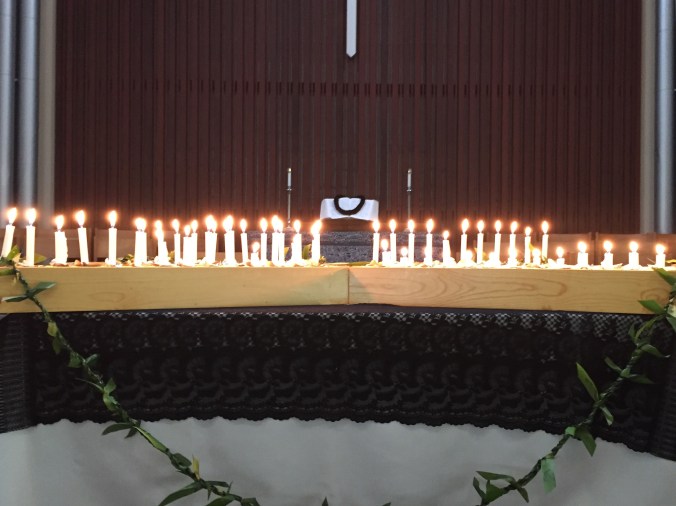
Say their names.

It was Saturday night in Orlando.
The night was filled with dancing,
Music whirling bodies merrily about the floor,
Laughing with loved ones
In common sanctuary,
When Death arrived, spinning bullets
Striking spinning dancers to the stone.
Rainbow festival yielded to one color, crimson.
Their names, accented with the Spanish
Of Caribbean islands or of South
American towns, spill haltingly
From my awkward tongue,
Because my voice is choked
With tears.

Stanley Almodovar III, 23
Amanda Alvear, 25
Oscar A Aracena-Montero, 26
Rodolfo Ayala-Ayala, 33
Antonio Davon Brown, 29
Darryl Roman Burt II, 29
Angel L. Candelario-Padro, 28
Juan Chevez-Martinez, 25
Luis Daniel Conde, 39
Cory James Connell, 21
Tevin Eugene Crosby, 25
Deonka Deidra Drayton, 32
Simon Adrian Carrillo Fernandez, 31
Leroy Valentin Fernandez, 25
Mercedez Marisol Flores, 26
Peter O. Gonzalez-Cruz, 22
Juan Ramon Guerrero, 22
Paul Terrell Henry, 41
Frank Hernandez, 27
Miguel Angel Honorato, 30
Javier Jorge-Reyes, 40
Jason Benjamin Josaphat, 19
Eddie Jamoldroy Justice, 30
Anthony Luis Laureanodisla, 25
Christopher Andrew Leinonen, 32
Alejandro Barrios Martinez, 21
Brenda Lee Marquez McCool, 49
Gilberto Ramon Silva Menendez, 25
Kimberly Morris, 37
Akyra Monet Murray, 18
Luis Omar Ocasio-Capo, 20
Geraldo A. Ortiz-Jimenez, 25
Eric Ivan Ortiz-Rivera, 36
Joel Rayon Paniagua, 32
Jean Carlos Mendez Perez, 35
Enrique L. Rios, Jr., 25
Jean C. Nives Rodriguez, 27
Xavier Emmanuel Serrano Rosado, 35
Christopher Joseph Sanfeliz, 24
Yilmary Rodriguez Solivan, 24
Edward Sotomayor Jr., 34
Shane Evan Tomlinson, 33
Martin Benitez Torres, 33
Jonathan Antonio Camuy Vega, 24
Juan P. Rivera Velazquez, 37
Luis S. Vielma, 22
Franky Jimmy Dejesus Velazquez, 50
Luis Daniel Wilson-Leon, 37
Jerald Arthur Wright, 31

As their friends and families mourn their murders,
Say their names.
IMG_1066

Root and Branch

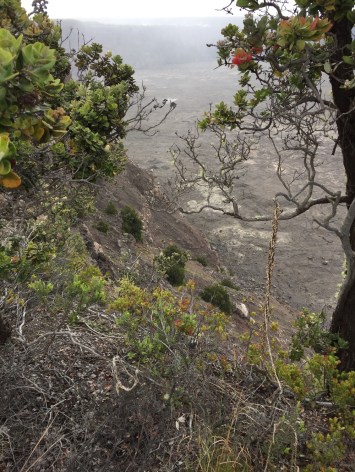
Kilauea Iki


An ‘ohi’a seed fell into the soil, and it found good soil, soil it liked immediately. So it did what seeds do: it sprouted. Two shoots emerged and began to grow.

One said, “I’m going up to see if I can touch the sky!”

The other said, “I’m going down to explore the rich earth.”

And so the two shoots separated. The lower shoot indeed explored that rich soil (and even some hard rocks it found). It became the root, and it spread smaller roots through the soil and around the rocks. 

It had little notion of what had happened to the shoot rising up, but the root would collect water and minerals from the soil, and send them up that rising shoot, which called for them. The root was glad to have food and energy come back down from above, but that was all it knew.

Sometimes everything would shudder, and the root wondered what was happening above even as it gripped more tightly to the earth to keep everything from falling.

One day, a heavy rain came through, and rushing winds, and suddenly the root found that a portion of itself was no longer sheltered in the earth. The flowing water had washed its soil covering away. It looked around in wonder at the surface world that it had never seen, and then it looked up. 

Soaring high above, it found that the upper shoot had become a grand tree, festooned with branches, bearing upon some of their tips the scarlet flowers of the ‘ohi’a. It was nothing like the tiny shoot that it remembered.

“You look wonderful,” said the root. “Did you find the sun?”

“It shines on me almost every day,” said the tree.

“I’m sure you’ve forgotten me,” said the root, “as grand as you’ve become.”

“Not for a moment,” said the tree above. “I’ve grown and changed, but you’re my root. You hold me fast when the winds would blow me down. You send me food and water from the ground that I could never find. You’re where I’ve come from, and where I am, and together we approach the sun.”

That’s what our families, our ancestors, do for us. They are the root. We grow and change, and they sustain us through the high winds of life’s troubles. They feed us as we stretch toward the people we’ll become. They give us what we need so we can grow.

We will blossom and flower because we have our roots.

I Guess it Needs to be Said

Liliuokalani Park, Hilo, HI

I guess it needs to be said: 

You don’t get to kill someone because they’re different. God made LGBTQ folks. Muslim folks. Black folks. Brown folks. You don’t get to kill them because of any of that.

You don’t get to kill people because you’re angry, or scared, or offended, or embarrassed. You don’t get to kill them out of resentment or a sense of betrayal. You don’t get to kill them out of privilege or pride. You don’t get to kill them. 

When the sword flashed in the Garden of Gethsemane, Jesus said, “Enough of this.” 

Two thousand years and millions of dead later, haven’t we had enough?

Windswept

IMG_1033In shock and horror,
outrage at the murder of so many
(one would have been too many)
targeted
(is there a more appalling word
to use for people?)
because they loved another human being
whose gender was their own,
I joined companions in a search for peace
atop the mountain summit,
Mauna Kea, snowy peak amidst the tropics,
holy summit for a thousand years.

I searched for peace, but found a mountain grieving.
The howling wind re-echoed with the cries of loss.
The streaming clouds wept hail upon the slopes.
The broken peace so far away
will not be mended from a mountaintop.

No, we must mend it from the valleys;
we must heal it in the plains;
we must nurture peace wherever human beings
hate each other for their skin, their past,
their faith, their loves.

Only then, perhaps, may we return
to Mauna Kea,
lay our peace upon the ahu,
giving thanks to God that we
have finally
attended to the prophets,
to the Christ,
to the truth-tellers and the songs,
and now can come to worship.

The Ocean Comforted

IMG_0859

Ala Moana Beach – Photo by Eric Anderson

This story begins with a little girl and a big ocean.

This little girl loved to play on the beach. She loved to watch the waves roll in, and the changing colors of the water. She loved to see the waves leap up from the rocks in great fountains of spray, and she loved to see them slide up on the sand. She loved to build sand castles, and watch the rising tide fill her moats with water. She loved to see the waves wash up over her creations, and slide back into the sea leaving the sand smooth and bare, as if nothing had ever been there at all. She’d laugh, and laugh, and laugh.

She’d swim, and dive, and watch fish. She even tried to surf.

The ocean made her joyful, and the ocean smiled to do it. But the ocean never really believed she’d do anything for it. Oceans are big, and compared to an ocean, this little girl really was quite small.

One day, while running along the beach, she noticed a plastic cup floating in the surf. Not far away, she saw a plastic bag. Then she spotted a lost pair of sunglasses. And it went on and on.

To the ocean, these bits of trash feel a little like something stuck under your fingernails. It didn’t like the feeling, but it was kind of used to it. Certainly there’s a lot of it about.

The little girl didn’t leave the cup where it was, or the bag, or the sunglasses. She picked up all of them, and everything else she could see, and took them away.

Every time the ocean saw her after that, she brought a bag with her, and filled it with those bits of flotsam trash she found. And she’d swim, and run, and build sand castles, and laugh, and laugh, and laugh. And she’d clear away all the trash she’d collected.

It’s a big world, and a big ocean. She paid it a favor that was small in some ways – but you’d better believe that the ocean was as grateful for her gift to it as she was for all its gifts to her.