“So again Jesus said to them, ‘Very truly, I tell you, I am the gate for the sheep.'” – John 10:7
It’s not your most compelling image, Jesus. In a section where you said, “I am…” three times, how many hold this one in memory? To say the truth, I barely do.
And yet a gate is comforting. It guards a home, a sheepfold, or a soul from harm. It’s hardly perfect, since a thief may climb the wall: They’ll have to work to work their ill.
The beauty of a gate is not protective force, but its capacity to swing, admitting those outside who’ve recognized the voice and come to claim their place and home.
You tell us you are gatekeeper and gate. May we remember that the gate is you, and when we close it, we usurp your power, your authority. and you yourself.
May we have faith and wisdom both to hold the gate wide open for the gathering flock and only close it in the most compelling circumstance, then open it with welcome love.
A poem/prayer based on John 10:1-10, the Revised Common Lectionary Gospel Reading for Year A, Fourth Sunday of Easter.
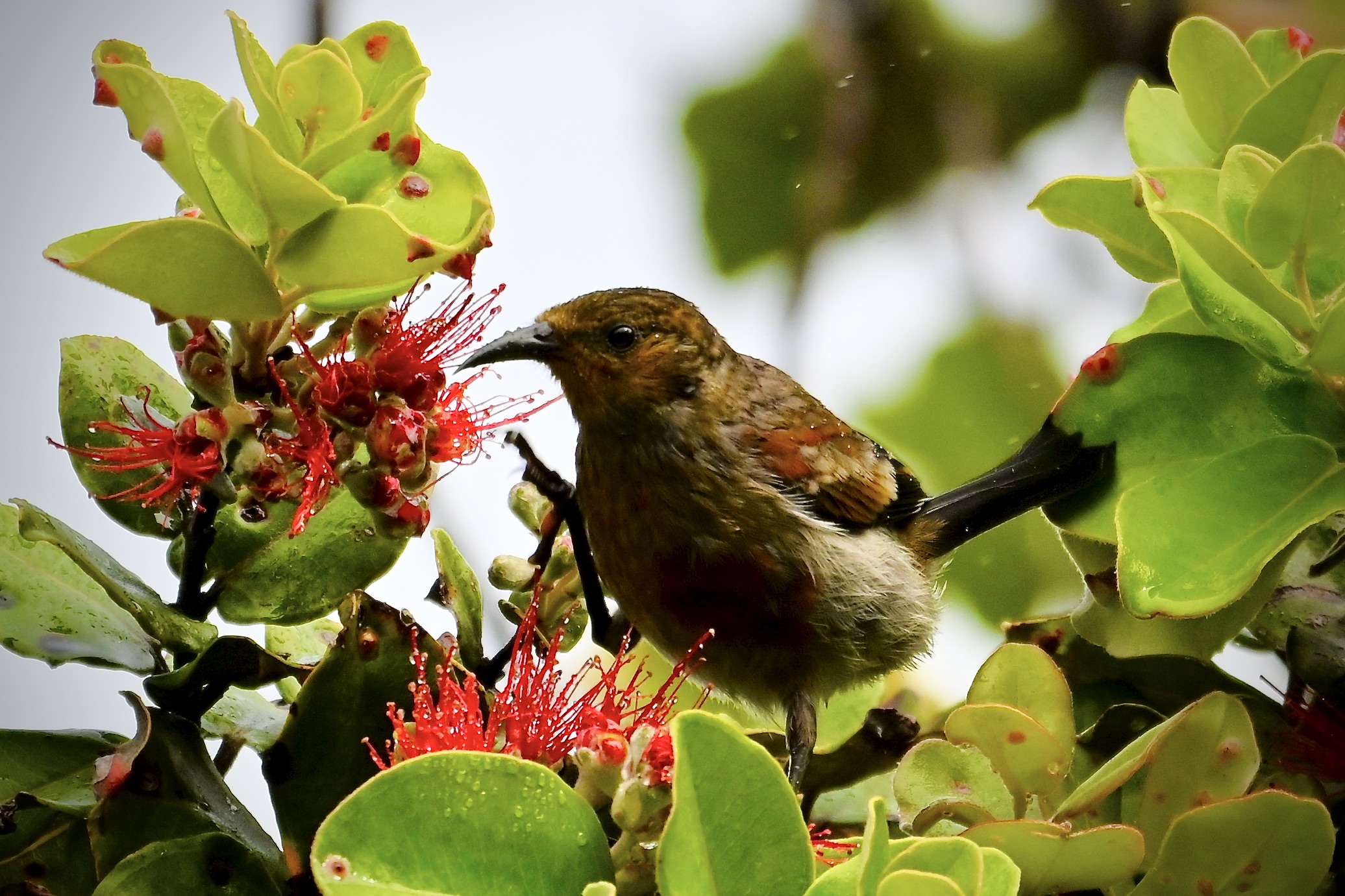
Sometimes a bird on the mountainsides just takes a liking for a particular ohi’a tree. I don’t know whether the nectar tastes better, or if you get a particularly crunchy kind of bug, or if there’s something else that gets a bird excited.
This is about an i’iwi who had a favorite ohi’a tree.
He like other trees as well. When the mamane were in blossom, he’d happily sip from those flowers as well, but as far as he was concerned there was nothing better than his favorite ohi’a tree. The flowers were the right color red, he thought, and they’d get that lovely gold tip as they blossomed. Sometimes there weren’t any flowers on it, of course, but that just meant he’d develop an appetite as he waited for them to bloom again.
It was his favorite tree.
I think you know, however, that sometimes trees in the ohi’a forest die. Sometimes the wind blows them down. Sometimes an earthquake from the volcano shakes the soil loose beneath them. Sometimes an eruption knocks them down. And sometimes, I’m very sad to say, they get very sick very quickly. Their leaves fall and, all too often, no leaves grow ever again.
The i’iwi’s favorite tree got sick.
He didn’t notice at first. He noticed it didn’t have any blossoms, of course, but that wasn’t unusual. A tree can’t bloom all the time. But then he noticed that some of the leaves were browning and dropping away. It looked like the tree was trying to grow new leaves, but there didn’t seem to be a lot of them. The i’iwi realized that the tree was in bad shape.
He shouted out his frustration to the world.
He carried on with living. But he decided it would make him too sad to see his favorite tree get sick and maybe – probably – die, so he spent his time in other parts of the forest. There were good trees there. None of them were his favorite tree. None of them could ever be his favorite tree.
One day, however, the forest’s blossoms were scarce in the groves he’d been browsing. The pattern of flowers led him, tree by tree, toward his favorite tree. He didn’t really want to go there, but if that’s where the nectar was, that’s where the nectar was. Eventually he found himself flying right toward his favorite tree.
It was covered with bright red ohi’a lehua.
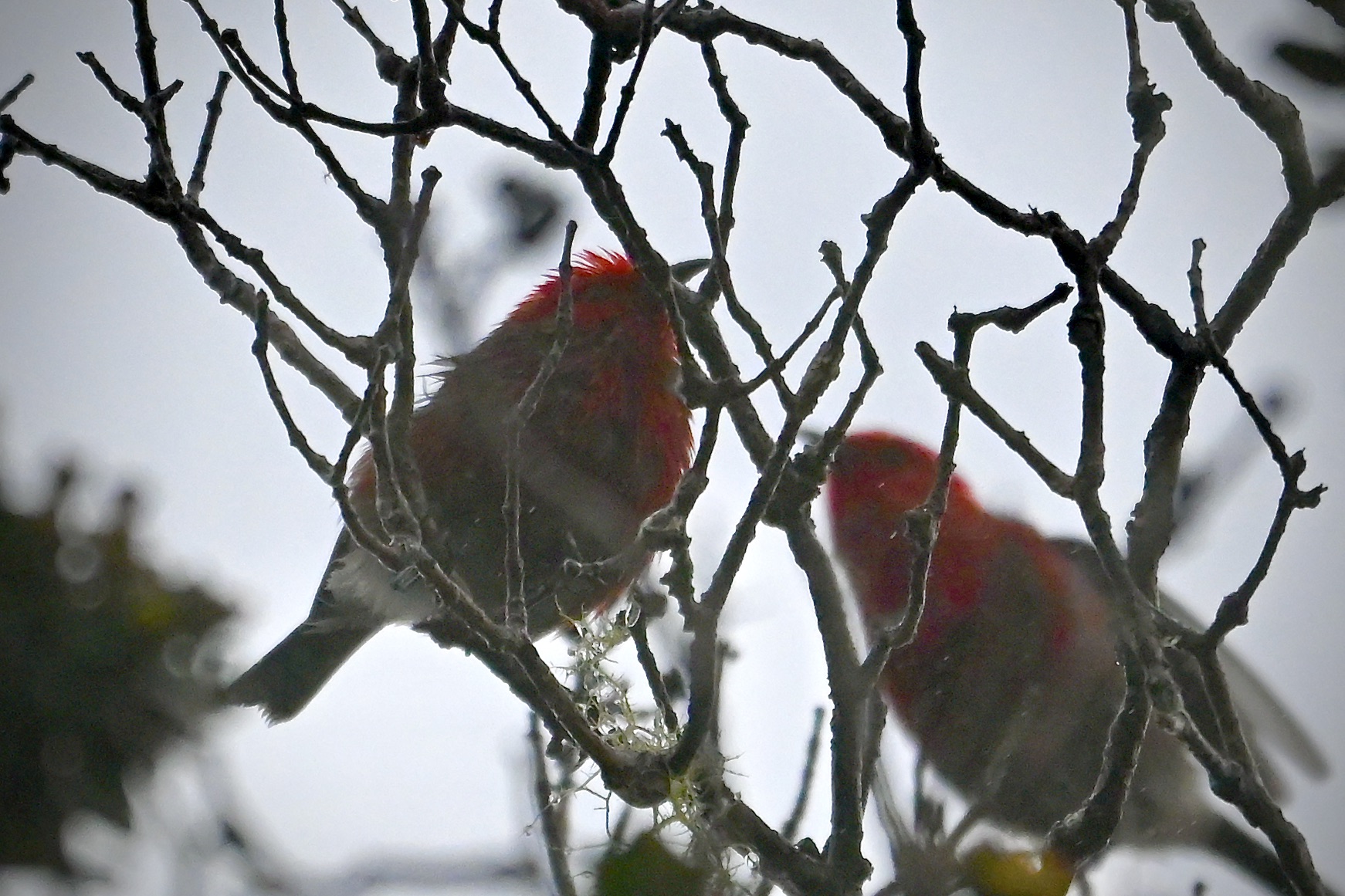
Imagine his surprise. He was sure the tree was dead, but it had survived, and it had even thrived. He flew around it, singing for joy. He settled onto a branch and lowered his long curved beak into a flower. The nectar tasted like heaven, even better than before, he thought.
This story is about Easter, but it’s not about mistaking who’s alive for someone who is dead. No. this story is about Easter because it’s about surprise. That i’iwi knew, knew to his soul, that his favorite tree was no more. Jesus’ friends and disciples, Simon Peter and Mary Magdalene, they knew that Jesus had died – as he had.
Both a Hawaiian bird and Mediterranean human beings learned that the world has more surprises in it than they’d imagined. An ohi’a that got better. A Savior who rose again to new life.
Happy Easter!
by Eric Anderson
Regrettably, there was a technical problem this morning, and the story was not recorded.
You’ve heard, I know, that there are some birds that winter with us here in Hawai’i, and that they fly to Alaska for the summer. Those birds might prefer to fly on a big jet, like you and I, but they use their own wings, even though some of them are pretty small birds. The kolea are the best known, but we’re also saying farewell to hunakai, ‘ulili, and ‘akekeke in the next month or so.
An ‘akekeke getting ready to fly looks like, well, it looks like an ‘akekeke does most of the time. It hops around the sands and stones and grasses near the ocean looking for crabs, worms, small fish, and basically anything it can eat.
A little flock of ‘akekeke noticed, however, that one of their number never seemed to pause much. Oh, she’d rest when she needed to, but the rest of the time her beak was pointed down, following her eyes constantly searching out the next worm, or small fish, or crab. She’d pause when she’d really filled herself up, but even with that she was hunting far more than her family or friends.
“What are you up to?” they asked her.
“I’m getting ready for the big flight,” she said.
“We all are, but we’re not eating all the time. You’re eating all the time. Why?”
“I want to make sure I can get all the things before it’s time to go,” she said.
“What are you talking about?” they asked her. “You can’t eat all the things. There’s too many things to eat to do that. And where would you put them?”
“I know,” she said, “but I’m going to look for as many as I can find, and who knows? Maybe that will be all the things.”
Why do I tell you this story? Well, it’s because out there along the walkways of the church there are Easter eggs. Some of them are ones you colored yesterday, and they look amazing. Some of them have sweets in them, and the sweets (not the plastic eggs) taste amazing.
What’s important, however, is that we find all the things. All the dyed eggs. All the plastic eggs. All the eggs you can use to make egg salad. All the eggs that have goodies in them.
Be like the ‘akakeke this morning. Find all the things!
by Eric Anderson
I tell two stories on Easter Sunday. I told this one just before the keiki began the annual Easter Egg hunt, where it is really important to find all the eggs. For the record, they did!
Today’s story doesn’t take place in the forests of Hawai’i. Nor does it take place in our time. It starts in a small village not far from Jerusalem, and it takes place on a day we’re familiar with because we celebrate it each year.
Surprise! It’s Palm Sunday.
He was a very young donkey. He’d only lived in one place, and he’d only really experienced one other creature, and that was his mother. He drank his milk and experimented with grass and hay and basically thought that life was pretty good, if a little dull.
On that day, however, a couple strangers came by and began to untie his halter and his mother’s halter from the fence. “What’s going on?” he asked his mother, who understood human language better than he did.
“These men say that the Lord needs us,” she said with some surprise.
“What does that mean?” he wondered, and his mother didn’t know, either.
Mystified, they followed the two strangers to a group of strangers. They put cloaks over his mother’s back and over his back, and then one of them sat on his mother while his friends cheered.
“What’s going on?” he asked his mother in some fright.
“They’ve asked us to carry Jesus to the city,” said his mother. “Just walk by me and everything will be fine.”
Off they went. One of the men led his mother along the road, though she seemed to know where she was going anyway. He trotted alongside – his legs were shorter than his mother’s, so he had to go faster to keep up.
As they made their way down a hill, other people began to gather along the road. They began to shout at Jesus and his companions. Some of them took their cloaks off and laid them on the road in front of the two donkeys. Others had taken branches from the trees and were waving them in the air as they shouted. Some of the leaves covered the road and the cloaks, and as the donkeys’ hooves stepped on them, they made a lovely scent rise.
“What are they saying?” he asked his mother, a little frightened by all the shouting.
“Blessed is the one who comes in the name of the Lord,” said his mother with wonder in her voice. “And they’re calling, ‘Help us! Save us!’”
The little donkey didn’t know how they were going to do that. He didn’t even know how he was going to help his mother carry Jesus. Abruptly, he knew that the thing he wanted most in the world, in fact, was to help his mother carry Jesus. He nuzzled up to her side.
“Let me help,” he said plaintively.
She said nothing at all, because Jesus reached over and rested his hand on the little one’s head. Just his hand. It didn’t weigh much at all. Jesus even scratched him behind the ears a little. But he proudly carried that hand along the way, through the city gates, and up the streets as the crowds grew and kept calling out in joy and with need:
“Help us! Save us! Blessed is the one who comes in the name of the Lord!”
by Eric Anderson
Watch the Recorded Story
I write these stories in full ahead of time, but I tell them from memory (and a certain amount of improvisation). The story as you read it is not necessarily as I told it.
“Jesus said, ‘Take away the stone.’ Martha, the sister of the dead man, said to him, ‘Lord, already there is a stench because he has been dead four days.'” – John 11:39
The first stones were the threats, the stones they reached for when you said, “The Father and I are one.” They called it blasphemy, and well, it would be if it weren’t true.
Given the risk of stones, which thrown, break bones, returning to Judea to heal your friend whose illness was not to the death would make no sense, at least if true.
But Lazarus was dead and in the grave when you decided to return. Dear Thomas pledged to join you in your death if stones were cast. I’m sure he thought he told the truth.
They came to you to weep. They came to tell you just how much they trusted you. “If you had been here, Lazarus would not have died.” Your tears proclaimed your love for Lazarus in truth.
“Remove the stone,” you called, despite the stink. “Remove the stone,” you called, though they recoiled. “Remove the stone,” you called, and Lazarus emerged. “Unbind him now,” you called: he lived in truth.
The stones they feared remained upon the ground. No stones would break your bones, though one would seal your tomb like Lazarus’. You there, as here, proclaimed “I am the resurrection and the life” in truth.
A poem/prayer based on John 11:1-45, the Revised Common Lectionary Gospel Reading for Year A, Fifth Sunday in Lent.
‘Apapane depend on finding flowers for their nectar, and also to find the bugs that they eat, because those bugs tend to like eating the nectar. For an ‘apapane, a grove of ohi’a in blossom is like a long buffet table with all the variety they could ask for. When the trees where they are aren’t blooming, they’ll search about to find some that are.
One ‘apapane turned out to be really good at finding trees in blossom. His friends and family grew to depend on him. He’d fly about early in the morning, find a grove of lehua, and summon the rest of the flock. They’d all descend on it and merrily feast on nectar and bugs until they set off to find another good spot.
One day, as this ‘apapane was making his morning search for nectar, he found two places before he headed back to his family and friends. One of the spots was barely okay. It would do if nothing else was available. The other spot was amazing. Every tree was just dripping with blossoms. A flock could spend a couple days and not visit every flower.
He could just about taste the nectar. He started flying back, and as he did, a thought crossed his mind. What if he led everybody back to the first spot, the one that was just okay? If he did, he could go to the second spot and have it all to himself.
He got back to the flock and said, “I’ve found something! It’s not great, but it will do until something better comes along.” So they followed him – to the first little grove.
As they settled in to sip nectar and hunt bugs, he quietly flew away to the second spot and drank nectar until he overflowed.
The next day he did it again. He found two spots, and led his friends and family to the one that wasn’t as good, while he snuck off to the better one. The next day he did it again. And again.
One of his friends noticed that he wasn’t finding good groves the way he had before, and then also noticed that he went missing shortly after leading them to iffy trees. So when he slipped away she followed him to the heavily flowered grove he’d found and not shared. As he took his first deep sip of an ohi’a blossom, she landed next to him.
“Is this what you’re doing now?” she asked. “Being selfish?”
“How do you know what I’m thinking?” he demanded.
“I don’t know what you’re thinking,” she said. “I do know what you’re doing. What you’re doing is showing your friends middling spots while you save the good spots for yourself.”
“What are you going to say to the others?” he wanted to know.
“That depends on what you do tomorrow,” she said.
Early the next day, he flew off to seek for ohi’a groves. His friend watched him go, and she watched him come back. The flock followed him to a stand of ohi’a trees, and they were covered in bright red blossoms.
He perched next to his friend.
“Better?” he asked.
“Better,” she said. “I’m glad to know you’re not selfish at heart.”
“How do you know that?” he asked. “Can you read my heart?”
“Of course not,” she said, “but what you do reveals your heart. When you act selfishly, you show a selfish heart. When you share, you show a sharing heart.
“Of the two,” she added, “I prefer the sharing.”
by Eric Anderson
Watch the Recorded Story
I write these stories in advance, but I tell them live from a combination of memory and improvisation. The story as written does not exactly match the story as told.
Photo of an ‘apapane in ohi’a blossoms by Eric Anderson.
Saltiness, sweetness, bitterness, and sourness. Those are the four senses of the human tastebuds. I’ve told stories about the first three over the last three weeks. Shall we go for sour?
Let’s go for sour.
He was the fasted akekeke in his generation (the English name is ruddy turnstone, and there is some reddishness in their brown feathers, and they do turn stones when looking for food). Yes, the fastest akekeke in his generation, and everybody knew it.
After hatching and fledging he’d quickly begun winning races among his siblings and cousins and friends in Alaska. They’d made a short journey to the shoreline where they’d munched on crabs and fish and snails before making the long flight to Hawai’i. That had been his first time, so even though he could fly very fast, he stayed with the other birds and they arrived on the island together.
But as spring approached and the return to Alaska, he started to think about winning.
“I’m going to win the race,” he announced to his friends and cousins.
“What race?” they asked.
“The race back to Alaska,” he said. “I’m going to win.”
“There’s a race?” they said, and they looked at one another in confusion.
“And I’m going to win,” he said firmly, and leaped into the air to practice.
“What are you talking about, son?” asked his father later on. “What race are you flying in?”
“The race to Alaska,” said the young bird. “I’m going to win.”
“But there’s no race,” said his father. “We just fly to the same place.”
“What good is that?” said the fastest akekeke in his generation. “There has to be a race. And I’m going to win.”
And that was that. His father, his mother, his sisters and brothers, his tutus, his cousins, his friends: Nobody could convince him that there wasn’t a race, that there wasn’t anything to win.
“I’m going to win the race,” he insisted.
When the day came for the akekeke to begin their flight to Alaska, he was among the first to take to the sky. He pressed on hard, and rapidly drew to the front of the flock, then beyond it. He was the fastest flyer in his generation, after all.
It wasn’t long before he couldn’t make out the other birds behind him. He was alone in the sky. He was confident, though, that he knew where he was going, and he was also right. He did. It was a long tiresome journey, but he made a successful landing on the Alaskan shores and began hunting for food.
He’d won.
But as he satisfied his hunger, he realized that another hunger remained unsatisfied. He’d won, but there was no celebration. There was nobody there. He was the only akekeke on a long empty beach. He was lonely. It was a sour victory.
It took quite some time before the other akekeke began arriving. It took longer for his father to find him. “How was your race?” he asked his son.
“The flight was all right,” he said, “but you’re right. It wasn’t a race.”
“The victory wasn’t what you thought?” said the father.
“It was sour,” said the son.
“How about now?” asked the father, “with everybody else here?”
The son looked around at the busily feeding akekeke, and the sourness subsided. He felt good again.
“Everybody is in the same place,” he told his father. “We’ve all won.”
by Eric Anderson
Watch the Recorded Story
I write these stories ahead of time, but I tell them from a combination of memory and improvisation. On this day, for example, one of the youngsters raced up to the front, which was a little unfortunate given the theme of the story.
“For this reason the promise depends on faith, in order that it may rest on grace, so that it may be guaranteed to all his descendants, not only to the adherents of the law but also to those who share the faith of Abraham (who is the father of all of us, as it is written, ‘I have made you the father of many nations’), in the presence of the God in whom he believed, who gives life to the dead and calls into existence the things that do not exist.” – Romans 4:16-17
An ox-cart won for Gordias the crown of Phrygia, so they say, and Midas tied the cart’s yoke with a knot so intricate removing it would win a continent.
Great Alexander, so they say, could not untie the knot. Perhaps he pulled the pin. Perhaps he sliced it open with his sword. His death released the Asian lands he’d won.
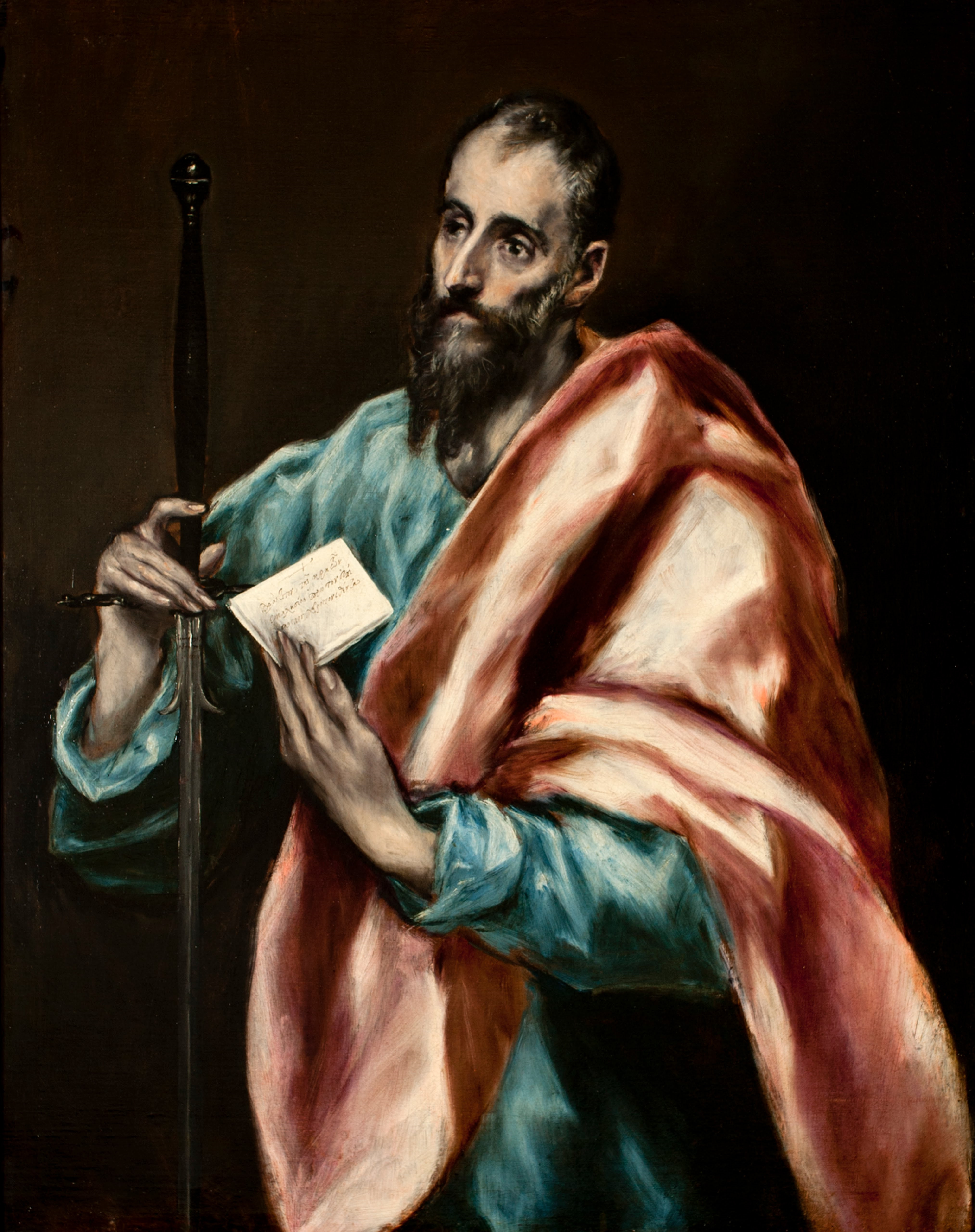
Three centuries and some, along came Paul with no ambition toward war and rule, but faced with as intractable a knot as Midas ever tied to hold a cart.
The knot held some, he thought, in servitude, in hopeless effort to be righteous when “not one is righteous, no, not one… they all have turned aside from kindness, every one.”
The knot barred others from the knowledge of their failure to do good (though honestly they should have known through what Creation tells of God’s eternal justice, wrath, and power).
How to release this knot? How meld these two communities into a house of faith? How reconcile circumcised with those uncircumcised, with mutual distrust?
How else? He tied a knot of elegant and pirouetting thought, a logical connection that would bind the Church in one, close fastened, one and all, to Jesus Christ.
What loving, faithful pains he took to show we travel in one boat, we worship just one God, we are one Church, wherever we began our faith’s life’s journey, Jew or Greek.
I wonder, though, if tying up new knots is all that useful when the animal needs water, and the lead is all too short, when dinner waits beyond the leash’s length.
I wonder if the Messianic fingers had already loosed the knot dividing us, and if, with all this elegance of thought, poor Paul re-tied it hopelessly again.
Some months ago upon a mountain trail I came upon a fence and gate, which served to give endangered plants a chance to grow, not be consumed by wandering ungulants.
The gate was closed by string, and at first glance I thought it held by a close-fastened knot, and reached toward it, fingernails prepared to pull and loosen its constricted coils.
But then I looked again. The knot did not secure the gate. It closed a loop, which I quite easily unwrapped and wrapped again, continuing along the mountain trail.
Dear Paul: Is that what you have tried to do? Is this a loop we can unwrap to make our way along the Way? Is grace beyond accessible to us despite the knot?
A poem/prayer based on Romans 4:1-5, 13-17, the Revised Common Lectionary Second Reading for Year A, Second Sunday in Lent.
Having selected my Lenten discipline of giving up judgmentalism (and writing about it), I was promptly challenged to keep that discipline. I hadn’t even finished the first essay about the project when I encountered this story on Religion News Service by a reporter I follow on the BlueSky social network, Jack Jenkins: “400 Christian leaders urge resistance to Trump administration on Ash Wednesday.”
One of the reasons I chose to examine judgment and judgmentalism this Lent is that I’ve been challenged for judgmentalism. I’ve been taken to task for criticizing some behaviors while excusing others. I’ve been told that some of the things I protest in some have been done by others – did I protest them?
The critique has sometimes been fair. I can’t say I was aware of all the examples that I didn’t protest (which makes it harder to protest them), but it’s also true that those wouldn’t have circulated in places where I pay attention. Limit your attention; limit your awareness. That’s something to consider as I continue this Lenten reflection on judgmentalism.
There on the very first day I had to discern and judge, because the statement invited religious leaders to sign on. Whether I signed or not, I would be making a judgment.
I hadn’t expected it to happen so fast. I hadn’t expected to face a significant decision before I’d laid up some intellectual foundations. Ah, well. As Robert Burns wrote to a mouse:
But Mousie, thou art no thy-lane, In proving foresight may be vain: The best laid schemes o’ Mice an’ Men Gang aft agley, An’ lea’e us nought but grief an’ pain, For promis’d joy!
When I first considered this question over pork chops and mashed potato, the first thing I thought of as a feature of discernment was time. Before choosing, give it time. Before deciding, give it time. Before acting, give it time. I expect to spend more time on this element (see what I did there?) through the next six weeks, but even as I thought it over I realized that we make a number of decisions in the moment and rightly so. When I finished my meal I drove home. I made decision after decision in those few minutes without reflecting on it for more than an instant. If I hadn’t, I’d have run the front of my car into a car in front of me.
Likewise, I have to admit that I have spent long periods of time considering my actions and ended up deeply regretting what I’d chosen. Time is no panacea.
Nevertheless, I decided I would consider the decision over a day.
(I decided I would decide. See what I did there?)
I read the statement “A Call to Christians in a Crisis of Faith and Democracy” several times. It’s not a subtle piece. “We are facing a cruel and oppressive government,” it claims. “This political crisis is driven by people who have fallen for the temptation of absolute power,” it asserts. “Governance is being hollowed out and replaced with corruption, loyalty tests, intimidation, and the normalization of lawlessness,” it states. Strong words. Strong judgments. The authors of the statement have looked at the acts of the administration and made conclusions about the character of those acts: cruel, oppressive, corrupt, and lawless. Further, they have asserted that the temptation of absolute power is a driving factor for those who direct those acts.
I face the question: Do I concur with those judgments? Do I agree with their characterization of these acts? Do I accept the diagnosis of the motives?
Further, I read the list of signatories. Although I’ve been in ministry a long time, I didn’t recognize all the names. I saw many that were familiar, including quite a few whose words and work I’ve greatly admired. I also saw a number of people from organizations I’ve never heard of. I saw that representatives of the “mainline” Protestant churches clearly predominated, with a lot of leaders from ecumenical settings. A number of the people who signed come from my own denomination, the United Church of Christ, including our General Minister and President. Some of the signers are colleagues I deeply respect. Some are dear friends.
I face the question: Are these people whose discernment I trust? While I still have to do my own work, can I trust the work they have done?
The statement is not simply a diagnosis of our condition. It is also a call to action. Those who signed made eight commitments. The authors expanded more on them than I have here:
Protect and stand with vulnerable people,
Love our neighbors,
Speak truth to power,
Seek peace,
Do justice,
Strengthen democracy,
Practice hope, and
Ground our discipleship in prayer and inward journey.
I face the question: Are these commitments I can make? Are they consistent with my understanding of Christianity? Are they things I have the power to do? Are they things I have the will to do?
I slept on it. I read the statement again (and again). I reviewed the names. I found more names I knew. I considered the commitments.
Here’s the thing: I knew I was inclined to add my name to the list when I read Jack Jenkins’ headline. That was my first judgment, my off-the-cuff discernment. But was it judgmental? Particularly given the strong language about the political and spiritual condition of the nation?
Also, was I (am I) merely reinforcing my own pre-established conclusions? On the Sunday after the election, I said, “The United States has re-elected as President a devourer of widows’ houses. Plain and simple. Already his followers have sent messages to African American children telling them to report for sale as slaves. Already his followers have sent messages to women: ‘Your body. My choice.’”
Of the three areas of discernment I’ve named here, I had no problems with the commitments. I’ve held those as virtues consistent with Christianity for many years (which raises the problem of reinforcing my conclusions again). There were more than enough people whose judgment I trust in the list to make their willingness to sign compelling. The sticking point was: Do I agree enough with the diagnosis section to sign on to it? Do I need to learn more that either confirms or refutes that characterization of the administration’s acts?
This morning I sat with it again, considered it again. And I came to the same conclusion with which I’d started: I believe I know enough. I agree with the characterization. I need to make the commitment.
“Then the devil left [Jesus], and suddenly angels came and waited on him.” – Matthew 4:11
He challenged you, Jesus. Summon the angels! They won’t let you fall. You won’t have a bruise on your heel, Nor a strike from a snake.
You said no. No to bread. No to flight. No to glory (that fails to transcend all the kingdoms of earth).
Then he left. And who came? Yes, the angels. The angels. They were hovering ’round, And they brought you relief.
Well, Jesus, I’m tempted. So tempted, you know, so hungry and weary, confused and distressed.
Where are the angels? Will they tend my bruises? Will they feed my hungers? Where are the angels, Jesus the Christ?
“There are angels hov’ring ’round.”
A poem/prayer based on Matthew 4:1-11, the Revised Common Lectionary Gospel Reading for Year A, First Sunday in Lent.
The image is Weite Gebirgslandschaft mit der Versuchung Christi (Vast Mountain Landscape with the Temptation of Christ) by Jan Brueghel the Elder – dorotheum.com heruntergeladen am 30. September 2012, Public Domain, https://commons.wikimedia.org/w/index.php?curid=21801997.