Well, That’s Just True.

[Jesus said,] “For those who want to save their life will lose it…” – Mark 8:35

Well. That’s just true.

It’s simply true that life will close for one and all
no matter how we seek to manage and extend it.
No human being lives their life on Earth and fails
to die: including Jesus, as You well recall.

So that’s just true.

I grant you that by effort, luck, and with
a spot of selfishness and pride, a person might
extend their life or live in comfortable bliss,
but You require every person’s soul of them in time.

So that’s just true.

In truth, I struggle more to see how offering myself,
how giving effort, time, or wealth,
how giving life itself,
will lead to life.

You say that’s true.

And so I move upon a cracked and twisting path,
one day embracing vanity,
the next one striving for beneficence,
as if the map were constantly redrawn.

You know that’s true.

O, reassure my heart, my Savior,
that I might in constancy adopt Your course,
not bribed by promise of new life,
but tranquil and serene in hope.

May this be true.

A poem/prayer based on Mark 8:31-38, the Revised Common Lectionary Gospel Reading for Year B, Second Sunday in Lent.

I’ll Take the Sign

God said, “This is the sign of the covenant that I make between me and you and every living creature that is with you, for all future generations: I have set my bow in the clouds, and it shall be a sign of the covenant between me and the earth.” – Genesis 9:12-13

I’m grateful for the promise, Holy One,
to never raise a flood to sweep all life from Earth.

I cannot quite forget, however,
that you did not say we could not do this thing ourselves.

As tides rise higher around my island,
testimony to the human hubris that grieves you,

I am grateful for the sign
that you, at least, keep faith.

A poem/prayer based on Genesis 9:8-17, the Revised Common Lectionary First Reading for Year B, First Sunday in Lent. And, er, it’s written late.

Photo by Eric Anderson.

Transfiguration Sonnet

Upon the mountain’s height the stones reflect
the sudden glow, not gleaming from the skies
as ordinary light. They are bedecked
with sudden radiance that mystifies.

Now where there were four figures there are six,
and two did not come up the earthen trail.
Three faces wear astonishment transfixed
to see the ancient prophets so unveiled.

The ever-daring one proposes booths
until a booming voice imposes hush,
for listening is like to admit truths
far more than motion taken in a rush.

But were I there, I fear my faltering frame
would hardly dare pronounce Messiah’s name.

A poem/prayer based on Mark 9:2-9, the Revised Common Lectionary Gospel Reading for Year B, Transfiguration Sunday.

Studies of the Heads of two Apostles (St. Peter and St. John) and of their Hands by Raphael (1483–1520), at the University of Oxford’s Ashmolean Museum. Black chalk touched with white on greyish paper. http://www.wikipaintings.org/en/raphael/studies-for-the-transfiguration, Public Domain, https://commons.wikimedia.org/w/index.php?curid=23549943.

Gathered Around the Door

And the whole city was gathered around the door. – Mark 1:33

The city is outside my door, Jesus,
but they are not calling to come in.

They have not come en masse to seek a healer
or a prophet who could liberate their souls.

Oh, one or two, perhaps. From time to time.
If they found solace, they have kept the secret well.

There is enough, in truth, to drive a lesser one
like me to seek the solitude you sought

When morning had not wakened those
whose needs had not been satisfied.

I’m not sure how I’d handle all those people
seeking what I know to be beyond my power

And so confess with sadness that I’m glad
I lack the power, and the crowds stay home.

A poem/prayer based on Mark 1:29-39, the Revised Common Lectionary Gospel Reading for Year B, Fifth Sunday after the Epiphany.

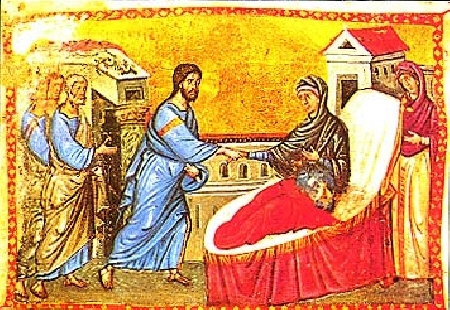
The image is Healing Peter’s Mother-in-law, from a 13th century manuscript from the Athos monasteries by an unknown author – http://shop.liturgie.de/, Public Domain, https://commons.wikimedia.org/w/index.php?curid=5187185.