A Piece of Bread

After saying this Jesus was troubled in spirit, and declared, “Very truly, I tell you, one of you will betray me.” The disciples looked at one another, uncertain of whom he was speaking. One of his disciples–the one whom Jesus loved–was reclining next to him; Simon Peter therefore motioned to him to ask Jesus of whom he was speaking. So while reclining next to Jesus, he asked him, “Lord, who is it?” Jesus answered, “It is the one to whom I give this piece of bread when I have dipped it in the dish.” So when he had dipped the piece of bread, he gave it to Judas son of Simon Iscariot. After he received the piece of bread, Satan entered into him. Jesus said to him, “Do quickly what you are going to do.” – John 13:21-27

For centuries your followers have sought to make
the choice of Judas make some sense.
Was he just greedy? Was he bereft of soul?
Did he have some agenda you would not accept?

Despite the Gospel writers’ efforts,
Judas’ treachery remains a mystery.

The greater mystery is how you shared that bread –
the bread we break in honor of your death –
how did you share that piece of bread and know,
and know that he contrived your death?

Who is it, Lord? your closest friend inquired.
You knew. You knew the name as well as you
discerned the anguish that approached, that would
be on its way, when you extended bread.

Were I to know such things, could I extend
a piece of bread as to a trusted confidante,
and breathe, “Do quickly what you do.”
The answer is a clear and easy, “No.”

Yet you released the bread into betrayer’s hand,
and put your life into his hand.
He took his hand into the night
to take your life.

Despite the Gospel writers’ efforts,
Jesus’ love and bravery remain a mystery.

A poem/prayer based on John 13:21-32, the Revised Common Lectionary Gospel Reading for Year B, Wednesday of Holy Week.

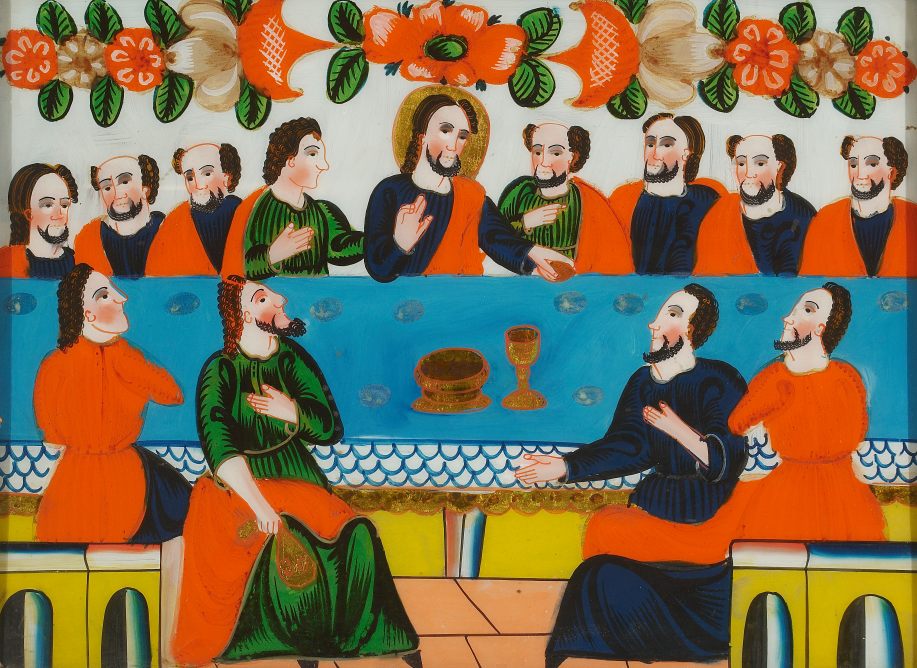
The image is by unknown artist (ca. 19th century) – http://www.rav.sik.si/sl/e-knjiznica/artoteka/item/zadnja-vecerja-2, Public Domain, https://commons.wikimedia.org/w/index.php?curid=17358033.
Destroy the Wisdom of the Wise

Tuesday of Holy Week, March 30, 2021

“…But we proclaim Christ crucified, a stumbling block to Jews and foolishness to Gentiles, but to those who are the called, both Jews and Greeks, Christ the power of God and the wisdom of God. For God’s foolishness is wiser than human wisdom, and God’s weakness is stronger than human strength.” – 1 Corinthians 1:23-25

We are practiced and proficient
at crucifying you, O Christ.

Before your squalls e’er cracked
the stable’s musty silence,
you suffered in your people’s
suffering.

How many shall we name?
The Calvaries of Scripture?
Brickworks in Egypt. Assyrian spears.
Mendacious monarchs. False prophets.

The flames of Solomon’s temple.
The ceaselessly repeated prophets’ bark:
“The widows and the orphans
have been left to die.”

We are practiced and proficient
at crucifying you, O Christ.

The hands that drove the nails
into your flesh did so adeptly, trained
by other flinching, bleeding flesh,
and other hopeless moans.

Other hands were just as deft
to rob the poor and call it right,
to crush the power of women and
to burn the Second Temple, too.

For followers of Christ the faith
might mean exclusion from their home,
bereavement from their trade,
and yes, it might mean crucifixion.

We are practiced and proficient
at crucifying you, O Christ.

I’ve been accustomed to using nails
of race and gender privilege,
to seeing nails of emptied magazines
and nails of gender definition.

I’ve mourned and not prevented
nails of poverty and war and greed
from fixing you – your people – to
the crosses that adorn this world.

But never had I thought to see
that foolishness and folly would conspire
to claim the crown of wisdom and
to crucify a host in just a year.

We are practiced and proficient
at crucifying you, O Christ.

No wonder that you wept.

A poem/prayer based on 1 Corinthians 1:18-31, the Revised Common Lectionary Gospel Reading for Year B, Tuesday of Holy Week.

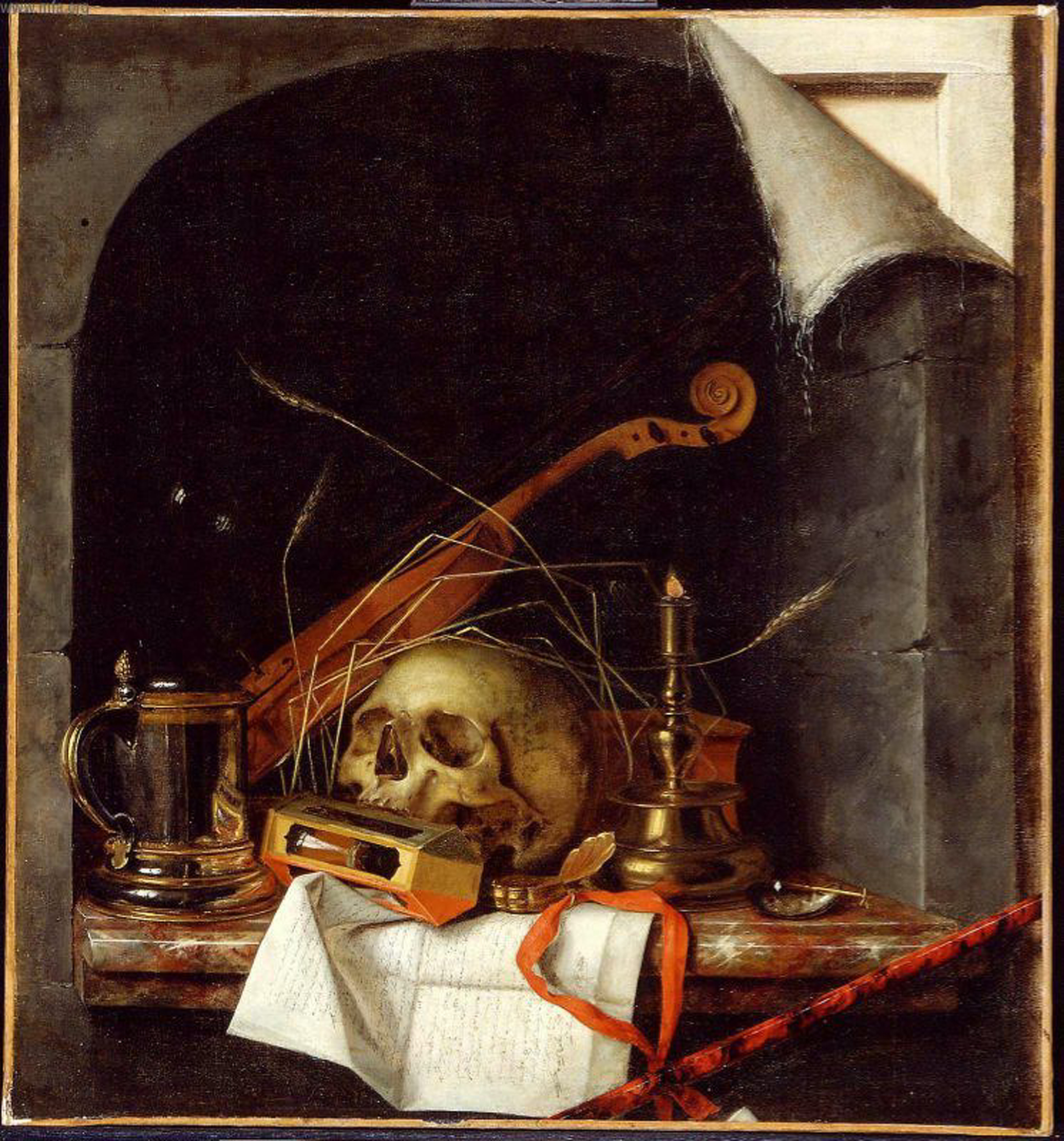
The image is Vanitas Still Life by Cornelis Norbertus Gijsbrechts (17th century) – http://www.Vanitasoceansbridge.com/oil-paintings/product/62477/vanitasstilllife, Public Domain, https://commons.wikimedia.org/w/index.php?curid=8052848.

Sweet-Scented Dust

Monday of Holy Week, March 29, 2021

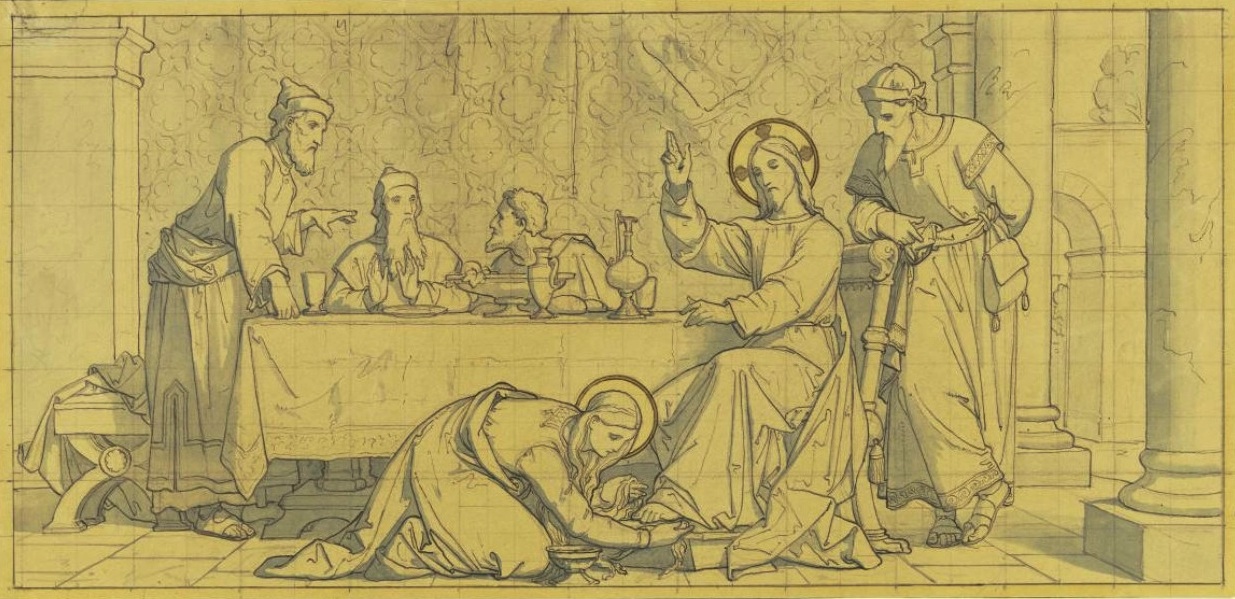
Mary took a pound of costly perfume made of pure nard, anointed Jesus’ feet, and wiped them with her hair. The house was filled with the fragrance of the perfume. – John 12:3

Oh, Jesus, must you say such shocking things?
She had, indeed, done such a precious thing for you,
so tender and so intimate, so grateful
for the love you bore for her and Martha.
For after all, you brought their brother back.

And now, with scent of spikenard rising in the house,
you spike the words of Judas, keeper of the purse,
by speaking of the day you would be laid to rest,
a tragedy that perfume could not sweeten, not
with rivers poured upon your lifeless corpse.

Oh, pause now, Jesus, for you shock us once again,
for must we ever have the poor with us?
Could not the rivers of the scent we’ve not poured out
transform this world into a paradise on earth?
Perhaps they could – but bottled they remain.

Except for this one jar unstopped above your feet,
the oil dripping from your soles into the earthen floor,
still warm from your still-pumping heart,
now rising to enchant your breath, their breath, our breath,
sweet-scented dust inhaled to death and life.

A poem/prayer based on John 12:1-11, the Revised Common Lectionary Gospel Reading for Year B, Monday of Holy Week.

The image is Mary Magdalene Anoints the Savior’s Feet by Dominik Mosler (before 1880) – [1], Public Domain, https://commons.wikimedia.org/w/index.php?curid=82653427.

In the Throng

Save us, we beseech you, O LORD! O LORD, we beseech you, give us success!
Blessed is the one who comes in the name of the LORD.
– Psalm 118: 25-26a

Festival season. Who needs it?
The city packed with visitors
(Okay, the vintners and the innkeepers: they need it).
Just throngs of throngs of throngs.

The throngs are noisy, just not quite
this noisy. What’s amiss?
They’re piling up along the road
from Bethany toward the Temple gate.

Good heavens. Now the trees are waving
as they strip the branches down,
to lay them in the road. I see
the hues of cloaks and coats as well.

“Hosanna! Save us!” now they shout,
a cry both pious, quoting of the psalm,
and eminently timely in these times.
“Blessed is the one who comes!” – but who?

Oh, dear. This doesn’t look so great.
No horse. No guards. No retinue.
A dusty teacher on a colt,
escorted by rough peasants.

A glance to one side or the next
reveals that not all shout or celebrate.
The priests, the guards, the noble ones:
They watch with faces set and grim.

And I would make my way away
from this, for I have things to do
that will not muddle me in symbols
of revolt, of pitiful defiance,

Yet the throng still presses, holding me
in place to watch the colt’s slow steps,
to listen as they shout, “Hosanna,” and
to wonder if such saving could arrive.

I fear, however, that the only route
from this display leads not into a royal seat,
but to the tender mercies of
a Roman governor.

Such mercies are not tender, no.
Such mercies lead beyond the Temple’s court
to where the hill is crowned too oft
with human figures writhing on a cross.

I watch the colt-borne teacher ride away,
followed by the throng, releasing me
to find my path again. My road will be
much easier than his.

A poem/prayer based on Mark 11:1-11, the Revised Common Lectionary Gospel Reading for Year B, Sixth Sunday in Lent, Liturgy of the Palms. 

The image is Einzug Christi in Jerusalem by Wilhelm Morgner – The Yorck Project (2002) 10.000 Meisterwerke der Malerei (DVD-ROM), distributed by DIRECTMEDIA Publishing GmbH. ISBN: 3936122202., Public Domain, https://commons.wikimedia.org/w/index.php?curid=155912.

Gift of the Greeks

“Now among those who went up to worship at the festival were some Greeks. They came to Philip, who was from Bethsaida in Galilee, and said to him, “Sir, we wish to see Jesus…” Jesus answered them, ‘The hour has come…'” (John 12:20-21, 23)

“Timeo Danaos et dona ferentes.” “I fear the Greeks, even those bearing gifts.” (Virgil, The Aeneid)

They bore no gifts for you, just asked to see you, Jesus.
Did you see them? John didn’t say. Instead, he quotes you
(at some length) reflecting on the seeds that die and live,
on lives that end to save themselves, on followers
in service, honor rising from humility.

Somehow you saw in their plain inquiry
the gathering malevolence that would
first strike you down, then lift you up,
then bear you breathless to the stony grave.
Stern gift, this glimpse into the future’s agony.

They could not know that they had given you
the indicator of the time.
They could not know that you had made the choice
to give the world yourself, and giving,
draw them, one and all, into the arms of God.

A poem/prayer based on John 12:20-33, the Revised Common Lectionary Gospel Reading for Year B, Fifth Sunday in Lent. 

The Apostle Saint Philip by El Greco (ca. 1610-1614) – qAERMjY3wbk87w at Google Cultural Institute, zoom level maximum, Public Domain, https://commons.wikimedia.org/w/index.php?curid=29844123. I could not resist using Doménikos Theotokópoulos’ portrait, as his Spanish nickname El Greco means “The Greek.”

Starting Over

“Jesus answered [Nicodemus], ‘Very truly, I tell you, no one can see the kingdom of God without being born from above.'” – John 3:3

And this is the judgment, that the light has come into the world, and people loved darkness rather than light because their deeds were evil.” – John 3:19

“You do not understand these things,”
you challenged Nicodemus, and I feel
a comfortable swell of pride because
I understand these things quite well.

As did, I’m sure, the teacher Nicodemus.

Is it so hard to understand
that you demanded people to revise their lives,
begin again, as if they were twice-born?
I understand these things quite well.

As did, I’m sure, the teacher Nicodemus.

The difficulty lies not in the metaphor –
we’ve got that cold – but in the living of
the metaphor, the struggle to begin again.
I understand these things quite well.

As did, I’m sure, the teacher Nicodemus.

Who wants to take a truly brand-new start
when there is so much stuff we have amassed,
such power, such persistent privilege?
I understand these things quite well.

As did, I’m sure, the teacher Nicodemus.

He knew, I know, the comfort of the shadows,
the safe familiarity of precedent,
the bland acceptance of persistent ills.
I understand these things quite well.

As did, I’m sure, the teacher Nicodemus.

My comfort is that you have stated that
God’s purpose is redemption and renewal.
There is always room to start anew.
I take assurance from this well of faith.

As did, I’m sure, the teacher Nicodemus.

A poem/prayer based on John 3:14-21, the Revised Common Lectionary Gospel Reading for Year B, Fourth Sunday in Lent – with John 3:1-13 included as well for context.

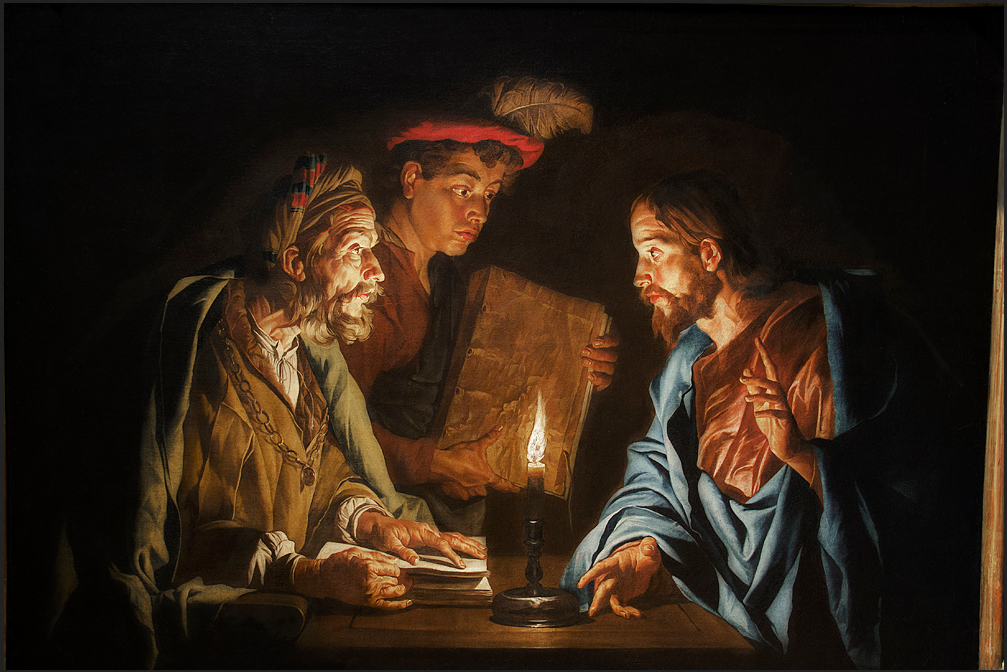
The image is Jesus Christ and Nicodemus by Matthias Stom, ca. 1640-1650 – https://www.blindbild.com/darmstadt-hessisches-landesmuseum-darmstadt-gemaldegalerie-november-2014/hlmd-matthias-stom/, Public Domain, https://commons.wikimedia.org/w/index.php?curid=88614990. I am particularly drawn to the use of the single light source in this painting.

Cleaning Crew

“Holy… well. Just holy. What happened here?”

“Some Galilean.”

“Just one Galilean made this mess?”

“Hard to believe, but yeah.”

“Wow. There’s dove feathers everywhere.”

“Not to mention… Well. Let’s just say that frightened sheep are clear about being upset.”

“Oh, my, you’re right there.”

“Yeah.”

“One Galilean? You’re sure?”

“Yep. I was here. One minute everything is normal, the next minute somebody’s yelling. Then there’s cattle lowing everywhere, and sheep slipping in dung, and doves scattering feathers around.”

“Wow.”

“Then there’s tables flying. He had these braided cords in his hand. Nobody was quite willing to challenge him.”

“C’mon! What about the Temple guards?”

“They were just too stunned to do anything. By the time any of them got moving, it was over.”

“What was it all about, do you think?”

“I can’t be sure. He was yelling something about turning his father’s house into a marketplace.”

“Seriously? Where has he been? It’s been like this since, well, forever.”

“He’s been in Galilee, I suppose.”

“Talk about out of touch.”

“Yeah. Well. It’s over now. Let’s get this mess cleaned up. Help me pick up these tables.”

“Aren’t these the money changers’ tables?”

“He knocked them over, too.”

“So… Is there anything left to pick up?”

“What do you think?”

“I think the money changers picked up every last coin before they ran.”

“You think right.”

“Oh, well. I’ll get this end.”

“I’ve got this end. Now: Heave!”

The image is Christ Chasing the Merchants from the Temple by Giovanni Benedetto Castiglione (ca. 1645-1655) – http://www.culture.gouv.fr — Réunion des musées nationaux/JACONDE, Public Domain, https://commons.wikimedia.org/w/index.php?curid=6867371

Picking Up

Making a whip of cords, he drove all of them out of the temple, both the sheep and the cattle. He also poured out the coins of the money changers and overturned their tables. – John 2:15

After the uproar and dispersal,
after the zeal and shouts,
after the sheep and doves
and cattle and bankers
had been driven out:

You know what you’ll see
in the Temple?
The same thing we see
in our Temples.

Tables replaced.
Stalls re-erected.
Coins re-stacked.
Business resuming
in God’s House.

A poem/prayer based on John 2:13-22, the Revised Common Lectionary Gospel Reading for Year B, Third Sunday in Lent.

The image is The Expulsion of the Merchants from the Temple (ca. 1568) by Jacopo Bassano, Public Domain, https://commons.wikimedia.org/w/index.php?curid=53240101. Jesus is barely visible in the background of the painting.