I Don’t Want to Hear About Fig Trees

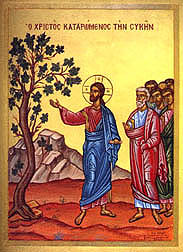
Then he told them a parable: “Look at the fig tree and all the trees; as soon as they sprout leaves you can see for yourselves and know that summer is already near. So also, when you see these things taking place, you know that the kingdom of God is near.” – Luke 21:29-31

I don’t give a fig for fig trees, Jesus.
Tell me clearly what the future brings.

I know that changes in the wind forecast
the rain, or sun, or clouds, or stormy blast
that drowns or feeds or shields the fields,
or lays them down in wind-swept rows.

I know that rumblings deep within the ground
presage emergence of the fiery rock
that ravages the things we’ve built
and does what we cannot: make land.

And, yes, I know that human beings have a way
of signaling the things they’ll do.
I mean, sometimes they say it loud and clear
and we, somehow, will not believe.

I even know that when I dare not say myself
the compass point to which I’ll set my course,
I’m pretty sure which ways I will not go,
and that’s a good prediction where I will.

So it’s not ignorance of figs and leaves
or strength of wind or human whim:
it’s weariness, my LORD. The fig may speak;
my spirit is too tired to hear its voice.

A poem/prayer based on Luke 21:25-36, the Revised Common Lectionary Gospel Reading for Year C, First Sunday of Advent.

The image is a Byzantine icon of Jesus as in Mark 11:12–14 – http://revcrystalk.files.wordpress.com/2009/04/miraclesofthelordpa31.jpg, Public Domain, https://commons.wikimedia.org/w/index.php?curid=19042975.
Another World

“If my kingdom were from this world, my followers would be fighting…” – John 18:36b

O Lord, a disingenuous remark, perhaps?
There was some fighting in the garden when
you were arrested, yes? When Malchus lost
an ear, which you restored with just a touch.

It’s funny how nobody mentioned that
before the Roman governor. It’s like
the movie. “They cut off my ear!” “Your ear?
Your ear is fine.” “Well. It got better.”

In the best taste? Well, no, perhaps. You told
your old friend Peter to re-sheathe his sword,
then he and they decamped while you
were taken to the priests and then to Pilate.

Now, Pilate knew quite well just what to do
with you, Messiah. Crush the serpent’s head;
the rest will follow it to death. What need
a trial for pretenders to Israel’s throne?

What need? The need for truth, of course,
the truth that you defined Messiah unlike those
before, or those to come. You refused
to found your throne upon a frame of shattered bones.

Instead, you said, your reign’s foundation would
be truth itself, and truth its sign, and truth its aim.
To which the governor would scoff, attention gone,
the bitter question, “What is truth?”

Another world you rule indeed, Messiah King,
where those in power seek to rule in truth.
In this our world – and Pilate’s too – the truth
is clay to be reshaped as fits the day’s desire.

May we, unlike the governor who left the room,
his question echoing unanswered, give
the time and concentration to discern the truth.
Truth’s Author waits for us to ask – and learn.

A poem/prayer based on John 18:33-37, the Revised Common Lectionary Gospel Reading for Year B, Proper 29 (34), Reign of Christ Sunday.

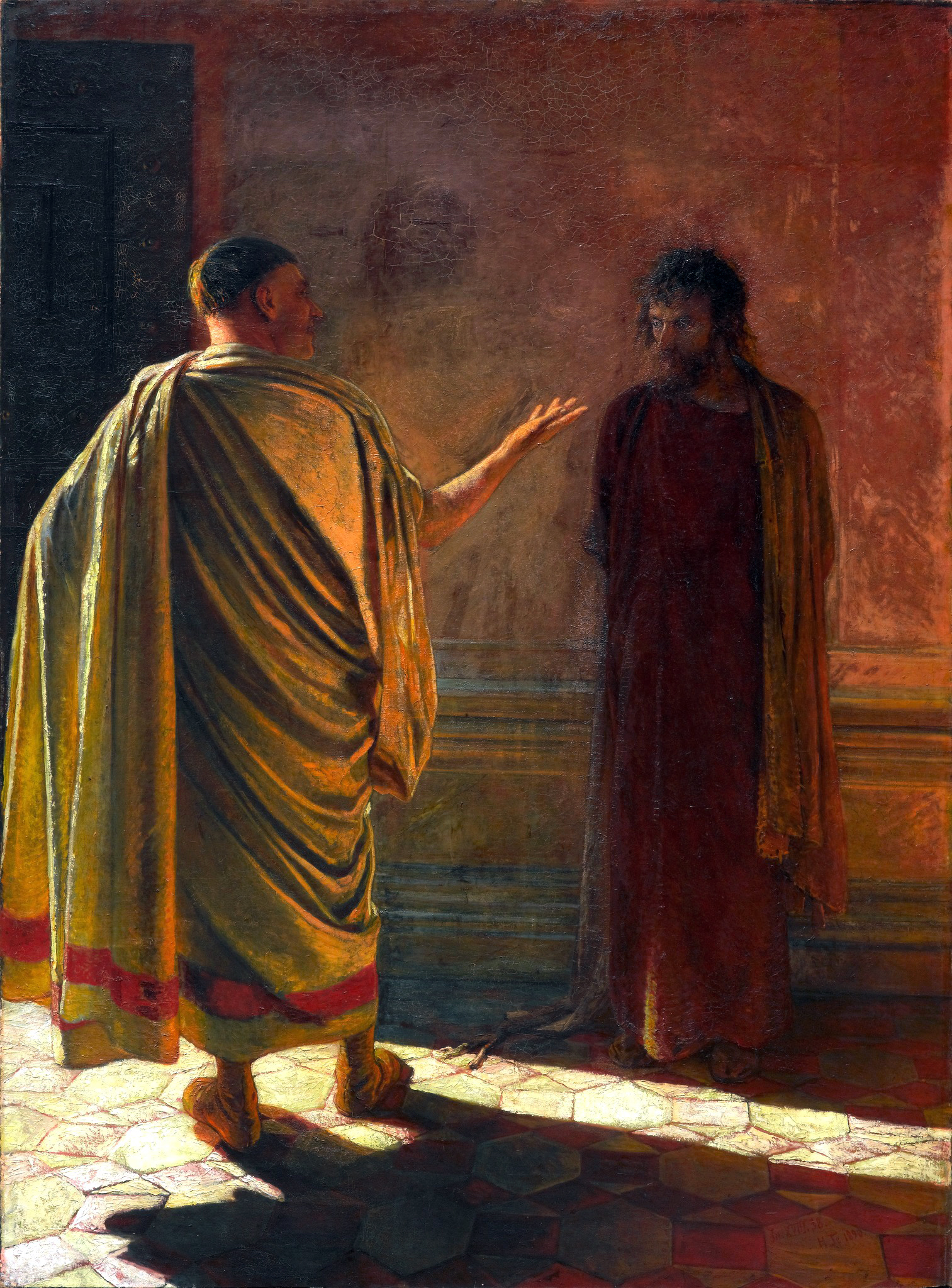
The image is What is Truth? Christ before Pilate by Nikolai Ge (1890) – http://www.picture.art-catalog.ru/picture.php?id_picture=7515, Public Domain, https://commons.wikimedia.org/w/index.php?curid=426635.

Distant Thunder

“The LORD! His adversaries shall be shattered; the Most High will thunder in heaven.” – 1 Samuel 2:10a

Ah, Hannah, generous of you, to spread your thanks
as broadly as a many-bristled brush, and not
to concentrate upon the detail of
your own distinctive celebration.

How dare we be so proud? We know
that God has lifted up, and God has tumbled down
the weary and the prosperous not once,
but time and time again across the span of time?

Indeed, these days have found us humbled once
again, at least we should be humbled now,
discard vainglory’s claim to safety through
the wonders of technology,

For all the care we take to trace disease,
and all success to find the means
to vaccinate the people, still
the folly of humanity prevails.

Ah, Hannah! Pray for us, that this reversal might
not bring us down to grovel in our pride,
to weep at further graves, lament our lost
communities and loved ones gone.

Yes, Hannah, pray for us, that this reversal might
lay down our pride, so we can stand
and raise each other up, to weep in joy
that we discarded folly’s ways in time.

O help us hear, upon the flowing wind,
the distant rumbles of salvation’s thunder, hope
that peoples near and far may know God’s grace,
and with their voices echo Hannah’s song.

A poem/prayer based on 1 Samuel 2:1-10, the Revised Common Lectionary Psalter Reading for Year B, Proper 28 (33).

The image is Anne, femme d’Elqana et mère de Samuel, priant (Hannah, Wife of Elkanah and Mother of Samuel, Praying) by Unknown author (10th century), found in the Psalter of Paris – Bibliothèque nationale de France (BNF). Cote : Grec 139, Folio 428v., Public Domain, https://commons.wikimedia.org/w/index.php?curid=14041273.

Devoured

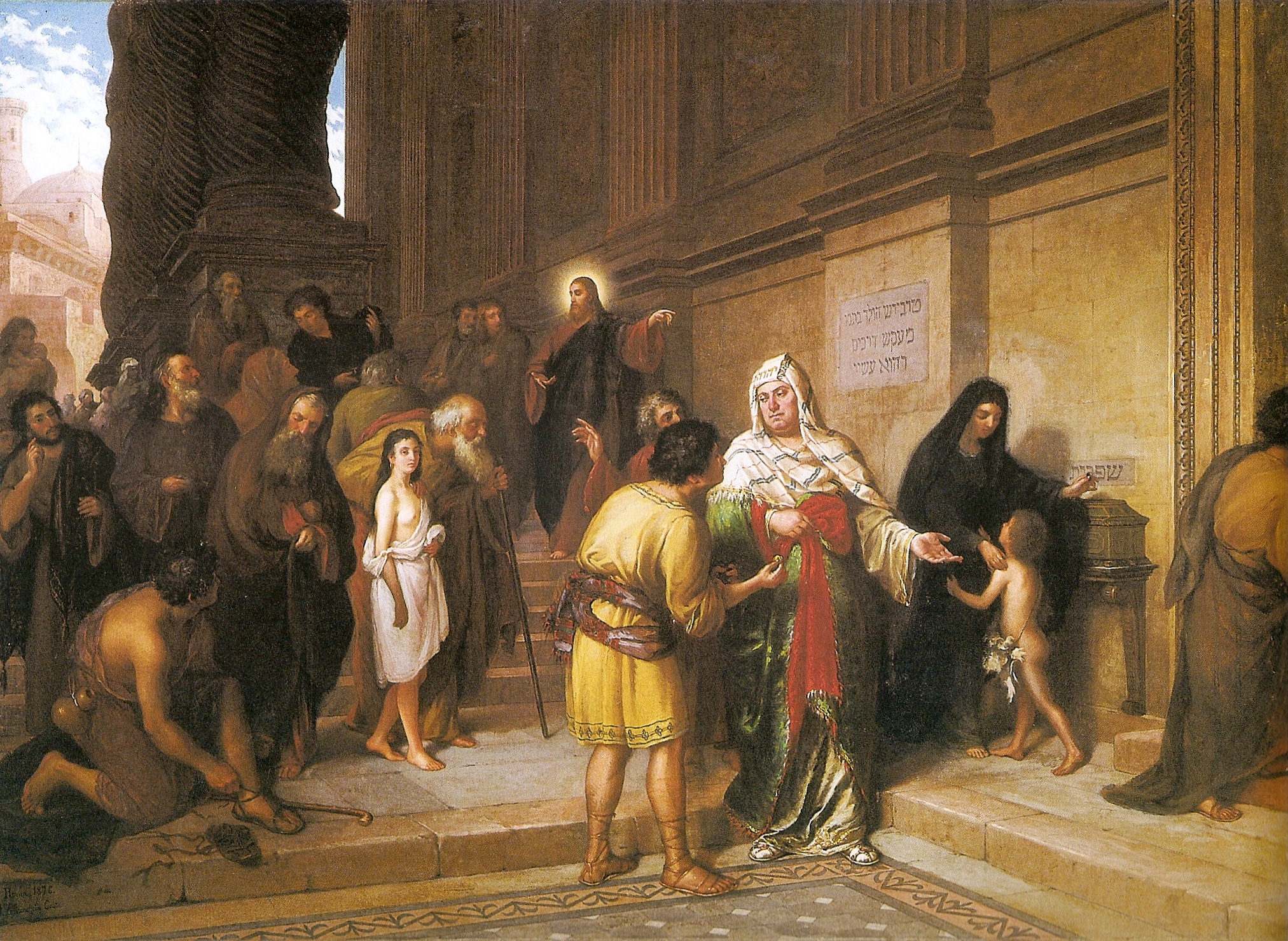
Note that both Jesus and the widow are in the background of the painting. The foreground features a religious official who resembles those Jesus described as liking to walk around in long robes and be greeted with respect.

“They devour widows’ houses…” – Mark 12:40a

“…But she out of her poverty has put in everything she had, all she had to live on.” – Mark 12:44b

So what was your expression, Jesus,
when you called your friends to see
the widow whose last coins had rattled down
into the treasury collection?

Did you watch with soft, approving eyes,
to see such faith, such generosity,
such confidence of God’s aloha
to relieve the crisis now at hand?

Or did your brow bear furrows
of concern, of worry, for her poverty
had now reached destitution, and
her final meal had clinked into the box?

Or did you grind your teeth to witness on
the Temple grounds the very thing
of which you’d warned? For here
a widow’s house had been consumed.

Oh, Jesus! Have you any teeth remaining in
your jaws? Or do you lubricate
their grinding with your tears? For still
the widows bring their homes… and we devour.

A poem/prayer based on Mark 12:38-44, the Revised Common Lectionary Gospel Reading for Year B, Proper 27 (32).

The image is O óbolo da viúva (The Widow’s Mite) by João Zeferino da Costa (1876) – Scan: MNBA/Banco Santos catalogue, São Paulo, 2002., Public Domain, https://commons.wikimedia.org/w/index.php?curid=15742896.