“Nicodemus said to him, ‘How can anyone be born after having grown old? Can one enter a second time into the mother’s womb and be born?'” – John 3:4
You knew, Nicodemus, and Jesus knew you knew that humans do not live a static life. They grow, adapt. They shift and change. Sometimes they even make a brand new start.
Sometimes they start as fresh as wandering wind, as pure as water droplets glistening. Where do they go? Who knows? The wind goes where it will, just like the Holy Spirit.
Though none can set or stay the Spirit’s way, one thing remains more firm than stone, more sure than night or day. Yes, God so loved the world not to condemn, but raise in radiant life.
A poem/prayer based on John 3:1-17, the Revised Common Lectionary Gospel Reading for Year A, Second Sunday in Lent.
I think you may have heard the story I’m not telling, the one about when the Tempter tried to tempt Jesus. He challenged him to turn stones into bread because Jesus was hungry, and Jesus said, “No.” He challenged him to prove he was the Messiah by jumping off the Temple roof, and Jesus said, “No.” He challenged him to rule the nations of the world by worshiping him, that is, Jesus worshiping the Tempter, and Jesus said, “No.” Then the Tempter went away.
But I’m not telling you that story.
I’m telling you what happened next, which is that the Tempter was angry and fed up and feeling like a failure. What do people do when they need a break? That’s right. They go on vacation in Hawai’i.
I promise you that most of the visitors aren’t angry Tempters.
But the Tempter walked the koa and ohi’a forests and tried to feel better about things, which wasn’t working. One of the problems with being a Tempter is that you never really do find peace inside yourself. So he decided that instead of peace, he’d find success. He’d tempt something, and this time he’d win.
He went searching, and he found an ‘apapane.
“’Apapane,” he said, “have I got a deal for you. I will give you the power to turn these stones into bread. Just do that, and you’ll never worry about being hungry ever again.” The Tempter demonstrated by turning some lava rock into bread. The scent rose into the air.
The ‘apapane gave it a sniff, and then flew a short distance to an ohi’a tree, where he sniffed at the nectar from a bright red blossom. He gave it a taste.
“No, thank you,” he said. “I’ll stick to nectar.”
The Tempter was very disappointed with this, but not ready to quit. He brought the ‘apapane to the top of the highest tree in the forest. “All you have to do is prove that God takes care of all God’s creatures,” the Tempter said. “Throw yourself down from this tree, and let the angels catch you.”
The ‘apapane looked at the ground far below, stretched out his wings, and flew. “I think I’ve got that one covered already,” he said.
The Tempter realized that this temptation had been a bad mistake, and he was rattled. Still, he was undaunted. He was going to have a success. This time he swept the ‘apapane all the way to the summit of Mauna Kea, and there he showed the bird all the nations and forests and mountains of the world. “Worship me,” said the Tempter, “and all of this will be yours.”
The ‘apapane shivered in the cold, and pecked experimentally at a small bug on a rock. “I’d rather live in the ohi’a forest,” he said. “It’s warmer and things taste better there.”
At that the Tempter gave up, both on tempting an ‘apapane and on his Hawaiian vacation. I believe he went to sulk in Antarctica, where there’s a lot of empty space to sulk in.
The ‘apapane went back to the forest and, when other birds asked him about his adventure, simply said, “I just chose to be myself, to enjoy my life and its nectar. It’s not really much of a temptation to be something or someone else than myself.”
If you’re tempted, friends, choose to be yourself, the best and truest self you can be. Send the Tempter sulking to Antarctica.
by Eric Anderson
Watch the Recorded Story
I write the story. I tell the story. In the telling, there are departures from the writing.
The tempter came and said to him, “If you are the Son of God, command these stones to become loaves of bread.” – Matthew 4:3
Temptation I recognize, Jesus (except when I don’t). My media diet is full to the brim of temptation, allure: “Buy this! Buy that! And life will be better for sure!”
At times I am sure that temptation disguises itself as need: a tool or a book or a thing enlivening live streams or enhancing worship or giving me something to think on anew.
Might temptation be present in obvious choices, the things that we get because Mom always got them? The symbols we use, uniforms donned. As I bow my head for a Sunday stole, do I hear a reproach in its wavering fringe?
And then there’s temptation I simply don’t recognize, and here I must ask: What’s wrong with transforming the stones into bread? Your need was as real as the need of five thousand or those who lived on the manna of Sinai.
Your retort to the Tempter – what does it mean? We live by the words of the mouth of God? Who would know that better than the Incarnate Word? And yet you consumed the fruit of the land, the bread from the ground, its flour ground (as you knew) between stones.
As a test, I can pass this one, Jesus. I can. There’s no sign the power of stone-flour bread is mine to command. But I wonder, Messiah. You spotted this test. You chose your best course. You passed the exam. But would anyone else? Could anyone else?
The Tempter was someone you knew to resist. I don’t always know. Sometimes, but not always. The action was one that would lead you astray. The paths that I follow all seem to be straight… to start. So I beg you to help me to choose the true bread, for I don’t always recognize the voice of God.
A poem/prayer based on Matthew 4:1-11, the Revised Common Lectionary Gospel Reading for Year A, First Sunday in Lent.
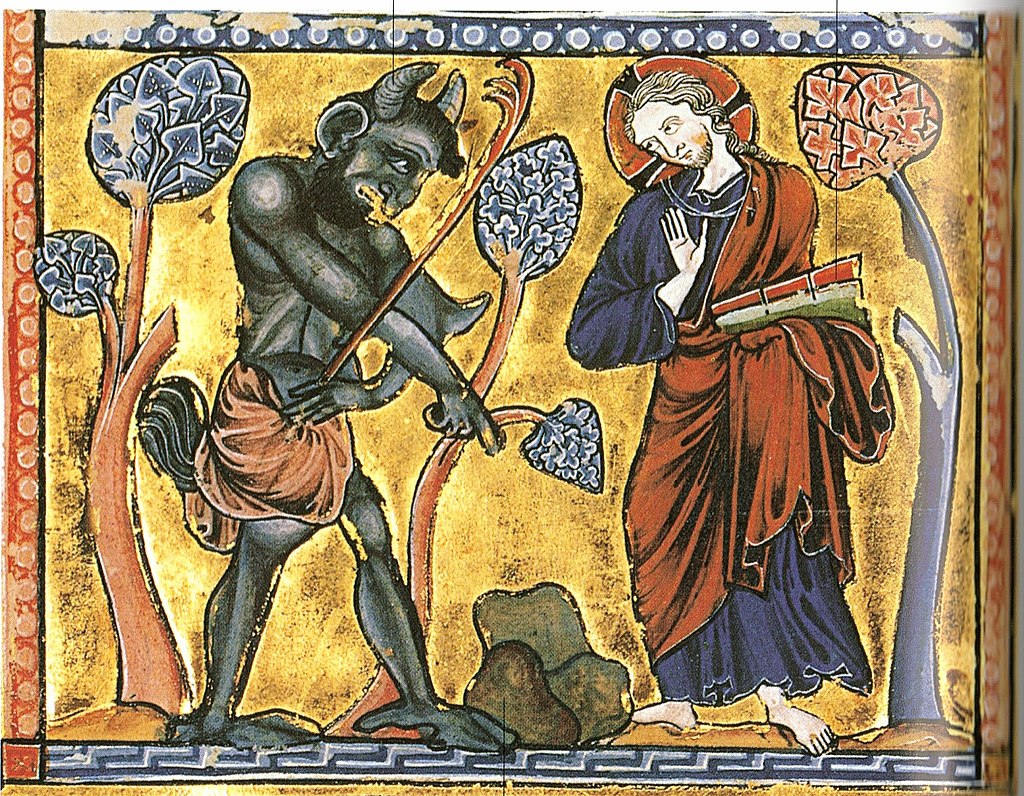
The image is an illustration in a Psalter ca. 1222 by an unknown artist – Self-scanned Rosa Giorgi: Bildlexikon der Kunst, Bd. 6.: Engel, Dämonen und phantastische Wesen, 384 S., Berlin: Parthas-Verlag 2003, ISBN 3936324042 / ISBN 9783936324044, S. 130, Public Domain, https://commons.wikimedia.org/w/index.php?curid=114178710.
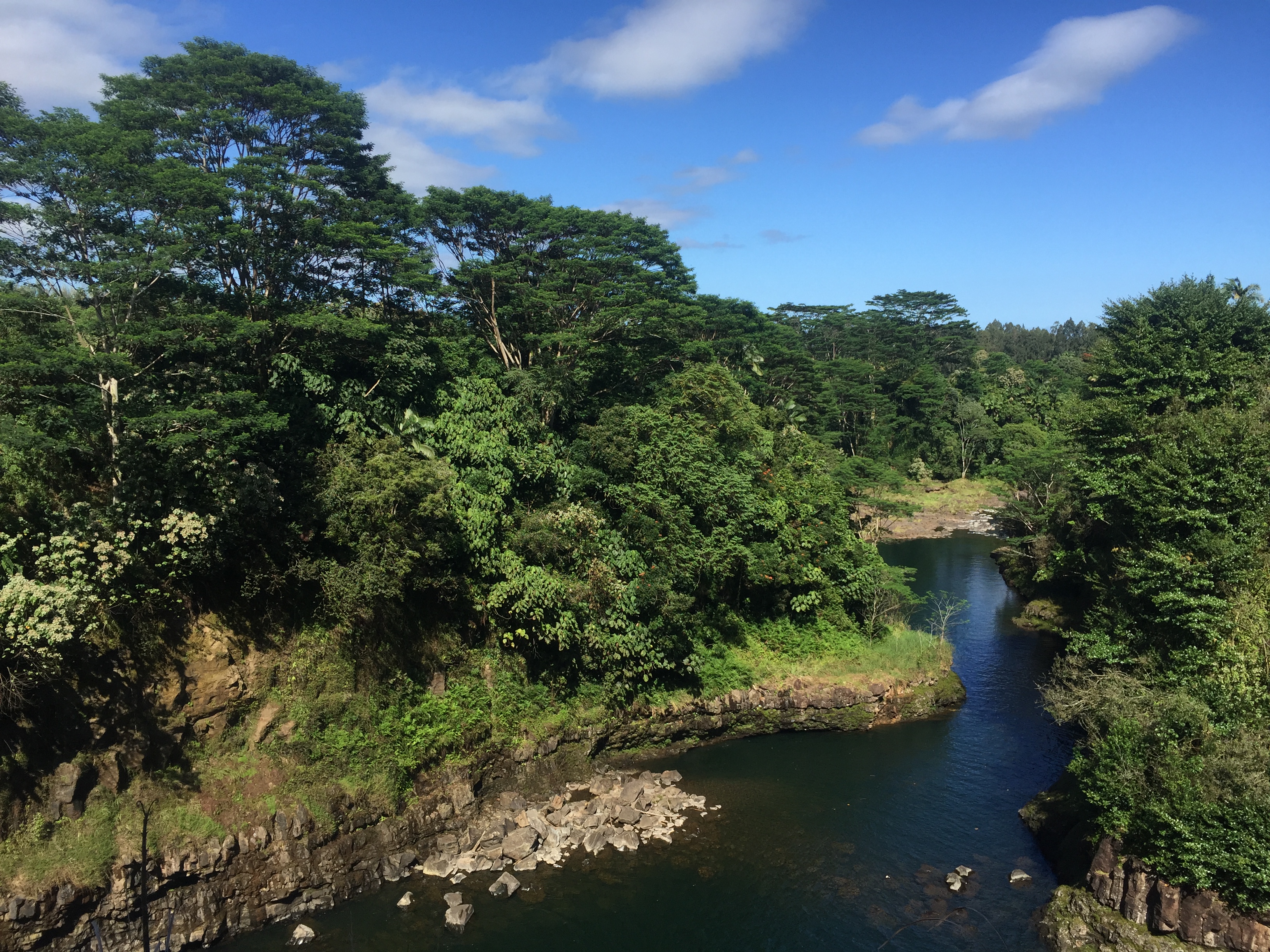
The river was a pretty good river. It had some charming waterfalls and some broad pools. It had earth banks solid rock banks and stony banks and down near where it entered the ocean, it had sandy banks. It made chuckling sounds over small rocks, roaring sounds as it fell, and seemed to create its own silence in its wide, slow sections. Anyone would say it was a pretty good river. – anyone, perhaps, except the river itself. You see, the river wanted to be a mountain.
It looked up to the mountain and envied its craggy sides and its lofty peak. It envied the clouds that wreathed its summit sometimes and the snowy crown they left behind. It envied the sheer mass of the mountain, so great that it pressed down the sea floor from which it had grown. It envied its grandeur. It envied its majesty.
The river wanted to be a mountain.
“Oh, I wish I could be a mountain,” it said in the musical rippling of the water over stones.
To the river’s surprise, the mountain heard, and to the river’s greater surprise, the mountain replied. “Why do you want to be a mountain?” it hummed with its deep, rumbling voice.
“I’d like to be as tall as you,” said the river. “I’d like to touch the sky. I’d like to see all the earth around me. I’d like people to look up to me with awe.”
“You’re nearly as tall as me,” pointed out the mountain. “Water that falls on my peak comes down to you – you and other rivers on my sides. Water you carry to the sea rises up to touch the sky. Between the oceans and the clouds, your waters cover all the earth. And you know that people look at your falls and pools with joy.”
“Yes, but I’ve heard stories,” said the river, “about times when God had special things to say, and those things were said up on the mountains. God spoke to Moses on a mountain, and Jesus taught on a mountain.”
“That’s true,” said the mountain. “I’ve heard those stories, too. And I’ve heard another story. Did you forget that one?”
“Which one?” asked the river.
“I’ve heard that before Jesus taught on a mountain, he was baptized. In a river.”
The river was silent, because that was a familiar story, too, and in its envy, it had forgotten it.
“I guess it’s not so bad to be a river,” said the river.
“I’m glad to hear it,” said the mountain. “Can I send the water that falls on me your way?”
“You can,” said the river. “And I’ll send it on to the ocean.”
The mountain stands, and the river runs, and both have their place in the life of the world, and in the stories of the Bible and our faith.
by Eric Anderson
Watch the Recorded Story
The story in this recording is told from memory of the text above. Sometimes the memory isn’t perfect, and by “sometimes” I mean “always.”
“As they were coming down the mountain, Jesus ordered them, ‘Tell no one about the vision until after the Son of Man has been raised from the dead.'” – Matthew 17:9a
Who would I tell, Jesus? What would I tell them? “He glowed like a lamp in the sun, but brighter!” “Moses was talking to him; so was Elijah!” “A voice told me to listen from a cloud!”
They’d shake their heads to hear the first, to hear the second, to hear the third. The last and final sentence, though, they’d hear and smile: “And when, pray tell, will you start listening?”
That question’s fair enough, I know. I blurted out those words of invitation rather than a question, like, “Should we build booths for you, as you are here?”
So, Jesus, no, I’ve learned a little bit. I’ll keep my silence ’till you give the word. And listen. I will listen, sure as day. And… maybe… wonder what you mean by “risen from the dead.”
A poem/prayer based on Matthew 17:1-9, the Revised Common Lectionary Gospel Reading for Year A, Transfiguration Sunday.
“What is love?” the little girl asked her mother at bedtime, but she fell asleep before she heard the answer.
“What is love?” chirped the coqui frog outside her window. She slept on.
“What is love?” crowed the rooster, who had no idea what time it was and didn’t care whether he crowed at sunrise or the middle of the night.
“What is love?” sighed the dove, and “What is love?” hummed the saffron finch, and “What is love?” purred the cat lying below them.
“What is love?” The question flew about the island, from creature to creature, from voice to voice. ‘Apapane sang about it on the mountain slopes and noio screeched about it above the waves. Pigs grunted it in their shelters and mongoose chittered it in their burrows.
“What is love?” asked the sheep and the pueo and the nene and the dogs. “What is love?” rumbled the mountain and “What is love?” sighed the clouds.
It was the wind who whispered it into the ear of the ‘io. Whispered it, and whispered it again, until the ‘io took wing and cried with a great voice, “Love is what lifts you up! Love is what carries you! Love is what makes you a home!”
The ‘io cried it, and the wind sighed it. The ‘apapane sang it and the pigs grunted it. The nene honked it and the chickens clucked it.
Outside a little girl’s window, a coqui frog chirped, “Love is what lifts you up. Love is what carries you. Love is what makes you a home.”
She woke suddenly, though whether it was the coqui’s voice that waked her I can’t tell you. “Mama!” she called, and both parents hurried to her room.
“I know what love is!” she said, and her mother said, “But of course. I told you when you asked me:”
And the two said together: “Love is what lifts you up. Love is what carries you. Love is what makes you a home.”
by Eric Anderson
Watch the Recorded Story
In the recording above, the story is told from memory of this text. I had no illusions that I would remember all of the creatures I’d put in the story (or the order), but I remembered more of them than I’d expected!
“I fed you with milk, not solid food, for you were not ready for solid food. Even now you are still not ready…” – 1 Corinthians 3:2
A food of miracles, this milk, that comforts the miraculous. The squalling ball of helpless and adorable fresh flesh would dwindle soon, would cease its noise, but better is delivery of milk to toothless gums, and better far is sleepy, satisfying milky burps.
So I am glad, nay o’er the moon with Paul, to feed us on the milk of breasts Divine, that my poor soul has sustenance, vitality, and vigor for the growth – ah, yes, the growth – that Paul had promised.
So what, I ask, is this more solid food to feed the soul? What is, I ask, more rich, more suited to the task than milk? What is, I want to know, the superfood of the soul?
For challenges arise, I see. If Paul demands we lay aside the jealousy and quarrels, I can only echo him. “What use are these?” we say. “Has not the Savior shown us better ways?”
But rising beyond Paul, the words of Jesus daunt, which set the bar for my comportment high. Anger and insulting? Lay aside. Admit my wrongs. Look not with lust. Say only yes or no and keep my word.
I sigh, aware the challenge beckons, and I seek nutrition of the spirit that will carry me along and to the end.
A poem/prayer based on 1 Corinthians 3:1-9 and Matthew 5:21-37, the Revised Common Lectionary Second Reading and Gospel Reading for Year A, the Sixth Sunday after the Epiphany.
I believe that I have mentioned schools before. A couple of my stories have visited nene school, and we’ve heard a little bit about ‘apapane learning to fly and ‘amakihi learning to sing. There are several species of fish, of course, that have made the ultimate commitment to lifelong learning, because…
They are always in schools.
This story is not about birds or fish, though it does take place in the water. This is about a honu school. Green turtles hatch on beaches, of course, and then the little turtles head down into the water. When they’re small they stay in shallow water, but as they grow they venture further out. That’s when it’s time to learn about deeper diving to graze on the seaweeds below or to hide from a hunting shark. That’s when I imagine a honu might go to school.
The teacher of this particular honu class was mostly feeling pretty satisfied. The students were cheerful and respectful. They were kind to one another and to her. They encouraged one another and they kept an eye out for one another. There hadn’t been a single episode where a student had got lost on the reef; someone always called before one wandered out of sight.
That’s a pretty good class.
There were two students, however, who were giving the honu teacher something of a headache, and for completely different reasons. One student insisted on trying things before he was ready for them. She’d set the class to dive to a particular depth, and he’d say, “I can dive deeper than that!” and promptly set out to do that. The problem was that sometimes he could dive deeper, and sometimes he couldn’t. He was still learning how much breath to take in; he was still learning how to feel the water movement in the deeper sections. He’d come back to the surface scared and panting, and ten minutes later he’d shout, “I can dive deeper than that!”
That was one headache.
The other student was entirely the opposite. “Let’s dive to this depth,” she’d say, and he’d shake his head. “I can’t do that,” he’d moan, even when he’d done that same dive the day before. “Let’s go just a little bit deeper,” she’d say, and he’d come right back to the surface.
That was two headaches.
Imagine now that she’s encouraging the one who’s not confident about his dives while the one who’s overconfident about his dives is diving and she had to go rescue him.
That’s three headaches.
When class was over one day she took them over to the beach for a rest and some one-on-two instruction. “I need for the two of you to work at a steady pace,” she said.
“But I know I can dive deeper!” said the first. “But I don’t think I can dive deeper!” said the second.
“Both of you can dive deeper,” she told them, “but this is something you learn to do by degrees. You make a little progress, and a little progress, and a little progress. If you don’t go a little farther, you don’t make progress. And if you go too far, you also don’t make progress. It’s like eating a big piece of seaweed. You take little bites until you’re not hungry any more.”
“You mean I really can dive deeper?” asked the second one. “Yes,” she said.
“You mean a little bit farther means I can dive farther tomorrow?” asked the first one. “Yes,” she said.
I wish I could say that both of them followed her advice in each class from then on. They didn’t. But they did better, and they did better with each passing day. Both of them learned to take those deep dives of the honu, and both of them were grateful they’d take it just a little bit at a time.
by Eric Anderson
Watch the Recorded Story
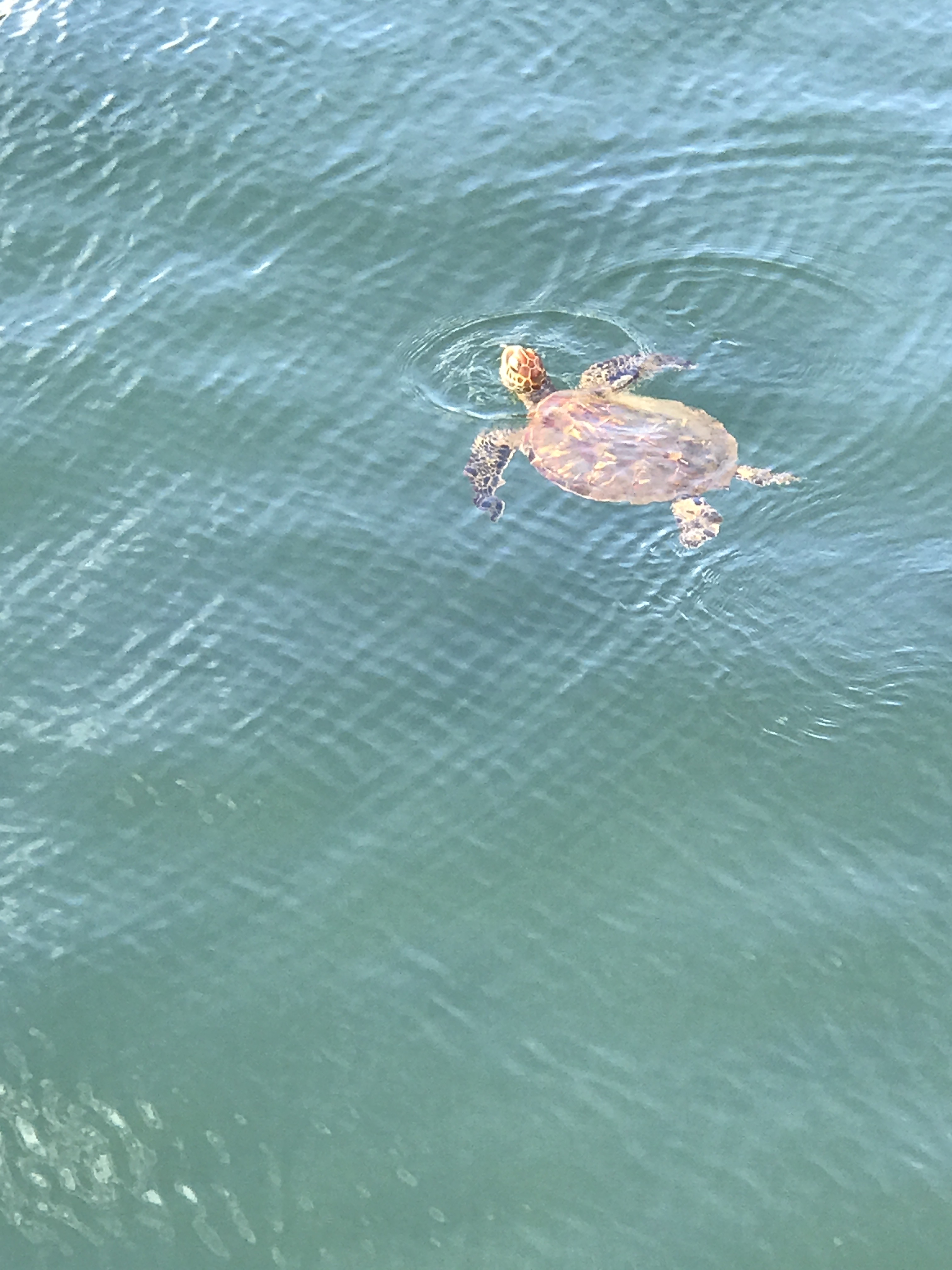
Photo of a honu (in shallow water) by Eric Anderson.
“If you remove the yoke from among you, the pointing of the finger, the speaking of evil, if you offer your food to the hungry and satisfy the needs of the afflicted, then your light shall rise in the darkness and your gloom be like the noonday.” – Isaiah 58:9b-10
“[Jesus said,] ‘You are the light of the world.'” – Matthew 5:14a
I’m trying, Jesus, I am surely trying (and don’t think I can’t see and hear and feel your smile twisting as you think “Oh, yes. You’re definitely trying… all my patience!”).
I’m trying to remove the yokes. I pray that you are seeing more success with that than I. I’m trying to refrain from speaking evil, even if it means I must lock down by tongue to silence.
And I’m trying, surely trying, Jesus, to direct my pointing finger solely to myself, to take the blame when it is mine, and not add strife with blame to others.
But.
I’ve got to say that my hard-won restraint has not been echoed widely, has it? You and I both know that finger-pointing is activity in which a multitude delights.
While I am struggling with my guttering light, a horde of people praise the shadows, and to my astonishment, they call the shadows light. No hungry fed, no naked clothed, evil celebrated.
My finger itches, Jesus, with the urge to point and then shout out (as once Isaiah was directed) with trumpet calls: “For shame, you hypocrites! You do not shine, you hide the light of God!”
And then I breathe in deep, down to the belly, as I contemplate your failures, Jesus, in the world. You called them out, the hypocrites who taunted you as your light shone upon the torturer’s cross.
I’ll do my best to shine, I will. I’ll try. I’ll feed that guttering wick and shield it from the howling winds as best I can. But man… My finger itches, Jesus. Yes, it surely does.
A poem/prayer based on Isaiah 58:1-12 and Matthew 5:13-20, the Revised Common Lectionary First Reading and Gospel Reading for Year A, the Fifth Sunday after the Epiphany.
“…and they offered a sacrifice according to what is stated in the law of the Lord, ‘a pair of turtledoves or two young pigeons.'” – Luke 2:24
“…for my eyes have seen your salvation…” – Luke 2:30
Bearing their eight-day-old sons, two-week-old daughters, the parents bring their sacrifices to the priests. Each brings a pigeon or a dove, but some a lamb. Those leading lambs wear finer clothes than those who bear two turtledoves. The gift is what they can afford.
One couple, bearing pigeons and a son, are told that they have been anticipated. An elder man accosts them in the Temple court to celebrate their child’s role in Israel’s salvation. “A light for revelation!” now he cries, but also, mother, know your heart will ache.
The couple might have edged away, but from another side a woman comes, another elder, face well lined with years. She comes and praises God for this small child. He will, she promises, redeem Jerusalem. She praises what she knows she will not see.
The parents fade once more into the crowd, and those about are well content to let them go. Their clothes were nothing fine; their feet were travel-stained, and their sacrifice would be no more than pigeons, what a family offered when they lacked both power and wealth.
A pity that a pious, virtuous crowd was blinded by a pair of pigeon’s wings.
A poem/prayer based on Luke 2:22-40 the Revised Common Lectionary Gospel Reading for Year A, the Presentation of the Lord.





 ordainedgeek