What Shall I Say to Them?

“God said to Moses, ‘I AM WHO I AM.'” – Exodus 3:14

I don’t usually indulge in the histories
of the shepherds who keep us.
What matter to me or to ewe
as long as they lead us to grass?
As long as they guard us from wolves?
As long as they don’t get us lost?

But Moses, for all of his protests to God,
did not keep his silence from us.
How often we heard how he lived dual lives,
one family held by the other as slaves?
How often we heard he had ruled as a prince
and fled as a criminal here to our hills?

Though I’ve not known a sheep with two hearts,
poor Moses had two in his breast.
One beat to the rhythms of royalty.
One pulsed with the sorrow of slaves.
He wept when he called out his orders.
He knelt when he tended our hurts.

I’m not one to linger by fire – it burns –
but when Moses turned aside to the flaming bush,
I followed, and listened, and chewed on the grass.
The voice challenged Moses to merge his two hearts,
to step up and lead, not as prince, but as prophet,
to commit his one heart to deliver his people.

He sidestepped and soft-shoed, did Moses.
“Who am I?” he demanded, “to set people free?”
No sheep ever asked, “Who am I?” but of course,
no sheep ever lived with two hearts in its chest.
“You are the one I have chosen,” said God.
Just one, said God. One man with one heart.

“Well, then, who are you?” asked the twin hearts of Moses.
“Who shall I say has given this command?”
A soul who couldn’t be sure of himself
asked another for certainty. An echoing
silence greeted the question awaiting an answer.
“What is your name?”

“I AM WHO I AM.” the voice softly declared.
“I am who I am” is all I could say
if asked to account for my being, my name.
“I am who I am” reveals my one heart,
my undivided soul, my unified self.
“I am” is enough for a human, for God, for sheep.

Are you listening, Moses? Do you understand?
“I AM WHO I AM,” is the living Divine,
but is also the nature of all living things.
Let your hearts be united now, Moses,
and see. You are who you are.
You are made in the image of God.

When he put on his sandals, returned to the flock,
I followed, and knew I would see him no more.
His separate hearts were not healed, no not yet.
They were healing, however. “I AM” had begun.
He called us together this time without tears.
He led us on home. He led us to home.

A poem/prayer based on Exodus 3:1-15, the Revised Common Lectionary Gospel Reading for Year A, Proper 17 (22).

The image is Moses before the Burning Bush by Domenico Fetti (ca. 1615-1617) – Kunsthistorisches Museum Wien, Bilddatenbank., Public Domain, https://commons.wikimedia.org/w/index.php?curid=5224456.

Story: Following the Heroines

August 27, 2023

Exodus 1:8-2:10
Romans 12:1-8

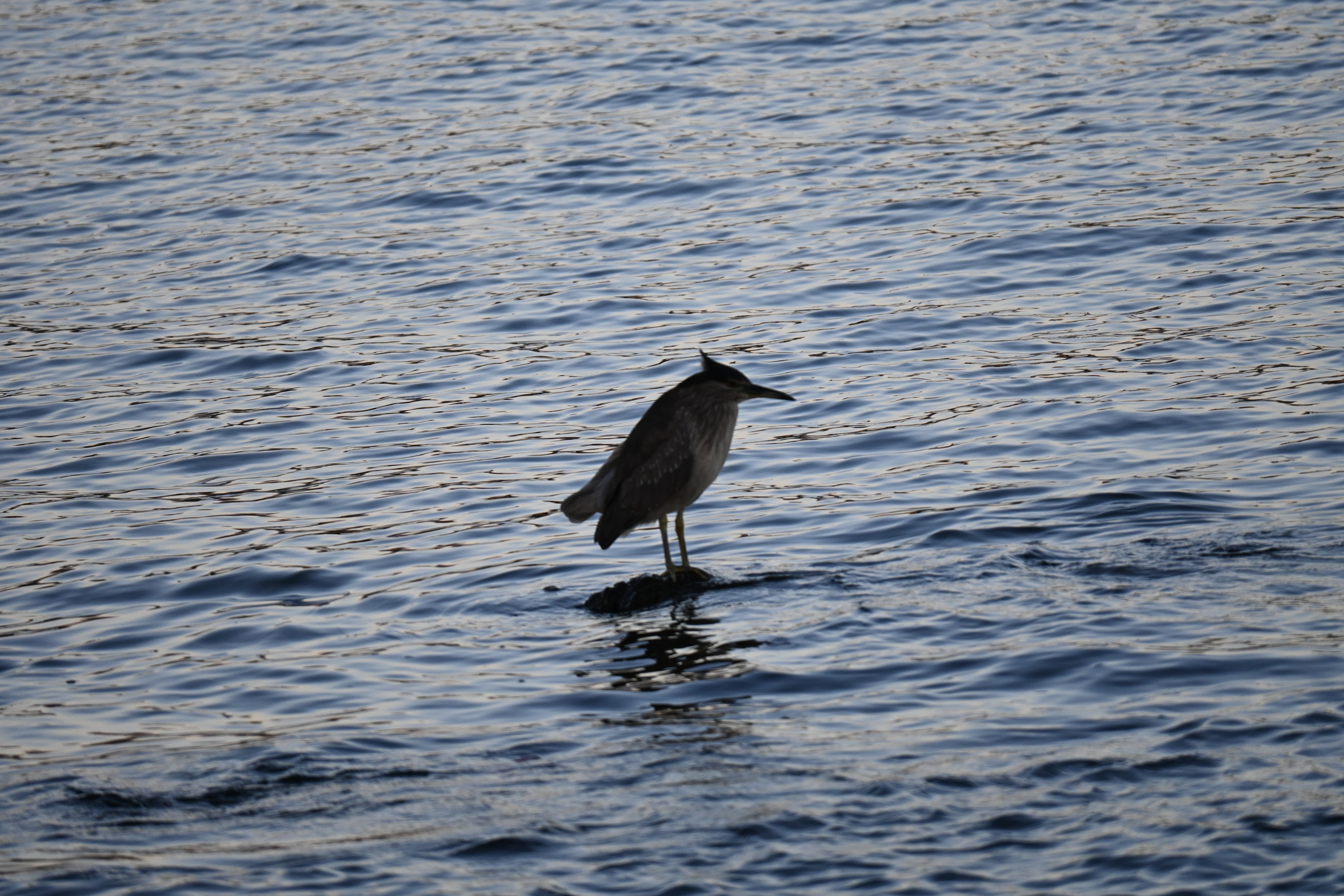
This story is not about a Hawaiian bird, although this bird does have relatives in Hawai’i. She was a black-crowned night heron. Black-crowned night herons live all over the world – they’ve been seen on all seven continents. They live here in Hawai’i, where you can find them in the shallow waters hunting for fish. The Hawaiian name is ‘auku’u.

I’m not sure what this bird called herself, partially because she lived a long time ago and languages change, partially because she lived in Egypt and I don’t know the Egyptian name for an ‘auku’u, and partially because I strongly suspect that birds don’t call themselves by the names people use for them anyway. She lived up to the name “night heron,” though, because she slept through most of the day and hunted the shallows of the Nile River at night. Hawaiian ‘auku’u, by the way, sleep and night and fish during the day.

This ‘auku’u, however, had had her sleep interrupted by the sounds of soldiers marching by. Although she hunted fish, she had no trouble concluding that they were hunting something. They went into little homes with their swords and spears ready, frightening the poor people within, most of whom worked hard all day with other people standing nearby with whips. Sometimes the ‘auku’u had seen the whips used on those poor people and she’d felt very sorry for them.

The soldiers didn’t seem to find what they were looking for, so they gathered together and marched away. A few minutes later, the heron heard voices from one of the little huts. A young girl rushed out, dashing from house to house and asking those within for things. When she returned, she had jars of sticky oil and pine pitch.

The ‘auku’u settled back to sleep again, but then the door to the hut opened again and the girl returned, this time accompanied by her mother. The mother carried a shallow bowl that glistened with newly applied oil and pitch. The two walked down to the riverbank, where the ‘auku’u watched unnoticed in the reeds.

The bowl wasn’t a bowl after all, but a woven basket, and the ‘auku’u was surprised to see that the oily pitchy coating worked to keep it afloat as they laid it in the water. The ‘auku’u was even more surprised to see that the improvised boat held a baby, a human baby. The mother and daughter cried as they pushed it out to where it could be caught in the current. It began to float slowly away.

The girl followed along on shore, moving slowly among the reeds to hide as best she could. The ‘auku’u was too curious to go back to sleep. She followed the girl and the girl followed the basket, rocking gently on the water.

They all three – baby, girl, and bird – heard the splashing ahead. Another group of women were swimming in the river. One saw the basket get caught in the reeds. Another went to fetch it. They gathered around the child, who was awake and yawning.

The ‘auku’u watched as one of the women adopted the baby as her own. She watched as the girl emerged from hiding, offering her mother’s services to care for the child. She watched as they all left the riverbank together.

The ‘auku’u didn’t understand all of what was going on, of course, but she recognized this: those soldiers had been a danger to this infant, one which would only get worse. The mother and sister had done their best to get him to place of safety, and they had succeeded. This new woman in the baby’s life had given him a home in which to grow.

The ‘auku’u didn’t know it, and frankly neither did any of the women, but the baby whose life they’d saved that day would grow up to deliver those enslaved people and lead them to a new home. We know him as Moses. He lived because of what those women had done.

by Eric Anderson

Watch the Recorded Story

I write these stories first, then tell them from what I remember of what I wrote. That process includes both a certain amount of, well, misremembering, and somewhat more improvisation.

Photo of an ‘auku’u in Hilo Bay by Eric Anderson.

Learn, Baby, Learn

But the midwives feared God; they did not do as the king of Egypt commanded them, but they let the boys live. – Exodus 1:17

Learn, baby, learn.

All you know of the harshness of living on Earth
are the infant’s discomforts, the hunger, the wetness,
the missing embrace, the blanket unwrapped.
There are forces unknown which will end your discomforts.
They would open your veins. They would have you breathe the Nile.

Learn, baby, learn.

There are some who bear swords and will use them on you.
There are some who will tell them to slaughter and kill.
There are some who will rotate their heads in their shame.
There are some who will watch and will nod in approval.
There are some who will believe that their silence is speech.

Learn, baby, learn.

Learn of the men who build power through fear.
Learn of the women they threaten with terror.
Learn of the ones who will not tread the path
of violent obedience, life-stealing loyalty.
Learn of the midwives and of your own kin.

Learn, baby, learn.

Your mother has given your life to the Nile –
a desperate step, a foolhardy plan –
the river’s rough reeds, woven in pitch,
are all to preserve you from Pharaoh’s desire,
to stop up your breath with the waves and the flood.

Learn, baby, learn.

A woman retrieves you from your fragile ark.
Though raised up in power, it’s pity that rules her.
Compassion and courage have saved you, small one:
Bithiah’s mercy, Miriam’s courage,
Jochebed’s thoroughness, Puah’s fear of God.

Learn, baby, learn.

Learn the mercy, the courage, the constant attention.
Learn the creative ways to harbor the innocents.
Learn the eyes that perceive the power of pity.
Learn the power of pitch against the waters that drown.
Learn, budding prophet, to be faithful to God.

Learn, baby, learn.

A poem/prayer based on Exodus 1:8-2:10, the Revised Common Lectionary Gospel Reading for Year A, Proper 16 (21).

The image is The Finding of Moses by Salvator Rosa (1660) – https://www.dia.org/art/collection/object/finding-moses-59779, Public Domain, https://commons.wikimedia.org/w/index.php?curid=79699569.

The two midwives are identified as Shiphrah and Puah in Exodus 1:15. Moses’ sister Miriam is first named in Exodus 15:20, where she is described as “the prophet Miriam.” Mother Jochebed’s name is revealed in Exodus 6:10. The “daughter of Pharaoh” is not named in Exodus. 1 Chronicles 4:17 calls her “Bit-yah,” or “daughter of the LORD,” and is the source of the name I’ve used here.

Story: Stranger

August 20, 2023

Isaiah 56:1, 6-8
Matthew 15:10-28

When the young myna was a fledgling, he didn’t pay much attention to other birds around. As he grew he took more of an interest in the little flock and those around.

Mynas don’t typically pay a lot of attention to other birds – they save most of their squawks and shrieks for other mynas – but this young myna was a little more territorial. He thought the grasses and seeds and bugs and worms on his turf should be for the mynas, and pretty much only for the mynas. Other birds weren’t worthy. They could go wait in a corner until the mynas were done.

He would fly and shriek at the cardinals and finches and waxbills that settled on his flock’s patch of grass until they flew off to find a quieter place for lunch. The other mynas mostly ignored this; some birds go through this stage, they told one another. He’ll grow out of it.

To their surprise, there was one bird he was particularly mean to. He didn’t actually peck at this bird, but he’d get closer and scream louder and flap his wings harder at the kolea than any spotted dove. It might be because the kolea was actually slightly bigger than he was, so he put more effort into his, well, I guess we’ve got to call it bullying, don’t we? than he needed to for a little yellow-beaked cardinal. And I’m afraid the other reason was that the kolea was always alone. The saffron finches usually fed in pairs, but the kolea was always alone.

To this bully of a myna, that just made him vulnerable.

He’d scream and flap and chase and generally make himself obnoxious. The kolea never said a word, just hopped or flew aside until the myna was satisfied. And he always came back.

Until one day when the kolea wasn’t there, and the myna thought he’d won.

“I drove that one off for good!” he exclaimed, but there was a big myna argument going on so nobody heard him to correct him.

Months passed, and one morning he landed on his flock’s favorite grassy area to find the same kolea, resting peacefully and feeding on grasses and bugs and worms. The myna was furious.

“How dare you come back?” he shrieked. “You’ve no business here, you coward. I drove you off once, I’ll drive you off again!”

“Hold on a minute,” said an older, somewhat wiser myna. “What are you talking about?”

“I drove this pest away months ago. He hasn’t dared to show his beak since.”

“You didn’t drive him off,” said the older myna. “He spends the summers in Alaska.”

“Where?” said the bully myna, who’d never heard of Alaska, and of course the older myna had never been to Alaska, so it took some time to explain that the kolea had flown 3,000 miles over the ocean to get there, and another 3,000 miles to get back.

“That kolea’s no coward,” said the older myna in conclusion. “Nor are the saffron finches or the northern cardinals or the spotted doves. They just don’t like all the noise while they eat.”

The bully myna was silent. He couldn’t fly 3,000 miles and back, and he knew it.

“The kolea’s more worthy of eating here than I am,” he said.

“Everyone’s worthy of eating here, youngster,” said the older myna. “’Worth’ has nothing to do with being hungry and needing food.”

After that the young myna still had to be reminded to let other birds alone from time to time, but that was OK, because it usually meant that he got to screech at other mynas instead, and that, as we know, is just what mynas love to do.

by Eric Anderson

Watch the Recorded Story

I tell these stories live without notes – so they will always be different from the text I’ve prepared.

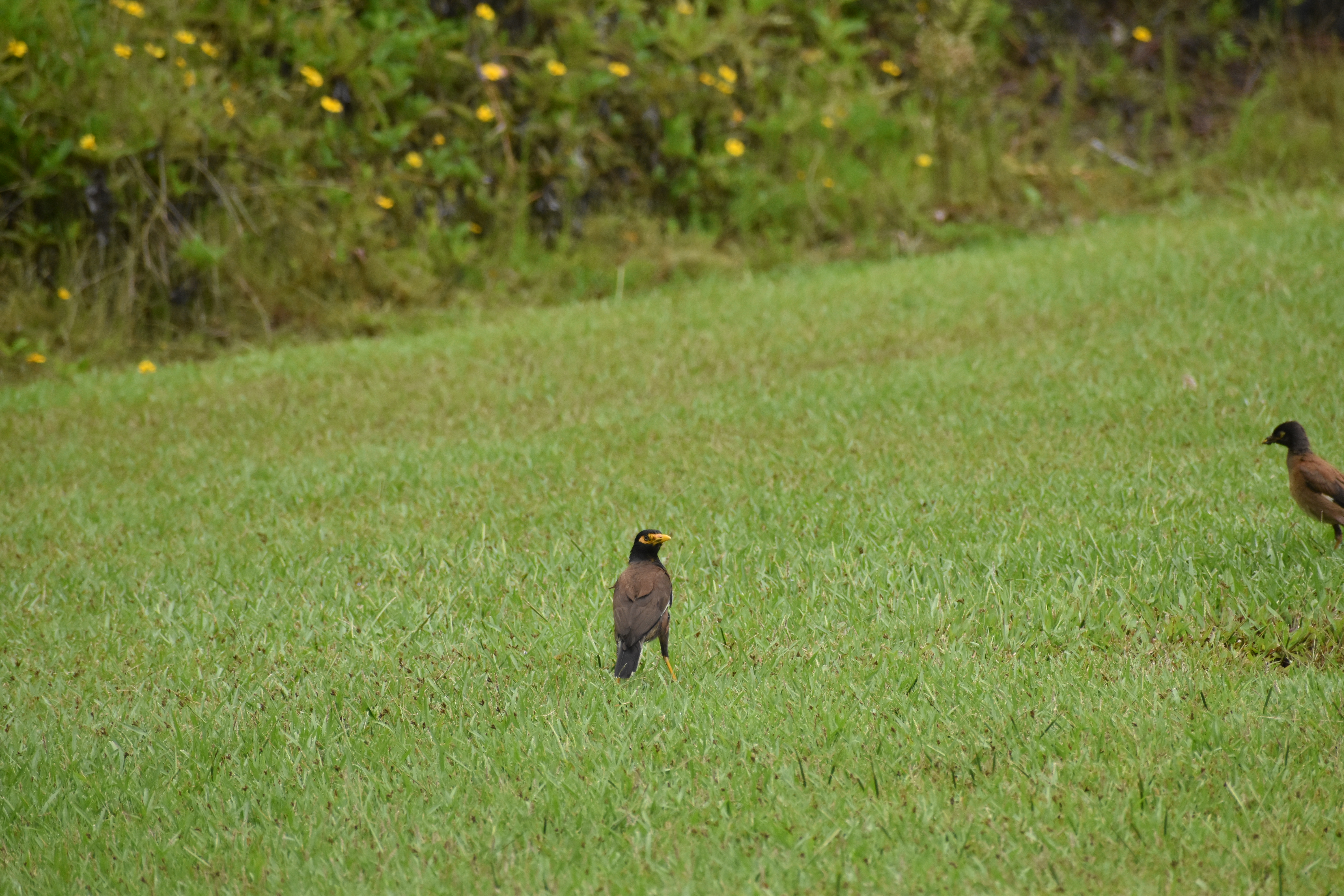
Photo of a myna by Eric Anderson

Bad Day

“Then the disciples approached and said to him, ‘Do you know that the Pharisees took offense when they heard what you said?'” – Matthew 15:12

I’m having a bad day, Jesus. I’d like to roundly curse
the next sad soul who crosses me – or simply falls
in front of me. I don’t much care if they have given me
offense or not. I’m just a sharing guy – sharing my bad day.

I see you know the feeling, Jesus. Did you care
you’d irritated anyone that day? They’d asked
about your followers and why they didn’t wash their hands
(I’d like to know myself). Was that so bad?

You counter-punched, and hard. You charged them with
a greed that left their parents sunk in poverty.
Okay, I’m sure that some had done precisely that,
but all? Oh, no. Though… they had not corrected it.

You called the crowds, and told them all their leadership
spoke excrement. No wonder they were angry, Lord!
You added extra measure, calling them “blind guides,”
when you knew well the blind can understand.

It’s good to step away from these things, Jesus, You had said
enough and more. You’d demonstrated all too well
the truth that what comes from the mouth defiles.
These leaders and your friends have heard it all.

I hear the cry for mercy, now. A desperate soul,
whose love has brought her to a foreigner
to bring her daughter to herself. And you –
you treated her far worse than you would treat a dog.

Now do you blush to hear the words again?
Now do you soften softly your hard heart?
Now do you praise the woman’s sharp perception
and persistence and bring healing to the child?

I’m having a bad day, Jesus. You would know
the worst of days, and take them better than you did
this day. Might you spare a moment then, I pray,
and soften stony heart inside of me?

A poem/prayer based on Matthew 15:10-28, the Revised Common Lectionary Gospel Reading for Year A, Proper 15 (20).

The image is Jesus and the Woman of Canaan by unknown artist (ca. 980 – 993) – Codex Egberti, Fol 35v, Public Domain, https://commons.wikimedia.org/w/index.php?curid=8096755.

Story: Favorite

August 13, 2023

Genesis 37:1-4, 12-28
Romans 10:5-15

In the old days, ‘elepaio followed the canoe makers through the koa stands as they searched for tree trunks that were suitable for a canoe. They were and are curious birds, and they would watch the trees fall and the people removing the limbs and branches so they could bring the trunk down to the shore for a canoe.

The people watched the ‘elepaio, because as well as being curious, they were hungry. If an ‘elepaio settled onto a koa tree and began to chase bugs and spiders, or if an ‘elepaio did the same on a log they’d just cut down, the canoe makers would move on. If the ‘elepaio was interested, they concluded, the tree must be too full of burrowing bugs to make a good hull.

People don’t cut koa for canoes much any more, but the ‘elepaio are still curious and will still follow people through the forest.

Which doesn’t have much to do with this story, because there aren’t any people in it. There’s an ‘elepaio, of course. And there are koa trees. There is one specific koa tree, and one specific ‘elepaio, and that koa tree was his favorite koa tree.

I’m not sure why. There were plenty of koa trees in that part of the forest, and to my untutored eye they looked rather the same. Oh, some were a little taller, and some were a little shorter, and some were wider, and some were thinner, but his favorite tree wasn’t the tallest or the shortest or the widest or the thinnest. It was just his favorite tree.

When people choose things as their favorite, they tend to act differently around it. It turns out that ‘elepaio do, too. On all the other koa trees he would search long and hard for the bugs and spiders that made up his breakfast, lunch, dinner, and any-time-of-the-day snacks. On his favorite tree, however, he’d sit quietly. It was too special, he thought, to be hunting on it. To his distress, the tree wasn’t doing well. Some of its leaves were turning brown.

“What’s wrong with my favorite tree?” the ‘elepaio asked himself out loud one day. “I think it’s sick.”

“What have you been doing to it?” asked an ‘akepa who overheard.

“Nothing,” said the ‘elepaio. “It’s my favorite tree. I don’t even hunt on it.”

The ‘akepa hopped over to the favorite koa, and said, “That might be the problem. There are lots of bugs in this tree. I don’t think that’s good for it.”

Sure enough, the bugs the ‘elepaio hadn’t been hunting on his favorite tree were making that tree rather ill.

“How can I treat my favorite tree just like everything else?” he asked.

“What about if you thought about it the other way around?” asked the ‘akepa. “What if you treat your favorite tree as well as you can think of – including cleaning off all the bugs – and then treat all the other trees as well as you treat your favorite tree?”

“You mean, treat all of them really well?” marveled the ‘elepaio.

“Treat all of them really well,” agreed the ‘akepa, and that is what the two of them did.

by Eric Anderson

Watch the Recorded Story

I write these stories ahead of time, and then tell them in worship without the manuscript or notes. As a result, the telling is somewhat… improvised.

Photo of an ‘elepaio (not in a koa tree) by Eric Anderson

Father Fooler Fooled

“Now Israel loved Joseph more than any other of his children because he was the son of his old age, and he made him an ornamented robe.” – Genesis 37:3

You strive with family, heel-grabber.
You strive with God (hey, how’s your hip?).
You set up strife of wives and slaves
to seek your favor, bear your children.
So from your favored woman you select
a favored son, just as your father did
(and as your mother did on your behalf),
and with a single coat you paint a target on his back.

You seized the heel. You took the blessing and the land.
You wrestled through the night with God
and were not fully overcome. You stole
your flocks from Laban and his daughter stole his gods.
You’re set up well, heel-grabber.
You’re blessed, God-wrestler, in your tent.

But now they’ll fool you, Trickster man.
They’ve sold your favorite son away.
They couldn’t tell you that. Oh no, not that.
They’ll bring that stunning coat with tears
and stains and you will be deceived.
Your weeping will not move them to the truth.

Your sons have learned their lessons well,
just as you did from soft Rebecca’s words,
and as your father did from Abraham,
the father of his slave’s offspring,
the wife-concealer, son near-executioner.
Where, heel-grabber, will it end?

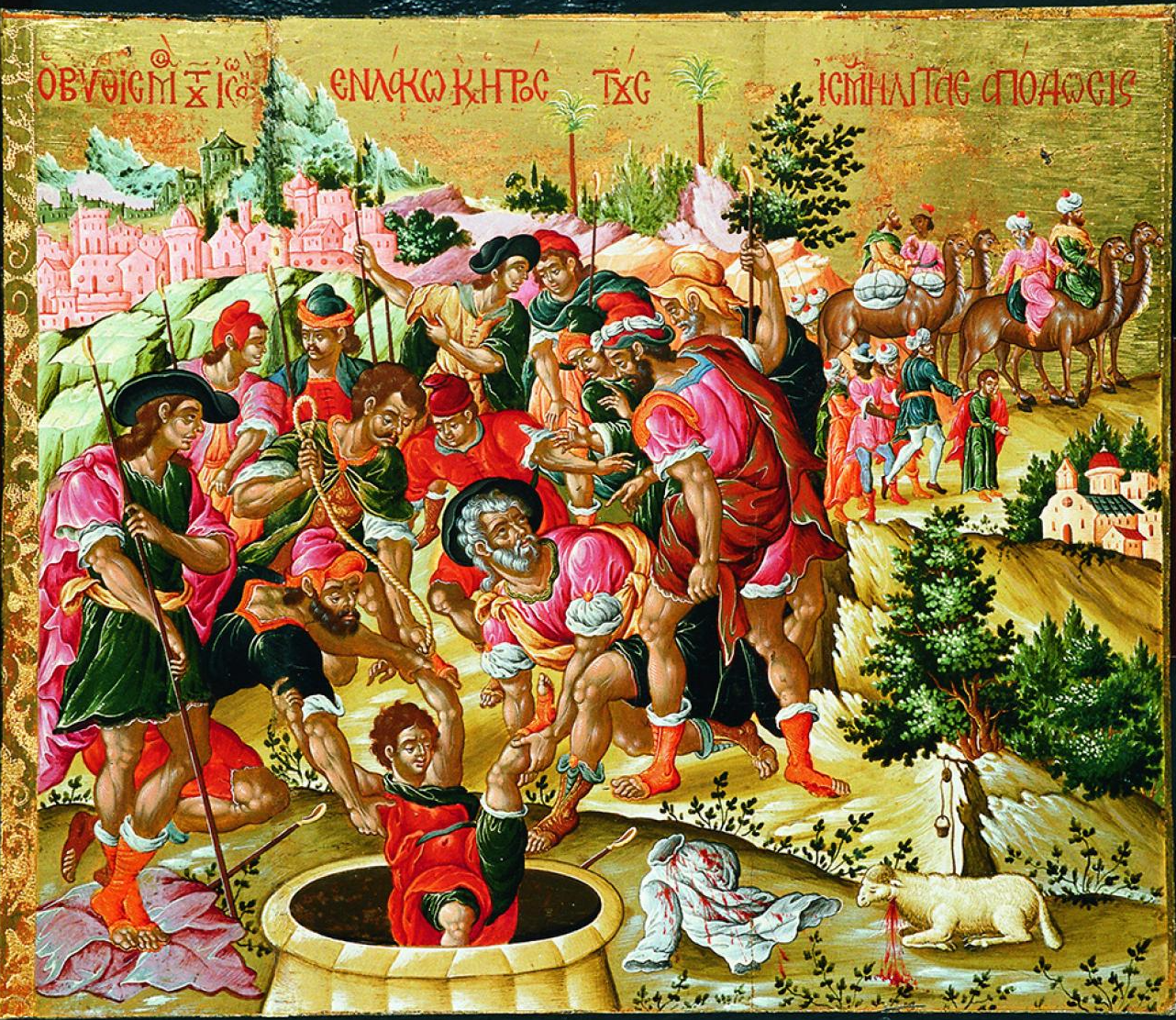
A poem/prayer based on Genesis 37:1-4, 12-18, the Revised Common Lectionary Alternate First Reading for Year A, Proper 14 (19).

The image is Brothers Sell Joseph into Slavery by Theodore Poulakis (between 1677 and 1682), Public Domain, https://commons.wikimedia.org/w/index.php?curid=120364437.

Story: Ohi’a at Rest

August 6, 2023

Isaiah 55:1-5
Matthew 14:13-21

How tall an ohi’a tree grows depends a lot on where its seed falls. If it falls into old, deep soil, rich with nutrients and able to hold water, the seed will spread its roots wide and raise its stem tall, until its leafy crown can wave eighty feet above the forest floor.

If the seed falls on the bare expanse of an old lava flow, however, the seed may struggle to sprout at all. It needs some soil, and the soil has to hold some water, but with time, an ohi’a’s roots can actually crumble some of the rock into more soil. In this way a plant with just a couple branches can grow into a tree – granted, still a small tree, but recognizably a tree and not a bush hugging the ground.

One such ohi’a seed had done just that. It had found a crack in an old lava flow, one that had contained some sand and some soil and would hold water. The ohi’a grew, and as it grew its roots found new spaces in the rock and filled them with soil. It took years, but one morning as the sun rose scarlet flowers bloomed along its branches, the red tendrils tipped with gold that gleamed in the morning light.

An ‘amakihi had already been visiting the little tree, because its leaves sheltered – almost – some of the bugs and spiders she liked to eat. She was the first bird to discover the ohi’a flowers in full bloom. She sipped their nectar and she ate the insects that had followed the scent of blossoms and basically enjoyed a good breakfast.

This went on for a while, with flowers blooming, then fading. After some time no new flowers grew, but where they had been, seed pods took shape. The ‘amakihi watched with interest as the pods split open and the winds took the tiny seeds and scattered them about the landscape.

And then… the tree did nothing. Well, it spread its green leaves, and it pushed out its roots, and maybe it got a little taller. But there were no new flowers, no new seed pods. Just… leaves and roots and stems.

One morning the ‘amakihi came by again to find the little tree aglow with crimson blossoms again. She rejoiced – she’d come to really like this tree – and she enjoyed her breakfast and lunch and dinner. She watched again as the blooms faded and the seed pods formed. She watched the tiny seeds sail away on the wind.

And then… nothing.

“What are you doing tree?” she asked one night as she settled in to sleep among its branches. “Why do you bloom and then stop?”

As I’ve noted before, trees talk in a dream. Sure enough, the tree replied in the whispery voice of air moving among leaves, “I’m resting.”

“Why do you rest?” asked the ‘amakihi, although she was resting as she asked (dreams happen while you’re resting most of the time).

“It takes a lot to make those flowers,” said the tree, “and to share that nectar with you and with the other creatures. Then it takes a lot to transform those flowers into seeds. I’m happy to do it, I’m happy to share, and I’m happy to be part of a new forest of ohi’a trees on this rocky ground – but I can’t do it all the time. Could you? Could you do anything day in, day out, forever?”

The ’amakihi wanted to say, “I could eat all the time,” but she was an honest bird and she knew she was asleep, and if that’s not resting what is?

“Rest well, tree,” she whispered.

“Rest well, bird,” came the soft reply.

All God’s creatures – including us – need our rest.

by Eric Anderson

Watch the Recorded Story

I write these stories first and then tell them from my (faulty) memory of the text I’d prepared. Differences are… inevitable.

Photo of an ohi’a in blossom (not resting) by Eric Anderson.

Following Jesus

Now when Jesus heard this, he withdrew from there in a boat to a deserted place by himself. But when the crowds heard it, they followed him on foot from the towns. When he went ashore, he saw a great crowd; and he had compassion for them and cured their sick. – Matthew 14:13-14

Where is he, then? This Jesus who is my
last hope of healing from this bitter rash?
It lingers and it spreads; my friends all know
that without healing, I will be cast out.

So where is Jesus? Yesterday I knew
he had returned from Nazareth to learn
of John the Baptist’s execution. Then,
they say, his weary face dissolved in tears.

He took a boat, they say, and so my son,
his wife, and daughter, shepherd me along
the rutted hillside trails above the beach
so we can see the sails of Jesus’ craft.

We’re not alone. The path, though trampled firm,
shows sign of feet ahead, and we can see
that others follow us behind, and more,
I’m sure, beat down the trail I cannot see.

He sailed, this weary disappointed man,
to weep and grieve in peace, and I regret
that he will find a multitude of us
awaiting his attention and his care,

Yet not enough regret to risk my health
and home and loves and place to “it will heal,”
for healing’s failure ends the life that I
have known and cherished deep within my soul.

My son cries, “Quickly, father, come! The sails
a-shiver! Look! The boat has turned to shore!”
We stagger down the pathless bluff. Now I
can see the spray-flecked face regard us all.

Just for a moment, graven deep, I see
the hollows of the skull beneath the skin
worn thin by weariness and grief. “He’ll turn
the boat,” I whisper, “out to sea, away.”

He gestures to the sailors and they strike
the sail, then bring the boat ashore. He stands,
he leaps upon the strand. He takes three steps
and people gather all about him there.

First one, then five, then ten, then dozens more
present their bodies’ and their souls’ dis-ease.
He comes to me; he sees my skin, he sighs,
and tells me not to fear. I will be well.

Before he turns away, I have to ask,
“You could have turned your craft far from this shore.
Why did you stay?” He gently says, “My friend,
I’ll always be with those who follow me.”

The day has drawn toward dusk. Somewhere they found
a heap of bread, and even some dried fish
to share about this seething crowd. My skin
is softening. I know I will be well.

Soon we shall follow once again the ruts
along the bluffs, this time toward hearth and home,
but not the same. For any path I take
to any place from here: I follow him.

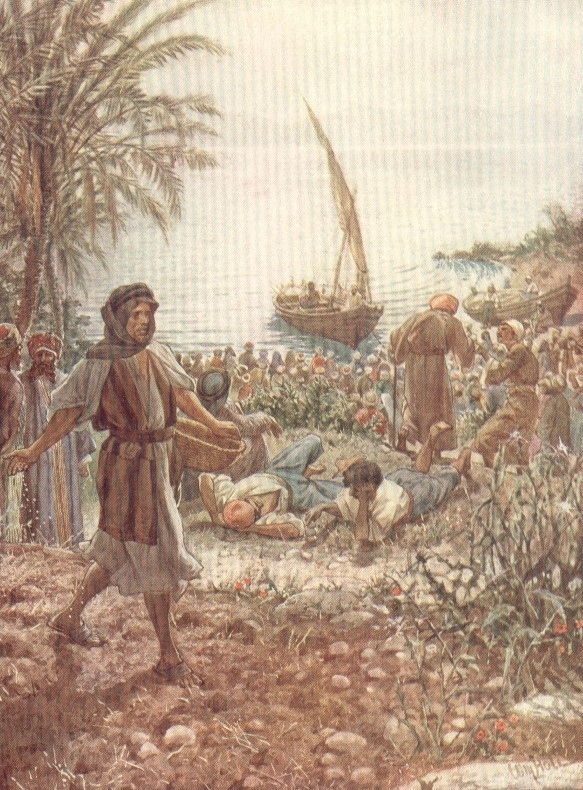
A poem/prayer based on Matthew 14:13-21, the Revised Common Lectionary Gospel Reading for Year A, Proper 13 (18).

The illustration is Feeding the Multitude from The Life of Jesus of Nazareth, Eighty Pictures by William Hole (1908) – http://www.jesuitas.org.co/documentos/dominical/GabrielPerez/100705.html, Public Domain, https://commons.wikimedia.org/w/index.php?curid=3222948.

Author’s note

Like a lot of clergy, I tend to identify primarily with Jesus in this story. We have something of a self-narrative that we are people who get asked to do many things. If I’d been in the boat, I’d have wanted to sail to somewhere else that the people seeking me couldn’t reach. This poem takes the perspective of those who tracked those sails along the shoreline of the Sea of Galilee, and helps me understand why Jesus didn’t do that. In a very real, embodied sense, those thousands of people followed Jesus.