Story: Dirty Finches

Two saffron finches in the grass.

September 1, 2024

James 1:17-27
Mark 7:1-8, 14-15, 21-23

Saffron finches don’t fly about in larger flocks like mynas, but they certainly do gather in small groups to feed and chirp and, one assumes, share the news of the saffron finch world. One little group was having a problem with not one, but two, of their members.

The first one who bothered them was, well, unwashed. Routinely. A finch is going to get dust and bits of grass and, I suppose, the occasional bug wing on their beak and face, and he did that. They’ll also get dirty feet and, if they’re hopping about on muddy ground, get dirty feathers. He did that, too.

Most saffron finches find ways to wash it off. They’ll clean with beak and toes and let the rain wash them off when they can. On a gray day a saffron finch is a pretty bright sight. But not this guy. Somehow a rain shower left him muddier. If he pushed bug wings off his head he’d get dirt in the feathers.

He was a sight, let me tell you.

The other troublesome bird was clean and bright. He not only got himself clean, somehow he avoided most of the dust and dirt that the other birds had to deal with. And… he let you know it.

“Are you going to clean those feet?” he asked. “There’s a bug wing on your beak,” he said. “Can you believe it? You’ve got a speck of mud on your feathers,” he commented.

He went on and on about the finch with the dirty feathers. “Look at that, he’s a disgrace,” he’d say, and “I’m so glad I’m not like him.”

They say “Sticks and stones may break my bones, but names will never hurt me,” but you know? Words hurt. And nearly every bird in the little flock of saffron finches felt the sting, with our dirty finch feeling it the worst.

What to do?

They got together, the other finches. They talked it over while the dirty finch and the absolutely clean finch were elsewhere. They come up with some possibilities. They made some decisions. They got ready to offer some options.

They called the whole flock together, including our two problem finches, and said, “We’ve got to see some changes here. First,” they said to the dirty finch, “we’re going to give you some help, because clearly you need it. We’ll help you with the preening and the cleaning and make sure you stay both healthy and show off your bright feathers.

The dirty finch, who thought he was going to be kicked out of the flock, chirped a grateful “Mahalo!”

The absolutely clean finch huffed, “I can’t believe you’re going to put up with him and his filth. You’re as bad as he is.”

“What we’re not going to put up with,” said the spokesfinch, “is your bullying any longer. You’ve been hardest on this finch here, but you’ve been at all of us at one time or another. Yes, your feathers are always immaculate, and no, our aren’t always at their best. But your tongue is never at its best, and that needs to change. Now.”

The absolutely clean finch was speechless for a moment (which was a good thing, if you think about it), and then he burst out with a harangue that few have ever heard. I’m afraid he didn’t learn his lesson, and I’m afraid he couldn’t stay with that flock.

When it came down to it, the things that make a finch dirty from the outside are things they could help with. But the things that make a finch dirty from the inside, all the harshness and bullying, those are the things that have to go.

by Eric Anderson

Watch the Recorded Story

I write these stories ahead of time, but I tell them from memory – memory and inspiration. What I’ve written does not match how I tell it.

Photo by Eric Anderson.

The Awkward Hour

“[Jesus said,] ‘…there is nothing outside a person that by going in can defile, but the things that come out are what defile.'” – Mark 7:15

The awkward hour – well, not quite an hour –
takes place each morn as I step in the shower.
While water cascades on my form and soap dislodges
clinging dust, my memory tunes to regret.

I sigh into the foam.

I’ve plenty to regret, and hope that you have less.
I recall failed relationships, the ways I’ve failed
my family and friends. I wonder how I’ve grieved
my God – and wonder, too, how I can claim to wonder…

My feet shift with discomfort.

The exercise might be worthwhile if
it prompted me to understandings new,
new ways to make amends, repair what had
gone wrong, but mostly I just grieve.

I close my eyes against the shampoo’s sting.

Symbolically, I’m doing all I can to cleanse,
but in my spirit: no. These demons have not been
expelled. They live quite happily within
my memories and recollected thoughts.

Knobs turned, the water does not fall.

Yes, Jesus, it is from within these things emerge,
defiling once again my spirit, laying low
my joy in you. I ask myself, “Why do this to yourself?”
and know I am not reconciled to me.

I pray that I am reconciled to you.

A poem/prayer based on Mark 7:1-8, 14-15, 21-23, the Revised Common Lectionary Gospel Reading for Year B, Proper 17 (22).

Photo by D O’Neil, CC BY-SA 3.0, https://commons.wikimedia.org/w/index.php?curid=682251.

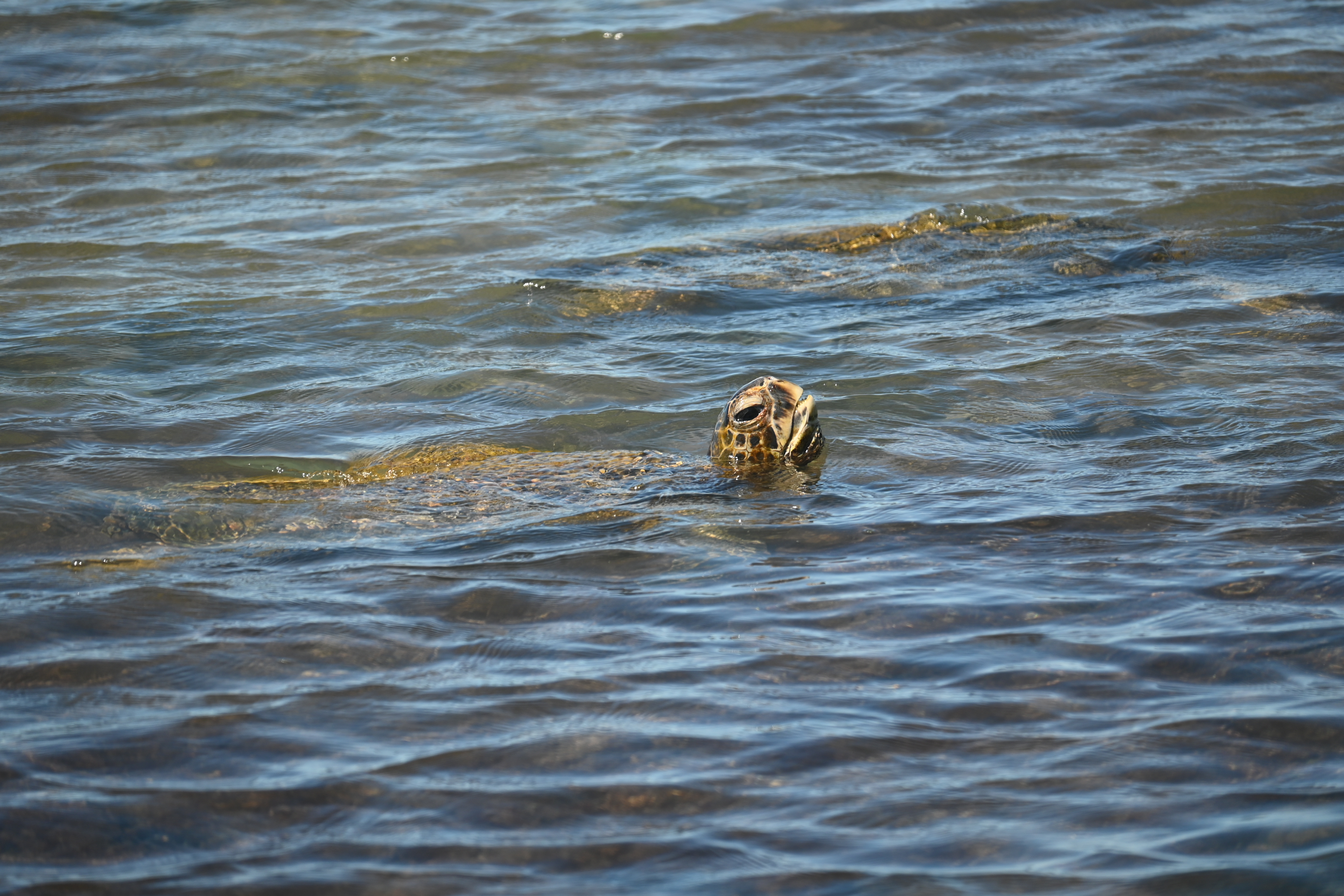
Story: Rocky the Honu

August 25, 2024

Psalm 34:15-22
Ephesians 6:10-20

A newly hatched honu isn’t very big. Two or three inches long. They spend their time feeding on the seagrasses in which they hide in the shallows of our island.

A kupuna honu is a lot bigger, up to four feet long and weighing over 300 pounds.

Our honu today was bigger than a hatchling and smaller than a kupuna. He was maybe a foot long, had well developed flippers and tail, and enjoyed both swimming in the ocean waters and in the shallows near the beach. And, like all honu, he liked sunning himself on the rocks or the sands.

But… he was worried about manō. Sharks. A good size tiger shark could be a real problem. He kept a wary eye out for manō as he swam along the reef, and he listened intently for the sound of water passing over their sleek fins. He had a good strong shell, he knew, but… well. Who could tell if that would be enough?

One day, though, he got an idea. He’d just seen a wave move some rocks up and down the beach. What if he could find some way to attach rocks to his shell? Corals and opihi and, for that matter, the sea grasses he liked to eat managed to stick to things. What might give him an extra shell?

I still don’t know what he found to do it, but he did find something sticky, and he covered his shell with it. Then he went to a beach loaded with loose stone, moving back and forth with the waves. As they went clattering down the beach, they stuck to his shell, and suddenly he was the best armored honu in history.

He rested on the beach for a while, delighted with his success. He napped in the sun. The rocks actually made him just a little warmer as the sun warmed them, which was really nice. When he woke up, he was hungry. So he started crawling down the beach into the surf.

He was surprised to find it really difficult to move along. The stones on his shell weighed him down, and his flippers strained to push him along. “It will be better when I get into the water,” he thought.

He was wrong.

As difficult as moving along the beach had been, swimming was worse. The stones dragged him right down to the sea floor, and he struggled to swim back up to breathe – honu aren’t fish, you know. They breathe air. Every time he caught a breath he’d be back under a moment later. Honu can hold their breath a lot longer than I can, but this was not good. Not good at all.

He struggled back to the beach until his tail was in the water and his head out of it, with waves lapping at his shell as he gasped.

“Too heavy?” asked a passing ‘ulili.

“Too right,” said the honu, who started scraping the stones off. The ‘ulili used his long beak to help pray them away.

“Thanks for your help,” said the honu, and the ‘ulili replied, “I’m happy to help, Rocky.”

Rocky the honu laughed, and he wore the name the rest of his long life, but he never wore any rocks again.

Armor has its price, you know. Sometimes its protection is too heavy for living. Sometimes we do best by relying on what we can carry.

by Eric Anderson

Watch the Recorded Story

I write these stories in advance, but I tell them on Sunday morning from (occasionally poor) memory and (occasionally creative) inspiration. What you’ve just read will not match what I said.

Photo of a honu by Eric Anderson.

Strange Protection

“Finally, be strong in the Lord and in the strength of his power; put on the whole armor of God, so that you may be able to stand against the wiles of the devil…” – Ephesians 6:10-11

I’m grateful that the struggle is not with
the powers of blood and flesh. Not if
I’m to rely upon these items
for protection of my vital spark.

What happens to the righteous? Why,
they suffer, as do those who speak of peace.
A shield of faith is powerless against
an arrow, or a club, or fist.

Should I entrust my head to its
salvation? The logic doesn’t work for me.
I wish I thought an offense of the Spirit,
of the Word, protected anyone, but… no.

And worst of all, to recommend
I gird my waist with Truth, as if
the truth has ever carried any weight
when cut so easily by lies.

But then I see a brilliant coral
called “The Armor of our God,”
protected by no more than truth,
feebly anchored to its rock.

These corals can be shattered by
a careless underwater step,
the floating residue of sun protection, by
a current that directs its food away.

If coral, brilliant in its indigo,
can live its fragile life beneath the sea,
I might, perhaps, submit my life
to living with this unprotective armor,

Rooted in the truth, acting righteously,
striding ever toward the reign of peace,
with faith displayed before me, head
a-crowned with Christ’s salvific work,

Equipped to bring the Spirit’s Word
to those who might, in turn, take on
this truth, this righteousness, this peace,
this saving faith, this summons from our God.

Author’s note: I have no idea what I was going to write about before I found this photo of an “Armor of God” Zoanthid coral.

A poem/prayer based on Ephesians 6:10-20, the Revised Common Lectionary Second Reading for Year B, Proper 16 (21).

Photo of an “Armor of God” variety Zoanthid coral by la.kien – https://www.flickr.com/photos/67619130@N07/6952012176/in/photolist-bAjT1U-ex665Z-ex6q1Z-8mZvs2-fgfi1z-4WFdDR-byjPn1-aoBVqF-4C8EsV-e35MjW-bMetRP-8AxwPo-8hRGc3-8zTVeH-8zTV8i-4KdVqj-4WKv3A-a6JBuH-4CcXgS-a68Ner-a6bDtY-a6bDEo-d8cXaC-8knfqw-8knfrL-adg9dt-eARtXV-eaP1mp-n3vueH-kdub15-e385Wo-6icch6-nxntwv-ne6ED7-69VkyF-eCZ3h3-fQbC2i-nPijbf-fHGFCK, CC BY 2.0, https://commons.wikimedia.org/w/index.php?curid=37054836.

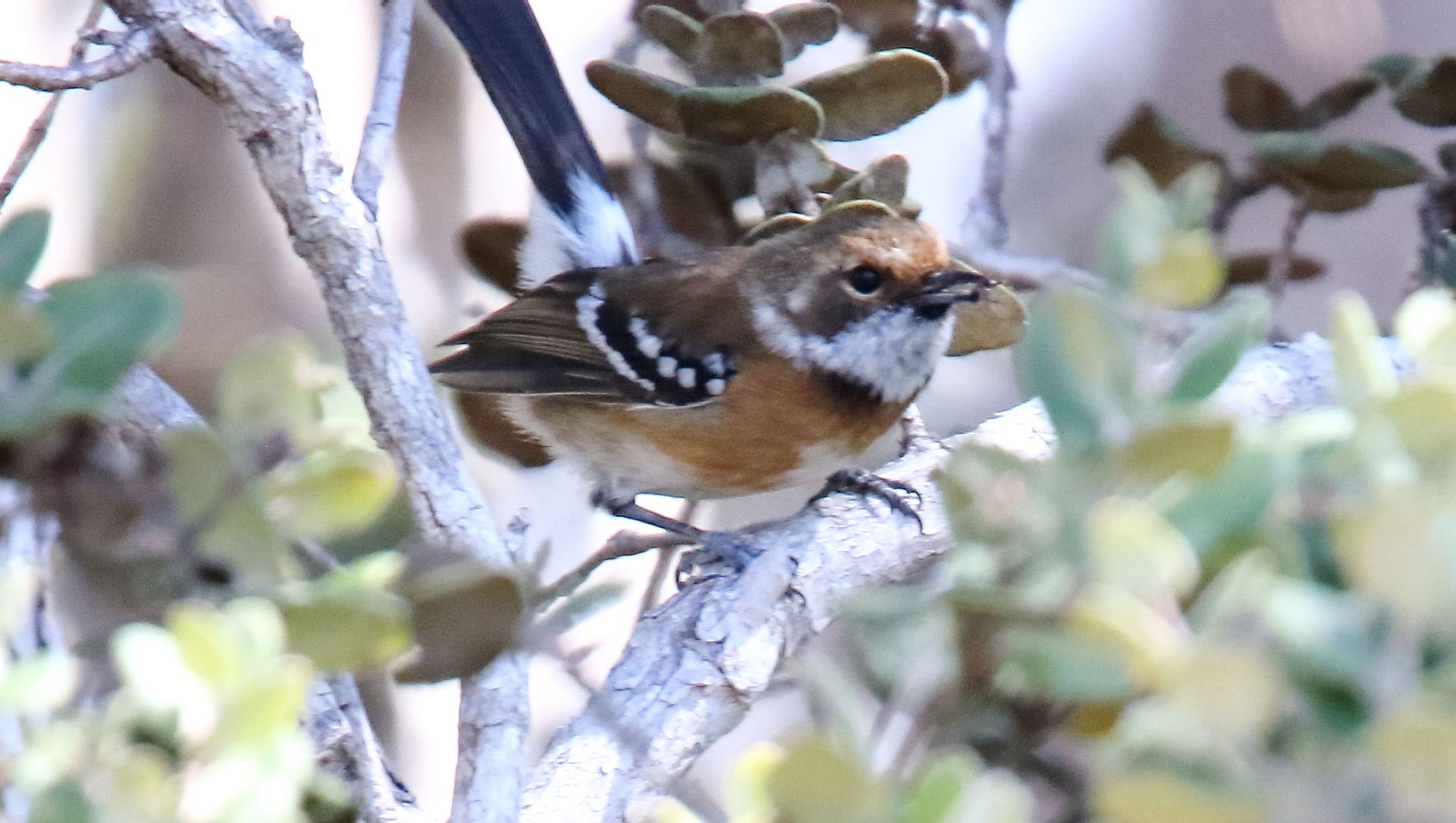
Story: In Front of Your Beak

August 18, 2024

Psalm 34:9-14
Ephesians 5:15-20

The ‘elepaio had a problem. She was hungry.

This is not an uncommon condition for an ‘elepaio, or for that matter for any bird up in the forests of Hawai’i. They tend to be small birds, but the things they eat are also small, so they tend to eat often or, to put it another way, whenever they can. Kind of like a human child in the middle of a growing time.

This ‘elepaio, however, had a somewhat different problem. It wasn’t that there wasn’t food around. There was plenty. It was that, well, she liked to look ahead.

Again, plenty of ‘elepaio look ahead. They’re the curious birds of the forest. They check out the people moving through the woods, and they check out the trees – for food, generally. But they do it up close and personal. If you’re walking through the forest and an ‘elepaio wants to find out more about you, they’ll perch pretty close.

This ‘elepaio, however, had somehow got the idea that the way to learn what was happening was with the big picture only. She’d perch high in a tree, looking out over the slopes for signs of the insects that she ate. And… she’d find them. Sure. Bugs get around, and you’ll find them high in a tree. What you won’t do is see them in a distant tree. They’re small. They don’t move the leaves and branches. In fact, if you look at leaves and branches from a distance, you’ll pretty much see… leaves and branches.

She was so intent one day on looking for bugs in distant trees that she didn’t hear her mother land behind her.

“Child,” said her mother, “what’s the problem?”

“I’m hungry,” said her daughter, “and I’m having trouble finding bugs to eat.”

“Why do you think that is?” asked her mother, as she watched a bug walk along the very branch her daughter was perched on.

“I think it’s just hard to do,” said the young ‘elepaio, who now had two bugs crawling along in front of her.

“Could it be that you’re looking too far ahead?” asked her mother, who knew it was.

“I don’t see how it could be,” said her daughter, who was so still that one of the bugs was near to climbing onto her.

“Look right in front of your beak,” said mother, and her daughter looked. Then she looked again, and then she ate one bug, then the other, and found two more on a nearby leaf.

“Better?” asked her mother.

“Better,” admitted her daughter, “but shouldn’t we be looking ahead for things?”

“It’s useful to look to the distance,” said her mother, “because there are important things there, which might be bugs, or storms, or a hunting ‘io. But there are also important things right in front of you, like breakfast, and water, and the materials for a nest.”

“And someone to teach me to look there,” said her daughter.

“And someone to be with you and care for you,” said her mother.

by Eric Anderson

Watch the Recorded Story

I write these stories in advance, in full, but I tell them from a combination of memory and new creation. Therefore the recording does not match the text above.

Photo of an ‘elepaio by Dominic Sherony – Hawaii Elepaio (Chasiempis sandwichensis), CC BY-SA 2.0, https://commons.wikimedia.org/w/index.php?curid=52150179.

Living Wise

“Do not get drunk with wine, for that is debauchery, but be filled with the Spirit, as you sing psalms and hymns and spiritual songs to one another, singing and making melody to the Lord in your hearts.” – Ephesians 5:18-19

I know the psalm: “The fear of the LORD
is the beginning of wisdom.” How did you
not know that, Paul?

(Especially since you gave advice
to Timothy to drink not only water, but a little wine
to soothe the stomach.)

It cannot be denied, of course, that alcohol
debauches so much of our bodies, brain and
liver and good sense.

Yet I would think that you would have
more puritanical advice than this, to be
filled with the Spirit.

I guess old Martin Luther got it right
when he set his great lyric to the tune
of an old drinking song,

And told his critics that the Devil should
not get all the good tunes. Fill up, you say,
with Spirit, and rejoice.

Not fear, but celebration; not in gloom,
but in rejoicing; not in silent prayer,
but in the flood of song:

This is wisdom. This is living faithfully.
This is making deep connections
with God’s grace.

The fount of wisdom springs from reverence,
but gains its height from joy and thanks.
May we be wise.

A poem/prayer based on Ephesians 5:15-20, the Revised Common Lectionary Second Reading for Year B, Proper 15 (20).

Photo by Eric Anderson.

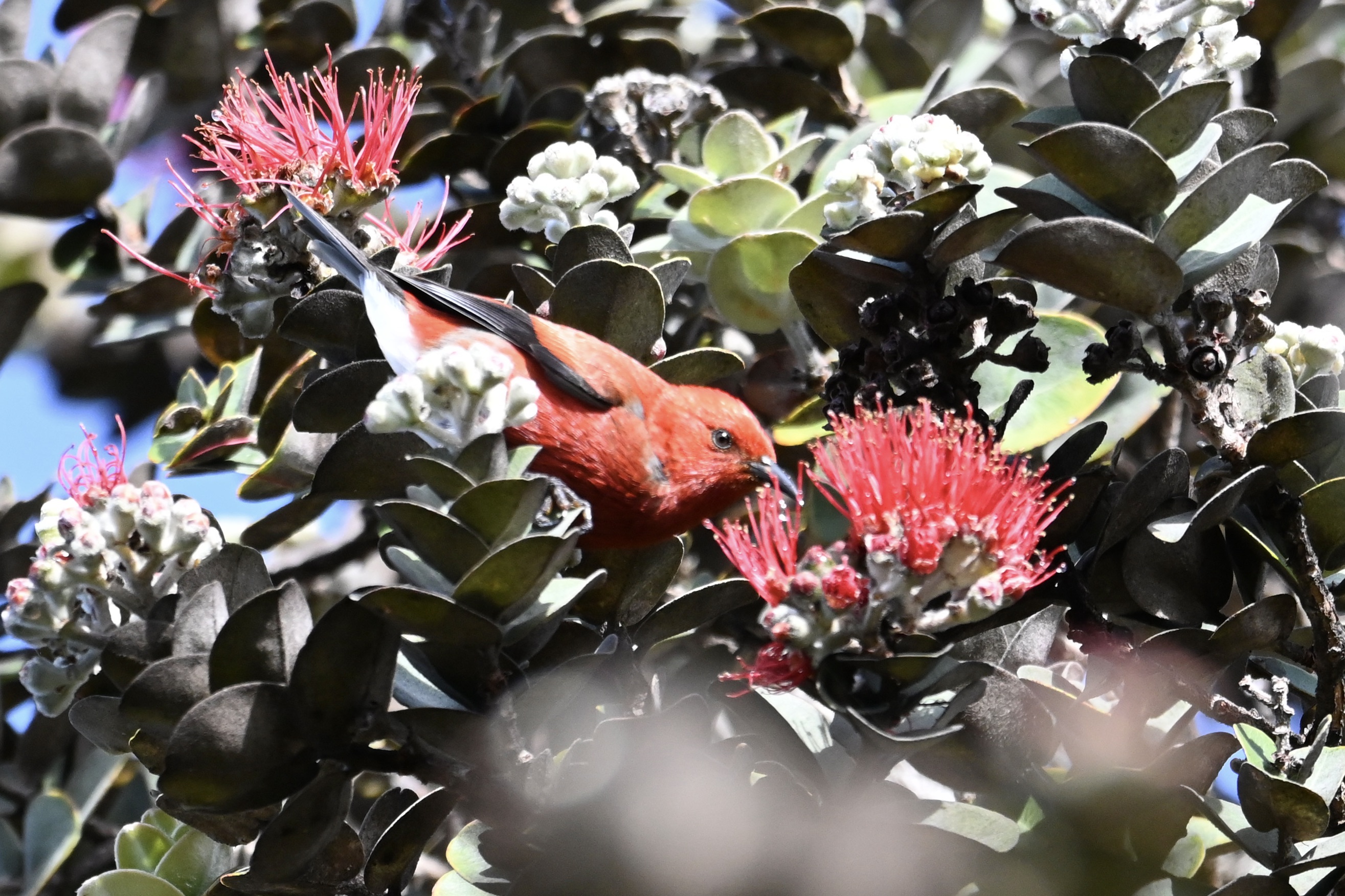
Story: The ‘Apapane Bully

July 28, 2024

2 Samuel 11:1-15
John 6:1-21

Last week I told you a story about an ‘apapane who, when he was selected to lead a mixed flock of ‘apapane, ‘amakihi, ‘akepa, and ‘alawi, learned a lesson about proper leadership. He may not have liked learning it, but he learned it, and in just two or three days.

This week, I’m sorry to say, the story is about an ‘apapane who didn’t learn that lesson in their week as leader, and… Well, maybe I should just tell the story.

He was big for an ‘apapane (not so big for an ‘io). That made him bigger than pretty much all of the birds, especially the smaller ‘akepa and ‘alawi. Other ‘apapane tended to hop or turn out of his way when he came to their branch or crossed his flight path. Even i’iwi, who tend to be the more aggressive of the forest birds, learned to recognize this ‘apapane and stayed out of his way.

It seemed natural that such a big, strong, confident bird should be selected as leader. Right? Leadership is what big, strong, confident people – er, birds – are for. Right?

It didn’t go well.

First of all, he didn’t really pay attention to the other birds. He’d just give orders. “Go find a better tree!” he ordered one bird, who was nearly caught by an ‘io that the leader hadn’t troubled to look for. “Let’s go!” he shouted when they headed to a new tree, but he didn’t bother to make sure that all the birds heard it. Half of them stayed behind. When he discovered that, he flew back to the old tree, screamed and shouted, and even beat at one or two of them with his wings.

Worst of all, he picked on the smaller birds. He’d find ‘akepa sipping nectar and he’d push them out of the way. He pecked at ‘alawi with his beak if they got close. And if they weren’t close, he’d hop over and peck them.

In short, he’d crossed the line from “leader” to “bully.”

Flock elders talked to him, and the next day went the same. His parents talked to him, and the next day went the same. Flock elders came in a group with his grandparents – always listen to tutu, right? – and it went exactly the same the next day.

The flock had had enough.

The last morning of his leadership, five flock elders perched before him. “Just so you know,” they said, “you will not be elected leader again.”

“How can that be?” he screeched. “I’m biggest and strongest. I’m made to lead!”

“We require leadership,” they told him. “We will not tolerate bullying.”

“You’ll do what I tell you!” he shouted.

“No,” they said. “Never again.”

Every single bird in the flock turned away from him. Not one turned in his direction. Not one followed his screeched orders. When he flew over to peck at an ‘akepa, ten other birds flew over and formed a living shield to protect her.

“You’ll be sorry!” he shrieked and flew away.

But as far as I know, that flock has never been sorry that they know the difference between leadership and bullying, and that they insist on leadership, and send bullying away.

by Eric Anderson

Watch the Recorded Story

I writes these stories in advance, then tell them from memory on Sunday morning. It’s a different medium, and the results differ, too!

Photo of an ‘apapane (who is not, as far as I know, a bully) by Eric Anderson.

Pluck it Out

“It happened, late one afternoon when David rose from his couch and was walking about on the roof of the king’s house, that he saw from the roof a woman bathing; the woman was very beautiful.” – 2 Samuel 11:2.

It happened? Oh, yes, and Oh, no.
It happened that you noticed.
It happened that you looked closely.
It happened that you inquired.
It happened that you sent.
It happened that you raped.
It happened that you sent the victim home.
It happened that she conceived by you.
It happened that you tried to cover it up.
It happened that her husband had more integrity than you.
It happened that you sent him to the army.
It happened that you ordered his death.

It happened, David, every step,
because you chose, decided, acted,
harmed, and hurt, and murdered.

A pity that you couldn’t have heard Jesus’ words,
which were, it’s true, a thousand years away:
“If your eye causes you to sin, tear it out.”
We’d read about a mystery of how you lost your eye,
not how you raped and killed with scarce a thought.

I hope Bathsheba’s presence smote your heart
with guilt on each remaining day you lived.

A poem/prayer based on 2 Samuel 11:1-15, the Revised Common Lectionary Alternative First Reading for Year B, Proper 12 (17).

The image is David Sees Bathsheba Bathing by James Tissot – https://www.newworldencyclopedia.org/d/images/3/3a/King_David_Bathsheba_Bathing.jpg, Public Domain, https://commons.wikimedia.org/w/index.php?curid=31379015.

Story: ‘Apapane Leadership

July 21, 2024

Jeremiah 23:1-6
Mark 6:30-34, 53-56

After the eggs have hatched and the chicks have learned to fly, many of the birds of the ohi’a and koa forest will come together in mixed flocks of ‘apapane, ‘amakihi, ‘akepa, and ‘alawi. They stay together to find ohi’a and mamane trees in blossom, which would also have attracted some tasty bugs.

It was the custom of one flock on the slopes of Mauna Loa to select a leader each week to keep the flock together and organize a watch for dangerous or suspicious creatures like cats, ‘io, pueo, and, well, people. The leader would look around for trees bright with flowers and guide the hungry birds toward them, while making sure nobody got left behind. It wasn’t the easiest thing for a bird to do, but most of them handled it pretty well.

One ‘apapane had been eagerly awaiting his turn to be flock leader. He was no longer that young, having seen a few summers and winters. He was something of a silent critic of the weekly leaders, silently scoring them on his own checklist. That one didn’t spot the mamane tree in blossom as fast as he had. This other one had been slow to get the birds moving. And this other one hadn’t properly spotted the watcher birds for ‘io. They’d spotted the hawk in plenty of time anyway, but it hadn’t been right.

At last came the week when the birds in the flock chose him as their leader for the next week. He was proud. He was excited. He was also… going to do something fairly complicated for the first time, and he was absolutely convinced that he knew exactly what should happen.

The result, the next morning, was a lot of birds screeching at one another, with their purported leader screaming the most and the loudest. He screeched at the ones who were supposed to be watching when they perched on a branch other than the one he’d selected. He screeched when they were ready to head to a new set of trees, and screeched when one or two birds headed off in the wrong direction. He screeched when a bird remained behind, and nearly pecked his tail as he flew right behind him to get him to the rest of the flock. He screeched when it was time to nap. He screeched when it was time to settle down to sleep.

When he turned about, one of the older birds, an ‘apapane kupuna, was perched behind him. He opened his beak to screech at her, but shut it quickly. He knew better than to screech at her.

“What have you been doing?” she said, “and don’t screech at me.”

“I’ve been leading,” he said, “like I’m supposed to.”

“You haven’t been leading like you’re supposed to,” she said rather severely. “You’ve been driving like you’re not supposed to. You’ve had birds who know perfectly well what to do confused and upset. Some of them went hungry today. While you were chasing that one bird there were two others that set off in the wrong direction and I had to go get them.”

“They should have listened to me!” he said.

“How could they,” she asked, “when you didn’t give them a clear direction?”

He was silent for a moment.

“You’ll try it again tomorrow,” said the kupuna ‘apapane, “and tomorrow you’ll plan, and you’ll chirp softly, and you’ll listen to the birds who know what they’re doing, and you’ll keep an eye on things and let other birds know when there’s a problem that they can help you with.”

“Be wise,” she said, “and attentive, and assuring. That will keep the flock with you, and fed, and comforted, and safe.”

Oh, it took some work, I tell you. But she was nearby the next day whenever he opened his beak to screech, and only one or two screeches got out. The day after he didn’t screech at all. By the time his week as leader was over, they followed him gratefully and gladly. Because he learned from his mistakes, and he learned how to lead.

by Eric Anderson

Watch the Recorded Story

I write these stories in full and in advance, but I tell them from memory and from improvisation. What you hear in the recording is not what you read above it.

Photo of an ‘apapane by Eric Anderson.

Teach Us, Jesus

“As he went ashore, he saw a great crowd, and he had compassion for them, because they were like sheep without a shepherd, and he began to teach them many things.” – Mark 6:34

Bring your compassion, Jesus,
for our shepherds howl like wolves.
They lay the rod of law with harshness
on the poor and spare the ones in power.

Teach us, Jesus.

Bring your compassion, Jesus,
for our shepherds carelessly use words
that others hear, and hearing ponder.
Pondering, they set themselves to violence.

Teach us, Jesus.

Bring your compassion, Jesus,
for the shepherds cannot find the way
that leads between our Scyllas and Charybdises,
and lost, we founder in moral morass.

Teach us, Jesus.

Bring your compassion, Jesus,
and teach us many things,
like how the shepherd cares first for the sheep,
whereas the predator consumes them.

Teach us, Jesus.

We are sheep without a shepherd.
Teach us many things.
And may we, by God’s grace,
learn.

A poem/prayer based on Mark 6:30-34, 53-56, the Revised Common Lectionary Gospel Reading for Year B, Proper 11 (16).

The image is Christ Preaching Amongst a Crowd of People, pen and ink. Artist unknown. Found at WellcomeImages. https://wellcomeimages.org/indexplus/obf_images/a0/a1/69c69bd8f2f91424aa360aeb47d6.jpg
Gallery: https://wellcomeimages.org/indexplus/image/V0049499.html
Wellcome Collection gallery (2018-03-28): https://wellcomecollection.org/works/ycntxjvs
CC-BY-4.0, CC BY 4.0, https://commons.wikimedia.org/w/index.php?curid=36668704.