Story: The ‘Amakihi Hoard

June 1, 2025

Acts 16:16-34
Revelation 22:12-14, 16-17, 20-21

He was young, which may explain why he tried something that an older bird would know didn’t work. He was also pretty anxious about things, which explains more. In the end, though, it was his tutu who saw the biggest reason, which was…

I’m getting ahead of myself. Perhaps I should start the story at the beginning.

The ‘amakihi was young. And, as I mentioned, he could get anxious about things. If it was sunny, he worried about whether rain would come again. If it was raining, he worried about whether it would ever stop. If he was surrounded by other birds, he worried about whether it would ever be quiet with all these birds singing. If he was by himself, he worried that he’d be lonely forever.

Mostly, though, he worried about being hungry.

As a young and growing bird, he’d driven his parents to distraction by his constant calls for food. Some birds, and people for that matter, eat when they’re hungry. He’d call for food when he was full, because he knew he’d be hungry again soon. That can be pretty unhealthy for people and for birds, but frankly his parents couldn’t keep up with his demands, so they fed him more or less the right amount of food.

When he left the nest, he kept it up. If he was hungry, he’d head for the nearest flower, snap up the bugs, and drink the nectar. If he was still hungry, it was time for the next flower and the next bug. And if he wasn’t hungry, he’d still move on to the next flower.

What kept him from getting sick from overeating is that he had to do enough flying between trees that he couldn’t quite eat more than was good for him. Not quite.

One day, though, he was watching some bugs instead of trying to eat them. They were bees in their hive, and they were gathering nectar and storing it away. Suddenly it struck him.

“I can gather flowers and store them away like the bees,” he said. “Then I’ll never have to worry about finding flowers, and I’ll never be hungry.”

Off he flew.

He started snipping blossoms from the trees: Ohi’a, Mamane, anything he could find. He tucked them into an abandoned nest he found, then flew out in search again. If there were other birds around, he’d chase them off first so he could get the flowers. He had gotten rather big with eating, so other birds tended to fly away. The forest filled with squawking, protesting birds as he flew about with flowers in his beak.

He’d made quite a few trips and the forest was in an uproar when he found his grandmother perched next to his store of flowers.

“Aloha, Tutu,” he told her.

“Aloha, grandson,” she said to him. “What are you doing?”

“Storing flowers,” he said, “so I’ll never be hungry.”

“Really?” she said. “Who gave you that idea?”

“The bees,” he said. “They store nectar and pollen and they’re never hungry.”

“Grandson,” said Tutu, “would you look carefully at your flowers?”

For the first time since he started collecting them, he looked. No longer connected to their branches, they’d wilted and faded. Their nectar had dried and disappeared. A few bugs were crawling on them, of course, but even the bugs preferred the liquid nectar of a living flower.

“Why did you do that?” she asked. “Did you really think it would work?”

“I thought that I needed food for myself,” said her grandson, “that the other birds couldn’t take away from me.”

“The forest is for everyone,” said Tutu, “for every one of us. We’re not bees, who have ways of storing things, and they share what they store with the entire hive. We are forest birds. We don’t hoard. We don’t keep things away from others, not from ‘amakihi, not from ‘apapane, not from i’iwi. We share.”

She looked at him closely. “What do we do, grandson?”

“We share, Tutu.”

“Good. Let’s go have lunch.”

They left the sorry hoard behind for the living flowers they shared with all the creatures of the forest.

by Eric Anderson

Watch the Recorded Story

I write these stories in full ahead of time, but I tell them from memory (and inspiration).

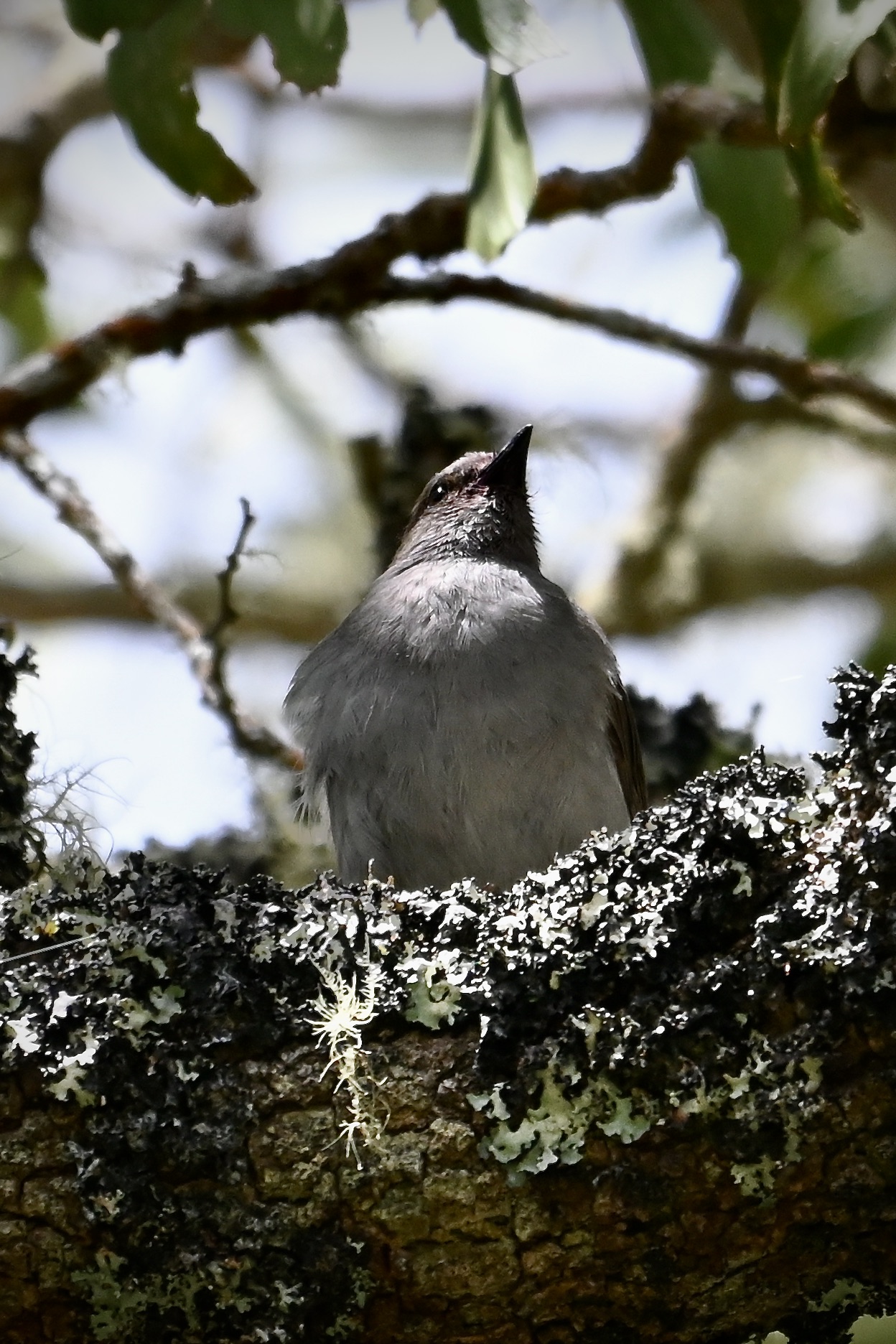
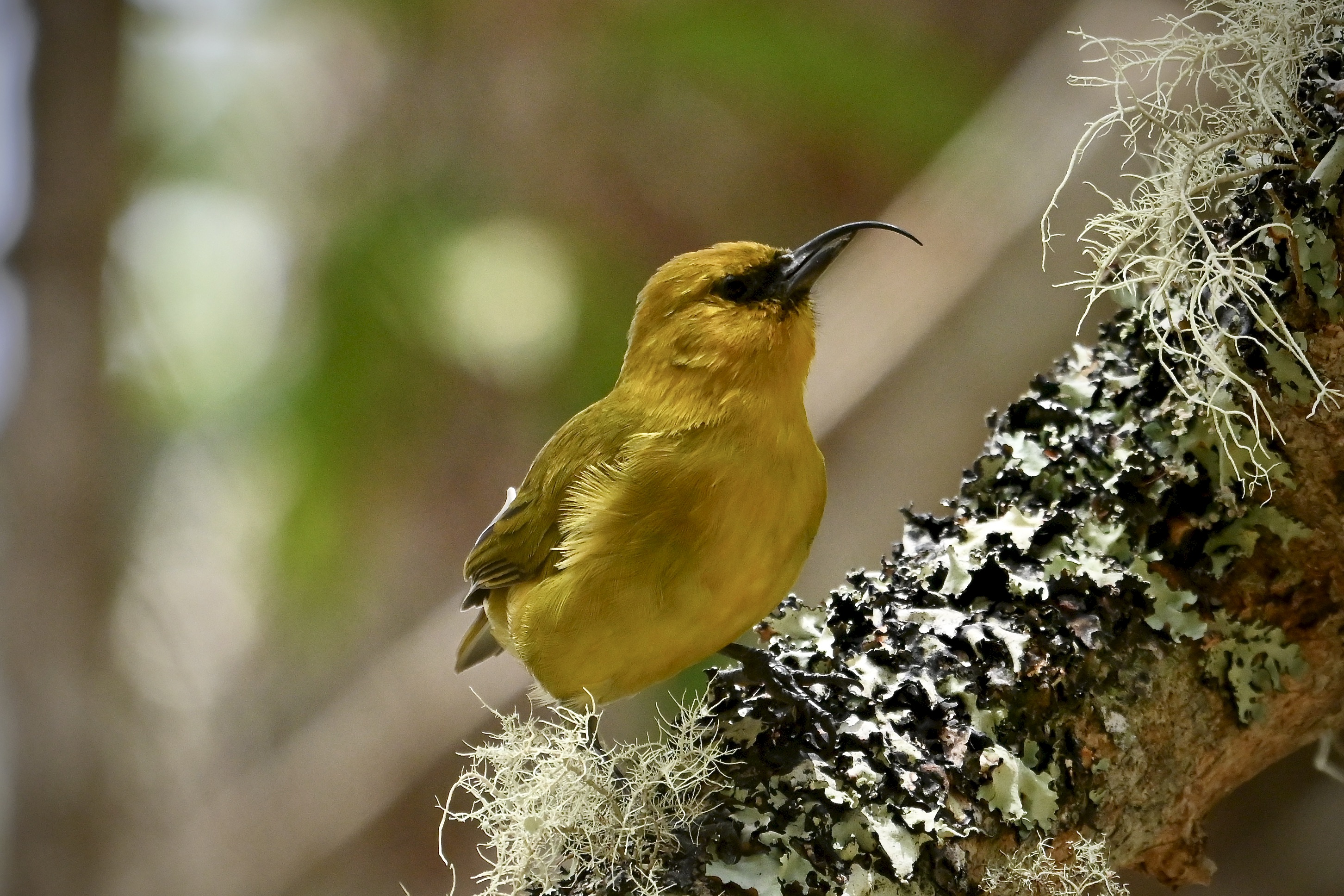
Photo of an ‘amakihi by Eric Anderson.

Chains and Chains

“One day as we were going to the place of prayer, we met a female slave who had a spirit of divination and brought her owners a great deal of money by fortune-telling. While she followed Paul and us, she would cry out, ‘These men are slaves of the Most High God, who proclaim to you the way of salvation.'” – Acts 16:16-17

My soul was heaped with chains.

A demon claimed my eyes,
my mind, my tongue, to speak
of things beyond a mortal’s ken.
Or possibly to fill the air with lies.

Some businessmen had claimed
my freedom. For as long as people paid
to hear the demon’s truth or lies,
the money went to them, and chains to me.

I still don’t know who claimed my legs
and tongue those days. The demon knew,
as I could not, that these strange men
were also chained, but to the healing power of a god.

I followed, but I don’t know how.
The demon’s words leapt from my lips,
but would it risk its power in the face of God?
Regardless, my legs pushed me after them.

I saw the look upon the speaker’s face,
a look of one whose patience had been tried
beyond its limited capacity. Beyond my hope,
he spoke the words that broke the demon’s chains on me.

I fell into the street and saw the businessmen
seize him and his companions, chain
them for the magistrates’ displeasure. I
looked down and found their chains bound me.

I am not fully free,
but I am freer than before,
and even though it cost them chains like mine,
I would be pleased to wear the chains of God.

A poem/prayer based on Acts 16:16-34, the Revised Common Lectionary First Reading for Year C, Seventh Sunday of Easter.

The image is Paul Casts Out the Devil from a Slave Girl in Philippi, attributed to Pieter Fransz, between 1610 and 1652. From Scenes from the Acts of the Apostles (series title). Photo by Rijksmuseum – http://hdl.handle.net/10934/RM0001.COLLECT.520428, CC0, https://commons.wikimedia.org/w/index.php?curid=84964425.

Story: The Molting ‘Apapane

May 25, 2025

Acts 16:9-15
John 14:23-29

He wasn’t the oldest among his siblings, cousins, and friends from nearby nests, but he was one of the first to molt from his young feathering to his adult colors. He’d had gray feathers on the chest and brown on his head and back, with black on his wings and tail. They all did. It made their games of hide-and-seek pretty difficult, because those colors melded into the shadows on the tree branches pretty well.

As I say, though, he was the first among them to start losing some of those brown and gray feathers, and start to gain the red feathers from head to tail. Frankly, it wasn’t going well. Loose feathers itched, and so did the new feathers as they grew in. They also didn’t fall out evenly. He found himself with a grayish belly blotched with the new red feathers.

“You look ridiculous,” said one of the young ‘apapane who played hide-and-seek with him, and, well, he felt ridiculous.

“Can’t you hide that?” asked another of the ‘apapane. He was a cousin, but he could be mean, even to a cousin. Our young ‘apapane couldn’t think of how.

“Go clean that up,” ordered one of the bossier young ‘apapane. She was one of those who thought she knew best for everybody else. But he still didn’t know how to take care of it, so he kept his perch and tried not to cry.

“Knock it off,” said the smallest of the young ‘apapane. All her feathers were still brown and gray, and she looked like she’d just been groomed by the finest feather-settlers of the forest. Everybody assumed that she was talking to the young bird with the splotchy red.

“Yeah, knock it off,” said the one who’d started this by calling him ridiculous in the first place.

“No, you knock it off,” said the smallest ‘apapane. “And you. And you. And all of you.”

She shook her wings and continued, “First of all, what can he do about it? You all know that our feathers will change from what we’re wearing to what our parents wear. Did you think that happened overnight? Didn’t you realize that it’s going to take time and that there are rough spots along the way?”

As it happened, none of them had thought about it.

“What are you going to do,” she demanded, “when this happens to you in a week or two? Are you going to make everybody going through this fly away, or are you going to help them when it itches and tell them it will be all right? What would you want for yourself?”

She asked that last question straight at the bird who’d ordered the molting ‘apapane to go clean that up. She didn’t say anything until it became clear that she had to answer.

“I’d want help,” she said.

“How about the rest of you?” demanded the smallest ‘apapane. They all admitted they’d want help.

“And that’s what you’ll get,” she said. “We’ll start with our friend here.”

“So how are you?” she asked. “Does it itch today?”

That’s how that generation of ‘apapane made it through their molt.

by Eric Anderson

Watch the Recorded Story

I write these stories in advance, but I tell them from memory and improvisation. What you have just read will not match the way I told it.

Photo of a juvenile ‘apapane in molt (at least that’s what I think it is) by Eric Anderson.

Not as the World Gives

[Jesus said,] “Peace I leave with you; my peace I give to you. I do not give to you as the world gives. Do not let your hearts be troubled, and do not let them be afraid.” – John 14:27

The world gave to you the way it gives, Lord:
Resentment, suspicion, condemnation, violence.
At the table you offered your peace to your friends.
In the garden, at the cross, peace fell away.

I pray, give to me as you give, not the world.
The world still loves to condemn and coerce.
In your peace I just might be able to stand,
my spirit unbowed by all evil’s power.

A poem/prayer based on John 14:23-29, the Revised Common Lectionary Gospel Reading for Year C, Sixth Sunday of Easter.

The image is The Last Supper by Jacopo Tintoretto (between 1579 and 1581) – Web Gallery of Art:   Image  Info about artwork, Public Domain, https://commons.wikimedia.org/w/index.php?curid=15542032.

Tintoretto painted more than one Last Supper. The chaotic atmosphere of this image drew me in, even as I was writing about peace, because peace in the chaos is our great challenge.

Who Are the People of Spirit?

May 13, 2025

[Verse 1]

Simon Peter went to see a man
A Roman centurion with power in his hands.
“Speak to us, Peter, we’d like to hear news
of a new way of living, one we can choose.”

[Chorus]

Who are the people of Spirit?
Open my heart to see.
Who are the people of Spirit?
Is it you? Is it me?

[Verse 2]

Simon Peter told his story to them
How a crucified brow bore a bright diadem.
Then he gasped as those Romans, unashamed
Displayed in their bodies the Spirit unchained.

[Chorus]

[Verse 3]

Simon Peter brought the Council the word
That even in Gentiles the Spirit had stirred.
“Who am I, who are you, to hinder our God?”
In the grace of the Spirit their spirits were awed.

[Chorus]

© 2025 by Eric Anderson

Watch the Premiere Performance

I first performed this song during worship at Church of the Holy Cross UCC in Hilo, Hawai’i, on Sunday, May 18, 2025.

Story: Welcome

May 18, 2025

Acts 11:1-13
John 13:31-35

The young ‘amakihi was nervous. She had been busy growing up, which ‘amakihi do a lot quicker than human beings do, but there was a lot to pack into that time. There was eating, and learning what to eat. There was taking care of her feathers, which changed when she molted and the feather lengths changed. And of course there was flying.

Then she had to learn about eating again, because there were things she could get to with working wings that she couldn’t get to in a nest. She learned about new bugs, new fruits, and new flowers. She’d been too busy to be nervous.

She was nervous now, though, because her parents had announced that the family would join a flock for the summer. She wasn’t really used to other birds. She’d met an auntie or an uncle or two, and of course her tutu, but these would be strange ‘amakihi. Would they like her? Would they be mean to her?

It made her more nervous to realize that the flock wouldn’t include just ‘amakihi. It would include ‘akepa, ‘alawi, and scariest of all, ‘apapane. She knew there were a lot of ‘apapane around. She’d seen far more of them than she had ‘amakihi. She’d also seen them chase ‘amakihi through the forest, even her own father. “I got too close to their nest,” he’d explained, and that made sense because she’d seen him chase other birds away from her nest, but still. The ‘apapane made her nervous.

“It will be all right,” said her father. “It’s different when birds aren’t worried about nests and eggs.”

“It will be all right,” said her mother. “You’ll make it all right.”

The day came when she and her brother and her parents flew over to an ohi’a tree filled with other birds. There were other ‘amakihi, and she knew some of them because her tutu were there. There was ‘akepa and ‘alawi showing off their green and bright orange feathers. Mostly, though, there were ‘apapane. They hopped through the branches, singing their beautiful songs, and looking very sharp in their red and black feathers.

One of them, who was keeping rather quiet, hopped over to the branch where she was sitting, keeping very quiet and hoping nobody would notice her.

“Hi,” said the ‘apapane. “What kind of bird are you?”

“I’m an ‘amakihi,” she said. “And you’re an ‘apapane.”

“I am,” he said, and looking rather nervous, said, “I feel really dumb. I’ve never seen most of these birds before. Do you know any of them?”

“Well, I know my family,” she said, “and I’ve seen a couple of these other birds before,” – she didn’t mention that they’d been chasing her father away from their nest – “but most of these birds are as new to me as they are to you.”

“Oh, good,” said the ‘apapane. “I guess this is new to most of us youngsters?”

“I think it is,” said the ‘amakihi. “I’ve been worried that nobody would like me.”

“You’ve made me feel better,” said the ‘apapane. “I think most birds would like you for that.”

“And you’ve made me feel welcome,” said the ‘amakihi. “Thank you so much for that.”

Mother had known, after all. She had made it all right.

by Eric Anderson

Watch the Recorded Story

I write these stories ahead of time, but I tell them from a combination of memory and improvisation. As a result, what you’ve just read will not match what you hear.

Photo of an ‘amakihi by Eric Anderson.

What Peter Didn’t Say

So when Peter went up to Jerusalem, the circumcised believers criticized him, saying, “Why did you go to uncircumcised men and eat with them?” – Acts 11:2-3

You think I wanted to eat with them?
I didn’t want to go at all.
I was riding pretty high, you know,
elated with a woman’s resurrection.
OK, the only place they’d put me up
was with a tanner, but a fisherman’s smelled worse.

Yes, I was riding high, and trying not
to think about the things that happen when
you’re riding high, the way success becomes
a series of new challenges, new obligations. I
was smelling those amidst the tannery.
It came for Jesus; it would come for me.

I didn’t know that I could lie in dreams
or visions, waking or asleep. I claimed
I’d never eaten food that was unclean,
and knew full well I’ve eaten shellfish when
the Romans hadn’t purchased all my stock.
And let’s ignore the grain I plucked on Sabbath Day.

A vision or a dream; regardless, it
would summon me to something new
I knew. I did not know what it would be,
but who gets visions for a trivial thing?
I didn’t know what that dream meant.
I knew I’d go where I’d not wish to go.

The house of a centurion was not
within my plan. Who knew what I would find
when I reached there? Most likely was
a naked sword to seek my naked gut.
Why trouble with a cross when you
can drain a troublemaker’s life without?

I had no plan to speak of Jesus there until
they asked, but ask they did, and I
pulled in my breath, and breathed it out,
and spoke with sometimes trembling voice
of Jesus, of his healing touch, his mercy to
such fools and failures as I am.

I certainly did not expect the fire of
the Spirit in a Roman house, of one
who marshals military might against
the people of this land. They said that he
feared God, but this? The Holy Spirit, lit
in him as it had been in me? Who knew?

And now, my friends, I have no plan for you.
I didn’t want to go. I went. I didn’t want to speak.
I spoke. I didn’t know the Spirit would appear.
She did. I didn’t know that God had welcomed them,
the Gentiles, just as openly as us. And now,
I have no words for you, except

To tell my tale again.

A poem/prayer based on Acts 11:1-18, the Revised Common Lectionary First Reading for Year C, Fifth Sunday of Easter.

The image is St. Peter and Cornelius the Centurion by Bernardo Cavallino (1640s) – Web Gallery of Art:   Image  Info about artwork, Public Domain, https://commons.wikimedia.org/w/index.php?curid=15452357.

Story: Imitation

May 11, 2025

Acts 9:36-43
John 10:22-30

How is a young bird, or a young turtle, or a young person supposed to figure out how to be an adult bird, or an adult turtle, or an adult human being? People, at least, get some instructions from their elders. We get taught how to get dressed, and what things are good to eat (or at least good for you to eat; opinions differ on whether things that are good for you are tasty enough to eat), and especially important things like, “Don’t touch the boiling tea kettle on the hot stove!”

Birds probably don’t get quite that much teaching. Certainly they don’t get the years of it that we do as we’re growing up.

A young ‘akekeke was learning how to be an ‘akakeke. He’d already made one trip from Alaska to Hawai’i, just as the kolea do, and he’d been sleeping and eating and flying about ever since. But he was confused.

You see, there were creatures who did very different things than ‘akekeke did, and he wondered if their ways might be better.

Mind you, there were plenty of creatures who did very similar things. Kolea and hunakai and ‘akekeke all hunted through the grasses and tidepools and rocks for insects, snails, and so on. If he imitated them, things went pretty well. He tried to imitate the ae’o, but he didn’t have long pink legs to hold his body out of the water of the fishpond and he ended up gasping and spluttering as he flapped his miserable way to shore.

The least successful of all was when he tried to imitate a honu. He flopped into the water in a calm spot and lingered below the surface. Then he tried to eat some seaweed on the underwater rocks. He choked on the water, of course, and once more hauled his bedraggled self onto the beach.

He looked about and saw his mother.

She asked, “What are you up to, son?”

“I’m learning,” he said. “I’m learning to be an ‘akekeke.”

She looked around at the other ‘akakeke on the shore, none of whom were trying to feed like a honu. “How?”

“By imitating what I see,” he said.

“Are you learning anything?” she asked.

“I’m learning that some things don’t work,” he said, and coughed up a little more water.

“I’m not saying you can’t learn anything from a honu,” said his mother, “but for basic things like eating and flying, I don’t think there’s much they can teach you. I don’t think you can eat the way they do, and they certainly can’t fly the way you do.”

“I suppose not,” said the ‘akekeke, who was a little sad about not learning anything with his imitations that day.

“You have taught me something today, something I can imitate,” he said.

“What’s that, son?” asked his mother.

“You’ve taught me to be kind.”

Whether we wear feathers, shells, or rubbah slippahs on our running feet, let’s all imitate those who are kind.

by Eric Anderson

Watch the Recorded Story

I write these stories ahead of time, but I tell them from memory (plus improvisation) during worship. What you have just read is not necessarily how I told it.

Photo of an ‘akekeke (ruddy turnstone) by Eric Anderson. Not far away, grazing in a shallow pool, there was a honu (green sea turtle).

Sabbatical 2025: The Video

During my sabbatical, which ran from February 1, 2025, to April 30, 2025, I had two major projects. In the end, I made progress on both but did not complete either.

I have a tentative list of stories which I will be preparing and submitting for publication. Just reading them took longer than I’d anticipated. I also didn’t make it to the islands of Maui or Moloka’i, in part because I’d had to schedule other needed appointments during that time. I do have a plan to complete that, however.

Something which hadn’t been on my list became enormously important: photography. Capturing the beauty I encountered really lifted my soul, and became the most restoring activity of my sabbatical.

For the time and for the wonders of the world formed by its Creator, I am deeply grateful.

Life Dreaming

“Peter put all of them outside, and then he knelt down and prayed. He turned to the body and said, ‘Tabitha, get up.’ Then she opened her eyes, and seeing Peter, she sat up.” – Acts of the Apostles 9:40

“To sleep, perchance to dream – ay, there’s the rub,
For in that sleep of death what dreams may come?”
asked William via Hamlet in the play.
In Joppa Tabitha had ceased her work.

She lay upon the cot unmoving as
her friends displayed with streaming eyes the cloth
and clothing she had made with loving hands
for them, their families, and those in need.

She’d lived a life full well and full of grace,
and if she’d died, a life reborn would come,
so said the messengers who preached the Way,
the Jesus Way she’d taken as her own.

What dreams moved through her soul as she lay still?
What visions came to eyes of spirit now
that those below her brow saw naught? What sight
of welcome to a life eternally?

Somehow she heard the summons, “Tabitha,
get up.” The dreams collapsed as her lids raised,
to see an unfamiliar, anxious face,
perhaps a little bit surprised, above.

She rose. She met her friends once more. What did
she say? We’ll wonder, since the author left
that out, and failed to write as well, what dreams
she’d had, which we may have ourselves someday.

She rose, awoke to love and work, restored
to life ephemeral, a life to end
someday once more, a life she would lay down
again, and dream the interrupted dreams.

A poem/prayer based on Acts 9:36-43, the Revised Common Lectionary First Reading for Year C, Fourth Sunday of Easter.

The image is the Tomb of Tabitha, Jaffa, Palestine by William H. Rau (1903) – This image is available from the United States Library of Congress’s Prints and Photographs divisionunder the digital ID ppmsca.10664.This tag does not indicate the copyright status of the attached work. A normal copyright tag is still required. See Commons:Licensing., Public Domain, https://commons.wikimedia.org/w/index.php?curid=18866918.

This poem includes quotes from Hamlet by William Shakespeare (ca. 1599 and 1601) and “Awake, Awake to Love and Work” by Geoffrey Anketel Studdert Kennedy (1921).