Open and Closed

“But they kept asking him, ‘Then how were your eyes opened?'” – John 9:10

From a Jerusalem street to the Pools
of Siloam, spittle-moist dust awash
in the waters, a new sense a-born
to beguile his return to the place
where the Healer no longer is found.

“How’s this?” they asked. “How can your eyes
be opened? You’ve never known sight
since the day you arrived.” “The man Jesus
made mud and he told me to wash;
when I did, my vision was born.”

Hard hurrying queries and skeptical
silences, speech disbelieved or
discounted or scoffed. Speaking a
simple story of fresh mud washed free,
but the hearts, not the eyes, were fast closed.

Is it part of our nature, God, something
inherent that makes human beings choose
their answers ahead? We question
and search but will not find a truth
when we’ve chosen the word we’ll accept.

Praise God for your vision, O once
sightless man, but praise God the more
for your wide-open heart, to hear
and to trust the man Jesus who said,
“Go the pool now and wash.”

A poem/prayer based on John 9:1-41, the Revised Common Lectionary Gospel Reading for Year A, Fourth Sunday in Lent.

The image is The Blind Man Washes in the Pool of Siloam (Le aveugle-né se lave à la piscine de Siloë) by James Tissot (between 1886 and 1894) – Online Collection of Brooklyn Museum; Photo: Brooklyn Museum, 2008, 00.159.173_PS2.jpg, Public Domain, https://commons.wikimedia.org/w/index.php?curid=10957455.

Oh My, How Rude

A Samaritan woman came to draw water, and Jesus said to her, “Give me a drink.” – John 4:7

Not even a “please?” Oh my, how rude
to ask – demand – a drink of water here.
This well is deep, and every drop I raise
for you, you stranger, is a drop I need
to raise again, and carry to my home.
You should have brought a bucket, sir.

Not even a “please?” Oh my, how rude
to ask – demand – my time and labor here.
I’ve things to do now, Jesus, as you know
(and as you knew that woman did as well),
some obligations of which you’d approve.
What could I raise to satisfy your thirst?

Not even a “please?” Oh my, how rude
to hint – imply – that your refreshment does
much more than mine. Your invitation comes
with obligation, we both know, and yet…
And yet… I thirst, O Jesus, how I thirst.
May I be satisfied in you.

A poem/prayer based on John 4:5-42, the Revised Common Lectionary Gospel Reading for Year A, Third Sunday in Lent.

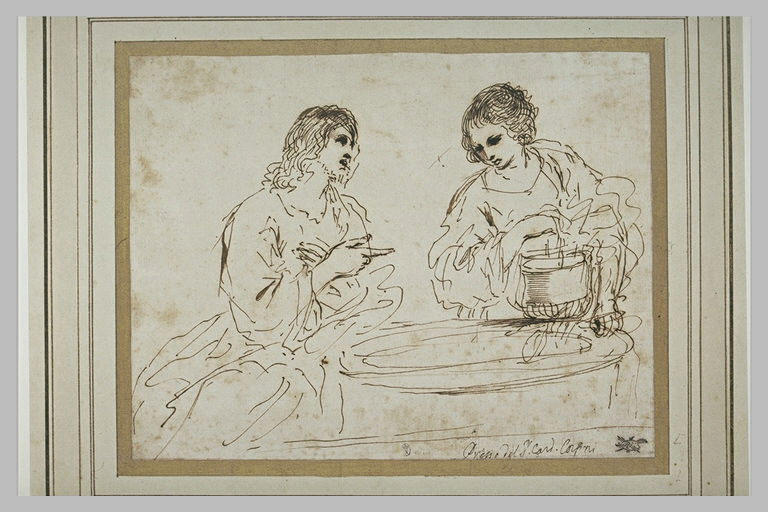
The image is Christ et la samaritaine, dessin by Guercino (ca. 1640) – http://www.culture.gouv.fr/public/mistral/joconde_fr?ACTION=CHERCHER&FIELD_2=AUTR&VALUE_2=GUERCINO IL, Public Domain, https://commons.wikimedia.org/w/index.php?curid=3792308.

Changing, Changed, Changeless

“Nicodemus said to him, ‘How can anyone be born after having grown old? Can one enter a second time into the mother’s womb and be born?'” – John 3:4

You knew, Nicodemus, and Jesus knew you knew
that humans do not live a static life.
They grow, adapt. They shift and change.
Sometimes they even make a brand new start.

Sometimes they start as fresh as wandering wind,
as pure as water droplets glistening.
Where do they go? Who knows? The wind
goes where it will, just like the Holy Spirit.

Though none can set or stay the Spirit’s way,
one thing remains more firm than stone,
more sure than night or day. Yes, God so loved the world
not to condemn, but raise in radiant life.

A poem/prayer based on John 3:1-17, the Revised Common Lectionary Gospel Reading for Year A, Second Sunday in Lent.

The image is Nicodemus by JESUS MAFA, from Art in the Christian Tradition, a project of the Vanderbilt Divinity Library, Nashville, TN. https://diglib.library.vanderbilt.edu/act-imagelink.pl?RC=48385 [retrieved February 28, 2023]. Original source: http://www.librairie-emmanuel.fr (contact page: https://www.librairie-emmanuel.fr/contact).

Tempted

The tempter came and said to him, “If you are the Son of God, command these stones to become loaves of bread.” – Matthew 4:3

Temptation I recognize, Jesus
(except when I don’t).
My media diet is full to the brim
of temptation, allure:
“Buy this! Buy that! And life
will be better for sure!”

At times I am sure that
temptation disguises itself as need:
a tool or a book or a thing
enlivening live streams or
enhancing worship or
giving me something to think on anew.

Might temptation be present in
obvious choices, the things that we get
because Mom always got them?
The symbols we use, uniforms donned.
As I bow my head for a Sunday stole,
do I hear a reproach in its wavering fringe?

And then there’s temptation
I simply don’t recognize, and here I must ask:
What’s wrong with transforming the stones
into bread? Your need was as real as
the need of five thousand
or those who lived on the manna of Sinai.

Your retort to the Tempter – what does it mean?
We live by the words of the mouth of God?
Who would know that better than the Incarnate Word?
And yet you consumed the fruit of the land,
the bread from the ground, its flour ground
(as you knew) between stones.

As a test, I can pass this one, Jesus.
I can. There’s no sign the power
of stone-flour bread is mine to command.
But I wonder, Messiah. You spotted this test.
You chose your best course. You passed the exam.
But would anyone else? Could anyone else?

The Tempter was someone you knew to resist.
I don’t always know. Sometimes, but not always.
The action was one that would lead you astray.
The paths that I follow all seem to be straight… to start.
So I beg you to help me to choose the true bread,
for I don’t always recognize the voice of God.

A poem/prayer based on Matthew 4:1-11, the Revised Common Lectionary Gospel Reading for Year A, First Sunday in Lent.

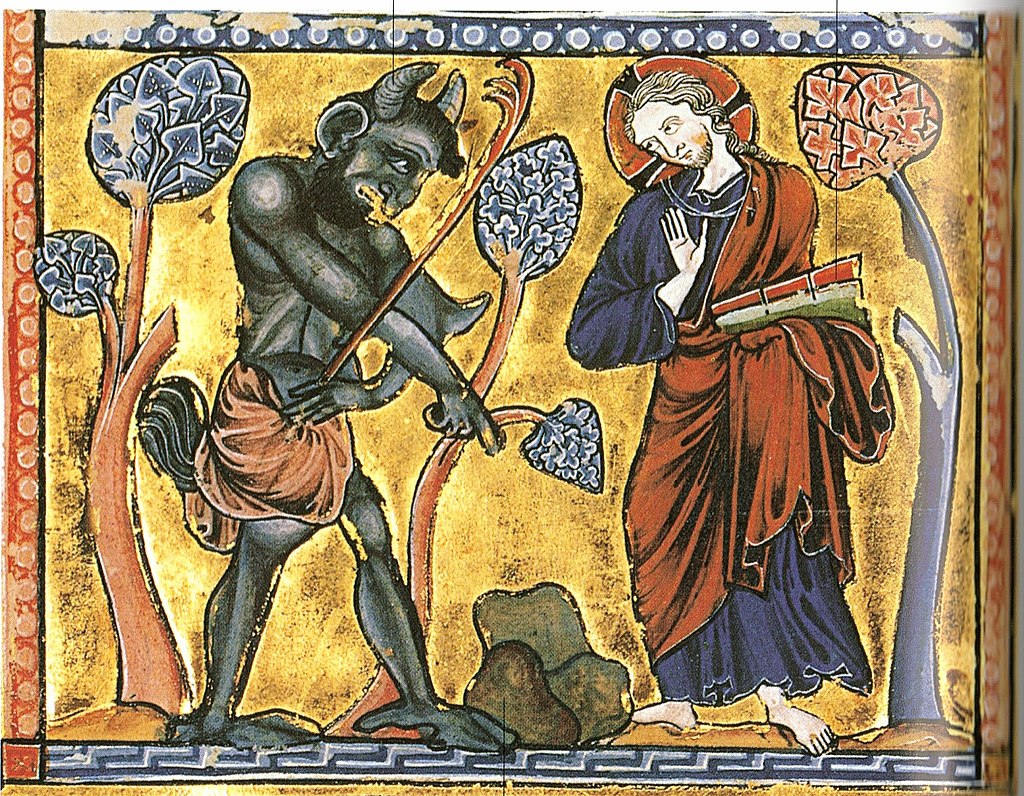
The image is an illustration in a Psalter ca. 1222 by an unknown artist – Self-scanned Rosa Giorgi: Bildlexikon der Kunst, Bd. 6.: Engel, Dämonen und phantastische Wesen, 384 S., Berlin: Parthas-Verlag 2003, ISBN 3936324042 / ISBN 9783936324044, S. 130, Public Domain, https://commons.wikimedia.org/w/index.php?curid=114178710.

Half Way Down

“As they were coming down the mountain, Jesus ordered them, ‘Tell no one about the vision until after the Son of Man has been raised from the dead.'” – Matthew 17:9a

Who would I tell, Jesus? What would I tell them?
“He glowed like a lamp in the sun, but brighter!”
“Moses was talking to him; so was Elijah!”
“A voice told me to listen from a cloud!”

They’d shake their heads to hear the first,
to hear the second, to hear the third.
The last and final sentence, though, they’d hear and smile:
“And when, pray tell, will you start listening?”

That question’s fair enough, I know.
I blurted out those words of invitation
rather than a question, like, “Should we
build booths for you, as you are here?”

So, Jesus, no, I’ve learned a little bit.
I’ll keep my silence ’till you give the word.
And listen. I will listen, sure as day.
And… maybe… wonder what you mean by “risen from the dead.”

A poem/prayer based on Matthew 17:1-9, the Revised Common Lectionary Gospel Reading for Year A, Transfiguration Sunday.

The image is Transfiguration by Latimore, Kelly, from Art in the Christian Tradition, a project of the Vanderbilt Divinity Library, Nashville, TN. https://diglib.library.vanderbilt.edu/act-imagelink.pl?RC=57114 [retrieved February 14, 2023]. Original source: Kelly Latimore Icons, https://kellylatimoreicons.com/.

Milk

“I fed you with milk, not solid food, for you were not ready for solid food. Even now you are still not ready…” – 1 Corinthians 3:2

A food of miracles, this milk, that comforts the miraculous.
The squalling ball of helpless and adorable fresh flesh would dwindle soon,
would cease its noise, but better is delivery of milk to toothless gums,
and better far is sleepy, satisfying milky burps.

So I am glad, nay o’er the moon with Paul, to feed
us on the milk of breasts Divine, that my poor soul
has sustenance, vitality, and vigor for
the growth – ah, yes, the growth – that Paul had promised.

So what, I ask, is this more solid food to feed the soul?
What is, I ask, more rich, more suited to the task
than milk? What is, I want to know,
the superfood of the soul?

For challenges arise, I see. If Paul demands
we lay aside the jealousy and quarrels, I
can only echo him. “What use are these?” we say.
“Has not the Savior shown us better ways?”

But rising beyond Paul, the words of Jesus daunt,
which set the bar for my comportment high.
Anger and insulting? Lay aside. Admit my wrongs.
Look not with lust. Say only yes or no and keep my word.

I sigh, aware the challenge beckons, and
I seek nutrition of the spirit that
will carry me along and to
the end.

A poem/prayer based on 1 Corinthians 3:1-9 and Matthew 5:21-37, the Revised Common Lectionary Second Reading and Gospel Reading for Year A, the Sixth Sunday after the Epiphany.

The image is Glass of Milk by NIAID, CC BY 2.0, https://commons.wikimedia.org/w/index.php?curid=82983911

Like the Noonday

If you remove the yoke from among you,
    the pointing of the finger, the speaking of evil,
if you offer your food to the hungry
    and satisfy the needs of the afflicted,
then your light shall rise in the darkness
    and your gloom be like the noonday.”
– Isaiah 58:9b-10

“[Jesus said,] ‘You are the light of the world.'” – Matthew 5:14a

I’m trying, Jesus, I am surely trying
(and don’t think I can’t see and hear and feel
your smile twisting as you think
“Oh, yes. You’re definitely trying… all my patience!”).

I’m trying to remove the yokes. I pray
that you are seeing more success with that than I.
I’m trying to refrain from speaking evil, even if
it means I must lock down by tongue to silence.

And I’m trying, surely trying, Jesus,
to direct my pointing finger solely to myself,
to take the blame when it is mine,
and not add strife with blame to others.

But.

I’ve got to say that my hard-won restraint
has not been echoed widely, has it?
You and I both know that finger-pointing is
activity in which a multitude delights.

While I am struggling with my guttering light,
a horde of people praise the shadows, and
to my astonishment, they call the shadows light.
No hungry fed, no naked clothed, evil celebrated.

My finger itches, Jesus, with the urge to point
and then shout out (as once Isaiah was directed)
with trumpet calls: “For shame, you hypocrites!
You do not shine, you hide the light of God!”

And then I breathe in deep, down to the belly, as
I contemplate your failures, Jesus, in the world.
You called them out, the hypocrites who taunted you
as your light shone upon the torturer’s cross.

I’ll do my best to shine, I will. I’ll try.
I’ll feed that guttering wick and shield it from
the howling winds as best I can. But man…
My finger itches, Jesus. Yes, it surely does.

A poem/prayer based on Isaiah 58:1-12 and Matthew 5:13-20, the Revised Common Lectionary First Reading and Gospel Reading for Year A, the Fifth Sunday after the Epiphany.

Photo by Eric Anderson.

On Pigeon’s Wings

“…and they offered a sacrifice according to what is stated in the law of the Lord, ‘a pair of turtledoves or two young pigeons.'” – Luke 2:24

“…for my eyes have seen your salvation…” – Luke 2:30

Bearing their eight-day-old sons, two-week-old daughters,
the parents bring their sacrifices to the priests.
Each brings a pigeon or a dove, but some a lamb.
Those leading lambs wear finer clothes
than those who bear two turtledoves.
The gift is what they can afford.

One couple, bearing pigeons and a son,
are told that they have been anticipated.
An elder man accosts them in the Temple court
to celebrate their child’s role in Israel’s salvation.
“A light for revelation!” now he cries,
but also, mother, know your heart will ache.

The couple might have edged away,
but from another side a woman comes,
another elder, face well lined with years.
She comes and praises God for this small child.
He will, she promises, redeem Jerusalem.
She praises what she knows she will not see.

The parents fade once more into the crowd,
and those about are well content to let them go.
Their clothes were nothing fine; their feet
were travel-stained, and their sacrifice would be
no more than pigeons, what a family offered
when they lacked both power and wealth.

A pity that a pious, virtuous crowd
was blinded by
a pair of pigeon’s wings.

A poem/prayer based on Luke 2:22-40 the Revised Common Lectionary Gospel Reading for Year A, the Presentation of the Lord.

The image is a mosaic of The Presentation in the Monastery of Hosios Loukas, Distomo, Greece. Photo by Hans A. Rosbach – Own work, CC BY-SA 3.0, https://commons.wikimedia.org/w/index.php?curid=8943645.

Distracted

“With what shall I come before the Lord
    and bow myself before God on high?
Shall I come before him with burnt offerings,
    with calves a year old?
Will the Lord be pleased with thousands of rams,
    with ten thousands of rivers of oil?
Shall I give my firstborn for my transgression,
    the fruit of my body for the sin of my soul?”
He has told you, O mortal, what is good,
    and what does the Lord require of you
but to do justice and to love kindness
    and to walk humbly with your God?

Micah 6:6-8

Look, God, I’m happier when you are vague,
when there’s some wiggle, some uncertainty,
when I can find a space to justify
the things I want, I’d rather, do.

Or, better, when the clarity shines on
the things that hide the errors of the days behind,
that shield me from their consequence,
excuse me without need to change my course.

Look, God, I’m wise enough to leave the lambs
and rams behind. I’ll make my sacrifices with
my time (and maybe with my treasure; we will see).
I don’t intend to buy your favor, no.

Intend to, no. Attempt to… that’s a yes.

You have told me, God, what things are good,
and I have heard, and taken them to heart,
and held them close, and meditated on them, and…
sometimes I’ve done them. Sometimes I have not.

‘Cause damn it, God, your justice is beyond me,
beyond us, so it seems. Your love of mercy breaks
my heart with all its blinding brightness. How
can I do other than come humbly to you on our walk?

So that is why I pour my time into the almost just,
the near-to-mercy, all the things that don’t quite work.
With all this busyness, how could you notice, God,
that am running round, not walking by your side?

It’s easier, you see, to place my energy
upon the altar as a sacrifice of praise
than to do justice well, to love with steadfast mercy, and
walk humbly with the God of my salvation.

A poem/prayer based on Micah 6:1-8, the Revised Common Lectionary First Reading for Year A, the Fourth Sunday after the Epiphany.

The image is “High priest offering incense on the altar, as in Leviticus 16:12,” by Illustrator of Henry Davenport Northrop’s Treasures of the Bible, 1894 – http://www.lavistachurchofchrist.org/Pictures/Treasures%20of%20the%20Bible%20(Moses)/target20a.html, Public Domain, https://commons.wikimedia.org/w/index.php?curid=6611903.

The Smaller Boat

“…Immediately they left the boat and their father, and followed him.” – Matthew 4:22

It’s the same boat. It’s the same net.
It’s the same lake. It’s the same fish.

They all seem a little smaller now.

They always were too big for this small beach,
my “Sons of Thunder,” louder and more
vigorous upon the lines than even I,
the Thunderer himself, had been.

Brash? I’ll say, and I’ve been brash and more.
We should have seen it coming, I expect,
when two such souls as she and I
brought similar selves into the world.

We tried the obvious and useless, yes we did.
“Please use your inside voices!” at a roar.
They laughed when they grew old enough
to see the irony, and laughter filled the house.

It filled the village and the beach and echoed
to the skies, the laughter of these two,
and if two parents, sober citizens, could not
join in, well, we smiled and smiled and smiled.

They always were too big for this small beach,
but still, I never thought they’d step away
to follow a poor traveling preacher or
take up a life of shouting out for God.

I’m glad, although I grumble at this pile
of nets awaiting my attention and repair.
This teacher can expand their lives and minds
and souls. The nets and fish and boat… will not.

My breathing settles in a gut-deep sigh.
I’ll claim the tear is sand blown in my eye.
There’s more room in this boat than just a while ago,
so how has it grown smaller in that time?

It’s the same boat. It’s the same net.
It’s the same lake. It’s the same fish.

They all seem a little smaller now.

A poem/prayer based on Matthew 4:12-23, the Revised Common Lectionary Gospel Reading for Year A, the Third Sunday after the Epiphany.

The image is Jesus calls James and John from their boat; their father Zebedee stands behind them. Woodcut, date and author unknown. Credit: Wellcome Library, London. Wellcome Images images@wellcome.ac.uk http://wellcomeimages.org Jesus calls James and John from their boat; their father Zebedee stands behind them. Woodcut. Published: – Copyrighted work available under Creative Commons Attribution only licence CC BY 4.0 http://creativecommons.org/licenses/by/4.0/

Author’s note: I need to credit two writers with renewing my thinking about Zebedee and this scene and I commend their work to you: Melissa Bane Sevier’s essay “Left Behind” and Maren Tirabassi’s poem “Zebedee (portrait of the original empty-netter).”