“For everyone who asks receives, and everyone who searches finds, and for everyone who knocks, the door will be opened.” – Luke 11:10
I’m knocking, Jesus. I can’t say the door is opening. I can’t say my search is finding anything. I can’t say my asking is receiving very much at all.
But…
I can hear you knocking, Jesus. I wonder if your asking is receiving very much from me? I wonder if your search is finding anything from me? I wonder if my heart’s door is opening to you?
Knock, knock.
A poem/prayer based on Luke 11:1-13, the Revised Common Lectionary Gospel Reading for Year C, Proper 12 (17).
“[Martha] had a sister named Mary, who sat at the Lord’s feet and listened to what he was saying.” – Luke 10:38-42
I’m listening, Jesus. Can’t you hear me listening?
I’m listening while I’m working. See how hard I’m working. All alone I’m working. Don’t you care? I’m working.
And I’m listening while I’m working. Have no fear about that, now. I’m listening.
I’m working because there’s work. So much need, so much work. Who else is working? Don’t you care I’m working?
Still listening; still working. Don’t worry about listening. I am listening.
The needs, they keep shifting. Some things I’ve done aren’t working. I’ll try something new. Don’t you care to share something new?
Let me get this done while I’m listening. Speak your peace, Jesus. I’m listening.
Yes, I’m listening, Jesus.
Can’t you hear me listening?
A poem/prayer based on Luke 10:38-42, the Revised Common Lectionary Gospel Reading for Year C, Proper 11 (16).
The story of Mary and Martha has often been used to praise contemplative spirituality and criticize engagement with others. I think that’s a misleading reading. Jesus commented on Martha’s worry and distraction, not her activity. What distinguished the two women was that Mary listened. Someone with a spirituality of involvement can be an active listener to Jesus, and a contemplative can certainly listen to self rather than to Christ.
The photo is of a fresco depicting Mary, Martha, and Jesus in Martha’s house. The fresco is in the St. Lazarus Roman Catholic Church in al-Eizariah (Biblical Bethany). Photo by Fallaner – Own work, CC BY-SA 4.0, https://commons.wikimedia.org/w/index.php?curid=72990656.
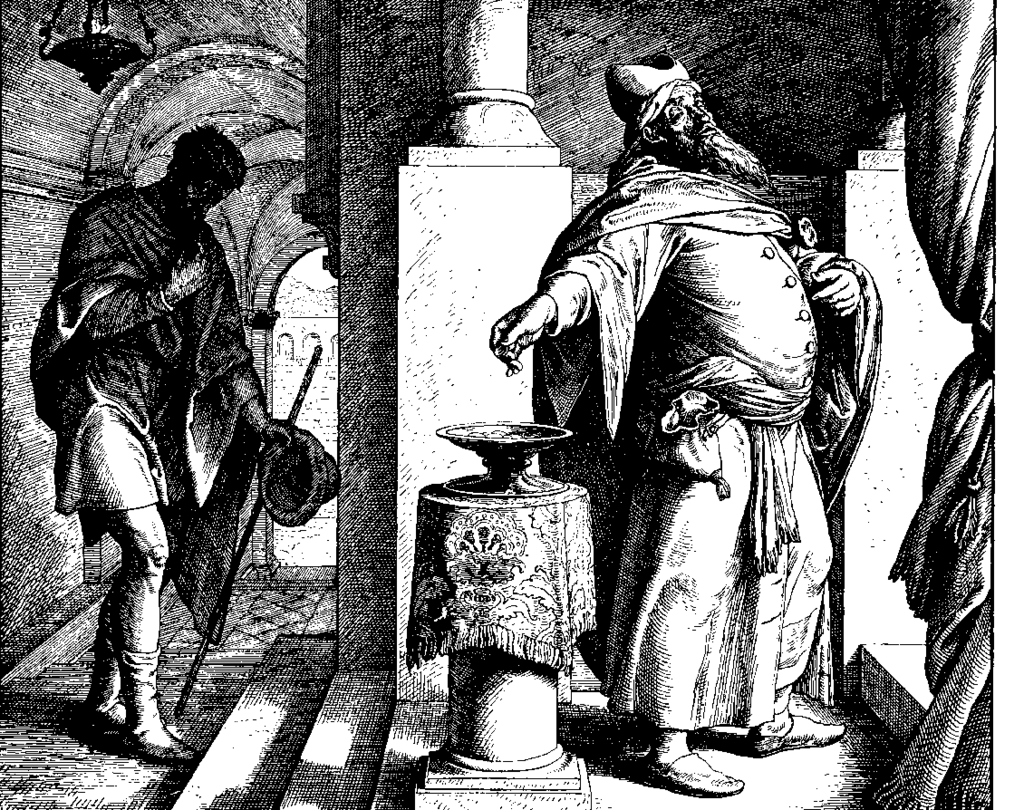
“Now by chance a priest was going down that road; and when he saw him, he passed by on the other side. So likewise a Levite, when he came to the place and saw him, passed by on the other side.” – Luke 10:31-32
They had reasons, I’m sure, to take the other side. I can’t imagine all the obligations they’d have had, of family and church and ordinary daily life. They had their reasons, yes, I’m sure.
Did their reasons reassure a dying man?
Do I have reasons? Yes, I have, commitments overwhelming. I try to think “strategically,” to “choose my battles,” “save the energy for when it’s needed,” “take my rest.” I have my reasons in their legions.
Do my reasons reassure a threatened woman?
Do we have our reasons? Yes, we have. Resources are not infinite by any means. What this one gets, another one does not. Dare we deprive another for the needs of one? We have more reasons than responses.
Do our reasons reassure a grieving child?
Do we have our reasons? Yes, of all the things we call our own, we cling to reasons – even more than gold or power or privilege or guns. We have our reasons and we will not let them go.
Do our reasons satisfy the One whose love embraces dying souls?
A poem/prayer based on Luke 10:25-37, the Revised Common Lectionary Gospel Reading for Year C, Proper 10 (15).
“When the days drew near for him to be taken up, he set his face to go to Jerusalem.” – Luke 9:51
“Jesus, that was rude.”
“No kidding. Not an open door in sight.”
“And just because we’re headed for Jerusalem.”
“These Samaritans are jerks.”
“Yeah. They’re jerks.”
“Hey, Jesus! Remember when Elijah called for fire from heaven?”
“Or when God rained destruction down on Sodom and Gomorrah?”
“They failed to welcome angels there, you know, just like this village failed to welcome us.”
“Yeah! Jesus! Let’s call fire down from heaven! That’ll teach them!”
“What’s that he said?”
“He said, ‘No.'”
“I heard that part. What did he mutter after that?”
“A prayer, I think?”
“I heard, ‘How long, O Lord?’ before his mutter got too soft to hear.”
“Oh, look! Here comes someone to join our merry band.”
“Jesus will make him feel at home, I’m sure.”
“Oh. No. He didn’t, did he?”
“What did he say this time?”
“Something about foxes having better beds than he does.”
“Well. That’s true, I’ve got to say. My pillows have been awfully hard of late.”
“Truth in advertising doesn’t sell, now, does it?”
“Well, here is someone else. Jesus told him, ‘Follow me.” That’s better, isn’t it?”
“Oh, wait. He wants to bury his father first.”
“Now what did Jesus say?”
“‘Let the dead bury their own dead.'”
“Ooo. Harsh, Jesus, harsh.”
“I don’t think he’s coming back do you?”
“And here’s one more. He wants to tell his family goodbye.”
“Oh, no. What did Jesus say this time?”
“‘No one who puts a hand to the plow and looks back will do.'”
“Well, that’s true. You get really crazy furrows if you plow while looking back.”
“But this is crazy! We’re supposed to be inspiring a movement! We’re supposed to be gathering a coalition! We’re supposed to be organizing a community!”
“Are we? Or does Jesus have another thing in mind?”
“I’ll ask him. Jesus! Where are we supposed to be going?”
“Did you hear him?”
“Not that well. What did he say?”
“‘This way.'”
A conversational poem/prayer based on Luke 9:51-62, the Revised Common Lectionary Gospel Reading for Year C, Proper 8 (13).
The image is Il allait par les villages en route pour Jérusalem (He Went Through the Villages on the Way to Jerusalem) by James Tissot (btwn 1886 and 1894) – Online Collection of Brooklyn Museum; Photo: Brooklyn Museum, 2006, 00.159.157_PS1.jpg, Public Domain, found on Wikipedia Commons.
Then [Elijah] lay down under the broom tree and fell asleep. Suddenly an angel touched him and said to him, “Get up and eat.” He looked, and there at his head was a cake baked on hot stones, and a jar of water. He ate and drank, and lay down again. – 1 Kings 19:-6
I know just what you will say, LORD. “What are you doing here?” you’ll ask. Oh, I will have an answer, which will not be any good as an excuse.
Still I climb the mountain, seeking you, though you have never been so far before amidst the labors and travails and trials. Still now, yes now, I journey and I climb.
I’ll tell you I was running to you, and we neither of us will be much deceived. I’ll tell you I’m the only one, and yes, I know as well as you the truth of that.
Amidst the carnage of the wind I’ll stand, amidst the terror of the quaking earth the same, against the roaring of the flames I’ll bare my face, then hide it from you when your stillness comes.
How pointless is my journey and my climb! I know full well the words I’ll hear: “What are you doing here?” And I will have no answer but to whine, and sigh, and wait for what come next:
Your next assignment, roles familiar: enlist new friends and colleagues to the work of justice-making, faith-inspiring, community-building, righteousness-living.
You’ll send me back and chide me that I thought I was alone, as there were not countless people who, in their imperfect way live humble, faithful, righteous lives.
But God, when I am humbled by your so appropriate rebuke, I’ll cling to this remembrance as I turn the journey from the mountain and am homeward bound:
When I was running needlessly and weary beyond thought or strength, you came to me. Just like the angel fed Elijah when he fled, you gave me comfort, solace, rest,
Before you pushed me down the mount again.
A poem/prayer based on 1 Kings 19:1-15a, the Revised Common Lectionary Alternate First Reading for Year C, Proper 7 (12).
“…Suffering produces endurance, and endurance produces character, and character produces hope, and hope does not disappoint us…” – Romans 5:3-5
So much suffering to endure world-wounding, nation-spanning, wailing, weeping, crashing, crushing.
Not all survive what they endure, bodies-bloodying, soul-searing, no comfort, no healing.
Some endure but suffer still, character assassinated, spirit speared, throat raw from silent shouts.
Character survives but hope? Not always. Heart-hurt, future-foundered. What to expect but what we’ve known?
But hope does not disappoint even if suffering, endurance, and character all fail, as they do.
Hope does not disappoint. It has been fulfilled. We suffer and endure, and we are not alone. There is a balm in Gilead. It heals the shattered soul.
A poem/prayer based on Romans 5:1-5, the Revised Common Lectionary Second Reading for Year C, Trinity Sunday.
The image is Saint Paul Writing His Epistles by Valentin de Boulogne (one of my favorite artistic depictions of the Apostle) – Blaffer Foundation Collection, Houston, TX, Public Domain, https://commons.wikimedia.org/w/index.php?curid=596565.
“…This is only the beginning of what they will do; nothing that they propose to do will now be impossible for them.” – Genesis 11:1-9
“…In our own languages we hear them speaking about God’s deeds of power.” – Acts 2:11
The crumbling bricks of Babel’s ziggurat still shape the land beyond mistake. Imagine what they might have done if they had only stayed together.
Imagine? I have seen it. Each year machines of death advance. Each year the wealthy gather plunder. Each year we live in threat of global fire.
What human beings can do united is matched alone by things that human beings can do without intent. The tides rise higher for our ever-growing folly.
I can’t but think a wise and caring God would scatter human pride before it cost uncounted workers health and lives, before it cost a city the necessities of life.
And then: a Pentecost, a festival of Law, when language’s divisions find reunion, Babel’s judgement finds reversal. What can not human beings do now?
One question, God, whose Holy Spirit cannot be predicted or confined: Were we ready to unite? Were we wise enough? Are we? Are we ready now?
A poem/prayer based on Genesis 11:1-9 and Acts 2:1-21, the Revised Common Lectionary Alternate First Reading and Alternate Second Reading for Year C, Pentecost Sunday.
“[Jesus said,] so that the love with which you have loved me may be in them, and I in them.” – John 17:26
I imagined I saw Jesus. He was kneeling by a river. I walked up close behind him. He didn’t say a word. “Oh, Jesus, have you heard of all the children who lie slain?” He never turned his head; he said, “I’ve heard.”
“Why are you kneeling by the river?” I demanded of his back. “There are children who need saving, there is evil beneath the sun. In churches and in grocery stores the blood must surely shout. He never turned his head; he said, “It shouts.”
“What will you do then, Jesus? Will the churches, temples, stores, and schools be stained with blood? Will we sup full of horrors every day of life?” He never turned his head; he said, “You shouldn’t.”
I fell down there beside him, and I found the river’s source as a torrent ran from Jesus’ streaming eyes. “How can you bear this suffering?” I begged him with my tears. He turned his head, and softly asked me, “How can you?”
A poem/prayer based on John 17:20-26, the Revised Common Lectionary Gospel Reading for Year C, Seventh Sunday of Easter.
“During the night Paul had a vision: there stood a man of Macedonia…” – Acts 16:9
“A certain woman named Lydia, a worshiper of God, was listening to us; she was from the city of Thyatira…” – Acts 16:14
I’ve got to hand it to you, Paul. Some of us struggle with visions. It’s hard to believe God’s directions sometimes. “Go here! No, not there. I mean here, over here!” It would be clearer if God didn’t use pronouns alone.
But you saw a man from Macedonia. (I’ve always wondered: how did you know? Was there a look in the eyes? Or a pattern of jewelry? Or an only-in-Macedonia, for-a-limited-time-only, get-it-now haircut!) You saw him. You said: “Let’s go.”
So far, so good. If my sense of God’s spirit were only so clear as to know which “there” was “here.” But “Come to Macedonia! Enjoy the sun! See the crowds! Hang out by the river and help us! Bring the word!” That even I understand.
Now here is where I really hand it to you, Paul. For there by the river in Philippi, leading city of the district, you found no men of Macedonia, but women. And their leader Lydia – was from Thyatira, near where you’d just been.
God’s visions can blind us, you know, when we read them as anything other than metaphor. You met a woman from Thyatira in Asia, not a man from Macedonia, and you recognized God’s promises fulfilled in her.
A poem/prayer based on Acts 16:9-15, the Revised Common Lectionary First Reading for Year C, Sixth Sunday of Easter.