Triumph

She went out and said to her mother, “What should I ask for?” – Mark 6:24a

What a triumph! What a dance!
The rumbles of applause! The smiles of delight!
The air is barely filling up my heaving lungs
as I give honors to the cheers.

Reward! A gift! My father wishes me to have a gift!
But what? My breathing has not slowed,
my mind is all a-whirl as surely as my limbs
where whirling just a moment past.

To mother then: “What shall I ask? What gift?”
She looks nonplussed. Then suddenly a smile,
hardly pleasant, but a smile resolute,
has shaken out the stillness of her face.

“Ask, daughter, for the head of John the Baptist.”
What? Can I believe my ears? My head
is twirling with a disbelief that my young life
has danced so joyfully for death.

I see no hesitation in her glance
that darts upon the king. His look of shock
has shaken quickly to a look of… power…
and a hint of admiration for the queen.

Well, then. I choose: “Bring me the head
of John the Baptist on a silver tray,”
I say in voice that only trembles with exertion.
The king my father nods and sends the man.

We watch our faces, back and forth, we three,
to see if one will blink, recall this fatal course.
None has. None does. None will. And so
the baptizer will take his bath of blood.

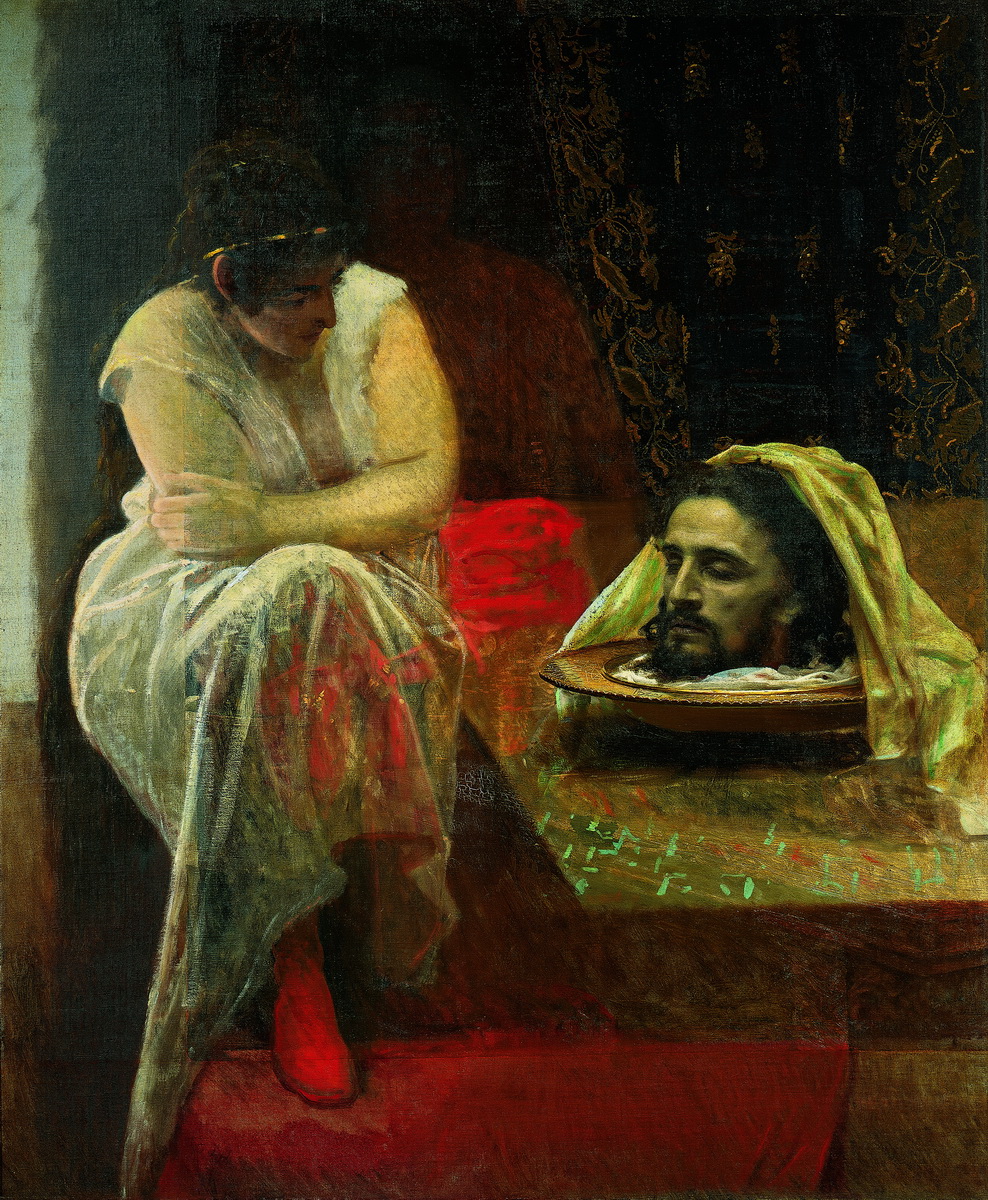
The head that lies before me is expressionless,
the platter spattered in carnelian.
Now king and queen regard no more their dancing daughter.
They nod once more. The deed is done.

A poem/prayer based on Mark 6:14-29, the Revised Common Lectionary Epistle Reading for Year B, Proper 10 (15).

The image is Herodias by Ivan Kramskoi – http://www.art-catalog.ru/picture.php?id_picture=16421, Public Domain, https://commons.wikimedia.org/w/index.php?curid=73681655.

Boasting Fool

But if I wish to boast, I will not be a fool, for I will be speaking the truth. – 2 Corinthians 12:6

Which is it, Paul? Which is it, God?
Foolish boasting from a boasting fool?
Or truth that, shared, inspires?
Truth that, shared, encourages?

I wish I knew.

I am, perhaps, more conscious of my weakness
than Paul was of his strength.
I doubt the exceptional character
of my revelations (let alone my self).

There is a hollowness inside
that hollers, “I am great!”
and echoes, “I am empty!”
and which is it, or both?

I wish I knew.

What can I do but echo the apostle
who expressed himself content with weakness
(I’m not sure I believe he was),
and begged the Holy Spirit then to fill

The empty spaces, tired places,
of the weary body,
of the weary mind,
of the weary soul.

A poem/prayer based on 2 Corinthians 12:2-10, the Revised Common Lectionary Epistle Reading for Year B, Proper 9 (14).

Photo by Eric Anderson

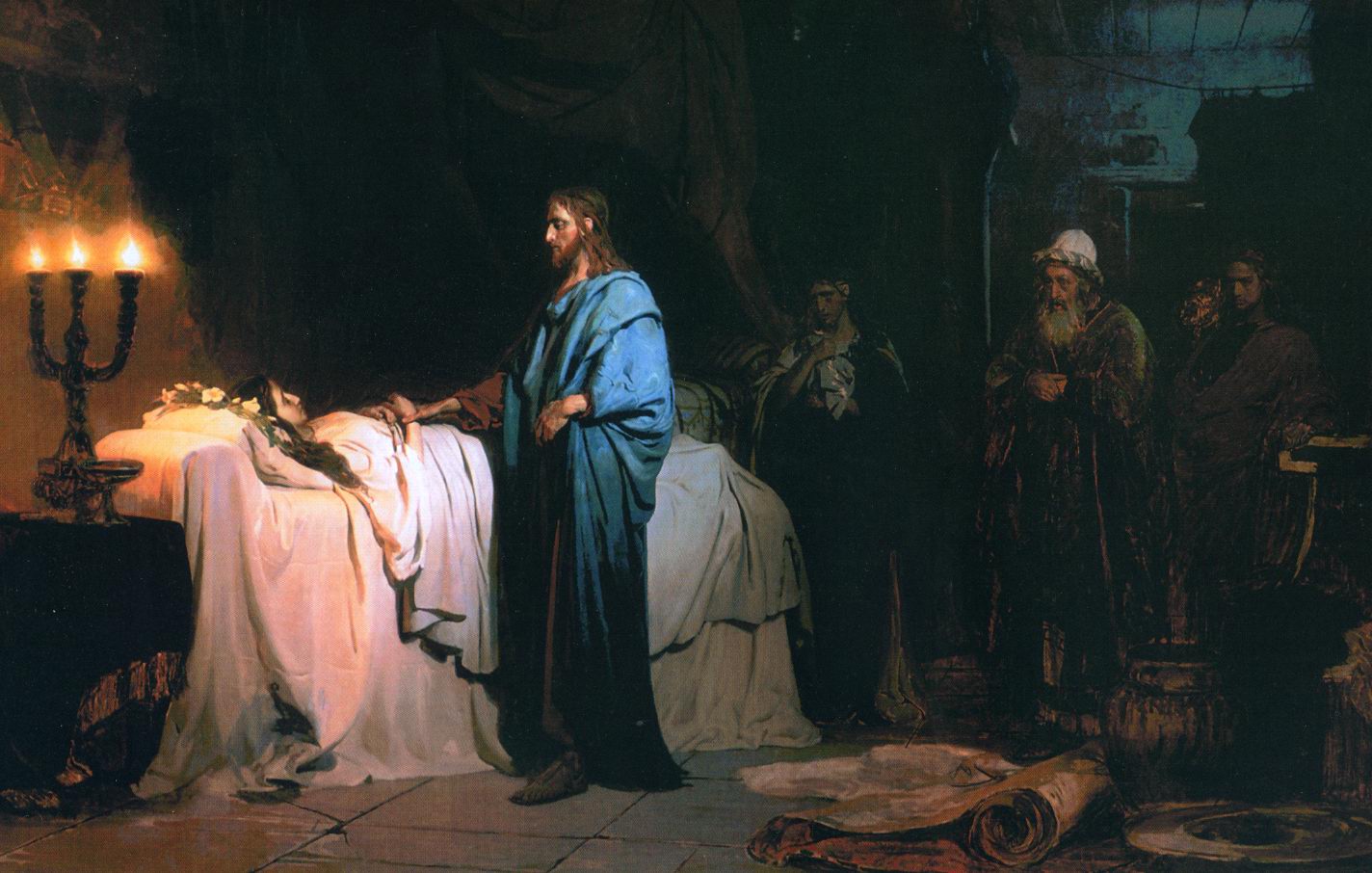
Urgent

“[Jairus] begged him repeatedly, ‘My little daughter is at the point of death. Come and lay your hands on her, so that she may be made well, and live.'” – Mark 5:23

“Immediately aware that power had gone forth from him, Jesus turned about in the crowd and said, ‘Who touched my clothes?'” – Mark 5:30

It’s not complicated, Jesus, it’s urgent.
My daughter/son/companion/father/mother
needs You. Just You. Only You.
They need You now.

Here I am. I’m on my knees.
My friend/lover/spouse/inamorata
will not survive without You. Just You. Only You.
They need You now.

Don’t pause. Don’t dawdle. Don’t turn aside.
My grandson/granddaughter/neighbor/acquaintance
needs You to touch them. Just You. Only You.
They need You now.

Don’t stop. Don’t heal anyone else. Don’t ask questions.
My aunt/uncle/grandmother/grandfather/cousin
needs Your time. Just You. Only You.
They need You now.

Seriously, Jesus. How am I to wait for You
when someone I love
needs You. Just You. Only You.
They need You now.

Oh. Well, that’s all right then.
How was I to know that You
make Your
own time?

A poem/prayer based on Mark 5:21-43, the Revised Common Lectionary Gospel Reading for Year B, Proper 8 (13).

The image is The Raising of Jairus’ Daughter by Ilya Repin (1871) – http://f.rodon.org/p/1/070901155909d.jpg, Public Domain, https://commons.wikimedia.org/w/index.php?curid=461972.

It’s Scary Out Here

“But [Jesus] was in the stern, asleep on the cushion…” – Mark 4:38

Yeah, absolutely. I’m going to wake him up.

You, Peter, have been shouting for a half an hour.
You, Andrew, have been shouting back.
James and John have been pulling on the same rope
in opposite directions. And you’re the experts.

I never thought I’d hear the Sons of Thunder
overmatched by screech of wind and wave.
Shout away, boys. I can’t hear you. You can’t hear you.
For sure the wind can’t hear you and it doesn’t care.

Thomas looks like he can’t believe what’s happening.
Philip, Bartholomew, and Judas all are seasick.
James son of Alphaeus is pretending to be a son of Zebedee,
but he knows nothing at all about boats.

Thaddeus and Matthew are praying beneath the thwarts.
I’m pulling on a rope when it’s handed to me,
and releasing it when Peter, Andrew, James, or John
snatches it away. At least two lines are streaming in the wind.

So, yes, I’m going to wake him up. I can’t believe
he’s not awake already. Peter’s stepped upon him twice,
and Philip tripped on him when making for the gunwale.
He’s soaked with spray amidst the pounding roar.

Maybe he can bring some order to this chaos.
Maybe he can heal the seasick.
Maybe he can bless us in the baptism of death.
Maybe he can just be with us as we drown.

That, at least, would be a comfort. It hasn’t been
a lengthy journey with the Teacher, and I wish
it wouldn’t end like this, but if we drown,
let’s drown together with the Master wide awake.

But man. That guy can sleep.

A poem/prayer based on Mark 4:35-41, the Revised Common Lectionary Gospel Reading for Year B, Proper 7 (12).

The image is The Storm on the Sea of Galilee by Rembrandt van Rijn, 1633 – www.gardnermuseum.org : Home : Info : Pic, Public Domain, https://commons.wikimedia.org/w/index.php?curid=6812612. The painting is still missing after being stolen from the Isabella Stewart Gardner Museum in Boston in 1990.

Of Itself

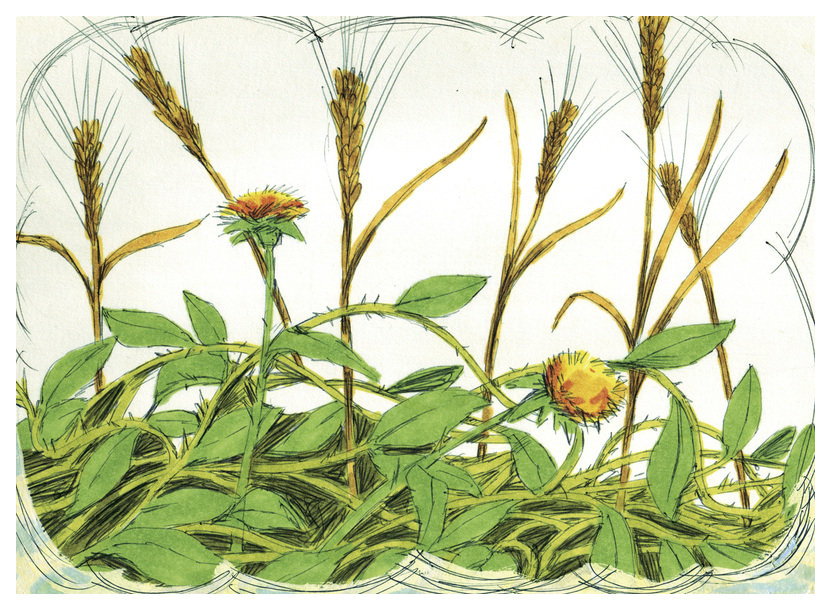
“The earth produces of itself, first the stalk, then the head, then the full grain in the head.” – Mark 4:28

I am the seed, cradled in the loving embrace of God.
I am the seed, held in the richness of mercy.
I am the seed, surrounded by blessings.
I am the seed, cracking my shell to grow.

I am the stalk, stretching toward the heavens.
I am the stalk, nourished by my roots below.
I am the stalk, proudly waving in the wind.
I am the stalk, upheld by the ground divine.

I am the head, making space for the seeds.
I am the head, barely aware of the soil that feeds me.
I am the head, dancing among the grasses.
I am the head, confident of my own grace.

I am the grain, ripe and rich and precious.
I am the grain, and I have no memory of the Earth.
I am the grain, the fruit of my own growing.
I am the grain, flying out upon the wind.

I am the seed, fallen now to the dust.
I am the seed, fearing the burning sun.
I am the seed, praying for soil to cover me…
I am the seed, cradled in the loving embrace of God.

A poem/prayer based on Mark 4:26-34, the Revised Common Lectionary Gospel Reading for Year B, Proper 6 (11).

The image is by Jim Padgett, an illustration for Read’n Grow Picture Bible Illustrations (Biblical illustrations by Jim Padgett, courtesy of Sweet Publishing, Ft. Worth, TX, and Gospel Light, Ventura, CA. Copyright 1984); used by courtesy of Distant Shores Media/Sweet Publishing, CC BY-SA 3.0, https://commons.wikimedia.org/w/index.php?curid=18886335.

Family

“…they could not even eat… …whoever blasphemes against the Holy Spirit can never have forgiveness… …’Whoever does the will of God is my brother and sister and mother.'” – Mark 3:20, 29, 35

I can’t quite imagine such enthusiasm,
people so eager to see you, Jesus,
that they drive me away from my lunch.

Yet there was the crowd surrounding your house.
You were far from the lake, no boat for escape,
just skeptical critics and uncertain neighbors.

And family.

I have to admire the gaslighting lie for
its creativity, if not its morality.
“He casts out the demons by power of demons.”

We’d believe it today, you know, Jesus,
just like we believe all those scurrilous tales
about peace through war, about life through death,

About wisdom through folly, about greed is good,
about white wealth is righteous, about injustice is right,
about male is empowered, female is servant,

And family.

Those were harsh words, you know, Savior.
No forgiveness for those who blaspheme against
the Holy Spirit? No forgiveness at all?

Forgive us if we’re just a little bit lost.
We’re barely acquainted with God’s Holy Spirit,
not enough to prevent this unforgivable sin!

As harsh as it was (and it was) to identify you
with the overlord of evil and captain of lies,
could you not forgive their hubris? Their fear?

Did they leave no room for repentance?
Did they step so far from the acceptable
to lose their place among humanity?

And family?

Have I blasphemed against the Holy Spirit?
Have I denied the power of God, of Spirit, of You,
to expand the circle, to welcome the newcomers?

Have I explained blessings of the world as evils?
Have I declared that what is should be,
though you and I know well that it should not?

Have I accepted boundaries that separate
this person from that person, this people from that people?
Have I pronounced as strangers those you choose

As family?

Forgive me what is unforgivable, which is
to deny the power of divine forgiveness, and
restore me to the blessed community

That you have summoned, symbolized by twelve,
expanding with the centuries imperfectly,
yet still the Church, the Way, the Faith,

The family.

A poem/prayer based on Mark 3:20-35, the Revised Common Lectionary Gospel Reading for Year B, Proper 5 (10).

Photo by Eric Anderson.


Peter’s Choice

“While Peter was still speaking, the Holy Spirit fell upon all who heard the word.” – Acts 10:44

I certainly didn’t expect that.

Look at them. Listen to them. Praising God
in languages I’m pretty sure
they do not understand
(I did that once).

I thought I’d seen and heard it all,
the thunderous voice resounding
on the mountain’s summit,
thousands taught and fed.

The accusation I would soon deny,
soon echoed by my very throat,
“I do not know the man,”
once, twice, thrice.

Familiar voice, familiar face, though
glazed with tears, muted by sobs,
a story I have never told.
It goes too deep.

Tongues a-flickering upon the heads
of friends whose tongues declared
in languages they did not know,
and I, I spoke so, too.

I heard my own untutored voice
declare the truth I had denied,
I knew this Jesus, and I
know his power.

Since then? What miracles! What sorrows.
People healed with no more than
to hear the name of Jesus Christ
roughly spoken in my voice.

The joy of hearing Stephen, face aglow,
speaking with courageous grace;
the anguish then to see him
done to death with stones.

The People of the Way dispersed by Saul,
then – miracle of miracles! – the Saul
who persecuted raised his voice
to praise the name of Christ.

And now I am confronted with a miracle
I hadn’t hoped for (hadn’t asked for)
as Gentiles (Romans for God’s sake)
rejoice in Jesus’ name.

Oh, what to do? I could explain it so:
It looks, I grant you, like the Holy
Spirit, but I’m sure it’s just
enthusiastic show.

Or possibly a consequence of what
they’ve eaten or they’ve drunk.
Too much wine; spoiled food.
Good thing I didn’t eat.

I might not need explain a thing, of course.
The people with me would keep silent
if I did, lest they be left to testify
to what this moment means…

No. No silence. No denial. I have learned…
a bit. “Can anyone withhold the water,”
(with my eyes, I tell them, “No”)
“to baptize the Spirit-filled?”

No silence. No withholding.
God has chosen these to bless.
Bring the water. Cleanse my expectations,
so an expansive future can begin in Jesus’ name.

A poem/prayer based on Acts 10:44-48, the Revised Common Lectionary First Reading for Year B, Sixth Sunday of Easter.

The image is Saint Peter Baptizing the Centurion Cornelius by Jan Erasmus Quellinus (late 17th century) – Own work, Public Domain, https://commons.wikimedia.org/w/index.php?curid=59323889.

Complicated

“Beloved, let us love one another, because love is from God; everyone who loves is born of God and knows God. Whoever does not love does not know God, for God is love.” – 1 John 4:7-8

The Bible is complicated – Love one another.
Faith requires discernment – Love one another.
Righteousness needs consideration – Love one another.
Perfection results from preparation – Love one another.

In the meantime, I’ll carry on with what I’ve been doing.

Love one another.

A poem/prayer based on 1 John 4:7-21, the Revised Common Lectionary Second Reading for Year B, Fifth Sunday of Easter.

The image is The Head of Christ Carrying the Cross, a wood sculpture by Heinrich Douvermann (ca. 1520-1530) – Photograph from Bildindex der Kunst und Architektur: object 20603132 – photograph number RBA 608 899 – image file mi10859f02a.jpg, Public Domain, https://commons.wikimedia.org/w/index.php?curid=37895066

Two Trials

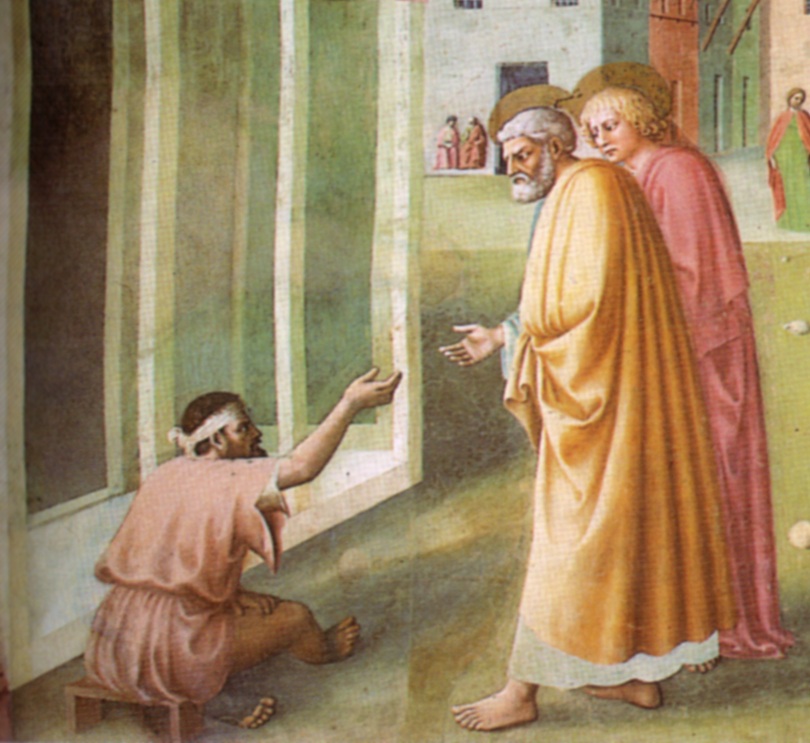
When they had made the prisoners stand in their midst, they inquired, “By what power or by what name did you do this?” – Acts of the Apostles 4:7

They tried two people for healing.
They tried one man for killing.

They tried two people who had offered new life.
They tried one man for rebuffing offers of aid.

The two people spoke for themselves.
The one man held his silence.

The two people declared a new truth.
The one man maintained an old, old lie.

The two people walked away free.
The one man was imprisoned in his guilt.

But…

One of the two faced other trials.
He died unjustly upside-down on a cross.

How many trials will defend the old, old lie?
How many will die, their lives uncherished?

In sorrow for the death of George Floyd.

A poem/prayer based on Acts 4:5-12, the Revised Common Lectionary First Reading for Year B, Fourth Sunday of Easter.

The image is a detail from Healing of the Cripple and the Raising of Tabitha by Masolino da Panicale (1424). Photo and crop: Cappella_brancacci, Guarigione_dello_storpio_e_resurrezione_di_Tabita(restaurato),Masolino.jpg: see filename or categoryderivative work: StAnselm (talk) – Cappella_brancacci,_Guarigione_dello_storpio_e_resurrezione_di_Tabita(restaurato),_Masolino.jpg, Public Domain, https://commons.wikimedia.org/w/index.php?curid=15047438.

Surprise!

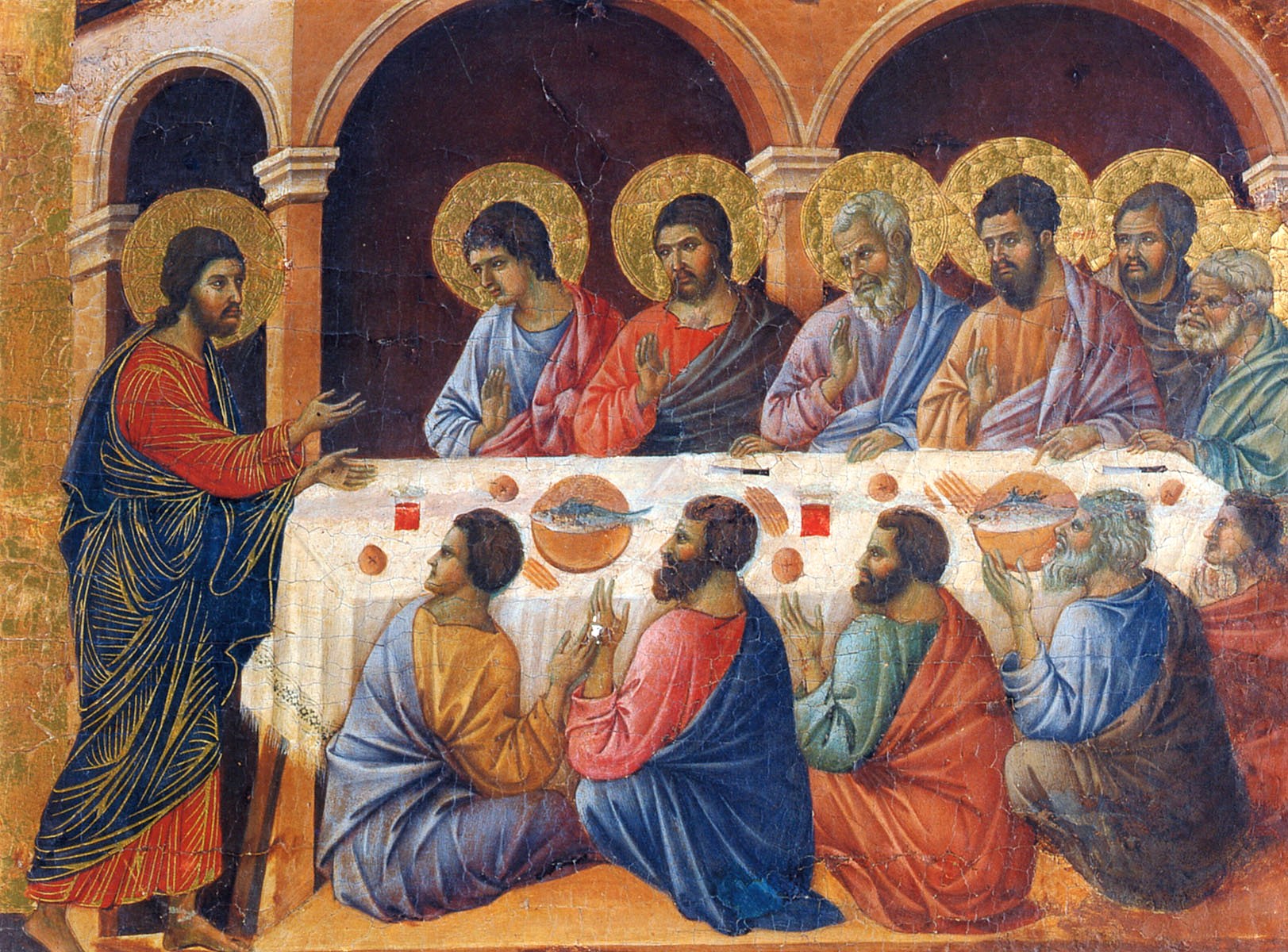
They were startled and terrified, and thought that they were seeing a ghost. – Luke 24:37

Surprise! I’m back!

Why are you surprised?

Mary Magdalene told you, I know. She’s had her demons,
but she can tell a story. Joanna can, and Mary, too,
and if they couldn’t they had company to share the tale
the angels told them. Oh, but no: you didn’t listen,
did you? You called it just an idle tale?

But why are you surprised?

I walked for miles toward Emmaus.
Cleopas and (sorry, I forget the name)
spent hours with me, fire in our feet
and in our hearts and then I broke the bread.
Which they just told you, right?

So why are you surprised?

You didn’t listen when old Simon there,
my so-rock-headed friend, said, “I’ve seen him!
Jesus lives!” He doesn’t have the gifted tongue
of Mary – no, not yet – but still you might
have done the favor of believing him.

Yes, why are you surprised?

Did I not tell you once and twice and so
and on again, again, again, that death
would come and death would go and I
would rise to come and speak with you?
And you are fearing ghosts, for heaven’s sake.

Sigh. Why are you surprised?

All right. You’ve heard the story thrice, and nope.
So here I am. You see me? Unconvinced.
I’m speaking right? You stubborn… argh.
Try touching. There’s even wounds to see
and feel; there’s bones beneath the skin.

No. You are still surprised.

For pity’s sake, can we move on from this?
I’m hungry. Have you anything to eat?

A poem/prayer based on Luke 24:36-48, the Revised Common Lectionary Gospel Reading for Year B, Third Sunday of Easter.

The image is Christ Appearing at the Apostles’ Table by Duccio di Buoninsegna (1308) – http://www.wga.hu/frames-e.html?/html/d/duccio/buoninse/index.html, Public Domain, https://commons.wikimedia.org/w/index.php?curid=3925674.

One of the fascinating literary features of the Gospels – more in some, less in others – is the way the evangelists let the Twelve stand in for the uncertainties, ignorance, and earnest-but-not-educated yearning of their readers. As a result, the Twelve (Eleven in this passage) have something of a slapstick comedy feel to them. When they become figures of wisdom, authority, and talent in Acts of the Apostles, it comes as something of a literary (if not spiritual, thanks to the Pentecost event) surprise. In tribute to their earnestness which is also ours, I offer this… “Try and catch up with me, will you?” version of Jesus.