“So the other disciples told him, “We have seen the Lord.” But [Thomas] said to them, ‘Unless I see the mark of the nails in his hands, and put my finger in the mark of the nails and my hand in his side, I will not believe.'” – John 20:25
Stretch out your hand, Jesus. Mine is stiff and still. Stretch out your hand, Jesus. I dare not reach to you or anyone.
I have no need to touch your scars. I see those well enough. I have no need to deepen your wounds (except that I already have).
No, stretch out your hand to me, Jesus. This season has been long and lonely. Stretch out your hand, Jesus, so I may feel your gentle touch.
A poem/prayer based on John 20:19-31, the Revised Common Lectionary Gospel Reading for Year B, Second Sunday of Easter.
For this is the reason the gospel was proclaimed even to the dead, so that, though they had been judged in the flesh as everyone is judged, they might live in the spirit as God does. – 1 Peter 4:6
I would wish you a restful Holy Saturday, my Savior, a Sabbath to honor God’s rest in Creation, a Sabbath to honor the leisure of freedom, a Sabbath between work done and to be done.
Yet this one verse of Scripture bewildering rings also with promise and grace, that your love would encompass not only the living, but also raise up the dead.
We honor the dead in our memory, unless we seek to excuse the living, and then we defame them, abuse them, discard them as surely as Pilate intended for you.
So Jesus, I pray you forgive my hope that your Holy Saturday set aside rest to welcome all spirits, once living, still living, into the new life for which you had died.
A poem/prayer based on 1 Peter 4:1-8, the Revised Common Lectionary Second Reading for Year B, Holy Saturday.
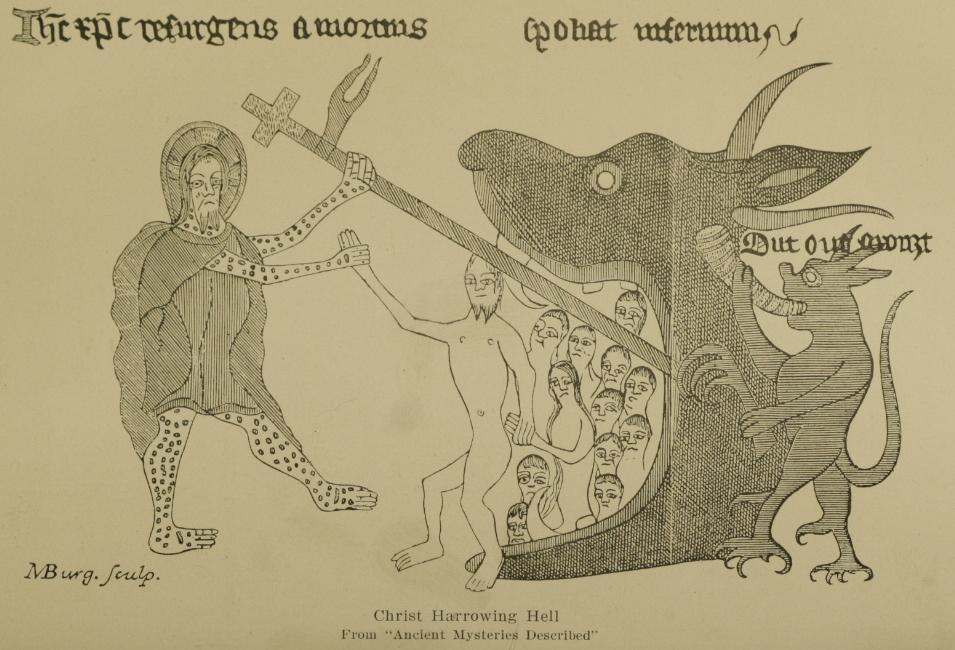
The image is The Harrowing of Hell by Michael Burghers (1647/8–1727) – Copied from the 1904 work “Plays of our Forefathers” by Charles Mills Gayley, Public Domain, https://commons.wikimedia.org/w/index.php?curid=3434524.
The video will be available beginning at noon on Good Friday, April 2, 2021.
These eight poems are based on Scriptures associated with “the Seven Last Words of Jesus” – and yes, there are eight lessons. I read the Biblical texts as well as the poems in the video above.
Good days, good days, he said, but did they seem so green and good to those who felt the yoke of Rome, to those whose load was not relieved?
No doubt they felt the burden pressing down, with no one seized to carry it behind, but at least they had the means to grieve, to shed their tears for one the cross would bear.
And surely, they would know that arrow, sword, and torch would come for them in time for he was right – in times not good, but not so hard, they execute the Christ – far worse they did and do
O were the only source of sin my ignorance! For then I’d claim the mercy of the Savior freely, pleading only that I did not know what I was doing.
But no, I must join the second soul suspended, fully knowing that for all the good I seek to do, my choices falter, resolution fails. The ill I would not do – I do.
“Forgive them in their ignorance,” he said. Forgive me in my knowledge. May I hear the echo of your reassurance: “You will be with me in Paradise.”
No word from Jesus on the cross. No word, but only clouds to dim the sun. No word, but only fabric’s failure and the curtain separating God from us has plummeted, has torn in tears.
A loud voice. A loud voice. You cried out with a loud voice, the opening words of David’s song: “My God, my God, why am I left alone?”
Was no breath left to finish it, to whisper, “You are holy,… to you they cried and were saved;… they were not put to shame”?
But no, they mocked and scorned (as in the psalm), they shook their heads. They might have recognized the words. Did anyone, did even you, recognize their end?
Theologies of glory lie ahead in days and years and hearts and minds. For now, the Maker of the Universe can only gasp, “I thirst,” and wonder at the sour taste, the halting breath, the sweet-sick scent of hovering Death.
[Jesus said,] “I give you a new commandment, that you love one another. Just as I have loved you, you also should love one another. By this everyone will know that you are my disciples, if you have love for one another.” – John 13:34-35
We’ve struggled, Jesus, really struggled with all these words, these words. “Love one another”: Sure, it sounds so good to say but when the chips are down what does it mean, you know?
Like who, exactly, should we love? My life is burdened, Jesus, with a host of people I have no great feeling for. I’ll treat them all OK, you know, but more? They’d take advantage sure.
And should we ask about abusers, Lord? How do we love the ones who do not love, who hurt and harm and rape and kill? What love do they deserve, when they will just abuse the more, you know?
How can we love the ones who do not love themselves, who cannot stretch their circumstance to make their living better? They absorb the love we give, you know, and offer nothing in return.
Then there are those who love themselves alone, or love their wealth, or love their weapons. They accept so little of the love we give. They offer only scorn, or pity, or at worst the flying messengers of death, you know.
Love for the rank unlovable, you ask? I’ll wait until your back is turned to roll my eyes. For all the reasons anyone could name, there are just some, you know, that not even their mothers could give love.
A complicated mandate, this mandatum, requiring more than words to get it all assembled, like a fine-laid piece of furniture, not just a rough-laid table like this one tonight, you know.
So Jesus, could you give us illustrations? A picture and directions? You know?
Why…
Why…
Why are you washing my feet?
A poem/prayer based on John 13:1-17, 31b-35, the Revised Common Lectionary Gospel Reading for Year B, Maundy Thursday.
The image is Christ Washes the Apostles’ Feet, a 12th or 13th century mosaic in Monreale Cathedral, Palermo, Sicily, Italy. Note the Latin “Mandatum” – commandment – at the top of the mosaic. Photo by Sibeaster – Own work, Public Domain, https://commons.wikimedia.org/w/index.php?curid=10756980.
After saying this Jesus was troubled in spirit, and declared, “Very truly, I tell you, one of you will betray me.” The disciples looked at one another, uncertain of whom he was speaking. One of his disciples–the one whom Jesus loved–was reclining next to him; Simon Peter therefore motioned to him to ask Jesus of whom he was speaking. So while reclining next to Jesus, he asked him, “Lord, who is it?” Jesus answered, “It is the one to whom I give this piece of bread when I have dipped it in the dish.” So when he had dipped the piece of bread, he gave it to Judas son of Simon Iscariot. After he received the piece of bread, Satan entered into him. Jesus said to him, “Do quickly what you are going to do.” – John 13:21-27
For centuries your followers have sought to make the choice of Judas make some sense. Was he just greedy? Was he bereft of soul? Did he have some agenda you would not accept?
Despite the Gospel writers’ efforts, Judas’ treachery remains a mystery.
The greater mystery is how you shared that bread – the bread we break in honor of your death – how did you share that piece of bread and know, and know that he contrived your death?
Who is it, Lord? your closest friend inquired. You knew. You knew the name as well as you discerned the anguish that approached, that would be on its way, when you extended bread.
Were I to know such things, could I extend a piece of bread as to a trusted confidante, and breathe, “Do quickly what you do.” The answer is a clear and easy, “No.”
Yet you released the bread into betrayer’s hand, and put your life into his hand. He took his hand into the night to take your life.
Despite the Gospel writers’ efforts, Jesus’ love and bravery remain a mystery.
A poem/prayer based on John 13:21-32, the Revised Common Lectionary Gospel Reading for Year B, Wednesday of Holy Week.
“…But we proclaim Christ crucified, a stumbling block to Jews and foolishness to Gentiles, but to those who are the called, both Jews and Greeks, Christ the power of God and the wisdom of God. For God’s foolishness is wiser than human wisdom, and God’s weakness is stronger than human strength.” – 1 Corinthians 1:23-25
We are practiced and proficient at crucifying you, O Christ.
Before your squalls e’er cracked the stable’s musty silence, you suffered in your people’s suffering.
How many shall we name? The Calvaries of Scripture? Brickworks in Egypt. Assyrian spears. Mendacious monarchs. False prophets.
The flames of Solomon’s temple. The ceaselessly repeated prophets’ bark: “The widows and the orphans have been left to die.”
We are practiced and proficient at crucifying you, O Christ.
The hands that drove the nails into your flesh did so adeptly, trained by other flinching, bleeding flesh, and other hopeless moans.
Other hands were just as deft to rob the poor and call it right, to crush the power of women and to burn the Second Temple, too.
For followers of Christ the faith might mean exclusion from their home, bereavement from their trade, and yes, it might mean crucifixion.
We are practiced and proficient at crucifying you, O Christ.
I’ve been accustomed to using nails of race and gender privilege, to seeing nails of emptied magazines and nails of gender definition.
I’ve mourned and not prevented nails of poverty and war and greed from fixing you – your people – to the crosses that adorn this world.
But never had I thought to see that foolishness and folly would conspire to claim the crown of wisdom and to crucify a host in just a year.
We are practiced and proficient at crucifying you, O Christ.
No wonder that you wept.
A poem/prayer based on 1 Corinthians 1:18-31, the Revised Common Lectionary Gospel Reading for Year B, Tuesday of Holy Week.
Mary took a pound of costly perfume made of pure nard, anointed Jesus’ feet, and wiped them with her hair. The house was filled with the fragrance of the perfume. – John 12:3
Oh, Jesus, must you say such shocking things? She had, indeed, done such a precious thing for you, so tender and so intimate, so grateful for the love you bore for her and Martha. For after all, you brought their brother back.
And now, with scent of spikenard rising in the house, you spike the words of Judas, keeper of the purse, by speaking of the day you would be laid to rest, a tragedy that perfume could not sweeten, not with rivers poured upon your lifeless corpse.
Oh, pause now, Jesus, for you shock us once again, for must we ever have the poor with us? Could not the rivers of the scent we’ve not poured out transform this world into a paradise on earth? Perhaps they could – but bottled they remain.
Except for this one jar unstopped above your feet, the oil dripping from your soles into the earthen floor, still warm from your still-pumping heart, now rising to enchant your breath, their breath, our breath, sweet-scented dust inhaled to death and life.
A poem/prayer based on John 12:1-11, the Revised Common Lectionary Gospel Reading for Year B, Monday of Holy Week.
Save us, we beseech you, O LORD! O LORD, we beseech you, give us success! Blessed is the one who comes in the name of the LORD. – Psalm 118: 25-26a
Festival season. Who needs it? The city packed with visitors (Okay, the vintners and the innkeepers: they need it). Just throngs of throngs of throngs.
The throngs are noisy, just not quite this noisy. What’s amiss? They’re piling up along the road from Bethany toward the Temple gate.
Good heavens. Now the trees are waving as they strip the branches down, to lay them in the road. I see the hues of cloaks and coats as well.
“Hosanna! Save us!” now they shout, a cry both pious, quoting of the psalm, and eminently timely in these times. “Blessed is the one who comes!” – but who?
Oh, dear. This doesn’t look so great. No horse. No guards. No retinue. A dusty teacher on a colt, escorted by rough peasants.
A glance to one side or the next reveals that not all shout or celebrate. The priests, the guards, the noble ones: They watch with faces set and grim.
And I would make my way away from this, for I have things to do that will not muddle me in symbols of revolt, of pitiful defiance,
Yet the throng still presses, holding me in place to watch the colt’s slow steps, to listen as they shout, “Hosanna,” and to wonder if such saving could arrive.
I fear, however, that the only route from this display leads not into a royal seat, but to the tender mercies of a Roman governor.
Such mercies are not tender, no. Such mercies lead beyond the Temple’s court to where the hill is crowned too oft with human figures writhing on a cross.
I watch the colt-borne teacher ride away, followed by the throng, releasing me to find my path again. My road will be much easier than his.
A poem/prayer based on Mark 11:1-11, the Revised Common Lectionary Gospel Reading for Year B, Sixth Sunday in Lent, Liturgy of the Palms.
The image is Einzug Christi in Jerusalem by Wilhelm Morgner – The Yorck Project (2002) 10.000 Meisterwerke der Malerei (DVD-ROM), distributed by DIRECTMEDIA Publishing GmbH. ISBN: 3936122202., Public Domain, https://commons.wikimedia.org/w/index.php?curid=155912.
“Now among those who went up to worship at the festival were some Greeks. They came to Philip, who was from Bethsaida in Galilee, and said to him, “Sir, we wish to see Jesus…” Jesus answered them, ‘The hour has come…'” (John 12:20-21, 23)
“Timeo Danaos et dona ferentes.” “I fear the Greeks, even those bearing gifts.” (Virgil, The Aeneid)
They bore no gifts for you, just asked to see you, Jesus. Did you see them? John didn’t say. Instead, he quotes you (at some length) reflecting on the seeds that die and live, on lives that end to save themselves, on followers in service, honor rising from humility.
Somehow you saw in their plain inquiry the gathering malevolence that would first strike you down, then lift you up, then bear you breathless to the stony grave. Stern gift, this glimpse into the future’s agony.
They could not know that they had given you the indicator of the time. They could not know that you had made the choice to give the world yourself, and giving, draw them, one and all, into the arms of God.
A poem/prayer based on John 12:20-33, the Revised Common Lectionary Gospel Reading for Year B, Fifth Sunday in Lent.
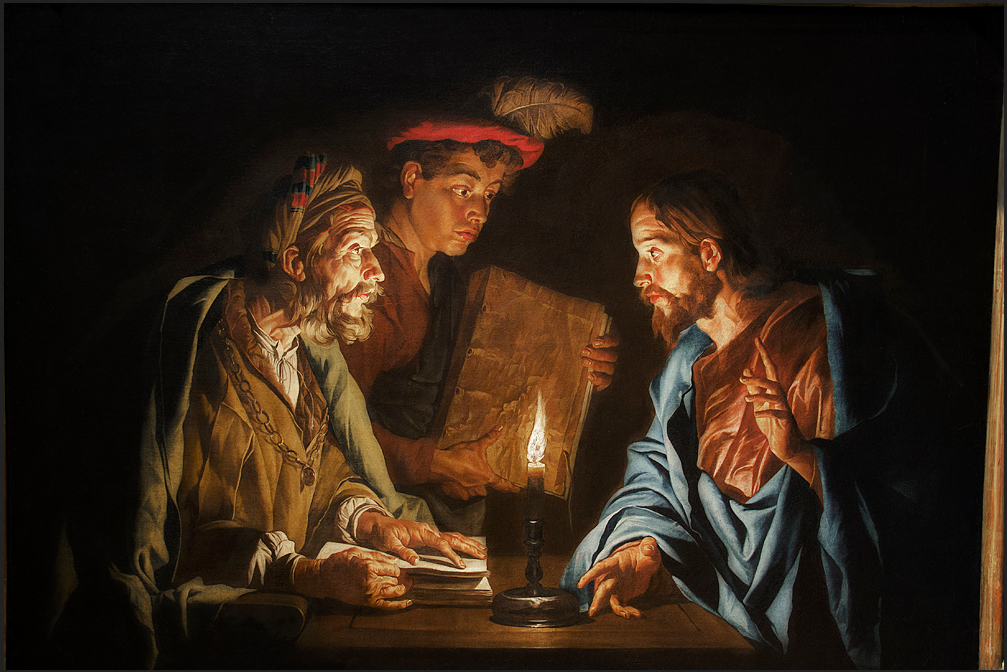
“Jesus answered [Nicodemus], ‘Very truly, I tell you, no one can see the kingdom of God without being born from above.'” – John 3:3
“And this is the judgment, that the light has come into the world, and people loved darkness rather than light because their deeds were evil.” – John 3:19
“You do not understand these things,” you challenged Nicodemus, and I feel a comfortable swell of pride because I understand these things quite well.
As did, I’m sure, the teacher Nicodemus.
Is it so hard to understand that you demanded people to revise their lives, begin again, as if they were twice-born? I understand these things quite well.
As did, I’m sure, the teacher Nicodemus.
The difficulty lies not in the metaphor – we’ve got that cold – but in the living of the metaphor, the struggle to begin again. I understand these things quite well.
As did, I’m sure, the teacher Nicodemus.
Who wants to take a truly brand-new start when there is so much stuff we have amassed, such power, such persistent privilege? I understand these things quite well.
As did, I’m sure, the teacher Nicodemus.
He knew, I know, the comfort of the shadows, the safe familiarity of precedent, the bland acceptance of persistent ills. I understand these things quite well.
As did, I’m sure, the teacher Nicodemus.
My comfort is that you have stated that God’s purpose is redemption and renewal. There is always room to start anew. I take assurance from this well of faith.
As did, I’m sure, the teacher Nicodemus.
A poem/prayer based on John 3:14-21, the Revised Common Lectionary Gospel Reading for Year B, Fourth Sunday in Lent – with John 3:1-13 included as well for context.




 ordainedgeek