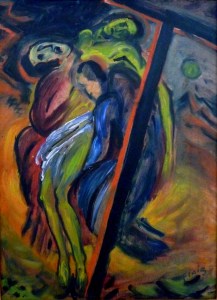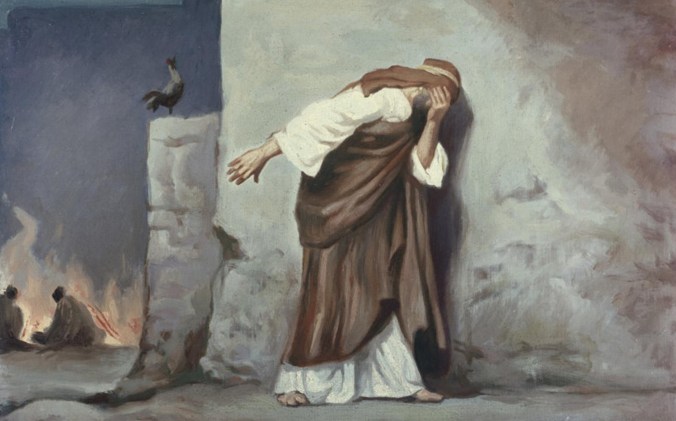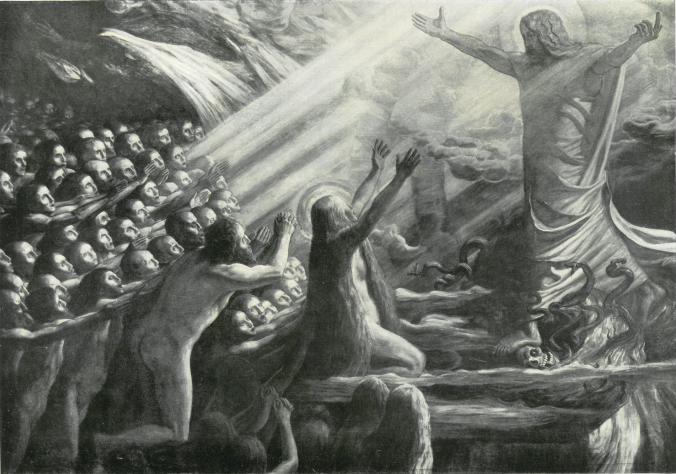
Before the Finish Line

IMG_2072Oh, what a night.
I shouldn’t be surprised
That they were so surprised
(My friends at last night’s supper).
A holy day is not a time, of course,
For breaking bodies with your bread,
For drinking blood instead of wine
(Hey, did you catch what I did there?
It’s like that plague of Egypt, where
God turned the water into blood?
Hey, anybody? No?).

So maybe telling everyone
That they would flee before the night was out
Was something of a downer.
Peter: Always first, you are
To give me the wrong answer
(Except that one most special time, you know,
Although I think that what you mean by “Christ”
And what I mean might be two different things).
Stay by me? “No, my friend, you won’t.
You will not even own that we are friends
Before the cock crows thrice.”

Oh, what a night. I guess I wore them out,
Or certainly they would have stayed awake
While I was praying, weeping, shaking
In anticipation of the end of night.
Night’s end! It should have been a rosy dawn
Whose colors summon promise, life, and joy!
But no, the day has brought me
No relief from woe.

Day has brought me no relief from woe.
Now they lay on questions.
Now they lay on whips.
Now they make a crown with thorns
(Now whose idea was that?)
And jam it hard into my brow.

It hurts.

It hurts, but less than when I saw my best friends run.
It hurts, but less than when I heard the rooster crow.
It hurts, but less than when I saw the face of Judas
Leaning toward me with a kiss.

It hurts.

Well, do your worst, you Romans.
You will; you always do!
Good luck to you, though, Romans,
Because you’ve broken my poor body
So my shoulders will not bear a cross
Up these stony streets. Take that!

I know you’ll find a way to get me there
And get the cross. You’ll fasten me upon the wood
And lift me up and watch and wait
Until my straining lungs exhale
A final time, my “It is finished.”
You’ll get me to my “finish line.”
(Ha! Foolish Romans! Beat me as you will,
You will not steal from me
A gallows humor even as I look
Upon the cross I cannot carry
Up to Calvary’s hill)

And, foolish Romans, do you think
My “It is finished” line is my finish line?
Not for a moment (Well, all right,
For more than just a moment:
For three days. But let that pass.).
I may not lift my cross, but I will lift my life
From out the grave you’d leave me.
No, Romans; and no, Judas;
No, kings and priests and others
Who would claim to speak for God:

You may drag me to a finish line
And claim I’m finished.
But I am never done, or gone,
And I will turn my finish line
Into a new beginning.

Holy Week: Palm Sunday Stones

IMG_2064Let the stones cry out, O Lord, for we are stunned to silence.
Let the cobbles of uneven paving end their reticence,
Break their stillness (does the shout of rock sound like a cracking?),
Raise their voices. Let the stones cry: “Save us! Lord, Hosannah!
Blessed are You who come to bring salvation of our God!”
Crackling praise. If loud enough, perhaps it might drown out
The heaving of our weeping.

We weep for children poisoned by the falling bombs in Syria.
We weep for warriors slain when missiles came to them with death.
We pray for people walking, standing, falling as the truck rolled on.
We pray for people worshiping, and waving palms, recalling You
And how devotion shattered in concussed reverberation.
Let the stones cry out, because your people’s voices
Have been called to weeping.

“Hosannah!” “Save us!” Cry it, stones, as Jesus makes his storied climb
Beneath the venerated gates, with steady step of his swift-borrowed steed,
The one he chose to honor Zechariah, “Humble, riding on a donkey,”
Yet still a declaration of his majesty. Cry it, stones, though your voice be muffled
By the palm leaves strewn upon your surfaces, by the cloth
That’s laid across your seams. Cry it, stones: “Hosannah! Save us!”
Because our voices have been lost to weeping.

Upon your humble mount, O Jesus, what comes to your ears?
The ears of One divine and human? Do you hear our sobs
Across the centuries, though muddled in the mix of cries,
“Hosannah! Save us! Bless us with salvation from our God!”
Their cry, the cry of stones, the cry of desperate humanity,
Is ours. Save us, Lord, from all the evil we would do:
Because our voices have been lost to weeping.

For Khan Sheikhoun

Aircraft circled in the sky, then turned.
The cylinders beneath their wings detached
And with the grace imparted by geometry
They traced their arc into the town.

What was the sound as they erupted?
Did explosions echo from the walls
Already fractured, crazed with crevices
From bombs and bullets previously struck?

Or was it silent, as the creeping poison
Exited the canisters and, carried on the very breath
Of air, passed softly through the lips
Of people, passed into their blood.

And then, and then, and then the cries
Of anguish, and of agony,
Of pain that wracks the body and
Of pain that wracks the soul.

And the world paused,

Afraid, perhaps, to breathe.

Then:

Unguided aircraft in the sky made descent
And in a mad cacophony of death
Erupted on the runways, in the hangars,
Tearing concrete, metal, wood, and flesh.

For the children of Khan Sheikhoun,
For the parents who will share their graves,
For the well-loved and the disregarded
Whose days ended in the poisoned air:

Justice.

So says the superpower.

But:

Tell me, children (and adults) of Khan Sheikhoun,
Has your life (too brief) been honored
With the blood that stained the taxi-ways
Of this airfield of your killers? Has it?

Tell me, children, do you know
If these explosions, this destruction
Will prevent another scene of horror?
For we have supped full of horrors…

Tell me, children, as I strain to hear:
What is your wish, as you breathe free
The scented air of God’s new life,
What is your wish? Your longing prayer?

More blood?

No?

Oh.

Weep, world, to know the will
Of these departed children:
“To live in peace and joy: No more.
To live in peace and joy: No less.”

Forgive us, children. We have failed.
We did not bring your long-for peace to you.
We have not brought your longed-for peace
To anyone. We have brought death and war.

Pause, world:

Fear to breathe

Until the planet’s children
Live in peace and joy.

No more.
No less.

On Tuesday, April 4th, a chemical attack on the village of Khan Sheikhoun in Syria killed over eighty people. Western leaders identified the Syrian government as responsible, and on Thursday, April 6th, United States forces attacked the Shayrat military airfield with cruise missiles, describing it as the source of the chemical bombing. 

The very next day, Syrian warplanes took off from the same base and carried out conventional air strikes. The war continued.

Syria 2001 what became of them by Willy Verhulst

2001 photo by Willy Verhulst, who asks, “What became of them?”

Jesus Wept

Child and Tear croppedAuthor’s note: This poem was written as part of a sermon called “When Jesus Wept” preached on April 2, 2017, at Church of the Holy Cross UCC in Hilo, Hawai’i.

Tears, come, and make your muddy traces
In the dust that yet adheres upon the visage
Of the Savior. Tears, come, as dust-caked voice
With muted tones inquires where he’s laid.
Tears, come, to join those springing from the eyes
Of friends most dear and of their comforters.
Tears, come, to stain the face of God.

Tears, come, because they do not understand.
Tears, come, because they fear when they need not.
Tears, come, because a few among them,
In just a little time,
May howl for your death.
Tears, come, because the road was long,
The body weary, spirit drained,
And who on Earth could hold themselves from weeping
In this sad community of tears?

Tears, come, because these are the depths of grief.
Tears, come, because the one you loved is gone.
Tears, come, because the resurrection has not happened yet,
Not the resurrection of the final day,
Nor the resurrection of today.

Tears, come, because we go to stand outside a tomb.
Tears, come, because we comprehend the paths of time.
Tears, come, because the grave of Lazarus,
Though opened, opens yet another tomb,
And they will carry you where you wish not to go.

Tears, come to testify to love.
Tears, come in solidarity with grief.
Tears, come to gather power for
A glorious resurrection.
Tears, come to anoint thee
For betrayal, for the trial,
For the torture, for the death,
For the tomb ahead.

Tears, come to Jesus’ eyes
And bathe his weary cheeks
With love, with grace, with awe.

Photo credit: The image is cropped from a photo by Giorgio Montersino, used by permission under Creative Commons license.

Inviting Questions

Duccio_di_Buoninsegna_-_Christ_and_the_Samaritan_Woman_-_Google_Art_Project

What would you ask of us, O Jesus, by
Our well of Jacob? How would you secure
Our trust, invite our glance to catch your eye,
Persuade us of your power by flesh obscure?

We keep the treasures of our souls at depths
Much like a well’s, and hide them even from
Ourselves. The treasures! Though our halting steps
You know from rising dawn to setting sun.

What may we ask of you, O Jesus, by
Our well of Jacob? What great secrets tease
From you, who’d see our downcast spirits fly
From mountain to the ever-rolling seas.

With questions let us comprehend your grace
That others may in you find, too, their place.

This poem was written for a sermon of the same title to be preached on March 19, 2017. As it happens, it didn’t make it into the sermon after all.

The image is “Christ and the Samaritan Woman” by Duccio di Buoninsegna, painted ca. 1311.

When the Tempter Quotes Scripture

tentaciones_de_cristo_botticelliThis poem was written as part of a sermon (of the same title) delivered at Church of the Holy Cross UCC in Hilo, Hawai’i, on March 5, 2017.

Did a quaking pulse accompany
You to the Temple’s zenith, Jesus?
With the Tempter?
Did your sandals slip or grip the cedar of the ridge?
Did your mortal soul take hold, just for a moment,
To protest:
“Tempter, you have lifted me too high”?

Ah, now you hear the words of sweet assurance:
“On their hands the messengers of God
Will bear you up,
No bruise will mar your angel-guarded feet
As gently they regain the comfort
Of the ground.”

Across the ages, words of Psalmist’s faith.
And did they challenge You to step, to leap,
To dive toward ground?
For just a moment, did you fail to see
The test it posed to God, and see instead a test
Of your own faith?

We know your story’s ending, Jesus,
How you deflected Tempter’s texts
And Tempter’s taunts
How you refused to put God to the test,
How you refused the bread and realms which were
In truth, your own.

We know this story’s end was the beginning,
Taking your unbruised feet to Galilee,
Samaria,
Jerusalem and Bethany and to the courts of Pilate
Where those feet were bruised and pierced by nails
For love
Of
Us.

Dust Prayer

kileaua-iki-sand-20161010“Remember you are dust, and to dust you will return.”

I’m not complaining, God, but I don’t feel like dust.
Sensations far more liquid dominate my body.
Perspiration trickles in the hollows of my spine.
I cannot count the instances of swallowing saliva.
I cannot count the welling tears of sadness,
Or joy, or simply yawning (wetly) at the close of day.
No, I don’t feel like dust. Like mud, perhaps, or clay
Unfired,
Unglazed,
Unfinished,
Unrefined.

“Remember you are dust, and to dust you will return.”

Liquid, then, or solid;
Dust and ashes, then, or dripping clay,
On this day of dust and ashes I recall
That none of this accreted star-stuff of my frame
Assembled to my own design or plan.
Yes, even though I eat and drink, sustaining skin and bone,
I do not, need not, supervise the flowing pathways
Which disperse the building blocks of me
To make
Me
Me.

Yes, I am dust, Your dust, O God:
Fearfully,
And wonderfully,
(And humbly)
Made.

Amen.

If We Could Love the Ocean

IMG_1212How can we love the ocean?
Its friendly waves deceive;
They rise to overturn and overthrow.
Its cooling depths will smother;
Its countless fathoms crush.
Its gentle surface warmth rises up
In thickening clouds
Which rage in rain and tempest.
So unlike us – or not so unalike?
If we could love each other,
Then we might love the ocean.
If we could love the ocean,
Perhaps we’d love ourselves.

The Wonders of the Sea

789C9037-A767-46EA-AD89-F54A843249C1The wonders of the sea are grand
The flowing wave which flings its diamond spray
Into the air, the glistening schools of fish,
The massive dignity of whales serenely swimming.

The wonders of the sea are tiny
A garden blooms within each pearl of water
And the ripples barely dampening the rocks along the shore
Glint merrily when lightly kissed by sunbeams.

This poem was written for a sermon on Ocean Sunday (Sept. 4, 2016): “Waves of Grace Command the Morning.”

I Wish…

IMG_1082I wish I had words to express my sorrow.
I do not.

I wish I had words to express my anger.
I do not.

I wish I had words to persuade the world.
I do not.

Only tears gathering at the corners of my eyes,
Tears insufficient to cleanse the bloodied shirts
Which could not shield the ebon bodies
Desecrated by lead.

I wish I had words to speak the bullets back to the chamber,
The fingers off of the triggers,
The guns back into the holsters,
The fear out of the hearts,
The aggression out of the speech.
I do not.

I wish I had words so all the world would know
And act as if it knew
That #blacklivesmatter.

But I do not.

In anger and in sorrow at the deaths of Alton Sterling and Philandro Castile.