“As he went ashore, he saw a great crowd, and he had compassion for them, because they were like sheep without a shepherd, and he began to teach them many things.” – Mark 6:34
Bring your compassion, Jesus, for our shepherds howl like wolves. They lay the rod of law with harshness on the poor and spare the ones in power.
Teach us, Jesus.
Bring your compassion, Jesus, for our shepherds carelessly use words that others hear, and hearing ponder. Pondering, they set themselves to violence.
Teach us, Jesus.
Bring your compassion, Jesus, for the shepherds cannot find the way that leads between our Scyllas and Charybdises, and lost, we founder in moral morass.
Teach us, Jesus.
Bring your compassion, Jesus, and teach us many things, like how the shepherd cares first for the sheep, whereas the predator consumes them.
Teach us, Jesus.
We are sheep without a shepherd. Teach us many things. And may we, by God’s grace, learn.
A poem/prayer based on Mark 6:30-34, 53-56, the Revised Common Lectionary Gospel Reading for Year B, Proper 11 (16).
David danced before the LORD with all his might… – 2 Samuel 6:14
Kick your heels up, David, send the linen skirted ephod swinging. Wheel and circle, drum your feet in time with tambourines and cymbals.
Some will scorn you in your very house, and some will watch in silent disapproval. Some will wonder how you dance when death struck down a helping hand last time.
What else to do but dance? you cry. The presence of the LORD has blessed the places where the mercy seat has paused. So what to do but dance with joy as it comes home?
Whirling skirts and pounding feet. Flying fringe and soaring hair. Kick your heels up, David. Dance! And bring us blessing in our heart and home.
The image is Transfer of the Ark of the Covenant by David by Paul Troger (1733), a fresco in the Altenburg Abbey Church, Altenburg, Austria. Photo by Wolfgang Sauber (2018) – File:Altenburg_Stiftskirche_-_Fresko_David_und_die_Bundeslade.jpg, CC BY-SA 4.0, https://commons.wikimedia.org/w/index.php?curid=77865740.
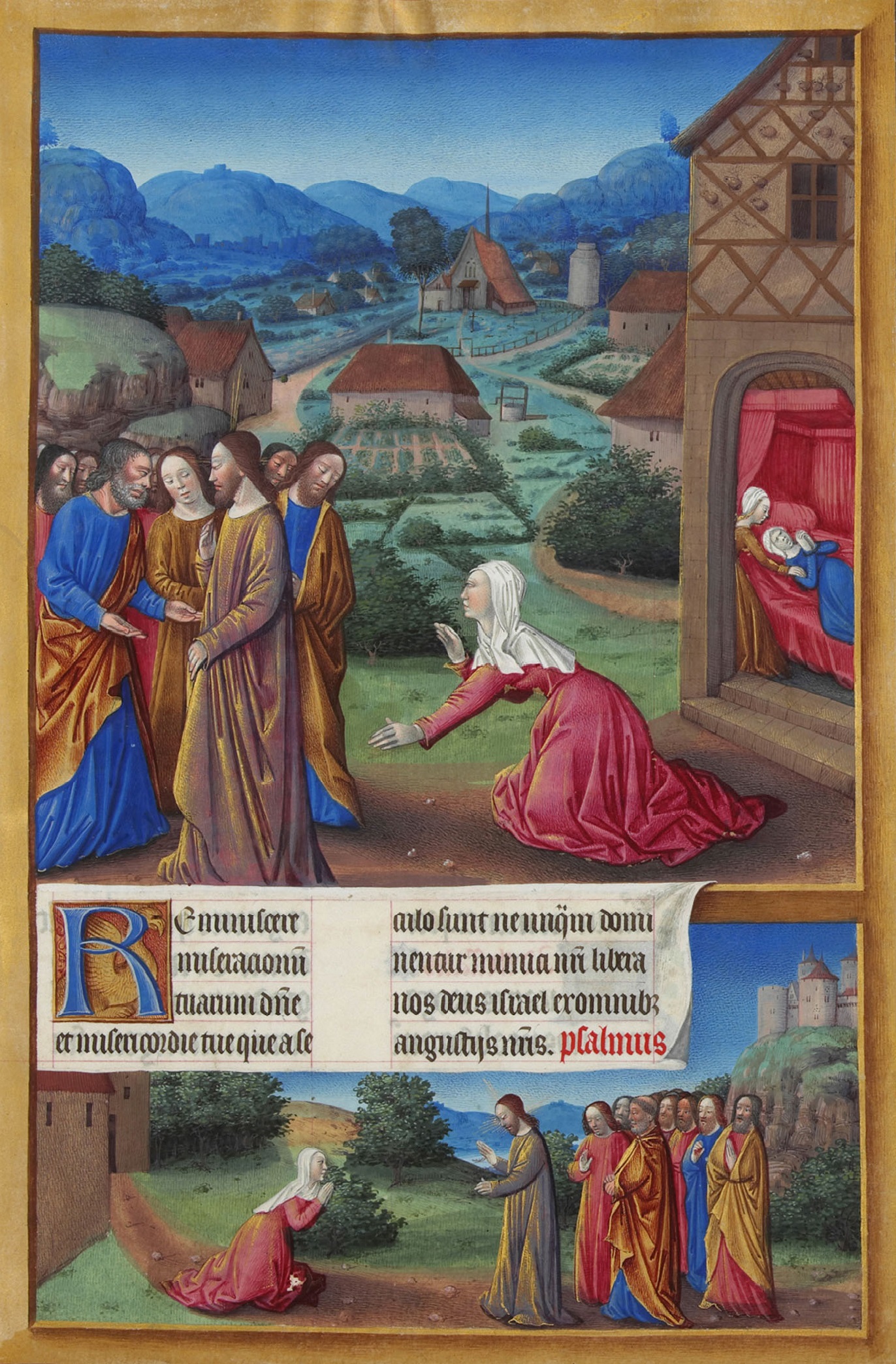
A poem/prayer based on Mark 5:21-43, the Revised Common Lectionary Gospel Reading for Year B, Proper 8 (13).
The image is of the healing of the woman with the hemorrhage from theTrès Riches Heures du duc de Berry. Artwork by the Limbourg brothers (between 1411 and 1416) – Photo. R.M.N. / R.-G. Ojéda, Public Domain, https://commons.wikimedia.org/w/index.php?curid=17443172.Somewhat unusually for images of this text, Jairus’ daughter is visible at right in the upper image.
“But he was in the stern, asleep on the cushion; and they woke him up and said to him, ‘Teacher, do you not care that we are perishing?'” – Mark 4:38
For once, it wasn’t me. I’m known, of course, for saying all the dumb things I could say to Jesus. This time, it wasn’t me.
(And wouldn’t you know, the time it wasn’t me, they left the culprit unidentified. I ask you, was that fair to me or not?)
No, I was busy with the flying rig, and leaning hard to counter all my lubberly companions who knew nothing of the balance of a boat.
I thought it best to wake him, too. I couldn’t calm the lubbers down. Perhaps he could, and then old James and John and Andrew might have saved the day.
Not even I, with all my lack of sense, would dare to utter what he did (I, too, will shelter here the guilty one). “We’re perishing! Or don’t you care?”
Though rope ran slick along my bloody palm, I winced to hear those words. I’d said them to my mother once, and only once. “I don’t believe you care at all!”
I knew that Jesus would respond no better than my mother had. Like her, he fixed the problem first, the wind and sea subsided,
But then he turned that steely glare upon us, one and all, even those who never would have mouthed those ill-considered words, and said:
“Why are you mewling cowards? Do you ask me if I care? Have you no sense? No confidence? No faith?” And we said nothing back at all.
In truth, my confidence was lacking then. I trusted in my seaman’s skills in preference to God. But none of us appreciated then what he had asked of us.
He asked us not to trust in him awake, but trust in him asleep. He asked not to trust in God when fiery pillars stride, but when the way is still unknown.
He asked us not to trust in signs, but in their absence. He asked us not to trust in prophecy, but in the new things prophets had not said.
We asked the question, “Who is this?” as if the answer mattered more than how we meet the challenges of life encouraged by our trust in God.
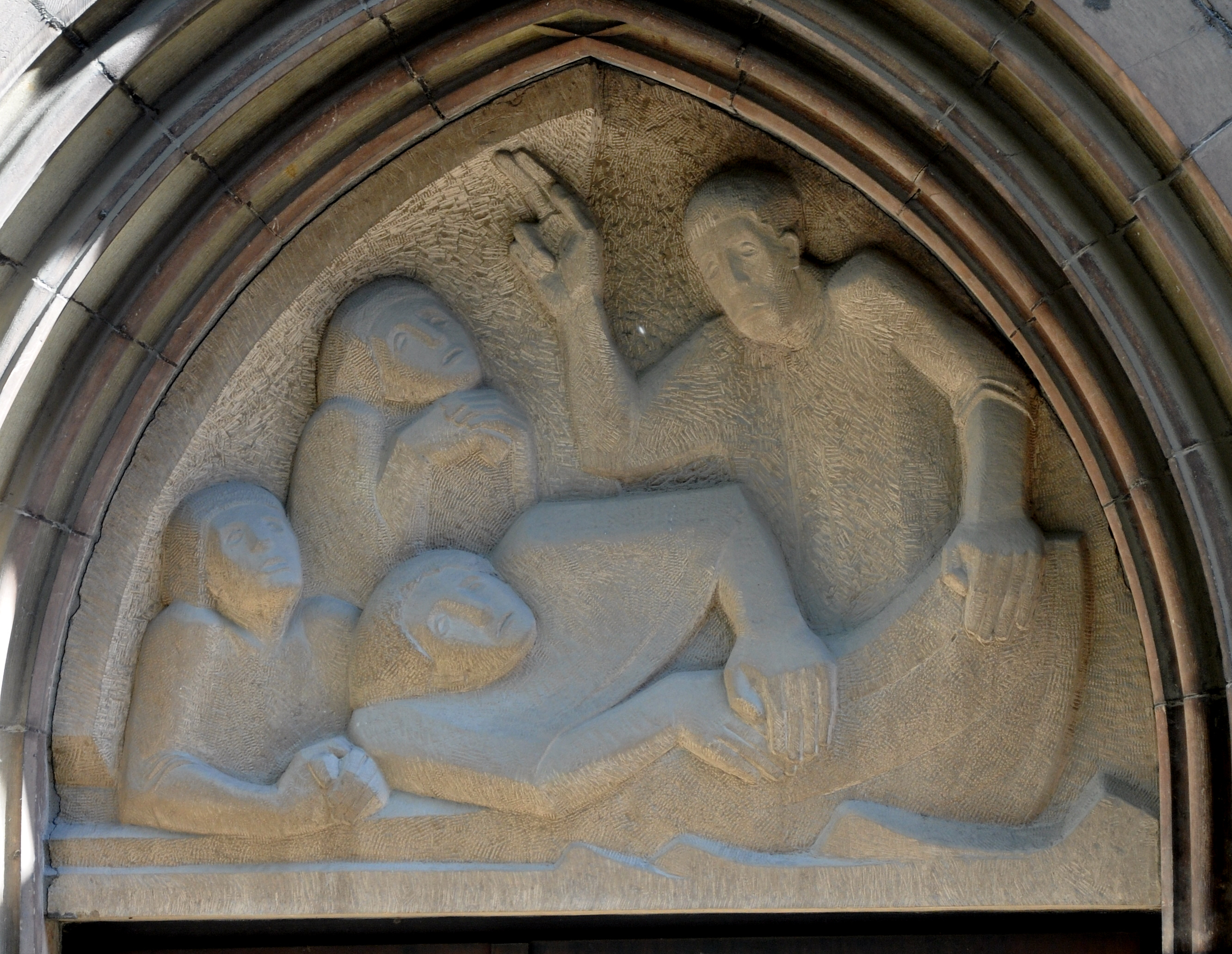
A poem/prayer based on Mark 4:35-41, the Revised Common Lectionary Gospel Reading for Year B, Proper 7 (12).
The image is Stillung des Sturmes durch Jesus (Jesus Calms the Storm), a relief on the exterior of the Stuttgart Stiftsckirche (Collegiate Church of Stuttgart), 1957, by Jürgen Weber. Photo by Andreas Praefcke – Self-photographed, CC BY 3.0, https://commons.wikimedia.org/w/index.php?curid=15039823.
“And the LORD was sorry that he had made Saul king over Israel.” – Samuel 15:35
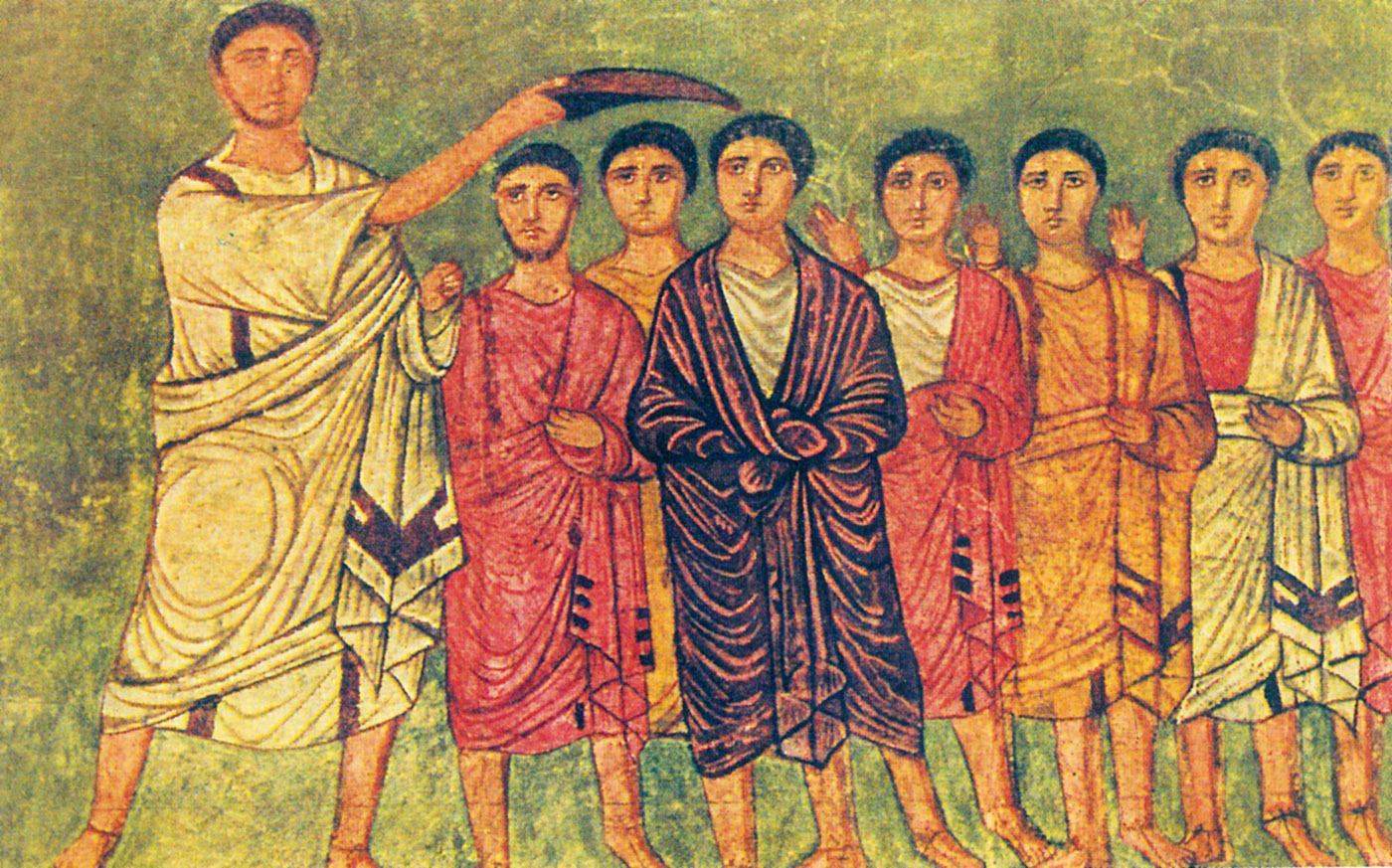
“Then Samuel took the horn of oil, and anointed him in the presence of his brothers; and the spirit of the LORD came mightily upon David from that day forward.” – 1 Samuel 16:13
Will you be sorry of my anointing, God? How much regret do you bear for me? How have I grieved you? How have I dismayed you? Or rather, not how. But when. And how much?
Truly we serve you a very short time, since our birth and our death are mere heartbeats away. How much regret does one soul lay on you? Does it burden you more as each person dismays?
If you are sorry of my anointing, O God, I cannot be surprised. I can only confess that I’m trying, and struggling, and failing, and sometimes, I might do it well if you try me again.
A poem/prayer based on 1 Samuel 15:34-16:13, the Revised Common Lectionary Alternate First Reading for Year B, Proper 6 (11).
“And he called them to him, and spoke to them in parables, ‘How can Satan cast out Satan? If a kingdom is divided against itself, that kingdom cannot stand. And if a house is divided against itself, that house will not be able to stand.'” – Mark 3-23-25
We’ve seen so many times and in so many places just how right you were back then. Divided nations run to evils unimagined, but so bitterly recalled.
You set aside the critics’ pointed accusation that in healing, you performed Satanic will by arts Satanic, too, which made no sense as you so rightly said.
And then they brought you word: your mother and your brothers ask, “How are you, brother, son?” Kept back from you by the besieging crowd they could not see how changed you had become.
“A house divided cannot stand,” yet you would break your home, insult your family. Had they not done the will of God who sent you? Were they not still one with you in love?
A poem/prayer based on Mark 3:20-35, the Revised Common Lectionary Gospel Reading for Year B, Proper 5 (10).
The image is Toute la ville étant à sa porte (All the City Was Gathered at His Door) by James Tissot (between 1886 and 1894) – Online Collection of Brooklyn Museum; Photo: Brooklyn Museum, 2006, 00.159.78_PS1.jpg, Public Domain, https://commons.wikimedia.org/w/index.php?curid=10195908.
Jesus bar-Yosef House with a hole in the roof Capernaum, Galilee
Dear sir:
In light of recent events which have damaged your public image, we offer our services as public relations consultants. We believe that we can increase your name recognition and your positive reputation.
To give you some idea of the value of our services, we would like to comment on two recent encounters that resulted in unnecessary conflict with significant public figures. You can evaluate our suggestions here and realize the benefits you would realize from a permanent business relationship with us.
We realize that your followers – or students; one of the things we’d like to clarify is their role in representing you and your ideas – were hungry while you were out walking with them that day. It is regrettable that they had not prepared for a trip. While we are not event planners, we recommend that you get some additional support to see that you are properly supplied.
The public relations concerns arose when they began to pluck grain on the sabbath. Everyone knows that the followers of a religious leader will be properly scrupulous about following the sabbath regulations. Indeed, a higher degree of respect for those practices is simply expected by the populace. In the moment, it would have gone much better if you had said, “Not now, friends. We don’t have far to go. There will be something to eat soon.”
You were walking just a short distance, weren’t you? We’re confident you were.
Alternatively, as noted above, you could have redirected them to use their pre-prepared foods. Best of all, you might have carried some yourself, and distributed those to your hungry followers. Imagine the positive responses to your generosity!
Then there was the man with the hand. We acknowledge that you actually broke no sabbath regulation at all. You didn’t anoint his hand with oil, which is permitted by most authorities. You didn’t even touch it.
Our concern is with your interaction with the other religious leaders in the room. Granted, they didn’t say anything to you. You might have interpreted that as consent, rather than challenging them for hardness of heart. You might also have said, “Let us see what miracles God will do on the sabbath,” which would have been very pious and quite successful.
Best of all, you could have said to the man, “Come see me tomorrow and we will see what God will do. Today we will rest, and God will rest.”
Frankly, Jesus, he’d been living with that hand for some time. One more day would not have been a burden.
These two events, and a couple of others, have generated some opposition to you and to your message. We firmly believe that you can move past them to a better, more productive relationship with the public at large and with your peers among the religious leadership. We think that some circumspection in some areas, and more emphasis of some elements of your teaching, will really resonate with the population. In short, we believe you have potential and hope to represent you.
The proposal in full is attached.
A poem/prayer based on Mark 2:23-3:6, the Revised Common Lectionary Gospel Reading for Year B, Proper 4 (9).
The image is Christ Heals the Man with a Paralyzed Hand, a mosaic in the Cathedral of Monreale, Sicily, Italy (late 12th – mid-13th cent.). Photo by Sibeaster – Own work, Public Domain, https://commons.wikimedia.org/w/index.php?curid=4515630.
“But Peter, standing with the eleven, raised his voice and addressed them…” – Acts 2:14
Has there been enough time to redeem me?
“You’re the Rock,” smiled Jesus. Oh, yes. I’m the rock. Always first to reply, always first to be chided. They smirked, those eleven, every time I was caught being first to say things they were thinking in silence.
Can a month or two’s passage possibly remake me?
“You’re the Rock,” they have said since the day that he rose. “You’re the first to have seen him” – I open my mouth to remind them of Magdalene, then shut it again. “You’re the Rock.” Well, at least we’re a dozen again.
I wonder what time could refashion a rock?
I told them my shame which the Teacher predicted. How could I hide it? They’d heard, and they’d seen the look on my face on that terrible morning when the heart of the Rock was as brittle as flint.
Passover to Pentecost can’t be enough time.
They never have heard what the Teacher said to me that glorious day when his death turned to life. My flint heart had shattered, and molten, ran over. What words could declare the forgiveness he gave?
But can I be reborn in these brief fifty days?
The wind rushes madly. Lights leap on our brows. Only the Marys sit silent, serenely. We’re out in the street. My God, we look drunk. I’m speaking a language I don’t think I’ve heard. How can I explain what has happened to me?
Fifty days weren’t enough, but a moment transformed me.
Now they look to the thick one, the Rock, to say something. I have no skill with words. I was trained to the net. But Jesus stayed with me, and I recall some things. I’ll start with this verse that he taught me from Joel.
I guess fifty days is enough to redeem.
A poem/prayer based on Acts 2:1-21, the Revised Common Lectionary First Reading for Year B, Pentecost Sunday.
“[Jesus prayed,] I am not asking you to take them out of the world, but I ask you to protect them from the evil one. They do not belong to the world, just as I do not belong to the world.” – John 17:15-16
Between the orbit paths of Jupiter and Mars, a horde of planetoids and rocks and dust surrounds the Sun, tracing their ellipses in a dance with gravity.
One speculation to explain these asteroids is that, long, long ago, a planet strayed too close to Jupiter’s titanic tides of gravity, and broke into these countless rocky shards.
When worlds almost collide, sometimes a world breaks up, and leaves the other without scar or trace of impact made. One shatters. One remains.
Your followers, dear Jesus, live in both a world of harshness, folly, lies, and fraud, and in the world of God’s creative grace. They seek to speak the one unto the other.
Yet when these worlds collide, or when they pass too close, which one will break, and which endure? Which one reflect the sun, which one be hard to see?
Oh, let it be the world of God’s creative love! Oh, let it be the world of Christ’s redeeming love! Oh, let it be the world of grace and truth! Oh, let it be! Oh, let it be!
A poem/prayer based on John 17:6-19, the Revised Common Lectionary Gospel Reading for Year B, Seventh Sunday of Easter.






 ordainedgeek

