Shine, Star, Obscuring Light

“In the time of King Herod, after Jesus was born in Bethlehem of Judea, wise men from the East came to Jerusalem, asking, ‘Where is the child who has been born king of the Jews? For we observed his star at its rising, and have come to pay him homage.'” – Matthew 2:1-2

Shine, star, obscuring light,
summoning to you our eyes.
Shine, star, uniquely bright,
raising our gaze
from the child you herald,
sheltered from harm in the light.

Journey, O wise ones, and follow the star.
Messiah is born.
Messiah is born.
Bring with you offerings costly and sweet
proclaiming Messiah has come.

Shine, star, obscuring light,
summoning to you our eyes.
Shine, star, uniquely bright,
raising our gaze
from the child you herald,
sheltered from harm in the light.

Journey, O wise ones, but not to the city
where monarchs are found,
where monarchs are found.
The Herods both ancient and modern are vicious.
Put not your trust in their words.

Shine, star, obscuring light,
summoning to you our eyes.
Shine, star, uniquely bright,
raising our gaze
from the child you herald,
sheltered from harm in the light.

Journey, O wise ones, away from the city.
The child is not there.
Journey, O wise ones, and do not return
to beard a vicious king in their lair.

Shine, star, obscuring light,
summoning to you our eyes.
Shine, star, uniquely bright,
raising our gaze
from the child you herald,
sheltered from harm in the light.

Journey, O wise ones, rejoice you have seen
Messiah is born,
Messiah is born.
Journey, O wise ones, attentive to dreams
that a bright day will come for us all.

Shine, star, obscuring light,
summoning to you our eyes.
Shine, star, uniquely bright,
raising our gaze
from the child you herald,
sheltered from harm in the light.

Before Maren Tirabassi asks, yes: these have become the lyrics for a song. I think I can perform/record it next week.

A poem/prayer based on Matthew 2:1-12, the Revised Common Lectionary Gospel Reading for Year B, Epiphany.

The image is the Magi and the Star by unknown artist, found in Eliza Codex 24, an Ethiopian Biblical manuscript (date uncertain) – Hill Museum & Manuscript Library, Public Domain, https://commons.wikimedia.org/w/index.php?curid=3106202.

What Do Angels Know?

“And he came to her and said, ‘Greetings, favored one! The Lord is with you.’ But she was much perplexed by his words and pondered what sort of greeting this might be.” – Luke 1:28-29

I almost wish I’d punched him in the nose.
What do angels know, anyway?

“Greetings, favored one!” he said.
I wish I’d told him, “Do not do me favors.
I’m up to here with ‘Just a little task,”
from parents and with posies from that man.

“Don’t do me any favors, angel!
I’m up to here with favors done,
and favors asked, and too few favors given.
Leave me to the chores I have already.”

“Perplexed,” Luke called it. There’s another man
who asked the favor of my memories,
and dressed them up in pink chiffon,
made me sweet as pie.

At least he didn’t blanche the tan
upon my face and rouge my cheeks
and paint a simpering smile on my lips.
No, centuries of artists, they did that.

I almost wish I’d punched him in the nose.
What do angels know?

What do angels know of explanations
to my mother, to my father,
to my oh-so-righteous fiancée?
Only one – my cousin – didn’t ask for words.

What do angels know of smirking gazes,
harsh denunciations, pity hidden
from those oh-so-righteous ones
and hardly even shared with me?

I wish I’d been like Moses, “No! Not I!”
Except it didn’t work for him at all.
And Jonah, I could follow him, through fish and all,
to sit unshaded bitter in God’s favor.

What do angels know?

Well. What do angels know?
They know who will say, “Yes.”
They know who will embrace the need,
and tolerate the scorn, and do the thing.

They know who will endure
the travels and travails, and sing
of mournful seven joys, will break their hearts.
That’s what angels know.

I really wish I’d punched him in the nose.
He knew I wouldn’t.

That’s what angels know.

Luke’s description of Mary during the Annunciation reveals very little emotion. The Greek word translated here as “perplexed” also means “upset.” Unlike my depiction here, Luke’s Mary appears composed, forthright, mindful, and faithful. This is in stark contrast with nearly every other story of a prophet’s call, and if only in the Magnificat, Mary played a prophet’s role. Thus my imaginative retelling here.

I don’t really think Mary would have punched Gabriel in the nose.

A poem/prayer based on Luke 1:26-38, the Revised Common Lectionary Gospel Reading for Year B, Fourth Sunday of Advent.

The image is Annunciation 1912 by Maurice Denis (1912) – Originally from en.wikipedia; description page is/was here., Public Domain, https://commons.wikimedia.org/w/index.php?curid=1880715.

Echo the Prophets

“He has brought down the powerful from their thrones, and lifted up the lowly;
he has filled the hungry with good things, and sent the rich away empty.” – Luke 1:52-53

Echo the prophets, Miriam.
Echo the prophets from Hannah
to Miriam, Samuel to Moses,
Deborah to Jael, Elijah to Elisha.
Echo the prophets, Miriam,
so this prophet’s mother will dance.

Echo the prophets, Miriam.
Echo the call for justice and right.
Echo inversion so those who are “great”
may tumble from comfort.
Echo the prophets, Miriam,
so the ones at the bottom will rise.

Echo the prophets, Miriam,
for the Word is at work within you.
You have been greeted with voices of angels.
You, you alone, know who is to come.
Echo the prophets, Miriam,
so your child will hear you and learn.

Echo the prophets, Miriam.
If the blessings of God seem slow
in their coming, attended with pain
and discomfort for you,
Echo the prophets, Miriam.
Let your voice rise in glorious hope.

Author’s note: The Hebrew name “Miriam” was rendered “Mariam” in the Greek language of the New Testament. Later English translations transformed “Mariam” to “Mary,” while leaving the Old Testament “Miriam” unchanged. I’ve chosen to use the original to emphasize Miriam/Mary’s connection to the ancient prophet Miriam.

A poem/prayer based on Luke 1:46b-55, the Revised Common Lectionary Gospel Reading for Year B, Third Sunday of Advent.

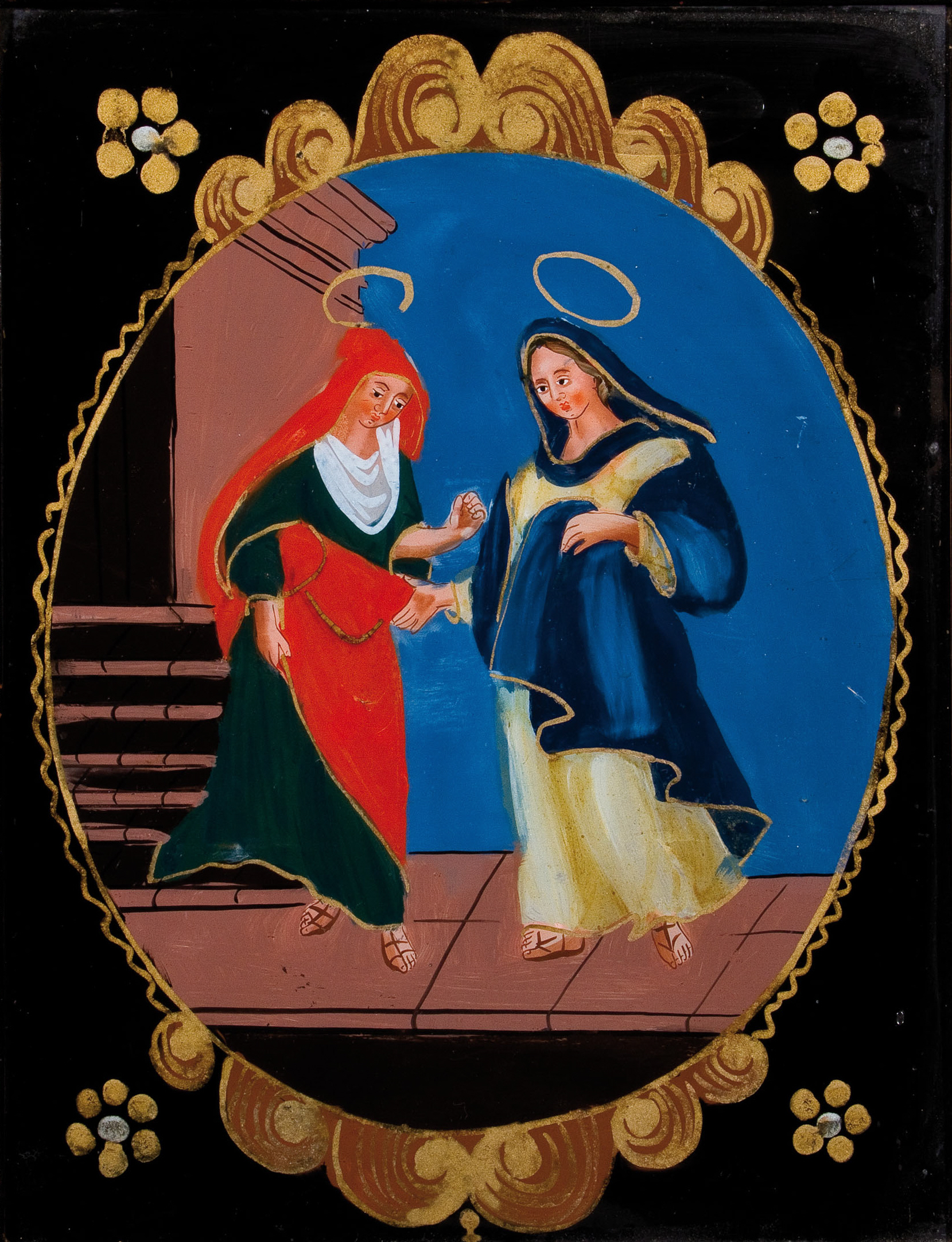
The image is Maria bei Elisabeth (Mary and Elisabeth), 19th century, by Werkstatt Sebastian Winterhalder, Rötenbach, Schwarzwald – Dr. Fischer Kunstauktionen, Public Domain, https://commons.wikimedia.org/w/index.php?curid=17821498.

Turn Around

“The beginning of the good news of Jesus Christ, the Son of God.” – Mark 1:1

“John the baptizer appeared in the wilderness, proclaiming a baptism of repentance for the forgiveness of sins.” – Mark 1:4

My life needs refreshing – turn around.
My body is aching – turn around.
My soul needs renewing – turn around.
My sad eyes are streaming – turn around.

Turn us around, John, turn us around.
Turn us and spin us to cleanse us today.
Turn us around, John, turn us around.
We’re desperate for living anew.

He came to the shore – turn around.
To be baptized by John – turn around.
The first to be bathed in the Spirit of God
Was Jesus himself – turn around.

Turn us around, John, turn us around.
We look for what’s greater than we – turn around.
Turn us around, John, turn us around.
Equip us for living anew.

A poem/prayer based on Mark 1:1-8, the Revised Common Lectionary Gospel Reading for Year B, Second Sunday of Advent.

The image is John the Baptist in the Wilderness, artist unknown but in the manner of Jusepe de Ribera – Royal Collection, Public Domain, https://commons.wikimedia.org/w/index.php?curid=92145938. The smile on the Baptist’s face suggests, to me at least, that he knows something about me and it amuses him.

Clouds

“But in those days, after that suffering, the sun will be darkened, and the moon will not give its light, and the stars will be falling from heaven, and the powers in the heavens will be shaken. Then they will see ‘the Son of Man coming in clouds’ with great power and glory.” – Mark 13:24-26

Outside my window, Jesus,
I see clouds (and sun; no moon).
The clouds will bring us rain
in fifteen minutes, thereabouts.

They will not bring the end of history.

Heaven and earth remain with us.
So do your words, of course.
Some stoke the watching fires,
peering into day and night.

They have not seen the end of history.

Perhaps we have it wrong.
Perhaps rain’s immanence
is not the story of the clouds,
nor do they promise Christ’s return.

They do not bring the end of history.

But just perhaps, if I look close,
in leaden billows or in silver froth,
I’ll see in them a mirror image
of their blessed Creator.

They need not bear the end of history.

A poem/prayer based on Mark 13:24-37, the Revised Common Lectionary Gospel Reading for Year B, First Sunday of Advent.

Photo by Eric Anderson.

Fuel

“Five of them were foolish, and five were wise. When the foolish took their lamps, they took no oil with them; but the wise took flasks of oil with their lamps.” – Matthew 25:2-4

Be ready, you told us, Jesus,
over and over. Watch the fig trees.
Watch for floods. One will go,
one will be left. Do your work.
Fuel your lamps. Invest your talents.
Care for the sick, imprisoned, and needy.

Over and over: “Be ready.”

Be ready to shine. Be ready to care.
Be ready to share. Be ready to welcome.
Be ready to celebrate. Be ready to help.
Be ready. Be ready. Be ready.

But.

Jesus, for how long?

If the groom had been on time,
ten glowing lamps would have
illuminated him along the way.

Not five.

How long? How much extra fuel
will keep my lamp alight to welcome you?
How much investment of my talents?
How many welcomed, visited, assisted?

How long, belated bridegroom Christ?
How long?

Just so you know I know: the only source
to feed the lamp of human light, the only
place to fill the soul is you, O God.
Is you.

If I am to endure to shine before you,
fill my lamp, O God, my flasks and barrels.
Only with your aid will my light shine
today, tomorrow, and in days to come.

A poem/prayer based on Matthew 25:1-13, the Revised Common Lectionary Gospel Reading for Year A, Proper 27 (33).

Photo by Eric Anderson. I know it’s of a tealight candle, not an oil lamp, but I like this picture.

Fringes

“[Jesus said,] ‘They do all their deeds to be seen by others; for they make their phylacteries broad and their fringes long.'” – Matthew 23:5

Some of my stoles have fringes.
Some do not.

I can’t say that the fringes
influence my choice of stole
for Sunday worship.

“Does the color match the season,
or the day (or can I tell myself
it matches) Sunday morn?”

And though I’ve heard
from colleagues once or twice,
“Why wear a stole to worship
in these islands?”
still I move the hangers
on the valet rod each week
to place upon my neck
the cloth cascade of color,
which may, or may not, terminate in fringe.

I take the best seat in the room.
I’m greeted by my title in the shops.
I stand where you can see me
in the sanctuary or on screen.

And pray – so deeply pray –
not to be worthy of the call
(who could be, and who ever was?)
but to be modest in the call
and stand aside so that a greater light
may shine, illuminating greater things

than me.

A poem/prayer based on Matthew 23:1-12, the Revised Common Lectionary Gospel Reading for Year A, Proper 26 (31).

Photo by Eric Anderson.

Unknown Grave

“Then Moses, the servant of the LORD, died there in the land of Moab, at the Lord’s command. He was buried in a valley in the land of Moab, opposite Beth-peor, but no one knows his burial place to this day.” – Deuteronomy 34:5-6

Note: The Hebrew text can be read that the LORD buried Moses after his death.

“Lay it down, Moses. You have walked and climbed
and spoken and shouted and struck and fed
and led for many, many years. Lay it down, old friend.
Your limbs have carried you, and now you rest.”

In view of promises that he had spoken, he
gently took a breath, and let it go. Unequaled
prophet of the once enslaved, now free,
his spirit spread its wings in eager flight.

They mourned him thirty days down in the valley,
never knowing where his flesh, at last at rest,
remained. Did Joshua ascend the slopes to dig,
or did an angel’s hands move dust for Moses’ clay?

In decades past, they’d panicked when he’d disappeared
upon the rumbling heights. With Moses’ final song
still shivering in their ears, they wept and grieved,
and if they climbed, they never found the prophet’s grave.

Today you’ll find a monument to Moses at
the summit of Mount Nebo, a shrine to mark
a grave at Nabi Musa near the road to Jericho,
but Moses’ grave was hidden from the folk he’d led.

They mourned this time without an idol’s aid,
not even the small comfort of a tended grave.
The leadership had passed unto another generation.
Was that enough to satisfy their grief?

Or was it simply that they’d seen, at last,
through passing of the years, that Moses’ legacy
was they, themselves, the once enslaved now free,
their lives his monument less brittle than the stones.

Though Moses died, his people lived. Though Moses died,
his people found a home. Though Moses died,
another generation rose. Though Moses died,
and though I die, the grace of God lives on.

A poem/prayer based on Deuteronomy 34:1-12, the Revised Common Lectionary Alternate First Reading for Year A, Proper 25 (30).

The image is Moses Sees the Promised Land from Afar, as in Numbers 27:12 by James Tissot (before 1903) – http://www.wcg.org/images/tissot/tissland.jpg, Public Domain, https://commons.wikimedia.org/w/index.php?curid=7154558.

Whose Image?

Then [Jesus] said to them, “Give therefore to the emperor the things that are the emperor’s, and to God the things that are God’s.” – Matthew 22:21

Nobody asked, “What things are God’s?”
for fear, perhaps, you’d speak the answer then:
“All things belong to God; all things, including you.”

Two millennia we’ve focused our attention
on the first, imperial, clause, debating what
the monarch, governor, or mayor should receive,

As if what they received did not belong to God,
both when the coins were in our hands and when
they’d dropped into official palms. They still belong to God.

As crimson cascades in its gruesome torrents
from the slain of Israel and Gaza, of Ukraine,
Myanmar, Maghreb, of Russia and Sudan,

Of Mexico and Ethiopia, and dozens, scores,
of nations bled by fewer deaths but still,
too many when the the only number should be, “none,”

What do you tell us now, in our imperial power?
Do you hold out the twenty dollar bill and say,
“Please, not like this. Oh, not like this”?

Or do you drop your head into your hands
and in a river of frustrated tears
weep for the desecrated images of God?

A poem/prayer based on Matthew 22:15-22, the Revised Common Lectionary Gospel Reading for Year A, Proper 24 (29).

Photo of a first century denarius of the Emperor Tiberius by Portable Antiquities Scheme from London, England – Tiberius, R6195, BMC 49. Uploaded by Victuallers, CC BY 2.0, https://commons.wikimedia.org/w/index.php?curid=10817585.

It Seemed So Easy

“[The people said,] ‘Come, make gods for us, who shall go before us; as for this Moses, the man who brought us up out of the land of Egypt, we do not know what has become of him.'” – Exodus 32:1

Those Ten Commandments seem so clear.
I hardly even needed to take notes
(though in all honesty my memory
is unreliable about the honor due to parents) to
live righteously with just a few missteps.
I certainly would never worship figurines.

Before I criticize those people in the desert wastes,
perhaps I’ll walk a mile in their shoes,
uncertain whether when the day is gone,
that water may be found, and whether on
the morrow manna will appear, to satisfy
the hungry travelers of Sinai.

The man whose staff wrought miracles
had vanished in the clouds that wrapped
the mountain’s height, in billowed fire
that no one could contemplate surviving.
In his absence who could speak to God?
Who could interpret God to them?

“Make for us gods,” they said, and so would I,
for with a leader vanished and the desert fierce
at hand, I’d seek – I’d want – to crystallize
my hopes, to incarnate my faith, to be
the comfort of my fears. A calf? Why not?
It symbolizes promise, strength, and growth.

You’ll find no statue of a calf among
the decorations on my wall or door.
You’ll find the cross – a symbol only, right? –
and yes, some artwork of my favorite stories, like
the walk with Jesus to Emmaus, and
the supper Jesus held with his close friends.

No, these for all their imagery, are not
my idols. I look for comfort rather more
in tasks completed, praises given me,
for though I blush at them, I trust in them
to keep me safe and soothe my soul
amidst the pains and sufferings of life.

They do not work. Oh, they will stimulate
a flush of pleasure in the moment, but
the feeling fades. I know if I rely
on human approbation, I will put my heart
in danger of starvation – I’ve been parched
when human love ran dry before.

It’s human, I suppose, to seek a way
to make the evanescent tangible,
to hold in hand or ear or brain or heart
a solid thing, a symbol sensible,
like praise or wealth or sex or dignity.
These are our ordinary golden calves.

Forgive us, Holy One, as we have failed to learn
how legion are the idols we will make,
how much they look like faithfulness they ape,
how little they will heal or comfort us.
Forgive us, God, and by your grace
dissolve our idols and restore our souls.

A poem/prayer based on Exodus 32:1-14, the Revised Common Lectionary First Reading for Year A, Proper 23 (28).

The image is The Golden Calf by James Jacques Joseph Tissot (French 1836-1902) – https://thejewishmuseum.org/collection/26377-the-golden-calf, Public Domain, https://commons.wikimedia.org/w/index.php?curid=7180440.