This is how you shall eat it: your loins girded, your sandals on your feet, and your staff in your hand; and you shall eat it hurriedly. It is the passover of the LORD. – Exodus 12:11
They tell us that the night for which we’ve longed has come. The days of bondage reach their end. The day is marked in blood and death, for which I sorrow. Blood besmirches my door frame, and spots the threshold where the lintel drips. But first: we eat.
We did not have a massive flock to search. Our neighbors had no flock at all. We sit together at the table laid in haste. A meal of meat is hardly everyday, but we will eat tonight in deadly haste. Yes, first: we eat.
Someday I’ll have the time for roasted lamb, to savor and rejoice in sensory delight. Tonight the flavor that I seek is freedom’s sweetness dropping from the chin, and so my staff rests by my sandaled feet. But first: we eat.
A poem/prayer based on Exodus 12:1-14, the Revised Common Lectionary Gospel Reading for Year A, Proper 18 (23).
The image is “The Feast of the Passover” by Charles Foster – from Charles Foster: The Story of the Bible from Genesis to Revelation Hartford, Conn., 1873., Public Domain, https://commons.wikimedia.org/w/index.php?curid=59186517
“God said to Moses, ‘I AM WHO I AM.'” – Exodus 3:14
I don’t usually indulge in the histories of the shepherds who keep us. What matter to me or to ewe as long as they lead us to grass? As long as they guard us from wolves? As long as they don’t get us lost?
But Moses, for all of his protests to God, did not keep his silence from us. How often we heard how he lived dual lives, one family held by the other as slaves? How often we heard he had ruled as a prince and fled as a criminal here to our hills?
Though I’ve not known a sheep with two hearts, poor Moses had two in his breast. One beat to the rhythms of royalty. One pulsed with the sorrow of slaves. He wept when he called out his orders. He knelt when he tended our hurts.
I’m not one to linger by fire – it burns – but when Moses turned aside to the flaming bush, I followed, and listened, and chewed on the grass. The voice challenged Moses to merge his two hearts, to step up and lead, not as prince, but as prophet, to commit his one heart to deliver his people.
He sidestepped and soft-shoed, did Moses. “Who am I?” he demanded, “to set people free?” No sheep ever asked, “Who am I?” but of course, no sheep ever lived with two hearts in its chest. “You are the one I have chosen,” said God. Just one, said God. One man with one heart.
“Well, then, who are you?” asked the twin hearts of Moses. “Who shall I say has given this command?” A soul who couldn’t be sure of himself asked another for certainty. An echoing silence greeted the question awaiting an answer. “What is your name?”
“I AM WHO I AM.” the voice softly declared. “I am who I am” is all I could say if asked to account for my being, my name. “I am who I am” reveals my one heart, my undivided soul, my unified self. “I am” is enough for a human, for God, for sheep.
Are you listening, Moses? Do you understand? “I AM WHO I AM,” is the living Divine, but is also the nature of all living things. Let your hearts be united now, Moses, and see. You are who you are. You are made in the image of God.
When he put on his sandals, returned to the flock, I followed, and knew I would see him no more. His separate hearts were not healed, no not yet. They were healing, however. “I AM” had begun. He called us together this time without tears. He led us on home. He led us to home.
A poem/prayer based on Exodus 3:1-15, the Revised Common Lectionary Gospel Reading for Year A, Proper 17 (22).
But the midwives feared God; they did not do as the king of Egypt commanded them, but they let the boys live. – Exodus 1:17
Learn, baby, learn.
All you know of the harshness of living on Earth are the infant’s discomforts, the hunger, the wetness, the missing embrace, the blanket unwrapped. There are forces unknown which will end your discomforts. They would open your veins. They would have you breathe the Nile.
Learn, baby, learn.
There are some who bear swords and will use them on you. There are some who will tell them to slaughter and kill. There are some who will rotate their heads in their shame. There are some who will watch and will nod in approval. There are some who will believe that their silence is speech.
Learn, baby, learn.
Learn of the men who build power through fear. Learn of the women they threaten with terror. Learn of the ones who will not tread the path of violent obedience, life-stealing loyalty. Learn of the midwives and of your own kin.
Learn, baby, learn.
Your mother has given your life to the Nile – a desperate step, a foolhardy plan – the river’s rough reeds, woven in pitch, are all to preserve you from Pharaoh’s desire, to stop up your breath with the waves and the flood.
Learn, baby, learn.
A woman retrieves you from your fragile ark. Though raised up in power, it’s pity that rules her. Compassion and courage have saved you, small one: Bithiah’s mercy, Miriam’s courage, Jochebed’s thoroughness, Puah’s fear of God.
Learn, baby, learn.
Learn the mercy, the courage, the constant attention. Learn the creative ways to harbor the innocents. Learn the eyes that perceive the power of pity. Learn the power of pitch against the waters that drown. Learn, budding prophet, to be faithful to God.
Learn, baby, learn.
A poem/prayer based on Exodus 1:8-2:10, the Revised Common Lectionary Gospel Reading for Year A, Proper 16 (21).
The two midwives are identified as Shiphrah and Puah in Exodus 1:15. Moses’ sister Miriam is first named in Exodus 15:20, where she is described as “the prophet Miriam.” Mother Jochebed’s name is revealed in Exodus 6:10. The “daughter of Pharaoh” is not named in Exodus. 1 Chronicles 4:17 calls her “Bit-yah,” or “daughter of the LORD,” and is the source of the name I’ve used here.
“Then the disciples approached and said to him, ‘Do you know that the Pharisees took offense when they heard what you said?'” – Matthew 15:12
I’m having a bad day, Jesus. I’d like to roundly curse the next sad soul who crosses me – or simply falls in front of me. I don’t much care if they have given me offense or not. I’m just a sharing guy – sharing my bad day.
I see you know the feeling, Jesus. Did you care you’d irritated anyone that day? They’d asked about your followers and why they didn’t wash their hands (I’d like to know myself). Was that so bad?
You counter-punched, and hard. You charged them with a greed that left their parents sunk in poverty. Okay, I’m sure that some had done precisely that, but all? Oh, no. Though… they had not corrected it.
You called the crowds, and told them all their leadership spoke excrement. No wonder they were angry, Lord! You added extra measure, calling them “blind guides,” when you knew well the blind can understand.
It’s good to step away from these things, Jesus, You had said enough and more. You’d demonstrated all too well the truth that what comes from the mouth defiles. These leaders and your friends have heard it all.
I hear the cry for mercy, now. A desperate soul, whose love has brought her to a foreigner to bring her daughter to herself. And you – you treated her far worse than you would treat a dog.
Now do you blush to hear the words again? Now do you soften softly your hard heart? Now do you praise the woman’s sharp perception and persistence and bring healing to the child?
I’m having a bad day, Jesus. You would know the worst of days, and take them better than you did this day. Might you spare a moment then, I pray, and soften stony heart inside of me?
A poem/prayer based on Matthew 15:10-28, the Revised Common Lectionary Gospel Reading for Year A, Proper 15 (20).
“Now Israel loved Joseph more than any other of his children because he was the son of his old age, and he made him an ornamented robe.” – Genesis 37:3
You strive with family, heel-grabber. You strive with God (hey, how’s your hip?). You set up strife of wives and slaves to seek your favor, bear your children. So from your favored woman you select a favored son, just as your father did (and as your mother did on your behalf), and with a single coat you paint a target on his back.
You seized the heel. You took the blessing and the land. You wrestled through the night with God and were not fully overcome. You stole your flocks from Laban and his daughter stole his gods. You’re set up well, heel-grabber. You’re blessed, God-wrestler, in your tent.
But now they’ll fool you, Trickster man. They’ve sold your favorite son away. They couldn’t tell you that. Oh no, not that. They’ll bring that stunning coat with tears and stains and you will be deceived. Your weeping will not move them to the truth.
Your sons have learned their lessons well, just as you did from soft Rebecca’s words, and as your father did from Abraham, the father of his slave’s offspring, the wife-concealer, son near-executioner. Where, heel-grabber, will it end?
A poem/prayer based on Genesis 37:1-4, 12-18, the Revised Common Lectionary Alternate First Reading for Year A, Proper 14 (19).
Now when Jesus heard this, he withdrew from there in a boat to a deserted place by himself. But when the crowds heard it, they followed him on foot from the towns. When he went ashore, he saw a great crowd; and he had compassion for them and cured their sick. – Matthew 14:13-14
Where is he, then? This Jesus who is my last hope of healing from this bitter rash? It lingers and it spreads; my friends all know that without healing, I will be cast out.
So where is Jesus? Yesterday I knew he had returned from Nazareth to learn of John the Baptist’s execution. Then, they say, his weary face dissolved in tears.
He took a boat, they say, and so my son, his wife, and daughter, shepherd me along the rutted hillside trails above the beach so we can see the sails of Jesus’ craft.
We’re not alone. The path, though trampled firm, shows sign of feet ahead, and we can see that others follow us behind, and more, I’m sure, beat down the trail I cannot see.
He sailed, this weary disappointed man, to weep and grieve in peace, and I regret that he will find a multitude of us awaiting his attention and his care,
Yet not enough regret to risk my health and home and loves and place to “it will heal,” for healing’s failure ends the life that I have known and cherished deep within my soul.
My son cries, “Quickly, father, come! The sails a-shiver! Look! The boat has turned to shore!” We stagger down the pathless bluff. Now I can see the spray-flecked face regard us all.
Just for a moment, graven deep, I see the hollows of the skull beneath the skin worn thin by weariness and grief. “He’ll turn the boat,” I whisper, “out to sea, away.”
He gestures to the sailors and they strike the sail, then bring the boat ashore. He stands, he leaps upon the strand. He takes three steps and people gather all about him there.
First one, then five, then ten, then dozens more present their bodies’ and their souls’ dis-ease. He comes to me; he sees my skin, he sighs, and tells me not to fear. I will be well.
Before he turns away, I have to ask, “You could have turned your craft far from this shore. Why did you stay?” He gently says, “My friend, I’ll always be with those who follow me.”
The day has drawn toward dusk. Somewhere they found a heap of bread, and even some dried fish to share about this seething crowd. My skin is softening. I know I will be well.
Soon we shall follow once again the ruts along the bluffs, this time toward hearth and home, but not the same. For any path I take to any place from here: I follow him.
A poem/prayer based on Matthew 14:13-21, the Revised Common Lectionary Gospel Reading for Year A, Proper 13 (18).
Like a lot of clergy, I tend to identify primarily with Jesus in this story. We have something of a self-narrative that we are people who get asked to do many things. If I’d been in the boat, I’d have wanted to sail to somewhere else that the people seeking me couldn’t reach. This poem takes the perspective of those who tracked those sails along the shoreline of the Sea of Galilee, and helps me understand why Jesus didn’t do that. In a very real, embodied sense, those thousands of people followed Jesus.
“When morning came, it was Leah! And Jacob said to Laban, ‘What is this you have done to me? Did I not serve with you for Rachel? Why then have you deceived me?'” – Genesis 29:25
O Holy One of Abraham and Isaac and of my husband-now-by-fraud, Jacob:
Hear my prayer.
My veil is now cast off. But will he view my face by flickering lamplight, or instead will he embrace me knowing that I am my sister. How could he not know?
I shiver here, O Holy One, for fear of what he’ll do upon discovering he’s been deceived. My face has never pleased him. Will he break it in his rage?
What am I doing here? My father claims I need a husband and to be the first to wed, before my sister does, and so I stood a-shaking in the gown and veil.
My sister, I am sure, wept bitter tears which I imagine I could hear during the vows, and which I still hear echoing within this dark and stifling room.
God, here I am, compelled to wed, and soon I’ll be compelled to mate, and then I’ll be compelled to bear, and bear resentful eyes of sister and of him.
What can I do? Where could I run? Perhaps I’ll speak to him, but to what end? The deed is done – except the deed, of course – and who will credit anything I say?
Oh, God. There’s laughter in the hall. My father’s voice, and his. Dear God. Preserve my life this night from violence, and bring me safe to morn.
Perhaps a dawn will come, some day, when Jacob, Rachel, and myself will laugh as Jacob laughs outside the door, and then we’ll weep for all the pain we’ve borne.
Quick, God! Oh, spirit me away! I dread this night, and fear the morn, and cannot see beyond these hours a future brighter than this unlit room.
He comes.
A poem/prayer based on Genesis 29:15-28, the Revised Common Lectionary Alternate First Reading for Year A, Proper 12 (17).
“No; for in gathering the weeds you would uproot the wheat along with them. Let both of them grow together until the harvest; and at harvest time I will tell the reapers, Collect the weeds first and bind them in bundles to be burned, but gather the wheat into my barn.” – Matthew 13:29-30
Such a simple story, Jesus. But I have to say that life is much more complicated than you’ve said.
We are not seeds, you know, that can be labeled “good” and “bad.” A person wobbles like a child’s toy through life, a nod to good this moment, leaning to the bad the next. No simple good and bad.
We need no enemy except what we call up ourselves to sow the bad amidst the good. Those who claim “good” know well their ill within and evil souls have shown the signs of care.
We’re more complex than this, your tale, suggests. We struggle so against the ills around us and we struggle with the ills within. How much we’d welcome weeding in our fields!
But…
If life is much more complicated than your story, how much harder would the task of weeding be, when wheat and weeds are all the same, and each may bear good fruit some day.
Your story may be simple, Jesus, but its lesson holds. Our lives are far too wound about with good and bad, with health and ill, to separate them in the here and now.
May we, someday, bear good fruit.
A poem/prayer based on Matthew 13:24-30, 36-43, the Revised Common Lectionary Gospel Reading for Year A, Proper 11 (16).
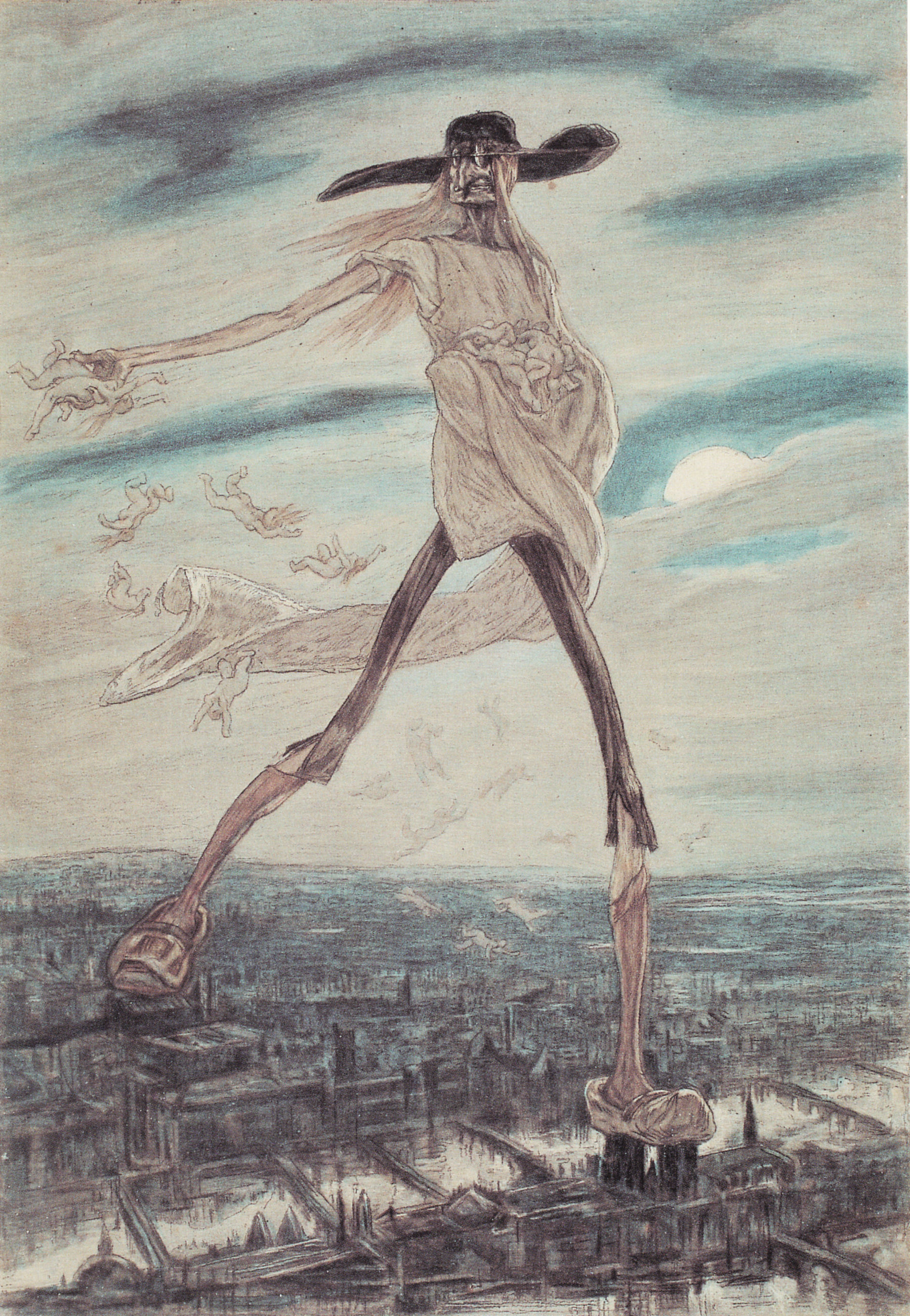
The image is Les Sataniques. Satan semant l’ivraie (The Satanics: Satan Sowing Tares) by Félicien Rops – photo by Hans Joachim Neyer (Hrsg.): Felicien Rops. 1833 – 1898. Katalog der Ausstellung im Wilhelm-Busch-Museum Hannover 17. Januar bis 21. März 1999. Hatje, Ostfildern 1999, ISBN 3-7757-0821-9, Abb. 61, Public Domain, https://commons.wikimedia.org/w/index.php?curid=12525528.
“Cast out this slave woman with her son; for the son of this slave woman shall not inherit along with my son Isaac.” – Genesis 21:10
O God who values children, how could You applaud this hideous, this (dare I say it) visibly unholy plan to send a mother and a child out to die near Beer Sheba, and of all places, this the Well of Seven, this the Well of Oaths.
What of the oath a parent makes to child when he is born? What of the oath a mistress lays upon herself when making one a slave? What of the oath a man should owe to one with whom he has conceived a child? What of the oaths pure decency demands?
Instead an oath to Sarah’s son is paramount. Instead You credit Sarah’s oath to see her son to elevation. Instead You make another oath to make another nation from another child. Could not You value these two lives for Ishmael’s life, for Hagar’s life itself?
I’d like to judge You, God, but I cannot. I’ve wondered if, like Hagar, I could bear to see my child’s life come to its end. I’ve tried to comfort those whose children died and known that mine had not. If anyone can judge You, it is they.
In humble, grateful, timid words I offer you a whispered thanks, for when the harshest wilderness was all I saw and knew, I found beyond all hope and bitter fear, You’d dug a well of water.
A poem/prayer based on Genesis 21:8-21, the Revised Common Lectionary First Reading for Year A, Proper 7 (12).
“And not only that, but we also boast in our afflictions, knowing that affliction produces endurance,and endurance produces character, and character produces hope, and hope does not put us to shame, because God’s love has been poured into our hearts through the Holy Spirit that has been given to us.” – Romans 5:3-5
Stop talking, Paul. You had me there at “We have peace with God.” That’s good. That’s great. That’s all I want (or need?) to hear. Stop there.
You can’t just stop there, can you?
“We boast in our afflictions” – but complaining isn’t boasting. “Affliction produces endurance” – unless it kills your spirit, Paul. “Endurance produces character” – it also fosters hubris. “Character produces hope” – is hope the same as resignation? “And hope does not put us to shame” – well, Paul, I’m with you there, as long as you do not expect me to assume I’ll get just what I hope for.
You can’t stop talking, can you?
Still, I’m grateful that you looped back round again to God’s salvation. We’re reconciled by Christ’s gift of self. We’re saved because we share Christ’s life.
But now, be still – not Paul, but me. If Tarsus’ famous correspondent can run on, the same is true of those of us less known. Stop, Eric, for we’ve made the crucial point:




 ordainedgeek