This poem rose from imagining Jesus’ conversation with his disciples as he ascended like a press conference. Can’t you just hear them calling their questions as the distance increased?
Blessings on the mothers rejoicing in their children. Blessings on the mothers in deep fear for their children. Blessings on the mothers whose children remember to call. Blessings on the mothers whose children refuse to call. Blessings on the mothers whose children are not related by blood. Blessings on the mothers heartbroken because they could never become a mother.
Blessings on the children rejoicing in their mothers. Blessings on the children in deep fear for their mothers. Blessings on the children whose calls end with “I love you so much.” Blessings on the children whose mothers keep breaking their hearts. Blessings on the children with more mothers than they can count. Blessings on the children still seeking a mother’s love.
Blessings on those who have lost. Blessings on those that have. Blessings on those that have never had. Blessings on those who seek.
Blessings for Mother’s Day.
First written as a Facebook post on May 10, 2020.
The image is Jesus retrouvé dans le temple (Jesus Found in the Temple) by James Tissot – Online Collection of Brooklyn Museum; Photo: Brooklyn Museum, 2007, 00.159.41_PS2.jpg, Public Domain, https://commons.wikimedia.org/w/index.php?curid=10195808
[Paul said,] “For as I went through the city and looked carefully at the objects of your worship, I found among them an altar with the inscription, ‘To an unknown god.'” – Acts 17:23
We didn’t have an altar in the church where I was raised. A table bore communion’s bread and cup before us all.
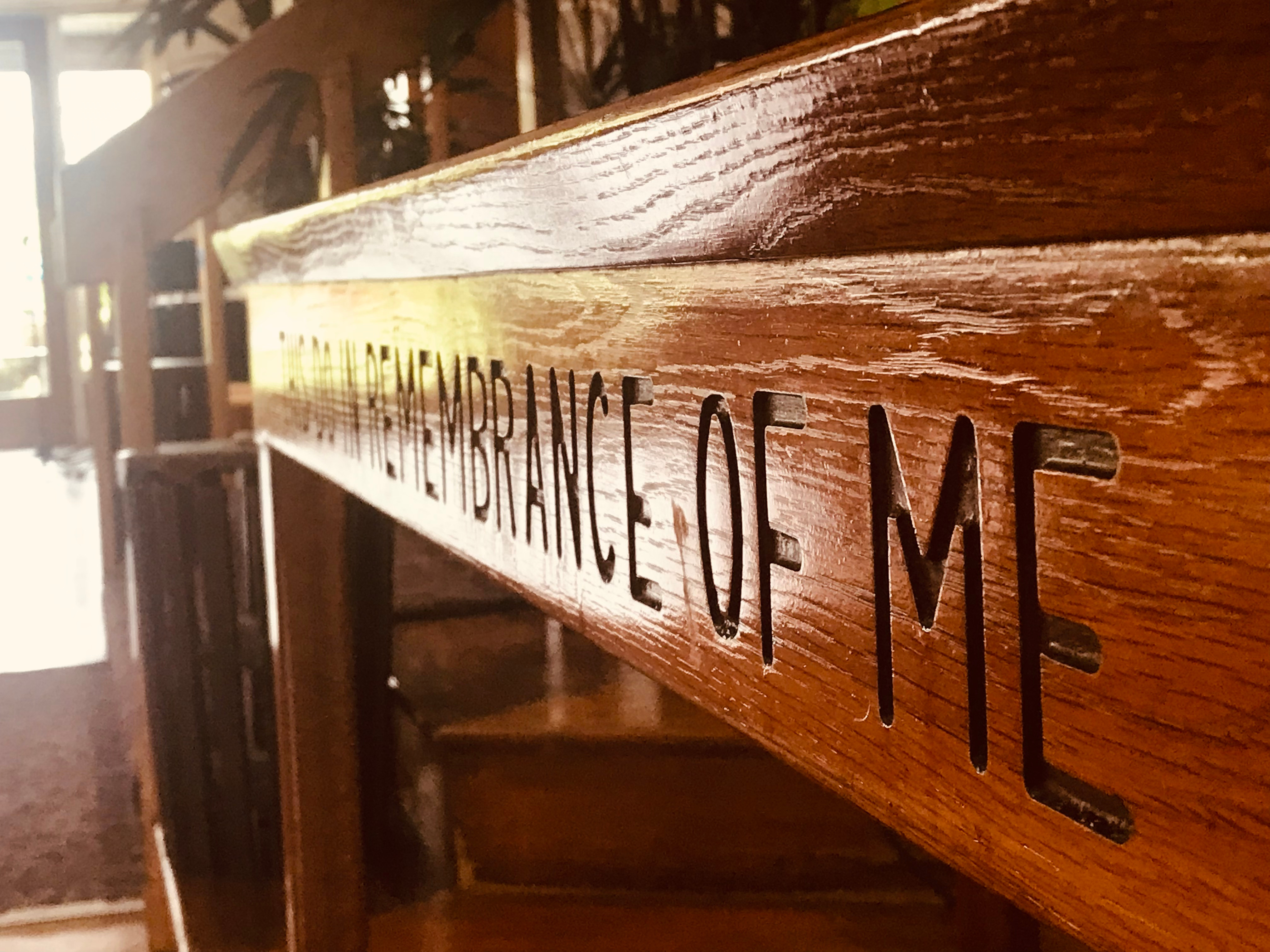
I’ve seen so many tables since, and many bear the words inscribed “In Remembrance of Me” (oft covered by a cloth).
Since youth I’ve been in churches where an altar takes its place, but rarely do they bear a word, but speak with just their shape.
I wonder: might the wisdom of those ancient Greeks guide us, and note upon our altars that we could know more of God?
Or just, perhaps, revise the way we spell the “altar” word, and be prepared at every point to “alter” what we know.
A poem/prayer based on Act 17:22-31, the Revised Common Lectionary First Reading for Year A, Sixth Sunday of Easter.
“Philip said to him, ‘Lord, show us the Father, and we will be satisfied.’ Jesus said to him, ‘Have I been with you all this time, Philip, and you still do not know me? Whoever has seen me has seen the Father. How can you say, “Show us the Father”‘?” – John 14:8-9
Like Philip, I’ll be satisfied to see what I expect to see. His vision might have been of swirling cloud, or pillar of fire dancing in the night.
And Peter, what would he expect? An army terrible beneath its banners? A monarch mighty on a throne whose feet were tended by his underlings?
The Magdalene anticipated… what? A corpse? and did not see her friend until he said her name. Her eyes were drawn to death.
So I, like Philip, will be satisfied to see what I expect, for you and I know well who sets the courses of my soul… Or, well, at least who claims to set them.
And I, like Philip, must be satisfied with who you are, O God, and not what I demand you be, and I, like Thomas, will be your bewildered follower on the way.
A poem/prayer based on John 14:1-14, the Revised Common Lectionary Gospel Reading for Year A, Fifth Sunday of Easter.
“All who believed were together and had all things in common; they would sell their possessions and goods and distribute the proceeds to all, as any had need.” – Acts 2:44-45
Bring me your time and a rose, apostles, gathered in prayer; gathered to share. Bring me your time and a rose-colored glass, to which we’ll aspire and fail.
Bring me the needs that were met, apostles, the poor lifted up, assembled to sup. Bring me the gifts of the rich, apostles, become poor in the blood of the cup.
Bring me the change – for it came, apostles. The rich held their wealth despite failure of stealth. Bring me the gifts for the saints, apostles, they gave for Jerusalem’s health.
The rose-colored glass will not hide, apostles, Saphira’s collapse, Ananias’ grim lapse. Nor the laud that is given to greed, apostles, however much time will elapse.
Bring me your time and a rose, apostles, gathered in prayer; gathered to share. Bring me your time and a rose-colored glass, to which we’ll aspire and fail.
A poem/prayer based on Acts 2:42-47 (with some reference to Acts 5:1-11), the Revised Common Lectionary First Reading for Year A, Fourth Sunday of Easter.
The image is The Distribution of Alms and the Death of Ananias by Masaccio (ca. 1426-1427), a fresco in the Brancacci Chapel, Florence, Italy – Web Gallery of Art: Image Info about artwork, Public Domain, https://commons.wikimedia.org/w/index.php?curid=15463099.
[Cleopus and his companion replied,] “But we had hoped that he was the one to redeem Israel.” – Luke 24:21
Cleopus: We needed a savior, we followed a healer, learned some from a teacher. We were crushed to see our longed-for Messiah crucified and slain, and know it was not he.
Judas Iscariot: We needed a savior, but he wouldn’t blink, he wouldn’t lift up the sword. The Zealot alike is tamed. He must be forced his power, even if by his friend he’s betrayed.
Simon Peter: What shall I make of the winds of these days? I ran, then I stopped. I followed and denied. I’ve looked in the empty tomb. Between death and failure my heart subsides, has settled into gloom.
Mary Magdalene: He set me free from torment within. I watched him set others free. You wanted a Savior? You had one, you know! Now the angels claim he lives once more and I’ve come to spread the news to find my word ignored.
Me: You’ve disappointed us all, O Christ. We’ve asked for the things you won’t give (So we’ve taken them instead). If we’re disappointed, what about you? Abandoned, betrayed, denied, ignored, as you labor to lead us to truth.
A poem/prayer based on Luke 24:13-35, the Revised Common Lectionary Gospel Reading for Year A, Third Sunday of Easter.
“So the other disciples told him, ‘We have seen the Lord.’ But he said to them, ‘Unless I see the mark of the nails in his hands and put my finger in the mark of the nails and my hand in his side, I will not believe.'” – John 20:25
I told you first, Peter. I told you first. “I have seen the Lord,” I told you, “after you had gone away from the grave. He’s alive, I tell you, alive. I have seen the Lord.”
I told you first, Peter, and you… well. I’ve seen your eyes narrow before when things don’t make sense, or you don’t understand. Then you made a comforting noise, but: I had seen the Lord.
Condescension from you isn’t new, Simon Peter. You’re polite, but you’ll always rely on the witness of your own two eyes – or the witness of another guy – even though I had seen the Lord.
Did you hear me that night when I laughed? Oh, the sight of your faces was rich! Where was your superior eye? Though puzzled, your eyelids spread wide! Now we had seen the Lord.
Is it mean of me to then delight when Thomas repeated your cant: “I’ll believe when I see it myself and have touched what I know I can’t.” Even though we had seen the Lord.
Will you learn, Simon Peter, from this? Will you learn to trust more than yourself? Will you learn to appreciate others? Will you learn to believe when a woman tells you: “I have seen the Lord.”
A poem/prayer based on John 20:19-31, the Revised Common Lectionary Gospel Reading for Year A, Second Sunday of Easter.
I struggled a great deal to find an image of Mary Magdalene fit for this poem. There ought to be one depicting her declaration “I have seen the Lord!” to the male disciples, but I didn’t find one. She is frequently shown at the crucifixion and, of course, at the empty tomb. Most versions of “Noli me tangere” (Do not hold onto me) leave me cold. Mary has frequently been confused with other women in the Bible, partially because so many of them were named Mary (Miriam), and partially because of a strange tendency on the part of Christians to assume Jesus had few followers in his lifetime, so if two people look similar or have the same name, they must be the same. Pope Gregory I’s 591 Easter homily erroneously conflated Mary Magdalene, Mary of Bethany, and the unnamed “sinful woman” of Luke 7. As a result, European Christians came to assume Mary Magdalene had been a prostitute and the misnomer has lingered and grown. Paintings of the “Penitent Magdalene” are… well. They’re awful. Truly awful.
Veneto’s portrait comes from the “Magdalene as Myrrhbearer” genre. The woman’s side-eye glance comes close to expressing what I imagine Mary Magdalene’s irritation with Jesus’ male disciples. Now if someone would only paint her rolling her eyes, that would be better.
These seven poems and the song are based on Scriptures associated with “the Seven Last Words of Jesus” – strangely, there are eight lessons. The video includes reading of the Biblical texts, reading of the poems, and performance of the song, “As We Bring Him Down.” The poetry and the video were prepared for Good Friday in 2022; I am reposting them for Good Friday 2023.
You strode those streets to teach, to worship and to heal. You strode those streets to cast the moneychangers from the Temple courts.
And now, with failing strength, you stumble up the street, too weak to bear the instrument of death. Where once you rode in festival parade they follow you to mourn for what has been and what will be.
I’m sure that Pilate knew just what he said. This is what happens to the ones who claim they have no emperor but Caesar. King of the Jews? Claim the title if you like, but know that title brings you only here, to die upon a cross, not reign upon a throne. So Jesus, claiming spiritual rule, will offer up his spirit to the Roman callousness and fear.
How strange a criminal, whose deeds “deserved” a death of torture, understood the reign of God much better than the priests, much better than the Roman Governor, much better than the monarch, better even than the ones who followed Jesus. “Jesus, remember me when you come into your kingdom.” For Jesus, entry to that realm was not through gates of stone, but gates of death. Beyond those gates our eyes see only shadow, but to his, and to this criminal, the shadows have been thrown by brilliant light.
Your friends look on, O Jesus. See? Your mother Miriam: she weeps with Miriam and Miriam. She will not urge you to a wedding feast, not now, or prompt you to transform the vinegar of death into a vintage rich with life. Instead, as scarlet stains your hands and feet, you transform stranger into son, and woman into mother. Here amidst the panoply of power and of hate, you fill the purifying jars of love.
Who could not bear to watch from heaven? Was it the sun, ashamed to the Savior die? Was it the moon, unable to divert its gaze? Was it the angels who had praised Messiah’s birth? Or was it simply that the clouds must gather, too, and witness bear, and mourn, and weep?
Forsaken the Anointed One. It seems so strange that Son of God, Messiah should cry out in abandonment – or… Does it?
Do we not hear the question echo down the years, the centuries, and on, “I was your God, and you my people, and you turned away.” We worship a forsaken God.
I could not blame you, Christ, if you let “It is finished” be your final word. You only came to do us good, and we? We desecrated you, we desecrated the tree on which we watched you die.
I could not blame you, Christ, if you decided that we had rejected your salvation – for we did – and now could live in suffering – as we do. And you, who stood for truth, nearly let us live the lie, but you could not let “It is finished” be the end.
The calloused feet that trod the miles. The mobile lips the formed the smiles. The fingers that bathed his friends’ toes Are still – are unmoving – Are released from the world and its woes.
[Chorus]
Hold him gently as we bring him down. Throw aside the bitter thorn crown. Lay him in the cloth we could find. The world has been cruel to the kind.
The sparkling eyes that held yours in peace. The worker’s hands that feared no disease. The ears that heard more than we knew Are still – are unmoving – Are now just memory for a few.
[Chorus]
The open arms we have crossed on the chest Where the loving heart beats not in his breast. Draw the fabric across the dear face So still – so unmoving Oh to see it again. Oh to find such a place.
“When he entered Jerusalem, the whole city was in turmoil, asking, ‘Who is this?'” – Matthew 21:10
The whispers whip round the jam-packed streets – Whispers? Well, no. The roar of the crowd means a whisper is shouted, and may not be heard by the hearer intended.
“Who is this?” they wonder, and some have their answers: “He’s a healer,” say some, “with remarkable power. So many return from him joyfully home!” The sick cry “Hosanna! O save us!” today.
“Who is this?” they wonder, and some say, “A teacher, a rabbi, a preacher with wonderful tales. He’ll challenge you, certainly, if you are careless. If you take time to listen, he’ll make you wise.”
“Who is this?” they wonder, and some say, “A monarch, Messiah, Anointed One: he’ll free us from Rome.” When they cry, “Hosanna!” it echoes with anger and yearning for freedom from Empire’s yoke.
“Who is this?” they wonder, and some say, “A rebel, a bringer of trouble, a sinner, a punk. Just watch: all these people will raise swords tomorrow, and on Tuesday the Romans will slaughter us all.”
“Who is this?” they wonder, and some have their answers. “Who is this?” they ask and the rider is silent. “Who is this?” they ask, little realizing the word being spoken in silence on a donkey’s foal.
“Who is this?” they wonder, as the beast ambles on. The Anointed One, yes, but the Humble One as well, who would rule as a healer, and guide as a teacher, but will save as One utterly faithful to God.
A poem/prayer based on Matthew 21:1-11, the Revised Common Lectionary First Reading for Year A, Sixth Sunday in Lent, Liturgy of the Palms.
“So I prophesied as I had been commanded; and as I prophesied, suddenly there was a noise, a rattling, and the bones came together, bone to its bone.” – Ezekiel 37:7
No vision, this… I smelled the chalky dust that rose from dried and crackling bones. I felt the beating sun as hot upon my frame as it had been to strip the blood and sinew from the moldering skeletons and leave no sign of moisture there, just calcium to rise and linger, pause and settle, paste the taste of chalk upon my tongue.
“Can these bones live?” you asked. In this… experience… how can I know what bones can do? “Speak to the bones,” you urged, “and promise breath and flesh and sinew. So they will know God.” I spoke, and as I spoke, I heard the clattering rattle of the desiccated bones, the scraping as they found their place. I smelled the tang of blood and sinew, then the salt as sweat appeared upon the new-formed skin.
“Speak to the breath,” you urged, “to all four winds, and let the breath come to these slain, and live.” I spoke again, and with a sigh the breezes swept across the flesh-strewn valley. Now a moan arose as lungs took air once more, and then a sigh as breath emerged again between the moistened lips. “These bones,” you said, “they live to be a sign of hope for Israel.”
And so the… vision? faded. But its hope endures. I know no valley filled with dusty bones has gone from silence to a rattling sound, nor of a sudden taken on the scent of sweat, or speech emerged from lips new-formed upon a skull. The slain are slain; the dead are dead. But we who live may see a better day, and by the power of God, the dead may rise to life.
A poem/prayer based on Ezekiel 37:1-14, the Revised Common Lectionary First Reading for Year A, Fifth Sunday in Lent.




 ordainedgeek