Prophesy to the Bones

Ezekiel once stood upon the city wall.
He stood, he gazed. I’m sure he wept.
For on that day he saw an army
terrible and merciless. It filled the valley,
all the valleys, that encircle Zion.
He stood. He gazed. I’m sure he wept.

When You showed him all those desiccated bones,
O God, what fashion did the valley take
in his imagination? Kidron?
The Outer Valley? Or Gehenna?
Or had You mercy enough to make it look
like a Babylonian valley spanned with gardens?

I doubt it mattered. Ezekiel wept, I’m sure,
upon the wall. I’m sure he wept the see
even an unfamiliar valley overflowing
with the dead. Bones so dry, dry as dust,
unmoistened even by the flood of tears
of a priest and prophet’s grief.

Command me, Holy One, to prophesy
and promise to the dusty bones that they
shall live again. Command me, Holy One,
to summon up the spirit breath to bind
with sinew all these bones. For then shall I
appreciate the salt of joyful tears.

A poem/prayer based on Ezekiel 37:1-14, the Revised Common Lectionary First Reading for Year A, Fifth Sunday in Lent.

Photo of a detail of the Knesset Menorah in Jerusalem by Deror avi – Own work, CC BY-SA 3.0, https://commons.wikimedia.org/w/index.php?curid=4085158.
No Explanation; No Blame

His disciples asked him, “Rabbi, who sinned, this man or his parents, that he was born blind?” (John 9:2)

All you need do, Redeemer, is explain.
Explain the suffering, the illness, the
dis-ease. Explain the disabilities,
ill fortunes, and abuse. Explain it all
so we may know the cause, the source, the blame.

In truth, we are less interested to see
the sufferer healed. We gain a measure of
self-satisfaction in our judgments, yes?
And leave the sad afflicted in the sad
result of “their own failed and sorry lives.”

But you, Redeemer, will not settle for
the sadness of our satisfaction. You
insist that we lay down our judgment, hear
the voices we would silence. You insist
we act as healers in the suffering world.

May we take your direction in this time:

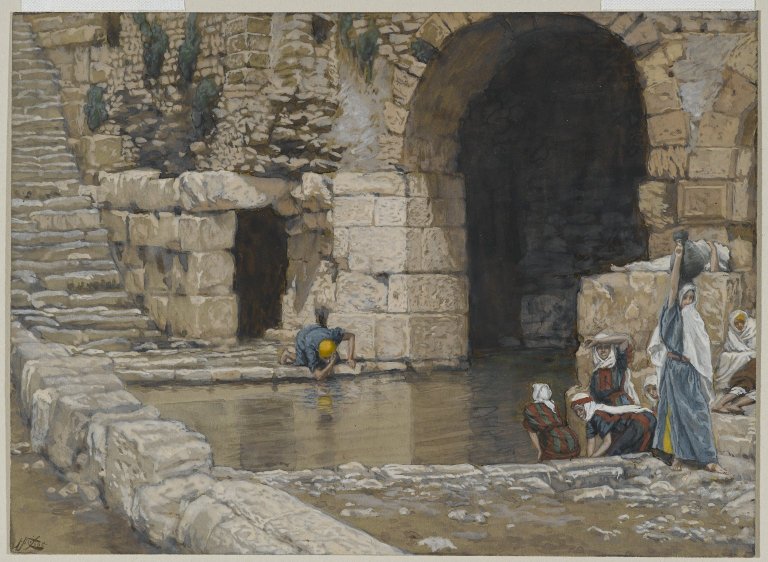
[Jesus said] to him, “Go, wash…” (from John 9:7)

A poem/prayer based on John 9:1-41, the Revised Common Lectionary Gospel Reading for Year A, Fourth Sunday in Lent.

The image is Le aveugle-né se lave à la piscine de Siloë (The Blind Man Washes in the Pool of Siloam) by James Tissot – Online Collection of Brooklyn Museum; Photo: Brooklyn Museum, 2008, 00.159.173_PS2.jpg, Public Domain, https://commons.wikimedia.org/w/index.php?curid=10957455.

Prayer Amidst Pandemic

O Holy One,

We’re frightened. Simply and honestly, we’re frightened. We can summon up our courage, but we must summon it amidst our fear.

We fear the thing we cannot see.

For some, this fear has led us into frenzy. Look, see the empty shelves where frozen foods and sanitizing lotion and toilet paper rolls were stocked. Look, see the calls and visits rising at the doctors’ offices, the urgent cares, the hospitals’ emergency rooms. Look, see the frenzy.

For some, this fear has led us into flat denial. Look, see the false-faced reassurances. Look, see the failures to anticipate. Look, see the bald refusal to take ownership of errors.

For some, this fear has led to false bravado. Look, see the gatherings still scheduled, defiant and unwise. Look, see the accusations leveled against “foreign” carriers of illness. Look, see the quest for blame replace the quest for health.

Look and see, O God. Look and see.

Now help us see, we pray, the actions of compassion. May we care for one another in our caution, less concerned with how this virus might affect “my” health than how it might bring harm to “yours.” May we keep our sickness to ourselves (for once, and if only this once, then at least this once). May we bring our groceries to share, our voices over telephones or video streams, our prayers…

Our prayers to you.

Grant strength to those who struggle to breathe. Grant protection to those who labor in healing. Grant compassion to those who share their ability to move about with those who must stay home. Grant connections of hearts between those who must refrain, for now, from touching hands.

In the name of the Healing Christ,

Amen.

Photo by Eric Anderson.

Sir, I See

Faster than a speeding teacher,
more focused than a paralytic healed,
more attentive than a crowd full of dinner:
Look! By the well! It’s a foreigner!
It’s a woman! It’s…
Me!

Could it be me, dear Jesus, so to grasp my thirst
so earnestly, so honestly,
to hold it up before you in its naked need?
Could it be me to have you take so seriously
all my urgent questions, still to leave me
speeding house to house, in all my
comic-fictive strength, inviting:

“Come and see! For I’ve been known
in strength and weakness, height and depth.
Come and see! For only you (and you and you)
and I together can determine once for all:
Could this One truly be the Christ?”

Could it be me?

A poem/prayer based on John 4:5-42, the Revised Common Lectionary Gospel Reading for Year A, Third Sunday in Lent.

Photo of a mosaic in Sant’Appolinare Nuovo in Ravenna, Italy, by © José Luiz Bernardes Ribeiro, CC BY-SA 4.0, https://commons.wikimedia.org/w/index.php?curid=52650776.

Hold the Complexity

I asked the Holy One, not once but time
and time again, to tell me what is first
and prime. The sound of silence breathed to me,
“Grace. Grace is first, and last, and everything.”

I might have raised a voice in protest to
the silent breath, to claim the privilege
of suffering for faith, through faith, in faith.
“Grace. Grace is first, and last, and everything.”

Have I not traveled farther in my span
of years than Abraham in his? Might I
not claim the mantle of such righteousness?
“Grace. Grace is first, and last, and everything.”

But breathed the silent syllables: “Did you
devise yourself, beloved child? Did you
create the feet you set upon the road?
Grace. Grace is first, and last, and everything.”

Blessed be the Holy One who makes to be
the things that were and things that have not been.
Blessed be the One whose sound of silence breathes:
“Grace. Grace is first, and last, and everything.”

A poem/prayer based on Romans 4:1-5, 13-17, the Revised Common Lectionary Second Reading for Year A, Second Sunday in Lent.

Photo by Eric Anderson.

Tempted; Deceived

Of course I’d be out-crafted
by the crafty in the absence
of the knowledge, of the wisdom,
to discern what’s right and wrong.

Of course I’d be deceived
by a deceiver in my
ignorance of good and bad,
of lawful and unlawful acts.

Of course I’d take the way that ends
my ignorance, my foolishness,
my childishness, my folly.
Wouldn’t anyone?

I’ll take that fruit and share.

I’ll also wish I’d thought,
in all my quest for wisdom, that
perhaps the One who loves me best
might ache at my betrayal.

A poem/prayer based on Genesis 2:15-17, 3:1-7, the Revised Common Lectionary First Reading for Year A, First Sunday in Lent.

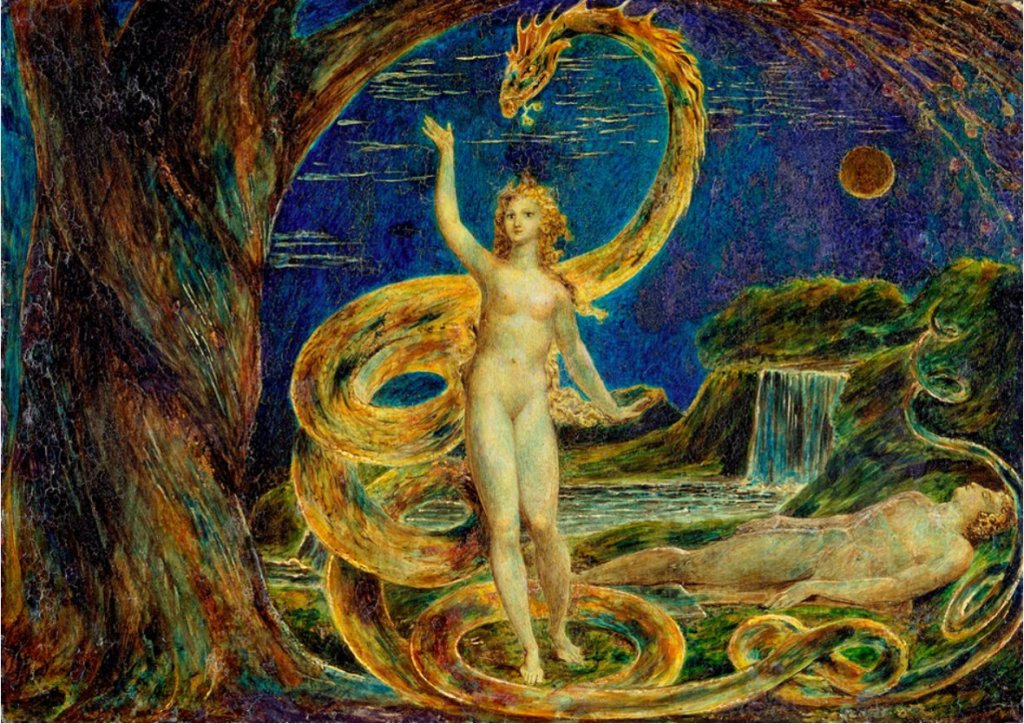
The image is Eve Tempted by the Serpent by William Blake – Victoria and Albert Museum, Public Domain, https://commons.wikimedia.org/w/index.php?curid=24661174.

Like an Angel

Speak to me like an angel, Jesus.

If it were me and not the Rock,
not the fearless Sons of Thunder,
I do not think I would have seen the cloud
that in its brightness overshadowed them.

Speak to me like an angel, Jesus.

For me, I think your radiant form
and figures suddenly at hand
would be enough to seal my eyes,
collapse my knees into the dust.

Speak to me like an angel, Jesus.

I might, in fact, have stuffed my clothes
into my ears lest I, lest we, should hear
of things beyond our understanding
said by you or Moses or Elijah.

Speak to me like an angel, Jesus.

That would have offered to
the Voice Divine a challenge!
“Listen to him!” bellowed into my
cloth-swaddled ears.

Speak to me like an angel, Jesus.

Gently lay your fingers on my shoulder.
Brush your fingertips along the seam.
As my grip loosens, lean and whisper,
softly: “Do not be afraid.”

A poem/prayer based on Matthew 17:1-9, the Revised Common Lectionary Gospel reading for Year A, Transfiguration Sunday.

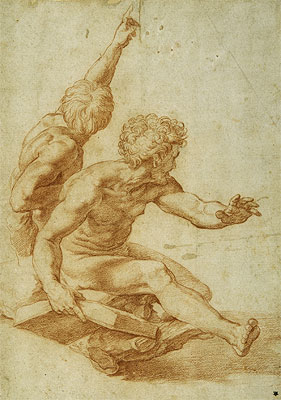
The image is a study of Saint Andrew and another apostle for The Transfiguration by Raffaello Sangio – http://www.topofart.com/artists/Raffaello_Sanzio_Raphael/painting/11317/St.Andrew_and_Another_Apostle_in’The_Transfiguration’.php, Public Domain, https://commons.wikimedia.org/w/index.php?curid=23549876.

Cracked and Worn

I didn’t want a divorce
but I got one, Jesus.
A broken relationship
handed to a judge.
No prison, but
I’ve never been released.

So many gifts I’ve laid
before your altar
never certain whether
there was someone I had hurt.
But no, I lie. There was always
someone whether I knew or not.

To reconcile, though – ah, there’s
the rub. For now I’ll ask
“On whose terms, precisely, Jesus?
I have my injuries, my hurts.
Who’ll make their peace with me?
Who’ll listen to my terms?”

Don’t say it, Jesus. I know
just what you’ll say to such
a question; you’ve no need
to say, “My terms.”
Oh, go ahead. I’ll wait. Just
say it… Oh. You did.

A poem/prayer based on Matthew 5:21-37, the Revised Common Lectionary Gospel reading for Year A, Sixth Sunday after Epiphany.

Photo by Eric Anderson.

Smoke-Choked Basket

Don’t look this way, Jesus, please.
If you’re looking for light, excuse me.

I’m only gasping underneath this
smoke-choked basket here because…

I’m not certain how much glow You’d get
even if you lift the basket.

A poem/prayer based on Matthew 5:13-20, the Revised Common Lectionary Gospel reading for Year A, Fifth Sunday after Epiphany.

The image is “Light Under a Basket,” a 1532 Bible illustration by the Italian Petrarca Master; Public Domain, https://commons.wikimedia.org/w/index.php?curid=4006971.

Mine?

You can stop right there, Jesus,
after beatitude/blessing/makarios
(Hey! I can pray in Greek!)
the first. You know as well as I
the poverty of my spirit.

No mustard seeds to see,
no pearls beyond appraisal,
no fields a-hundred-fold
to view for you. Just sighs
and bluster nearly equal there.

So you might want to think again
about this notion you would make
the realm of heaven mine. I can’t
conceive of an idea much worse
despite the virtues of the thinker.

For you to give the realm of God
to me is just as ludicrous
as if you gave the keys of heaven
to a fisherman named, “Rock.”

Oh. That’s right. You did.

A poem/prayer based on Matthew 5:1-12, the Revised Common Lectionary Gospel reading for Year A, Fourth Sunday after Epiphany.

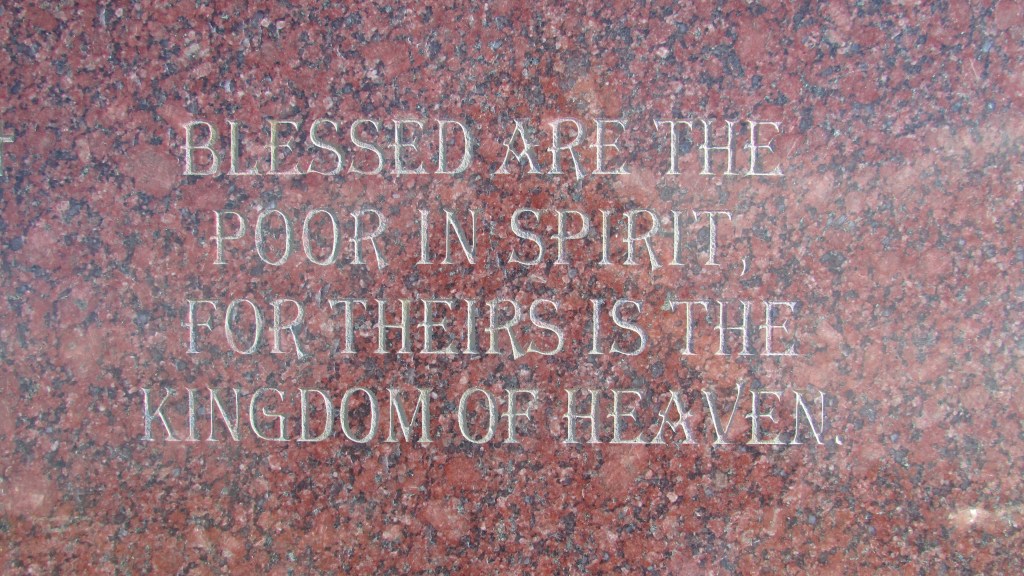
Photo is of a monument at Our Lady of Peace Shrine, Pine Bluffs, Wyoming. Photo by Chris Light – Own work, CC BY-SA 4.0, https://commons.wikimedia.org/w/index.php?curid=53688733.