Kicking the Cobblestones

A mosaic of a boy feeding a donkey, ca. 5th century CE.

“[Jesus] said to them, ‘Go into the village ahead of you, and immediately as you enter it, you will find tied there a colt that has never been ridden; untie it and bring it. If anyone says to you, “Why are you doing this?” just say this, “The Lord needs it and will send it back here immediately.”‘” – Mark 11:2

I was just minding my business, which is:
Kicking at cobblestones. It’s what I do.
Others may carry the great and exalted
or strain to haul carts, but not me. Oh, no.

I kick at the cobblestones. It’s what I do.

Along come these dudes. I’d never seen them
or smelled them or known them, so what did they do?
They untied the rope that ran from my halter
along to the post. I didn’t panic. Or move.

I kicked at the cobblestones. It’s what I do.

Give me a chance, though, idiot dudes,
and I’ll kick your cobbles. You know that I will.
They fussed at the rope and they petted my nose.
I sniffed them for sugar, but they weren’t that smart.

I kicked at the cobblestones. It’s what I do.

A couple of neighbors – I’d seen them before –
spoke to the dudes. I paid no attention.
I had my afternoon plans good and set.
Neither neighbors nor dudes would bollix those up.

I kick at the cobblestones. It’s what I do.

There’s a tug at my halter. Both neighbors and dudes
are nodding, and telling me, “Come along now.
The Lord needs your services. Step down the road.”
I’d have reared or planted my feet, but I went along.

I kicked at the cobblestones. It’s what I do.

Next thing I know there’s cloth piled on me.
I thought about kicking it off. It was hot.
But then there’s another dude sitting upon me.
I braced then to toss him off, placing my feet,

Kicking the cobblestones. It’s what I do.

“A moment,” the dude said, and breathed in my ear,
“I need you today,” and his hand brushed my neck.
Are you kidding? There are others who’ll carry
and haul. They’re not me. I’m my own. I won’t carry at all.

I’ll kick at the cobblestones. It’s what I do.

But my hooves took their steps down the Bethany slope,
into the valley, along to the gates.
There were people about and they shouted, “Hosanna!”
They laid clothing and branches ahead of our way.

They covered the cobblestones – but it’s what I do.

I kicked at the cloth and I kicked at the greens.
The dude on my back, well, he chuckled at that.
“Kick away, little friend,” came that intimate whisper.
“It won’t be too long ’till you’re back home at last.

“And kicking the cobblestones.” It’s what I do.

With anyone else on my back I’d have bolted.
The noise and the heat, the dust made me sneeze,
the leaves made for treacherous footing beneath,
so that kicking made balance a tenuous thing.

When kicking the cobblestones is what I do.

The dude left my back with a softly said, “Thank you.”
Two of the dudes stripped the cloaks from my spine.
They turned me around to the gates and the valley,
and back up the Bethany hill to my home

Where I kicked at the cobblestones. It’s what I do.

A poem/prayer based on Mark 11:1-11, the Revised Common Lectionary Gospel Reading for Year B, Sixth Sunday in Lent, Liturgy of the Palms.

The borrowing of a “colt that has never been ridden” is an odd element in the odd story of Jesus’ serio-comic “triumphant entry” into Jerusalem. Mark gave it twice as much time as he gave to describing the procession itself. The entire project of borrowing an unridden colt begs for disaster: arrest for theft, an animal that refuses to move, Jesus careering through the streets on a bucking colt. I don’t claim to have captured the colt’s perspective in any real way here. Hopefully I’ve given some idea how odd it all was.

The image of a child and a donkey is by a Byzantine mosaicist of the 5th century – The Yorck Project (2002) 10,000 masterpieces of painting (DVD-ROM), distributed by DIRECTMEDIA Publishing GmbH. ISBN: 3936122202., Public Domain, https://commons.wikimedia.org/w/index.php?curid=148600.

Promise Unfulfilled…?

But this is the covenant that I will make with the house of Israel after those days, says the LORD: I will put my law within them, and I will write it on their hearts; and I will be their God, and they shall be my people. – Jeremiah 31:33

Of all the promises you’ve made, O God,
through human speech of ancient poets, this
I wait for most expectantly. Oh when, I ask,
will human hearts be oriented to your will?

From Jeremiah’s day to this, I do not see
a sudden change in human righteousness.
Not even Jesus’ resurrection prompted us
to set aside our greedy lust for power,

Our tolerance for prejudice,
enshrining it in law that breaks the Law
I yearn to feel a-written on my heart.
How bright would be the dawn of such a day!

But God, I fear that knowledge of your law
within the heart would do no better than
to write it on papyrus, paper, wood, or stone.
We learn it, and we know it, and we break it.

So did you, have you, written on our hearts,
and did we find a way to curtain it away,
as centuries of Christians have ignored
the Savior’s last command to love?

I tremble that this promise is fulfilled.

A poem/prayer based on Jeremiah 31:31-34, the Revised Common Lectionary First Reading for Year B, Fifth Sunday in Lent.

The image is Cry of prophet Jeremiah on the Ruins of Jerusalem by Ilya Repin – http://www.art-catalog.ru/picture.php?id_picture=11437, Public Domain, https://commons.wikimedia.org/w/index.php?curid=3257688

Nicodemus Nods

“And this is the judgment, that the light has come into the world, and people loved darkness rather than light because their deeds were evil.” – John 3:19

Too close to power, Nicodemus,
to be unaware
of what a savage place the palace, or
the council chamber, is.

The finest houses are adorned
with “those retired”
by the coups and calumnies
of those who rule.

Sometimes they’ve stepped across
the corpses slaughtered
on the battlefields of Munda
or the streets of Rome.

By sprays of blood or of dishonor,
Caesar’s heirs and Herod’s
threaten you, poor Nicodemus,
and you know it well.

The light has come into the world
by law and prophets’ words,
and greed has shrouded it in murder, theft,
and royal robes.

So nod, then, Nicodemus, as
you ponder on the snake
which, lifted up, no longer threatened life
but gave it back again.

How strange to find the light at night
as Moses’ people found
their healing in the very form they feared.
So, Nicodemus, nod.

The day approaches when you’ll gaze
upon the lifeless form
of light, and carry it into the dark,
and light will shine once more.

A poem/prayer based on John 3:14-21, the Revised Common Lectionary Second Reading for Year B, Fourth Sunday in Lent.

The image is Nicodemus by JESUS MAFA, from Art in the Christian Tradition, a project of the Vanderbilt Divinity Library, Nashville, TN. https://diglib.library.vanderbilt.edu/act-imagelink.pl?RC=48385 [retrieved February 28, 2023]. Original source: http://www.librairie-emmanuel.fr (contact page: https://www.librairie-emmanuel.fr/contact).

United

For Jews ask for signs and Greeks desire wisdom, but we proclaim Christ crucified, a stumbling block to Jews and foolishness to gentiles, but to those who are the called, both Jews and Greeks, Christ the power of God and the wisdom of God. – 1 Corinthians 1:22-24

Even Cephas, who when travelling with Christ
was always first to say it wrong, agrees:
Do not divide the church.

Apollos, now, whom some of you
prefer to me, prefer to Christ, agrees:
Do not divide the church.

I asked him if he’d come to you,
and do you know the words he said? “No.”
“I could divide the church.”

If you must give me up to live in Christ,
then do it. Give up Cephas, too.
Do not divide the church.

I was not crucified for you.
My resurrection still is years away.
Do not divide the church.

Or else – what follows then?
A Church dividing like the fractured bread –
Do not divide the church –

But unlike when our Savior broke it
on the hillside, who will eat?
Do not divide the church.

Across the centuries, I see it. So can you.
Love abandoned for these power plays.
Do not divide the church.

Or they will follow your example.

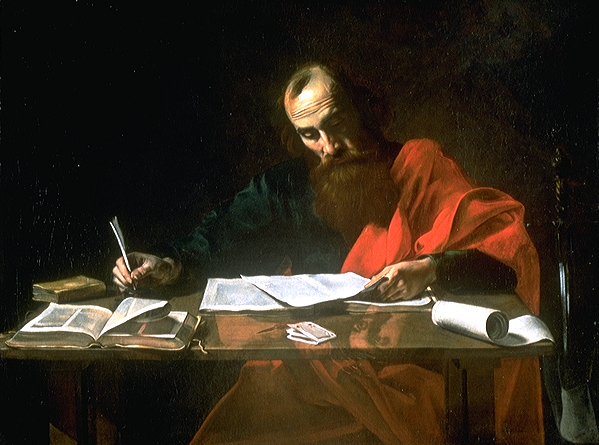
A poem/prayer based on 1 Corinthians 1:18-25, the Revised Common Lectionary Second Reading for Year B, Third Sunday in Lent.

The image is Saint Paul Writing His Epistles by Valentin de Boulogne (between 1618 and 1620) – Blaffer Foundation Collection, Houston, TX, Public Domain, https://commons.wikimedia.org/w/index.php?curid=596565.

Simon Peter’s First Denial

Then he began to teach them that the Son of Man must undergo great suffering and be rejected by the elders, the chief priests, and the scribes and be killed and after three days rise again. He said all this quite openly. And Peter took him aside and began to rebuke him. But turning and looking at his disciples, he rebuked Peter and said, “Get behind me, Satan! For you are setting your mind not on divine things but on human things.” – Mark 8:31-33

Don’t you like it, Simon, when I say
that your Messiah is not what you want?
Don’t you like it, Simon, when I tell you
raising up will be upon a cross?

Of course you don’t, dear Simon. How
could anyone be pleased to hear
Messiah is no conqueror, no King
except to turn the tables over Death.

I told you, but you wouldn’t hear that, Simon.
You tell me how I’ll live my life
and die my death, and no. That is not yours
to settle or define. It’s mine. And God’s.

Ah, Simon Peter, my dear Rock, so hard
of head, so transparent of heart,
so certain of what must be true,
and come to pass, and be:

I chide you hard for this denial now.
A night will come when your denials will
emerge like clockwork ticking toward the dawn.
And then, I will not chide, for you will turn aside

And weep.

A poem/prayer based on Mark 8:31-38, the Revised Common Lectionary Gospel Reading for Year B, Second Sunday in Lent.

The image is The Denial of Saint Peter by a Follower of Hendrick ter Brugghen (ca. early to mid-1600s) – http://www.christies.com/lotfinder/paintings/follower-of-hendrick-terbrugghen-the-denial-of-5747353-details.aspx, Public Domain, https://commons.wikimedia.org/w/index.php?curid=29903198. In a rather-quick-and-not-very-diligent search, I did not find many artistic renderings of this scene in Mark 8. I chose to look into the connections, tenuous as they are, between Simon Peter’s rebuke here and his denial of Jesus in Mark 14.

Wilderness

COL; (c) City of London Corporation; Supplied by The Public Catalogue Foundation

“He was in the wilderness forty days, tempted by Satan; and he was with the wild beasts; and the angels waited on him.” – Mark 1:13

Why did I come to Jordan?

My life in Galilee was nothing much.
I did my work. I paid attention to my mom.
I read the texts and prayed upon their words.
If nobody was eager to accuse me of great sin,
I can’t say anybody was inclined to say,
“Here’s one who’s lived a life untarnished.”

My mother, to choose one, would never say those words.

Still, my conscience rested easy. My sins
were bearable enough to wait until the day
of offering within the Temple, and even then
I’d struggle some to name my sins. So why
did I accept the labor of the miles
and seek a baptism, repenting for my sins?

The Spirit drove me dripping to the wilderness.

I’d had a life which had its just rewards,
its comforts, and its faithfulness, but now
my heart will never rest at “home.”
The softest bed will scratch my soul until
I set once more upon the road to speak
to new assemblies, gathered for the Word.

My life will be a wilderness.

Oh, can I not just take the road to home?
Can I not set aside the heavenly words
as meant for someone else, and not for me?
Must I embark upon a journey, knowing that
it leads to only one imaginable
destination: a shameful death upon a cross?

There’s little mercy in the laws of Rome.

I’d cry out, “Get behind me, Satan,” but temptation
is behind me, and before me, and at either side.
It’s graven deep within my bones which long
for hearth and home. What do I care for bread,
for power, or for Messianic name?
All I want, my God, is to go home.

But now my home is wilderness in truth.

Oh, you can come now, angels. Wipe
my sweat-soaked brow, and dry my streaming eyes.
Supply the bread I’ve done without
and gently satisfy my body’s thirst. Just like
the prophet long ago, I take your nourishment.
I take the highway of the wilderness,

From this day forth, and always.

A poem/prayer based on Mark 1:9-15, the Revised Common Lectionary Gospel Reading for Year B, First Sunday in Lent.

The image is The Temptation in the Wilderness by Briton Rivière (1898) – Art UK, Public Domain, https://commons.wikimedia.org/w/index.php?curid=39630461.

Clinging

“But Elisha said, ‘As the LORD lives, and as you yourself live, I will not leave you.'” – 2 Kings 2:2, 2:4, 2:6

You threw your mantle over me, Elijah, as I plowed the fields.
(You failed to mention that you’d taken that direction from the LORD.)
You would not pause to let me kiss my parents, no. But cook an ox
upon the fire of its yoke, and feed the neighbors? Yes. You’re strange,
Elijah. From that mantle day, I’ve clung to it and you. I’ve seen
your challenges to kings and queens. I’ve seen God’s fiery judgement fall.

So now you’d leave me, prophet of the trumpet voice, to serve your God
and speak to kings as if they had no soldiers to command. Have we
been walking on the road toward your death and burial? Should I
have asked the gathered prophets for a shovel, casting earth and tears
upon your stiffening form, just as you cast the mantle on my back
which stiffened, knowing that the furrows of my life would grow new fruit.

I said I’d follow then. I tell you I will follow now, despite the lack
of tools to dig or fill your grave. I’ll follow you across the stream
divided by your mantle’s touch, not knowing if I can return
to Jericho without a muddy swim and wade. I’ll follow you
though tears are all that fill my eyes, so that your spirit takes its flight
and I see nothing more than mist, despairing of your spirit’s gift.

Fire. Horses.
Galloping between us.
Whirling, swirling wind.
You rise beyond my grasping hand.
Father, no!
The chariots of Israel steal away my heart!

Your mantle falls.
I’ll cling to it
until my sobs have eased
and I can test
to see if God
is with me.

A poem/prayer based on 2 Kings 2:1-12, the Revised Common Lectionary Gospel Reading for Year B, Transfiguration Sunday.

The image is The Ascension of Elijah, Russian icon of the Novgorod school, late 1400s, by Anonymous artist from Novgorod – http://www.bibliotekar.ru/rusIcon/2.htm, Public Domain, https://commons.wikimedia.org/w/index.php?curid=4157865. Until I looked over Orthodox icons for this post, I hadn’t seen images of Elisha grasping Elijah’s mantle as if to hold him to the earth. It’s a powerful image.

Retreat

In the morning, while it was still very dark, he got up and went out to a deserted place, and there he prayed. And Simon and his companions hunted for him. – Mark 1:35-36

You started ministry, O Savior, in retreat.
You rose from Jordan’s cleansing water and
retreated to the wilderness.
I guess temptation’s not precisely a
vacation, is it? Still, forty days
away from obligation sounds,
well, pretty good.

Then just a few days into ministry –
such active days, with teaching in
the synagogue there in Capernaum,
the place where everybody knew your name,
and were surprised to hear you speak with force,
and issue a command a demon must
perforce, obey,

Then healing Simon’s ailing mother-in-law
(where was his wife, I wonder?), and
the others who, with Sabbath ended,
made their way to Simon’s house in search
of respite from their pains, their demons quashed,
their illnesses relieved, their spirits freed,
their futures brightened –

Now you step away from exorcism, healing touch,
and liberating word. Now you seek night’s sheltering cloak,
to hide you from those seeking you. Now you
ask, perhaps, if struggling with the Tempter
might have been the gentlest part of ministry.
Now you seek a rest in God more healing
than a night of sleep.

The fishermen became the hunters, then.
They sought you, tracked you, brought you down
as arrow brings the hart unto its knees.
“They seek you, Jesus.” That was their excuse,
but you, and they, knew well their desperate need
to be with, learn from, follow you
in a new day.

You rise. You slap the clinging dust away
from off your robe. You slip the sandals on
(perhaps you’d shed them so to pray on holy ground).
“Let us go on,” you told them. Yes, they’re welcome
on the road of ministry, as weary as it is.
You’ll make your times of solitude along the Way
and maybe, they will, too.

A poem/prayer based on Mark 1:29-39, the Revised Common Lectionary Gospel Reading for Year B, Fifth Sunday after the Epiphany.

The image is an illustration of Mark 1 by Distant Shores Media/Sweet Publishing, CC BY-SA 3.0, https://commons.wikimedia.org/w/index.php?curid=18886209.

Astounded

They were astounded at his teaching, for he taught them as one having authority, and not as the scribes. – Mark 1:22

Astounded I was, for certain – not, however,
in a good way.

I know there’s nuance, theory, opinion,
but not so this Jesus.

I’m a great one for clarity. Say what you think
but modestly, right?

Not so this Jesus. He laid it out clear
and said he was right.

Astounded I was, and a little offended
by arrogance there.

That’s when the shouting began. Oh, not me.
A poor man afflicted

By demons within. I knew him. We knew him.
The Teacher did, too.

“I know who you are!” he cried out, then called him
“the holy one of God.”

I was moving to gentle him, comfort him, lead him
away and to home, when

Jesus delivered his order: “Be silent! Come out
of his spirit!” And silence.

The man drew his breath, then exhaled with a sigh,
clearing the tension away.

He smiled, gave his thanks, took his seat near the wall.
Nobody knew what to say.

And now I must listen again to this arrogant Jesus
who seems to know everything,

Because with a word he set this man’s spirit free.
None of the rest of us did.

Perhaps Jesus’ ideas are not just opinion. Perhaps
he knows more than he says.

A poem/prayer based on Mark 1:21-28, the Revised Common Lectionary Gospel Reading for Year B, Fourth Sunday after the Epiphany.

The image is Christ Healing a Possessed Man in the Synagogue at Capernaum, an 11th century fresco in the bell tower of Lambach Abbey, Lambach, Austria, by an unknown artist – Scan aus: Rudolf Lehr –- Landes-Chronik Oberösterreich, Wien: Verlag Christian Brandstätter 2004 S. 79 ISBN 3-85498-331-X, Public Domain, https://commons.wikimedia.org/w/index.php?curid=6633986.

Nathanael

“Philip found Nathanael and said to him, ‘We have found him about whom Moses in the law and also the prophets wrote, Jesus son of Joseph from Nazareth.’ Nathanael said to him, ‘Can anything good come out of Nazareth?’ Philip said to him, ‘Come and see.'” – John 1:45-46

I made the journey down the Jordan
to hear the Baptist’s words, not Philip’s dreams.
Admittedly, if John had said he was
Messiah, I’d have turned my head.
But no. He told us he was just an echo
of Isaiah, straightening the roads.

Oh, Philip, my old friend. How many figments you
would follow! I am not so credulous.
Messiah? Here? Unlikely, don’t you think?
He’d either be upon the road, an army at
his heels, or hidden in a cave as David did.
Messiahs do not listen to a Baptist.

And he’s from where? From Nazareth?
Oh, Philip, you have lost your mind.
Can anything of good or right come out of there?
They’re all too ordinary, Philip, stuck
in their pursuit of daily bread.
You’ll never find Messiah in that place.

But now: you’ve told me, “Come and see.”
For friendship and for mercy, I will come.
Forgive me if the skeptic’s frown distorts my face.
I have no skill to wear deception’s mask.
Your Messianic man will know me when he sees me.
He’ll know I bring to him no thought of guile.

A poem/prayer based on John 1:43-51, the Revised Common Lectionary Gospel Reading for Year B, Second Sunday after the Epiphany.

The image is Nathanaël sous le figuier (Nathaniel Under the Fig Tree) by James Tissot – Online Collection of Brooklyn Museum; Photo: Brooklyn Museum, 2008, 00.159.59_PS2.jpg, Public Domain, https://commons.wikimedia.org/w/index.php?curid=10195839.