Story: Why Do You Fly So Far?

A myna (a dark colored bird with yellow feathers around the eye) and a kolea (Pacific Golden-plover, a light brown bird with darker brown spots) in a grassy field.

December 14, 2025

Luke 1:46-55
Matthew 11:2-11

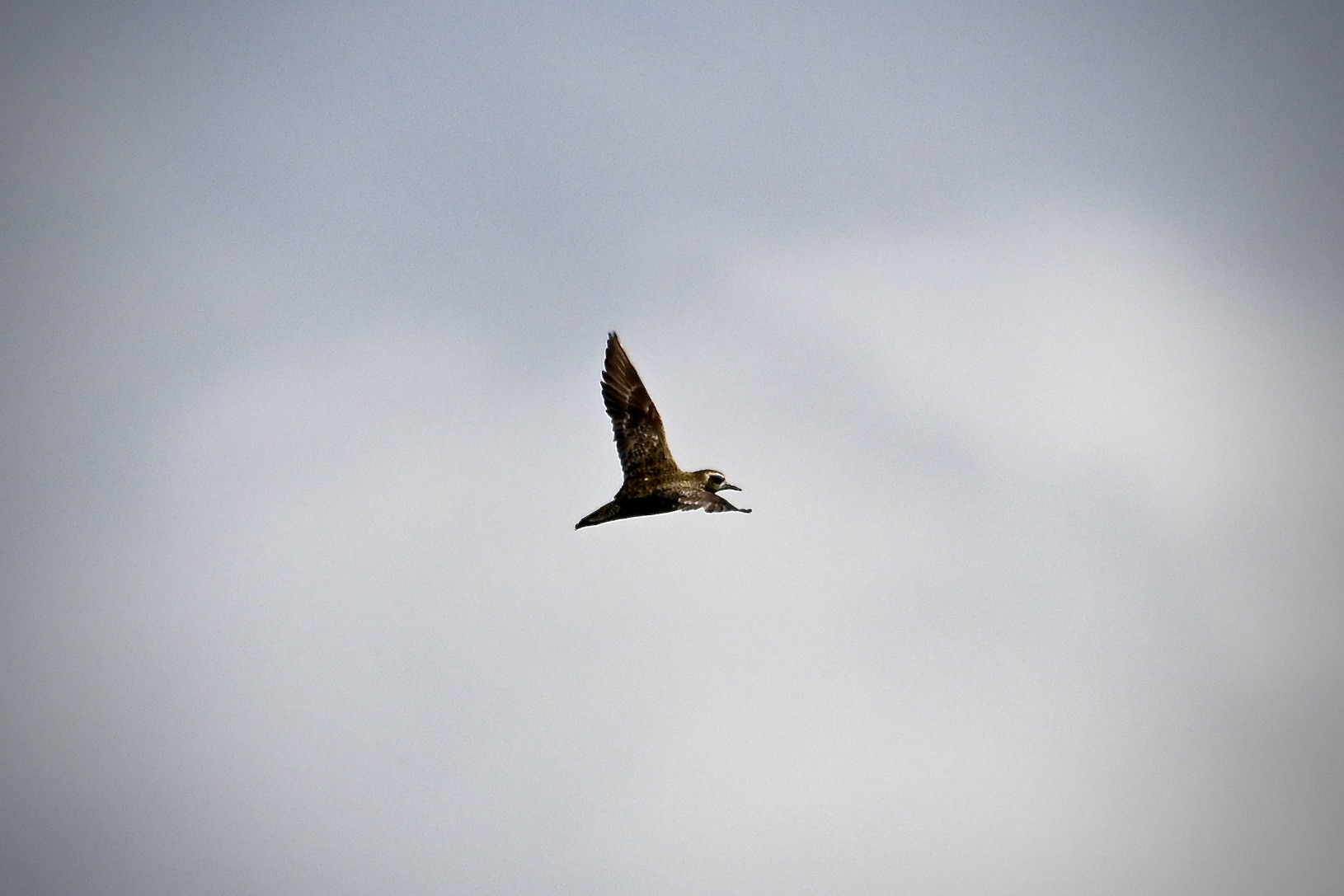
The kolea is a pretty mellow bird. They’re not terribly skittish, though some will keep a sensible distance from people. We are a lot bigger than a kolea and probably look kind of scary to them.

The myna, on the other hand, is not a mellow bird. They sing a fair amount, but they also screech and argue. They’re pretty sociable with one another, and one moment everybody is happy and content, and the next moment everybody is hollering at one another.

Which makes them a lot like some people, now that I think of it.

Mynas fly, of course, but you could call them homebodies. They don’t tend to go very far. Kolea, on the other hand, fly long distances from where they nest in Alaska to where they spend the winter here in Hawai’i. If you’ve ever flown on an airplane to the North American continent, you know that’s a long flight. Well, kolea fly it with their own wings and they don’t go as fast, so it takes longer.

The mynas find it all rather puzzling and strange.

A myna was picking worms and seeds alongside a kolea one day. The two of them were quiet most of the time, because by chance most of the myna’s other friends had had a big argument and flown off to continue it somewhere else. So it was just the two of them.

“I’ve always wanted to know,” said the myna to the kolea. “Why do you fly so far?”

The kolea thought about it. “I’m not sure anyone has asked me that before,” he said.

“Well, I’m asking,” said the myna.

“I do like the change,” said the kolea, “and I know that it gets awfully cold in Alaska during the winter.”

“Then why not stay here?” asked the myna.

“There are different things there,” said the kolea, “and it just feels right to raise chicks there.”

“Then why fly all the way here?” asked the myna. “What do you come here to see?’

The kolea was quiet for so long that the myna was about to ask the question again, but then the kolea spoke:

“I come to see different trees, trees that blossom red and purple and gold. I come to see soaring mountains crowned with snow when there’s green all around the island. I come to see waterfalls that make rainbows. I come to see mountains with fire and beaches with black sand.

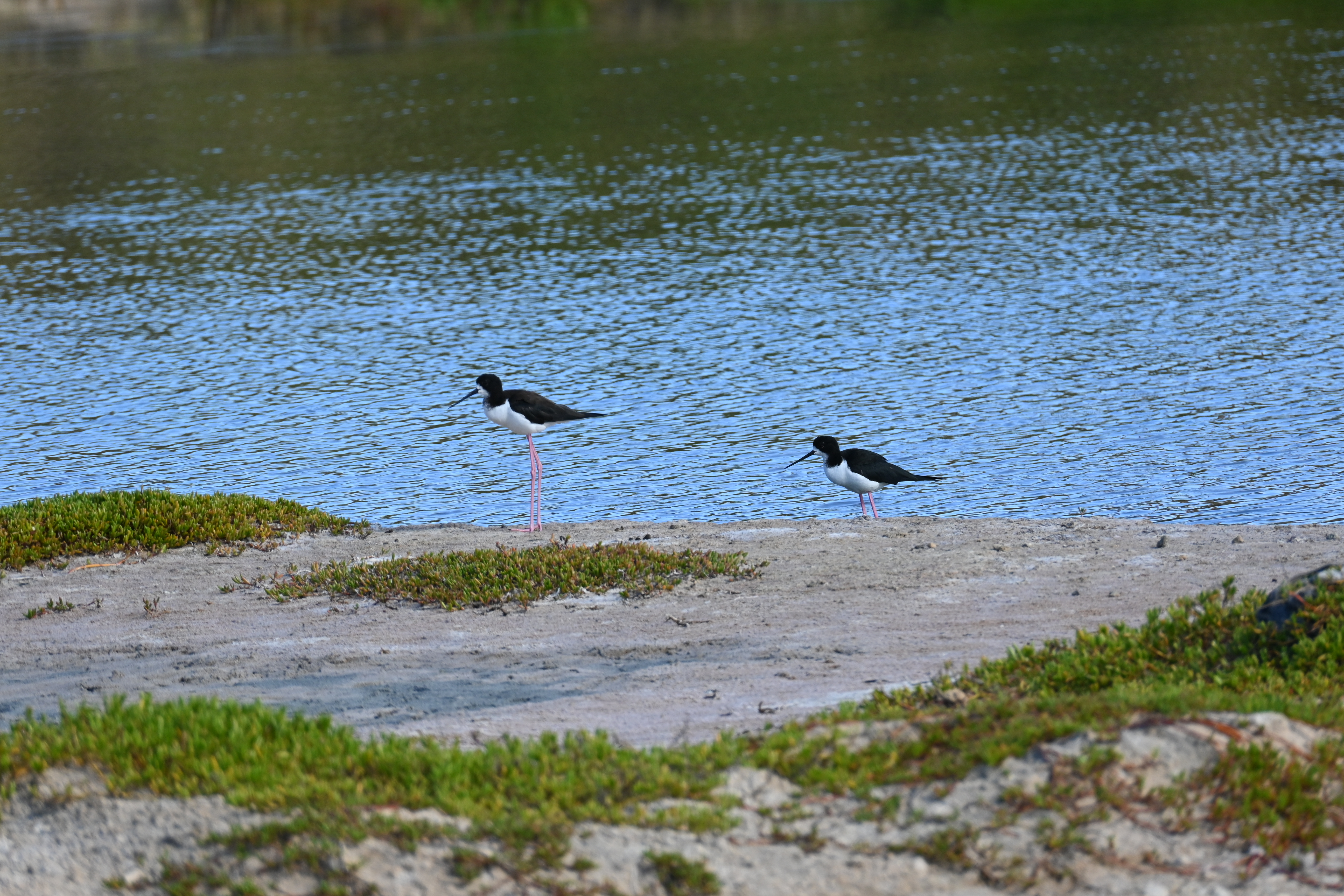
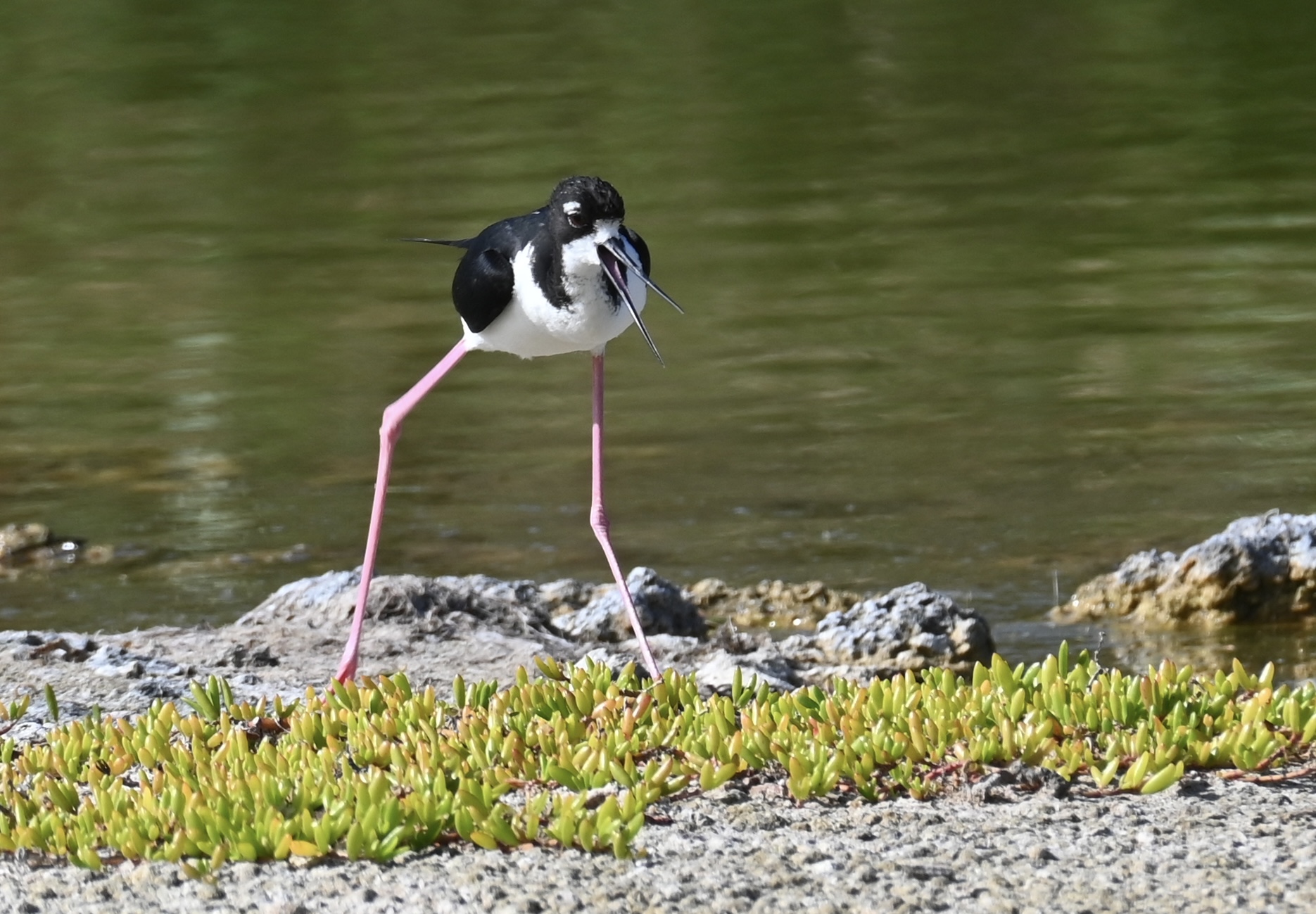
“I come to see birds that also live in Alaska, like ‘akekeke, and birds that don’t live in Alaska, like ‘apapane and nene and saffron finches.

“I don’t think I’d appreciated, though, that I also come to see mynas, and to be asked questions I was never asked. The next time I fly to Hawai’i, I’ll be coming to see you.”

“I’m glad,” said the myna. “Next time you fly from Alaska, I’ll be very glad to see you.”

by Eric Anderson

Watch the Recorded Story

I write these stories in advance, but I tell them from memory (and inspiration). The story you have just read is not identical to the story as I told it.

Photo of a myna (on left) and a kolea (on right) by Eric Anderson.

Story: The Best Flock

December 7, 2025

Isaiah 11:1-10
Matthew 3:1-12

An ‘apapane wanted to know what the best way to be a flock is.

There are plenty of examples if you journey around the island. He found an i’iwi, who said, “Keep it small, less than ten. And chase everybody else away. Speaking of which, ‘apapane, it’s time you got out of here!”

He checked with a myna, who said, “Oh, just get a few birds together.” “Yeah,” said a second myna, “but make sure they don’t argue.” “What do you mean by that?” demanded a third myna. “Don’t you get cross with me!” said the first, and the ‘apapane flew away as the mynas argued about… nothing.

The ‘akiapola’au, the ‘akepa, and the ‘amakihi said that it’s useful to join a flock because then some of the predators, like cats and such, get intimidated. “A good flock is one that keeps us safe,” they told him.

That sounded pretty good.

He looked in on the ‘akekeke, who said, “Just stay together!” He asked the kolea, who prefer to keep some distance from one another. He thought about asking some fish, but they weren’t coming to the surface to talk to any hovering birds.

It was the nene, however, who gave him the most to think about.

When he found a nene to talk to, they were gathered around one of their number who’d hurt her wing. The little group was hungry and rather footsore as they trooped along, looking for ‘ohelo berries (or pretty much anything they could eat).

“Why aren’t you flying?” he asked one of them.

“Because she can’t fly for a while,” said the one in front.

“Can’t you leave her while you go eat?” he said.

The nene looked at him as if he’d lost his mind.

“A good flock is one where nobody gets left behind,” the nene said.

The ‘apapane returned to his part of the forest, and gathered his friends and family and any other birds he could. Together they could find food and shelter. Together they could scare off some of the dangers. But most of all, he told them:

“A good flock is one where nobody gets left behind.”

by Eric Anderson

Watch the Recorded Story

I write these stories ahead of time, but I tell them from memory plus inspiration. As a result, the recording of how I told it does not match how I wrote it.

Photo of four nene by Eric Anderson.

Story: Caterpillar’s Hope

An orange and black butterfly resting on a fern leaf.

November 30, 2025

Isaiah 2:1-5
Romans 13:11-14

Caterpillars don’t have the easiest life. They don’t get around very much – but then, when you move mostly to find another leaf to eat, you don’t need to move very far. There are things about that, while you’re eating leaves, would be very happy to eat you, and that makes for more than a few anxious moments. A lot of the birds I happily tell stories about would happily eat a caterpillar, and that makes them rather sad.

Caterpillars are among the most hopeful creatures on Earth, however. Each one of them hopes to go from an animal that crawls slowly across the branches to one that flies through the skies. They hope to go from someone that you hope will be overlooked (and so not eaten) to one that glows brightly in the sunlight. They hope that the beauty they feel on the inside will be mirrored on the outside.

What’s amazing is that that’s what happens.

Two caterpillars were sharing their hopes on a branch one day between bites of leaf. I’m going to leave out the biting and chewing, because it actually took more time than the conversation. Caterpillars are serious about eating.

“I’m really looking forward to being a butterfly,” said the first.

“Me, too,” said the second.

“I can’t wait to fly,” said the first.

“Me, too,” said the second.

“I’d like to see more of the world than this flower patch,” said the first.

“It’s a good patch,” said the second.

“I’m not saying it isn’t,” said the first.

“You’re right, though,” said the second. “It would be nice to visit another one.”

“All we’ve got to do,” said the first caterpillar, “is wait.”

“Just wait?” asked the second.

“Just wait,” said the first.

“That doesn’t’ sound right,” said the second. “I think we’ve got to build a chrysalis, and stay in it, and then come out as butterflies.”

“Don’t be silly,” said the first. “You hope for it, and then it happens.”

“I don’t think so,” said the second. “I think you hope for it, and then you do something about it. And then it can happen.”

I don’t know what happened to the first caterpillar. I hope it made a chrysalis and became a butterfly, because the second caterpillar was quite right. Caterpillars become butterflies in the chrysalis. They’ve got to make things happen to make other things happen.

Dream of better days. Hope for them, and believe they can come to be. But don’t forget to do the work for them. Hope is good, but hope and effort are better.

by Eric Anderson

Watch the Recorded Story

I write these stories ahead of time, but I tell them on Sunday from memory plus inspiration. The story you just read will not be identical to the story as I told it.

Photo of a monarch butterfly by Eric Anderson.

Story: Decisions, Decisions

November 23, 2025

Jeremiah 23:1-6
Luke 23:33-43

The common waxbills may be the smallest birds in Hawai’i – meaning how big the adults get. Newly hatched chicks even of very large birds can be smaller. But if you see a very small bird with a rosy beak, it’s likely to be a common waxbill.

They like to eat the small seeds of grasses and herbs, and they tend to move about in flocks of anywhere from a pair up to thirty or forty birds. With a flock, of course, comes the problem of decision. If I’m the only one who needs to make a choice, well, I can make the choice. I decide whether to go this way or that way. When there’s somebody else, though, now we have to work out our direction, our left or right, our up or down.

Waxbills have the same problem. When they’ve eaten the seeds in this plot of grass, how do they decide where to go next?

A waxbill decided one day, after a certain amount of chirped argument, that somebody had to take charge. Somebody had to make the decision. Somebody had to rule.

“We’re going this way,” he called, and took off. Most of the other waxbills took off with him, but not all, so he circled back and screeched at them until they, too, joined the rest of the flock and flew with him. Some of them were relieved not to have to argue any more. Others were irritated that they had ideas that nobody listened to. And there were a few that didn’t want to go in this direction at all.

One of the nice things about being a bird that eats grass seed is that, pretty much any direction you go is likely to have grass in it. They flew. They found. They ate. But not everybody in the flock was happy.

The next day, the waxbill in charge decided to take charge again, but this time some of the waxbills wouldn’t go at all. He chirped at them. He screeched at them. He even flew at them as if he was going to hit them with his wings. But they wouldn’t go.

Eventually the flock settled back to the ground again, and one of them said, “I don’t mind following you, but we need to take trouble to agree which way we’re going to go.”

“No, we don’t,” said their self-appointed leader. “I know what I’m doing. I’m in charge.”

“We all have ideas about where to find seeds,” said the waxbill speaking for the others. “Some might be more right. Some might be more wrong. And that includes you. If we all share, we’ve got a better chance that the ones who are more right will be heard, and that we, as a group, will find more seeds.”

“You’re a fine leader,” he went on, “but you’re not the only one with good ideas. We’ll follow – but we’ll also contribute. If you don’t want to listen, well, somebody else will have to lead.”

It took longer that way. It did. But this little flock of little birds did better than they ever had before at finding good clumps of grasses in seed, and they did it with birds who felt better about their leadership and their fellow fliers in the flock than they ever had before.

It can be a challenge to make decisions. It might be that the most important decision you can make is how you make a decision for yourself and with others.

by Eric Anderson

Watch the Recorded Story

I write these stories in full ahead of time, but I tell them from memory (plus improvisation). As a result, what you read and what you hear will be different.

Photo of common waxbills by Eric Anderson.

Story: Teacher’s Example

November 16, 2025

Isaiah 65:17-25
2 Thessalonians 3:6-13

It’s been a while since I’ve talked about nene school, which hasn’t changed what’s gone on there a bit. Goslings have gone to school, they’ve learned about advanced eating and flying, and some of them have wondered about becoming nene teachers themselves.

There was a time when there were just two nene teachers. Both of them were solid at the job. They could coax a timid flyer into dramatic aerobatics. They could coach a fussy eater into finding a much wider diet – sort of a nene version of heavy pupus. They held their students’ attention. They taught their lessons. Best of all, the students learned.

That’s the mark of a good teacher, when the students learn.

One of the students noticed something else, too.

Both teachers taught that it was important for nene to care for the flock. If you see a storm coming, they said, warn your neighbors. If it looks like a mongoose might be close to a nest, drive them away. If you found a good clump of ‘ohelo berries, call your friends over. Take care of the flock. The other members of the flock will take care of you.

That was an important lesson, and they mentioned it every day.

One of the teachers, though, seemed a little confused about its application. When her students were learning about finding food, she was very helpful. “Look for these colors as you’re flying about,” she’d say. And when they found some, she gave them lots of praise. “Well done, my friends!” she’d say to the beaming young nene.

And then she’d eat the food they’d found.

The other teacher did things differently. He was helpful about finding food, too. “These are the colors to watch for,” he’d say. “Make sure to look side to side.” And like his colleague, he had good things to say to his students when they found that tasty clump of ‘ohelo. “That’s exactly right,” he’d tell them. “Well spotted.”

But then he said, pretty much every time, “Call the other students in. Is anybody hungry?”

As I said, one of the students notice this, and one day he asked his parents about it. “My teachers help me a lot,” he told them, “but when we find food, one of them eats it. I suppose that’s OK; she is the teacher, after all. But the other one invites us to share. Which one am I supposed to learn?”

His parents looked at one another, and then they looked back at him. “Which one makes you feel better?” they asked. “Which one makes you feel like you’re an important part of the flock? Which one seems to be strengthening the flock as a whole?”

“Well, that’s easy,” said their son. “It’s the one who invites us to eat.”

“So which example will you follow?”

He thought about it.

“I spotted some ‘ohelo a few minutes ago,” he told them. “Are either of you hungry?”

by Eric Anderson

Watch the Recorded Story

I write these stories in full ahead of time, but I tell them on Sunday morning from memory and inspiration. The recording does not match the prepared text.

Photo of two nene in flight by Eric Anderson.

Story: Flowers and Friends

November 9, 2025

Haggai 2:1-9
2 Thessalonians 2:1-5, 13-17

Life isn’t always easy in the mountain forests. Sometimes it gets really wet and uncomfortable, and while feathers are pretty good at keeping you warm and dry, they’re not perfect. Sit in the rain long enough, and an i’iwi will feel pretty cold and wet.

Worse, though, is when it gets dry, because the trees and the plants rely on water. When there’s been no rain for a good while, they have to save their energy. It’s like when you’ve been running around a lot and need to rest for a while. The way a tree rests, or another kind of plant rests, is to hold off on making flowers or fruit. When there’s more water, then it’s time to bloom.

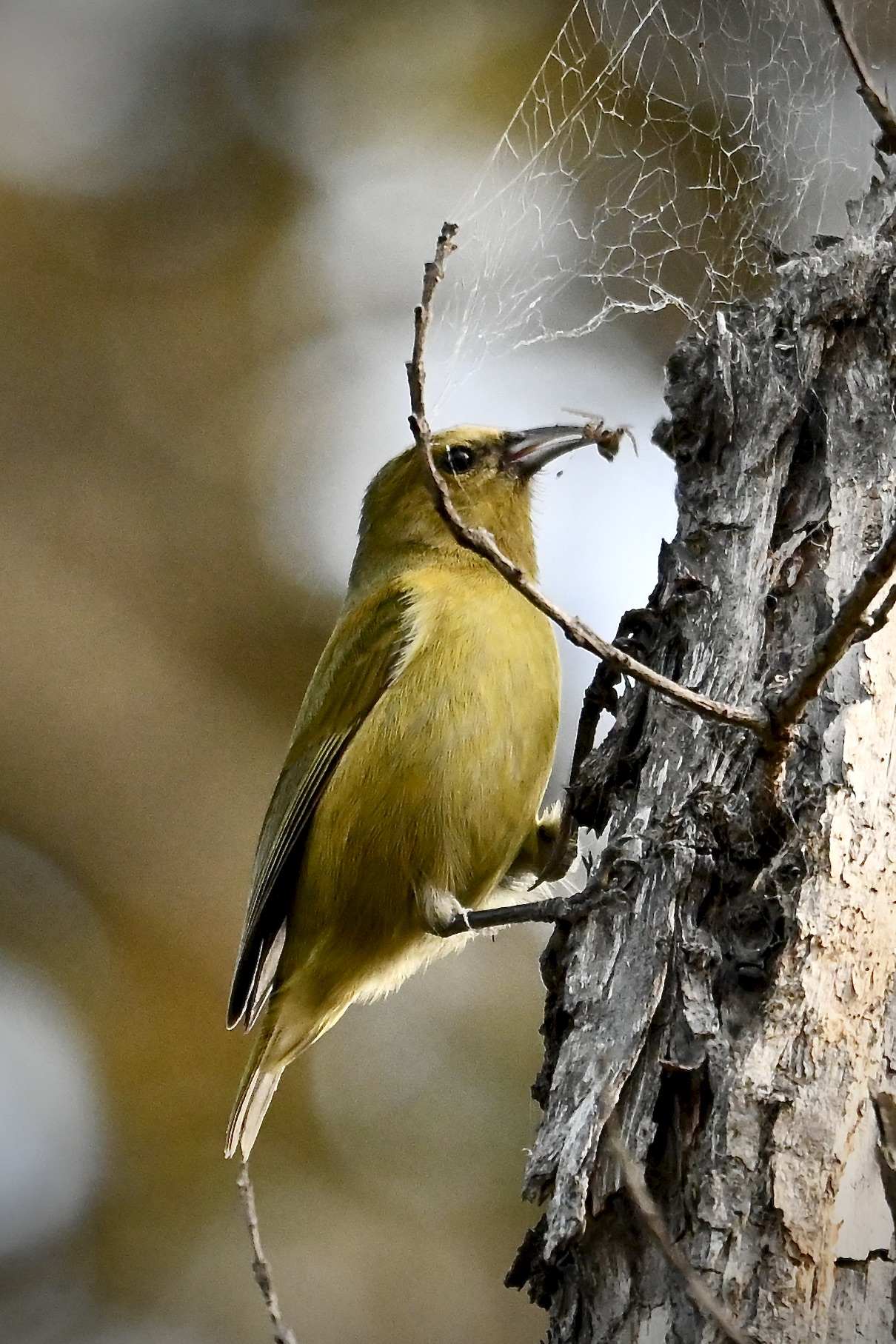
The birds can mostly cope with that. The ‘elepaio eats bugs, and lots of the bugs eat things other than nectar. The ‘apapane and the ‘amakihi eat lots of nectar, but they can make a good meal from worms and spiders. They miss the nectar, but they can feed themselves.

The i’iwi has a rougher time. They will eat bugs, but they’re built to eat nectar, not bugs, and when the flowers aren’t blooming, they get hungry.

It was dry on the mountain. And the i’iwi were hungry.

As I’ve mentioned, while some i’iwi don’t get along with other birds, some i’iwi get along just fine. So there was a little flock of ‘apapane and ‘amakihi and ‘akepa that were worried about their i’iwi friend, who wasn’t saying much, but she was clearly getting hungrier and hungrier.

“What can we do?” an ‘amakihi asked an ‘apapane, who replied with a bird shrug, because he didn’t know, either.

“What can we do?” an ‘elepaio asked his friend the i’iwi, which was the same question but had the advantage of being asked of the right bird. Unfortunately, she didn’t know either.

“You’ve showed me where you’re finding some bugs to eat, and that’s helped some,” she said, “but I’m afraid I’m not as good at catching them as you. I don’t think you can get me more food any better than that.”

“I still want to help,” said the ‘elepaio, and all the other birds did the same.

“You know how you can help?” said the i’iwi. “Stay right where you ware. Stay close to me. Show me you care.”

“How will that help?” asked the ‘apapane, who had a very practical mind. “You can’t eat that.”

“Perhaps not,” she said, “but when you’ve done all you can to help me eat, I’m glad to have your company. It may not feed my stomach, but it feeds my heart.”

So they perched there together in the same tree. Sometimes one or the other birds would sing, and once the ‘amakihi caught a spider and gave it to the i’iwi, who ate it with a hearty “Mahalo.”

Mostly, though, they sat in friendship, friendship that fed the heart even better than flowers.

by Eric Anderson

Watch the Recorded Story

I write these stories in full ahead of time, but I tell them in worship from memory (and improvisation). The story when you watch it will not match the story when you read it.

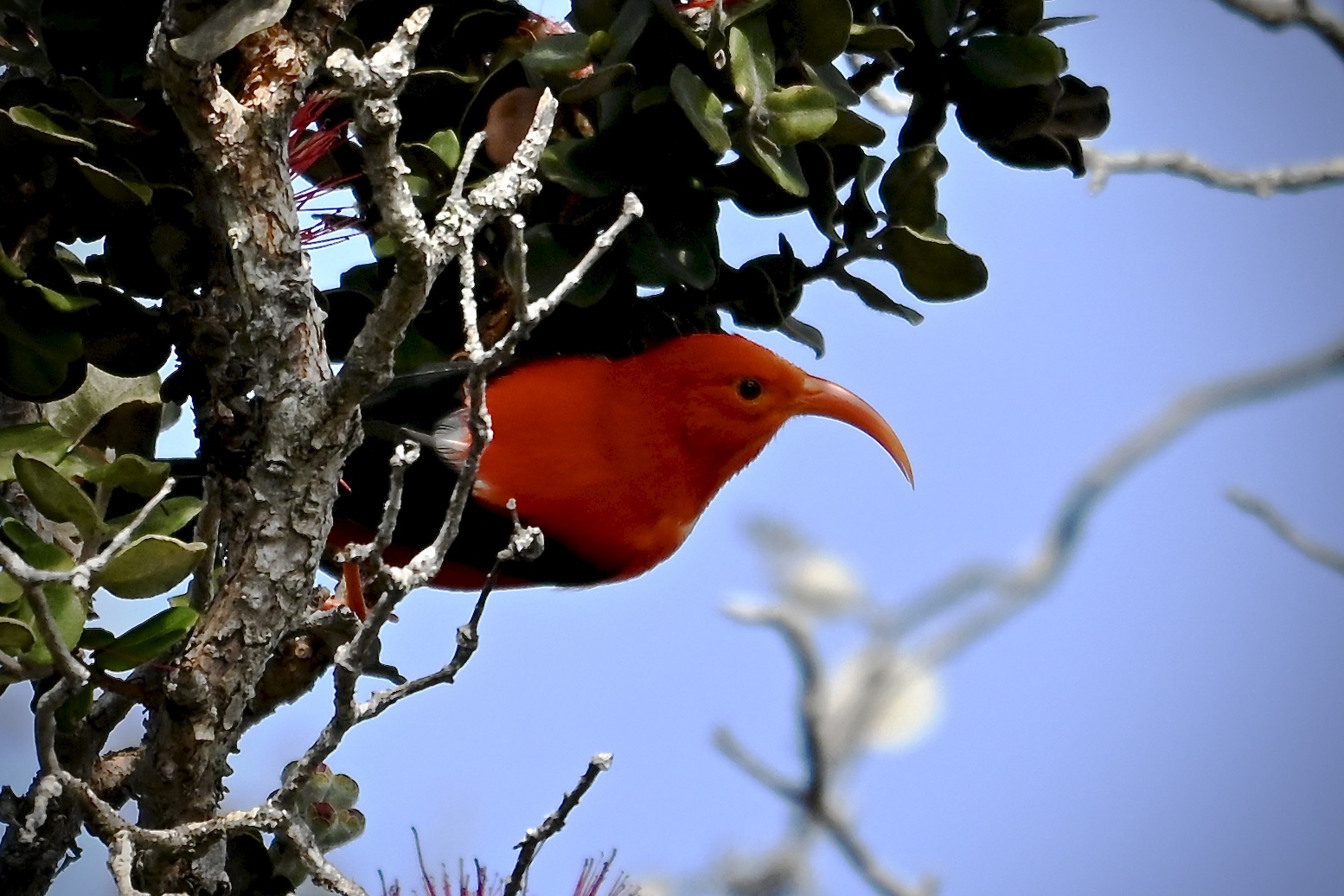
Photo of an i’iwi (who hopefully isn’t hungry) by Eric Anderson.

Story: Honu Up a Tree

November 2, 2025


Isaiah 1:10-18
Luke 19:1-10

When was the last time you saw a honu up a tree?

Never?

Well, I never have either. It’s not a natural place for a honu to be. A honu really prefers to be in water, like the honu in this picture.

Unfortunately, one day a honu found herself in a tree.

As I mentioned, I’ve never actually seen, let alone photographed, a honu up a tree. I’m afraid that photo is the result of a certain amount of non-artificial intelligence that produced that unconvincing image.

It was a storm, of course. Ordinarily honu in a storm find a safe place to ride it out, which is frequently offshore. I don’t know precisely what happened with this honu, and I’m not sure she ever did, either. One minute she was being tossed about in the water, and the next minute she was flailing around in a tree, not getting anywhere, and getting sprayed by the waves and the rain.

All in all, not where she wanted to be.

When things got brighter, the birds came out and found the honu in the tree, and they knew she wasn’t supposed to be there.

“Can you swim out?” asked an ala’e ke’oke’o, who was a swimming bird, even though the honu had better flippers on her limbs than the ala’e ke’oke’o had on his.

“I’ve tried all night,” said the honu. “My flippers can’t move these leaves the way they move water.”

“Besides,” she added, “I’m a pretty high off the ground here, and those rocks look hard. I think I might hurt myself if I fell from here.”

The birds looked things over and thought about it. Winged creatures don’t think about falling very much.

“I know,” said some of them. “Let’s pull some of the leaves and twigs out of the way so she’ll slip down slowly.”

“Right!” said some others. “And we’ll go get some other leaves and grass and mud and sand and we’ll cushion the rocks below her.”

That’s what they did. Some pulled up grass for padding, some moved branches of naupaka aside (OK. She was in a naupaka bush, not a tree, but it looked like a tree to her). The pile of padding grew and her distance from it slowly shrank. They worked slowly but steadily, cautiously but creatively, until with a creaking sound the last naupaka branches bent and lowered her to the top of the padded mound.

The birds cheered as the honu hauled herself off with her flippers and made her way down the beach to the water.

At water’s edge she turned and said, “Mahalo nui loa, friends. I hope you get help like this if you’re ever up a tree!”

One of the birds, a kolea, shrugged and said, “Most of us will be quite fine up a tree. But if you can help me out like this if I’m ever stuck in the water, I’ll be just as grateful as you are now.”

Then she waved and swam off into the deep. I don’t know if she ever did have to help a bird stuck in the water, but I know she would have, and she’s ready to if there’s ever a need.

by Eric Anderson

Watch the Recorded Story

I write these stories ahead of time, but I tell them from memory and improvisation. What you have just read is not identical to the way I told it.

Photos of a honu and of naupaka by Eric Anderson, as is the not-very-convincing blending of the two.

Story: Remember

October 26, 2025

Ephesians 1:11-23
Luke 6:20-31

I remember a good number of things. I also forget a good number of things. Some of them I’m happy to forget, especially if they made me unhappy at the time. Some of them I wish I could remember, especially if they involve the question of where did I put down my keys?

The i’iwi wasn’t much worried about the things he’d remember. He was worried about the things others would remember about him.

A lot of i’iwi get remembered by other birds as being, well, kind of aggressive. Bossy. Selfish. They drive other birds away from the places that they’re eating. Other kinds of birds do that, too, but when an i’iwi gets aggressive, ‘apapane and ‘amakihi will tend to give in and fly away.

“But is that,” he asked himself, “how I want to be remembered?”

He knew plenty of i’iwi that loved to chase other birds away. They claimed that they ate better when they did, but he also knew i’iwi that tended to ignore other birds, even slept in the same trees overnight. They seemed to eat just as well, he thought.

“How do I,” he asked himself, “want to be remembered?”

He had a friend who was one of the most effective bullies around. Where some of the aggressive i’iwi would chase an ‘apapane for a couple of feet, he’d chase them for a twice or three times as far. Sometimes he’d chase a bird so far that he’d find another bird in the place where he’d started, and he’d chase that one, too. If that seems like extra work to you, it does to me, too. Still, he was flashy (but then, all i’iwi are pretty flashy) and he was popular (as long as he wasn’t chasing you).

“But is that,” he asked himself, “how I want to be remembered?”

Then he remembered his grandmother.

She didn’t take any nonsense from other birds, no she didn’t. No ‘apapane had ever driven her away from a cluster of ohi’a blossoms. But she’d never chased an ‘apapane, either, or an ‘amakihi, or a young i’iwi. In fact, she’d let other birds know when she’d found a good spot, whatever the color of their feathers.

His grandmother loved him. He knew that, because she used to hop aside so he could get to the best flowers.

He loved his grandmother.

He went to find her, and said, “I want to be remembered like you, grandmother.”

“That’s good,” she said. “Let’s go see if we can find something good to eat, and then we’ll let everybody else know.”

That’s how both of them would be remembered.

by Eric Anderson

Watch the Recorded Story

I write these stories in advance, but I tell them from memory (plus improvisation) during Sunday worship. The story you have just read will not precisely match the story as I told it.

Photo of an i’iwi (being reflective?) by Eric Anderson.

Story: Hold On

October 19, 2025

Genesis 32:22-31
Luke 18:1-8

Where I grew up on the shores of the Atlantic Ocean, there are birds that eat worms. In fact, a lot of birds eat worms. Some of them would eat worms (and bugs, and spiders) that burrow into trees. Some of these would use their beaks to dig holes into the bark to get those caterpillars out. Some would even carve pretty big holes in the wood.

Those birds are called woodpeckers.

On our island, we don’t have woodpeckers, we have the ‘akiapola’au, and I think I’ve mentioned before that it’s a very rare bird. They only live on our island, and there are less than two thousand of them. They have a short lower beak, and they use that to dig into tree bark where caterpillars or worms might be hiding. When they find one, they use the curved top beak like a fishhook, only they’re catching the worm.

I guess you could say they use both the upper and lower beak to actually eat what they’ve caught.

One day an ‘akiapola’au caught a caterpillar, but he wasn’t alone when he did. There were several other birds around, and none of them had the unique beak of an ‘akiapola’au. Therefore they had a lot of different ideas about what the ‘akiapola’au should do with his newly caught caterpillar.

“It’s stuck on your beak,” said an ‘apapane. “You can’t eat it from there. How are you going to get it into your mouth?”

“He could put it down,” suggested an ‘amakihi, who may have said that because he was hungry and thought he could get to the caterpillar if it crawled off.

“Is it too big to eat?” asked an ‘elepaio, which isn’t a very big bird but neither is an ‘akiapola’au. “You could bite it into smaller pieces.”

“That sounds like a good idea!” said the hungry ‘amakihi, who hoped to get one of the smaller pieces.

The ‘akiapoloa’au swung the caterpillar around, using the twigs and branch to get it from the hook of his beak toward his mouth. The other birds chimed in with advice like “Left!” “Right!” “Up!” “Down!” which wasn’t very helpful.

The worst advice came from an i’iwi, whose beak curves pretty dramatically, too. “Just put the caterpillar down,” she said. “Get some flower nectar instead. I mean, yuck!”

The hungry ‘amakihi echoed her, but the ‘akiapola’au ignored them all, all except an ‘alawi, another bird that likes a menu of bugs and caterpillars, who simply said, “Hold on.”

Hold on.

The ‘akiapola’au held on as he used the twigs to get the caterpillar lined up just right, and then, well, he was a happier ‘akiapola’au because he wasn’t as hungry. He looked at the helpful ‘alawi, who was searching for a caterpillar of her own.

“When you find what you need,” he said, “hold on.”

There are plenty of things in life that it’s good to let go of. Hot pans. Mosquitoes. Sharp things. There are plenty of habits in life that it’s good to let go of. Greed. Making fun of other people. Eating too much sugar.

But when you find what you need, whether it’s the food for the body or the food for the soul, the best advice there is, is: “Hold on.”

by Eric Anderson

Watch the Recorded Story

I write these stories ahead of time, but I tell them from memory, so what I said will not match what I wrote.

Photos of an ‘akiapola’au (and his lunch) by Eric Anderson.

Story: ‘Apapane Faith

Juvenile 'apapane with spotted feathering

October 5, 2025

Habakkuk 1:1-4, 2:1-4
Luke 17:5-10

Birds, by their very nature, rely on faith. Every bird knows about gravity; every bird knows that what goes up must come down. Every bird knows that while flight is the most natural thing in the world to them, it is also the most unnatural thing in the world. Somehow they hold those two things together.

At least, most of the time they do.

One young ‘apapane had learned to fly from his parents. He’d flown any number of times on his own. He was also still pretty young, so a lot of his feathers were still grey and brown. That had been fine. Now, however, some of his adult colors were coming in, so he had red feathers mixed among the grey and brown, and he had a speckled look. Frankly, I think he looked really interesting, but he thought he looked odd, even a little ugly.

With feathers that looked like that, he thought, how could he keep up with flying?

I don’t think that makes much sense, do you? He’d been flying just fine, and suddenly he didn’t believe he could fly because his feathers were changing? But you know, the first step in doing something is believing that you can do the thing. He stopped believing he could do the thing.

So he stopped flying.

He did manage to feed himself by journeying to other trees in the slowest, and possibly most exhausting way possible. He hopped from twig to twig, then from branch to branch, and when branches got close he jumped from tree to tree. It took time, and it wore him out, and frankly made him hungrier, but he did it.

It was a funny way to live for an ‘apapane.

It took a while for the other birds to notice, because he did turn up among his family and friends, even if he turned up later than everyone else. They just assumed he’d flown off in some other direction and finally got turned around the right way.

It was Tutu, his grandmother, who noticed the way he hopped, rather than flew, from tree to tree. She hopped over to his branch and said, “Are you all right, grandson? Have you hurt your wings?”

“No, they feel fine,” said her grandson.

“Then why are you hopping everywhere?” she asked. “Why aren’t you flying?”

“Well, just look at me,” he said. “Do these look like flying feathers? If I take off with these I’ll crash a moment later.”

“You think you can’t fly because of these feathers?” asked his grandmother.

“That’s right, Tutu,” he said.

Grandmother thought. She was a wise old bird, and she knew that you have to believe you can fly if you’re going to fly. She was tempted to let him hop around until he finished molting, but she knew he’d be pretty miserable the whole time. And who knows? He might never come around to believing again. That would be sad.

“Grandson, are you an ‘apapane?”

“Yes, of course I am,” he said, puzzled.

“Do you believe that you have wings?”

“Of course I do.”

“Do you believe in your feathers?”

“They’re right here,” he said.

“I believe in your feathers, too,” said Tutu, “the ones you have and the ones you’ll grow. In fact, all your family believes in them. Do you believe us?”

“I’m not sure,” he said.

“It takes just a little belief,” said his grandmother, “and that’s the amount of belief it takes to spread your wings. You’ve done it before. You can do it now.

“Believe it. Spread your wings, grandson. Fly.”

by Eric Anderson

I regret that we continue to have problems with the audio in our video stream, so a recording of this story is not available.

Photo of a young ‘apapane by Eric Anderson.