Card Sense

There was a boy who loved the card trading game Yu-Gi-Oh. He loved the time with his friends, he loved the play, and he loved the cards themselves, with their figures and monsters.

He’d save his chore money to buy new expansion sets of new cards, and then he’d do more chores so that he could buy more cards.

He’d trade cards he had many of for other cards he hadn’t obtained.

And then he’d gather his friends, and the games would begin. It was fun.

Over the course of a few weeks, though, things changed. He came to think more of the cards than of what he did with them. He played less, and traded more. His trades grew more self-serving, and downright shrewd. He managed to talk his friends into exchanges that worked for him, and not for them.

When they actually stopped trading and played, he won more and more often as his increased collection of “special” cards gave him more and more of an advantage. It wasn’t much fun for his friends when he had all the winners and they didn’t. He hardly noticed that when he brought out his cards that suddenly they were busy, or wanted to do something else, or just hadn’t brought their cards that day. It allowed him to scan through his collection instead.

Until one day, as he was laying out his cards on a table, and wanted to point one of them out to his friends. When he looked up, there was nobody there. Nobody would enjoy it with him.

He thought hard about that.

A few days later, he brought out his special cards, and one by one, he passed them around to his friends. One for you, one for you, one for you, one for you… until they were all shared.

And then: they could play. And it was a good game.

Half the Way: Shrink!

CanyonThis story is about a wizard on his travels.

Do you know what a wizard is? It’s somebody who can work magic – at least in stories. In stories, magic is a pretty cool thing to have, or be able to do: to make things happen by using a spell.

This wizard had a spell that was really, really useful when traveling, so he set out in confidence, even though the road he was following could be a difficult one. It went through a narrow canyon, with cliffs rising steeply to either side, and sometimes big rocks would fall and block the way.

Plenty of people would choose another road, but not this wizard. He made his way down the path, enjoying the sunlight winking over the canyon walls.

And sure enough, he got to a place where a huge boulder had come loose from the cliff high above, and fallen in a very narrow section of the gorge. There was no space between the boulder and the side that he could squeeze through on the right, and no space that he could squeeze through on the left. It was too tall and too rugged to climb, and as for going under, well, he hadn’t brought a shovel.

So now was the time for the spell to prove its worth. He stood resolutely before the boulder, pointed his finger at its rocky greatness, and intoned:

“All the way, all the way, all the way… Shrink!”

The boulder shuddered, and some gravel came loose and pattered on the path, but the huge rock remained absolutely huge.

The wizard, confused, confronted the rock again, pointing his finger at its stony magnificence, and intoned:

“All the way, all the way, all the way… Shrink!”

This time the boulder didn’t even shudder. It did nothing except sit there in all its immensity.

“All right,” said the wizard to himself. “I’m tired. I’ve been walking all day, and I haven’t had supper. I’ll eat, I’ll get a good night’s sleep, I’ll wake fully rested, I’ll make breakfast, and then I’ll take care of this rock.”

And that is exactly what he did. He made his supper and ate it, he went to bed early and slept well under the stars (a good night’s sleep is important; ask your parents!), he got up and ate a good breakfast (a good breakfast is important; ask your parents!), he packed up his gear for the day, and stood once more before the boulder, and cried:

“All the way, all the way, all the way… Shrink!”

Once more the great rock shuddered, and more dust rose on the path below it. But other than that, it remained just as gigantic as it had the night before.

Now the wizard sat down to do something he hadn’t done to this point: he sat down to think.

(Thinking is a good thing. Just ask your parents!)

He thought for a good while, and then an idea lit up his face. He sprang to his feet again, and once more faced the rock. He directed his finger, and with all the strength he could mustered declared:

“Half the way, half the way, half the way… Shrink!”

And the enormous boulder shivered as it did, indeed, collapse to half its size. Which was still gigantic, and still blocked the path, so the wizard cried again:

“Half the way, half the way, half the way… Shrink!”

Again the rock shrank, and still it blocked the path, so the wizard repeated four or five times (he lost count):

“Half the way, half the way, half the way… Shrink!”

Until the boulder was a rock he could step around with ease, and go on his way.

There are things in the world that are too big to change, for sure and certain. But sometimes, we can take them on in smaller ways, chunk it down and do a little at a time. Eventually, those small things add up to make a big difference.

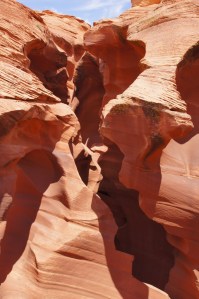
Photo “2011-06-13 Arizona, Antelope Canyon 065 Lower Antelope Canyon” by Allie_Caulfield via Flickr. Used by permission under Creative Commons license.

Overhand or Underhand?

Baseball_showing_stitching_on_grass

Two young baseball players, new to the team (if not quite to the game) found themselves in deep disagreement one day over the proper way to throw a baseball.


“Overhand!” insisted the team’s new shortstop. “That’s the best way – the only way. It gets there faster, and you can throw it farther. Underhand just doesn’t cut it.”

“Underhand is best!” argued the second baseman. “You’ve got more control. It goes where you want it to, and it’s easier for your teammate to catch.”

Neither would give an inch.

“Overhand!”

“Underhand!”

“Overhand!”

“Underhand!”

This went on for some time.

At last, the coach had reached her limit for unreasoned discussion – or, well, argument. She told the players to take to the diamond for some fielding practice. As the infielders and outfielders took their positions, she told one of the other players to stand on first base.

“Here’s the situation,” she called to the team. “We’ve got one out, and there’s a runner on first. That could be the tying run in this game. So we’ve got to get these runners out!”

She stepped up to the plate with bat and ball, and hit a scorching ground ball between second base and third. The shortstop ran to intercept it, caught it neatly, and she looked to where the second basement was running to cover the bag as the runner took off from first.

The second baseman was close. Really close. So the shortstop – the overhand thrower – tossed the ball underhand to the second baseman just as his foot tapped the bag. One out.

Now the second baseman – the underhand thrower – spun to look toward first base. The coach was sprinting down the base path, making for first. So he cocked his arm back, and fired a fast straight throw (overhand!) to the first baseman, who caught it just before the coach’s foot could come down on the bag.

Double play!

All the players hooted and hollered their congratulations, and the coach walked over to the wondering pair who’d just reversed their argument in a fraction of a second.

“It’s not about one way to do things,” she told them. “There’s a place and a time for underhand, and a place and a time for overhand. You just need to learn which is which.

“Now, play ball!”

Baseball image by Hector Rodriguez – originally posted to Flickr as Baseball, CC BY 2.0, https://commons.wikimedia.org/w/index.php?curid=10178609

‘Apapane Pride – And Hubris

‘Apapane_and_Nestlings

An ‘Apapane and nestlings, courtesy National Park Service

If you were very lucky, and found the right tree, and if you stood in the right place where the branches weren’t too think, and if you looked at the right place, you might see the ‘Apapane nest high in an ohi’a tree.

There were three chicks in the nest, about 2 weeks old, they were hungry all the time, and they had grown feathers – so they were starting to think about flying.

Birds grow up faster than people.

One of them, who might have been the oldest but they all hatched at the same time so who knows?, was sure that he was ready to fly. So when his mother had flown off to get some food – did I mention that they were hungry pretty much all the time? – he hopped up on the side of the nest, spread his wings, and launched himself into the air.

Well, I’m afraid he didn’t get far. Those new feathers weren’t quite grown out, or his wing muscles weren’t quite strong enough, or some combination of the two, and he was lucky to find himself grasping a branch not far below with his wings all a-flutter and his heart racing.

And that was before his mother got back and hounded him along the branch he’d landed on to the tree trunk and then some hopping and frantic fluttering to bring him back to the nest at the top of the tree.

Quite aside from all the air she blew at him with her wings, she gave him The Look.

You know The Look, right? It’s the one your mother gives you when she’s Just Had Enough?

I know The Look.

And likewise this little bird got to know The Look.

Two days later, though, all their wings were stronger and now the mother thought they were ready to fly – did I mention that birds grow up faster than people? So the mother nudged them onto the edge of the nest one by one. Our proud chick went first, and sure enough, his wings were ready and he flew off. But I’m afraid he still had more pride than wing strength, so when he tried to fly farther than the next tree he found himself on the ground a little ways past it. It took some time before he was rested enough to come back to his home tree.

The second chick, I’m afraid, let his fears get the best of him. He’d watched his brother do badly, of course, but even without that, he wouldn’t believe he could do it. His mother nudged him up on the edge of the nest, and there he stayed, even when his mother gave him The Look.

You now The Look, right?

I know The Look.

And this little bird got to know The Look.

When he still wouldn’t take off, his mother finally resorted to pushing him right off the nest. He frantically sawed the air with his wings, and to his surprise, found himself flying right over to the next tree, where he perched with his heart pounding and his mind soaring.

Then came the last one. He stepped up, and looked at his mother, who nodded. He spread his wings, and looked at them carefully, to see all the feathers were in place. He thought they were, but he looked at his mother, and she nodded again. He flapped his wings a couple of times, just to feel how the air pressed against them, and one last time, looked at his mother. She nodded once again.

So he stepped off into space, let his wings descend and rise again…

And he flew.

The Ocean Comforted

IMG_0859

Ala Moana Beach – Photo by Eric Anderson

This story begins with a little girl and a big ocean.

This little girl loved to play on the beach. She loved to watch the waves roll in, and the changing colors of the water. She loved to see the waves leap up from the rocks in great fountains of spray, and she loved to see them slide up on the sand. She loved to build sand castles, and watch the rising tide fill her moats with water. She loved to see the waves wash up over her creations, and slide back into the sea leaving the sand smooth and bare, as if nothing had ever been there at all. She’d laugh, and laugh, and laugh.

She’d swim, and dive, and watch fish. She even tried to surf.

The ocean made her joyful, and the ocean smiled to do it. But the ocean never really believed she’d do anything for it. Oceans are big, and compared to an ocean, this little girl really was quite small.

One day, while running along the beach, she noticed a plastic cup floating in the surf. Not far away, she saw a plastic bag. Then she spotted a lost pair of sunglasses. And it went on and on.

To the ocean, these bits of trash feel a little like something stuck under your fingernails. It didn’t like the feeling, but it was kind of used to it. Certainly there’s a lot of it about.

The little girl didn’t leave the cup where it was, or the bag, or the sunglasses. She picked up all of them, and everything else she could see, and took them away.

Every time the ocean saw her after that, she brought a bag with her, and filled it with those bits of flotsam trash she found. And she’d swim, and run, and build sand castles, and laugh, and laugh, and laugh. And she’d clear away all the trash she’d collected.

It’s a big world, and a big ocean. She paid it a favor that was small in some ways – but you’d better believe that the ocean was as grateful for her gift to it as she was for all its gifts to her.

Hidden Healing

I Feel Down by Lisa Brank

“I Fell Down” by Lisa Brank

This story begins with some children playing. All was as it should be, that is: just a bit exuberant, just a bit frenetic, just a bit noisy.

OK, maybe it really exuberant, really frenetic, and really noisy. But that’s as it should be.

The ball they were tossing about and chasing sailed right over the head of one boy, who went pelting along after it. He ran so fast that his feet started to run away with him, or perhaps he ran faster than his feet. You know how it is: you suddenly realize that you can’t step out far enough ahead of yourself to stay on your feet.

And sure enough, down he went, splat on the ground.

And of course, the place his knee came down was the place where the rock was. Of course. It always is, isn’t it?

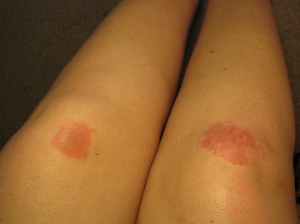
So he got up with some sounds that might have been sobs, and looked down at the dirt and the leaves and the red liquid oozing there. He walked off home with a limp and a groan, and there might have been a tear or three on his face.

When he got home, he found Mom and Dad there, and they did the things that parents do for a child with a skinned knee. They washed it off (and that stung), and they put ointment on it (and that stung), and they put a bandage on it, which didn’t sting, but didn’t actually make him feel a lot better.

What really concerned him was the thought that it might not get better. Even though he’d seen it washed off, and even though he’d seen it the ointment go on, he was sure that underneath the bandage it was dirty and ugly and bleeding. So he’d try to look under the bandage, lifting up just a little, but all he could see underneath was in shadow. It was just dark.

Until the day when the bandage came off. Imagine his surprise when he saw that it wasn’t all dirty and bleeding. New skin was growing where the scrapes had been, there was no sign of bleeding, and the redness was fading away. Over the next days he watched in wonder as the new skin grew, until there was no sign his knee had ever hit that rock.

Sometimes, healing happens where we just can’t see it. Sometimes, it happens where we can. God made us so that things do get better, most of the time. And even then, I think God heals us in ways we just won’t see until God’s finger points it out.

Sun Astonished

St_Peter's_church_-_stained_glass_window_-_geograph.org.uk_-_488217

Photo from St. Peter’s Church, Strumpshaw, UK. By Evelyn Simak, CC BY-SA 2.0, https://commons.wikimedia.org/w/index.php?curid=13011751

Note: I’m now posting my sermons each week on the Church of the Holy Cross’s website. That’s the place to subscribe to see them.

However, I also prepare a story each week “for the children” — knowing perfectly well that it’s for everyone present. I’ll be posting those here.

Today’s story is an adaptation of the use of water in three forms as an image of the Trinity. I’m well aware of its limitations as a theological illustration, but I began picturing the relationship of water with the Sun and… Well, here’s the story.

 When Water and the Sun first met, the Sun spent most of its time being astonished.

There was plenty of reason. As the Sun gazed down from the sky, Water spilled across nearly everything it could see. There were oceans and oceans of Water, sparkling blue, reflecting the Sun’s rays. What a sight!

So the Sun beamed down on the Water (well, that’s what the Sun does to everyone and everything), and the Sun was astonished again. Because clouds began to form between the Sun and the Water, and the Sun didn’t know where they’d come from. They glowed silver in its radiance (except at the edges of the world, where they broke light up into these amazing oranges and reds), and the Sun asked, “Who are you, and where do you come from?”

The clouds replied, “I’m your friend Water, sailing on the air!”

The Sun was astonished.

Soon the Sun had more cause for wonder, because the clouds began to shrink away as water fell from them in streams (they’d come to Hilo, of course). When the clouds cleared, the Sun looked down upon a carpet of white so bright the Sun itself blinked to see it: snow atop the summit of Mauna Kea.

“Who are you,” the Sun asked, “and where do you come from?”

The snow replied, “I’m your friend Water, in solid crystals resting on the mountain!”

The Sun was astonished.

The Sun watched Water melt from the snows, and run glittering down the mountainside. The Sun watched Water leaping and dancing down the falls, turning its sunbeams into rainbows. The Sun watched Water return to the oceans, and leap invisibly once again into the air until it whirled up in clouds.

The Sun was astonished.

But God — God the Creator, God the Begotten One who would be born of Mary, God the Holy Spirit moving over the waters —

God smiled.