How is a young bird, or a young turtle, or a young person supposed to figure out how to be an adult bird, or an adult turtle, or an adult human being? People, at least, get some instructions from their elders. We get taught how to get dressed, and what things are good to eat (or at least good for you to eat; opinions differ on whether things that are good for you are tasty enough to eat), and especially important things like, “Don’t touch the boiling tea kettle on the hot stove!”
Birds probably don’t get quite that much teaching. Certainly they don’t get the years of it that we do as we’re growing up.
A young ‘akekeke was learning how to be an ‘akakeke. He’d already made one trip from Alaska to Hawai’i, just as the kolea do, and he’d been sleeping and eating and flying about ever since. But he was confused.
You see, there were creatures who did very different things than ‘akekeke did, and he wondered if their ways might be better.
Mind you, there were plenty of creatures who did very similar things. Kolea and hunakai and ‘akekeke all hunted through the grasses and tidepools and rocks for insects, snails, and so on. If he imitated them, things went pretty well. He tried to imitate the ae’o, but he didn’t have long pink legs to hold his body out of the water of the fishpond and he ended up gasping and spluttering as he flapped his miserable way to shore.
The least successful of all was when he tried to imitate a honu. He flopped into the water in a calm spot and lingered below the surface. Then he tried to eat some seaweed on the underwater rocks. He choked on the water, of course, and once more hauled his bedraggled self onto the beach.
He looked about and saw his mother.
She asked, “What are you up to, son?”
“I’m learning,” he said. “I’m learning to be an ‘akekeke.”
She looked around at the other ‘akakeke on the shore, none of whom were trying to feed like a honu. “How?”
“By imitating what I see,” he said.
“Are you learning anything?” she asked.
“I’m learning that some things don’t work,” he said, and coughed up a little more water.
“I’m not saying you can’t learn anything from a honu,” said his mother, “but for basic things like eating and flying, I don’t think there’s much they can teach you. I don’t think you can eat the way they do, and they certainly can’t fly the way you do.”
“I suppose not,” said the ‘akekeke, who was a little sad about not learning anything with his imitations that day.
“You have taught me something today, something I can imitate,” he said.
“What’s that, son?” asked his mother.
“You’ve taught me to be kind.”
Whether we wear feathers, shells, or rubbah slippahs on our running feet, let’s all imitate those who are kind.
by Eric Anderson
Watch the Recorded Story
I write these stories ahead of time, but I tell them from memory (plus improvisation) during worship. What you have just read is not necessarily how I told it.
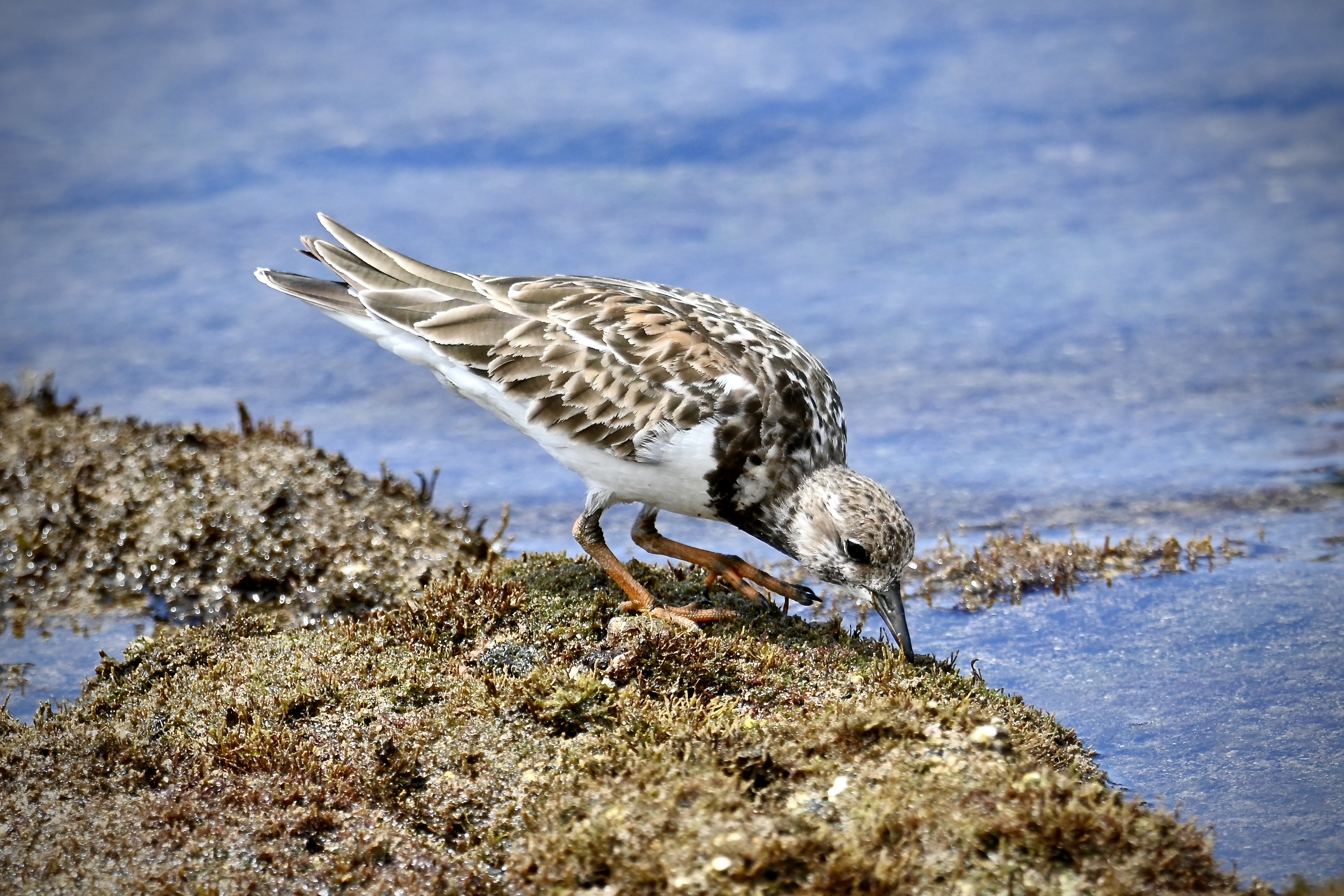
Photo of an ‘akekeke (ruddy turnstone) by Eric Anderson.Not far away, grazing in a shallow pool, there was a honu (green sea turtle).
I was on Kauai in March at Ha’ena Beach. It’s a special place, even though the day I visited it was, let’s face it, raining. Come to think of it, it was Hilo weather. I probably should have left that at home.
While I was there I saw three birds that were very special to me, because I’d never seen them before. Two of them don’t live on our island.
While I was there, I didn’t see them talking, but perhaps, just perhaps, they had a conversation after I left. It might have gone like this:
“Who was that guy with the camera?” asked one of the koloa, a Hawaiian duck.
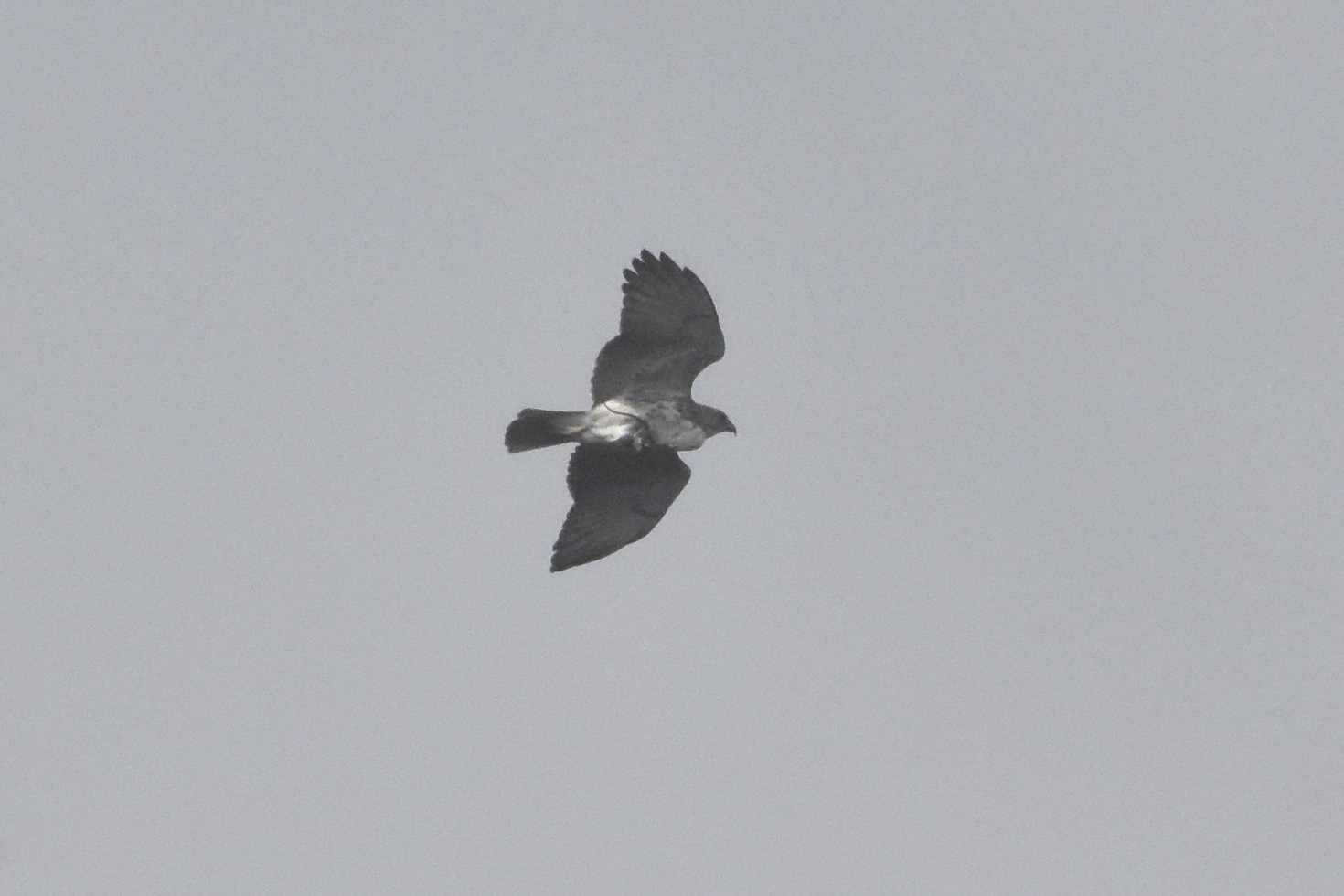
[There are a pair of koloa flying in the upper photo.]
“He took a lot of pictures of me,” said the male white-rumped shama, showing off his long blue-black tail.
[The male shama is posing at upper right.]
“You posed,” said his wife, whose tail was much shorter and whose feathers were gray rather than deep blue.
[The female shame is at lower right, and also posing.]
“He took all of our picture,” said the ‘alae ‘ula (Hawaiian gallinule) from the swampy ground where he had been feeding and, as far as anyone could tell, not noticing.
[The ‘alae ‘ula is at lower left.]
“He took my picture the most because I’m special,” said the male shama. “I mean, look at these feathers! Look at this tail! Wouldn’t you take my picture if you could?”
The other birds had to admit that they probably would.
“You see?” said the shama. “I’m special.”
“Yes, you’re special,” said the female shama, “but I’m special, too. You’ve got more spectacular feathers than I do, but try and lay an egg without me.” The female koloa quacked her agreement before her husband could protest.
“You’re all special,” sighed the ‘alae ‘ula. “I wish I had your feathers, shama, or your black-barred wings, koloa. I’m afraid I’m not special. He took my picture and then went away.”
The other four birds were rather uncomfortable about this, because it was true. I took the ‘alae ‘ula’s picture and went away.
“It was raining rather hard,” said the shama, who stayed beneath leaves while it happened unlike the koloa or the ‘alae ‘ula.
“It was,” said one of the koloa. “Perhaps water doesn’t roll off of him…”
“…Like water off a duck’s back?” laughed her mate.
The birds had a good laugh, and then the shama said seriously, “’Alae ‘ula, you’re very special. There are so few of your kind in the world.”
“That’s a tough way to be special,” said the ‘alae ‘ula, and it’s true. It is tough being in a small group in a big world.
“There’s only one you,” said a koloa. “That’s true of me, and all of us. There’s only one. You’re special, each and every one of you.”
The ‘alae ‘ula nodded solemn gratitude to each of the other special birds, and went back to feeding.
Like each of them, each of us – each of you – is unique in the world, precious, and special.
Even if water doesn’t necessarily roll off you like water rolls off a duck’s back.
by Eric Anderson
Watch the Recorded Story
I write these stories in advance, but I tell them from memory plus improvisation. What you have just read is not identical to the way I told it.
Photos of (clockwise from upper left) two koloa in flight, a male white-rumped shama, a female white-rumped shama, and an ‘alae ‘ula by Eric Anderson.
‘Apapane are not generally aggressive birds. They tend to be the ones that fly away from other, touchier, birds. Once in a while, though, ‘apapane will flock together and this discourages the bullies (which are mostly i’iwi, I’m sorry to say).
One year, an ‘apapane got an idea.
First, he gathered as large a flock as he could. There were dozens of birds, maybe a hundred birds. No i’iwi would threaten them, he knew.
Second, he chased away all the non-‘apapane. ‘Apapane will flock with ‘amakihi and ‘akepa sometimes, but not in this flock, no. He made sure that for every bird he chased away, he invited two or three more ‘apapane to join. The flock got bigger.
Third, he set his ultimate plan in motion. He called them into a stand of ohi’a bright with blossoms. “These are our trees, ‘apapane trees,” he told the gathered birds. “We will keep them for ourselves and only for ourselves. We will chase away the i’iwi so they never bother us again. More than that, we will chase away the ‘amakihi and the ‘akepa and the ‘alawi and anyone else who tries to steal our nectar. We will be the grandest birds in the forest.”
Sure enough, that’s what they did. They chased the other birds away from the trees they called theirs. They soaked up the sunlight, they reveled in the nectar, they crunched up the bugs.
The ohi’a forest, however, changes. The grove that is bright with blossoms today goes to seed tomorrow. The trees they had claimed for their own went from flower to seed. The ‘apapane began to get hungry.
“Do not fear!” he called. “It’s time to go get other trees.”
With that, an ‘apapane army took to the air. They flew to another stand of blossoming trees and they chased away all the other birds. Except for one. One bird remained perched in her tree, sipping from one of the bright red blossoms.
An i’iwi.
“Get out,” ordered the leader of the ‘apapane army. “These are our trees. ‘Apapane trees. You are not welcome.”
The i’iwi took another sip. “And what will you do if I don’t go?” she asked.
“We’ll mob you,” said the ‘apapane. “You’ll never have any peace.”
“But if I let you chase me from every tree with flowers, I’ll never have any peace, either,” said the i’iwi. “If I can’t have peace I might as well have nectar. And,” the i’iwi looked over the ‘apapane leader’s shoulder at the birds behind him, “I’m not sure if you’ve got a mobbing flock back there.”
One of the birds swallowed hard and hopped forward. “We’re not bullies,” he said. “It’s one thing to keep bullies away. It’s another thing to make other birds hungry.”
“Keep your place!” whistled the leader. “This is my decision! Mine alone!”
And that’s where the ‘apapane army broke up. There were birds who wouldn’t be bullies, so they flew away. There were birds that wouldn’t be servants, and they flew away. And there were birds that had had enough of army life, and they flew away.
Only three birds remained: the i’iwi, the ‘apapane leader, and the first ‘apapane who had refused to be a bully.
The ‘apapane leader asked the i’iwi, “So now you’ll bully us?”
“No, I don’t think so,” she said. “There’s plenty of nectar in the forest. Eat your fill.” The ex-leader stared at her a moment before flying away himself.
“Would you like some nectar?” the i’iwi asked the ‘apapane who wouldn’t be a bully.
“I would. Thank you. Thank you for everything,” he said, and side by side they sipped from the bright red flowers.
by Eric Anderson
Watch the Recorded Story
I write these stories in advance, but I tell them from memory plus improvisation. What you have just read is not identical to the way I told it.
The akiapla’au is a small bird. It has a unique beak, with a short lower beak, and a longer top beak that hooks down in front of the lower beak. It may look odd, but the lower beak can drill into tree bark after bugs and grubs, and the top beak hooks them to draw them out.
If that seems strange, just imagine that you had to chase the chocolate chips through a cookie, and you might think a double-purpose beak sounds pretty good.
An akiapola’au is a small bird. It isn’t any bigger than a saffron finch or a yellow-beaked cardinal. There aren’t very many of them, either, perhaps about 1,900 here on Hawai’i Island. There aren’t any anywhere else in the world.
I think they’re pretty wonderful and pretty special.
A youngish akiapola’au, however, wasn’t certain about this. I don’t know whether he knew that birds like him live only on this one island, but I’m certain he knew there weren’t a lot of them around. Think about how you know so many of the people of Hilo, and how many of them you call “auntie” or “uncle.” After a couple of years, he knew pretty much every akiapola’au there was, and he called a lot of them “auntie” or “uncle.”
“There aren’t very many of us, and we’re very small birds,” he said to himself one day. “How will we ever make a difference in the world?” He had dreams, he did. He wanted to make the world better. He wanted someone else to benefit because he lived. He wanted to love the world somehow.
“But how?” he asked himself. “I’m too small to move anything bigger than a caterpillar with this beak of mine. And if we gathered all of us together and flapped our wings as hard as we could, what could we akiapola’au do but make a light breeze that the trade winds would blow away?”
It made him sad.
“Auntie,” he asked one day, “how can I make a difference?”
“What makes you think you don’t?” she asked.
“I’m too small to move anything,” he said, “and there aren’t enough of us together to make anything different.” Sadly, he dug out another little worm, hooked it with his upper bill, and ate it.
“What did you just do?” asked his auntie.
“Nothing,” he said, startled. “Well. I ate a worm.”
“Look at that tree over there,” said his auntie. “What do you see?”
“I see a sick tree,” said the younger akiapola’au. “It’s had so many caterpillars and worms that it’s fading. It might be dying.”
“What about this tree?” asked auntie.
“This tree is doing better,” he said.
“Why?”
“It doesn’t have so many worms and bugs,” he said.
“Why?” she asked.
“Because… I’m not sure. Is it because we’ve been eating them?”
“It is. And not just us. Other birds do the same. Between us, we’re helping this tree stay healthy.”
“But that’s just one tree,” he protested.
“I feed from lots of trees, and you know you do, too,” said his auntie. “That’s still a difference.
“You and I are small in the world,” she told him, “but these trees have better, stronger lives because of us. We make a difference for them, and they make a difference for us. For that matter, they make a difference for all the creatures of this forest. Our small difference contributes to everyone’s lives. You make the world a little better every day.”
by Eric Anderson
Watch the Recorded Story
I write these stories ahead of time, but I tell them from memory supplemented by improvisation. The story you just read will not match the way I told it.
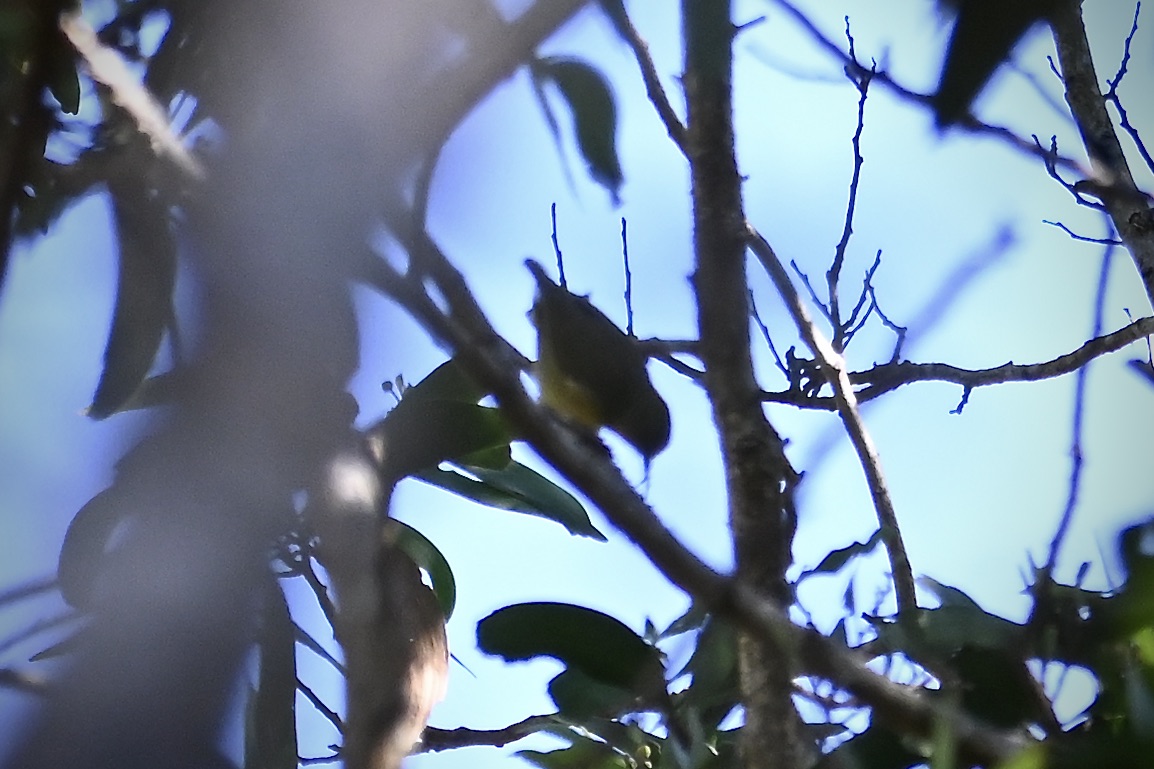
Photo of an akiapola’au (though it’s not a good one) by Eric Anderson.
January 15, 2025 (for a meeting of the Hawai’i Conference Committee on Ministry)
Nene School was in session. There was a new teacher that year, but he was getting help from a more experienced nene. She had been his teacher some years before. And because he was new, he had a relatively small class. Just three students.
Two of them were siblings, a brother and sister. The third was immediately interested in Food Identification part of the curriculum – Nene School basically consists of Flight and Food. The new teacher thought he’d be a good student, but mostly he was hungry. Time after time the teacher would have to rush over as the student reached out for yet another inedible item.
It kept him hopping.
He hoped that the brother and sister would be good flight students, since they’d already learned to fly together. His hopes were dashed, however, the first time they took off for basic formation flying. Honks of “You’re took close!” and “Get away from me!” resounded over the rocks and forest. He could barely be heard over them to try to coach them into position. Eventually there was a collision, and the two bruised siblings settled down to the ground to continue their recriminations.
The teacher could feel his teacher’s eyes on the back of his head, watching him as his class turned into a full-fledged disaster – that’s a disaster with feathers on. Or fluttering down from the sky because they didn’t stay on.
This went on for a week, and things didn’t get better. The hungry young nene never seemed to listen or retain what he’d been told. The siblings fought on the ground, climbing, cruising, descending, and on the ground again. The watching teacher said nothing. The young teacher got desperate.
As the class ended with more flying feathers, more angry honking, and a certain amount of vomit from an ill-considered berry, he burst out in fury: “You are the worst nene I’ve ever met! You’ll never learn! I’m sorry you were ever hatched!”
Shocked, the students flew away.
He turned to find his teacher standing right behind him. He couldn’t read the look in her eyes. “What?” he challenged.
“I’m disappointed,” she said.
“I’m disappointed in them, too,” he growled.
“I’m disappointed in you,” she said.
“What?”
“Haven’t you noticed that the siblings have been carefully listening to every word you’ve said about finding food? Haven’t you noticed that they never ask you twice about it? That they’ve learned so much in just a week?”
He hadn’t noticed.
“Haven’t you noticed that the third one sticks right by you in flight? He was awkward the first day, but he’s been right off your wingtip ever since. Haven’t you noticed?”
He hadn’t noticed.
“When they come back tomorrow, what are you going to say?” she asked, and then left him to consider.
The next morning, the three students stood anxiously before their teacher. They almost hadn’t come back. The older nene had persuaded them to come.
“I’m very sorry for what I said yesterday,” he said. “I had no business saying any of that. You’re here to learn, and I haven’t been teaching you very well.”
“Youngster,” he said to the hungry student, “I want you to keep an eye on the brother and sister here. They’ve done really well at learning what’s good to eat and what’s not. You can trust what they do.”
“And you two,” he said to the siblings, “can learn a lot from this youngster here. He’s been keeping good formation on me since the second day. Watch him. He’ll show you what to do.”
I won’t tell you that things went absolutely smoothly after that – there were still ruffled feathers and feelings, and the hungry student only gradually gave up whatever looked good at the time – but I will say that the students learned. All the students. One of whom was the teacher.
by Eric Anderson
I wrote this story as the opening devotional for a meeting of the Hawai’i Conference UCC Committee on Ministry Chairs.
She wasn’t vain, though she might have been. Her feathers ranged from deep black with white accents to the fiery orange-red that complimented her long curved beak. In short, she was an i’iwi, and those are feathers any bird would wear with pride.
Some birds are vain, and those birds might settle and resettle their feathers with their beak or their feet. They might avoid rainfall that would slick their feathers across their body, which can end up looking pretty sad and messy. Wet red feathers might look shiny and glossy, but they might also look dull and out of place. There are birds who would worry about that.
She wasn’t one of them. She kept herself neat because feathers in their places are more comfortable. She liked to greet other birds with some sense that she’d respected them by looking good. No, she wasn’t vain. But.
She didn’t like getting wet. She didn’t like it much at all.
Wet feathers might be glossy or they might be dull, but mostly she thought they were chilly and cold. And, well, wet. She didn’t like the sensation of drops pooling along her skin. Feathers are pretty good at shedding water, but they’re not as good as an umbrella or a raincoat. Eventually the rain seeps in, and she just didn’t like it.
“Yuck,” she said during one rainstorm. “I hate rain.”
A friend heard her complaint, which she’d made many times before. “You always say that,” he replied.
“I always hate rain,” she said. “Always.”
“Well, if you always hate rain,” said her friend, “have you ever thought of finding shelter?”
As it happens, she’d tried it. She’d tried trees with thick canopies of leaves. The rain got through. She’d tried gaps in the branches. They let water in, too. The saddest failure had been when she found a lava tube and settled there. To her horror, the rain poured in through the opening and flooded floor. Water rising from below, she thought, wasn’t any better than coming down from above. She told her friend so.
“Well, you can fly. Fly someplace without rain,” he told her, rather annoyed.
“All right. I will,” she said, and flew out into the rain.
Fortunately for her, she flew west across the center of the island toward Kona. I’m afraid she’d have found more rain, not less, here on the Hilo side. Sure enough, she found herself flying out from under the clouds as they exhausted their rain upon the slopes of Mauna Loa and Mauna Kea. Soon she flew over the sunny grasslands west of the mountains.
And she saw nothing to eat.
She flew back and forth, looking for ohi’a or mamane trees, and while she saw one or two, she certainly didn’t see a forest. It took a while for her to realize the truth: the trees she relied on relied in turn on rain. They needed the water that annoyed her, in order to provide her with the nectar that she needed.
Hungry, she turned back toward home, flying back beneath the clouds still shedding their rain. Back on the branch with her friend, she began sipping nectar from the damp flowers, with raindrops speckling her feathers.
“You’re back,” said her friend. “Didn’t you find sunshine?”
“I did,” she said, “but it turns out that rain isn’t so bad. At least the trees think so, and,” she paused to take another sip, “if they think so, I do, too.”
by Eric Anderson
Watch the Recorded Stories
I write these stories in full in advance, but I tell them from memory plus improvisation. What you have just read will not match the way I told it on Sunday.
The ‘elepaio has the reputation for being the most curious bird of the forest, but once there was an ‘apapane who was as curious as nearly any ‘elepaio. He had questions about everything. Why were his feathers brown when he was younger, and why did they turn red? Why did some trees have blossoms and others didn’t? Why did the days grow shorter and longer again?
He found answers to some of his questions, and he didn’t find answers to others of his questions. He never gave up asking them, though, and he never gave up trying to find out.
One morning, while enjoying a late morning snack of bugs, it suddenly occurred to him: Why do bugs taste sweet?
I’m not sure that bugs would taste sweet to you or to me, but the bugs he was eating that day definitely tasted sweet to him. He hadn’t thought about it before, but why should a bug taste sweet? Shouldn’t they be salty, or tangy, or something like that? Why sweet?
He asked around to see if anyone else knew, but nobody did. They hadn’t thought about it, and they weren’t all that interested. “If they taste good, that’s all that matters,” said one of his friends, and didn’t help any further. So the ‘apapane decided to watch and see what sweet bugs ate.
What they ate, he discovered, was a lot of things that he also ate. Those bugs ate fruit. They ate ohi’a nectar. They even ate other bugs who were eating sweet fruit and nectar. The sweetness of what they ate was being carried along to make them at least somewhat sweet.
“That’s amazing!” he said to himself. “But now the question is: Why is fruit sweet? Why is nectar sweet?”
Again, he went to friends and family to ask, and again they didn’t know. “It tastes good; that’s all that matters,” said the same friend. So he began to watch the trees, to see what they did to produce sweet fruit and flowers.
I’m afraid that being an ‘apapane rather than a human being meant that he never did learn the answer to that. He could see that the trees spread their leaves to the sun, but he couldn’t see the way that the green of the leaves combined water from the roots with energy of the sun to make the sweetness that made the tree grow. He couldn’t see that sweet sap being concentrated in the flowers to make nectar, and later in the fruits to feed the seeds of later trees. People have microscopes and chemistry equipment and lots of years asking and answering these questions. He didn’t.
He had to admit that he wouldn’t answer the question of sweet nectar, at least until he learned something new. For him, sweet nectar would remain a sweet mystery.
It never stopped him from enjoying it, though.
by Eric Anderson
Watch the Recorded Story
I write these stories in advance, but I tell them from memory and improvisation. There will be differences between the story I’ve written and the story I told.
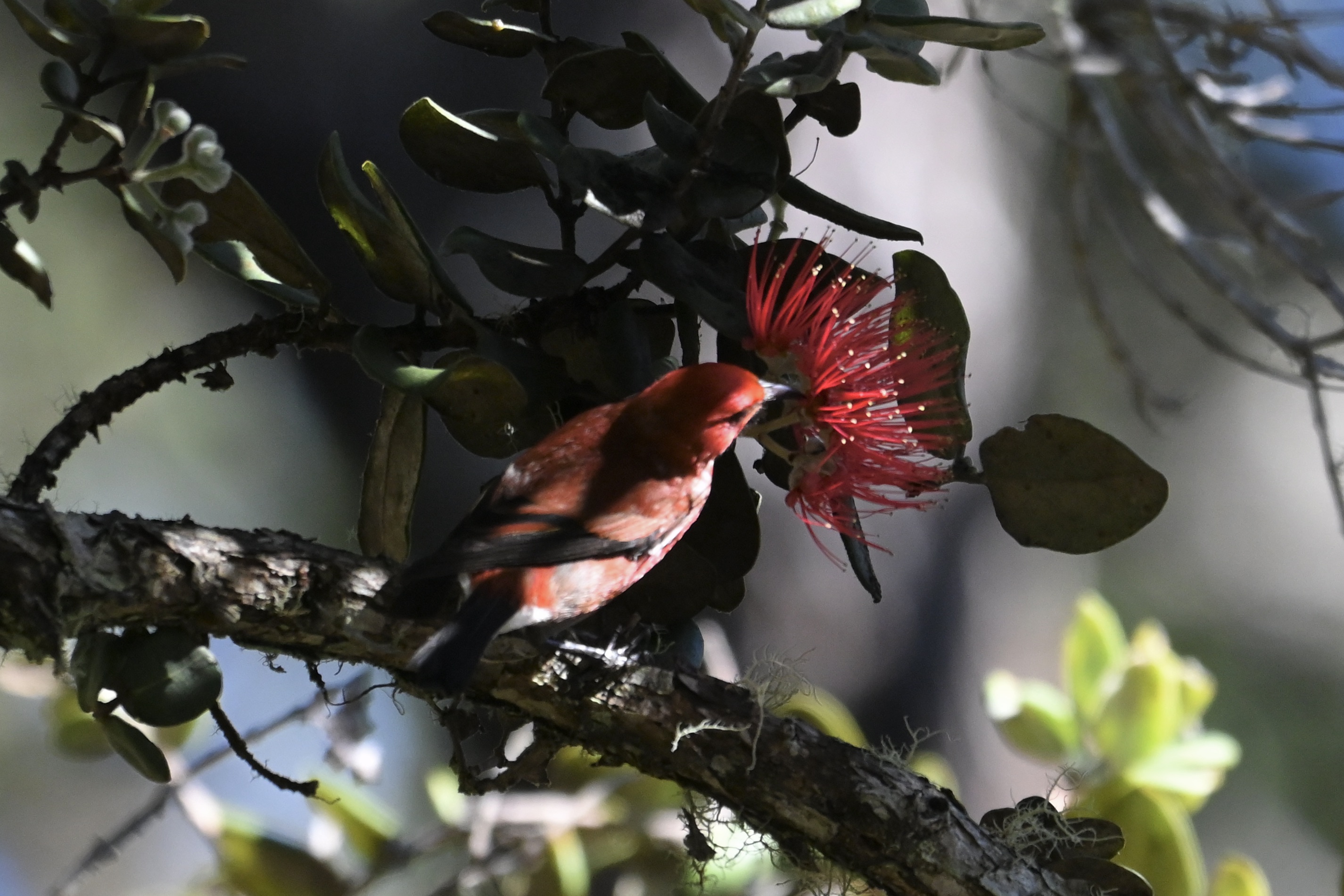
Photo of an ‘apapane feeding from an ohi’a blossom by Eric Anderson.
I wrote this skit to meet a very particular need. Our Sunday School coordinator had surveyed the young people, and nobody (really nobody) wanted to play Joseph. Could I write a pageant that didn’t include Joseph? The result is what’s below.
We didn’t have any children who wanted to play the magi, either, so the original script didn’t include them. As rehearsals began, more of them wanted to participate, and so the size of the shepherd’s flock increased, a second shepherd got lines, and so did more of the magi.
By Eric Anderson
CHARACTERS
Mary: A young woman Gabriel: An angelic messenger Angels: A musical chorus Star: A bright object in the sky Shepherd: A tender of sheep Sheep: A wooly creature Magi 1: A scholar dressed a lot like a king Magi 2: Another scholar dressed a lot like a king (non-speaking) Magi 3: One more scholar dressed a lot like a king (non-speaking)
SCENE 1: [MARY enters and sits at center stage, twiddling her thumbs]
Mary: I’m bored.
[GABRIEL enters]
Gabriel: Hail, O favored one!
Mary: (to audience) Well, this might be more interesting.
(to Gabriel) Who are you, and what kind of “Hello” is that?
Gabriel: What would you prefer?
Mary: “Hello” would be nice.
Gabriel: In that case, hello. My name is Gabriel. I’m an angel. Do not be afraid!
Mary: Was I supposed to be afraid?
Gabriel: It’s not required. I’m supposed to say that, though.
Mary: Are other people afraid?
Gabriel: People tend to get nervous talking to an angel, yes.
Mary: Oh, right. You’re an angel. You said. Well, I’m glad to talk to anybody. I’m bored.
Gabriel: Why are you bored?
Mary: I’m supposed to be getting married soon, but my family is doing all the wedding plans. Every time I try to suggest something, my father or my mother will say, “Oh, no, it’s better this way.” Actually, they both say it. Then they disagree about what the best way is, and send me out of the room. So I don’t have a lot to do.
Gabriel: Couldn’t you talk to your fiancé? What’s his name?
Mary: Joseph. And no. Now that we’re engaged, we don’t spend a lot of time together. He’s working. And I’m… not.
Gabriel: I think I can promise that your life is about to get more interesting.
Mary: Well, that’s good. What’s happening?
Gabriel: Mary, you have found favor with God. And now, you will conceive in your womb and bear a son, and you will name him Jesus. He will be great and will be called the Son of the Most High, and the Lord God will give to him the throne of his ancestor David. He will reign over the house of Jacob forever, and of his kingdom there will be no end.
Mary: What did you just say?
Gabriel: Mary, you have found favor with God. And now, you will conceive in your womb…
Mary: (interrupting) Did you just say I’m going to have a baby?
Gabriel: Yes. Yes, I did.
Mary: How is that going to happen?
Gabriel: Nothing is impossible with God.
Mary: And this is God’s plan? It seems a little… unexpected.
Gabriel: I grant you that God hasn’t done this before.
Mary: And I’m having this baby… why?
Gabriel: He will be great and will be called the Son of the Most High, and the Lord God will give to him the throne of his ancestor David…
Mary: (interrupting) Did you just say I’m going to be the mother of the Messiah?
Gabriel: Yes. Yes, I did.
Mary: Wow.
Gabriel: You did say you were bored.
Mary: Yes. Yes, I did.
Gabriel: Are you less bored?
Mary: Now I’m terrified.
Gabriel: That’s not bored.
Mary: I think I need to go talk to Joseph. He’ll want to know.
Gabriel: I’m sure that’s true. Where is Joseph, anyway?
Mary: This way.
[MARY and GABRIEL exit]
Narrator: Nine months later…
Scene 2:
[SHEPHERD and SHEEP enter]
Shepherd: Well, another boring night.
Sheep: Baa!
Shepherd: Why don’t you ever seem to sleep, sheep?
Sheep: Baa!
Shepherd: Have you ever thought of counting sheep, sheep?
Sheep: Baa!
[pause]
Shepherd: Well, I agree. Counting to one isn’t all that helpful.
[ANGELS enter]
Angels: Hallelujah!
Shepherd: What?
Angels: Hallelujah!
Shepherd: Are you hearing what I’m hearing, sheep?
Sheep: Baa!
[GABRIEL enters]
Gabriel: Do not be afraid!
Shepherd: OK.
Sheep: Baa!
Gabriel: I am bringing you good news of great joy for all the people: to you is born this day in the city of David a Savior, who is the Messiah, the Lord. This will be a sign for you: you will find a child wrapped in bands of cloth and lying in a manger.
Shepherd: Could you repeat that?
Sheep: Baa!
Gabriel: I am bringing you good news…
Shepherd: Did you just say that the Messiah has been born down in Bethlehem?
Gabriel: That’s exactly what I said.
Shepherd: And we can go see him?
Gabriel: You can do exactly that.
Shepherd: And greet the father and the mother?
Gabriel: The mother for sure. The father, well, that’s a little tricky.
Shepherd: Are you going to explain that?
Gabriel: No.
Sheep: Baa!
Gabriel: Are you going to go visit the child?
Sheep: Baa!
Shepherd: You heard him.
Angels and Gabriel: Hallelujah!
Scene Three:
[ANGELS, GABRIEL, SHEPHERD, and SHEEP exit]
[MARY enters with BABY]
[GABRIEL enters]
Gabriel: Where’s Joseph?
Mary: He went looking around the town for baby things. We hadn’t brought anything. All we’ve got are these bands of cloth and a manger.
Gabriel: That’s going to be tricky this late at night.
Mary: Everything has been tricky. Explaining my pregnancy to my family, my friends, and to Joseph was tricky. Then getting summoned down to Bethlehem for the census was tricky. Then finding a place to stay the night was tricky. Having a baby in a stable was tricky. All in all, it’s all been tricky.
Gabriel: Well, I’ve got good news.
Mary: I’m not sure I’m ready for more of your good news. That’s what’s got me here in a stable with a newborn.
Gabriel: You’ll like this one. I’ve brought some people to give thanks for the birth of the Messiah!
[ANGELS, SHEPHERD, and SHEEP enter]
Angels: Hallelujah!
Mary: More angels?
Sheep: Baa!
Mary: And sheep.
Shepherd: Hi! Are you the mother of the Messiah?
Mary: And a shepherd. Where’s Joseph? When’s he coming back?
Gabriel: I know this isn’t what you expected, Mary. This is no palace. It’s not even your own home. Or a house, in fact. But you know what a miracle this is. You know, better than anyone, that God has been at work. These are people…
Sheep: (interrupting) Baa!
Gabriel: …and creatures who have come to understand God’s miracle as well.
Angels: Hallelujah!
Mary: That is pretty wonderful, now that you put it like that.
[THREE MAGI ENTER]
Gabriel: And look! More visitors!
Mary: Couldn’t they have waited until Joseph got back?
Magi 1: Look, it’s been a long trip. And we got lost. So we stopped for directions in Jerusalem.
Mary: Jerusalem? Where the king is?
Magi 1: That’s the place. That’s where a new monarch should be born, right?
Mary: Gabriel, this sounds like trouble. The king is not going to be happy to hear about the birth of a Messiah. Would you go fetch Joseph, please?
Gabriel: Ah. You’re right. This is trouble. We’ll take care of it. No problem. You guys, magi, king-like people: Don’t go home via Jerusalem. OK?
Magi 1: Really? The king seemed to want to meet this child. A lot.
Mary: Seriously, where’s Joseph?
Gabriel: Go home another way.
Magi 1: Well, OK. You’re the angel. In the meantime, we’ve got some gifts for the child. Here they are: gold, frankincense, and myrrh.
[EVERYBODY stares at the gifts]
Mary: Wow. Joseph needs to see this.
Gabriel: He will. And you won’t need to worry about your safety. Shepherds, creatures, wise people from far away have come to rejoice in this child. The heavens themselves are celebrating. Take a look:
[STAR enters]
Mary: Oh, wow.
Star: Welcome, newborn Messiah!
Mary: Where’s Joseph? He should see this.
Star: He’s three streets away on his way back. I’ll light the way for him.
Mary: Thank you. Thank you all. Thank you for welcoming my baby into the world.
Gabriel: We’re glad to do it. Happy Birthday, little Jesus!
The ‘io is not famous for singing. It makes a loud cry, for sure, which is majestic and dramatic, but nobody would call it musical. Except, perhaps, for once long ago, so long ago that there were no people living here on Hawai’i Island, and it belonged to the birds.
You see, there was an ‘io who wanted to sing. She’d heard the ‘apapane and the rest. She’d even admired the more subtle honks of the nene. When, she wondered, could she sing like that?
One morning, as the sun rose over the sea, the ‘io felt the world change. One moment everything was as it had always been, the next she knew that something different, something extraordinary, something wonderful, had taken place. Somehow she knew, deep in her heart, that the Creator had become part of the Creation in a deeply special way. Somehow she knew, though she never knew the name and didn’t even know what a human baby looked like, that Jesus, the Christ, was born.
When you know something that’s that wonderful, you just can’t keep still. She leapt into the air and soared through the sky. But that wasn’t enough. She danced on the breeze, pirouetted through the sky. And that wasn’t enough. Even though she knew she couldn’t do it, even though she knew it would be the same cry she’d always made, she opened her beak to sing.
Then: she sang.
There’s an old story that on the night Jesus was born, the animals across the world gained the ability to speak in human language. Who knows if that was true on Hawai’i Island, where there were no people whose language they could speak? What there was, was singing. And on that Christmas morning, an ‘io sang.
She sang so loud and so well that the ‘apapane began to sing along, and even to make new harmonies. Then the ‘amakihi chimed in, and the ‘akepa. The koa’e kea soared above the Kilauea caldera, and both noio and pueo flew up from the seacoast and the grasslands. Every one of them, with a voice they’d never known before, sang.
The ‘io led them all in the song, making new melodies, new variations, new rhythms. As she did, she circled and rolled, dove and climbed, dancing on the air, as the smaller birds wheeled around her.
It didn’t last long. Songs, even songs of joy, have an end. The small birds went back to the nectar in the trees. The pueo returned to the grasslands, the noio to the sea.
The ‘io let her tired wings carry her back to a tall tree, where she settled and breathed in, breathed out, because it’s a lot of work singing and flying and dancing at the same time.
An i’iwi poked its beak out of the next tree and chirped, “Thank you for the good news and the good song.”
The ‘io nodded back and said, “You’re welcome. Thank you for singing with me.”
And that is how the ‘io sang a Christmas song.
by Eric Anderson
Watch the Recorded Story
I write these stories in advance, but I tell them from memory (and improvisation), so the story as I tell it in the recording won’t precisely match what I originally wrote.
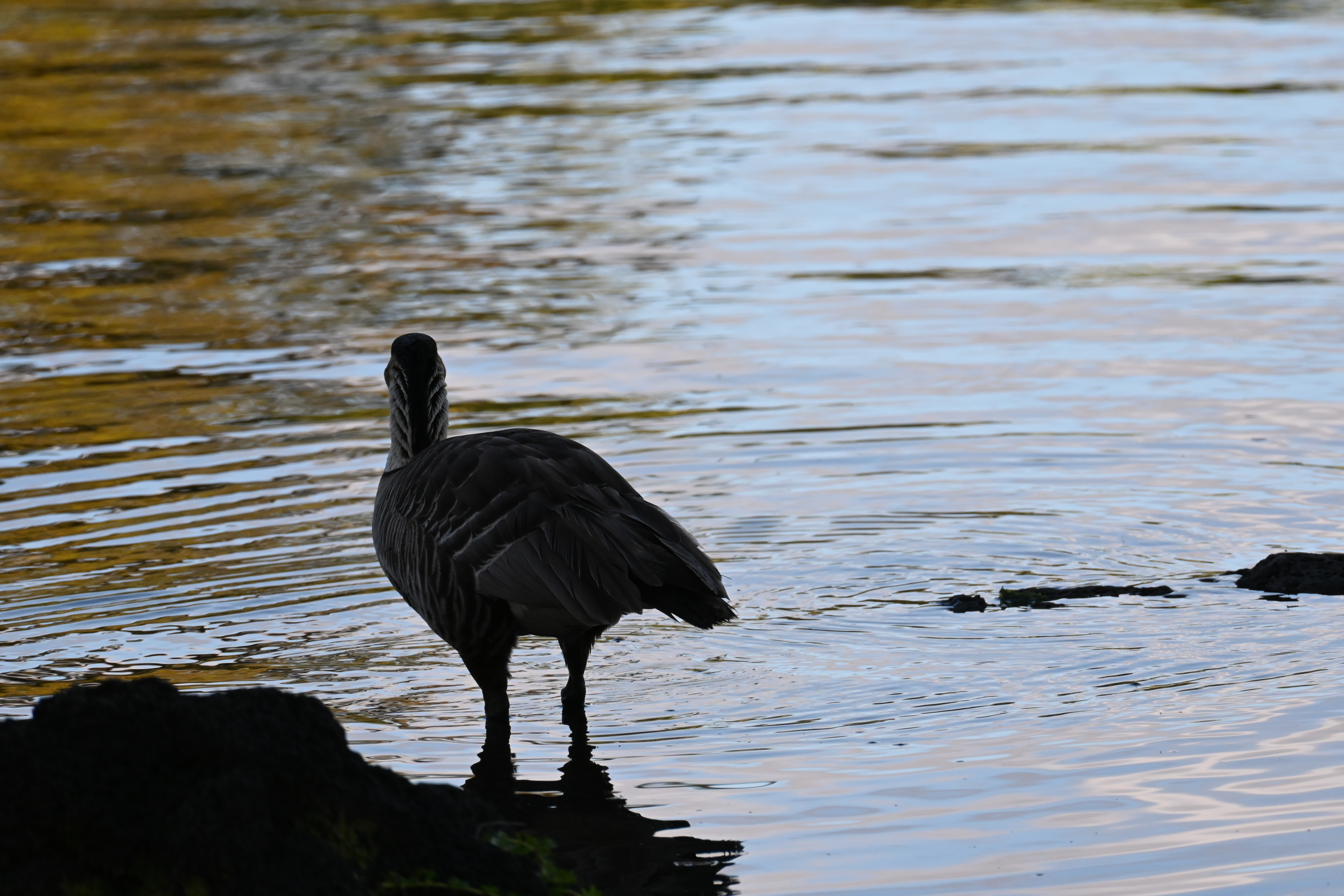
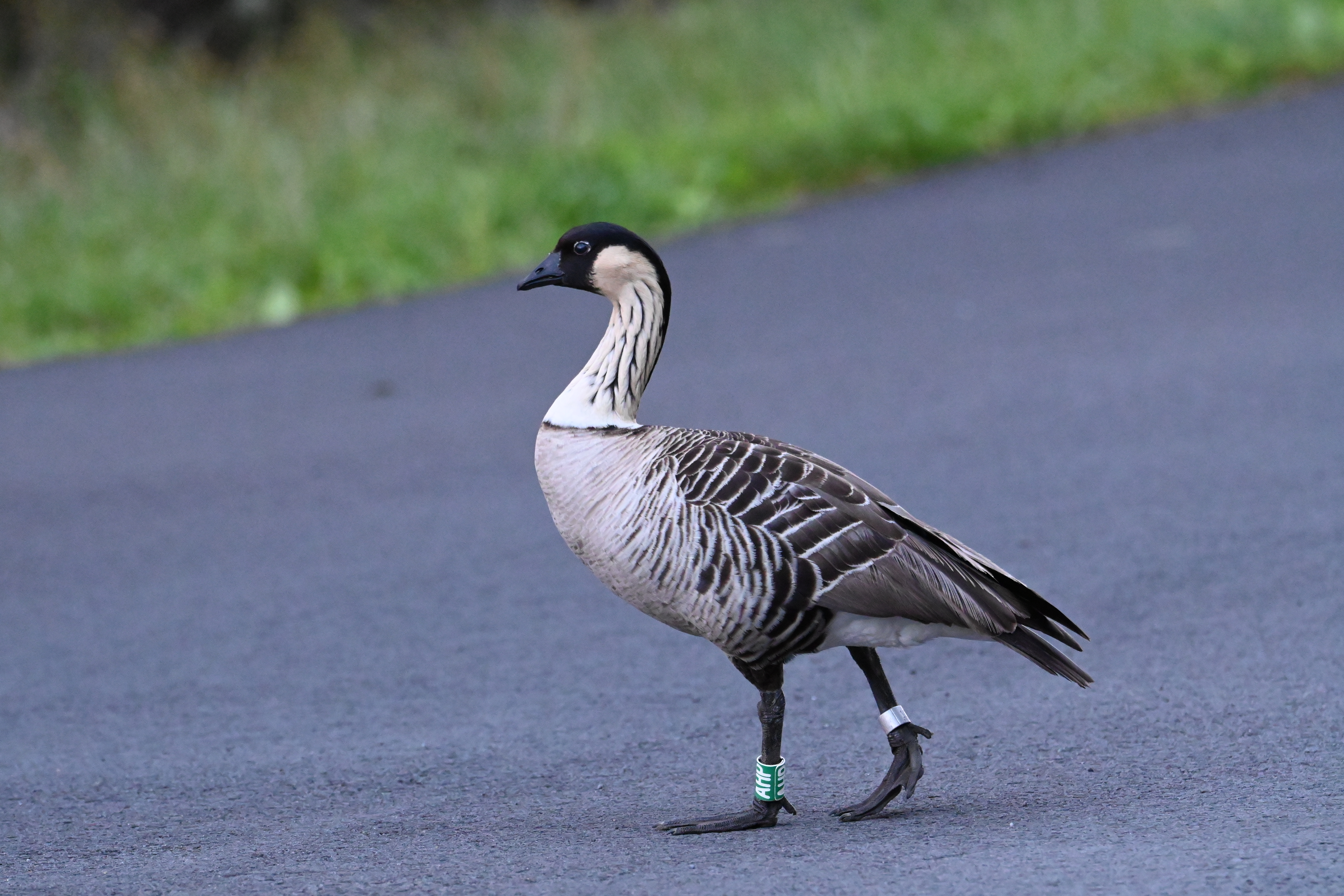
The nene (a Hawaiian goose) was going to change the world.
He wanted to change a lot of things. Some of them, he thought, might be more difficult than he could actually do. He wanted ‘ohelo to grow more evenly through year, for example. Without learning how to plant and cultivate, which is hard to do when you have wings rather than hands, he didn’t think he’d get that accomplished anytime soon. Still. It’s nice to have a goal.
Mostly, though, he had ambitions to change the way that creatures interacted with one another on Hawai’i Island.
Most creatures in the forest don’t bother one another very much. Yes, the i’iwi gets possessive about flowering ohi’a trees sometimes. Yes, the ‘apapane get touchy around their nests. And there are mongoose that eat eggs. The nene thought that could change, too, but like the ‘ohelo idea, he thought it would take some time to persuade the mongoose to turn vegetarian.
What he most wanted to change, however, was the careless actions of human beings.
Other creatures don’t bother nene much, but human beings do. They come walking up where nene are feeding, they pick food the nene need to eat, and worst of all, they drive fast through places where nene walk and rest. I’m afraid that the biggest danger to a nene these days is getting hit by a car.
So our ambitious nene developed a plan to stand by the side of a road and talk to the people driving by. Or, well, honk at the people driving by. Yell at the people driving by.
I’m afraid it didn’t go well. The cars went by at the same high speeds they had before. A few of them stopped instead. One person even got out and went over to try to pet the nene, who decided that flying away was the best thing to do.
He watched for some time as the cars raced by at the same high speed with no change at all.
It made him sad.
Another set of wings fluttered next to him. It was a curious ‘elepaio. “What were you doing?” she asked.
The nene told her he was trying to get people to drive more carefully.
“That takes a lot of doing,” the ‘elepaio observed. “There are a lot of people to persuade. How is it going so far?”
The nene admitted that it wasn’t working so far.
“There’s an easier place to start,” mused the ‘elepaio. “What if you started with yourself?”
“What do you mean?” asked the nene.
“It’s right to be concerned about what others do,” said the ‘elepaio, “and to get them to change it. But the first step and the easiest step is to do what you can about yourself. Step back from the road. Walk further away. Do what you did a few minutes ago, and fly away from foolish people.
“You’ve got to start somewhere,” said the ‘elepaio. “Start with you.”
by Eric Anderson
Watch the Recorded Story
I write these stories ahead of time, but I tell them on Sunday mornings from memory and improvisation. What you have just read is not exactly what you’ll see in the video.




 ordainedgeek