Story: Welcome

May 18, 2025

Acts 11:1-13
John 13:31-35

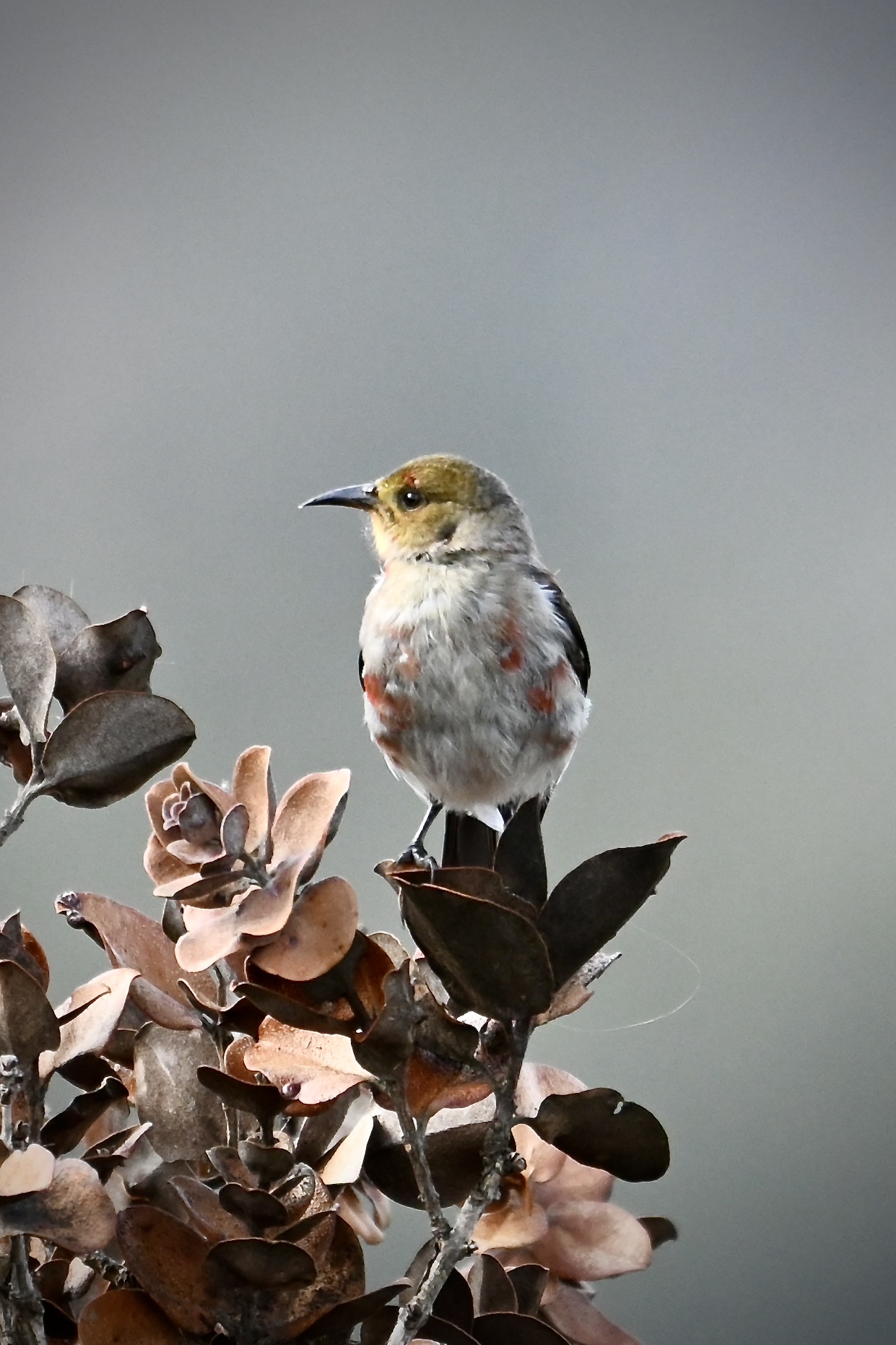
The young ‘amakihi was nervous. She had been busy growing up, which ‘amakihi do a lot quicker than human beings do, but there was a lot to pack into that time. There was eating, and learning what to eat. There was taking care of her feathers, which changed when she molted and the feather lengths changed. And of course there was flying.

Then she had to learn about eating again, because there were things she could get to with working wings that she couldn’t get to in a nest. She learned about new bugs, new fruits, and new flowers. She’d been too busy to be nervous.

She was nervous now, though, because her parents had announced that the family would join a flock for the summer. She wasn’t really used to other birds. She’d met an auntie or an uncle or two, and of course her tutu, but these would be strange ‘amakihi. Would they like her? Would they be mean to her?

It made her more nervous to realize that the flock wouldn’t include just ‘amakihi. It would include ‘akepa, ‘alawi, and scariest of all, ‘apapane. She knew there were a lot of ‘apapane around. She’d seen far more of them than she had ‘amakihi. She’d also seen them chase ‘amakihi through the forest, even her own father. “I got too close to their nest,” he’d explained, and that made sense because she’d seen him chase other birds away from her nest, but still. The ‘apapane made her nervous.

“It will be all right,” said her father. “It’s different when birds aren’t worried about nests and eggs.”

“It will be all right,” said her mother. “You’ll make it all right.”

The day came when she and her brother and her parents flew over to an ohi’a tree filled with other birds. There were other ‘amakihi, and she knew some of them because her tutu were there. There was ‘akepa and ‘alawi showing off their green and bright orange feathers. Mostly, though, there were ‘apapane. They hopped through the branches, singing their beautiful songs, and looking very sharp in their red and black feathers.

One of them, who was keeping rather quiet, hopped over to the branch where she was sitting, keeping very quiet and hoping nobody would notice her.

“Hi,” said the ‘apapane. “What kind of bird are you?”

“I’m an ‘amakihi,” she said. “And you’re an ‘apapane.”

“I am,” he said, and looking rather nervous, said, “I feel really dumb. I’ve never seen most of these birds before. Do you know any of them?”

“Well, I know my family,” she said, “and I’ve seen a couple of these other birds before,” – she didn’t mention that they’d been chasing her father away from their nest – “but most of these birds are as new to me as they are to you.”

“Oh, good,” said the ‘apapane. “I guess this is new to most of us youngsters?”

“I think it is,” said the ‘amakihi. “I’ve been worried that nobody would like me.”

“You’ve made me feel better,” said the ‘apapane. “I think most birds would like you for that.”

“And you’ve made me feel welcome,” said the ‘amakihi. “Thank you so much for that.”

Mother had known, after all. She had made it all right.

by Eric Anderson

Watch the Recorded Story

I write these stories ahead of time, but I tell them from a combination of memory and improvisation. As a result, what you’ve just read will not match what you hear.

Photo of an ‘amakihi by Eric Anderson.

What Peter Didn’t Say

So when Peter went up to Jerusalem, the circumcised believers criticized him, saying, “Why did you go to uncircumcised men and eat with them?” – Acts 11:2-3

You think I wanted to eat with them?
I didn’t want to go at all.
I was riding pretty high, you know,
elated with a woman’s resurrection.
OK, the only place they’d put me up
was with a tanner, but a fisherman’s smelled worse.

Yes, I was riding high, and trying not
to think about the things that happen when
you’re riding high, the way success becomes
a series of new challenges, new obligations. I
was smelling those amidst the tannery.
It came for Jesus; it would come for me.

I didn’t know that I could lie in dreams
or visions, waking or asleep. I claimed
I’d never eaten food that was unclean,
and knew full well I’ve eaten shellfish when
the Romans hadn’t purchased all my stock.
And let’s ignore the grain I plucked on Sabbath Day.

A vision or a dream; regardless, it
would summon me to something new
I knew. I did not know what it would be,
but who gets visions for a trivial thing?
I didn’t know what that dream meant.
I knew I’d go where I’d not wish to go.

The house of a centurion was not
within my plan. Who knew what I would find
when I reached there? Most likely was
a naked sword to seek my naked gut.
Why trouble with a cross when you
can drain a troublemaker’s life without?

I had no plan to speak of Jesus there until
they asked, but ask they did, and I
pulled in my breath, and breathed it out,
and spoke with sometimes trembling voice
of Jesus, of his healing touch, his mercy to
such fools and failures as I am.

I certainly did not expect the fire of
the Spirit in a Roman house, of one
who marshals military might against
the people of this land. They said that he
feared God, but this? The Holy Spirit, lit
in him as it had been in me? Who knew?

And now, my friends, I have no plan for you.
I didn’t want to go. I went. I didn’t want to speak.
I spoke. I didn’t know the Spirit would appear.
She did. I didn’t know that God had welcomed them,
the Gentiles, just as openly as us. And now,
I have no words for you, except

To tell my tale again.

A poem/prayer based on Acts 11:1-18, the Revised Common Lectionary First Reading for Year C, Fifth Sunday of Easter.

The image is St. Peter and Cornelius the Centurion by Bernardo Cavallino (1640s) – Web Gallery of Art:   Image  Info about artwork, Public Domain, https://commons.wikimedia.org/w/index.php?curid=15452357.

Story: Imitation

May 11, 2025

Acts 9:36-43
John 10:22-30

How is a young bird, or a young turtle, or a young person supposed to figure out how to be an adult bird, or an adult turtle, or an adult human being? People, at least, get some instructions from their elders. We get taught how to get dressed, and what things are good to eat (or at least good for you to eat; opinions differ on whether things that are good for you are tasty enough to eat), and especially important things like, “Don’t touch the boiling tea kettle on the hot stove!”

Birds probably don’t get quite that much teaching. Certainly they don’t get the years of it that we do as we’re growing up.

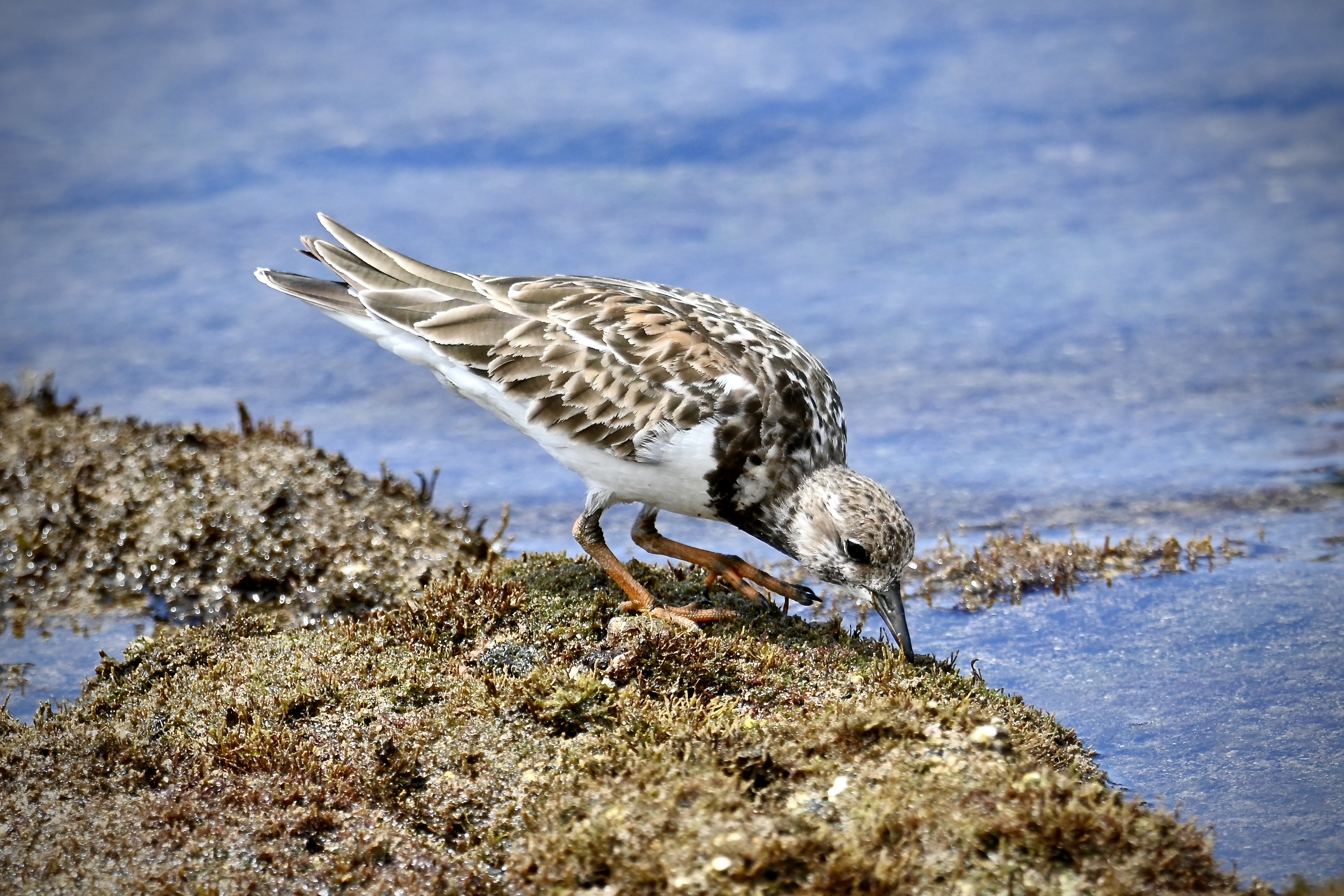
A young ‘akekeke was learning how to be an ‘akakeke. He’d already made one trip from Alaska to Hawai’i, just as the kolea do, and he’d been sleeping and eating and flying about ever since. But he was confused.

You see, there were creatures who did very different things than ‘akekeke did, and he wondered if their ways might be better.

Mind you, there were plenty of creatures who did very similar things. Kolea and hunakai and ‘akekeke all hunted through the grasses and tidepools and rocks for insects, snails, and so on. If he imitated them, things went pretty well. He tried to imitate the ae’o, but he didn’t have long pink legs to hold his body out of the water of the fishpond and he ended up gasping and spluttering as he flapped his miserable way to shore.

The least successful of all was when he tried to imitate a honu. He flopped into the water in a calm spot and lingered below the surface. Then he tried to eat some seaweed on the underwater rocks. He choked on the water, of course, and once more hauled his bedraggled self onto the beach.

He looked about and saw his mother.

She asked, “What are you up to, son?”

“I’m learning,” he said. “I’m learning to be an ‘akekeke.”

She looked around at the other ‘akakeke on the shore, none of whom were trying to feed like a honu. “How?”

“By imitating what I see,” he said.

“Are you learning anything?” she asked.

“I’m learning that some things don’t work,” he said, and coughed up a little more water.

“I’m not saying you can’t learn anything from a honu,” said his mother, “but for basic things like eating and flying, I don’t think there’s much they can teach you. I don’t think you can eat the way they do, and they certainly can’t fly the way you do.”

“I suppose not,” said the ‘akekeke, who was a little sad about not learning anything with his imitations that day.

“You have taught me something today, something I can imitate,” he said.

“What’s that, son?” asked his mother.

“You’ve taught me to be kind.”

Whether we wear feathers, shells, or rubbah slippahs on our running feet, let’s all imitate those who are kind.

by Eric Anderson

Watch the Recorded Story

I write these stories ahead of time, but I tell them from memory (plus improvisation) during worship. What you have just read is not necessarily how I told it.

Photo of an ‘akekeke (ruddy turnstone) by Eric Anderson. Not far away, grazing in a shallow pool, there was a honu (green sea turtle).

Sabbatical 2025: The Video

During my sabbatical, which ran from February 1, 2025, to April 30, 2025, I had two major projects. In the end, I made progress on both but did not complete either.

I have a tentative list of stories which I will be preparing and submitting for publication. Just reading them took longer than I’d anticipated. I also didn’t make it to the islands of Maui or Moloka’i, in part because I’d had to schedule other needed appointments during that time. I do have a plan to complete that, however.

Something which hadn’t been on my list became enormously important: photography. Capturing the beauty I encountered really lifted my soul, and became the most restoring activity of my sabbatical.

For the time and for the wonders of the world formed by its Creator, I am deeply grateful.

Life Dreaming

“Peter put all of them outside, and then he knelt down and prayed. He turned to the body and said, ‘Tabitha, get up.’ Then she opened her eyes, and seeing Peter, she sat up.” – Acts of the Apostles 9:40

“To sleep, perchance to dream – ay, there’s the rub,
For in that sleep of death what dreams may come?”
asked William via Hamlet in the play.
In Joppa Tabitha had ceased her work.

She lay upon the cot unmoving as
her friends displayed with streaming eyes the cloth
and clothing she had made with loving hands
for them, their families, and those in need.

She’d lived a life full well and full of grace,
and if she’d died, a life reborn would come,
so said the messengers who preached the Way,
the Jesus Way she’d taken as her own.

What dreams moved through her soul as she lay still?
What visions came to eyes of spirit now
that those below her brow saw naught? What sight
of welcome to a life eternally?

Somehow she heard the summons, “Tabitha,
get up.” The dreams collapsed as her lids raised,
to see an unfamiliar, anxious face,
perhaps a little bit surprised, above.

She rose. She met her friends once more. What did
she say? We’ll wonder, since the author left
that out, and failed to write as well, what dreams
she’d had, which we may have ourselves someday.

She rose, awoke to love and work, restored
to life ephemeral, a life to end
someday once more, a life she would lay down
again, and dream the interrupted dreams.

A poem/prayer based on Acts 9:36-43, the Revised Common Lectionary First Reading for Year C, Fourth Sunday of Easter.

The image is the Tomb of Tabitha, Jaffa, Palestine by William H. Rau (1903) – This image is available from the United States Library of Congress’s Prints and Photographs divisionunder the digital ID ppmsca.10664.This tag does not indicate the copyright status of the attached work. A normal copyright tag is still required. See Commons:Licensing., Public Domain, https://commons.wikimedia.org/w/index.php?curid=18866918.

This poem includes quotes from Hamlet by William Shakespeare (ca. 1599 and 1601) and “Awake, Awake to Love and Work” by Geoffrey Anketel Studdert Kennedy (1921).

Story: Special

May 4, 2025

Acts 9:1-20
John 21:15-17

I was on Kauai in March at Ha’ena Beach. It’s a special place, even though the day I visited it was, let’s face it, raining. Come to think of it, it was Hilo weather. I probably should have left that at home.

While I was there I saw three birds that were very special to me, because I’d never seen them before. Two of them don’t live on our island.

While I was there, I didn’t see them talking, but perhaps, just perhaps, they had a conversation after I left. It might have gone like this:

“Who was that guy with the camera?” asked one of the koloa, a Hawaiian duck.

[There are a pair of koloa flying in the upper photo.]

“He took a lot of pictures of me,” said the male white-rumped shama, showing off his long blue-black tail.

[The male shama is posing at upper right.]

“You posed,” said his wife, whose tail was much shorter and whose feathers were gray rather than deep blue.

[The female shame is at lower right, and also posing.]

“He took all of our picture,” said the ‘alae ‘ula (Hawaiian gallinule) from the swampy ground where he had been feeding and, as far as anyone could tell, not noticing.

[The ‘alae ‘ula is at lower left.]

“He took my picture the most because I’m special,” said the male shama. “I mean, look at these feathers! Look at this tail! Wouldn’t you take my picture if you could?”

The other birds had to admit that they probably would.

“You see?” said the shama. “I’m special.”

“Yes, you’re special,” said the female shama, “but I’m special, too. You’ve got more spectacular feathers than I do, but try and lay an egg without me.” The female koloa quacked her agreement before her husband could protest.

“You’re all special,” sighed the ‘alae ‘ula. “I wish I had your feathers, shama, or your black-barred wings, koloa. I’m afraid I’m not special. He took my picture and then went away.”

The other four birds were rather uncomfortable about this, because it was true. I took the ‘alae ‘ula’s picture and went away.

“It was raining rather hard,” said the shama, who stayed beneath leaves while it happened unlike the koloa or the ‘alae ‘ula.

“It was,” said one of the koloa. “Perhaps water doesn’t roll off of him…”

“…Like water off a duck’s back?” laughed her mate.

The birds had a good laugh, and then the shama said seriously, “’Alae ‘ula, you’re very special. There are so few of your kind in the world.”

“That’s a tough way to be special,” said the ‘alae ‘ula, and it’s true. It is tough being in a small group in a big world.

“There’s only one you,” said a koloa. “That’s true of me, and all of us. There’s only one. You’re special, each and every one of you.”

The ‘alae ‘ula nodded solemn gratitude to each of the other special birds, and went back to feeding.

Like each of them, each of us – each of you – is unique in the world, precious, and special.

Even if water doesn’t necessarily roll off you like water rolls off a duck’s back.

by Eric Anderson

Watch the Recorded Story

I write these stories in advance, but I tell them from memory plus improvisation. What you have just read is not identical to the way I told it.

Photos of (clockwise from upper left) two koloa in flight, a male white-rumped shama, a female white-rumped shama, and an ‘alae ‘ula by Eric Anderson.

Certainty

“He fell to the ground and heard a voice saying to him, ‘Saul, Saul, why do you persecute me?’ He asked, ‘Who are you, Lord?’ The reply came, ‘I am Jesus, whom you are persecuting.'” – Acts of the Apostles 9:4-5

He knew. He knew for certain, Jesus,
that your followers were wrong,
and more than wrong, were spreading tales
that would do violence to souls.

He knew for certain, Jesus,
so he brought force to body and to soul.

He knew. He knew for certain, Jesus,
until a light his eyes could not endure
cast him from beast to ground,
his certainty undone to hear your voice.

He knew for certain, Jesus,
that he’d persecuted you.

He knew. He knew for certain, Jesus,
that he had heard your voice,
and knew your will and way:
certainty anew.

He knew for certain, Jesus,
so he proclaimed you.

May I, like he, receive a thorn in flesh
or soul to keep me from elation,
from certainty that could transform
glad proclamation to sad persecution.

A poem/prayer based on Acts 9:1-20, the Revised Common Lectionary Gospel Reading for Year C, Third Sunday of Easter.

The image is The Conversion on the Way to Damascus by Caravaggio (ca. 1600-1601), Public Domain, https://commons.wikimedia.org/w/index.php?curid=15219516. This is one of my favorite paintings.

Sabbatical and Ordained Geek

Sunrise behind a palm tree.

January 28, 2025

On February 1st, I begin a three month sabbatical, a time to lay down my responsibilities as Pastor of Church of the Holy Cross UCC in Hilo, and to use the time to learn, to renew, and to take on some projects that I haven’t been able to accomplish amidst the daily tasks of ministry. I described my sabbatical objectives in today’s edition of What I’m Thinking embedded above; there is a transcript available here.

What, if anything, does my sabbatical mean for Ordained Geek?

I will be posting less material here. The weekly #lectionprayers are a part of my sermon preparation process. With no sermons to write for three months, I don’t plan to compose those poem/prayers. Likewise I don’t expect to write new stories for worship during this time. Again, I prepare those for worship services I won’t be leading in February, March, and April. The stories and the poem/prayers will certainly return in May, when I resume both my preaching responsibilities and my preparation practices.

That doesn’t mean I’ll have no posts during that time. I may share a story or two that I haven’t before. There are some stories I’ve written elsewhere, or never actually written in full, that I want to consider for the collection which is one of my sabbatical objectives. I anticipate posting them here to help me review them.

I also expect to write some other reflections. I have committed myself to commenting on injustices when I see them, and I already see them. It’s possible that I may turn to poetry for those, and it’s possible that I will write additional essays. One is taking shape in my head, and I expect to post it before long.

I may also prepare some other pieces arising from my sabbatical experience. I didn’t do that when I last took a sabbatical in 2014, but in those days I worked in electronic communications. I had to set much of that aside in order to find refreshment in the time. That’s less true now, so we’ll see how that goes. Besides, I rather hope to share a few photos from my travels around the Hawaiian Islands.

It is also vaguely possible that I’ll write and share new songs during this time. It’s not a part of my sabbatical plan, but I hope that some of my refreshment may come through music. If so, I may post them here.

And finally, I will commit to a Lenten discipline of some kind. I don’t know what it will be, but the chances are good it will be visual (for me, that usually means photography). If it makes sense, you’ll probably see the results here.

You’ll see less from me these three months, but there will be new things coming during that time, and certainly once May has arrived.

Thank you for your encouragement and support!

Story: The ‘Apapane Army

Two birds with bright red feathers on their heads sitting on a branch, with a third bird flying up toward them from below.

January 26, 2025

Nehemiah 8:1-3, 5-6, 8-10
Luke 4:14-21

‘Apapane are not generally aggressive birds. They tend to be the ones that fly away from other, touchier, birds. Once in a while, though, ‘apapane will flock together and this discourages the bullies (which are mostly i’iwi, I’m sorry to say).

One year, an ‘apapane got an idea.

First, he gathered as large a flock as he could. There were dozens of birds, maybe a hundred birds. No i’iwi would threaten them, he knew.

Second, he chased away all the non-‘apapane. ‘Apapane will flock with ‘amakihi and ‘akepa sometimes, but not in this flock, no. He made sure that for every bird he chased away, he invited two or three more ‘apapane to join. The flock got bigger.

Third, he set his ultimate plan in motion. He called them into a stand of ohi’a bright with blossoms. “These are our trees, ‘apapane trees,” he told the gathered birds. “We will keep them for ourselves and only for ourselves. We will chase away the i’iwi so they never bother us again. More than that, we will chase away the ‘amakihi and the ‘akepa and the ‘alawi and anyone else who tries to steal our nectar. We will be the grandest birds in the forest.”

Sure enough, that’s what they did. They chased the other birds away from the trees they called theirs. They soaked up the sunlight, they reveled in the nectar, they crunched up the bugs.

The ohi’a forest, however, changes. The grove that is bright with blossoms today goes to seed tomorrow. The trees they had claimed for their own went from flower to seed. The ‘apapane began to get hungry.

“Do not fear!” he called. “It’s time to go get other trees.”

With that, an ‘apapane army took to the air. They flew to another stand of blossoming trees and they chased away all the other birds. Except for one. One bird remained perched in her tree, sipping from one of the bright red blossoms.

An i’iwi.

“Get out,” ordered the leader of the ‘apapane army. “These are our trees. ‘Apapane trees. You are not welcome.”

The i’iwi took another sip. “And what will you do if I don’t go?” she asked.

“We’ll mob you,” said the ‘apapane. “You’ll never have any peace.”

“But if I let you chase me from every tree with flowers, I’ll never have any peace, either,” said the i’iwi. “If I can’t have peace I might as well have nectar. And,” the i’iwi looked over the ‘apapane leader’s shoulder at the birds behind him, “I’m not sure if you’ve got a mobbing flock back there.”

One of the birds swallowed hard and hopped forward. “We’re not bullies,” he said. “It’s one thing to keep bullies away. It’s another thing to make other birds hungry.”

“Keep your place!” whistled the leader. “This is my decision! Mine alone!”

And that’s where the ‘apapane army broke up. There were birds who wouldn’t be bullies, so they flew away. There were birds that wouldn’t be servants, and they flew away. And there were birds that had had enough of army life, and they flew away.

Only three birds remained: the i’iwi, the ‘apapane leader, and the first ‘apapane who had refused to be a bully.

The ‘apapane leader asked the i’iwi, “So now you’ll bully us?”

“No, I don’t think so,” she said. “There’s plenty of nectar in the forest. Eat your fill.” The ex-leader stared at her a moment before flying away himself.

“Would you like some nectar?” the i’iwi asked the ‘apapane who wouldn’t be a bully.

“I would. Thank you. Thank you for everything,” he said, and side by side they sipped from the bright red flowers.

by Eric Anderson

Watch the Recorded Story

I write these stories in advance, but I tell them from memory plus improvisation. What you have just read is not identical to the way I told it.

Photo of three ‘apapane by Eric Anderson.

New Year’s Resolution: No Regrets

The 1943 booking photos of Sophie Scholl. They show three views of a brown haired young woman: in profile, face front, and from a quartering side.

January 24, 2025

People who know me well may sigh at the title of this essay. They’d be right. Regret is a familiar presence in my life. I replay most of my disappointments in my memory quite often. I don’t “solve” them. I don’t develop theories about how I might have influenced a different outcome. I just… regret them.

Those who know me well might encourage me to shed regret, but neither they nor I expect me to do so.

I hope to prevent regret. Well, no. I hope to prevent one kind of regret.

In 1946 the Rev. Martin Niemoller addressed the Confessing Church in Frankfurt, Germany. In his speech he confessed the failures he and other church leaders had made as the Nazis consolidated their power in the 1930s. Later, his words were set poetically. This version is displayed at the United States Holocaust Memorial Museum in Washington, DC:

First they came for the socialists, and I did not speak out—
     Because I was not a socialist.

Then they came for the trade unionists, and I did not speak out—
     Because I was not a trade unionist.

Then they came for the Jews, and I did not speak out—
     Because I was not a Jew.

Then they came for me—and there was no one left to speak for me.

Niemoller’s confession is a sigh of regret for his silence.

I pledge that I shall not regret my silence.

I believe that the return of Donald Trump as President of the United States marks the end of this nation’s republican form of government. I do not believe that there will be another Presidential election, at least one in which anyone other than a single candidate can possibly emerge as victor. Frankly, I’d love to be demonstrated wrong about this, but the evidence is grave. In 2021, Mr. Trump’s words inspired thousands of people to invade the seat of the legislature as they were counting votes: the signature activity of a republic. With his first-day pardons of those criminally indicted and convicted, he has demonstrated that he will not tolerate limits upon his claims of power. Instead, he will promote those who support him with words, and also those who support him with violence.

How will this be accomplished? I do not know. I can think of more than one way, and I will not write them here. I don’t need to give anyone any ideas.

Already the President and his supporters have called for the punishment of a religious leader who dared to ask him – ask him – to act with mercy. The President himself insulted the Right Reverend Mariann Edgar Budde, Bishop of the Episcopal Diocese of Washington, DC. One of his followers, a member of Congress, called for her to be “deported.” Others have decried the use of a religious setting to make “political” statements, as if Christianity had no connection to, and no obligation to call for, mercy.

Let me be clear. Christians, and Christian leaders, have an obligation to call for mercy. They have an obligation to call for justice. They have an obligation to speak for those at risk of harm. Niemoller knew it – too late. Bishop Budde knew it, and spoke the truth of the Gospel.

May she inspire me.

In the weeks I have been considering this essay (it is weeks in the writing), I had initially intended to take as a guide the example of Dietrich Bonhoeffer, another of the German Confessing Church leaders but one whose words landed him in prison. He was executed after he was implicated in the 1944 assassination plot in which a bomb injured Adolf Hitler. Earlier than most, Bonhoeffer spoke against German violence against Jews, and passed up several opportunities to leave Germany for safer posts in England and the United States.

I will not leave.

More recently, however, I have reread the story of Sophie Scholl, a twenty-one year old university student executed by the Nazi German government for “treason” in February 1943. She and other students published The White Rose, naming the government’s sins and urging resistance. Caught after only seven months, she and two others, one of them her brother Hans, were executed within days.

They spoke out, and they paid the price.

I will speak out.

To be honest, I doubt that my words will have much influence. I doubt that my words will dissuade the administration from its administration of evils. I doubt that my words will prevent the dissolution of the republic. I even doubt that my words will annoy them enough to bother to silence me.

Nevertheless, I will speak out.

No regrets.

The image is the booking photograph of Sophie Scholl, taken in 1943 by an unknown German police officer – Stadtarchiv München[1]; Quellen zur Weissen Rose, 20.2.1943[2], Public Domain, https://commons.wikimedia.org/w/index.php?curid=114539963.