“And this is the judgment, that the light has come into the world, and people loved darkness rather than light because their deeds were evil.” – John 3:19
Too close to power, Nicodemus, to be unaware of what a savage place the palace, or the council chamber, is.
The finest houses are adorned with “those retired” by the coups and calumnies of those who rule.
Sometimes they’ve stepped across the corpses slaughtered on the battlefields of Munda or the streets of Rome.
By sprays of blood or of dishonor, Caesar’s heirs and Herod’s threaten you, poor Nicodemus, and you know it well.
The light has come into the world by law and prophets’ words, and greed has shrouded it in murder, theft, and royal robes.
So nod, then, Nicodemus, as you ponder on the snake which, lifted up, no longer threatened life but gave it back again.
How strange to find the light at night as Moses’ people found their healing in the very form they feared. So, Nicodemus, nod.
The day approaches when you’ll gaze upon the lifeless form of light, and carry it into the dark, and light will shine once more.
A poem/prayer based on John 3:14-21, the Revised Common Lectionary Second Reading for Year B, Fourth Sunday in Lent.
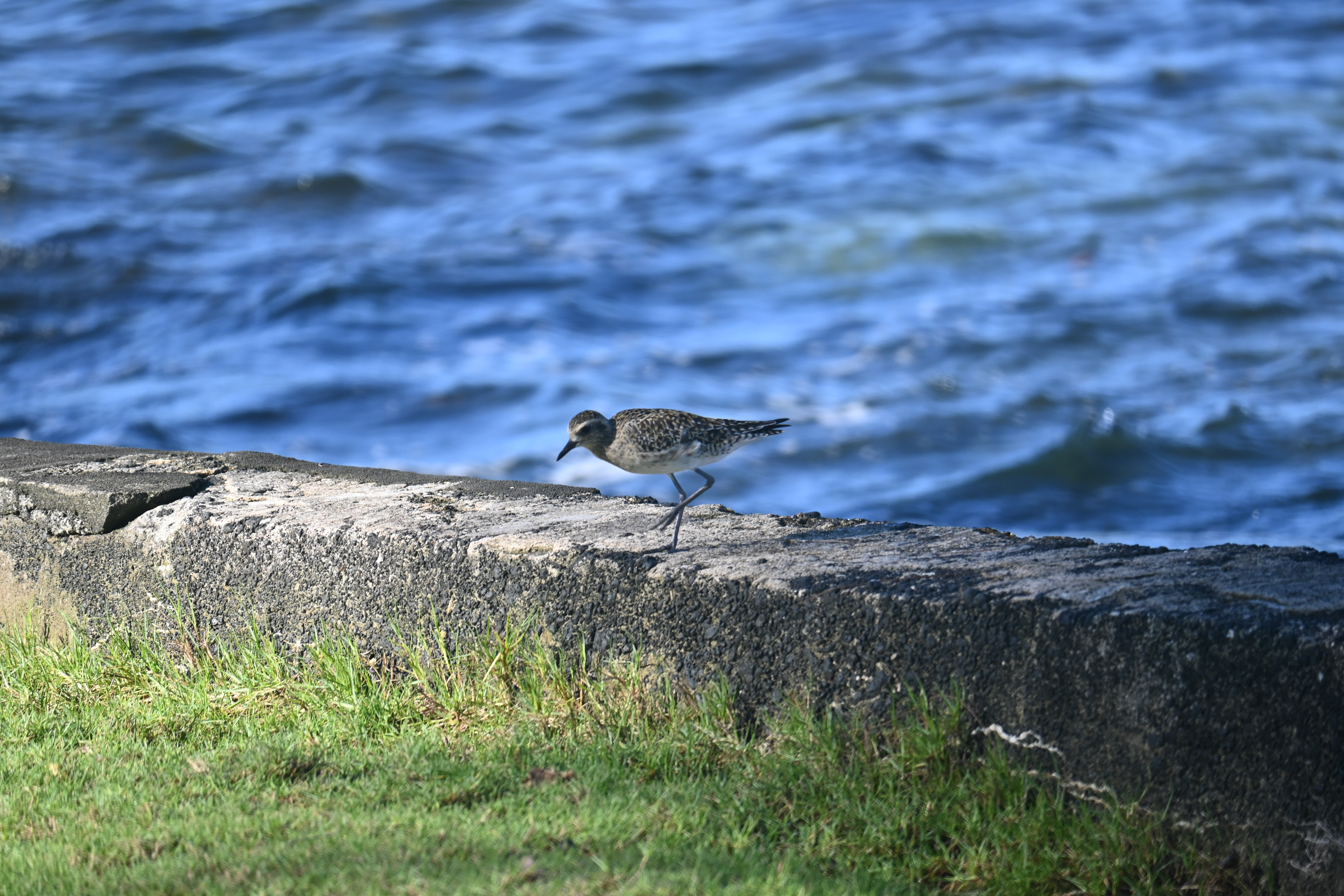
The kolea had successfully made his first flight to Hawai’i the previous fall. He’d hatched a young bird in Alaska, he’d been fed by his parents, he’d learned to find his own food, and eventually he’d taken off for the long journey to Hawai’i. He’d found a spot here to look for worms and seeds and berries. He’d worn his mottled tan and brown feathers through the winter months. He was starting to put on the black and white feathering of summer.
He’d also been paying attention to people. I advise you to pay good attention to people, because you are people, and paying attention to people who are people like you helps you to learn how to be people, and it also helps you to know what other people are going to do, like when they might step backward and one people steps on another’s people’s toes.
Um. Person’s toes.
While it’s useful for people to listen to people, it’s not always so useful for other creatures. For some reason, this kolea heard a lot of people talking about signs. If you want to find your way to Hilo, follow the signs. If you want to find your way to the beach, follow the signs. If you want to go not too fast and not too slow, follow the signs.
Where, wondered the kolea, would he find signs on the way to Alaska?
Mind you, people do put signs out on the waters. If you look around Hilo Bay, there are marker buoys out there to help boats find their way to the harbor mouth and back home. They’re easier to see at night, when they blink red and green. As you get further from the shore, however, there are fewer of them, and not many at all across the vast expanse of ocean.
The kolea hadn’t noticed any on the way to Hawai’i, and didn’t expect to see any on the way to Alaska.
“Where will I find the signs?” he asked.
“Why do you want signs?” an older kolea wanted to know.
“People use them all the time,” he answered, and the other kolea thought he meant kolea people rather than human people, and flew away because he wasn’t making any sense.
It was another older kolea who sat him down for a heart-to-heart, brain-to-brain, and feather-to-feather talk.
“What signs do you expect to see?” she wanted to know.
“Clouds, stars, lights, glowing plankton in the ocean,” he said.
“Did you see any coming here?” she asked.
“Of course I did,” he told her, because those things happen around the oceans.
“Did they tell you how to get here?” she asked.
Well, no, they hadn’t.
“How did you get here?” she asked.
He gave her an answer that he understood, and she understood, because they’re both kolea and they can fly three days over open ocean without signs, but that I don’t understand because I’m a human person and I don’t know how they do it.
“The signs are inside you,” she told him.
We live with a lot of signs around, it’s true, telling you everything from what the name of this church is to how far it is to Kona. Some things, however, and some of that is in our lives of prayer, take place within us, in our hearts and in our souls. There are signs for that, like the Bible, but down deep we’ll find the guidance of the Holy Spirit to bring us safely home.
by Eric Anderson
Watch the Recorded Story
I write these stories ahead of time and tell them in worship services from memory. As a result, the prepared text and the told story rarely match. I’m quite pleased how much of the paragraph with all the people I remembered this week.
Don’t you like it, Simon, when I say that your Messiah is not what you want? Don’t you like it, Simon, when I tell you I’ll be raised up on a cross?
Of course you don’t, dear Simon. How could anyone be pleased to hear Messiah is no conqueror, except to turn the tables on Death.
I told you, but you wouldn’t hear it, Simon. You tell me how to live my life and die my death, and no. That’s not yours to settle or define. It’s mine. And God’s.
Ah, Simon Peter, my dear Rock, so hard of head, transparent of heart, so certain of things that must be true, and come to pass, and be:
I chide you hard for this denial now. A night will come when your denials will tap like a clock ticking toward dawn. And then, I will not chide, for you will turn aside
This song is based on the #lectionprayer “Simon Peter’s First Denial.” As you’ll find there, I was asked if the poem had been set to music. It hadn’t – but now, with some lyric adjustment, it has.
The song’s premiere performance was on February 28, 2024.
For Jews ask for signs and Greeks desire wisdom,but we proclaim Christ crucified, a stumbling block to Jews and foolishness to gentiles, but to those who are the called, both Jews and Greeks, Christ the power of God and the wisdom of God. – 1 Corinthians 1:22-24
Even Cephas, who when travelling with Christ was always first to say it wrong, agrees: Do not divide the church.
Apollos, now, whom some of you prefer to me, prefer to Christ, agrees: Do not divide the church.
I asked him if he’d come to you, and do you know the words he said? “No.” “I could divide the church.”
If you must give me up to live in Christ, then do it. Give up Cephas, too. Do not divide the church.
I was not crucified for you. My resurrection still is years away. Do not divide the church.
Or else – what follows then? A Church dividing like the fractured bread – Do not divide the church –
But unlike when our Savior broke it on the hillside, who will eat? Do not divide the church.
Across the centuries, I see it. So can you. Love abandoned for these power plays. Do not divide the church.
Or they will follow your example.
A poem/prayer based on 1 Corinthians 1:18-25, the Revised Common Lectionary Second Reading for Year B, Third Sunday in Lent.
It was summertime. The nests around the ohi’a and koa forests had had their eggs, had had their cheeping chicks, and had been emptied. Young birds were flying about with their parents and aunties and uncles. The summer flocks were coming together.
Much of the year, the honeycreepers of the Hawaiian forests don’t gather in big flocks. They move about by themselves or in twos or threes. But in summertime, they gather, and they gather ‘amakihi with ‘akepa with ‘alawi and even some ‘apapane. But not, most of the time, i’iwi. When nesting time comes back around the flocks disperse. In summer, they fly together.
A young i’iwi watched a flock of ‘amakihi and ‘akepa and ‘apapane skimming the trees as they searched bugs and blossoms. He turned to his grandfather. “Should we fly with them?”
“Oh, no!” humphed his grandfather. “They don’t have the right kind of beak.”
In fact, none of the birds in the flock had the long curving bill that the i’iwi did.
He asked his grandmother, “Should we fly with them?”
“Oh, no!” said his grandmother. “They don’t have the right color feathers.”
The ‘apapane came closest, but he had to admit that you could see the difference.
“Should we fly with them?” he asked his friends, and they all said, “No! They can’t do what we do!” in different ways.
A day later, all by himself, he approached the flock, and perched next to an ‘amakihi.
“You don’t have a long curved bill,” he remarked.
“No,” said the ‘amakihi, somewhat puzzled. “I don’t.”
“It seems to work well enough,” said the i’iwi.
“It works pretty well, I think,” said the ‘amakihi.
“It might be awkward to get into an ohi’a blossom from below,” said the i’iwi, and the ‘amakihi admitted this was true.
“You don’t have bright red feathers,” said the i’iwi.
“True,” said the ‘amakihi. “Mine are bright yellow.”
“Do they get you places?” asked the i’iwi.
“They got me here,” said the ‘amakihi.
“Can you do all the things I can do?” asked the i’iwi.
“Probably not,” said the ‘amakihi. “Can you do all the things I can do?”
“Probably not,” said the i’iwi.
Then he asked, “Do you mind if I fly along with your flock?”
“With your red feathers and curved beak and things I can’t do?” said the ‘amakihi. “Join us and welcome.”
That’s how an i’iwi became part of a summertime flock.
by Eric Anderson
Watch the Recorded Story
I write these stories, then tell them from memory. Since my memory can be erratic, the stories as told rarely match the stories as written.
Then he began to teach them that the Son of Man must undergo great suffering and be rejected by the elders, the chief priests, and the scribes and be killed and after three days rise again.He said all this quite openly. And Peter took him aside and began to rebuke him.But turning and looking at his disciples, he rebuked Peter and said, “Get behind me, Satan! For you are setting your mind not on divine things but on human things.” – Mark 8:31-33
Don’t you like it, Simon, when I say that your Messiah is not what you want? Don’t you like it, Simon, when I tell you raising up will be upon a cross?
Of course you don’t, dear Simon. How could anyone be pleased to hear Messiah is no conqueror, no King except to turn the tables over Death.
I told you, but you wouldn’t hear that, Simon. You tell me how I’ll live my life and die my death, and no. That is not yours to settle or define. It’s mine. And God’s.
Ah, Simon Peter, my dear Rock, so hard of head, so transparent of heart, so certain of what must be true, and come to pass, and be:
I chide you hard for this denial now. A night will come when your denials will emerge like clockwork ticking toward the dawn. And then, I will not chide, for you will turn aside
And weep.
A poem/prayer based on Mark 8:31-38, the Revised Common Lectionary Gospel Reading for Year B, Second Sunday in Lent.
Usually I tell you stories about birds. Sometimes I tell you stories about other kinds of creatures, like honu. Sometimes I tell you stories about trees and seeds, and once or twice about clouds. And from time to time, I tell you stories about people, young people and older people.
And I make these stories up.
Today I’m going to tell you a story that I didn’t make up, although I’m putting the words together for it. It’s about a real person who lived and died over two hundred years ago, someone whose life made an enormous difference for you and for me. His name was ‘Opukha’ia.
He was born not terribly far from here in Ka’u. His early life was a sad one. There were wars as Kamehameha I sought to rule all the Hawaiian Islands, and in one of those wars ‘Opukaha’ia’s parents and siblings were killed. He was taken in first by one of Kamehameha’s warriors, and later by an uncle, who was a priest of the Hawaiian gods. The uncle raised ‘Opukaha’ia to become a priest as well.
One day ‘Opukaha’ia visited an American ship anchored offshore, and decided that he wanted to leave Hawai’i, feeling like he had lost his connection with his home with the death of his immediate family. His uncle, I should say, didn’t want him to go. There were two young Hawaiians on the ship, as a young man named Thomas Hopu had already signed on as a cabin boy. The ship made a long voyage, first to Alaskan waters to collect cargo, then to China to sell cargo and take on different cargo, and then all the way around the southern tip of Africa before making their way to the east coast of North America. The ship’s captain invited ‘Opukaha’ia to stay with him at his home in New Haven. New Haven, as it happened, was the site of Yale College, which taught math, science, literature, law – and religion.
The story goes that the young man was sitting on the steps of the main college building when a senior named Edwin Dwight came along and asked him if he wanted to learn. ‘Opukaha’ia wanted to learn very badly, and Edwin Dwight became his tutor. I’m not sure when he adopted the English name Henry. When the ship’s captain had to leave for another voyage, Edwin Dwight found Henry ‘Opukaha’ia another host with a relative named Timothy Dwight. He was, at the time, President of Yale College.
It took some years for Henry ‘Opukaha’ia to accept baptism and membership in the Christian Church, but not because he was slow to believe. He devoured study of Christianity just as eagerly as he ate up study of the English language with a series of mentors and tutors. He wasn’t sure of his own soul. He took it very seriously. He didn’t want to sadden God by falling away from his faith.
I don’t think he did make God sad, by the way.
He had a tremendous influence on the brand-new missionary movement in New England. The American Board of Commissioners for Foreign Missions was founded just a year after Henry ‘Opukaha’ia landed in New Haven. Originally, they planned to send missionaries to India and Sri Lankha. ‘Opukaha’ia made them consider Hawai’i, in great part because he was willing, available, and training to go as a missionary who spoke the language. In 1820, just ten years after the founding of the organization, the American Board of Commissioners for Foreign Missions landed its first missionary company here on this island, over in Kona.
Sadly, Henry ‘Opukaha’ia was not with them. He contracted a disease and in those days there was no effective treatment for it. He died at age 26 in Cornwall, Connecticut. Nearly his last words were, “Aloha o’e.”
by Eric Anderson
Watch the Recorded Story
I prepare these stories ahead of time in writing (it’s what you’ve just read). I tell them on Sunday morning from what I remember of what I’ve written and what I create in the moment. They are not the same.
The image of Henry ‘Opukaha’ia was prepared for the publication of his memoirs, Heneri Opukahaia, A Native Hawaiian, 1792-1818, by Edwin Welles Dwight, 1830.
COL; (c) City of London Corporation; Supplied by The Public Catalogue Foundation
“He was in the wilderness forty days, tempted by Satan; and he was with the wild beasts; and the angels waited on him.” – Mark 1:13
Why did I come to Jordan?
My life in Galilee was nothing much. I did my work. I paid attention to my mom. I read the texts and prayed upon their words. If nobody was eager to accuse me of great sin, I can’t say anybody was inclined to say, “Here’s one who’s lived a life untarnished.”
My mother, to choose one, would never say those words.
Still, my conscience rested easy. My sins were bearable enough to wait until the day of offering within the Temple, and even then I’d struggle some to name my sins. So why did I accept the labor of the miles and seek a baptism, repenting for my sins?
The Spirit drove me dripping to the wilderness.
I’d had a life which had its just rewards, its comforts, and its faithfulness, but now my heart will never rest at “home.” The softest bed will scratch my soul until I set once more upon the road to speak to new assemblies, gathered for the Word.
My life will be a wilderness.
Oh, can I not just take the road to home? Can I not set aside the heavenly words as meant for someone else, and not for me? Must I embark upon a journey, knowing that it leads to only one imaginable destination: a shameful death upon a cross?
There’s little mercy in the laws of Rome.
I’d cry out, “Get behind me, Satan,” but temptation is behind me, and before me, and at either side. It’s graven deep within my bones which long for hearth and home. What do I care for bread, for power, or for Messianic name? All I want, my God, is to go home.
But now my home is wilderness in truth.
Oh, you can come now, angels. Wipe my sweat-soaked brow, and dry my streaming eyes. Supply the bread I’ve done without and gently satisfy my body’s thirst. Just like the prophet long ago, I take your nourishment. I take the highway of the wilderness,
From this day forth, and always.
A poem/prayer based on Mark 1:9-15, the Revised Common Lectionary Gospel Reading for Year B, First Sunday in Lent.
One of the themes that tends to pop up in my stories is something like, “When is it a good time to fly?” Sometimes the birds asking that question are chicks wondering whether they’re ready for their first flight. Sometimes it’s older but still young birds trying to figure out how far they can go. Sometimes it’s older birds trying to balance the needs of nest-building and chick-feeding. Sometimes it’s just a bird thinking, “What does the world look like over there?”
A little group of ‘apapane decided to discuss the question in some detail. They thought that they’d like to become wise birds, wise ‘apapane, wise creatures that would have some good reasons to choose to fly at some times, and not to fly at other times.
“When is a good time not to fly?” asked one of the little flock.
“When there’s an ‘io overhead,” said one.
“Or a pueo,” added another.
“Or the shadow of something big and you’re not sure what it is,” said a third.
“It’s not a good time to fly in a big wind,” put in one.
“I’m not crazy about flying when there’s lightning,” said another.
“What about if you’re lost?” asked one of the ‘apapane. “Is that a good time to fly?”
They thought about it. “If you just stay in place when you’re lost,” said one slowly, “you don’t see anything different than what you’re seeing. I think you have to fly at least a little bit so that you can see new things, which might be the old things you’re trying to find.”
“If it’s a high wind and the tree is breaking, that’s a good time to fly,” added an ‘apapane who had been thinking about this for a while.
“What is a good time to fly?” asked the first bird.
“When the tree is breaking,” said the bird who didn’t want anyone to forget that.
“When the tree you’re in is out of bugs and nectar,” said another.
“When your wings and feathers are ready, and not before,” said one of the younger ones whose first attempts at flapping his wings hadn’t gone well.
“When you want to sing with the birds in another tree,” said a particularly musical ‘apapane.
“When it’s naptime and everybody is singing in your tree,” said an ‘apapane who liked to rest after a meal.
They fell silent for a bit at this point. Suddenly the first bird, the one who’d been asking the questions, the one who really wanted to be a wise ‘apapane, laughed out loud.
“When you feel like it!” she sang, and soared up into the sky.
Flying is all about the practical things, and there are plenty of times when flying is a bad idea, when it’s dangerous. Human beings don’t fly, at least not without an airplane, but we have our own times to stretch our wings, as it were. Be careful and don’t take off when it’s dangerous, friends, but make sure to appreciate the joy when you do.
by Eric Anderson
Watch the Recorded Story
I write these stories ahead of time, but during worship I tell them from memory plus improvisation. So what you hear in the recording does not and will not match what you’ve just read.
“But Elisha said, ‘As the LORD lives, and as you yourself live, I will not leave you.'” – 2 Kings 2:2, 2:4, 2:6
You threw your mantle over me, Elijah, as I plowed the fields. (You failed to mention that you’d taken that direction from the LORD.) You would not pause to let me kiss my parents, no. But cook an ox upon the fire of its yoke, and feed the neighbors? Yes. You’re strange, Elijah. From that mantle day, I’ve clung to it and you. I’ve seen your challenges to kings and queens. I’ve seen God’s fiery judgement fall.
So now you’d leave me, prophet of the trumpet voice, to serve your God and speak to kings as if they had no soldiers to command. Have we been walking on the road toward your death and burial? Should I have asked the gathered prophets for a shovel, casting earth and tears upon your stiffening form, just as you cast the mantle on my back which stiffened, knowing that the furrows of my life would grow new fruit.
I said I’d follow then. I tell you I will follow now, despite the lack of tools to dig or fill your grave. I’ll follow you across the stream divided by your mantle’s touch, not knowing if I can return to Jericho without a muddy swim and wade. I’ll follow you though tears are all that fill my eyes, so that your spirit takes its flight and I see nothing more than mist, despairing of your spirit’s gift.
Fire. Horses. Galloping between us. Whirling, swirling wind. You rise beyond my grasping hand. Father, no! The chariots of Israel steal away my heart!
Your mantle falls. I’ll cling to it until my sobs have eased and I can test to see if God is with me.
A poem/prayer based on 2 Kings 2:1-12, the Revised Common Lectionary Gospel Reading for Year B, Transfiguration Sunday.
The image is The Ascension of Elijah, Russian icon of the Novgorod school, late 1400s, by Anonymous artist from Novgorod – http://www.bibliotekar.ru/rusIcon/2.htm, Public Domain, https://commons.wikimedia.org/w/index.php?curid=4157865. Until I looked over Orthodox icons for this post, I hadn’t seen images of Elisha grasping Elijah’s mantle as if to hold him to the earth. It’s a powerful image.