Usually I tell you stories about birds. Sometimes I tell you stories about other kinds of creatures, like honu. Sometimes I tell you stories about trees and seeds, and once or twice about clouds. And from time to time, I tell you stories about people, young people and older people.
And I make these stories up.
Today I’m going to tell you a story that I didn’t make up, although I’m putting the words together for it. It’s about a real person who lived and died over two hundred years ago, someone whose life made an enormous difference for you and for me. His name was ‘Opukha’ia.
He was born not terribly far from here in Ka’u. His early life was a sad one. There were wars as Kamehameha I sought to rule all the Hawaiian Islands, and in one of those wars ‘Opukaha’ia’s parents and siblings were killed. He was taken in first by one of Kamehameha’s warriors, and later by an uncle, who was a priest of the Hawaiian gods. The uncle raised ‘Opukaha’ia to become a priest as well.
One day ‘Opukaha’ia visited an American ship anchored offshore, and decided that he wanted to leave Hawai’i, feeling like he had lost his connection with his home with the death of his immediate family. His uncle, I should say, didn’t want him to go. There were two young Hawaiians on the ship, as a young man named Thomas Hopu had already signed on as a cabin boy. The ship made a long voyage, first to Alaskan waters to collect cargo, then to China to sell cargo and take on different cargo, and then all the way around the southern tip of Africa before making their way to the east coast of North America. The ship’s captain invited ‘Opukaha’ia to stay with him at his home in New Haven. New Haven, as it happened, was the site of Yale College, which taught math, science, literature, law – and religion.
The story goes that the young man was sitting on the steps of the main college building when a senior named Edwin Dwight came along and asked him if he wanted to learn. ‘Opukaha’ia wanted to learn very badly, and Edwin Dwight became his tutor. I’m not sure when he adopted the English name Henry. When the ship’s captain had to leave for another voyage, Edwin Dwight found Henry ‘Opukaha’ia another host with a relative named Timothy Dwight. He was, at the time, President of Yale College.
It took some years for Henry ‘Opukaha’ia to accept baptism and membership in the Christian Church, but not because he was slow to believe. He devoured study of Christianity just as eagerly as he ate up study of the English language with a series of mentors and tutors. He wasn’t sure of his own soul. He took it very seriously. He didn’t want to sadden God by falling away from his faith.
I don’t think he did make God sad, by the way.
He had a tremendous influence on the brand-new missionary movement in New England. The American Board of Commissioners for Foreign Missions was founded just a year after Henry ‘Opukaha’ia landed in New Haven. Originally, they planned to send missionaries to India and Sri Lankha. ‘Opukaha’ia made them consider Hawai’i, in great part because he was willing, available, and training to go as a missionary who spoke the language. In 1820, just ten years after the founding of the organization, the American Board of Commissioners for Foreign Missions landed its first missionary company here on this island, over in Kona.
Sadly, Henry ‘Opukaha’ia was not with them. He contracted a disease and in those days there was no effective treatment for it. He died at age 26 in Cornwall, Connecticut. Nearly his last words were, “Aloha o’e.”
by Eric Anderson
Watch the Recorded Story
I prepare these stories ahead of time in writing (it’s what you’ve just read). I tell them on Sunday morning from what I remember of what I’ve written and what I create in the moment. They are not the same.
The image of Henry ‘Opukaha’ia was prepared for the publication of his memoirs, Heneri Opukahaia, A Native Hawaiian, 1792-1818, by Edwin Welles Dwight, 1830.
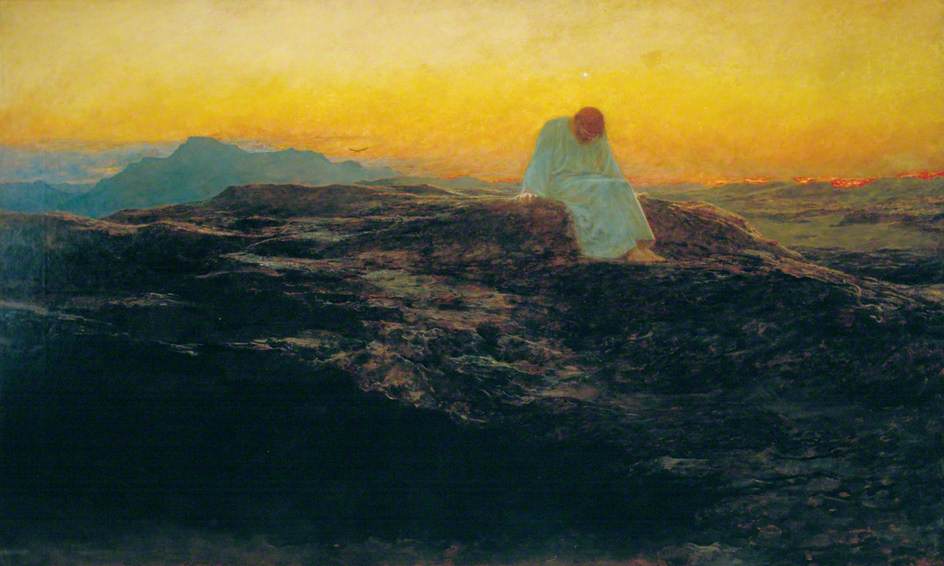
COL; (c) City of London Corporation; Supplied by The Public Catalogue Foundation
“He was in the wilderness forty days, tempted by Satan; and he was with the wild beasts; and the angels waited on him.” – Mark 1:13
Why did I come to Jordan?
My life in Galilee was nothing much. I did my work. I paid attention to my mom. I read the texts and prayed upon their words. If nobody was eager to accuse me of great sin, I can’t say anybody was inclined to say, “Here’s one who’s lived a life untarnished.”
My mother, to choose one, would never say those words.
Still, my conscience rested easy. My sins were bearable enough to wait until the day of offering within the Temple, and even then I’d struggle some to name my sins. So why did I accept the labor of the miles and seek a baptism, repenting for my sins?
The Spirit drove me dripping to the wilderness.
I’d had a life which had its just rewards, its comforts, and its faithfulness, but now my heart will never rest at “home.” The softest bed will scratch my soul until I set once more upon the road to speak to new assemblies, gathered for the Word.
My life will be a wilderness.
Oh, can I not just take the road to home? Can I not set aside the heavenly words as meant for someone else, and not for me? Must I embark upon a journey, knowing that it leads to only one imaginable destination: a shameful death upon a cross?
There’s little mercy in the laws of Rome.
I’d cry out, “Get behind me, Satan,” but temptation is behind me, and before me, and at either side. It’s graven deep within my bones which long for hearth and home. What do I care for bread, for power, or for Messianic name? All I want, my God, is to go home.
But now my home is wilderness in truth.
Oh, you can come now, angels. Wipe my sweat-soaked brow, and dry my streaming eyes. Supply the bread I’ve done without and gently satisfy my body’s thirst. Just like the prophet long ago, I take your nourishment. I take the highway of the wilderness,
From this day forth, and always.
A poem/prayer based on Mark 1:9-15, the Revised Common Lectionary Gospel Reading for Year B, First Sunday in Lent.
One of the themes that tends to pop up in my stories is something like, “When is it a good time to fly?” Sometimes the birds asking that question are chicks wondering whether they’re ready for their first flight. Sometimes it’s older but still young birds trying to figure out how far they can go. Sometimes it’s older birds trying to balance the needs of nest-building and chick-feeding. Sometimes it’s just a bird thinking, “What does the world look like over there?”
A little group of ‘apapane decided to discuss the question in some detail. They thought that they’d like to become wise birds, wise ‘apapane, wise creatures that would have some good reasons to choose to fly at some times, and not to fly at other times.
“When is a good time not to fly?” asked one of the little flock.
“When there’s an ‘io overhead,” said one.
“Or a pueo,” added another.
“Or the shadow of something big and you’re not sure what it is,” said a third.
“It’s not a good time to fly in a big wind,” put in one.
“I’m not crazy about flying when there’s lightning,” said another.
“What about if you’re lost?” asked one of the ‘apapane. “Is that a good time to fly?”
They thought about it. “If you just stay in place when you’re lost,” said one slowly, “you don’t see anything different than what you’re seeing. I think you have to fly at least a little bit so that you can see new things, which might be the old things you’re trying to find.”
“If it’s a high wind and the tree is breaking, that’s a good time to fly,” added an ‘apapane who had been thinking about this for a while.
“What is a good time to fly?” asked the first bird.
“When the tree is breaking,” said the bird who didn’t want anyone to forget that.
“When the tree you’re in is out of bugs and nectar,” said another.
“When your wings and feathers are ready, and not before,” said one of the younger ones whose first attempts at flapping his wings hadn’t gone well.
“When you want to sing with the birds in another tree,” said a particularly musical ‘apapane.
“When it’s naptime and everybody is singing in your tree,” said an ‘apapane who liked to rest after a meal.
They fell silent for a bit at this point. Suddenly the first bird, the one who’d been asking the questions, the one who really wanted to be a wise ‘apapane, laughed out loud.
“When you feel like it!” she sang, and soared up into the sky.
Flying is all about the practical things, and there are plenty of times when flying is a bad idea, when it’s dangerous. Human beings don’t fly, at least not without an airplane, but we have our own times to stretch our wings, as it were. Be careful and don’t take off when it’s dangerous, friends, but make sure to appreciate the joy when you do.
by Eric Anderson
Watch the Recorded Story
I write these stories ahead of time, but during worship I tell them from memory plus improvisation. So what you hear in the recording does not and will not match what you’ve just read.
“But Elisha said, ‘As the LORD lives, and as you yourself live, I will not leave you.'” – 2 Kings 2:2, 2:4, 2:6
You threw your mantle over me, Elijah, as I plowed the fields. (You failed to mention that you’d taken that direction from the LORD.) You would not pause to let me kiss my parents, no. But cook an ox upon the fire of its yoke, and feed the neighbors? Yes. You’re strange, Elijah. From that mantle day, I’ve clung to it and you. I’ve seen your challenges to kings and queens. I’ve seen God’s fiery judgement fall.
So now you’d leave me, prophet of the trumpet voice, to serve your God and speak to kings as if they had no soldiers to command. Have we been walking on the road toward your death and burial? Should I have asked the gathered prophets for a shovel, casting earth and tears upon your stiffening form, just as you cast the mantle on my back which stiffened, knowing that the furrows of my life would grow new fruit.
I said I’d follow then. I tell you I will follow now, despite the lack of tools to dig or fill your grave. I’ll follow you across the stream divided by your mantle’s touch, not knowing if I can return to Jericho without a muddy swim and wade. I’ll follow you though tears are all that fill my eyes, so that your spirit takes its flight and I see nothing more than mist, despairing of your spirit’s gift.
Fire. Horses. Galloping between us. Whirling, swirling wind. You rise beyond my grasping hand. Father, no! The chariots of Israel steal away my heart!
Your mantle falls. I’ll cling to it until my sobs have eased and I can test to see if God is with me.
A poem/prayer based on 2 Kings 2:1-12, the Revised Common Lectionary Gospel Reading for Year B, Transfiguration Sunday.
The image is The Ascension of Elijah, Russian icon of the Novgorod school, late 1400s, by Anonymous artist from Novgorod – http://www.bibliotekar.ru/rusIcon/2.htm, Public Domain, https://commons.wikimedia.org/w/index.php?curid=4157865. Until I looked over Orthodox icons for this post, I hadn’t seen images of Elisha grasping Elijah’s mantle as if to hold him to the earth. It’s a powerful image.
I’ve told you a couple stories over the years about nene and their flight school. I’m also sure you’ve heard that a number of fish have swimming schools. Today’s story is about some ‘apapane and their music school.
Music school? Yes, indeed. ‘Apapane have a pretty wide vocal repertoire – that is, they sing a lot of songs – and plenty of ‘apapane create their own songs, frequently adapting from older melodies. They sing throughout the year, and they sing from a pretty early age. They are, you could say, natural singers.
A natural talent, however, becomes better and better when you work at it.
So the ‘apapane have music schools. Rather like your Sunday School, or your daily school, you’ve got a gathering of students and a more experienced teacher. They’re perched in a tree, though, not sitting on chairs with desks or a table.
This one music school, however, rather puzzled the students. It kept moving. They’d come to a big tree in the morning, following the sounds of the teacher singing. She’d have them singing with her for a couple hours, then take a break for a meal, and they’d scatter about the nearby ohi’a trees collecting nectar and insects.
To start class again, she’d start singing – from a different tree.
In fact, it was always a different tree. It was a different tree every morning, it was a different tree after lunch, it was a different tree after mid-afternoon snack, it was a different set of trees every single day.
The teacher’s singing would bring in new students sometimes, ‘apapane who hadn’t been in the neighborhood of yesterday’s tree might hear her voice from this morning’s tree. As older students were quietly told that they’d completed their program, new students from new sections of the forest kept joining. It meant that the group never sounded completely polished, with long-trained singers perched near brand new singers, and it never actually ended, just cycling on.
This bothered one of the students. He thought it made much more sense to get a group together, train them together, and graduate them together. You’ve probably noticed that it’s what humans do with schools most of the time. He went to the teacher during a lunch break and said, “Why do you move about like this? Why not stay in one place and teach there?”
The teacher looked at the young birds guzzling nectar and hunting insects in the tree and the trees around and said, “Do you think these trees will be able to feed these students this afternoon?”
The young ‘apapane hadn’t thought of that. They’d need trees that hadn’t been hunted over later in the day.
“And how do you think,” she asked, “other young ‘apapane will find me if I stay in one place all the time?”
He didn’t have an answer for that, either.
“This way works,” she told him. “We have the food we need to keep us going, we have the music to practice to keep us learning, and we have the new students coming to keep all the ‘apapane singing. We nourish ourselves. We learn new music. We welcome new singers.”
She spread her wings. “Lunch is nearly over. It’s time for a new tree. Let us go on!”
And they did.
by Eric Anderson
Watch the Recorded Story
I write these stories ahead of time, but I tell them from what I remember – and what I invent in the moment.
Toward the end of 2022, someone asked me what I thought of Elon Musk’s acquisition of Twitter, the “micro-blogging” service whose brief post format had attracted a good number of users over the years, including me. Musk had owned the company less than two full months at that point, but had already taken steps to slash the workforce, relax the hate speech restrictions, and suspend legitimate journalists. The questioner expected I’d be supportive of Musk’s claims to provide a platform with truly open speech. I replied that I thought he’d make the platform unusable in about six months.
I am lousy at predictions. I was off by about six months.
I no longer post to Twitter – or to X, its rebranded moniker. I still check it from time to time, and find less and less that informs or inspires me. I’ve downloaded the archive of what I’ve posted over the years, and I suspect that someday, a day not too far into the future, I will close my account entirely.
I’m sad about it. During my sojourn as a communications specialist for a UCC Conference, I spent a lot of time in the emerging world of social media. I remember, for example, that you had to establish a connection to a university to join Facebook (really!), which I did. I joined Twitter despite my skepticism that it could facilitate human community building while maintaining a 140 character message limit.
In 2011 I realized I was wrong about that. That was the year of the “Arab Spring,” when populations from Syria to Libya began demonstrating against their unresponsive governments. In some places, they won new freedoms with peaceful protests. But in others, civil wars erupted. In March a young man in Libya named Mohammed Nabbous, who had practiced citizen journalism via Twitter as well as his own website, died from a sniper’s bullet in Benghazi, Libya. He had gained the trust and support of a number of professional journalists, including National Public Radio’s social media specialist, Andy Carvin. When Carvin announced Nabbous’ death on his Twitter feed, the community came together to mourn and to comfort one another. It was a moment I’ve never forgotten.
At 140 characters a post, people performed the most elemental of human compassionate acts: comforting the grieving. Twitter could and did provide a communications medium of human community.
Twitter continued to be that kind of medium for many years (even if it did double the character limit). As with all communities, it developed rules of conduct that members had to follow, or find another group. Every community does this, whether it’s a social club, a religious organization, or a political entity. There are things we do not do in this setting together. There are other things we (usually more informally) expect people to do.
Twitter’s enforcement of those rules raised questions, of course, though I usually heard more complaints about the rule violations that didn’t provoke an effective response. I suppose that says something about the kind of people I choose to pay attention to. By and large, they do not speak with venom and bile. They were unlikely to violate Twitter’s community standards.
One of the first things that happened after the Twitter acquisition was the relaxation of those standards. Those rules had been developed with the input of the users over a decade. Suddenly they no longer mattered. Studies showed a rapid rise in hate speech rooted in racism, sexism, and homophobia, and a corresponding decrease in effective response. Some users began to leave the platform because of the level of the abuse.
That was what I had in mind when I answered that question about Twitter in December 2022.
Something else, however, was happening, and it took me a while to realize what it was.
I do not follow Elon Musk’s Twitter handle. I have not blocked it, but I do not follow it. Suddenly, I began to see posts from him – not in the general feed, but in my Notifications, an area that, in theory, reflects activity by accounts I have specifically selected or, increasingly, from accounts identified by an algorithm. I had definitely not chosen to be notified of Musk’s posts. Nor had I interacted with them such that they should be selected by the algorithm. Unless… the algorithm had been adjusted so that the service owner’s posts would be highlighted for service users, one and all.
I have no real objection to a media company owner insisting that his opinions be highlighted by the media outlet he owns. Publishers do that all the time. Frankly, I do it myself on this blog, where I am the only contributor. That’s the nature of media companies.
But Twitter used to be a community. Now… it isn’t.
My decision to stop posting to Twitter, therefore, is a choice to no longer contribute uncompensated material to a publisher. Yes, it means that I’ll have somewhat more difficulty in reaching potential members of my own audience, but to be honest, they’re spending a lot less time on Twitter, too. The service has ceased to function to foster and support developing community. It has made the transition to media company (relying primarily for content on people they’re not paying) and, more to the point, it has chosen to spotlight the contributions of its owner.
I’ve looked over the last few items that Mr. Musk’s algorithm has dropped into my Notifications. Without exception, they have no value to me. They are mostly jokes that are, frankly, not funny. Some are offensive. Some are sexist. Some are racist. I don’t need to know any of it, and I’m happier not knowing any of it.
Mr. Musk has nothing to say that is worth my attention.
I will miss the community. It was rough and ready, and for certain the participants did not always rise to the standards of care and compassion which marked the response to Mohammed Nabbous’ death. I will miss the challenge of sorting information posted during a crisis into more- or less-likely. I will miss the #3tweetsermon, which has moved to my church’s Facebook Page as the #3postsermon, a much less evocative name. I’m still surprised that I was, if not unique, so close to it that I never found anyone else posting with that hashtag.
Farewell, Twitter. I will miss you. You’ve been fading away for over a year, and the time has come to say, “Goodbye.”
In the morning, while it was still very dark, he got up and went out to a deserted place, and there he prayed. And Simon and his companions hunted for him. – Mark 1:35-36
You started ministry, O Savior, in retreat. You rose from Jordan’s cleansing water and retreated to the wilderness. I guess temptation’s not precisely a vacation, is it? Still, forty days away from obligation sounds, well, pretty good.
Then just a few days into ministry – such active days, with teaching in the synagogue there in Capernaum, the place where everybody knew your name, and were surprised to hear you speak with force, and issue a command a demon must perforce, obey,
Then healing Simon’s ailing mother-in-law (where was his wife, I wonder?), and the others who, with Sabbath ended, made their way to Simon’s house in search of respite from their pains, their demons quashed, their illnesses relieved, their spirits freed, their futures brightened –
Now you step away from exorcism, healing touch, and liberating word. Now you seek night’s sheltering cloak, to hide you from those seeking you. Now you ask, perhaps, if struggling with the Tempter might have been the gentlest part of ministry. Now you seek a rest in God more healing than a night of sleep.
The fishermen became the hunters, then. They sought you, tracked you, brought you down as arrow brings the hart unto its knees. “They seek you, Jesus.” That was their excuse, but you, and they, knew well their desperate need to be with, learn from, follow you in a new day.
You rise. You slap the clinging dust away from off your robe. You slip the sandals on (perhaps you’d shed them so to pray on holy ground). “Let us go on,” you told them. Yes, they’re welcome on the road of ministry, as weary as it is. You’ll make your times of solitude along the Way and maybe, they will, too.
A poem/prayer based on Mark 1:29-39, the Revised Common Lectionary Gospel Reading for Year B, Fifth Sunday after the Epiphany.
Let’s be clear. Songbirds are not noted for being in-your-face kinds of birds, except every once in a while when there’s a big argument about the melody. I’m sure you’ve seen birds flying angrily at one another from time to time. I’m afraid it’s usually because somebody thinks somebody else isn’t singing it right.
The ‘akepa, with their bright orange feathers or with olive an green head and wings and a yellow chest if they’re female, are generally pretty shy birds. They keep mostly to themselves, perhaps foraging for their favored bugs and insects with a friend or a mate. If you ask their opinion, they’re likely to tell you, but they’re not likely to offer it in the first place.
One ‘akepa, however, was really shy about offering an opinion. It’s not that she didn’t think her thoughts were worthless; it’s just that she thought everybody else’s thoughts were equally worthwhile. That can lead to some good discussions when the question is something like, “What is the meaning of life?” “I’ve got one or two ideas. What are yours?” will get things started, won’t they?
When the question is, “Is there a good assortment of bugs for breakfast in that tree?” and your answer is, “I suppose there might be. But what does a good assortment look like to you?” – well, that kind of answer isn’t as helpful.
“Were you in that tree today?”
“I might have been. What do you mean by today?”
Her friends, even the one she most frequently went bug-seeking with, yearned for a good, solid, straightforward statement from her.
It came. It came on a stormy, windy day. She and her friend were in neighboring trees, both of them dancing in the wind. When I say dancing, I mean, jumping up and down and spinning around with no regard for a musical beat.
Looking at her friend’s tree, she noticed that the limb her friend perched on was starting to crack. “Do you think this would be a good time to go to another tree?” she called.
“I don’t want to fly right now!” called her friend.
“You might want to fly more than you think you do,” she called again, and her friend, riding the bucking branch up and down and side to side, barely heard her and said nothing.
As the branch began to really tear away at the trunk, our uncertain ‘akepa screamed, “Fly away right now now now!” and then came the sounds of wood breaking and the leaves scraping against other branches as it all came down. Some green and yellow feathers whirled away on the stormy wind.
“Good idea, flying,” heard our uncertain ‘akepa from just above, and there was her friend, breathing hard and looking a little the worse for wear, holding tight as her new branch in the new tree rocked about. “I’m really glad you were sure about that.”
Not everything in life is cut and dried, hard and fast. Not everything is wide open to options and opinion. It’s important to know the difference, especially when branches are falling in the storm.
by Eric Anderson
Watch the Recorded Story
I tell these stories from my memory of what I’ve written (which is the text you’ve just read). The story as told is… different.
Author’s Note: This sermon was written for the installation of Kahu Keoki Kiwaha as Pastor of Puka’ana Congregational Church UCC in Captain Cook, Hawai’i. Unfortunately I fell ill and was unable to deliver it. I am deeply grateful to the Rev. Jonathan Roach for taking on that task, literally reading it in the car on the way to the church that Saturday morning.
Kahu Kiwaha has my best wishes and fervent prayers as he begins the work of his calling as Pastor and Teacher, and I look forward to many years of shared ministry.
January 13, 2024
Exodus 3:1-12 Luke 22:14-20, 24-27
When a kahu is first installed or ordained, they make the choice of the Scripture for that ordination or installation service. Other kahu look carefully at their selection, which most of the time, unsurprisingly, is a call story: one of the prophets, one or more of the disciples, perhaps an apostle. It says a lot about how they understand God’s call to them, about the ministry they believe they’ll undertake, even about their ongoing relationship with God.
So I eagerly awaited the word: whose call story would Keoki Kiwaha choose? And it was: Moses.
Wait. Moses?
Moses.
Oh, dear. Keoki, you poor unfortunate soul.
Moses had about as unwelcome a call, and as challenging a ministry, and as unsatisfactory a fulfillment of his ministry, as you can imagine. He was just out watching sheep, when the burning bush and the divine voice called. He was directed to perform the simple task of freeing the people of Israel from Pharoah, and later to guide them to their ancestral home. In the end, he died on a hilltop, gazing at the promised home that he would not reach.
Keoki, I am so sorry. And this certainly explains why you’ve been holding God’s call at arm’s length for so long.
Moses may hold the record for most protests offered to God by a summoned prophet. I count four. One: “Who am I?” Two: “Who are you?” – a good question when a deity starts giving you directions, actually. Three: “They won’t believe me or listen to me.” Four: “I’m a lousy public speaker.”
Four protests. Actually, four unsuccessful protests. Take note. God was more stubborn than Moses. God is more stubborn than you.
Cheryl Lindsay writes at ucc.org, “A common thread in biblical call narratives is the inherent insufficiency of the called. Some are reluctant due to the costs associated with the work. Others question that God is actually seeking them. Nearly all considered themselves ill-equipped for the assignment that God invites them to fulfill.” Dan Clandenin echoes that at JourneyWithJesus.net: “No one in their right mind would think themselves worthy or capable of that call — or any call, for that matter. To speak the unspeakable. To name the Unnameable. The presumption. The audacity. The futility. To remove your sandals and stand on ‘holy ground.’”
Of course you’re not “worthy.” Who is? What you are is the one God called. You have everything you need, or you have the ability to learn everything you need, or you will grow into what you need, and what did God say when Moses asked, “Who am I?”
God said, “I will be with you.”
God says the same to you, Keoki.
Like Moses, you have things to learn. Please learn not to whine as much as Moses. My goodness, he could whine. Yes, the people are hungry. Yes, the people are thirsty. Yes, you don’t know how to find the food and the water not just to satisfy but to nourish them. But you don’t need to go to God and say, “They’re about to kill me.” If they are, God knows that and doesn’t need to be reminded. If they’re not – and they’re probably not – God knows that, too, and do you really need to hear the divine sigh that goes with the divine rolling of the eyes?
“The people are hungry and the people are thirsty and God, I don’t know what to do. I need your help.”
Why couldn’t Moses learn that prayer?
You could also learn to delegate better than Moses. It’s a low bar. One of his regular whines was that everybody depended on him. Because he was really bad at assembling a team of leaders to support his community. Who told him he needed help? Everybody. His family. His father-in-law. The elders he ought to have equipped. His designated successor, Joshua. God. I mean, everybody knew that Moses overdid it.
You have congregational leaders who have done this for a long time. I know that leads to the frustration of “We’ve always done it that way” – but you folks here at Puka’ana know not to say that, right? Some of the things we’ve always done that way – which haven’t always been done that way, just done that way in living memory and sometimes not even that – some of those things are done that way because they work. Some of them don’t work any more. Some of them never did work but it looked like they did. Together you’ll figure out what’s good, what’s better, and what we can leave behind because the past is where it belongs.
Moses… wasn’t good at that.
Moses also wasn’t good at getting support from other leaders around him. You have colleagues on this island, on other islands, and throughout the United Church of Christ. You have access to an educational system that has been equipping kahu for about four hundred years – which, I have to admit, sometimes falls into the category of “perhaps we ought to change this process just a lot.” Get the support you’ll need.
Moses wasn’t good at that.
He was good at staying centered in God’s call – eventually. He kept his focus on the freedom of his people. He kept his focus on their survival. He kept his focus on the standards by which they would live. He kept his focus on their journey with God. None of those tasks were easy, by any means. If Moses had gone after the frequent distractions, however, far too many of them might have failed.
Be clear in your call. That’s not a one-and-done. The fact that you’ve accepted a call to leadership in Christ’s Church at this moment does not define how you live out that call in the coming years. It will shift and it will change. The world’s needs are not constant, so God’s call is not changeless. God’s love, yes. The ministry you do to express God’s love: that is new with the dawn. Be clear in your call.
Moses’ first call was to human freedom. I think that may be a common element for most calls to ministry. Whether it is freedom of the body, or release of the mind, or the unburdening of the soul, God has consistently called prophets and apostles and a Messiah to set my people free.
Be clear in your call.
Remember that you are not Moses. You are Keoki. Keoki has strengths and abilities that Moses did not. You, for example, do not need somebody else to speak for you. You can sing like Miriam as well as speak like Aaron. So you don’t need to make Moses’ mistakes, either. You can make Keoki’s mistakes. I assure you that I’ve found it much easier to make Eric’s mistakes than those of Jeremiah, my own Biblical call icon.
Learn from Moses’ mistakes as well as his successes. Learn also from Keoki’s mistakes and from your successes.
You have a long road ahead, Kahu, and I suspect that like Moses’ journey, the one thing it will not resemble is a straight line. As Harry Chapin sang, “There’s no straight lines make up my life, and all my roads have bends.” Lean with the curves. Lean into the curves. Slow down where you have to, because roadside ditches are unpleasant and the plummeting cliffs that are their alternatives are worse. As I found one day on a road on Maui, sometimes you’ll have to back up and let others go by or things will go very badly indeed.
And… don’t be surprised when you don’t reach the Promised Land in this lifetime.
Commentators over the centuries have spilled a lot of ink over Moses’ death before he reached the Promised Land. Why why why didn’t he make it over the Jordan River? Was it fair? Was it right? Was it consistent with the mercy of God?
Our journey to the Promised Land, however, isn’t one that ends in this lifetime. In this lifetime, we labor and lead and preach and teach for a community that more closely resembles the Peaceable Realm of God. Nobody – including Moses, including Isaiah, including Jeremiah, including Ezekiel, including Mary, including Simon Peter, including Paul of Tarsus, including Jesus – have established the Peaceable Realm on Earth. People have gotten closer. People have stepped further away. But reached it? No.
With all the best wishes for your success in ministry and with all appreciation of your talents and with all anticipation of your growing skills, you’re not going to get there either. Not in this life.
It’s the grace of God that, in the end, sustains us throughout our Earthly journey. It’s the grace of God that, in the end, guides us in sight of our destination. It’s the grace of God that, in the end, makes the bridge from this life, through death, to the goal toward which we’ve labored. It’s the grace of God that, in the end, will bring us home.
Moses. Really? Well. God bless you.
God blessed the world when Moses was called. God blessed the world when Keoki was called. God bless us all as we find our freedom and make our way to God’s eternal home.
by Eric Anderson
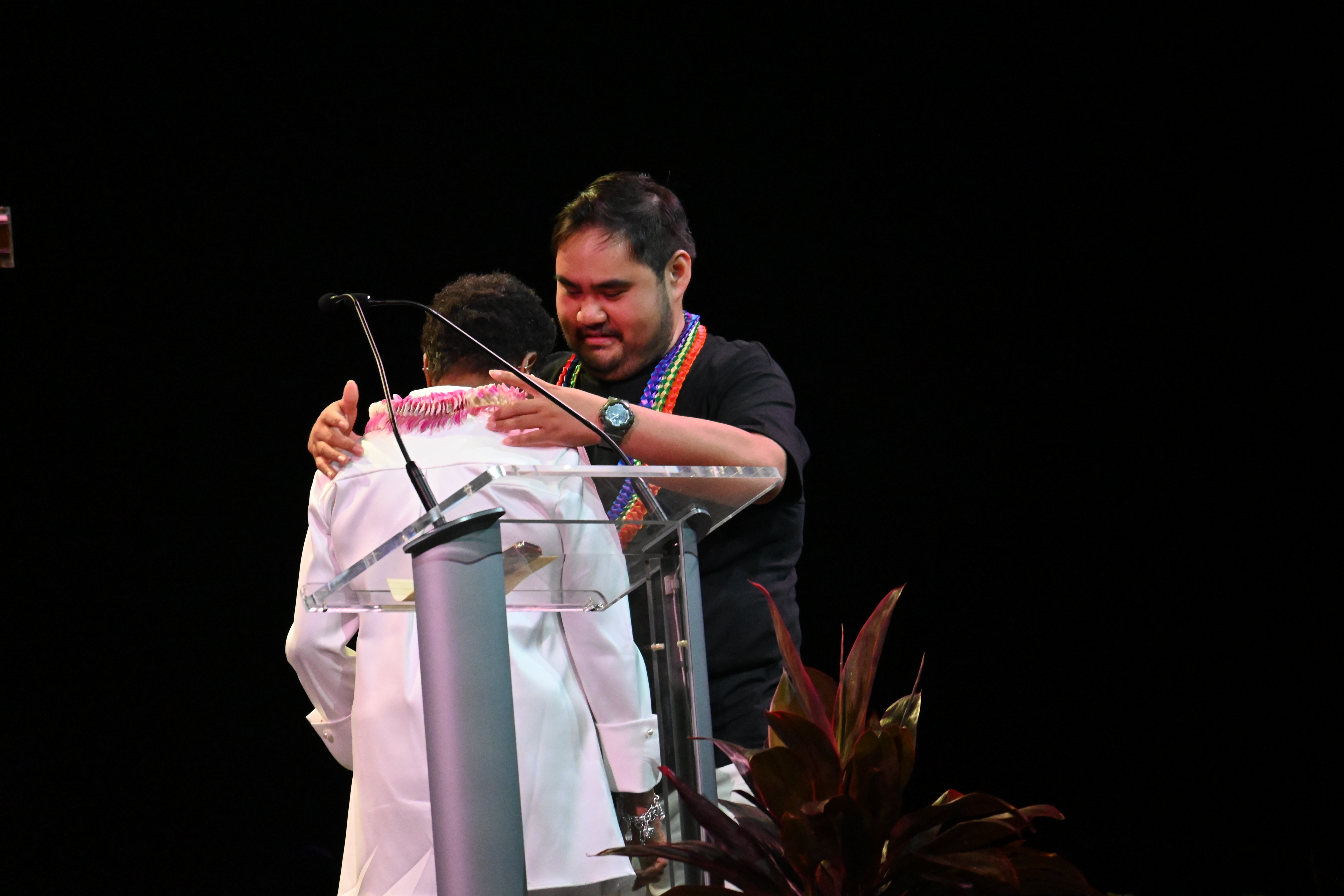
The photo of Keoki Kiwaha (r.) presenting a lei to the newly elected General Minister and President of the United Church of Christ, the Rev. Dr. Karen Georgia Thompson, was taken in July 2023 by Eric Anderson.
The ‘elepaio was hungry. I’m not sure why. Any time I’ve been walking around the forested areas of Hawai’i, there have been lots of bugs. Bugs here, bugs there, bugs everywhere. Lots of bugs.
Mostly the bugs make me uncomfortable. I’m not an ‘elepaio. To an ‘elepaio, those are breakfast, lunch, and dinner.
For some reason, that day, the ‘elepaio wasn’t finding many bugs.
Most ‘elepaio are known to be curious. They flit about checking tree trunks and limbs, and fallen trees, for bugs on the bark and bugs that have burrowed into the bark. They look carefully around the leaves and twigs for the movement that indicates a bug, a snack, a meal. If you’re walking about in their territory, they’re likely to come take a look at you and check you out. In old times, canoe makers would watch them to see what trees had lots of bugs – which made them bad for canoes – and the curious ‘elepaio would watch them in reply.
This ‘elepaio was an exception. He’d had some very unpleasant experiences with ‘io and pueo, and even a mongoose or two. He wouldn’t move far from his chosen trees to see what the movement in other branches was all about. And as I said, he wasn’t finding a lot of bugs in his chosen trees.
“I’m hungry,” he grumped aloud.
“I’m not,” said another ‘elepaio in a neighboring tree.
“There’s no bugs here,” he told her.
“There’s bugs here,” she told him.
“I think the bugs have all gone away,” he sighed.
“If they have, they’ve all come here,” she said.
“I’m hungry,” he moaned.
“I think you’re not listening,” she said.
So she flew over and perched right next to him and gave him a gentle tap with her beak.
“There’s bugs a-plenty in that tree,” she said. “More than you and I could eat in a lifetime.”
“They’ve all gone away, I’m sure,” he said.
She nearly flew away in frustration at that, but after a moment, she said, “Come and see.”
“I don’t dare,” he told her. “What about ‘io and pueo and mongoose?”
“You’ll only find out if you come and see,” she told him.
Curiosity is a complicated thing. Curiosity helps us learn new things, but sometimes those things are things we’d rather not know. Curiosity gives us new experiences, but sometimes those are experiences we’d rather not have. Curiosity had led him to the ‘io and the pueo and the mongoose. Would curiosity bring him to enough bugs that they’d feed him for a lifetime? How curious did he dare to be?
His friend said, “Come and see.” She’d seen. She’d learned. She’d experienced. She invited.
He went, and saw, and ate.
by Eric Anderson
Author’s Note: I wrote this story for worship at Church of the Holy Cross UCC on January 14, 2024. Unfortunately, I fell ill and wasn’t able to tell it live.




 ordainedgeek