Mary Magdalene went and announced to the disciples, “I have seen the Lord…” – John 20:18
Christ’s first messenger to those he called as messengers was Mary. Mary Magdalene. His friend. She traveled with him on his road.
“Apostle to apostles,” she’s been called, though they, it must be said, did not believe. But she was right and they were wrong.
So, those who now decide to set aside the witness of their sisters, you would mute the Magdalene
As if you’d set your course into a desert wasteland, and there deprive yourselves of water.
A poem written in response to votes at the Southern Baptist Convention’s annual meeting on June 14, 2023, to ban women from pastoral roles and remove churches led by women from the denomination’s rolls.
“And not only that, but we also boast in our afflictions, knowing that affliction produces endurance,and endurance produces character, and character produces hope, and hope does not put us to shame, because God’s love has been poured into our hearts through the Holy Spirit that has been given to us.” – Romans 5:3-5
Stop talking, Paul. You had me there at “We have peace with God.” That’s good. That’s great. That’s all I want (or need?) to hear. Stop there.
You can’t just stop there, can you?
“We boast in our afflictions” – but complaining isn’t boasting. “Affliction produces endurance” – unless it kills your spirit, Paul. “Endurance produces character” – it also fosters hubris. “Character produces hope” – is hope the same as resignation? “And hope does not put us to shame” – well, Paul, I’m with you there, as long as you do not expect me to assume I’ll get just what I hope for.
You can’t stop talking, can you?
Still, I’m grateful that you looped back round again to God’s salvation. We’re reconciled by Christ’s gift of self. We’re saved because we share Christ’s life.
But now, be still – not Paul, but me. If Tarsus’ famous correspondent can run on, the same is true of those of us less known. Stop, Eric, for we’ve made the crucial point:
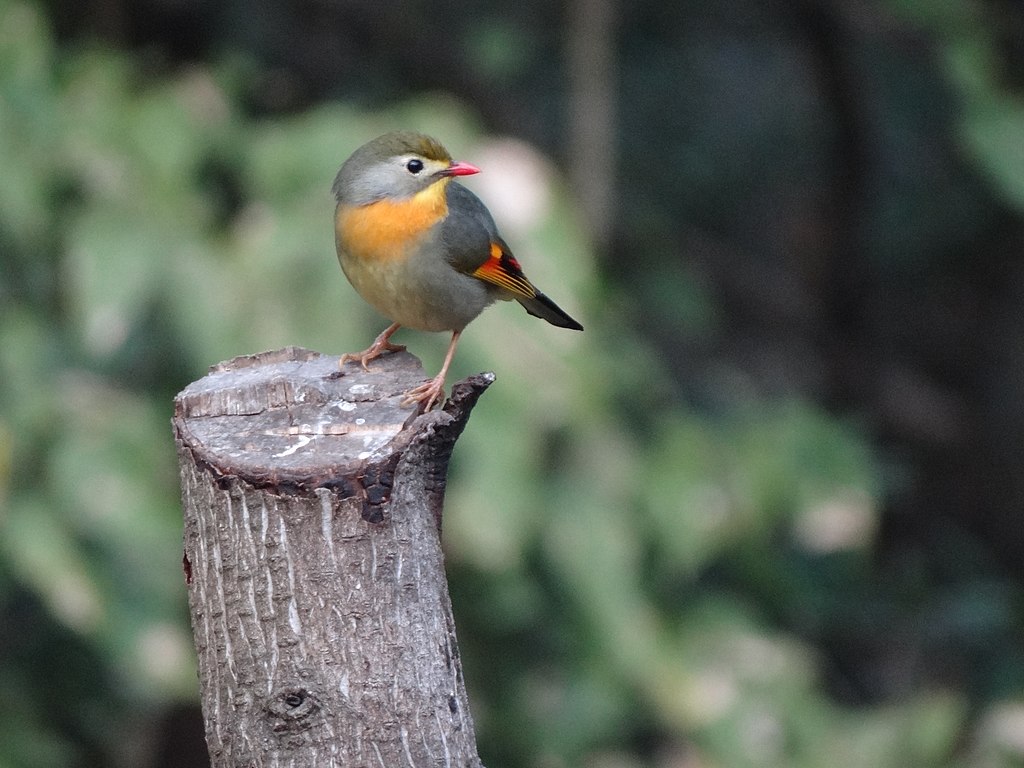
The red-billed leiothrix, like myna and the mejiro, is a bird that’s a relative newcomer to Hawai’i Island. They’ve been here for a little over a hundred years.
They can be pretty cheerful singers, on the whole, with a nice lilting chirp. They’re better known on Hawai’i Island for what they sound like when they’re alarmed, though. It’s a loud and harsh rapidly repeated sound that almost sounds like some sticks being rubbed together. If you’re walking about in the forests or the kipukas up the mountains, you’re likely to hear it, because they tend to make it when humans are about.
A grandfather was instructing his grandchildren in making the call (I can’t imitate it, I’m afraid). After he’d taught them how it was done, he turned to the times to make the sound.
“You make it when there’s an i’o about, or a pueo,” he said. “And don’t forget to make it when there’s a human around. We always want to let people know about those.”
The grandchicks wanted to know what a human was like, so after explaining that it was a big flightless bird with very peculiar wings, grandfather taught them to make the call again.
“Who should hear this sound?” one of the chicks asked her grandfather.
“What do you mean, who should hear this sound?” he asked.
“Well, I thought this would be just a leiothrix sound,” she said. “Mynas probably aren’t interested, are they? Other birds might not understand.
“And if some birds do understand,” she continued, “it might not be so good for us.”
“What do you mean?” asked grandfather quietly.
“If I see an i’o and make the sound,” she said, “then all the birds will hide. If I’m not as good or as quick at hiding as they are, the i’o might try for me, wouldn’t it? If some other birds are exposed, then we leiothrixes will be better off.”
Grandfather stayed quiet for a long time. Then he sighed.
“You’re right, of course,” he said. “If we don’t alert other birds to the i’o or the human, we’ll be safer when we see the danger first. But what if the ‘apapane sees the pueo first? Or the ‘akepa? Or the mejiro? What if they alert only their own kind, and not us? What happens then?”
Now the chicks were silent, until the one who’d asked the question said, “Nothing good.”
“Nothing good,” said grandfather. “We warn everybody so that everybody will warn us.”
“I see,” said the chick who’d asked, and her brothers and sisters nodded, too.
“How loud do we make the warning sound?” asked grandfather.
“As loud as we can!” said the chicks.
“Who should hear?” asked grandfather.
“Everyone!”
So when you’re walking the kipukas and the forests on the mauna, you’ll hear the leiothrixes, warning everyone that you’re near.
by Eric Anderson
Watch the Recorded Story
I tell these stories from my… not quite reliable memory of the text I’ve written. Differences are inevitable – and regular.
As Jesus was walking along, he saw… (Matthew 9:9) And as he sat at dinner in the house… (Matthew 9:10) While he was saying these things to them, suddenly… (Matthew 9:18) Then suddenly a woman… (Matthew 9:20) When Jesus came to the leader’s house… (Matthew 9:23)
Skip lightly, Jesus, skip lightly. Just a pause at the table, just a quick word. Look how he rises to follow your call! How lightly his step echoes yours.
Skip lightly, Jesus, skip lightly. Your words will dance at the table with all. “Why eat with these people? They know that they need me. They know I am with them, God’s mercy bestowed.”
Skip lightly, Jesus, skip lightly. A father arrives; he has fear in his eyes. “Skip quickly, Jesus, or my daughter dies.” The dishes, untasted, rest cooling behind.
Skip lightly, Jesus, skip lightly, as need reaches out for your power to heal. Stop quickly, Jesus, stop and assure her her body, renewed, can flourish again.
Skip lightly, Jesus, skip lightly. Death has come quicker than your skipping feet, but Death cannot hold what you have raised up, and the little one joins in the dance.
Skip lightly, Jesus, skip lightly. From outcast to souls disregarded, from parent to patient to mourners and on for a moment, skip lightly with me.
Skip lightly, Jesus, skip lightly. I cannot hold you to my place and time. Teach me the skipping, the light-footed step, that carried your grace to each person’s need.
A poem/prayer based on Matthew 9:9-13, 18-26, the Revised Common Lectionary Gospel Reading for Year A, Proper 5 (10).
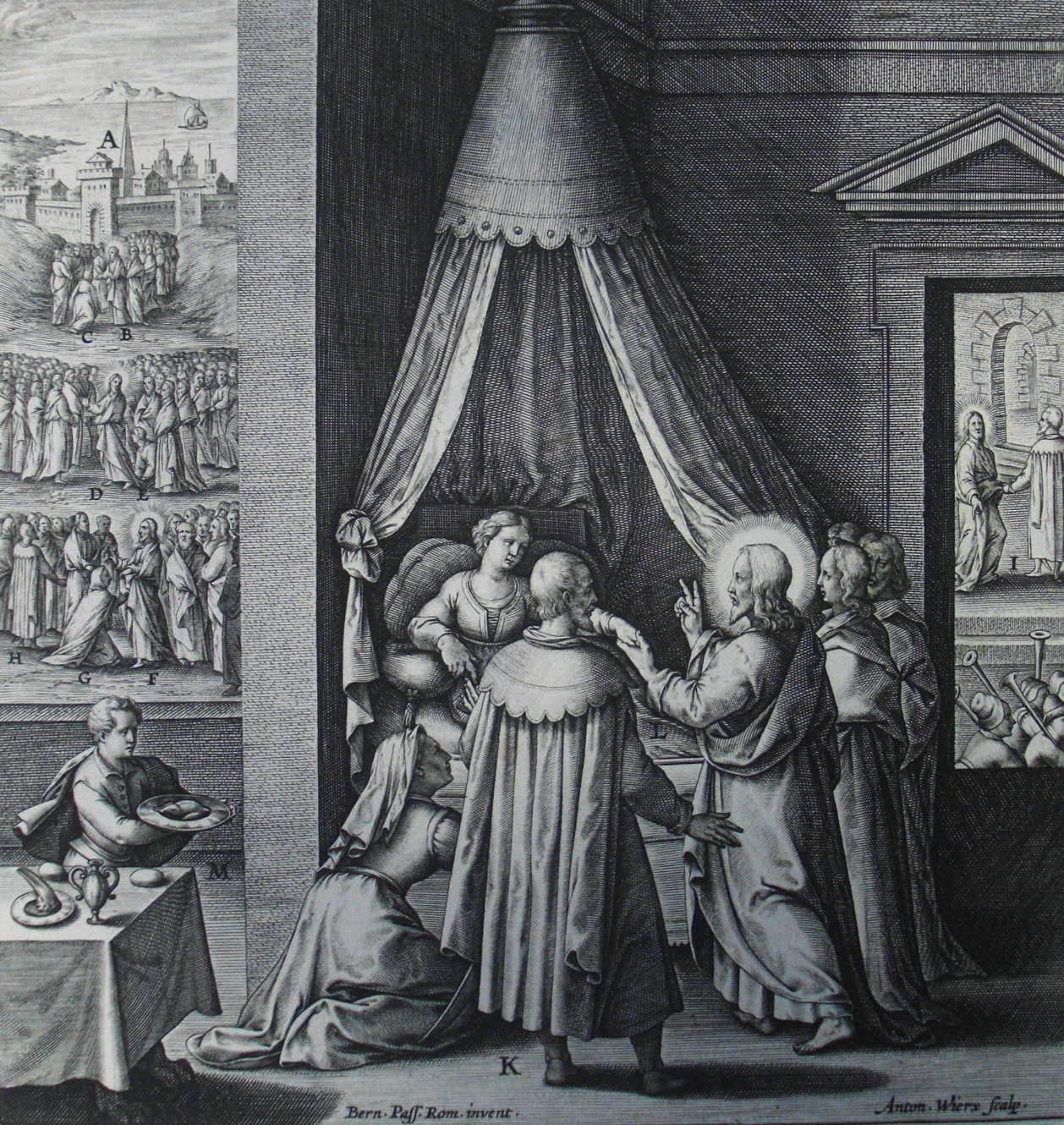
The image (which includes the healing of the woman as well as the resurrection of the daughter) comes from the Phillip Medhurst Collection of Bible illustrations in the possession of Revd. Philip De Vere at St. George’s Court, Kidderminster, England. Photo by Philip De Vere – Own work, CC BY-SA 3.0, https://commons.wikimedia.org/w/index.php?curid=44393013.
The young ‘amakihi had had a bad morning. First there was the big wind that had woken him, first by howling in his ears, then by twisting the branch he was perched on in a very odd way, third by pitching him off the branch into the air, and finally by whirling him along for a way, struggling to get himself upright and under controlled flight.
He’d managed it, but he was still breathing hard when he clutched the twigs of another ohi’a tree tossing in the breeze. It soon settled down, though – that had been a big puff of wind, but just one – when things got exciting again. His eyes caught movement overhead and he took to his wings once more, this time diving further down into the forest canopy to escape the i’o that had just broken from its spotting circle toward a hunting dive. His heart was beating wildly again when he found a space within the branches the i’o couldn’t reach. The i’o flew off to hunt somewhere else.
His breath was just settling to normal when suddenly there was an i’iwi whistling at him. The tree he’d perched in also contained the i’iwi’s nest, and she wasn’t about to put up with an ‘amakihi near her nest. She’d stayed quiet while the hawk was near, but after that. Well. Lots of whistles.
He flew off to another tree, blessedly free of i’iwi, i’o, or high winds, and reflected on his lousy morning. “This is a rotten world,” he said aloud.
“You think so?” said a voice. He looked up. Just to crown his bad morning, just when he’d said something she was bound to criticize, there was his mother.
“If you’d had the morning I’ve had,” he couldn’t help saying, “you’d agree. The world is rotten.”
“Is it?” she said, and beckoned him to follow. They flew over to a great field of lava rock, dark grey and hard and heating up in the morning sun.
“Right! Just like this! Hard and colorless and hot,” he told his mother, who said: “Look again.”
This time when he looked he saw the water droplets left by a rain shower, shining like stars in a grey sky, but now on earth rather than above. He looked again and saw, in the cracked rock, water soaking into small bits of sand. Some of those bits of sand had green things growing in them, some of them had fern shoots, some had leaves waving above. There was ohi’a growing here and there from those crevasses: shoots, stems, bushes, even small trees. His mother led the way down to one young tree in full blossom. They landed amidst the perfume of its nectar.
“The world isn’t so bad,” he said when she gave him a look. ‘Amakihi mothers have a Look, you know, much as many human mothers do.
“Taste,” she said, and even though he knew what he’d taste, he did.
He gave his mother an ‘amakihi smile. She gave him one back.
“The world,” he said, “is good.”
by Eric Anderson
Watch the Recorded Story
I tell these stories from my memory of what I’ve written. And, well, my notion of how they might be improved in the telling.
“God saw everything that he had made, and indeed, it was very good.” – Genesis 1:31
Well, God, what is good? Hold on, I’ll see.
When Earth was a chaotic void amidst a formless universe, You made the light, and see! You called it good.
When sky and planet took their shapes and water rolled alone, You raised the land and blessed the sea. You called it good.
When land and ocean bore no life You whispered to the sands and rocks. They sprouted greens and reds and blues. You called it good.
When light was general, You rolled its radiance into the burning stars, and gentled night with moonbeams. You called it good.
When Earth was green but silent You scattered creatures in the sea and air, from ocean’s depth to dizzying heights. You called it good.
When land remained bereft of creatures You supplied the lack of things that crawl or run. They slithered and they leapt from pole to pole. You called it good.
Then You considered all this life and made anew a pair like You, created in Your image, and you blessed them. You called it good.
From tiniest seed to leaf-crowned stem, from drifting plankton to leviathan, from wren to soaring albatross, from smallest ant to elephant,
From woman on to mahu and to man, from skin of ebony to cinnamon to tan, from farthest north to deepest south, from those who speak a myriad of tongues,
You called it good. You called them good. You called us good. You called Creation good. And we in foolish bravery would contradict Your words, and claim that “those” do not deserve our care,
When You declared them good.
A poem/prayer based on Genesis 1:1-2:4a, the Revised Common Lectionary First Reading for Year A, Trinity Sunday.
The wind made its way across the ocean. In the distance it could see the green slopes of Hawai’i Island and the great mountains rising. As it swept over the sea, it took water vapor that the sun had raised from the waters and pushed it ahead as growing clouds. As the clouds passed over Hilo, they showered the earth with rain.
The wind moved on, and now the clouds dispersed on the shoulders of the mountains, and the sun poured down in shimmering waves. The wind blew through the town and over the fields, and it cooled the stifling heat. As it did, it blew hard enough to pluck hats from heads and turn umbrellas inside out before they could be closed.
A nene near seaside turned into the wind and spread her wings. The flowing air began to lift her even before she swept them down in a powerful stroke. The wind helped carry her aloft until she turned to fly inland.
Not just birds, but seeds flew on the wind, so that new plants would grow.
In places the wind eased things, but in places I have to admit that the wind broke things. Nails in a roof popped loose. An old tree tumbled to the ground, where its trunk would nourish new trees yet to grow there. A sudden gust scattered a myna’s nest over the ground, and the parents-to-be screeched and started building again.
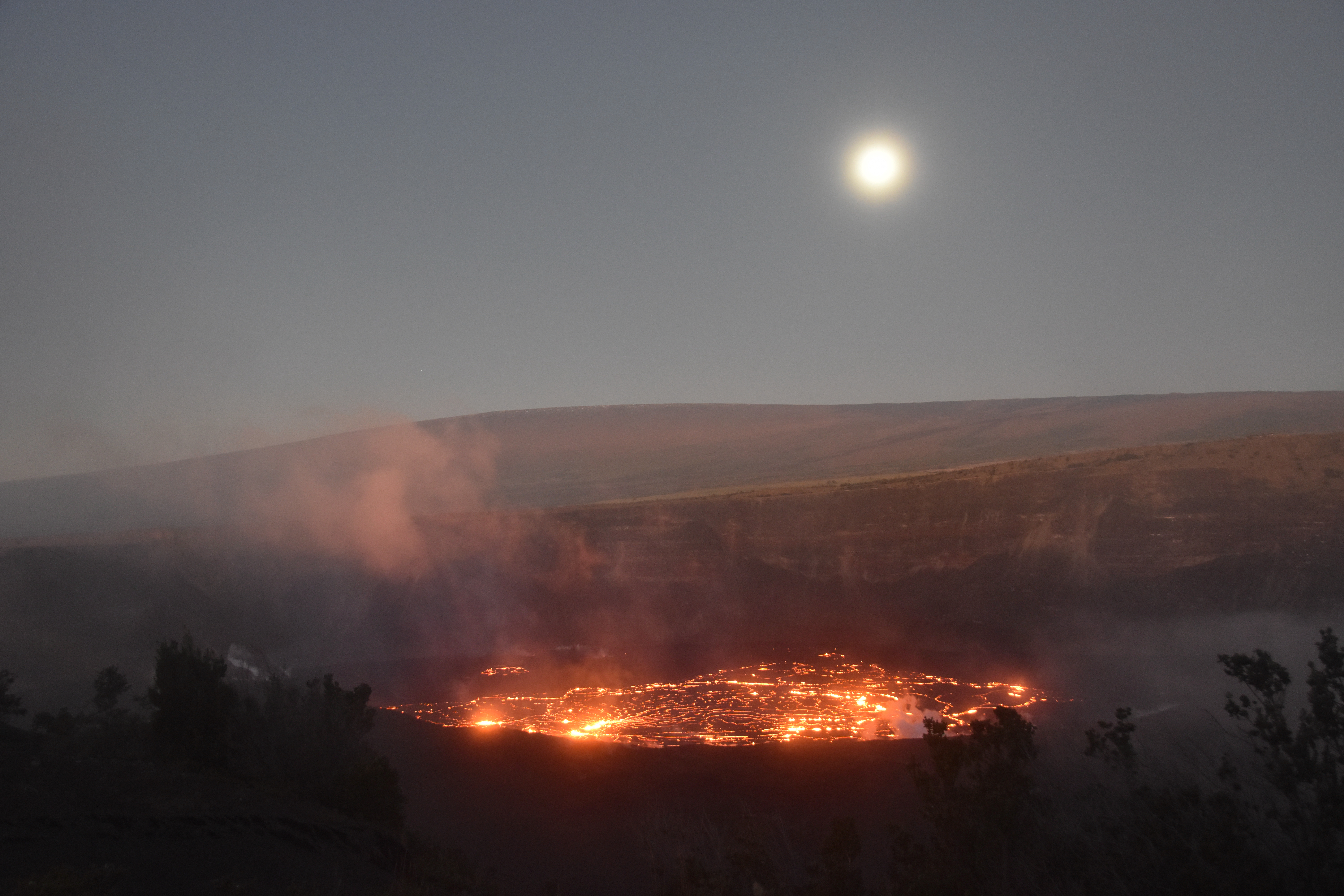
The flowing wind swept over the summit of Kilauea, where fumes rise from the volcano’s liquid heart beneath. It carried the sulfur and tiny flecks of glassy ash further along the island, dispersing them as it went. Oh, they smelled it and they frowned in Kona!
But when the sun set, those bits of glassy ash caught the light and glowed in red and orange and gold. The people and the creatures and the birds gazed at it with satisfaction. “It’s a Kona sunset,” they said.
The wind laughed to hear them say it, for the Kona sunset depends on the Kilauea wind.
And the wind blew on, far over the Pacific Ocean to lands far distant from our shores, blowing where it will.
It’s an old, old thing to compare the Holy Spirit of God to the winds that blow across our planet. In the ancient languages of the Bible, and also in Hawaiian (but not in English) the words for “wind,” “breath,” and “spirit” are the same: Ruach. Pneuma. Ha. Like the winds of earth, the Holy Spirit brings the things of life, for the spirit as well as the body. Like the wind beneath the wings of the birds, the Holy Spirit can lift us up. Like the wind that brings down trees, the Holy Spirit will shake our ideas and assumptions and make us consider new things. Like the wind that creates a Kona sunset, the Holy Spirit creates, helps us create, and helps us appreciate, beauty.
The Holy Spirit is God’s gift to the world, to the Church of Jesus, and most of all, to you.
by Eric Anderson
Watch the Recorded Story
On Sunday I tell the story from memory of the story I’ve written – and I rarely strive to remember it word for word. The differences are part of the creative process – or so I tell myself.
“And a young man ran and told Moses, ‘Eldad and Medad are prophesying in the camp.'” – Numbers 11:27
“But others sneered and said, ‘They are filled with new wine.'” – Acts 2:13
Oh, what we would not give for prophecy with order. These seventy we know. These two we will ignore. Oh, what we would not give for prophecy predictable. Seventy selected to tell us what we know.
Your Spirit raises prophets without due regard to order. We’d all do well with twelve. We’ve no great need for more. With twelve we’d know the words before the prophets even voice them, saving time, so much time we might have to discern.
Why is the Spirit’s call so destructive of our order? We know our daily ways. We follow our set hours Until a strident voice, just like the nails upon a blackboard unsettles our assurance and overturns our peace.
Oh, have your own way, Spirit, in the wreckage of our order. They’ll call us drunk, you know, Or they’ll run and tattletale. With Moses, Peter, Matthias, we’ll join the Spirit’s order alongside Eldad, Mary, Justus, Medad – and Mary, too.
A poem/prayer based on Acts 2:1-21 and Numbers 11:24-30, the Revised Common Lectionary First Reading and Alternate First Reading for Year A, Pentecost Sunday.
I was a little sad when I realized this week that, because of our Sunday School recognition time, I wouldn’t be telling a story. I’m told that the young people and the people who’ve been young people quite a long time – you know, those young people – appreciate those stories. So I’m sorry that there’s no story today.
Once upon a time there was a young ‘apapane who was struggling with flying.
So, OK, I wasn’t sorry about there not being a story for very long.
This young ‘apapane’s problem was not, in fact, flying. He had mastered all the tricky business of holding his wings just so, and moving them down just so, and moving them back up just so, so that he moved forward through the air without diving or climbing or veering off to the left or slanting off to the right. Straight and level – it was so pretty to watch.
It was also, to some extent, the problem. Straight and level works just fine when you’re above the treetops or there’s short trees or bushes or grasses beneath you. When you’re in the trees, though, straight and level is a recipe for straight into a painful encounter with a tree branch.
He could turn just fine, and go up and down. Somewhere along the line, however, someone told him to fix his eyes right ahead, and not to look to either side. “Keep your eyes on where you’re going,” they said, and that’s what he did. It was kind of an accomplishment, actually, because an ‘apapane’s eyes are on the sides of the head, so they’re always looking all around. But he learned to focus, and he kept his focus, and it worked just fine until he whacked a wing on a cluster of leaves to one side, or smacked his feet against blossoms just below, or clocked his head against a tree branch that was just out of the tiny circle where he’d been looking.
He struggled with flying, and it was a painful struggle.
One evening as he was nursing a headache his grandmother asked him what he thought he was doing. “I’m keeping my eyes on what’s ahead of me,” he said.
“Then why do you keep flying into things?” she asked.
“Because they’re off to one side,” he said.
I will spare you the long lecture she gave him about the need to pay attention to more than what’s just ahead of you. Although maybe I shouldn’t – because you and I, we have to pay attention to more than just what’s right in front of us, too, don’t we? There’s the things that are coming from one side or the other. If we keep our eyes on our footsteps we’ll bonk our heads on what’s above. If we think only about what’s just in front of us, how can we ever be ready for what’s coming farther along?
The long lecture from his grandmother stung, I admit. But not as much as his head and his wings and his feet hurt from all those collisions. He learned to look ahead, and to the side, and up and down, and beyond.
by Eric Anderson
Watch the Recorded Story
This story was told from a copy of the text above, so the usual warnings about differences due to memory don’t apply. Instead, there are differences because there are differences.
This poem rose from imagining Jesus’ conversation with his disciples as he ascended like a press conference. Can’t you just hear them calling their questions as the distance increased?



 ordainedgeek