Story: Sighing on the Wind

February 12, 2023

1 Corinthians 3:1-9
Matthew 5:21-37

“What is love?” the little girl asked her mother at bedtime, but she fell asleep before she heard the answer.

“What is love?” chirped the coqui frog outside her window.  She slept on.

“What is love?” crowed the rooster, who had no idea what time it was and didn’t care whether he crowed at sunrise or the middle of the night.

“What is love?” sighed the dove, and “What is love?” hummed the saffron finch, and “What is love?” purred the cat lying below them.

“What is love?” The question flew about the island, from creature to creature, from voice to voice. ‘Apapane sang about it on the mountain slopes and noio screeched about it above the waves. Pigs grunted it in their shelters and mongoose chittered it in their burrows.

“What is love?” asked the sheep and the pueo and the nene and the dogs. “What is love?” rumbled the mountain and “What is love?” sighed the clouds.

It was the wind who whispered it into the ear of the ‘io. Whispered it, and whispered it again, until the ‘io took wing and cried with a great voice, “Love is what lifts you up! Love is what carries you! Love is what makes you a home!”

The ‘io cried it, and the wind sighed it. The ‘apapane sang it and the pigs grunted it. The nene honked it and the chickens clucked it.

Outside a little girl’s window, a coqui frog chirped, “Love is what lifts you up. Love is what carries you. Love is what makes you a home.”

She woke suddenly, though whether it was the coqui’s voice that waked her I can’t tell you. “Mama!” she called, and both parents hurried to her room.

“I know what love is!” she said, and her mother said, “But of course. I told you when you asked me:”

And the two said together: “Love is what lifts you up. Love is what carries you. Love is what makes you a home.”

by Eric Anderson

Watch the Recorded Story

In the recording above, the story is told from memory of this text. I had no illusions that I would remember all of the creatures I’d put in the story (or the order), but I remembered more of them than I’d expected!

Milk

“I fed you with milk, not solid food, for you were not ready for solid food. Even now you are still not ready…” – 1 Corinthians 3:2

A food of miracles, this milk, that comforts the miraculous.
The squalling ball of helpless and adorable fresh flesh would dwindle soon,
would cease its noise, but better is delivery of milk to toothless gums,
and better far is sleepy, satisfying milky burps.

So I am glad, nay o’er the moon with Paul, to feed
us on the milk of breasts Divine, that my poor soul
has sustenance, vitality, and vigor for
the growth – ah, yes, the growth – that Paul had promised.

So what, I ask, is this more solid food to feed the soul?
What is, I ask, more rich, more suited to the task
than milk? What is, I want to know,
the superfood of the soul?

For challenges arise, I see. If Paul demands
we lay aside the jealousy and quarrels, I
can only echo him. “What use are these?” we say.
“Has not the Savior shown us better ways?”

But rising beyond Paul, the words of Jesus daunt,
which set the bar for my comportment high.
Anger and insulting? Lay aside. Admit my wrongs.
Look not with lust. Say only yes or no and keep my word.

I sigh, aware the challenge beckons, and
I seek nutrition of the spirit that
will carry me along and to
the end.

A poem/prayer based on 1 Corinthians 3:1-9 and Matthew 5:21-37, the Revised Common Lectionary Second Reading and Gospel Reading for Year A, the Sixth Sunday after the Epiphany.

The image is Glass of Milk by NIAID, CC BY 2.0, https://commons.wikimedia.org/w/index.php?curid=82983911

Story: Deep Dives

February 5, 2023

Isaiah 58:1-12
Matthew 5:13-20

I believe that I have mentioned schools before. A couple of my stories have visited nene school, and we’ve heard a little bit about ‘apapane learning to fly and ‘amakihi learning to sing. There are several species of fish, of course, that have made the ultimate commitment to lifelong learning, because…

They are always in schools.

This story is not about birds or fish, though it does take place in the water. This is about a honu school. Green turtles hatch on beaches, of course, and then the little turtles head down into the water. When they’re small they stay in shallow water, but as they grow they venture further out. That’s when it’s time to learn about deeper diving to graze on the seaweeds below or to hide from a hunting shark. That’s when I imagine a honu might go to school.

The teacher of this particular honu class was mostly feeling pretty satisfied. The students were cheerful and respectful. They were kind to one another and to her. They encouraged one another and they kept an eye out for one another. There hadn’t been a single episode where a student had got lost on the reef; someone always called before one wandered out of sight.

That’s a pretty good class.

There were two students, however, who were giving the honu teacher something of a headache, and for completely different reasons. One student insisted on trying things before he was ready for them. She’d set the class to dive to a particular depth, and he’d say, “I can dive deeper than that!” and promptly set out to do that. The problem was that sometimes he could dive deeper, and sometimes he couldn’t. He was still learning how much breath to take in; he was still learning how to feel the water movement in the deeper sections. He’d come back to the surface scared and panting, and ten minutes later he’d shout, “I can dive deeper than that!”

That was one headache.

The other student was entirely the opposite. “Let’s dive to this depth,” she’d say, and he’d shake his head. “I can’t do that,” he’d moan, even when he’d done that same dive the day before. “Let’s go just a little bit deeper,” she’d say, and he’d come right back to the surface.

That was two headaches.

Imagine now that she’s encouraging the one who’s not confident about his dives while the one who’s overconfident about his dives is diving and she had to go rescue him.

That’s three headaches.

When class was over one day she took them over to the beach for a rest and some one-on-two instruction. “I need for the two of you to work at a steady pace,” she said.

“But I know I can dive deeper!” said the first. “But I don’t think I can dive deeper!” said the second.

“Both of you can dive deeper,” she told them, “but this is something you learn to do by degrees. You make a little progress, and a little progress, and a little progress. If you don’t go a little farther, you don’t make progress. And if you go too far, you also don’t make progress. It’s like eating a big piece of seaweed. You take little bites until you’re not hungry any more.”

“You mean I really can dive deeper?” asked the second one. “Yes,” she said.

“You mean a little bit farther means I can dive farther tomorrow?” asked the first one. “Yes,” she said.

I wish I could say that both of them followed her advice in each class from then on. They didn’t. But they did better, and they did better with each passing day. Both of them learned to take those deep dives of the honu, and both of them were grateful they’d take it just a little bit at a time.

by Eric Anderson

Watch the Recorded Story

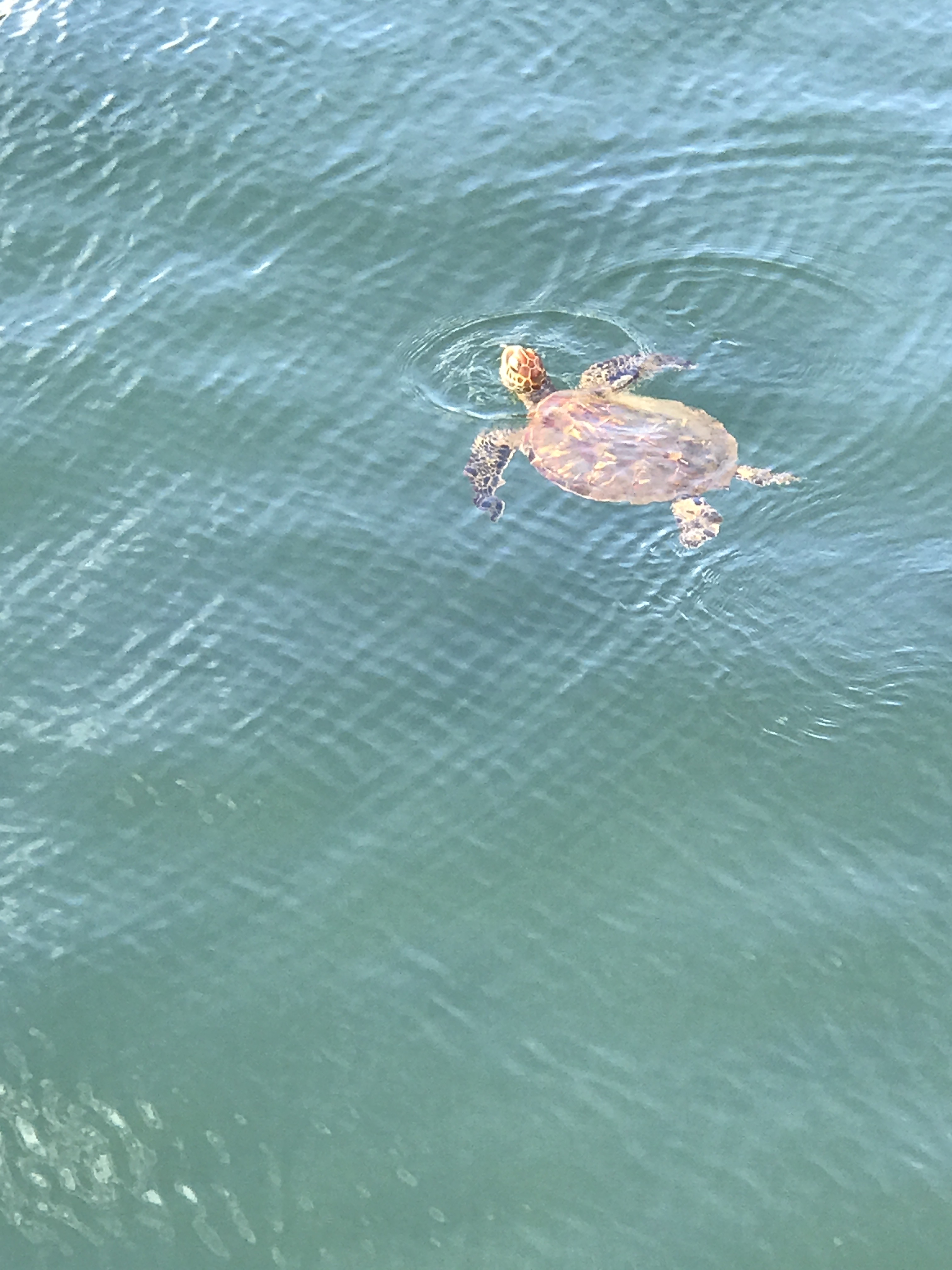
Photo of a honu (in shallow water) by Eric Anderson.

Like the Noonday

If you remove the yoke from among you,
    the pointing of the finger, the speaking of evil,
if you offer your food to the hungry
    and satisfy the needs of the afflicted,
then your light shall rise in the darkness
    and your gloom be like the noonday.”
– Isaiah 58:9b-10

“[Jesus said,] ‘You are the light of the world.'” – Matthew 5:14a

I’m trying, Jesus, I am surely trying
(and don’t think I can’t see and hear and feel
your smile twisting as you think
“Oh, yes. You’re definitely trying… all my patience!”).

I’m trying to remove the yokes. I pray
that you are seeing more success with that than I.
I’m trying to refrain from speaking evil, even if
it means I must lock down by tongue to silence.

And I’m trying, surely trying, Jesus,
to direct my pointing finger solely to myself,
to take the blame when it is mine,
and not add strife with blame to others.

But.

I’ve got to say that my hard-won restraint
has not been echoed widely, has it?
You and I both know that finger-pointing is
activity in which a multitude delights.

While I am struggling with my guttering light,
a horde of people praise the shadows, and
to my astonishment, they call the shadows light.
No hungry fed, no naked clothed, evil celebrated.

My finger itches, Jesus, with the urge to point
and then shout out (as once Isaiah was directed)
with trumpet calls: “For shame, you hypocrites!
You do not shine, you hide the light of God!”

And then I breathe in deep, down to the belly, as
I contemplate your failures, Jesus, in the world.
You called them out, the hypocrites who taunted you
as your light shone upon the torturer’s cross.

I’ll do my best to shine, I will. I’ll try.
I’ll feed that guttering wick and shield it from
the howling winds as best I can. But man…
My finger itches, Jesus. Yes, it surely does.

A poem/prayer based on Isaiah 58:1-12 and Matthew 5:13-20, the Revised Common Lectionary First Reading and Gospel Reading for Year A, the Fifth Sunday after the Epiphany.

Photo by Eric Anderson.

On Pigeon’s Wings

“…and they offered a sacrifice according to what is stated in the law of the Lord, ‘a pair of turtledoves or two young pigeons.'” – Luke 2:24

“…for my eyes have seen your salvation…” – Luke 2:30

Bearing their eight-day-old sons, two-week-old daughters,
the parents bring their sacrifices to the priests.
Each brings a pigeon or a dove, but some a lamb.
Those leading lambs wear finer clothes
than those who bear two turtledoves.
The gift is what they can afford.

One couple, bearing pigeons and a son,
are told that they have been anticipated.
An elder man accosts them in the Temple court
to celebrate their child’s role in Israel’s salvation.
“A light for revelation!” now he cries,
but also, mother, know your heart will ache.

The couple might have edged away,
but from another side a woman comes,
another elder, face well lined with years.
She comes and praises God for this small child.
He will, she promises, redeem Jerusalem.
She praises what she knows she will not see.

The parents fade once more into the crowd,
and those about are well content to let them go.
Their clothes were nothing fine; their feet
were travel-stained, and their sacrifice would be
no more than pigeons, what a family offered
when they lacked both power and wealth.

A pity that a pious, virtuous crowd
was blinded by
a pair of pigeon’s wings.

A poem/prayer based on Luke 2:22-40 the Revised Common Lectionary Gospel Reading for Year A, the Presentation of the Lord.

The image is a mosaic of The Presentation in the Monastery of Hosios Loukas, Distomo, Greece. Photo by Hans A. Rosbach – Own work, CC BY-SA 3.0, https://commons.wikimedia.org/w/index.php?curid=8943645.

Story: Simple Song

January 29, 2023

Micah 6:1-8
Matthew 5:1-12

Male ‘amakihi sing a very simple song. They also have a more complex song, and the female ‘amakihi sing that one, too, but when a male ‘amakihi is looking for a female ‘amakihi hoping that they’ll build a nest and a family together, he sings the simple song.

It’s basically a series of tweets strung together.

Not what you’d call complicated.

Ages ago, though, I can imagine that it might have been… more complicated. In those days the ‘amakihi would have sung songs that rose and fell, that stopped and started, that got louder and softer. Those are things that the ‘apapane do to this day. In those days, I imagine the ohi’a forest ringing with songs, echoing from the trunks and the branches, sometimes in harmony, sometimes in cacophony, and rarely quiet. Can you imagine that?

The thing is, it would also have been confusing. With ‘amakihi singing complicated songs, and ‘apapane singing complicated songs, and who knows what other birds contributing their own complicated songs, I can imagine ‘amakihi finding ‘apapane and ‘apapane finding ‘amakihi. It’s not a big issue, briefly embarrassing for both of them, but I can imagine that there was one young male ‘amakihi who decided he was tired of being mistaken for an ‘apapane.

“What about if I come up with something different from the ‘apapane?” he asked his elders.

“No one would come to you,” said the elders.

“Nobody is finding me now,” he told the elders. “I won’t be losing anything by trying something else.”

Some of the elders got huffy, which happens sometimes when they’ve been caught not thinking clearly.

“I’m going to try it,” he said,” and some of them huffed at him. With a complicated song, of course, and an ‘apapane turned up to see if there was somebody looking for her.

The young ‘amakihi found a good branch and began to sing his simple song: just a note repeated several times. It was loud. It was bold. It was impossible to miss even with all the complicated ‘apapane and ‘amakihi songs about. A couple of female ‘apapane turned up, intrigued. But best of all, along flew a young ‘amakihi hoping to find a husband and build a family.

“Nice song,” she said.

“Thank you,” he said.

“I’m glad you kept it simple,” she said.

“So am I,” he said.

I don’t know whether anything like this ever happened among the ‘amakihi and the ‘apapane of Hawai’i Island. To be honest, probably not. Still, the simple song of the ‘amakihi has worked for them for a long time, and there are simple things that people can do that would work pretty well for us as well: Honesty. Caring. Fairness. Respect. Faith. It’s amazing how often we make it all complicated, and find that things fall apart, when Jesus’ words to “Love one another” are simple, clear, and would do so much to make a better world.

by Eric Anderson

Watch the Recorded Story

The story was told from memory of this text. Predictably, memory makes… differences.

Photo of an ‘amakihi by Bettina Arrigoni – Hawaii Amakihi (male) | Palilia Discovery Trail | Mauna Kea | Big Island | HI|2017-02-09|12-21-50.jpg, CC BY 2.0, https://commons.wikimedia.org/w/index.php?curid=74674240.

Distracted

“With what shall I come before the Lord
    and bow myself before God on high?
Shall I come before him with burnt offerings,
    with calves a year old?
Will the Lord be pleased with thousands of rams,
    with ten thousands of rivers of oil?
Shall I give my firstborn for my transgression,
    the fruit of my body for the sin of my soul?”
He has told you, O mortal, what is good,
    and what does the Lord require of you
but to do justice and to love kindness
    and to walk humbly with your God?

Micah 6:6-8

Look, God, I’m happier when you are vague,
when there’s some wiggle, some uncertainty,
when I can find a space to justify
the things I want, I’d rather, do.

Or, better, when the clarity shines on
the things that hide the errors of the days behind,
that shield me from their consequence,
excuse me without need to change my course.

Look, God, I’m wise enough to leave the lambs
and rams behind. I’ll make my sacrifices with
my time (and maybe with my treasure; we will see).
I don’t intend to buy your favor, no.

Intend to, no. Attempt to… that’s a yes.

You have told me, God, what things are good,
and I have heard, and taken them to heart,
and held them close, and meditated on them, and…
sometimes I’ve done them. Sometimes I have not.

‘Cause damn it, God, your justice is beyond me,
beyond us, so it seems. Your love of mercy breaks
my heart with all its blinding brightness. How
can I do other than come humbly to you on our walk?

So that is why I pour my time into the almost just,
the near-to-mercy, all the things that don’t quite work.
With all this busyness, how could you notice, God,
that am running round, not walking by your side?

It’s easier, you see, to place my energy
upon the altar as a sacrifice of praise
than to do justice well, to love with steadfast mercy, and
walk humbly with the God of my salvation.

A poem/prayer based on Micah 6:1-8, the Revised Common Lectionary First Reading for Year A, the Fourth Sunday after the Epiphany.

The image is “High priest offering incense on the altar, as in Leviticus 16:12,” by Illustrator of Henry Davenport Northrop’s Treasures of the Bible, 1894 – http://www.lavistachurchofchrist.org/Pictures/Treasures%20of%20the%20Bible%20(Moses)/target20a.html, Public Domain, https://commons.wikimedia.org/w/index.php?curid=6611903.

Story: The Greatest

An ‘apapane who is not diving.

January 22, 2023

1 Corinthians 1:10-18
Matthew 4:12-23

Even when he was very young, they said of him, “This ‘apapane will be one of the greatest singers of his generation.” He had a sweet and true voice, with an ability to produce trills that were faster than anyone had ever heard before. He had a range from mauna to makai, high notes to low notes, and each one was pitch-perfect and noteworthy.

“Such a singer,” sighed the aunties and the uncles and the tutus. “Such a singer.”

All would have been absolutely perfect if he had wanted to be the greatest ‘apapane singer of his time. But he didn’t.

It wasn’t that he didn’t want to be a singer, and it wasn’t that he disliked singing. One of the reasons everybody knew how good he was is that he did enjoy singing. He loved singing. He sang a lot, and he sang beautifully when he did. The problem was that he really wanted to be the greatest diver of his generation.

If you have been wondering why you’ve never heard about ‘apapane divers, well, it’s because they don’t.

He’d been watching the koa’e kea, you see, who nest in the cliffs near the ohi’a trees where the ‘apapane build their nests. He’d first admired them as they soared around Halemau’uma’u and the Kilauea crater, riding the rising air column over the summit. They are elegant when they soar.

Just to see them fly some more, he’d followed some down the slopes from the summit to the sea, which is where koa’e kea go fishing. That had been an eye-opener. He circled at some distance and watched while a bird would hover briefly, spot a fish below the surface, and then dive straight down to catch it. What grace! What elegance!

That, he was sure, was the way to be.

It made him nervous, but he decided to try it. He had no appetite for fish, mind you, so he didn’t worry much about where to dive. He just picked a spot, hovered briefly in mid-air, pointed his beak down, and dove.

It was his first attempt, so it wasn’t all that bad, but things did not go well once he hit the water. His feathers clumped up and he couldn’t see which way was up. His bird-feet had no webs between the toes so even though he instinctively paddled his legs, not much happened. His first dive was about to become his last dive when a beak grabbed him and hauled him to the surface. There was something of a flurry, and then he was hanging from the beak of a koa’e kea heading back to shore.

It dropped him on the ground, wet and disheveled, and now that it didn’t have anything in her beak she said, “What was that all about?”

“I want to be the greatest diver on the island,” gasped the ‘apapane.

She looked him up and down – feathers not meant for ocean water, feet without webs, and a beak designed for bugs and nectar, not fish.

“I don’t think that’s going to work,” she said. “I think it’s likely to drown you.”

He had to admit this was true.

“I’ll tell you what, though,” she said thoughtfully. “I’ve never seen an ‘apapane dive before at all, so right now you’re the best ‘apapane diver on the island. But… I think it best you don’t try it again.”

“I won’t,” he said, as he felt his feathers start to dry. “I’ll go back to singing.”

“Good plan,” she said. “I think that will work a lot better.”

by Eric Anderson

Watch the Recorded Story

In the video above, I am telling the story from memory. My memory can be… inventive.

Photo by Eric Anderson.

The Smaller Boat

“…Immediately they left the boat and their father, and followed him.” – Matthew 4:22

It’s the same boat. It’s the same net.
It’s the same lake. It’s the same fish.

They all seem a little smaller now.

They always were too big for this small beach,
my “Sons of Thunder,” louder and more
vigorous upon the lines than even I,
the Thunderer himself, had been.

Brash? I’ll say, and I’ve been brash and more.
We should have seen it coming, I expect,
when two such souls as she and I
brought similar selves into the world.

We tried the obvious and useless, yes we did.
“Please use your inside voices!” at a roar.
They laughed when they grew old enough
to see the irony, and laughter filled the house.

It filled the village and the beach and echoed
to the skies, the laughter of these two,
and if two parents, sober citizens, could not
join in, well, we smiled and smiled and smiled.

They always were too big for this small beach,
but still, I never thought they’d step away
to follow a poor traveling preacher or
take up a life of shouting out for God.

I’m glad, although I grumble at this pile
of nets awaiting my attention and repair.
This teacher can expand their lives and minds
and souls. The nets and fish and boat… will not.

My breathing settles in a gut-deep sigh.
I’ll claim the tear is sand blown in my eye.
There’s more room in this boat than just a while ago,
so how has it grown smaller in that time?

It’s the same boat. It’s the same net.
It’s the same lake. It’s the same fish.

They all seem a little smaller now.

A poem/prayer based on Matthew 4:12-23, the Revised Common Lectionary Gospel Reading for Year A, the Third Sunday after the Epiphany.

The image is Jesus calls James and John from their boat; their father Zebedee stands behind them. Woodcut, date and author unknown. Credit: Wellcome Library, London. Wellcome Images images@wellcome.ac.uk http://wellcomeimages.org Jesus calls James and John from their boat; their father Zebedee stands behind them. Woodcut. Published: – Copyrighted work available under Creative Commons Attribution only licence CC BY 4.0 http://creativecommons.org/licenses/by/4.0/

Author’s note: I need to credit two writers with renewing my thinking about Zebedee and this scene and I commend their work to you: Melissa Bane Sevier’s essay “Left Behind” and Maren Tirabassi’s poem “Zebedee (portrait of the original empty-netter).”

Story: Unclear on the Concept

January 15, 2023

Palm 40:1-11
John 1:29-42

He was still a young ram, and was spending his first season as the senior ram of a small flock. Frankly, most of the ewes in the flock knew more than he did about being a sheep on the mountain slopes, and several of them were smarter than he was, too.

Fortunately, being senior ram of a small flock doesn’t require a lot. Basically, you have to wake up in the morning and look around. If there’s grass where you are, you stay there and everybody eats. If there isn’t, you look around some more, and if you see a spot with grass, you say, “There’s a spot with grass,” and everybody goes over there and eats. And if you don’t see a spot with grass, you ask, “Anybody see a spot with grass?” and somebody says, “Over there.”

And then everybody goes over there and eats.

It’s not a great baaahther.

He was feeling his way into responsibility, however, and he tended to be a bit rambunctious – I’m afraid this story is rather full of puns, and I feel a little sheepish about it – so he could be a little nervous and irritable. Instead of waking up calmly and looking about, he’d spring to his feet and turn around wildly in all directions, like a confused compass. “On your bleat!” he’d shout (he meant, “On your feet!”) and then “Come along, ewe!”

I did apologize for the puns, didn’t I? It’s shearly a pity I didn’t stop making them, isn’t it?

His greatest confusion, however, came the morning that the first lamb arrived. Suddenly the flock was bigger – not much bigger, as it was a small lamb, but he was used to the numbers before, and now there was one more.

“Oh, no,” he said. “That’s too many. Take it back.”

“You can’t take lambs back,” they told him.

“Then I’ll take it back,” he said, even if he had no idea where to go. He walked over to where the lamb was standing by its mother, and said, “Come along. I’m taking you home.”

That was when he noticed that the other ewes of the flocks were crowding in between him and lamb.

“What are you doing?” he said, making the same pun a second time.

“We are ending a rampage,” said the ewes, making a new pun for the first time.

“What are you talking about?” he said as the wall of ewes pressed him away from the lamb.

“Lambs,” said the oldest one, “aren’t for giving back or sending away. Lambs are for treasuring and protecting. Lambs are for raising and celebrating. Lambs are for the joyful present and the promising future of this flock. If you want to be a rampion” – oh, good, another pun! – you will start taking care of this lamb and the other lambs coming right now.”

“Well,” he said, “if ewe put it that way.” He was too rattled to come up with a new pun.

“Think it over,” they said. “Take a ramble.”

He did do a little lam(b)enting, but he came around. The smallest and newest ones in the flock are for treasuring and protecting, for raising and celebrating, for the joyful present and the promising future. For sheep – and for us.

by Eric Anderson

Watch the Recorded Story

In the recording above, I told the story from memory of this prepared text. My memory is… not perfect. But I did remember most of the puns.

Photo of a mother and lamb by Wanderschäfer Sven de Vries – Own work, CC BY-SA 4.0, https://commons.wikimedia.org/w/index.php?curid=116038086.