Story: Beyond the Horizon

October 30, 2022

2 Thessalonians 1:1-4, 11-12
Luke 19:1-10

I don’t know how they became friends, or even how they met one another. When kolea make their journey to Hawai’i Island, they tend to find some space for themselves fairly close to the coastline. They like to look for worms and bugs and such in the grassy lawns that human beings maintain. They’re ground birds, rarely found on roofs or trees.

In contrast, the ‘apapane likes to be in trees, and in trees that grow further up the mountain. As I say, I’m not sure how a kolea and an ‘apapane ever met, let alone how they became friends. But year after year this kolea would make his way back to the Kohala peninsula and, after a good rest and a meal, take a shorter flight up the slopes of Kohala looking for a flash of red in the forest. Then the two of them would talk story until they’d caught up with the last several months.

This year the kolea found the ‘apapane looking… dreamy. After sharing the stories about nests and eggs and chicks, the ‘apapane sat and looked out over the mountain slope down to the sea and beyond. “I envy you,” she said. “You know what’s beyond the horizon.”

The kolea had told that story many times, so he just nodded. “That’s true,” he said. “Out in that direction is a very big ocean, and then there’s Alaska.”

“Do you ever wonder what’s beyond the horizon in other directions?” asked the ‘apapane.

“Not much,” said the kolea. “Except for those two big flights each year, I don’t stray far from the places I’ll find grubs to eat.”

“Well,” said the ‘apapane, turning to the northwest, “what do you suppose is over there?”

The two of them looked at a pile of clouds with a bit of bluish black in the middle. “I don’t know,” he said.

“I wonder,” sighed the ‘apapane.

“Shall I find out?” said the kolea. “I can take a flight to see what’s in the clouds.”

The ‘apapane accepted the offer, and the kolea headed off to the northwest, and was quickly lost to sight. It took nearly four hours before he was back again. He grabbed a snack at the base of the ‘apapane’s tree before joining her on the branch again.

“So what’s over there?” asked the ‘apapane.

“Maui,” said the kolea.

“What’s Maui?” asked the ‘apapane.

“It’s another island, smaller than this one, with a wide valley and a great big mountain on it. That’s the bluish black outline you can see. It’s not nearly as far as Alaska.”

The two birds were quiet for a while, and then the ‘apapane said, “It must be nice to always know what’s over the horizon.”

“But I don’t always know what’s over the horizon,” said the kolea. “I also don’t know what the next day will bring. I hope it will have a tasty worm or two, just the way you hope it will have ohi’a blossoms.”

“We both move into something mysterious, then,” said the ‘apapane, “which we hope will be a little familiar.”

“We both fly into tomorrow,” said the kolea, “with hope.”

by Eric Anderson

Watch the Recorded Story

The story was told from memory of this manuscript in the video recording above. And, well, embellished.

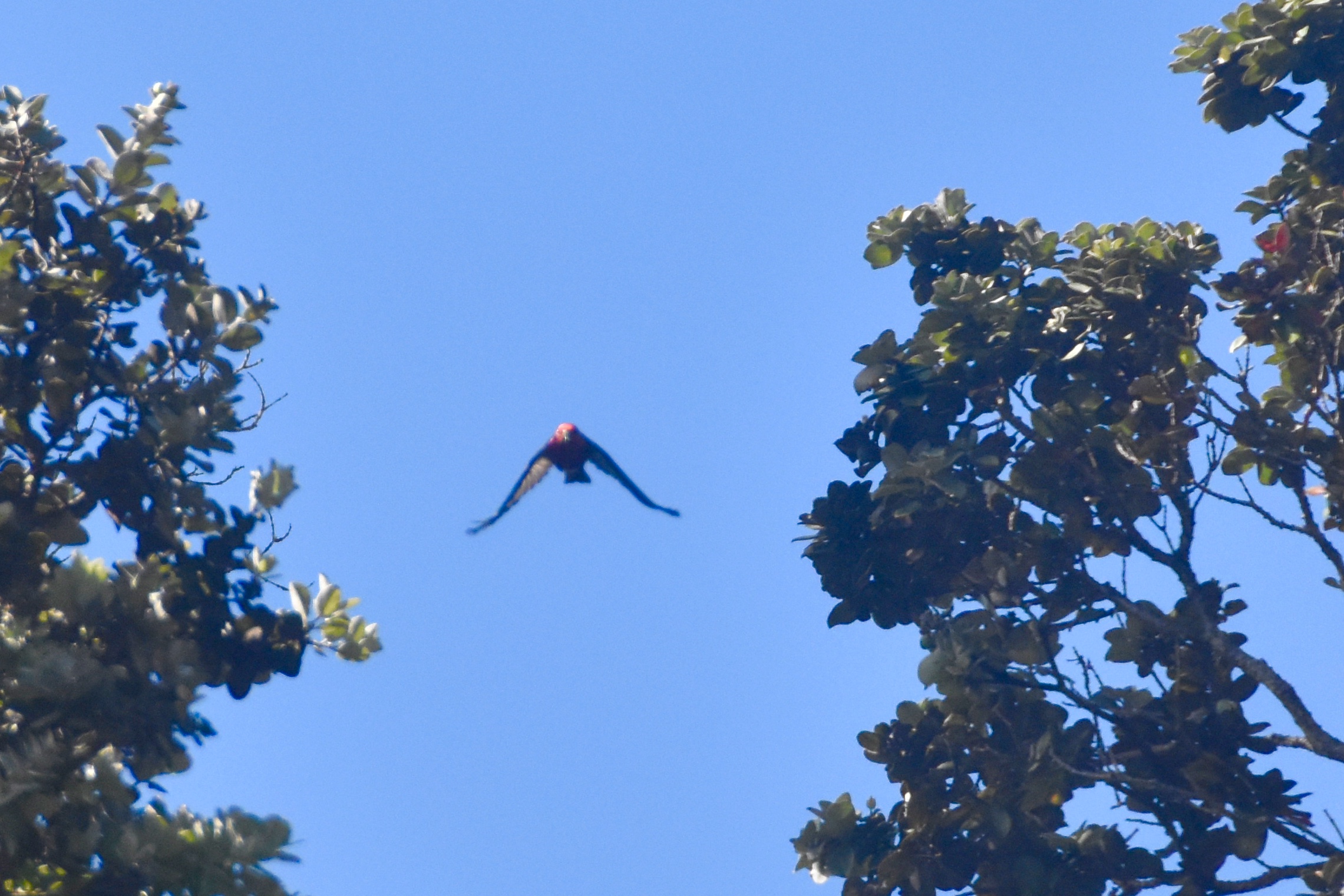
Photo of an ‘apapane in flight by Eric Anderson.

A Boast

“Therefore we ourselves boast of you among the churches of God for your steadfastness and faith during all your persecutions and the afflictions that you are enduring.” – 2 Thessalonians 1:4

Let me boast of the teacher
whose time in the classroom
was short, but whose time
to inspire was longer and glorious
and still… all too short.

Let me boast of the caretaker,
rarely at worship because of her charge,
but shining with spirit in every
encounter, aglow with affection
so clear in my memory.

Let me boast of the less-known,
forgotten, ignored,
whose passage of Earth left its light,
instead of the powerful, wretched indeed,
to leave us so broken in sorrow.

Let me boast of the saints.

A poem/prayer based on 2 Thessalonians 1:1-4, 11-12, the Revised Common Lectionary Second Reading for Year C, Proper 26 (31).

The image is The Forerunners of Christ with Saints and Martyrs by Fra Angelico (1420s) – Public Domain, https://commons.wikimedia.org/w/index.php?curid=3000363.

Story: Dive or Skim

October 23, 2022

Psalm 84:1-7
Luke 18:9-14

It’s a funny thing. The koa’e kea – the white-tailed tropicbird – and the noio – the black noddy – eat basically the same foods. They like small fish, they like squid. But they catch their food in very different ways. One koa’e kea had noticed this.

“That,” he said to another koa’e kea, “is disgusting.”

“What is?” she asked. The two were flying out to their fishing grounds from the ledges of Kilauea.

“Them,” said the first, “those noio. Watch them crowd together. Why can’t they hunt alone? There’s a horde of them fishing there. Then the noise. Every last one of them is screeching and calling. They’re flying low, and any bird should know that you can’t spot fish if you’re not high over the water. And most of all“ – he shuddered even as he was flying – “they don’t even know how to do a proper dive.”

“Really?” asked his friend. “What do they do?”

“Watch,” said the first, and they watched as noio after noio skimmed low over the water. The surface of the ocean rippled with the movement of the small fish beneath it. The noio dipped their beaks into the water, seized a fish without landing, and flew on as they swallowed.

“They don’t even pause on the surface to properly appreciate their meal,” he moaned.

“Aren’t there big fish down there, too?” asked his friend, who had noticed larger forms deeper in the water.

“Ahu,” said the koa’e kea, “skipjack tuna. They’re chasing the same fish as the noio. I don’t know why they’re not all crashing into one another, and why none of those noio have become lunch for an ahu.”

They watched the chaotic scene for a while, and then the second koa’e kea said, “You know, it seems to work.”

“What?” he said.

“With those ahu around, the small fish are closer to the surface,” she said, “and with so many birds in the air you wouldn’t want to pause on the surface. From all I can tell from here, none of them look like they’ll go hungry.”

“Do you want to fish like a noio?” he demanded.

“No, I’d rather dive from a good height,” she said, “and I’d rather not have a lot of other birds about because I’d crash into one when I’m diving. I’m not eager to run into an ahu under water, and one of my dives might get down to where they are. I can’t call the noio disgusting, though,” she continued. “They’re living, and thriving, and happy, and fed. That’s a pretty good life for a seabird, don’t you think?”

I don’t know for certain whether she’d convinced him, because he didn’t say anything more as they flew out to their own fishing grounds farther from shore. I’ll call her wise, though, to recognize that there’s more than one way to live a good life as a seabird, and to appreciate a seabird who does things differently.

by Eric Anderson

Watch the Recorded Story

The story is told from memory of this manuscript. That is enough to cause some differences. Today, there was another presentation before the story, and, well, you’ll just have to see it to believe it.

Photo of a noio in flight (though not actually skimming the surface) by Eric Anderson.

Contemptible

[Jesus] also told this parable to some who trusted in themselves that they were righteous and regarded others with contempt… – Luke 18:9

Truly you see that he is contemptible.
Imagine a collaborator, a Quisling, a snake
who slithers his way to take chicks from the nest.
Such is this man, who is rich from his friends –
if he has any, now, since he fronts for the Romans
and seizes their substance for them and himself.

I thank you, Creator, that I have not fallen
to such mean temptation or villainous deed.
You’ll find that my substance is shared with my household.
You’ll find that my giving to you is correct.
You’ll find I am faithful in all of my doings.
To you I give praise for your law and design.

Now listen, O Great One, as he struggles to pray.
My studies have given me words fit for angels,
to proclaim your glory as if my voice echoed
the song of the heavens and heaven’s chorale.
And he prays for mercy? Sure, mercy he covets,
but we know his plea is yet more of his greed.

Truly you see that he is contemptible,
in life and profession, in false piety.
Let not his petition leave grit in your ears,
but hear my thanksgiving and praise to your name.
You, and you only, can judge your Creation.
You, and you only, can say what contemptible is.

A poem/prayer based on Luke 18:9-14, the Revised Common Lectionary Gospel Reading for Year C, Proper 25 (30).

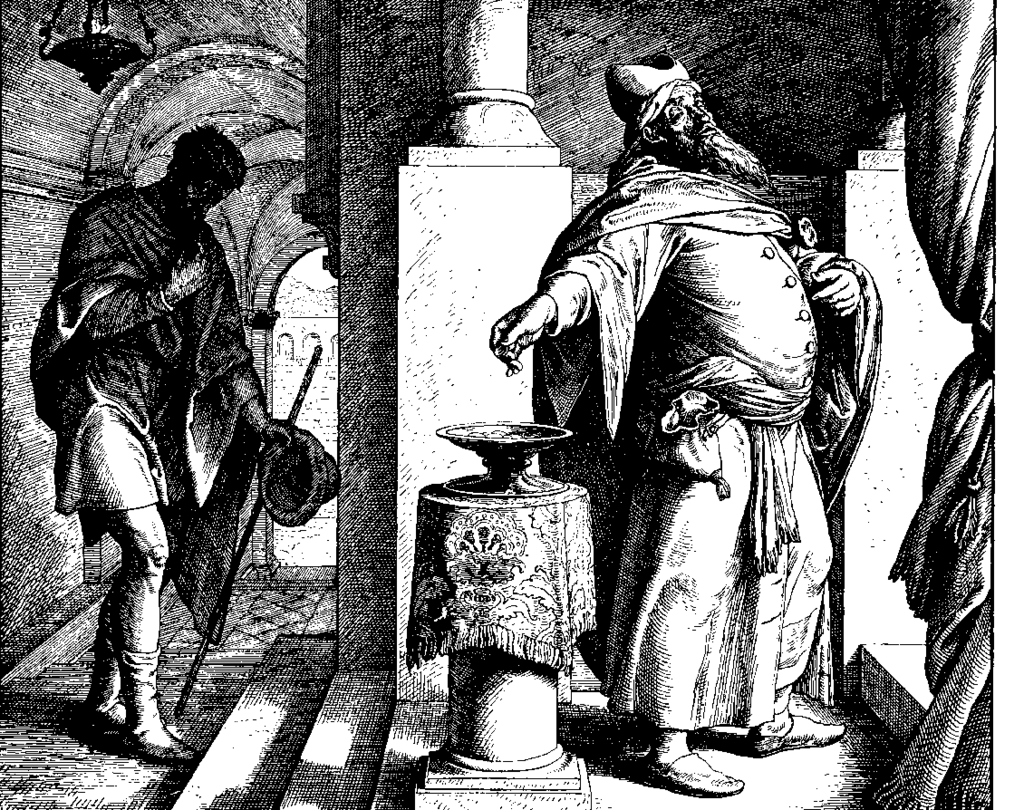
The image is a woodcut for Die Bibel in Bildern, 1860, by Julius Schnorr von Carolsfeld – Die Bibel in Bildern, Public Domain, https://commons.wikimedia.org/w/index.php?curid=5490865.

Song: Take the Labyrinth Road

This is the premiere streamed performance of “Take the Labyrinth Road,” sung live at 11 AM HST on October 19, 2022. It was written for the Pastoral Leaders Retreat of the Hawai’i Conference, United Church of Christ, and first played during that event on October 12, 2022.

by Eric Anderson
October 7, 2022

C Dm F Em / C Dm C G / C F Dm G / C G F G / C – – –

Twisting, turning paths
from without to within
Over gravel, soil and roots.
Let the time begin
For a journey of the soul
from brokenness to whole…
ness in the Spirit,
Come take the labyrinth road.

The journey curves about
in the world, in the heart,
And the ground below is rough
or is smoothed by art.
Moving body, moving soul
from brokenness to whole…
ness in the Spirit,
Come take the labyrinth road.

No promises on the way
for insight or inspiration
Just a time to step away
for peaceful contemplation,
For a journey of the soul
from brokenness to whole…
ness in the Spirit,
Come take the labyrinth road.

© 2022 by Eric Anderson

Story: The Pueo that Caught a Pig

October 16, 2022

Genesis 32:22-31
Luke 18:1-8

As you know, there are birds and animals that don’t eat meat, and there are birds and animals that eat entirely meat, and there are birds and animals that eat either one, depending on what they find. Most of the meat-eating animals have a similar strategy about what they eat. They tend to look for something to eat that is smaller than they are. If that sounds a little bit like bullying, well, I think that’s where bullying comes from. I wish we could think of other people as people, and not as “this is someone I can bully.”

There are a few creatures that do hunt for animals larger than they are. The pueo is not one of them. The pueo flies about over the grasslands and looks for smaller things: mice, small birds, more mice, more small birds… basically, lunch.

This is the story of the pueo that caught a pig.

He didn’t mean to. He was distracted in his flying that day. Everything was nice and clear and there wasn’t a lot of wind. He wasn’t hunting with his full attention; he was mostly daydreaming in the air. Still, when he saw some grass move out of the corner of his eye, he was on it in a flash. Movement in the grass meant a mouse or a small bird. Movement in the grass meant lunch.

In this case, however, what it meant was a napping pig whose ear had just flicked at a fly and moved the grass. The pueo only discovered his mistake when he’d grabbed the pig by the top of her head. All the dreaminess of soaring about the sky vanished in a flash, as the pig woke up, felt the pueo on her head, and dashed off in a panic.

The pueo didn’t know what to do, so he hung on.

The pig tossed her head and tried to use her front feet to knock the pueo off her head, but her legs were too short. She threw her head from side to side as she ran so that one moment the pueo was pulled left and the next pulled right.

The pueo hung on. Dust was flying from beneath the pig’s feet but so were feathers from the pueo’s body. The sensible thing to do might have been to fly away, but there were so many feathers in the air that he wasn’t sure he could control his flight, and if he once fell underneath the pig’s feet that wouldn’t be good at all. As for the pig, if she’d thought about it, she could have rolled over and forced the pueo to let go, but she was startled and frightened and panicked, so she didn’t think of it.

This went on for some time until the pig ran out of energy and stopped, trembling. The pueo’s feet were tense and cramped and he still didn’t dare let go.

“Who are you?” said the pig, “Why did you do this?”

“I thought you were a mouse,” said the pueo, knowing that this sounded silly as he said it.

“What do you want?” said the pig.

“I want to go home,” said the pueo. “And I’d like to go home without your footprints in my feathers.”

“I’d like to go home without your claw marks on my head,” said the pig, “but I’m not getting what I want.”

“I’m going home without a lot of feathers,” said the pueo. “I’m not even sure I can fly.”

“What if,” said the pig, “we both get what we want? I want you off my head, and you want to be off my head, don’t you?”

“That would be best,” agreed the pueo.

The pig walked over to a larger rock, one that rose above her head. The pueo, with some difficulty, unclenched his feet and stepped cautiously onto the rock, then hurried up to its top. The pig looked up at him. He was too high for her to reach.

“Thanks for bringing me to a safer place,” he said.

“Thanks for getting off my head,” she said. “Don’t do it again.”

“I won’t,” he said. “I’ll make every effort to avoid it.”

She went home with some scratches. He went home without a few feathers, ones that would have to grow back before his flying was at its best. They went home having given one another the thing they wanted most: an opportunity for peace.

by Eric Anderson

Watch the Recorded Story

The story was told from memory of this prepared text. And so… it’s not the same.

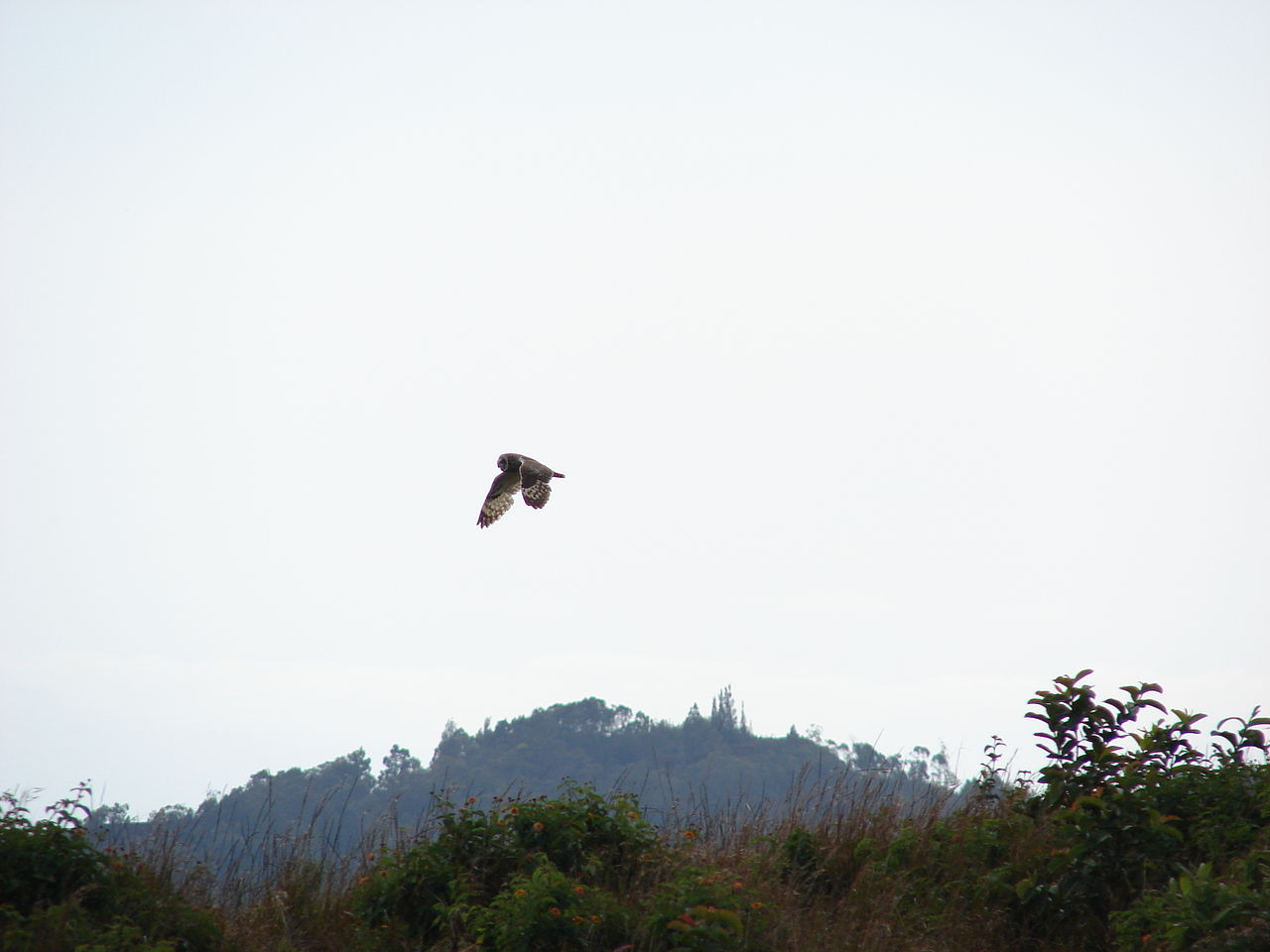
Photo of a pueo in flight by Forest & Kim Starr, CC BY 3.0, https://commons.wikimedia.org/w/index.php?curid=6167276.

Subdued

“The sun rose upon [Jacob/Israel] as he passed Penuel, limping because of his hip.” – Genesis 32:31

I had you, God.
You know it. I know it.
You saw you weren’t prevailing.
You know it. I know it.
And then you pulled a dirty trick!
You know it. I know it.
You pulled my hip right out of joint.
You know it. I know it.
It didn’t matter; I held on to you and held.
You know it. I know it.
You did not want the daylight to reveal you.
You know it. I know it.
And so you called for me to let you go before the dawn.
You know it. I know it.
“Oh, no,” I said. “You have to bless me first.”
You know it. I know it.
You did; you gave me a new name.
You know it. I know it.
A name about the struggle.
You know it. I know it.
And now I limp.
You know it. I know it.
But I won.

A poem/prayer based on Genesis 32:22-31, the Revised Common Lectionary Alternate First Reading for Year C, Proper 24 (29).

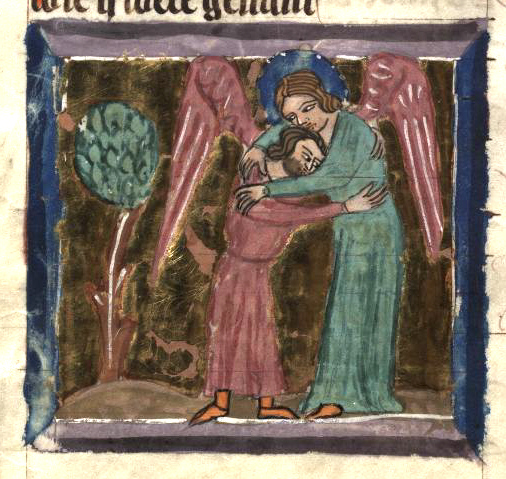
The image is Jacob Wrestling the Angel by Anonymous (Meister 1) ca. 1350-1375 – Hochschul- und Landesbibliothek Fulda, Public Domain, https://commons.wikimedia.org/w/index.php?curid=23797771.

Story: Details, Details

October 9, 2022

2 Kings 5:1-3, 7-15c
Luke 17:11-19

The three ‘amakihi chicks had emerged from their eggs over the course of a day, and they promptly set out to do what newly hatched chicks do: they grew. Mother and father brought them food and cleaned the nest and did the things that ‘amakihi parents do. After a couple of weeks, they set out to teach them to fly.

This turned out to be complicated.

The three stepped up out of the nest along a branch and took their positions, ready to fly. “Get your wings ready!” called mother, and that’s where the instruction began. Two of the chicks extended their wings, but the third on the branch just looked confused. “How do I get my wings ready?” he asked.

Mother and father both extended their wings and spread the feathers along them. The first two chicks had been pretty close, though not perfect. The third one hadn’t apparently been paying attention to seeing his parents fly. It took a while, but he got those wings out and open and spread.

“Now open up your tail feathers,” said father. This time was the turn of the second chick to look confused. “Tail feathers?” she asked, as her two brothers both their tails into the shape of a fan. Father and mother demonstrated, and finally her tail took the proper shape.

Everybody managed to get the next section of the flight lesson, hopping up and down and doing some gentle wing flaps. All three managed to get in more and more wings beats before settling back down onto the branch again.

“Very good,” said mother. “The last thing to remember as we take your first flight to that branch over there” (she pointed with her beak) “is to lift up your feet and tuck them up to your belly.”

Now it was the first chick on the branch to look confused. “Shouldn’t I leave them down to grab the branch?” he said.

“No,” said father. “Your balance will be off if you do that.”

“No,” said mother. “You’ll reach out with your feet when you’re approaching the branch.”

That last chick looked uncertain and confused, and sure enough, when he and his brother and his sister took off, his legs weren’t properly tucked up. They flew fairly straight to the branch their mother had showed them, but he veered wildly up and down and from side to side before seizing that branch a good distance from his brother and sister. All of them were panting, but he was panting the hardest.

“That’s a good start,” said mother.

“This is really complicated!” wailed the chick who hadn’t tucked his feet up. “Really complicated,” said the sister whose tail was still working at stretching out.” “There’s so many things to remember,” complained the chick who hadn’t known to stretch out his wings.

“It’s all little things,” said father, “but you’re right. There are a lot of little things.”

“Put the little things together,” said mother, “and you’ll fly with safety and delight.”

It’s the little things, and the little things put together, that make us able to do the big things, like flying, and friendship, and love.

by Eric Anderson

Watch the Recorded Story

Technical problems today have delayed the availability of the video, and unfortunately there were audio problem with the recording. You’ll notice that the volume is very low at the beginning of the story and gets much more audible about half way through, at 12:55. We regret the errors.

And, of course, the story as told is not quite the same as the story as written.

Photo of an ‘amakihi by Bettina Arrigoni – Hawaii Amakihi (male) | Palilia Discovery Trail | Mauna Kea | Big Island | HI|2017-02-09|12-21-50.jpg, CC BY 2.0, https://commons.wikimedia.org/w/index.php?curid=74674211.

How Many Miracles?

“Now the Arameans on one of their raids had taken a young girl captive from the land of Israel, and she served Naaman’s wife. She said to her mistress, ‘If only my lord were with the prophet who is in Samaria! He would cure him of his leprosy.'” – 2 Kings 5:2-3

“…his flesh was restored like the flesh of a young boy, and he was clean.” – 2 Kings 5:14

The first of the miracles was a girl enslaved,
who’d been torn from her home and forced to serve.
She was not embittered. She retained compassion.
She directed her “lord” to a prophet with power.

The general went to the king, and the king went and wrote
to a king, who in fury and fear rent his clothes.
By a miracle word reached the prophet, who said,
“Send the general here to be well.”

With chariots and horses and servants he came,
but only a messenger stood at the gate,
for the prophet, miraculously still unimpressed
remained in the house; directives he sent.

Now the general cursed and would fly down the road,
back to his home with his malady still.
“He told me to wash!” he denounced the directives,
and he would have rejected the miracles, save…

That his servants (among them, assuredly, slaves)
miraculously summoned their courage and said,
“It’s too simple for you? You can do what is hard.
Do the simple thing. See if it works.”

By a miracle the pride of the general faded.
He listened to those whom the culture despised.
He’d followed advice of a girl and a slave,
now the wisdom of slaves took him to Jordan’s side.

In the washing, the general found his skin cleansed.
A miracle true, a healing assured, his status restored.
A miracle once more: He sought out the prophet.
He raised up his thanks and he praised Israel’s God.

A series of miracles, built upon miracles,
a general who thanked, a general who listened
to slaves who cared and a prophet who ordered –
But the first of the miracles was a girl enslaved.

A poem/prayer based on 2 Kings 5:1-3, 7-15c, the Revised Common Lectionary Gospel Reading for Year C, Proper 23 (28).

Biblical illustration of 2 Kings 5:3 by Jim Padgett, courtesy of Sweet Publishing, Ft. Worth, TX, and Gospel Light, Ventura, CA. Copyright 1984. Released under new license, CC-BY-SA 3.0 by Distant Shores Media/Sweet Publishing, CC BY-SA 3.0, https://commons.wikimedia.org/w/index.php?curid=18903284.

Story: Filled by God

October 2, 2022

Habakkuk 1:1-4, 2:1-4
Luke 17:5-10

A myna and a saffron finch got interested in human religion. What can I say? People who pray are fascinating. They perched outside churches on Sundays and they listened to the things people were saying and sometimes they even chirped along with the music.

They found communion a bit difficult to understand.

“I was at one church,” said the myna, “and at one point during worship everybody got up from their seats, stood in line to come up to the front, and ate a cookie.”

“A cookie?” said the saffron finch. “That sounds rather nice. I saw people taking pieces from a loaf of bread and dipping it in a cup. When it came out it was purple. Then they ate it.”

“Soggy bread?” asked the myna. “The cookie sounds better. But come to think of it, I’ve seen people dip little wafer cookies in a cup, too.”

“Sometimes the one up front drinks from a big cup,” observed the saffron finch.

“And sometimes everybody gets little cups,” said the myna.

“At this one church in Hilo,” said the saffron finch, “everybody gets a little baggie with a cup of juice and a square of something soft.”

“Bread?” asked the myna.

“We could hope it’s candy,” said the saffron finch.

“But what does it all mean?” asked the myna, and they thought about it.

“They’re sharing in a meal,” said the saffron finch slowly.

“It’s a pretty small one, for humans,” observed the myna.

“And they do have something to drink, and it’s pretty nearly always purple,” said the saffron finch, “and they do it together, even if they have to line up for it.”

“They always look like they’re prayerful, too,” said the myna, “as if God is right there in the bread and the cup.”

“They say that, too,” said the saffron finch. “This is the body of Christ, they say.”

“Perhaps,” said the myna, “this is a part of worship where they take in the blessings.”

“Perhaps,” said the saffron finch, “this is a part of worship where they stop talking to be nourished by God.”

I have to say that for two birds watching from outside, they did pretty well. Communion is when we remember Jesus’ gift to us in a way he told us to do: remembering his body in the bread, and remembering his blood in the cup. Communion is when we literally take those blessings inside ourselves by eating and drinking bread and wine (I’m afraid the myna was wrong about the cookies). Communion is when we Christians stop talking for a moment and let ourselves be filled by God.

by Eric Anderson

Watch the Recorded Story

I tell these stories in worship from memory of this manuscript – and between my memory and my affection for improvisation, things change.

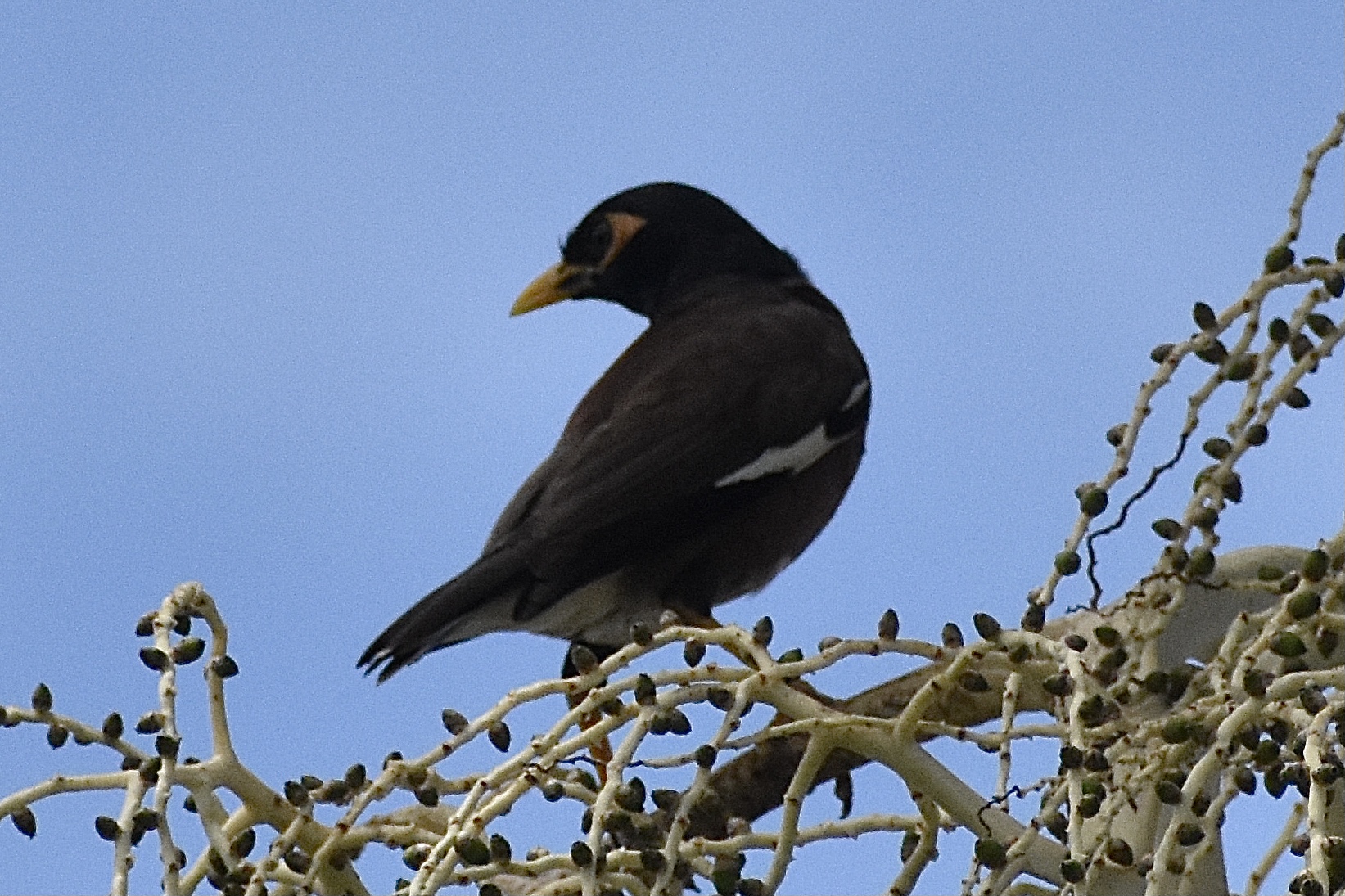
Photo of a myna by Eric Anderson.