Hindering God

“[Peter said,] ‘If then God gave them the same gift that he gave us when we believed in the Lord Jesus Christ, who was I that I could hinder God?'” – Acts of the Apostles 11:17

Look at them, God. Look at them, Jesus.
Listen to their voices praising your names.
It does my heart good – well, mostly it does.
It’s also made my heart stop, you know?

For a time it all seemed so clear –
in retrospect, why should I have thought that? –
with the Holy Spirit giving me words
and gathering the people in.

We grew so fast! Not everyone
was ready for our size. Well, nobody
was ready for our size. Some thought
they’d hide their selfishness within the crowd.

Our sharing started to collapse. We tried
enlisting serving people then to serve.
Who knew that they, like we, would call
attention to themselves so fatally?

It seemed like such a good idea
to take this trip, to visit Lydda,
get the summons to relieve the grief
in Joppa over Tabitha.

But now… a nightmare in the house
of Simon. Scads of creatures I have pledged
I will not eat, and a voice declaring
these things clean three times, three times, three times.

I get it now. Whatever might be said
about a wider diet, it’s a wider church
that’s on the menu here in Caesarea,
with Latin tongues extolling God.

But… what a shambles this will be.
We’d barely started with our own,
and they have hardly come together yet.
We haven’t learned to truly love each other.

However deep Cornelius’ faith – I’m sure it’s deep –
how will he find acceptance in Jerusalem?
I find my heart is in my mouth right now
to share his table, eat the Gentile meal.

That’s bad enough, as I think most will come around.
This fellow Saul, the one who sees things differently,
I have a feeling he will be their advocate
as fiercely as he once denounced both them and us.

But…

These Greeks and Romans will reshape this church,
and sometimes that will be just fine, a shedding of
the weight imposed by ancient custom we
no longer need and should not bear.

If only he were just a simple tradesman, this Cornelius,
or worker of the soil, or fisher of the sea.
Instead he is an agent of the Empire,
oppressor’s instrument against us.

Yes, that will change this church, this Way.
The day will come, I’m sure, when some will see
us as oppressors, not oppressed, and ask
if this is what our Savior taught, and how we love?

What will we tell them in that day?
In welcoming the ones the Holy Spirit called,
we welcomed also all the power we had feared,
and holding it, rejoiced, as the Spirit drained away.

A poem/prayer based on Acts 11:1-18, the Revised Common Lectionary First Reading for Year C, Fifth Sunday of Easter.

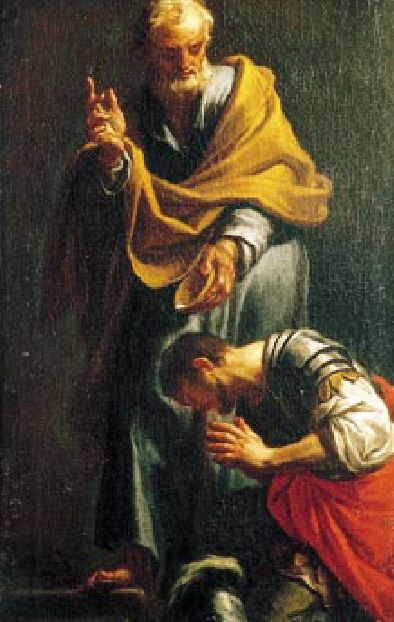
The image is Peter Baptizing the Centurion Cornelius (1709) by Francesco Trevisani – http://www.istrianet.org/istria/illustri/trevisani/works.htm, Public Domain, https://commons.wikimedia.org/w/index.php?curid=1804538.

I Don’t Want to Try

May 8, 2022

Acts 9:36-43
John 10:22-30

by Eric Anderson

It was coming up to graduation day in the i’iwi school – why, yes, i’iwi go to school. They learn to fly from the nest, but there’s advanced flying techniques to learn, and flower identification, and how not to be where the i’o is hunting. These things are important.

One i’iwi was not looking forward to the final test. She was quite good in most subjects. She was a strong flyer. She knew the flowers of the ohi’a forest like the back of her… wing. She had learned to find sheltered places in the trees when hungry i’o were near. But… there was one thing she had not mastered.

She didn’t eat upside down.

That’s one of the things that i’iwi frequently do. They get to a flower, particularly those like the ‘opelu or ‘oha wai, flowers which sort of point downward from their stems, and they swing upside down so they can push their curved beak into the flower from below. They sip the nectar, swing back up again, and push off to the next flower. It’s a pretty basic way for i’iwi to eat.

For whatever reason, this young i’iwi found the whole idea incomprehensible. “I’ll get a headache,” she said. “I never have,” said her teacher. “I’ll miss the flower opening with my beak,” she said. “There’s always a second time to try,” said the teacher. “I’ll lose my grip,” she said. “That’s not likely,” said the teacher, “and besides, you can fly.”

“I’ll just sip ohi’a,” she said. “You can do that,” sighed her teacher, “but ‘oha wai is pretty tasty. And you won’t graduate from i’iwi school.”

She just set her wings and looked cross.

A little later, she watched her best friend sip from an ‘ohelu flower – upside down – and asked, “How can you do that?”

“It’s not hard,” said her friend. “How can you not?”

“I’ve tried enough new things,” she said. “I don’t want to try any new ones.”

“OK,” said her friend. “I guess you can live the rest of your life without trying anything new. I can’t imagine that will go well for you.”

She thought about it as her friend flitted from flower to flower, sipping the ‘ohelu nectar.

“All right,” she said. “I don’t want to try. I don’t really think I can do it or that it will be good. But I can’t live the rest of my life without trying new things. So I’ll try this one, too.”

She hopped onto a flowering stem, let herself swing upside down with a shudder, and poked her beak into the blossom. A moment later she’d hopped to another stem with another flower and did it all over again.

“Not so bad?” asked her friend.

“I guess I can try a few more new things,” she said. And she did.

Watch the Recorded Story

The photo is of an i’iwi sipping from a mamane flower. National Park Service photo. Public Domain.

What Is This I’m Wearing?

[Simon Peter] turned to the body and said, “Tabitha, get up.” Then she opened her eyes, and seeing Peter, she sat up. He gave her his hand and helped her up. Then calling the saints and widows, he showed her to be alive. – Acts of the Apostles 9:40b-41

Just a moment, now… what’s happening?

Someone is here – no one has been in here in quite some time.
I hear him breathing and… is that a murmured prayer?
I think I’ll let my eyes stay shut
and puzzle this thing out.

This doesn’t quite feel quite like my bed. That’s what
I last remember and – oh, my! – I felt so bad.
The aches, the failing strength, the fear.
I struggled so to breathe.

Who is this man beside my bed? It’s not
the doctor, sure. I know his sounds.
Why is there no one else?
What’s that I hear?

Beyond the door are quiet sobs, the kind
I’ve made when weeping had near run
its course, and the springs
of tears were running low.

That’s Martha’s weeping; that is Miriam’s.
Is Anna there? Joanna, too? The widows, then,
my friends. But why are they
not here, where this man is?

Could he be a physician, better than
the one I had? So it must be.
My breath is so much easier
than it had been. Oh, yes.

Oh, now. His murmuring, his prayer
has reached its end. Although my eyes
are shut I feel his gaze, and…
is that a smile I feel?

Then: “Tabitha, get up,” in soft
but roughened voice, as if
he was more used to shouts
above the roaring sea.

Just: “Tabitha, get up,” and so I might just choose
to let my eyelids rise – them first, you see –
and take a good long glance at this
more capable physician.

Yes: “Tabitha, get up,” but wait. Before I do,
with all my friends beyond the door,
one burning question to resolve:
What is this I’m wearing?

A poem/prayer based on Acts 9:36-43, the Revised Common Lectionary First Reading for Year C, Fourth Sunday of Easter.

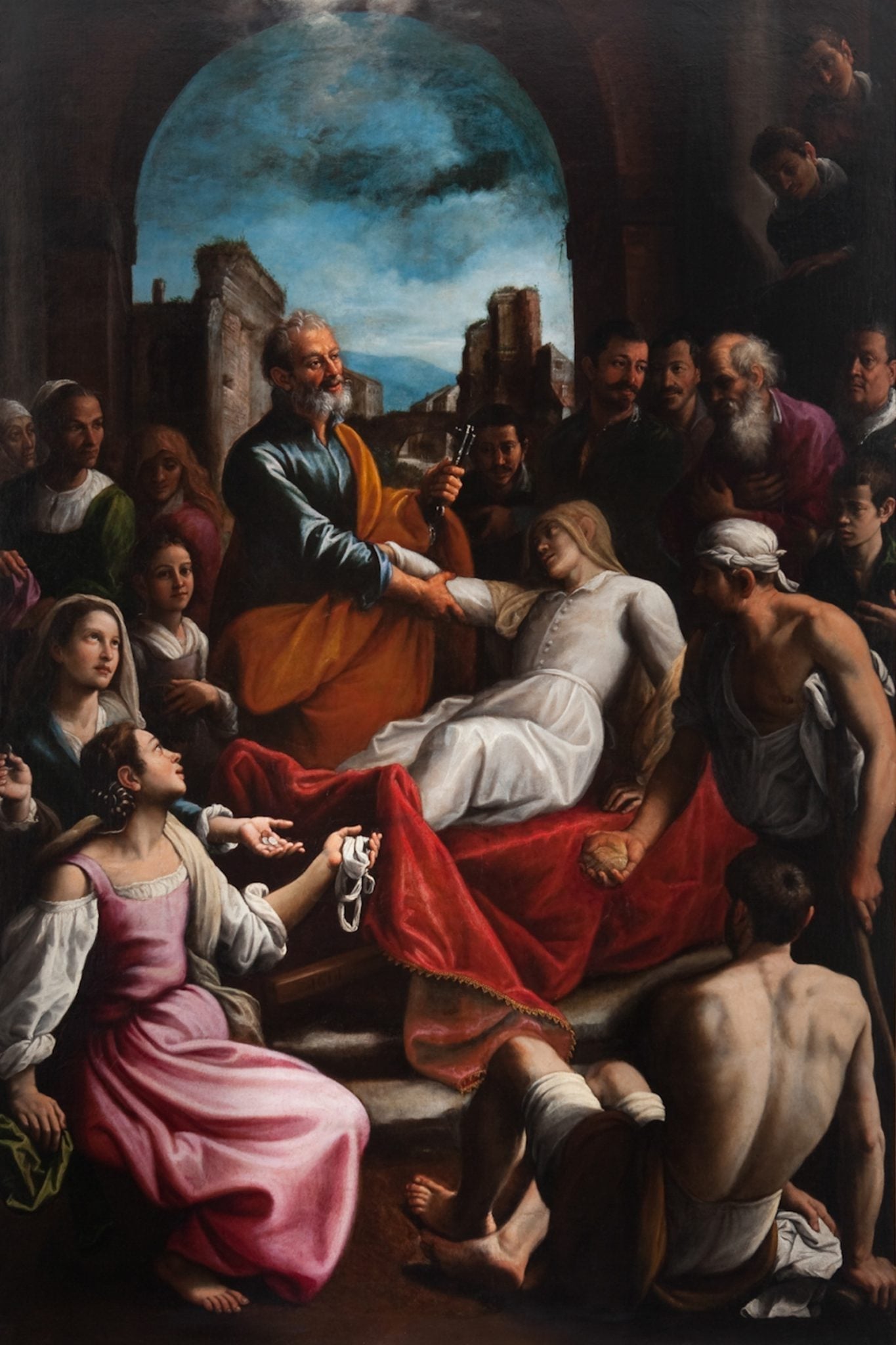
The image is San Pietro resuscita Tabitha, Saint Peter Raises Tabitha, by Fabrizio Santafede (1611). Digital capture by Deca16894 – Own work, Public Domain, https://commons.wikimedia.org/w/index.php?curid=106100094.

Luke’s account of those attending the body of Tabitha lacks any names; I’ve used women’s names found in the New Testament for Tabitha’s friends. The story clearly states that Simon Peter asked everyone to leave him alone with her body. For whatever reason, the artists’ depictions of the scene routinely ignore this.

The Time to Be Brave

May 1, 2022

Acts 9:1-20
John 21:1-19

by Eric Anderson

It was late April, and it was about to be May. The kolea didn’t know that. Pacific golden plovers, the English name for na kolea, don’t pay much attention to the calendars that people use. I’m not entirely sure what they pay attention to, but they do get a sense at about the same time, don’t they, that it’s time to fly from Alaska to Hawai’i or that it’s time to fly from Hawai’i to Alaska.

It was, in fact, about time to fly from Hawai’i to Alaska. One of the kolea was acutely aware of that, even though he was a fairly young bird. He’d only made the long flight once, from his Alaskan birthplace to the shores of Hawai’i Island. He’d really enjoyed the winter here, even if by our standards it was rather cold. The worms and bugs he ate had been more than plentiful, and the rains tended to drive the worms up from their flooded tunnels.

You and I might call that disgusting. The kolea called it lunch. Unless it was dinner. Or a mid-afternoon snack.

He knew it was time to fly to Alaska because his feathers had changed color. For most of the winter they’d been a dappled cream and brown, handsome enough but not dramatically so. Over the weeks of March and April (which he didn’t call March or April) he’d developed deep black feathers on his chest and face, set off by bands of white. His mother called him handsome. His friends called him handsome, though some of them teased him about it. There was another young kolea that he hoped found him handsome, but he was reluctant to ask her about it.

So he knew it was time to fly.

He just… didn’t want to.

His one trip to Hawai’i hadn’t been dramatically awful, but it hadn’t been great, either. It was just over two solid days in the air, beating his wings twice a second the entire time, with no place to land and rest and nothing to eat the entire way. His eyes had ached from holding them open so long and his wings hurt for days. Why would one ever want to do such a thing more than once?

Hawai’i Island, he thought, made a nice place to live. So he decided to stay.

“Oh, no, you don’t,” said his mother. “This isn’t where we have our families,” said his father. His friends just said, “You’ve got to be kidding.”

Only one young kolea asked him why. So he told her about the aches and the pains and why should one do that ever again?

“Because sometimes you have to be brave,” she told him.

That evening she joined a growing flock of kolea. They would leave together soon. When she turned her head, she saw a familiar bird. “Hello, handsome,” she said.

He might have blushed beneath his feathers, but who could tell?

“I decided that it’s time to be brave,” he said.

As the evening fell, the two of them were part of the flock that rose high in the air and began their long flight back to Alaska.

Photo by Eric Anderson.

Three Days

For three days [Saul] was without sight, and neither ate nor drank. – Acts 9:9

Well, that was quite a shock.

One moment I was striding, filled with confidence
and rectitude, the next:
Flat on my back, blinded by a light,
deafened by a voice.

I suppose I needed such a shock.

Is there a greater barrier to learning something new
than certainty? I fear not.
I was so certain, knew beyond all doubt, that
this Jesus movement was a fraud.

Well. I learned.

And now I wait and wonder: what is next?
“You will be told.”
Oh, good. And yet not good, for what may I expect
of One whom I oppressed?

Or those who followed him?

How strange to find expansion of the soul
in clouded sight?
I had created my own spirit’s shroud, of course,
but now I see.

Metaphorically, that is.

Now to be truthful, God, to whom I pray
with greater clarity
since vision failed three days ago, I thank you
for this time of rest.

I am not ready for the tasks you might
require of me, or
the penitence I must perform for those
who do not trust me.

Why should they, after all?

I am not ready yet for much beyond
extended monologue
to you, here in this house along the
Straight Street of the city.

Here I will pray and breathe.

And when you find me ready, Lord,
with eyes still dim,
or eyes as comprehending as my soul,
I’ll take your road.

I’ll follow you.

Amidst the daily noises of the street,
what’s that? A knock.
What’s that? The voices by the door.
What’s that? A hand.

A voice that calls me: Brother Saul.

A poem/prayer based on Acts 9:1-20, the Revised Common Lectionary First Reading for Year C, Third Sunday of Easter.

The image is The Conversion of St Paul by Caravaggio, found in the Church of Santa Maria del Popolo, Rome. Photo by Alvesgaspar – Own work, CC BY-SA 4.0, https://commons.wikimedia.org/w/index.php?curid=44143233.

There is some suggestion in the writings of the Apostle Paul (he used that Greek version of the Hebrew Saul when writing his letters in Greek) that he did not fully regain his physical sight after this experience. In 2 Corinthians 12 he spoke of a “thorn in the flesh,” suggesting a disability without describing it. At the close of Galatians (6:11) he wrote, “See what large letters I make when I am writing in my own hand!” Though that might be due to unfamiliarity with using a pen, it might also be because of poor eyesight.

A Lenten Success

I try to avoid patting myself on the back in public – but if I don’t, what is social media for?

For some years I have chosen to follow two parallel disciplines each Lent. One is a fairly straightforward decision to refrain from something during the forty-six days of the season (I include the Sundays for this). I’ve given up fast food, beer, soda, computer games, and similar kinds of things (though never coffee – never coffee). I have almost never been able to successfully repeat one of these, so I generally have to choose something new and different each year.

The second discipline, on the other hand, is to take something on. I’ve followed exercise programs and prayer cycles. Frequently I’ve done creative projects with photography or poetry. In fact, my weekly Lection Prayers are an outgrowth of one Lenten season. I simply kept going with them.

This year I set a goal I was not certain I could achieve. I decided to write a song each week of Lent.

Although my repertoire of compositions has expanded greatly over the years, the truth is that I don’t write songs all that often. I was astonished when I counted the songs I’d written in 2021 and came up with a dozen. For me, songwriting requires a good deal more time, concentration, and focus than most other writing projects. I have and do write to deadlines, but I generally prefer to follow some kind of inspiration when it comes to music. I usually am happier with the results.

To set a goal for songwriting which is half my output in the previous year – in six weeks – well. I wasn’t sure I could do it.

I did give myself some space. I did not insist that each song be composed within an assigned week. All I required was that there be six songs by the end of the season. Nor did I impose any subjects or themes on them. The songs would be what they were, and they could fit into the sacred or the secular as it came along. I also knew I’d write one anyway: I’ve made a habit for a few years now of writing something for Easter. Still. Six songs in six weeks?

Friends, I did it. And… all six have now been performed and are available on YouTube.

Wisdom, Feed Us

Premiere performance during the Community Concert of March 11, 2022.

Dream of Peace

Premiere performance during the Community Concert of March 25, 2022.

Come On, Guitar

Premiere performance as A Song from Church of the Holy Cross, March 23, 2022.

Creature of this World

Premiere performance as A Song from Church of the Holy Cross: April 6, 2022.

As We Bring Him Down

Premiere performance during Scripture and Poetry for Good Friday, April 15, 2022.

Walk, Mary, Walk

Premiere performance during What I’m Thinking #259, April 18, 2022.

Let’s Pause, Thomas

“Then [Jesus] said to Thomas, ‘Put your finger here and see my hands. Reach out your hand and put it in my side. Do not doubt but believe.'” – John 20:27

Let’s pause, Thomas.

Ignore, for now, the jealousy inside.
They saw. You didn’t. That’s how these things go.
Some are in the wrong place at the right time,
others in the right place at the right time.

Pause and let it go, Thomas.

Did Jesus not show signs enough
for anyone? Can you not leave
to others this new sign? Must you claim it, too?
How many would accept their friends’ report?

Just pause, Thomas.

For if you make a jealous declaration,
demanding what the others all have seen,
you risk commitment to the course
they’re on, a course of hardship and of pain.

So think, Thomas.

This sight and touch will drive you far from
Galilean lakeside breakfasts. It will take
you over tossing seas to strangers who
will, some, believe your words – as you did not your friends.

Just think, Thomas.

Your jealous energy will turn to zeal
and you will find a sharpened spear
awaits you there, three thousand miles
from home. So pause. And think.

Before you speak.

A poem/prayer based on John 20:19-31, the Revised Common Lectionary Gospel Reading for Year C, Second Sunday of Easter.

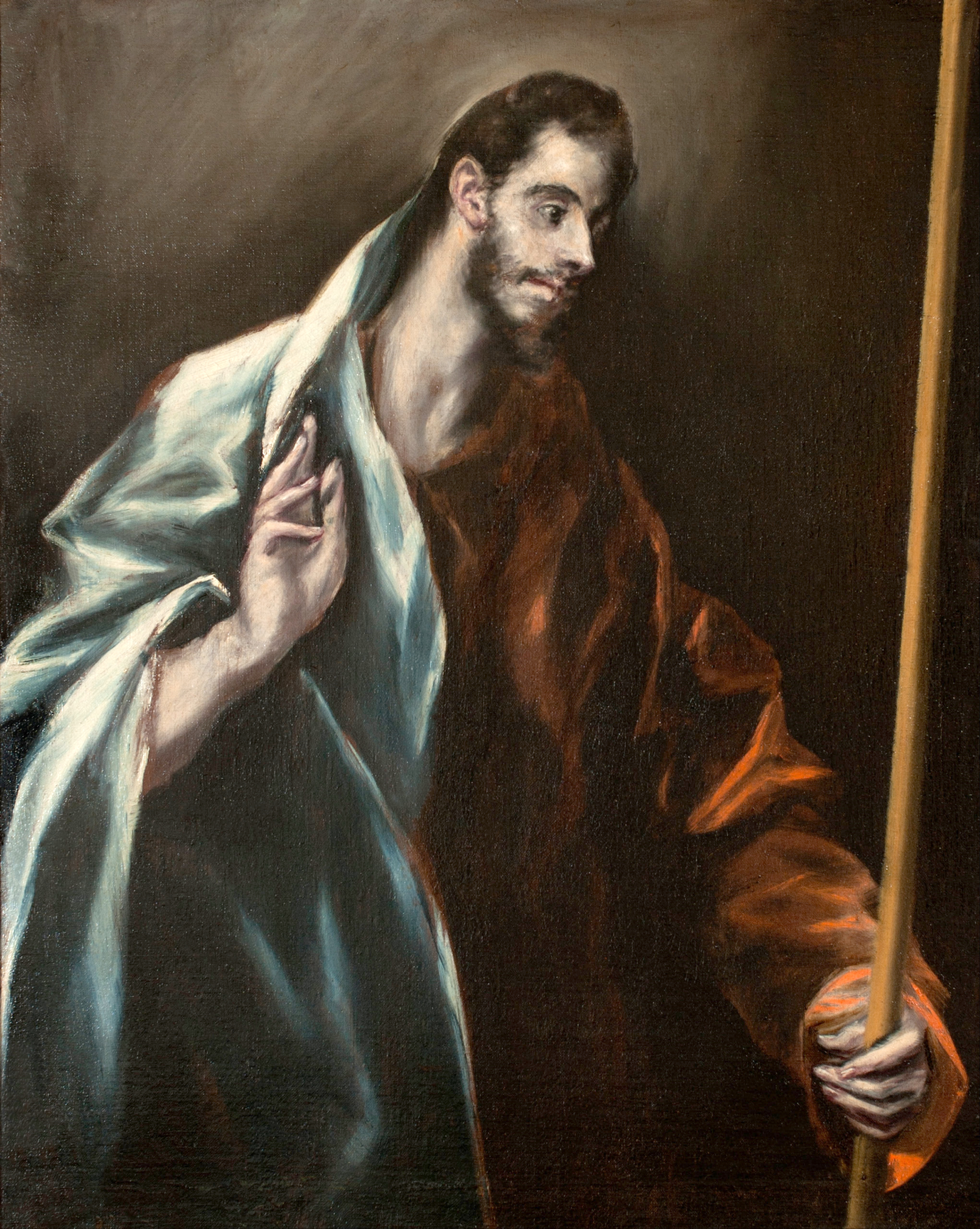
The image is Santo Tomás Apóstol (Apostle St Thomas) by El Greco (ca. 1610-1614) – HQFzobTvKDaFzQ at Google Cultural Institute, zoom level maximum, Public Domain, https://commons.wikimedia.org/w/index.php?curid=29844110.

Scripture and Poetry for Good Friday 2022

The video will premiere at noon HST on Good Friday, April 15, 2022.

These seven poems and the song are based on Scriptures associated with “the Seven Last Words of Jesus” – strangely, there are eight lessons. The video includes reading of the Biblical texts, reading of the poems, and performance of the song, “As We Bring Him Down.”

First Reading: Luke 23:26-32

You strode those streets to teach,
to worship and to heal.
You strode those streets to cast
the moneychangers from the Temple courts.

And now, with failing strength, you stumble up the street,
too weak to bear the instrument of death.
Where once you rode in festival parade
they follow you to mourn for what has been and what will be.

Second Reading: Matthew 27:33, 34, 37

I’m sure that Pilate knew just what he said.
This is what happens to the ones who claim
they have no emperor but Caesar.
King of the Jews? Claim the title if you like,
but know that title brings you only here,
to die upon a cross, not reign upon a throne.
So Jesus, claiming spiritual rule, will offer up
his spirit to the Roman callousness and fear.

Third Reading: Luke 23:35, 36; 23:34, 39-43

How strange a criminal, whose deeds “deserved”
a death of torture, understood the reign of God
much better than the priests, much better than
the Roman Governor, much better than the monarch,
better even than the ones who followed Jesus.
“Jesus, remember me when you come into your kingdom.”
For Jesus, entry to that realm was not through gates of stone,
but gates of death. Beyond those gates our eyes
see only shadow, but to his, and to this criminal,
the shadows have been thrown by brilliant light.

Fourth Reading: John 19:25-27

Your friends look on, O Jesus. See?
Your mother Miriam: she weeps with Miriam
and Miriam. She will not urge you to a wedding feast,
not now, or prompt you to transform the vinegar
of death into a vintage rich with life.
Instead, as scarlet stains your hands and feet,
you transform stranger into son,
and woman into mother. Here amidst
the panoply of power and of hate,
you fill the purifying jars of love.

Fifth Reading: Luke 23:44-45

Who could not bear to watch from heaven?
Was it the sun, ashamed to the Savior die?
Was it the moon, unable to divert its gaze?
Was it the angels who had praised Messiah’s birth?
Or was it simply that the clouds must gather, too,
and witness bear, and mourn, and weep?

Sixth Reading: Matthew 27:46

Forsaken the Anointed One.
It seems so strange
that Son of God, Messiah
should cry out in
abandonment – or…
Does it?

Do we not hear the question echo
down the years, the centuries, and on,
“I was your God, and you my people,
and you turned away.”
We worship a forsaken God.

Seventh Reading: John 19:28-30

I could not blame you, Christ,
if you let “It is finished” be
your final word. You only came
to do us good, and we?
We desecrated you,
we desecrated the tree
on which we watched you die.

I could not blame you, Christ,
if you decided that we had
rejected your salvation – for we did –
and now could live in suffering – as we do.
And you, who stood for truth, nearly let
us live the lie, but you could not let
“It is finished” be the end.

Eighth Reading: Luke 23:46

“As We Bring Him Down”

The calloused feet that trod the miles.
The mobile lips the formed the smiles.
The fingers that bathed his friends’ toes
Are still – are unmoving –
Are released from the world and its woes.

[Chorus]

Hold him gently as we bring him down.
Throw aside the bitter thorn crown.
Lay him in the cloth we could find.
The world has been cruel to the kind.

The sparkling eyes that held yours in peace.
The worker’s hands that feared no disease.
The ears that heard more than we knew
Are still – are unmoving –
Are now just memory for a few.

[Chorus]

The open arms we have crossed on the chest
Where the loving heart beats not in his breast.
Draw the fabric across the dear face
So still – so unmoving
Oh to see it again. Oh to find such a place.

[Chorus]

Cross-posted at holycrosshilo.com.

Poetry and music © 2022 by Eric Anderson

Hold Still, Mary

Then the disciples returned to their homes. But Mary stood weeping outside the tomb. – John 20:10-11

Slow down, Mary.

You’ve made the trek three times this morn.
Once slowly, drawn reluctantly but certainly
to this one place, a garden you would water
with your tears.

Slow down, Mary.

The second trip you ran with panicked feet,
aghast with loss and injury.
What had they done with Jesus?
Death by torture – wasn’t that enough?

Slow down, Mary.

You might have beat the fisherman
in that footrace, except you’d run the race
before already, and the other one?
Who could outrun the one that Jesus loved?

Slow down, Mary.

You sought their help. You might have guessed –
I’m sure you did – that they’d no help
to give. Now, Joseph might have known,
and Nicodemus might have helped, but not these two.

Slow down, Mary.

Let them return, uncertain and afraid,
until they bring their friends together.
You: wait. Take one more look into
the empty tomb. Ignore the words of angels.

Slow down, Mary.

If his disciples cannot help, nor angels,
sweep your tear-swept eyes across the garden,
and see if there is one who says your name,
to whom you’d cling until the sunset comes.

A poem/prayer based on John 20:1-18, the Revised Common Lectionary Alternate Gospel Reading for Year C, Easter Sunday (Resurrection of the Lord). 

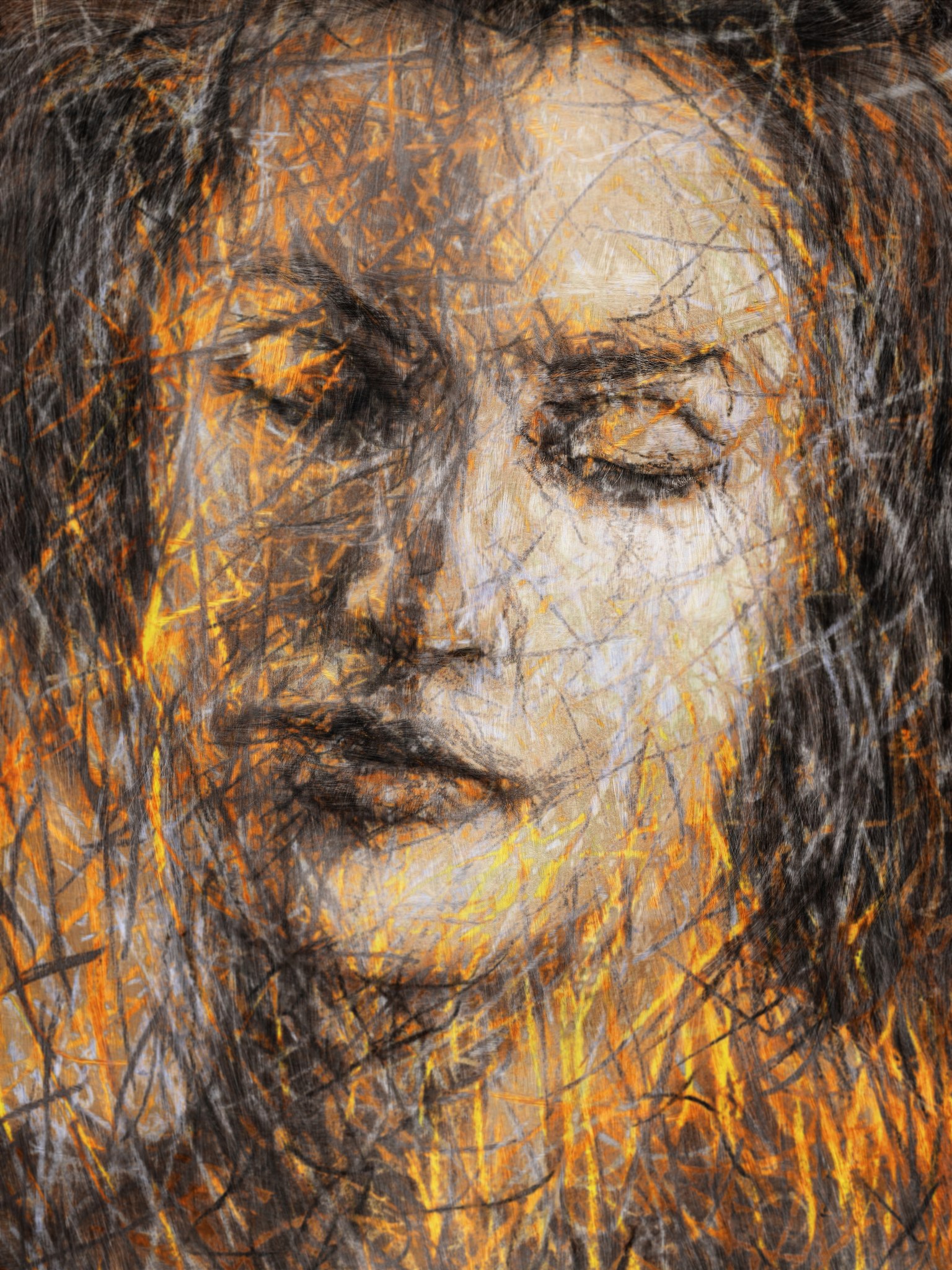
The image is Mary Magdalene, a digital Proundism image by Koorosh Orooj – http://profoundism.com/free_licenses.html http://profoundism.com/free_licenses_mary_magdalene.html, CC BY-SA 4.0, https://commons.wikimedia.org/w/index.php?curid=108033456. The original image has much more precise detail than the lesser resolution one displayed here.

Weeping Stones

Kamokuna, Hawai’i, August 18, 2016

“Some of the Pharisees in the crowd said to him, ‘Teacher, order your disciples to stop.’ He answered, ‘I tell you, if these were silent, the stones would shout out.’ As he came near and saw the city, he wept over it…” – Luke 19:29-41

If you had brought the crowd to silence, Lord,
and made the air to still so stones could speak,
would they have cried aloud their praise?
Or would they have, instead, shed tears of grief?

Red, flowing tears, as hot with loss
as ever streaked a human face,
as hot as those you tasted on the cross,
as scarlet as the blood you shed.

They flow, these tears of Earth, today
from vents beneath the salty sea,
from fissures high upon the mounts
and far downslope in forest glades.

You wept to recognize that people will
not do the things that make for peace.
The stones in chorus weep to see
our violence laid hard on you.

And when the scarlet tears encounter salt,
the heat of sympathy explodes in sand,
black sand, gray cinder, groaning now
to bear the land extending into sea.

Weep stones. Weep people, weep. Weep all
Creation. In the confluence
of scarlet tears and human tears
we build new land on sable sand.

A poem/prayer based on Luke 19:28-40 (plus verses 41-44), the Revised Common Lectionary Gospel Reading for Year C, Sixth Sunday in Lent, the Liturgy of the Palms. 

Photo by Eric Anderson