“…and Israel saw the Egyptians dead on the seashore.” – Exodus 14:30b
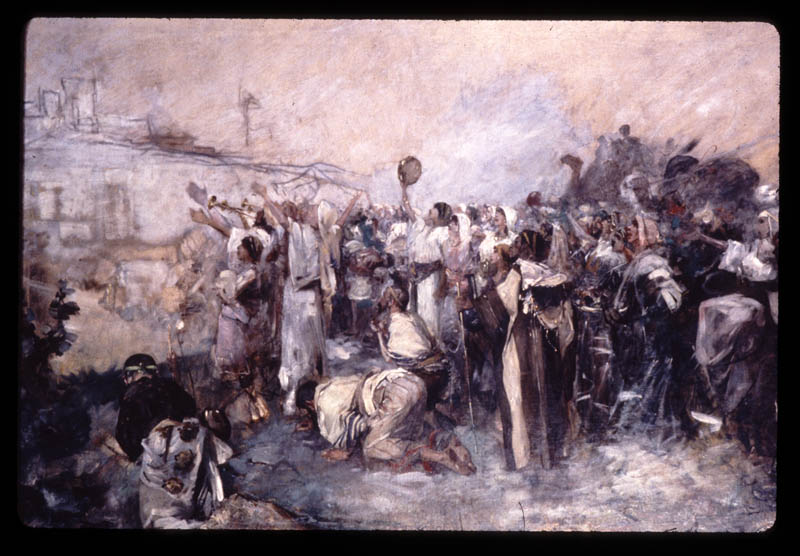
“Then the prophet Miriam, Aaron’s sister, took a tambourine in her hand; and all the women went out after her with tambourines and with dancing. And Miriam sang to them: ‘Sing to the LORD, for he has triumphed gloriously; horse and rider he has thrown into the sea.'” – Exodus 15:20-21
Gasping, panting, wheezing on the edge of the sea.
I can’t imagine where they found the energy to sing, to sound the tambourine, to dance. My feet are lead; they sink into the marshy mud that runs along the reedy shore.
Gasping, panting, wheezing on the edge of the sea.
We were not last in line, but close enough to feel as if we were the least in all of Israel. No doubt the chariots and archers were not close enough, but we could feel their breaths upon our necks.
Gasping, panting, wheezing on the edge of the sea.
I ran, we ran, we galloped through the slime and muck and knew – and knew – we were too slow. We were too late. We were too weak. We knew – we knew – that swords and chains and whips would be our lot.
Gasping, panting, wheezing on the edge of the sea.
Then suddenly we climbed the bank, the shore had made its way to us, it seemed, lest we expire before our limbs had carried us to it. And still we heard the cries of the Egyptians.
Gasping, panting, wheezing on the edge of the sea.
With trembling I reversed my gaze to see the sword that shortly would relieve my life, and saw the waters closing, heard the malice of Egyptian voices carried off by wails of fear.
Gasping, panting, wheezing on the edge of the sea.
And now… I cannot summon up the strength to sing, or dance, or beat the tambourine. When breath returns, perhaps I will be strong to sing a song of thanks that now I do breathe free.
Gasping, panting, wheezing on the edge of the sea.
The churning waters have devoured the Egyptians. The shores are strewn with all the corpses of the drowned. One gazes up at me with vacant eyes, no more surprised than I to see I live and he has died.
Gasping, panting, wheezing on the edge of the sea.
So when I sing, dear Lord, in celebration of this gift may I remember to regret the slain. Though ill was their intent, and evil was their goal, they, too, could claim the title of your children.
Gasping, panting, wheezing on the edge of the sea.
Oh, will a sunrise ever come, O God, that sees the power-filled renouncing their prerogatives? When slavery in all its forms is done? When death no longer rules? When no one casts their eyes on corpses,
Gasping, panting, wheezing on the edge of the sea?
A poem/prayer based on Exodus 14:19-31 and Exodus 15:1b-11, the Revised Common Lectionary First Reading and alternate Psalm Reading for Year A, Proper 19 (24).
It sounds so… easy… Jesus. Like when those friends of mine cajoled their mother into asking you – the gall! – to ask you if her sons could sit at either side of you upon your throne.
Oh, yeah. Like that was gonna happen. I knew full well that your ideas were not in line with theirs – the gall! – but also, well, they weren’t in line with mine but trust me, you’ll see my way, won’t you now?
Such simple steps. First me, then me and Andrew, say, or me and Matthew or Iscariot to talk to James and John (and mom) – the gall! – and get them straightened out. And if that doesn’t work, we’ll get the group. And you.
But really, just how many times will I be forced to make this run-around? How many times will James and John (and mom) – the gall! – be able to repeat this sorry circle and distract us from your better work?
Once ought to be enough. Or twice. They’re smarter than they ought to be, you know, these Sons of Thunder and their mom – the gall! – but I’d be willing now to go as high as seven and then they can be tax collectors to us all.
What’s that you said? Like… Matthew? Oh. The gall.
A poem/prayer based on Matthew 18:15-20 (with references to Matthew 20:20-28 and 18:21), the Revised Common Lectionary Gospel Reading for Year A, Proper 18 (23).
And [Joseph] kissed all his brothers and wept upon them; and after that his brothers talked with him. – Genesis 45:15
Where does that conversation start? “You sold me into Egypt.” “Well, yes, we did. We, um, thought…” “Well, we didn’t think…” “Mostly, Joe, we felt…” “Yeah, we felt, and mostly what we felt…” “…Was angry.” “Yeah.” “Angry.”
I get angry, God. Oh, yes. Despite the best advice, I’m ready now to test You. Yes, and such a test. For if our weary state is not so great a hardship as the state of slavery, or worse, imprisoned and yet guiltless, or worse, awaiting a deliverance that should not be delayed, yet is…
Our weary state is bad enough that I can set it side-by-side with seven years of famine and with seven years of harvests left to rot amidst the fields. We ignored the Josephs who would tell us to prepare for harsher times…
Well. Suffice it to admit my heart is aching and my blood is pounding and I do not weep for resolution but I weep in deep frustration and I am not ready to embrace my not-so-sorry siblings.
I hesitate as well to reach for You, O God.
So.
May I swiftly come into that place “and after that” enjoyed by Joseph, Reuben, Judah, and the rest. Restore to us the unity of family. And… as I come to You, may my tears drench Your neck and may Your tears run down beyond the collar of my robes, as sweet upon the ground as is the dew of Hermon.
A poem/prayer based on Genesis 45:1-15 and Psalm 133, the Revised Common Lectionary Alternate First Reading and Alternate Psalm for Year A, Proper 15 (20).
We left you there upon the mountain, Lord. The safest place for you – or well, for us – well insulated from the crowd’s demands for things that we, in truth, cannot provide.
If you are there upon the mountain, Lord, then you will not repeat those awkward words, “You give them something now to eat.” With just five loaves of bread at hand (as well you knew).
If we had known about that pair of fish, well, that would surely make the difference in our well-meaning cluelessness. “Bring them to me,” was all you said, and all were fed.
So you are there upon the mountain, Lord, and when we have once more resumed our breath, when we are not so weary carrying those baskets full, we will be there for you.
But now that you are on the mountain, Lord, we find that we cannot return to you with quite the ease we promised. Now a wind opposes our return to land and you.
We’d rather be upon the mountain, Lord, instead of struggling with our oars and sail to make some headway into this head wind. How can we find your presence once again?
But now the wind blows from the mountain, Lord, and with it moves a terrifying shape, a figure of the dead and of our deaths, to take us from your side for now and ever.
“Take heart!” we hear. “Do not now be afraid!” Oh, these, we know, are words of angels, heard by those they summon to great deeds, the likes of which are not within our feeble skills.
And, “It is I!” you cry, O Lord, a word of doubtful reassurance. Who is that who walks upon the gale-tossed sea? A ghost we comprehend; a Savior, not as much.
But when you were upon the mountain, Lord, we strove to come to you despite the wind and now see you come to us, and how can we do other but to meet you here?
So call us from the mountain, Lord, and call us from the heaving sea, and may we take our faltering steps upon the waves and reach – and find – and grasp – your outstretched loving hand.
A poem/prayer based on Matthew 14:22-33, the Revised Common Lectionary First Reading for Year A, Proper 14 (19).
Hoarsely breathing. Sweat’s aroma growing. Taste of dust across the teeth. A shapeless silhouette against the stars. Muscles aching, skin abrading, jaw clenched tight, we wrestle to the dawn.
In ignorance I strain. In ignorance I fumble for a hold. In ignorance I push or pull or pivot. In ignorance I gasp for breath, inhale, exhale, and beg for blessing, beg for name.
Is this you, God? Do you produce this ache by dislocation of my frame? Is this the silent panting struggle with Creation? Is this you, God?
No name. Just a name for me, a name for a devoted wrestler, but I weary of the struggle, weary of the pain, weary of the ignorance.
If you must put your arms about me once again, might it be a parent’s warm embrace and not to separate my fragile, aching bones. Oh, bless me as I am.
A poem/prayer based on Genesis 32:22-31, the Revised Common Lectionary First Reading for Year A, Proper 13 (18).
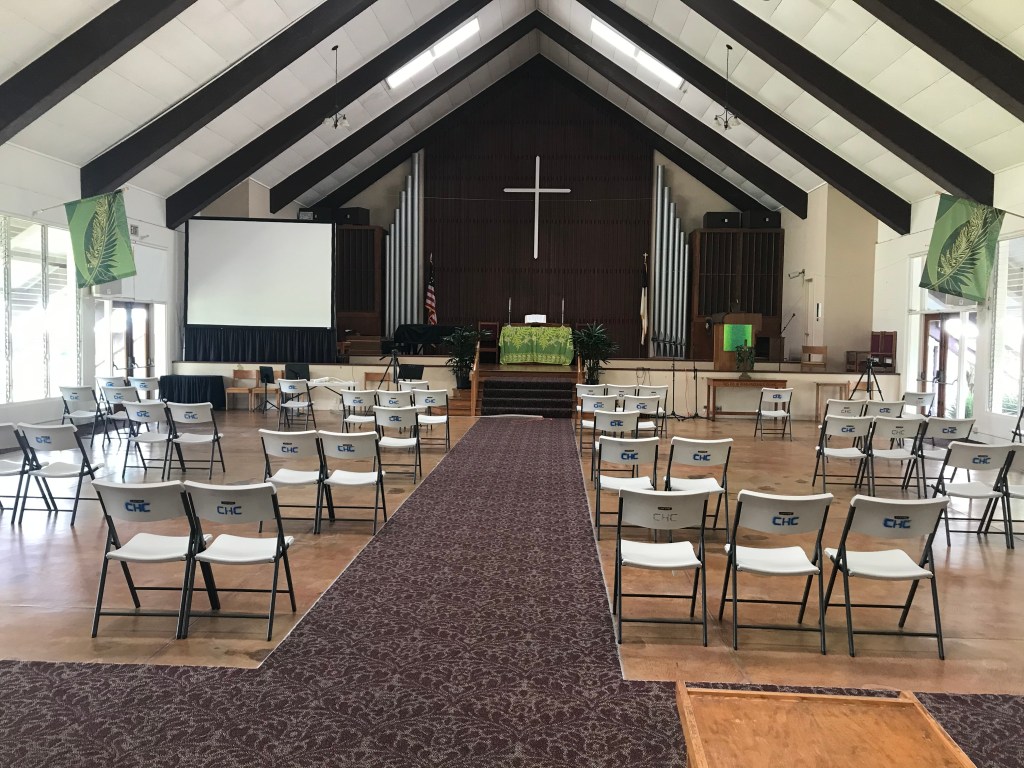
Church of the Holy Cross configured for distanced seating. Note camera tripods.
Part Three became inevitable as infection rates in the state of Hawai’i and the county of Hawai’i declined to the point that a congregation could be gathered once more at Church of the Holy Cross. The steps required to reduce risk of virus transmission created new challenges for liturgy. The state still limits gatherings to less than fifty people, which also turned out to be the capacity of the church sanctuary when chairs replaced pews. Having a congregation meant that the sound system now needed to serve two groups: the worshipers in the space and the worshipers over the Internet – and they had different needs.
In many parts of the country, churches still worship exclusively over the Internet because infection risk is still too high in their area. On Hawai’i Island, we went some time with no new cases at all. We are now seeing new cases again, between zero and three a day. We are watching those reports carefully and will discontinue in-person worship if it continues to rise.
Chairs, Masks, Sinks, Books, and Screen
Church of the Holy Cross is blessed with pews that are not attached to the floor. Early on, we thought we might rearrange the pews themselves, but were confronted with the problem of sanitizing the furniture between services. Since four congregations worship in the room during the day, we needed a cleaning regimen. Rather than risk virus material settling into the cloth (and damage to fabric and wood from bleach-based cleansers), we stacked up the pews and replaced them with folding chairs. Those chairs also allow us to seat household groups of different sizes together while keeping space around single worshipers.
All the congregations clean twice: once as they enter the space, and again as they leave. While it seems redundant, it offers better protection and reinforces the sound practices of caring for yourself (cleaning before) and caring for others (cleaning afterward). Chairs, pulpit and lectern, microphones and stands, and window louver levers, and other touch areas get cleaned. All congregations take attendance so that contact tracing can be done if we become aware of someone with a positive test for COVID-19. Worshipers enter through a kitchen with sinks for hand-washing and sanitizer for those who prefer that. Everyone wears a mask (and we have more available). The walks have six foot tape marks to maintain distance. After service, everyone exits through a separate door.
Hymnals and Bibles have been removed. We only provide a large-print bulletin for those with vision challenges; everyone else relies upon the projector screen for worship. We do not sing hymns together. We do speak prayers together. There is singing, however: two musicians sing from near the back of the chancel while wearing masks. The closest seats in the congregation are twenty-five feet away.
The preacher and lay leader now speak from separate lecterns with separate mics (covered with disposable foam shields). And, of course, there is no greeting line at the close of service.
We’ve Got to Move
We discovered the first week that the lack of congregational singing made for a very still hour – too still. While there was a “movement prayer” at the beginning of the service, it was too short and in the wrong place. A church member offered to lead additional movement, so the two vocal performances now also serve to lead the congregation in motion. It’s not actually hula, but the gestures come from that tradition. In addition, I lead a brief prayer in movement immediately after the sermon.
Attendance has been in the forties, which is close to the capacity of the room. We can accommodate a few additional worshipers just outside the sanctuary in an area covered by the roof (and equipped with speakers). We may need to add a screen in our Building of Faith if more people begin to attend.
Still Streaming
With the capacity of the room reduced, and knowing that people needed to continue to reduce contacts, we resolved to continue live streams into the future. We had to do things differently – again.
Video Cameras
With the streaming-only format, we had to do very little camera movement. There were only two places that people ever stood – three on a Communion Sunday – so a single camera operator could manage it even though he was also acting as a musician. Now we have five (and added a sixth) plus seven on Communion Sunday: pulpit, lectern, piano, organ, chancel for vocal anthems, bell (rung before service), and communion table. That meant we needed camera operators throughout the service.
We also had to place the cameras differently. We wanted to reduce the distraction they would cause the worshipers who were present and we wanted to give the worshipers at home the best experience we could. The cameras aren’t really capable of a high-quality shot over a long distance. We also faced cable length limits.
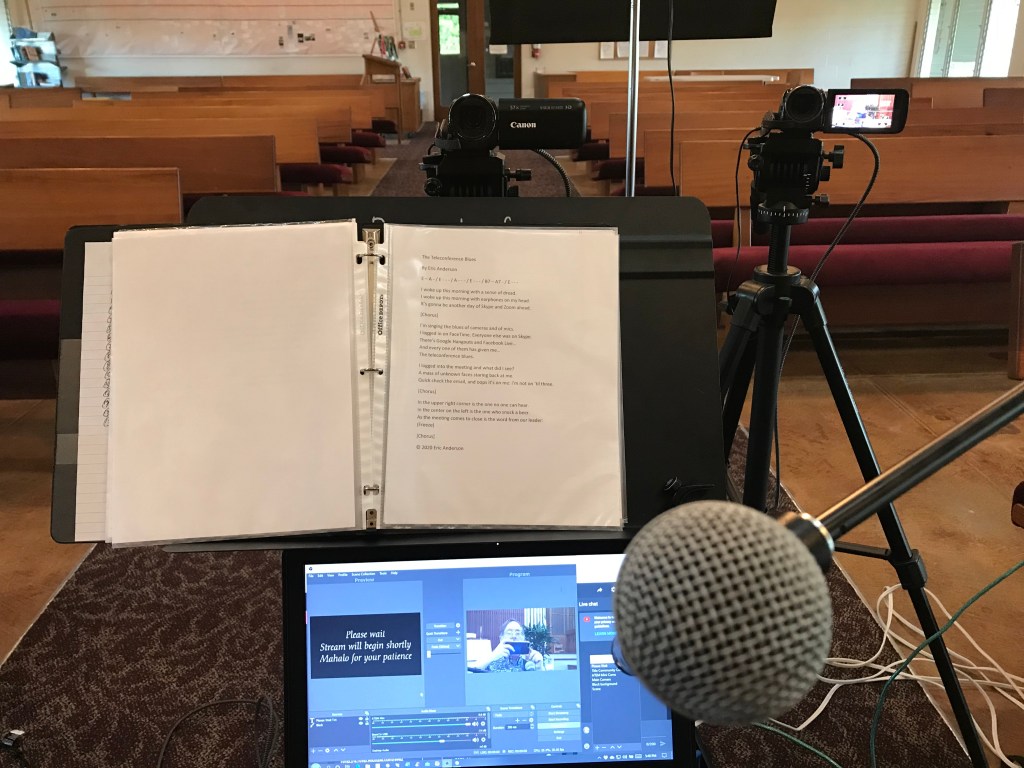
Both cameras, therefore, needed to be toward the front (their tripods are visible in the photo at top). One camera stands against the wall to the right for a shot of the pulpit and organ. The other stands just left of center for the lectern, piano, and chancel.
These are the same Canon camcorders we have been using: a Vixia HF R52 and a Vixia HF R800. The one by the wall now has a much longer cable run. In addition to a fifteen foot HDMI cable with a mini-connector on one end, we use a coupler and a twenty-five foot HDMI cable to reach the switcher. This is close to the limit of an HDMI signal. The first time we set it up, we tried to get some more slack with another cable extension, and it simply would not work. The other camera is close enough that its fifteen foot cable suffices.
For the first couple weeks, we set up the Logitech webcam as a wide shot to provide the switcher with another source. She never used it, so we’ve retired that camera.
We have, however, added another video source. The church has used projected words and imagery for some years. That slide show can also be used as a video source via HDMI.
The first two weeks taught us something else about the video: it was really hard for the director to select a shot without a preview image of it. She needed to know whether a camera had settled – or was even on the right subject – before switching to it. One of the lacks of the Blackmagic Design ATEM Mini (though not its newer sibling, the ATEM Mini Pro) is a multi view of its sources.
How could we create that? I’ve seen some creative ideas, including using several splitters and a multi view converter, but then I saw someone using field monitors. These are small screens that are mostly used to provide videographers with a better view of their shot than provided by the built-in screen of the camera. Our two Timbrecod DC-80 7″ screens have an HDMI pass-through. We place them between the cameras and the switcher, and now the director can see what the camera sees before choosing it.
Laptop running OBS Studio, two Timbrecod field monitors, and the ATEM Mini on the video director’s desk.
One immediate annoyance was that the field monitors could not be used with the ATEM’s first input. I’ve done some research, and apparently the ATEM misreads the frame rate with some active pass-throughs, but only on the first input. We use input one for the slides, and the cameras get two and three.
Sound
The church installed a new sound system just over two years ago which, frankly, makes the challenge of providing sound to both the sanctuary worshipers and the online worshipers even possible. The old system, well… best to avoid that nightmare.
Our sound mixer is a Soundcraft Ui24R, a completely digital device. It has no physical knobs or sliders, but can be controlled via a keyboard and mouse, a network connected computer, a tablet, or even a smart phone. Its USB connection bears a host of signals, not just the main mix. A connected computer can select individual channels or one of eight auxiliary outputs.
Each auxiliary output can have its own mix. This is a game-changer.
Why? Because there are things that people worshiping over the Internet need to hear through the sound system that people in the sanctuary should not. In particular, we have to be very careful about amplifying the organ. The potential for feedback through the sanctuary speakers is mostly manageable, but it has to be carefully monitored. The organ produces plenty of sound, and amplifying it isn’t particularly helpful.
People worshiping over the Internet, however, need to hear it. They also need to hear the piano. We added two microphones in the chancel area (a pair of MXL 990 condenser mics) to pick up those sounds – and they are not part of the main mix. We include them only in the auxiliary mix.
We confronted cable length limits again. Although we can control the Soundcraft via a tablet, we had to connect our streaming computer to it via USB, and it was twenty-five feet away. USB has a length limit of around fifteen feet. In this case, we were delighted to find that an active extension cable did the job. We also experimented with using an active USB hub in the chain, and found that it didn’t work.
We have been frustrated with a relatively weak signal from the Soundcraft Ui24R. It reaches OBS with relatively low volume. The basic mixing controls in OBS wouldn’t bring it to desired levels – but it turns out that there’s an Advanced Audio panel that allows one to boost the base volume of an audio source. We’ve currently set it to add 10 decibels, and I’m considering a boost to 12.
Catching My Breath
I keep hoping that we can find a “normal” once again, and not have to make too many more adaptations. We probably aren’t there. One of the signals for our worship service is the ringing of the church bell. We’re able to film it because we have lots of windows and the bell is just outside.
What we can’t do in the stream, however, is hear much of it. It’s too far away from any of the microphones. We also can’t hear much of the congregation’s responses. I’m not eager to take on the challenge of adding “house sound” microphones to the mix, but that may be coming.
It is a relief to have a congregation present. They do provide an energy that is missing in the one-way stream approach we chose. My Sundays include a certain amount of anxiety – I’m deeply concerned for the health of the worshipers – but I find I am less exhausted by the experience of worship than I had been.
I don’t think much of your agricultural practice, Jesus. “The kingdom of heaven may be compared to…” a farmer who leaves the weeds amidst the wheat, and only separates the two at harvest.
Well, let me tell you, Jesus, that the weeds are not just growing peacefully beside the wheat. They steal the water, hide the sun, choke the grain. The wheat begs your relief!
“O that you would kill the wicked, O God, and that the bloodthirsty would depart from me!” “Do I not hate those who hate you, O LORD? And do I not loathe those who rise up against you?”
I need a farmer who will bring me aid and comfort from the spreading weeds of greed and folly ravishing the struggling grain of your own planting, LORD. “I hate them with perfect hatred,” indeed.
Unless…
Unless, of course, I let the Psalmist’s prayer take root within my heart and blossom there: “See if there is any wicked way in me;” test me to see if I grow like the weeds.
Ah, now I am less eager for your justice or your retribution or your weeding. Now I am content to grow in peace however fragile, to become, I pray, your wheat and not your weed.
“See if there is any wicked way in me, and lead me in the way everlasting.”
A poem/prayer based on Matthew 13:24-30, 36-43 and Psalm 139, the Revised Common Lectionary Gospel Reading and Psalm for Year A, Proper 11 (16).
A view of cameras, microphone, and streaming software for the May 22 Community Concert.
In Part One, Gentle Reader, I explained how a mild mannered ordinary local church pastor with a somewhat strange skill set became a televangelist, and some of the tools he used to become one.
(I will now abandon the use of “Gentle Reader” references, since I’ve never much cared for that 19th century style of English prose.)
Two months later, we have seen marked improvements on the technical side and have made some changes to the experience of worship as well. We continue to use YouTube Live as the streaming method; we have not sought to expand to send streams to other services at the same time. We use email reminders (typically Friday afternoon and another on Sunday morning) to give our newsletter subscribers a quick way to find the links to the video and to the worship materials on our website.
The order of service has had one significant addition: a hymn for people to sing together at home. This came as a suggestion from a worshiper, and we implemented it in about two weeks once we were satisfied that the musicians could manage preparing two songs. We’ve had some very positive feedback on that addition, and we’ve tried to really support it by making the lyrics available with our worship materials and, more recently, including them in the video stream.
The worship leaders also changed their positions. Webcams, including the Logitech C922, are designed for a short distance between the lens and the subject. That put the two musicians closer together than physical distancing guidelines recommend – and sent the wrong message. For some weeks now the leaders have stood at music stands with a six foot table (our communion table) between them. The webcam serves as a wide shot that includes both participants and displays the distinctive cross above and behind.
The real technical achievement is moving to more than one camera.
The hardware video switcher, a Blackmagic Design ATEM Mini, arrived on April 27. The most basic function of this device is to switch between four different audio/visual signals arriving via HDMI. It has a USB connection, and a computer recognizes it as it would a webcam – an audio/video source. Once cabled to the laptop, the ATEM became another source OBS could use.
What about cameras with an HDMI out port? This developed into a rather frustrating exercise. I have owned a Canon Vixia HF R52 for some years. I’ve used it to shoot videos of lava, and it was the main camera for the What I’m Thinking video series for a long time. When I worked for the Connecticut Conference, we used a pair of identical cameras for studio recordings and for live streams. I knew its HDMI out would work.
I really wanted to have at least two cameras, though, and preferably three (three cameras is common on TV studio sets). I bought a pair of very inexpensive cameras, expecting they wouldn’t be great, but that they’d do. Well, they didn’t. They connected over HDMI just fine, but the HDMI output when in shooting mode displayed what was on the screen, which sounds good until you notice all the little icons about battery life, focus mode, and so on. There was no item in the camera’s menu that allowed me to turn off the little pictures that cluttered the picture. In addition, connecting the HDMI cable turned off the camera’s own display, so a camera operator couldn’t see what the camera saw.
I hoped I’d be able to use my own DSLR, but ran into the same problem (both of them, in fact). I couldn’t turn off the icons. The camera’s live display went dark.
This time when I went shopping I made a visit to the manufacturer’s websites and read the full user’s manual. The Canon Vixia HF R800 met the criteria, and with its older sibling has captured our worship service since.
But wait, there’s more! These cameras come with HDMI cables, but they’re about three feet long. That’s not long enough. They use a mini-HDMI connector, so that was something to check carefully in ordering. We chose to continue using the webcam for the wide shot, but now it had to be further away from the computer. That meant procuring a USB extension cable. I don’t even want to talk about tripods.
Well. We strive and we learn.
Our Current Configuration
A Sunday configuration with the technical station at right, consisting of hardware switcher, laptop running a software switcher and encoder, and an audio mixer.
The worship service of June 14, 2020.
We use three cameras. The Logitech webcam gives us a wide shot, which we do not move. The two Canon Vixia camera are both mounted on tripods with halfway decent fluid heads (as is the Logitech). They each provide a “one shot” (single individual) for those standing at the music stand lecterns. One of the team serves as camera operator – they are about eight feet apart.
The two Vixias feed their signals via HDMI to the ATEM Mini. The ATEM and the webcam connect to a laptop via USB, as does the Behringer mixing board. The laptop runs the OBS Studio software. We added another person to the team to handle the switching chores. I admit that it is a hodgepodge system. There are literally two devices performing video switching chores. It has, however, allowed us to significantly improve the worship’s video dimension.
We have become more proficient with OBS as well. We use more titling, particularly during the hymn for singing at home. We use recorded video of the worship space sometimes when people are moving back and forth to microphones.
Controlling the ATEM Mini with my toe.
I use all three cameras during the Wednesday song performances as well as the Community Concerts. I put the ATEM literally at my feet and change cameras with my big toe. I have not learned to sing and change cameras at the same time, so it mostly happens between songs.
Blackmagic released another version of the ATEM – the ATEM Mini Pro – just after I’d placed our order. Both products spent a lot of time in backorder (as I write this, they’re on backorder again). The Pro device includes a streaming encoder itself, allowing it to push out a stream without a laptop running OBS. It also includes a multiview feature that allows the operator to see the output of all connected cameras on a connected monitor.
The Experience
Hardware and liturgy changes aside, the experience of leading these services online has remained pretty consistent. They take real effort to plan, although they are simpler in some ways. We select fewer pieces of music than our previous services. There is a prelude but not a postlude, one hymn rather than four, one anthem but no offertory. Only three musicians participate, and one records her performance in advance. The service is shorter. The combined story and sermon takes less time than the two individually.
The major difference between these experiences and a worshiping congregation is the absence of the worshiping congregation. The worship leaders do not experience the energy of the gathered people. Instead, we pour our efforts into an unresponsive camera lens. We cannot even see the live comments made on YouTube.
In retrospect, I wonder if a video conferencing solution might have provided some of that feedback, given us some of that missing energy. My experience of teleconferences does not give me a great deal of confidence that it would. Having held a few church board meetings in this way, I have found more discomfort with the technology than I had feared. Some weeks of experience could have helped with this, of course.
We have received appreciative notes from people about the services we are providing, and the viewer numbers are close to an in-person Sunday. At least half of the views happen at some time after Sunday. If nothing else, we have learned that people will engage in a worship experience at some time other than ten o’clock on Sunday morning – and that we should continue to make one available.
Looking Ahead
Church of the Holy Cross is now working on the ways we will hold in-person worship with due caution and care for the health of the worshipers. We will continue to stream our services. It introduces yet more technical challenges. We will need to use the sanctuary’s installed sound system, which fortunately can be piped to the computer as an audio source… via a long USB cable that will need to actively bolster the signal. The cameras will have to be further away from the switcher – more extension cables. The cameras will need operators. The operators will need instruction. And so on.
Now Sarah said, “God has brought laughter for me…” – Genesis 21:6
Where is the laughter, O God? Where is the delight in your created multiverse? Where is the wonder that bubbles up in human beings rejoicing?
But who can laugh in days like these? Who can laugh? Four hundred thousand people now have died around the world? One hundred thousand of our closer neighbors?
Yes, who can laugh in days like these, when the essential work and heightened risk and sickening and dying falls upon the people burdened by the sin of racism?
Yes, who can laugh when clubs and shields and “rubber bullets” strike, when tear gas drives the ministers from holy ground, when violence asserts the mantle of Christ’s Church.
Yes, who can laugh, for who can breathe? Who can laugh, for who can see for tears? Who can laugh, for who do so through a mask? Who can laugh, for who can see their neighbor smile?
The LORD said to Abraham, “Why did Sarah laugh?… Is anything too wonderful for the LORD?”
O LORD, let justice roll down like waters, and righteousness like an ever-flowing stream, and we will laugh.
A poem/prayer based on Genesis 18:1-15, 21:1-7, the Revised Common Lectionary First Reading for Year A, Proper 6 (11).
When I look at your heavens, the work of your fingers, the moon and the stars that you have established; what are human beings that you are mindful of them, mortals that you care for them?
I look to Your face, O Righteous and Holy One. It should be beaming bright as noonday sun, and in its radiance my eyes should be dazzled. Then why instead do Your hands obscure Your face? Why does Your forehead tremble? Why do Your shoulders shake? Why does a river run from both Your eyes down to Your feet?
You have given them dominion over the works of your hands; you have put all things under their feet…
Why do the heavens wail? Why does the lightning strike? Why do Your eyes flash amidst Your tears, rising suddenly above Your trembling hands? Why do Your brows draw together in holy wrath arising from Your sorrow? You have made us, after all, a little less than You. We stand in crowns of glory and of honor.
You stand. I fall. My face is to the ground. Your glory is too wonderful for me, too great Your anger, and too great Your grief. Your foot descends to hover just above my neck. “Is this,” You ask, “dominion you would choose? It’s not? Then why,” You whisper, “do you force it on My children?”
A poem/prayer based on Psalm 8, the Revised Common Lectionary Psalm Reading for Year A, Trinity Sunday.
Detail of a large gypsum relief showing the Assyrian king Tiglath-pileser III placing his foot on the neck of an enemy. From the North-West Palace, reused in South-West Palace at Nimrud, Iraq. ca. 728 BCE. The relief is now in the British Museum. Photo by Dr. Osama Shukir Muhammed Amin FRCP(Glasg) – Own work, CC BY-SA 4.0, https://commons.wikimedia.org/w/index.php?curid=90697184.