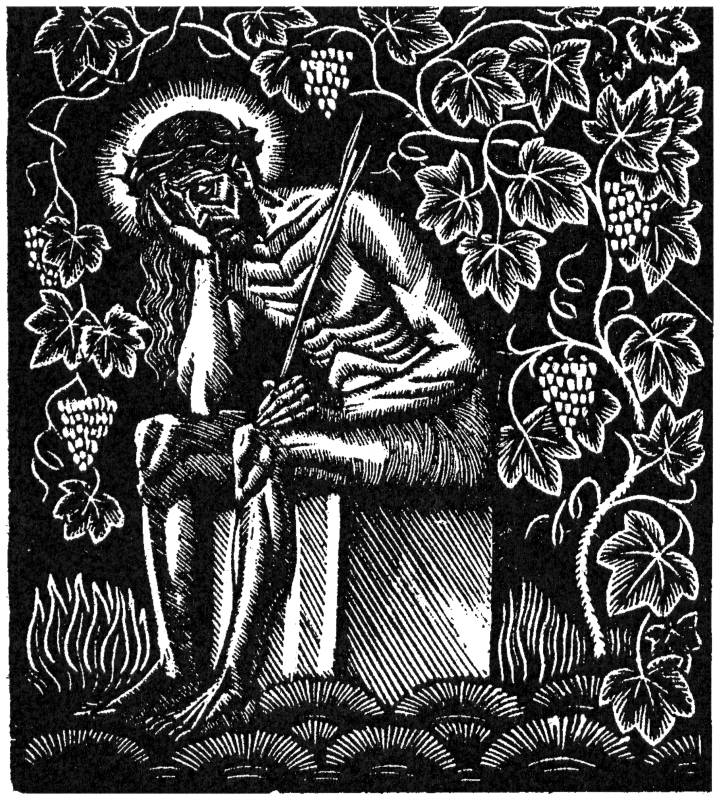
“He made my mouth like a sharp sword, in the shadow of his hand he hid me; he made me a polished arrow, in his quiver he hid me away.” – Isaiah 49:2
Ah, Jerusalem, feel my cutting words! Ah, priests and scribes, feel my penetrating points! Ah, you who stand for God: I wait no longer in the shadow. I speak. I fly.
I wrote this song in the fall of 2018, when a number of conversations turned to a wish for Jesus to come along and start to flip some tables. I expected it to be a rousing, even raucous anthem: but it turned to lament.
They’re changing money in the temple, Jesus. They’re not giving full value for each coin. They’re changing money in the temple, Jesus. They’ve turned a house of prayer… Into a house of thieves…
[Chorus]
What are you going to do about it, Jesus? The gold is piled high… What are you going to do about it, Jesus? Do you see where the gold… lies?
They’re piling money in the towers, Jesus. They won’t even pay the builders their full coin. They’re piling money in the towers, Jesus. They’ve given all that power… Into the hands of thieves…
[Chorus] Listen… to the gold lies. Listen… to the golden lies.
We’ve exchanged our priests for tycoons, Jesus. We’ve given our worship to the coin. We’ve traded priests for tycoons, Jesus. We’ve given our allegiance… To generations of thieves…
[Final Chorus]
What are you going to do about it, Jesus? The gold is piled high… What are you going to do about it, Jesus? Or the tables, where the gold… lies?
Flip the tables: the gold… flies! Toss the tables, Jesus. Make the gold… fly!
Step. Step. Step. Step. Along the road. Down the hill. Across the valley. Up the hill. Rest. Repeat.
I never wished for an interesting life.
Led away today, carrying a man.
Step. Step. Step. Step. Along the road.
What’s all the noise? The cloth is nice beneath my hooves, though frankly I don’t care.
Step. Step. Step. Step. Down the hill.
I could walk this route with my eyes shut. I nearly am today. Who wants a palm leaf in the eye?
Step. Step. Step. Step. Across the valley.
I can’t help notice that among the cheering crowd are sour faces, but I frankly don’t much care.
Step. Step. Step. Step. Up the hill.
It’s funny, though. This man does not weigh much, in truth and yet it seems he bears the world upon his shoulders.
Better his than mine, of course.
Step. Step. Step. Step. Rest.
I wonder – who will lead me home again?
The image is Einzug Christi in Jerusalem (1912), by Wilhelm Morgner – The Yorck Project (2002) 10.000 Meisterwerke der Malerei (DVD-ROM), distributed by DIRECTMEDIA Publishing GmbH. ISBN: 3936122202., Public Domain, https://commons.wikimedia.org/w/index.php?curid=155912.
That’s not the shout of “preacher in a panic,” that. Nor is it Jesus’ commentary on a new disciple who, all eager, failed to strip the palm tree of its fronds to deck the road for his approach.
I might imagine, though, the sad and smiling faces of the other gospel writers who, whatever else they may have written right or wrong, included palms upon the road up to the city’s gate.
At least there’s clothes and cloaks to lay beneath the feet of this strange-sought, strange-borrowed colt, who probably could do without the noise and would prefer the eat the absent fronds.
No, Luke, the colt does not awaken my concern, nor do I worry that its burden misses leaf and branch. Instead, imagination balks to think of waving clothes, not palms, upon this Sunday morn.
Oh, yes. Imagination balks.
We’ll wave our palms, dear Luke, not clothes. But really: how could you forget the palms?
A poem/prayer based on Luke 19:28-40 the Revised Common Lectionary Gospel reading for Year C, Sixth Sunday in Lent. In Luke’s account of Palm Sunday, he does not mention any palms.
We gaze into the night and see the stars a-whirl upon the canvas of infinity.
About the stars the planets dance, making their rounds, spinning, gathering heat, reflecting light.
We gaze into the night with our feet firmly planted on sacred stone.
On mountain’s peak we stand on sacred stone. At ocean’s edge we stand on sacred stone.
When rock runs liquid down the slopes and steams into the sea, it is sacred stone.
When weather wears the rock to soil in layers of richness, it is sacred stone.
When loosened by ohi’a’s root, mixed up with life’s decay, it is sacred stone.
A stately galaxy. A star’s vast heat. A planet’s core. Sacred stone.
A bed for flowers. A soaring pali. A mountain sighing. Sacred stone.
We live on sacred stone.
Sacred stone.
I was asked to provide a closing for a meeting of interfaith leaders last night. I said something like this, which I can’t precisely remember, and has become the seed for this poem.
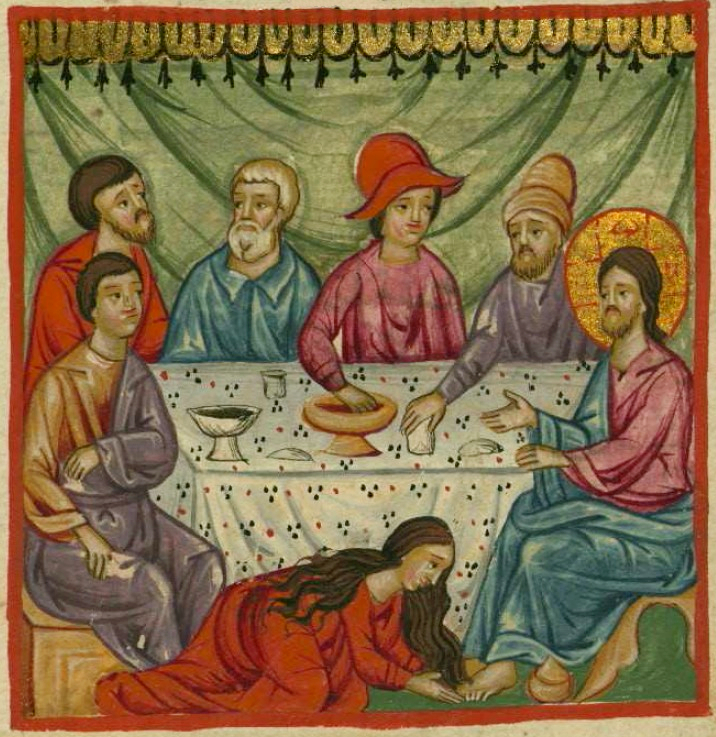
Mary Anoints Jesus by Ilyas Basim Khuri Bazzi Rahib
Jar a-tilting, oil spilling, aroma filling, nostrils widen.
Hair uncovered, tresses flowing, oil clutching to her locks.
Soft voice speaking to her weeping: “Thank you, Mary, for your gift.”
A poem/prayer based on John 12:1-8, the Revised Common Lectionary Gospel reading for Year C, Fifth Sunday in Lent.
Illustration from a 1684 Arabic manuscript of the Gospels, copied in Egypt by Ilyas Basim Khuri Bazzi Rahib (likely a Coptic monk). In the collection of The Walters Art Museum, Baltimore, Md. (on page 51 of the .pdf copy of the document released by the museum under the Creative Commons Attribution-NonCommercial-ShareAlike 3.0 Unported license).
I originally wrote this reflection in April 2011, shortly after I’d shared my most successful April Fool’s Day gag ever: a claim to have been summoned as an “ethical missionary” at a major American corporation. I’ve slightly changed the essay to reflect the fact that since then, I’ve moved from my work with the Connecticut Conference UCC to Church of the Holy Cross UCC in Hilo, Hawai’i. I’ve also inserted a video of the song I wrote about the event, performed in April 2012.
Bear with me a moment, for I must begin this blog post with an apology.
To my friends on Facebook: I sincerely apologize for distressing you with my April Fool’s Day prank last week. I’d never actually intended it to deceive, only to amuse: but it was harder than I thought to create a gag that was both plausible and transparently impossible. Or in other words, I failed to create a fiction that was stranger than truth, and so I deceived, and so I distressed. I’m very sorry.
So what did I do?
I posted a note that I’d be moving to a new job — I hasten once more to say this is NOT TRUE — as the UCC’s first “Ethical Missionary” to a major American corporation. The note included more spurious details, many intended to reveal the joke for what it was, but that’s the summary. A number of my friends responded, and a startling (to me) number took it seriously. I learned a great deal.
I learned again that I have wonderful friends. I’d posited a move across the country, and without exception people expressed two heart-warming things: that they were very happy for my exciting new challenge, and very sad that I’d be so far away. Holding that sense of joy for another with that feeling of loss is, I think, a very deep mark of friendship.
And let us not ignore as well the fact that (so far) all have forgiven me for deceiving them!
I learned again that reality is much stranger than the human imagination — or at least my human imagination. I honestly believed I’d weighted the note with too many impossibilities to be credible. I hadn’t. Let’s face it, on a planet in which both the duck-billed platypus and the giraffe exist, I hadn’t much chance of doing so.
More striking, however, than these two reminders was the revelation of a sudden hunger. My friends sincerely wanted to believe in an ethical missionary, and in a major corporation willing to accept such a person. A friend who is ordained in another denomination praised the forward thinking of the UCC. Another called it “the coolest job EVER.”
It makes me think: maybe it’s a crazy idea, but maybe it’s not such a bad idea.
An ethical missionary to a big corporation faces an enormous challenge, because corporations already have an ethical code which has the advantage of being both clear and compelling. It’s about “the bottom line.”
The bottom line refers to the last line of a particular financial report in a corporation, the line which describes the return to shareholders, the company’s owners. The company’s managers, who may not be among the owners, see it as their duty to keep that number healthy (growing, increasing, certainly above zero). There are plenty of other ethical touchstones as well, about transparency and such, but many of those function to serve the primary goal of returning value to the stockholders.
Jesus, of course, told a story about precisely this situation. We call it the ‘parable of the talents:’ a master going on a journey assigns three servants to steward portions of his fortune while he is away. The two who successfully increase his wealth receive commendation; the one who fails (though without suffering loss) receives condemnation. Ethical managers of a corporation emulate those two faithful stewards.
I think, however, that that model is no longer sufficient (and possibly never was). The group of shareholders, however large, is not an adequate community to consider in making ethical choices. The owners’ interest is served by keeping finances transparent within the management team, but they are also served by making them opaque to customers, employees, and the general public. We have laws to prevent fraud in those interactions, but the laws that exist actively conflict with the primary ethic which guides business decisions day-to-day.
The great theologian and ethicist Reinhold Niebuhr noted this problem nearly eighty years ago in Moral Man, Immoral Society. His brother H. Richard Niebuhr considered the problem of inadequate circles of concern in The Responsible Self, published posthumously in 1962. People in groups act strongly in their own interest; they fail over and over to consider their impact on those around them: the customer, the neighbor, the public.
The financial crisis that erupted in 2008 illustrates this truth over and over and over again. It rose from a game of “pass-the-risk,” one marked by layer after layer of deception, justified by the interests of the shareholders (and not unmarked by the interests of the managers, too). As one might notice from the lack of public prosecutions, it seems to have been legal.
But ethical? Is it ethical to place the global economic system at risk in order to bring maximum return to your shareholders?
I will not, anytime soon, become an ethical missionary to the world of corporate America (or corporate multi-national). If such a job exists, I haven’t heard about it, and though I’ve shifted my ministry from the Connecticut Conference of the United Church of Christ to Church of the Holy Cross UCC in Hilo, Hawai’i, I’m fully committed to ministry in the church setting. It’s a crazy idea.
I’ve never worried before, O God, about the younger son’s repentance. I’ve always gratefully assumed he walked the roads of sackcloth and of ashes. What a shock his father’s welcome must have been!
But now… I wonder.
Was he another twister of the truth? Was he another one who turns the world around his little finger? Did Narcissus blush with shame at his temerity, his lies? And did the pounding of his heart betray his gratitude or hidden glee?
And now… I wonder.
In that Great Somewhere, do you wait for me? Do you wonder when I’ll lay aside deceit – delusion sweet for me, unwitting lie to you – and truly bring my starving soul back home? Does the pounding of my heart betray my gratitude or deeply hidden lies?
Yes now… I wonder.
A poem/prayer based on Luke 15:1-3, 11b- 32, the Revised Common Lectionary Gospel reading for Year C, Fourth Sunday in Lent.
Their sins caught up with them, those Galileans, when their blood got mingled with their sacrifices; not to mention, those unspeakably perverse and foolish people crushed by falling blocks when Siloam’s tower fell: Well. I knew it would catch up with them.
No, seriously, Jesus, wait. I’m talking now.
Have you not said that God is just? Have you not said that God is righteous? Have you not said that God will not be mocked? Not even mocked by cracked foundation stones?
No, seriously, Jesus, wait. I’m talking now.
When I’ve been foolish, yes, and sinful, I’ve owned up. I’ve said, “I’m sorry,” even (sometimes) made amends. I’ve done my best (sometimes) to make things right with them and you.
Should not your justice fall on them as well as me?
OK. I’ll wait. You’re talking now.
…
No, seriously, Jesus, are you kidding me? They weren’t egregious sinners? They weren’t different from me? And what? It’s me you summon to repentance?
…
Oh, great. So I’m a fruitless fig tree now? Have you not noticed all this time I spend proclaiming your divinity, your righteousness, your way? And while you’re looking, see where they bear far less fruit that I…
…
Well, no, I know, I’m not exactly perfect…
…
Well, yes, I know, I’ve many things to change…
…
And yes, I know that I’m the only one who really can change me, and yes, I know I really can’t change anyone else but me, but…
No, seriously, Jesus, wait. I ache for this poor broken world, for all this suffering Creation. Why can’t the evil suffer for the ills they bring? Why must the good endure the pain instead?
No, seriously: Why?
Why?
…
All right. In ignorance unblessed, I’ll keep my eye on me.
A poem/prayer based on Luke 13:1-9, the Revised Common Lectionary Gospel reading for Year C, Third Sunday in Lent.
Photo of the And Jesus Wept statue at St. Joseph Roman Catholic Church in Oklahoma City, OK. Photo by Mike Krzeszak; used by permission under Creative Commons license.