‘Apapane Solo

Once a young ‘apapane learned to sing (which is not unusual).

He grew up to sing with his family, with his friends, and with pretty much any other ‘apapane around. They liked to sing to each other in the trees as they sought the nectar from ohi’a lehua.

Singing just made this little bird feel good. Hearing the songs of the other birds around him made him feel even better. He wasn’t alone. He wasn’t forgotten. He was part of a flock, and they loved and cared for each other as they sang.

As ‘apapane go, he was an adventurous one. He would fly some distance away just to see what was there. He wanted to see new things, and discover new things, and (of course) going to a different part of the forest helped him find ohi’a that was in blossom.

The rest of the flock liked it when he’d explore, and they liked it when he came back, because he often could lead them to the next stand of trees bearing the bright red blossoms that sustained them.

One day, though, he went farther than usual. He was gone far longer than he’d been before, and while he was gone, the other ‘apapane realized they had to move on. The lehua on their stand of trees were going to seed. Making the best guess at the direction he’d taken, they set out after him.

They guessed wrong. Where he flew mauka, up the mountain, they flew makai, toward the lower slopes. They were sure he’d catch up, or they’d find him. But they didn’t.

When he made his long flight back to the ohi’a grove he’d left that morning, he found himself alone.

Sitting in the last tree with fading flowers, he felt very sorry for himself. He took a sip of the last nectar, and munched on some incautious insects, but mostly he felt alone. He opened his beak to make a sound something like a sob. It was a very sad noise.

In a moment, though, it shifted, because all his life he’d sung the ‘apapane song. His lungs and throat and beak all took that shape, purely by reflex, and he began to sing. He sang solo, no other ‘apapane replied, but in the song he realized that he still carried the ‘apapane music with him. His flock was with him, even if he had no idea where they were. They were with him in the song.

He carried on singing until he fell asleep.

The next day, he made a guess at which way the flock had flown, and they made another guess about where they might find him. They’d fly, and settle in the trees, and sing the ‘apapane tune. This time, good fortune was on the wing. He heard them first (there were more of them to hear, after all), but they soon heard his merry reply.

And so they sang once more together.

There is always something connecting us. Sometimes it’s a song, sometimes it’s a feeling. Always, though, it’s love – aloha – that links even people who are very far apart. Even when it seems that we’re at our loneliest, there is always someone who loves you, and best of all, there is always God who loves us best.

The video comes from the American Bird Conservancy’s YouTube channel.
 

Tempest Prayer

20170908 Irma

God of the eye of the storm,
the list grows.
Houston’s population
wading, swimming, weeping
at the floods. Those swelling
waters carried homes and hopes
and lives away along a lengthy
stretch of seacoast and
inland.

And now, O God, the winds
and waves sweep over emerald isles,
carrying away so much
and leaving tears.
Barbuda, Antigua,
Saint Martin, Anguilla,
Tortolla, the Turks, the Caicos,
Puerto Rico, La Española,
and moving still…

Cuba…

Florida…

With another storm
advancing just behind.

As winds rage, the ground shakes
Chiapas, buildings crumble,
the bereft mourn.

O, God, for all who weep
beneath the storm,
above the rocking earth,
I ask your tender grace
to catch and hold their tears.

And God, I ask
for all who weep
beneath the storm,
above the rocking earth,
that you equip my hands
and hands of millions
with your power to help
and heal.

Do what I cannot do, O God,
help me do more than I am able,
for your weeping children.

Amen.

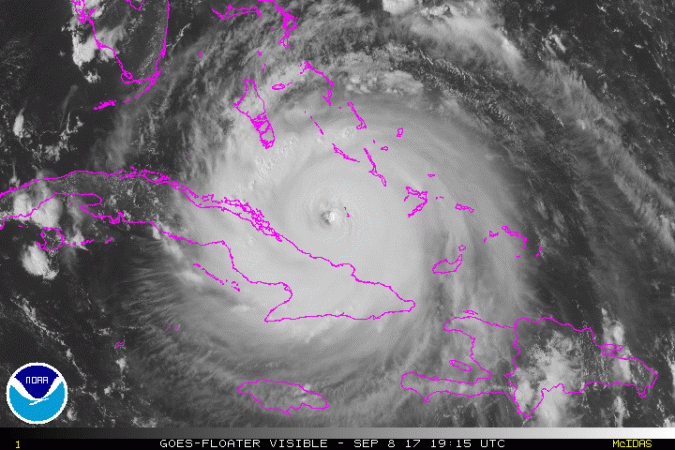
Satellite image courtesy National Hurricane Center. Give here toward disaster relief through the United Church of Christ.

The Many Forms of the Land

20170727 Kamokuna entryA little boy came to his grandmother one day because he had an urgent question. He had to decide what he’d do with the rest of his life.

His grandmother thought he had plenty of time to figure this out yet, since he was only nine or ten years old, but there was no stopping him when he got going on something. So she sat with him and listened.

First, he wanted to become a race car driver, and get behind the wheel of a big and powerful car, and zoom around the track at incredible speeds, and win great big trophies beneath the waving checkered flag. Oh, how he wanted to be a race driver.

“But, grandmother,” he abruptly said, “I don’t think I can do it. I don’t think I’m tall enough. You have to be really tall to drive a race car, right?”

Grandmother tried to break in that he had plenty of time to grow, and she didn’t think you had to be really tall to drive a car, but he didn’t give her a moment to speak. He was off again.

This time, he wanted to be an airplane pilot. He imagined soaring high above the clouds, and seeing places far away, and looking down on the land or the ocean from his airplane above. Oh, how he wanted to be a pilot.

“But, grandmother,” he abruptly said, “I don’t think I can do it. To fly an airplane, you have to go really high. I don’t even like climbing ladders. I don’t think that will work.”

Grandmother tried to tell him that he might learn to be more comfortable on ladders, and she’d seen him racing along the upper levels of the playground equipment, but he didn’t give her a chance to say a word. He was off again.

Now he wanted to be an explorer. He wanted to meet new people who’d never seen other people before. He wanted to be the first to see rivers and waterfalls, and find new kinds of plants and animals. He wanted to wear a leather jacket and a big hat, and speak fifty languages to the people who marched through the wilderness with him. Oh, how he wanted to be an explorer.

“But, grandmother,” he abruptly said, “I don’t think I can do that, either. After all, I really just like to stay at home.”

Grandmother was quick, this time. She jumped in before he picked another thing he’d love to do, but for some reason could never do. I think the hug might have been what worked to help him listen rather than keep talking.

“Grandson, listen to me for a little while,” she said. “I want you to close your eyes and imagine the things I describe to you.

“Imagine the mountaintop,” she said. “You’ve been there. You’ve seen how hard and sharp the rocks are. It’s a harsh, rugged place. And that’s the land. Yes, that’s what land is.”

Going on, she said, “Now imagine the beach. On the beach, it’s soft sand. It settles beneath your foot, and it tickles your toes. You can lie down on it and it cradles you. And that’s the land, too. Yes, that’s what the land is.

“Now imagine the forest, with its soaring trees and ferns growing wildly everywhere. In some places there are rocky outcrops, and in others swamps and reeds. The trees reshape the land as time passes. And that’s the land, too. Yes, that’s what land is.

“And now, grandson, imagine the volcano. Imagine the hot, liquid rock flowing down the mountainsides. Imagine it pouring red-hot into the ocean, and imagine the way it makes new land where there was water before. And that – the liquid lava and the bursting sand, and the hardened rock of the growing shoreline, that’s the land. Yes, that’s what land is, too.

“Land is like all of that, and even more things. Land doesn’t have an imagination; it doesn’t dream of the things it can be, and yet it takes all these shapes.

“Now imagine, grandson: if land can take on so many forms without a will or purpose or imagination, what makes you think that you’re more limited than the land? You have a brain to consider all sorts of things that might be.

“And grandson, you might make any of them happen.”

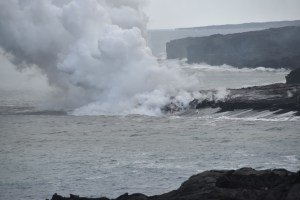
The photo is of lava entering the Pacific Ocean at Kamokuna, Hawai’i, on July 27, 2017. Photo by Eric Anderson.

Baby in the Grass

Moses Laid Amid the FlagsOK! Who’d like to guess what kind of creature today’s story is about?
People? Well, yes, that’s exactly right. Today’s story is about people. You’re very smart.

Parents, I need to let you know this, you’re raising very bright children. Well done!

Today’s story, in fact, comes from the Bible. I’m going to tell it a little differently, but if you’re curious about how it goes, you’ll find it in the first and second chapters of Exodus. OK?

Right. Well, the people of Israel, the descendants of Jacob, had lived in Egypt for quite some time. They’d been really helpful many years before, when they’d helped Egypt survive a terrible famine, when very little would grow, but along came a king who didn’t care to remember that any longer. In fact, he looked around and saw how many Israelites there were, and he decided that he’d make them into slaves. So he did.

That’s pretty horrible.

Then he decided something even more horrible. He was frightened that they would try to find their freedom, or even rebel against him, so he told the Egyptians that they should take every boy born to the Israelites and throw him into the river.

Now, let’s take a test of your sense of right and wrong. Does anyone here think that sounds like a good things to do?

OK. I’m really glad to hear that.

Well, an Israelite woman had a baby boy, and she decided that she didn’t want him killed, even if the king did say so. So she kept him hidden for three months, and that was hard. Babies are noisy. Have any of you ever noticed that? Yes, I thought you had.

So the mother made a basket, and she coated it with tar so it would keep water out, and float. Then she took it to the river with the baby, and floated it on the water where she knew people would find it soon. Just to be sure, she had her daughter keep an eye on it.

Pretty soon, along came one of the king’s daughters. She found the basket, and she knew it was wrong to throw babies in the river. So so adopted this little boy, and took him into her own home, into the very house of the Egyptian king.

This boy’s name was Moses, and he would go on to lead the Israelites out of Egypt, ending their slavery and establishing their freedom.

Now, I expect that from time to time, people will encourage you to do something that you think is wrong. Maybe it will be offering to help you cheat on a test, or it will be to ask you to do something mean to somebody. Maybe people will tell you that you should be cruel to someone because of the way they look, or talk, or the things they can do, or the things they can’t do.

When that happens, I hope you’ll remember these women: Moses’ mother and sister, and the daughter of the Pharaoh. They knew what they’d been told to do, and they knew what was right. They did what was right.

When it made all the difference, they did what was right. And I hope you will, too.

The image shows Miriam placing the basket with Moses in the reeds. The painting (in the public domain) is by Jacques Joseph Tissot.

An(other) Open Letter to the President of the United States of America

20170824 ESAAugust 25, 2017

The President of the United States
1600 Pennsylvania Ave.
Washington, DC 20500

Dear Mister President:

I learn today that you have pardoned Joseph Arpaio, former Sheriff of Maricopa County, Arizona, for his conviction related to violations of citizens’ civil rights in defiance of federal court orders.

Further, I learn today that you have issued a directive to the Defense Department which will ban transgender persons from serving in the United States Armed Forces.

And, of course, I have listened to your words and your tone over the last two weeks since white supremacists marched in Charlottesville, Virginia, and one of them killed a young woman. Your initial response made a false equivalence between people attempting to preserve their civil rights and people who seek to take those rights away from them. Your second response clearly condemned the racist and violent agenda of white supremacy. It was late, but it was clear. But the very next day you returned to that false equivalency again.

Let me be clear with this, sir: there are no two sides between those who would dominate and those resisting domination. We are not talking about plain bigotry. We are talking about who makes choices for other people. The white supremacists claim that they should make the decisions which impact those of darker skins, or who are women, or who find love differently than they.

They are wrong. They should not. And you should not encourage them as you did last week in Phoenix, as you have done today with the pardon for Mr. Arpaio, and as you have done today with a ban on transgender persons.

Fortunately, there is a remedy for this. It is called repentance, and it is an ancient religious tradition. Here’s how it works:

You acknowledge the wrong.

You apologize for the wrong.

You do what can be done to undo the wrong. Now, you can’t revoke the pardon for Mr. Arpaio, but you can clearly order ICE agents to refrain from the racial profiling activity Mr. Arpaio engaged in.

And you strive never to do that wrong again.

Sir, you owe it to the American people. We need to see that you serve all America’s citizens, and not just those with light skin.

If you cannot, there is another remedy. It’s also very simple. It goes like this:

You address a letter to the Secretary of State, which reads:

“I resign the office of President of the United States.”

Because, sir, if you cannot apologize for these words and actions, you should not hold this office.

Peace to you,

Eric Anderson

Sometimes You’ve Just Got to Fly

The koa’e kea (or white-tailed topic bird) lives on the cliff sides around Kilauea. Well, some of them do. Some of them lives elsewhere around the islands.

White-tailed_tropicbird by YooshauThe koa’e kea flies down to the ocean to search for fish in the tossing waves. It is a strikingly beautiful bird, with bright white feathers set off by jet black ones. Plus, it has a long, narrow tail – the tail is longer than its body! It streams out behind it in flight.
This one koa’e kea was a serious kind of bird. He wanted to be certain to take care of things that were important. That meant, first of all, keeping himself properly fed, so he was often found scanning the sea for signs of fish or squid (sorry, calamari). He did not want his energy to flag because he’d skipped a meal.

He also paid a great deal of attention to making sure he had a proper nesting place. He looked carefully for the best place, where the nest would be safe from predators (or from accidentally falling down the cliff side).

He paid attention to other important things, too. He knew the importance of friends. So he joined in the conversations and the controversies, and he was always there with a joke.

(I’m afraid I’ve never been able to properly appreciate the humor of the koa’e kea. It mostly sounds like “SQUAWK!” to me.)

He found himself puzzled by his friends, however. Sometimes, for no apparent reason, everybody would take off and start to circle around Kilauea’s summit. They’d dip and dive, and climb and soar. They weren’t hunting anything (food was four thousand feet below in the ocean), they weren’t telling jokes (since every conversation went something like, “SQUAWK!” “What did you say?”), and they certainly weren’t tending nests.

It was all rather baffling.

Worse, he seemed to be the only one who didn’t understand it. His friends did it, but so did their parents. So did their parents’ friends. So did his parents. Everybody, from time to time, would just soar about the volcano.

Everybody except him.

He asked his friends about it, but they were just vague. “Why fly about the volcano? Well, no reason, I suppose,” they’d say. He swallowed down his annoyance. And finally asked his mother.

“Son,” she said, “you’re a good son.”

He nodded his thanks.

“But sometimes I think you miss things from doing everything so seriously. Life is more than keeping fed; it’s also about enjoying the fish you caught. It’s more than having a nest; it’s also about rejoicing in the chicks you raise. It’s more than chatting with friends; it’s also about enjoying their company in silence.”

“Son,” she said, “I know you can use you wings to get from place to place. But did you ever just stretch them out and fly?”

He looked puzzled.

“Sometimes,” she told him, “you just need to fly.”

You and I, well, we don’t have hollow bones and feathered arms. We’ll have to fly in other ways. But when we do find those ways – a song to sing, or a hill to climb, or a picture to make, or a thought to think – that’s when we, too, can fly.

And I assure you that this koa’e kea: he learned to fly.

20170819 Kilauea panorama

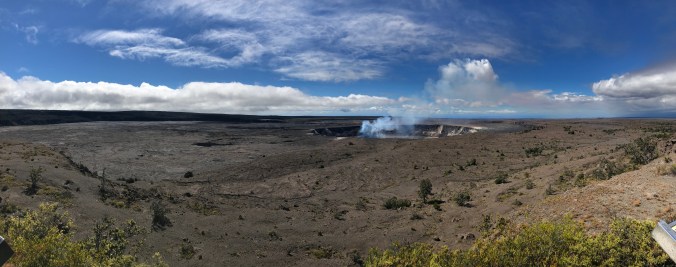
Kilauea Summit (Photo by Eric Anderson)

Photo of white-tailed topic bird (koa’e kea) in flight by Yooshau – Own work, CC BY-SA 3.0, https://commons.wikimedia.org/w/index.php?curid=18333581.

An Open Letter to the President of the United States after Charlottesville

Downtown Charlottesville 201708

Downtown Charlottesville, Virginia, on August 14, 2017. Her name was Heather Heyer. Photo by Bob Mical. Used by permission under Creative Commons license.

The President of the United States
The White House
1600 Pennsylvania Ave.
Washington, DC 20500

Dear Mister President,

I listened to your words on Saturday, August 12th, responding to the racist and white supremacist rally and riot in Charlottesville, Virginia. I heard you lament the violence and I heard you cast blame on “many sides. On many sides.”

Mister President, you must choose a side.

On the one side, there are those marchers: all white, mostly men. These are the ones shouting, “You will not replace us,” and “Blood and soil.” Do you recognize those words, sir? Do you recognize that the latter was a slogan of the Nazi Party in Germany? Do you recognize that the former implies a race-based rivalry between American citizens?

Do you recognize that you have fed both of these?

On the other side, there were the other marchers. Their skins were white, and brown, and deep brown. They were men and women. Many of them stood with arms linked wearing the vestments of religious leaders. Those people sang songs of peace as those others, carrying clubs and guns, shouted their slogans of division and hate.

These are the people mowed down by a speeding car, driven into them in an act of terror.

Do you recognize that you have failed to heed these voices of justice and peace?

The white supremacists know. They heard your words. They recognize that you have not condemned their false doctrines or their belligerent slogans or their evil purposes.

Until you condemn their ideals, until you condemn their goals, until you condemn their actions, they will know. We will all know.

I call upon you now to fulfill your oath. Be President to the United States to the entire United States. Repudiate the voices of white supremacy; reject their affirmation of racism. Make it clear. Make it certain. Make it forceful.

If you do not: the citizens of this country are listening. And we will know which side you have chosen. So will all the world.

I await your repentance and your amendment.

Sincerely yours,

Eric S. Anderson
Pastor, Church of the Holy Cross United Church of Christ
Hilo, Hawai’i

Ego without Wisdom

I sent this letter on Sunday, August 13th. I had not yet decided whether to post this after the President’s statement on August 14th condemning racism and white supremacy. His return to rhetoric blaming counter-protesters on August 15th, however, prompted me to make this letter public.

Don’t Feed the Ego of the Ruler

Recently, a pastor of a large church on the mainland — the Rev. Dr. Robert Jeffress of First Baptist Church (SBC) of Dallas, Texas — wrote this to the Christian Broadcast Network News:

“When it comes to how we should deal with evil doers, the Bible, in the book of Romans, is very clear: God has endowed rulers full power to use whatever means necessary — including war — to stop evil. In the case of North Korea, God has given Trump authority to take out Kim Jong-Un.”

The passage to which he refers is Romans 13:1-7. I’ll include it in full at the close. He’s given us a very shallow reading of the text, and considered absolutely none of its context. In Romans 8, for example, the apostle Paul (the writer) notes that there are other powers in the world that are clearly unauthorized by God. Paul urges people to bless those who persecute them in Romans 12, maintaining a theme found elsewhere in the letter that suggests the Christian community in the imperial capital was under stress. Lots of stress.

Dr. Jeffress also ignores the context of Paul’s life and death. He was executed by the rulers whose “God-given authority” Paul so blithely commends in Romans 13. Does Dr. Jeffress really mean to say that Roman persecution of the early Church, which claimed the lives of so many of its earliest leaders, was God-driven? Does he mean to imply that their arrests, detentions, and executions were the result of their “bad conduct”?

Dr. Jeffress, were he to look, could find abundant Biblical examples of good conduct being rewarded with bad treatment at the hands of authorities. The people of Israel enslaved by Egypt… The prophet Elijah pursued by King Ahab and Queen Jezebel… The prophet Jeremiah imprisoned by King Zedekiah… Jesus…

Paul was simply wrong. Authority is no indicator of God’s favor, endorsement, or direction. As I read this text, I actually hear Paul trying to restrain a burgeoning movement toward violent rebellion. He’s attempting to restrain a violent response to an increasingly violent persecution by the governing authorities. Governing authorities, I note once more for Dr. Jeffress’ sake, that took his own life unjustly.

But truthfully, I didn’t need to do much Biblical research to know that Dr. Jeffress was wrong, because his public statement giving Divine approval to authority applies both to the U.S. President and to the Supreme Leader of North Korea.

Most troubling for a servant of Christ, the public statement serves only to inflate the ego of the President. It provides no new information about the situation. It gives no moral guidance. It offers no alternatives to death and destruction.

Dr. Jeffress, Jesus is not about inflating the ego of rulers.

Dr. Jeffress, Jesus is not about uncritical moral decision-making.

Dr. Jeffress, Jesus is not about death and destruction.

Hear me when I say this:

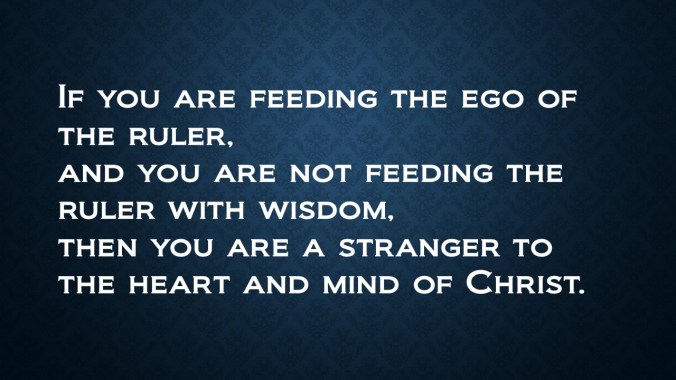
If you are feeding the ego of the ruler, and you are not feeding the ruler with wisdom, then you are a stranger to the heart and mind of Christ.

I’ll say it again:

If you are feeding the ego of the ruler, and you are not feeding the ruler with wisdom, then you are a stranger to the heart and mind of Christ.

Dr. Jeffress: Repent.

Ego without Wisdom

Romans 13:1-7

Let every person be subject to the governing authorities; for there is no authority except from God, and those authorities that exist have been instituted by God. Therefore whoever resists authority resists what God has appointed, and those who resist will incur judgment. For rulers are not a terror to good conduct, but to bad. Do you wish to have no fear of the authority? Then do what is good, and you will receive its approval; for it is God’s servant for your good. But if you do what is wrong, you should be afraid, for the authority does not bear the sword in vain! It is the servant of God to execute wrath on the wrongdoer. Therefore one must be subject, not only because of wrath but also because of conscience. For the same reason you also pay taxes, for the authorities are God’s servants, busy with this very thing.

Pay to all what is due them—taxes to whom taxes are due, revenue to whom revenue is due, respect to whom respect is due, honor to whom honor is due.

The Patient Honu

Honu swimmingThere are plenty of things to like about being a honu, a sea turtle. Just to start, there’s the joy of swimming in warm tropical waters, and of dipping down deep for the refreshing coolness, and rising to the surface again for a breath of air. Oh, yes, that’s something to like.
Swimming will also bring you down to the beds of sea grass, where you can nibble the tips from their shoots. Well, yes, I expect the honu would enjoy that more than you would, or than I would, for that matter. But we’d all enjoy doing acrobatics in the water, and when you’re ready for a rest, I know we share with the honu a huge affection for naps in the warm sun on the beach.

A young honu had done all this and more. Born on a beach on this island, he’d actually made a swim all the way around, and further, he’d taken a little expedition over to Maui. He’d seen different kinds of fish, watched seabirds float on the air, and tasted different sorts of seaweed. He’d sunned himself on white sand beaches, gray sand beaches, black sand beaches, and even a green sand beach. He rather thought he’d seen it all.

But he found one older honu rather puzzling.

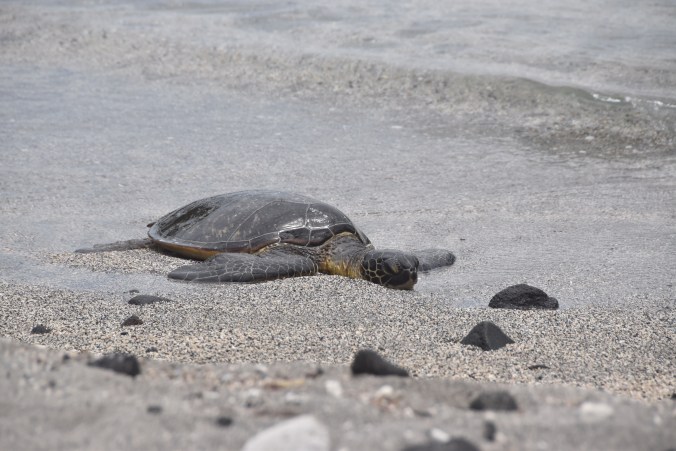
He found her one day after she’d pulled herself up on a beach for a nap in the sun. The trouble was, there wasn’t any sun. It was clouds from one edge of the sky to the other. She appeared to take no notice as she lay there placidly on the beach, just as still and calm as if the sun were beaming down.

The younger one hauled himself up close to her and asked her what she was doing.

Then he asked again. And again. He had to tap her flippers once or twice to catch her attention. When this honu napped, she took her naps seriously. Finally she was awake enough to hear his question.

“What are you doing?” he asked.

“I’m napping in the sun,” she said.

He took another look about to make sure of his facts. No, he didn’t see any sun.

“But it’s cloudy,” he told her.

“I know,” she said.

“There’s no sun,” he said.

“That’s true,” she replied. “At least not now.”

“Then what…?”

“There are things in life that only come along once or twice,” she told him. “There are some kinds of fish you’ll see only once, or maybe even never, that your elders can tell you about. There are seaweeds that only grow in special places. There are friends who’ll decide to move about and you may not see them for years.”

“But there are other things,” she went on, “that come and go all the time. The kohola (humpback whale) visits in the winter, and swims away in the spring, and comes back the next year. You eat the tips of the sea grass, and they grow more. The tides roll up and roll back on the island shores.

“Sunshine is like that. It’s waiting behind those clouds. There will be sun on the beach.”

Sure enough, the clouds parted and a sunbeam glistened on the beach and on the water. Just for a moment, as it happened. And not where the two honu were talking. In fact, it disappeared almost as quickly as it appeared.

“It will be back,” the older honu sighed. “For some things — sea grass, rain, waves, tides, and sun — all you have to do is wait.”

And she laid her head back down on the sand, closed her eyes, and resumed her nap in the sun — the sun which would come as she waited.

Honu on beach

The Puzzled Nene

20170729 NeneThere was a young nene — that’s the Hawaiian goose, by the way, and did you know that it’s Hawai’i’s state bird? Good!

There was a young nene who lived on the slopes of Kilauea. Sometimes he’d be high up on the mountain, flying in search of ripe ‘ohelo or grass seeds or naupaka berries. Sometimes he’d fly makai, down to the rocky shoreline, where the other naupaka might be ripe.

It was on one of those days — when he was happily swallowing down the white ripe naupaka berries with some friends — when something unexpected appeared. A tall creature, standing easily five or six times his own height, came around a rock and stopped abruptly, standing on two legs. Three or four others appeared as well, stepping up onto rocks and coming into view.

The nene gave a small honk of greeting, but the creatures made no such understandable sound back. They did seem to be calling to each other.

They didn’t approach; in fact, they drew back some after the initial encounter. The nene found that puzzling. He was surprised that they didn’t come near.

Even more puzzling, they each produced flat rectangular objects that they held between themselves and the little group of nene. That made no sense at all to young bird, or to any of his friends. Did these creatures not want to look at them?

Most puzzling of all, after a time of box-holding, non-sensical noise-making, and back-drawing, the creatures turned on their two heels and walked away. Without eating a single naupaka berry.

To a hungry nene, that was the most puzzling thing of all.

If the nene ever learned what it was all about, I never heard about it. There were many things he didn’t know. He didn’t know that he and his friends were rather rare, and that humans had come to care about them. He didn’t know that humans aren’t supposed to approach nene, and if they do, they’re supposed to step away without troubling them. He didn’t know that humans are supposed to leave their food alone, so that the nene have enough to eat. He didn’t know any of that.

He didn’t know that there were people watching over him and his cousins, to see that they had every chance to live a good and healthy nene life.

Unlike the nene, we do know that God watches over us. We may not know precise how God is caring for us at any given moment, but we do know that God care at every single moment.

We know that God is always there.

Photo by Eric Anderson, taken with a flat rectangular object that shielded his face from the nene.