Running

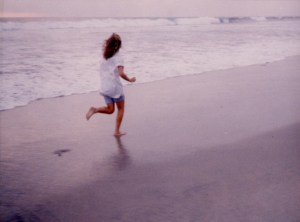
Running beach Don GrahamI don’t know how she reached the age of seven years old without learning to run, but she hadn’t.

I guess she hadn’t seen the point. There weren’t any reasons that she couldn’t run — she’d never even been told “No running in the house!” by her parents (probably because she didn’t) — she just didn’t run. She could walk, slowly or quickly, as the moment required, but she didn’t run.

Now came the day that she wanted to. So she set out to learn.

Running isn’t like walking (you heard it here first, folks!). In walking, there’s always one foot on the ground. When you’re running, there are times when you sail through the air.

She’d watched her friends and family, and even slowed down movies, so she knew this. So she started with hopping.

First she hopped back and forth with both feet together. Then she tried hopping on one foot. Then she hopped from one foot to the other: back and forth, back and forth, back and forth.

She tried making longer hops forward.

Then she tried making one one-legged hop forward, followed by another, followed by another.

She fell down on hop number four.

That might have been discouraging, but she only sat up and congratulated herself for picking a soft field to practice in.

She tried different approaches. Sometimes she hopped a little more sideways (kind of like a crab) and sometimes she tried crossing her feet back and forth in front of her (she gave up that one pretty quickly). When her feet got tangled up, she’d try the same thing again, and if it tripped her the second or third time, she tried something else.

She kept at it, remembering to experiment through the process, and keep her mind on the goal.

By the end of the day, she was running around the field with a grin as wide as the sea. She wasn’t fast, it was true, but she was authentically running, and she knew she’d get faster with each new day.

Her friends, it must be said, were very impressed, both with the running, and with the smile. Together, they charged off into each new day.

Photo by Don Graham. Used by permission under Creative Commons license.

Imagining Cleopas and Companion

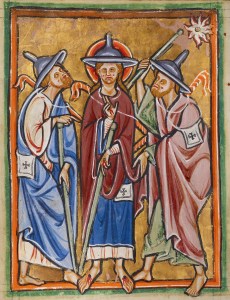
The_Road_to_Emmaus_-_Google_Art_ProjectI wrote this little dialogue for the sermon “Hidden Messiah, Visible Messiah,” preached on April 30, 2017, at Church of the Holy Cross UCC in Hilo, Hawai’i. It, um, “fills in” part of the story omitted from Luke 24:13-35. I’ve always enjoyed inventing these conversations. So here it is in a stand-alone format.

One: “That was Jesus.”

Two: “Yes. That was Jesus.”

One: “So he’s really resurrected?”

Two: “Apparently so.”

One: “Just like Mary Magdalene, and Mary, and Joanna said.”

Two: “Just like they said.”

One: “Wow.”

Two: “Wow.”

The two disciples were silent for a moment.

Two: “And how far did we just walk with him?”

One: “About six miles or so.”

Two: “And we didn’t recognize him until just a moment ago.”

One: “That’s right. We didn’t.”

Another silence falls.

One: “Do you want to go back to Jerusalem and tell this story to all our friends?”

Two: “No. Do you?”

One: “Not for a moment.”

More silence.

One: “We have to, though, don’t we?”

Two: “Yes, we do. Let’s get going.”

One: “They’re going to hold this over our heads for two thousand years aren’t they?”

Two: “Could be. But if you’re lucky, Cleopas, they won’t remember your name.”

Hidden Things

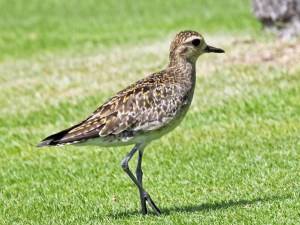
Pacific_Golden_Plover_hawaii_RWDAs I invited the young people to come forward, I gathered my notes and brought them down front with me. 

I don’t usually bring notes with me for these stories, but I’ve managed to get the name of this bird wrong five times this morning, and I want to get it right. Because this story is about a kolea.

There are a lot of kolea about this island these days. In English, they’re called the [look at notes] the Pacific Golden Plover (the Hawaiian name is easier, isn’t it?). They’re all born in Alaska, which is a long way from here, and they have the good sense to fly here to Hawai’i to spend the winter. That’s where they are now, but they’re all getting ready to go back to Alaska. There they’ll look to find mates, and build nests, and lay eggs, and hatch chicks, and raise the young birds.

And then they’ll fly three or four days, flying without landing, to come back to this island again.

Well, this one young kolea had only made one of those long flights: the time she flew here after her birth in Alaska. That had been a grueling four days, but she made it, and she had enjoyed her stay here on Hawai’i. The time is coming for her to make the trip to Alaska for the first time.

Which means that she eats pretty much anything she can find, so she’ll have the strength. But she’s also wondering what will happen back in Alaska.

Will she find someone to build a nest with, and raise a family with? Will she find love? And how will she know?

The older birds have been telling her not to worry. Male kolea fly and dive about to show their territory. There are calls and hops and ways to hold their wings.

One older female took her to a grassy place, maybe a little bit like our lanai, and said, “Look there. Is there anything to eat in that grassy place?”

The kolea looked, and quickly counted eight bugs and two slugs.

Yes, kolea like slugs. I’m glad something does. I’m really glad that something isn’t me!

“Yes,” she said, “I count eight bugs and two slugs.”

Why are you making that face? Oh. You don’t like thinking about eating slugs. Well, I don’t either. We’ll think about something else, then.

The older kolea said, “Look again. Now tell me, how many of those do you actually see?’

“Well,” said the younger one. “Just two, actually.”

“How do you know the other ones are there?”

“I can see that they must be there. It’s how the grass moves, or doesn’t move when the wind is blowing.”

“That’s right,” said the older bird. “We learn about what is hidden by how it changes what we see.

“So don’t worry. There will be a bird who loves you. And he’ll show it. You’ll know how he feels by how he acts toward you. You’ll see more than enough signs to know.”

I’m sure she will.

And it’s true of us, too. We learn about what is hidden by the way it influences what we can see. So we can see that others love us by how they act toward us, how they care for us, how they listen to us and talk to us.

So that when somebody loves and care about you, you will know.

Photo is by Dick Daniels (http://carolinabirds.org/) – Own work, CC BY-SA 3.0, https://commons.wikimedia.org/w/index.php?curid=18649090. Used by permission.

To the Attorney General of the United States

IMG_2103Dear Mr. Attorney General,

According to your statement in an interview, you do not feel that a judge on “an island in the Pacific” should be able to review a federal executive order.

Apparently, Mr. Sessions, you haven’t heard that federal judges do, in fact, have the power to review executive and congressional action and evaluate them for constitutionality and adherence to other relevant federal law. Or, I suppose, you haven’t heard that the judge in question is, in fact, a federal judge.

I’ll assume that you know that this island in the Pacific is a full member of the United States of America.

Well, Mr. Sessions, this is one of several islands in the Pacific, it’s true. Islands, it seems, where we can read an executive order and spot its inhumanity, its injustice, and its betrayal of American values. Islands, it seems, where we understand the processes of American jurisprudence. Islands, it seems, where we will stand for the best of America when others will not.

Mr. Sessions, you are an officer of the court. You owe a federal judge an apology. Mr. Sessions, you are a cabinet member of this administration. You owe an entire state (some of whose citizens voted for your principal) an apology. Mr. Sessions, you are a human being. You need to examine your heart, abandon these policies of racial and religious discrimination, and start over.

Mr. Sessions, you need to repent.

Sincerely yours,

Eric S. Anderson, Pastor
Church of the Holy Cross United Church of Christ
Hilo, Hawai’i

Slippers and Resurrection

Flip-flop by Zeev BarkanThis story is about that same little girl who always seemed to have two things on her mind. You might remember her from the times that she was trying to fly kites and understand love and so forth.

Well, she awoke one morning and put together her two-item agenda for the day. And the first thing she wanted to do was learn how to run and keep her rubber slippers on her feet.

You see, that was just something she’d never been able to do. At some point when running along, whether the ground was grassy or graveled or paved or something else, suddenly she’d be running with only one rubber slipper on one foot. The other would be somewhere else in the field, or the driveway, or wherever. It never failed — and she was determined to make that change.

The second thing she wanted to do that day was understand how Jesus had risen from the dead. It was around Easter time, after all, and she’d heard a lot about that.

Let it not be said that she was afraid of asking difficult questions!

So she and her friends went out to a nice grassy field, and they started running. They went hither and yon and up and down and back and forth and this way and that, and pretty much every time, there was at least one rubber slipper left behind.

Sometimes two. Or frequently two.

They tried different things. They tried putting their legs straight down, which didn’t help their speed or, as it turned out, prevent the other slipper from falling off. They tried clenching their toes in all sorts of different ways, but somehow they couldn’t maintain the grip all through their strides. They tried running with knees up and knees back; they tried running backwards and sideways; they tried swapping them from one foot to the other (because, after all, why not?).

None of it worked, or if it did, it slowed them down so much they might as well have been walking. At some point, a slipper would sail away as if it had something else it would rather do.

It was all quite disappointing.

So she went to find her grandparents, who usually had pretty good answers to difficult questions like this. They were together, so she hopped up before them and asked, “How do I keep my slippers on when I run?”

(It took the grandparents a little time to understand the question, which had taken them by surprise.)

Then they looked at each other for a second or two, before they looked back at their granddaughter and confessed, “We don’t know. If there is a way to keep them on when you’re running, we never found it.”

“In fact,” they added, “We always thought that’s why you call them slippers. Because they slip off, you know.”

The news came as a disappointment, but also as something of a relief. After all, it meant that she and her friend weren’t hopelessly clueless about life.

But speaking of the unknown, she put her second question to them: “How did Jesus rise from the dead?”

Her grandparents looked at one another again, and then back at their granddaughter.

“We don’t know that, either,” they gently said. “It’s a more amazing thing than keeping a rubber slipper on. But we think it has to do with how much God loves, and how strong God’s love is. It’s strong enough to bring Jesus to us. It’s strong enough to bring Jesus’ message to us. And it’s strong enough to bring Jesus back to us.”

She thought about that for a moment, and gave her grandfather a big hug. “Love like that?” she asked.

“Like that, only even bigger,” he told her.

She gave her grandmother and even bigger hug, and asked, “Love like that?”

Her grandmother laughed for sheer joy and said, “Exactly like that: Only even bigger, and grander, and stronger.

“Yes, grandchild: Exactly like that.”

Two notes: First, this story led into the dedication of rubber slippers collected by the church to be given to local school health aides. They will be available for children whose rubber slippers break or disappear during their active days, and for those who appear at school without them.

Second, I was told after the service by a proud (and wondering) grandmother that her grandchildren run around all day in rubber slippers without them ever falling off. So I guess there is a secret to it — but I sure never learned what it is!

The photo is by Ze’ev Barkan, used by permission under Creative Commons license.
Searching for Jesus

2017 Easter egg hunt group

Photo by Gloria Kobayashi

I told this story to the young people waiting to begin the Easter Egg hunt. I must say, for a group of children eager to find decorated eggs and candy, they were remarkably patient with the storyteller! They even posed for a photo.

You’re all here to hunt for Easter eggs that have been scattered around the church grounds. And what a lovely sunny morning it is to do it!

Some those eggs might look familiar, if you were here yesterday and part of the group that dyed them all these wonderful colors. These are real, cooked eggs. If you crack one open, well, you’ll find lunch.

You know, you make it into egg salad?

Some of them, though, are brightly colored, but not because they were dyed by people yesterday. Their color got molded right into the plastic. And I’m told that if you open the plastic eggs, you might find something sweet inside…

Money? Well, I don’t think these eggs will have money in them. Chocolate, now: that’s a real possibility.

On the first Easter, they didn’t go on an Easter egg hunt. Instead, some of Jesus’ friends went on a kind of Jesus hunt. That’s sort of like an Easter egg hunt, but a lot simpler. There was only one place to look, and that was the place where he’d been buried on Friday, after he’d died on the cross.

What turned it into a Jesus hunt was that he wasn’t there any longer. That’s unusual. Most people, when they die and are buried, tend to stay in the same place.

Easter eggs, now they can be anywhere. And suddenly it turned out that Jesus could be anywhere, too, except for the one place that they’d been certain he’d be. He had been dead, but he was no longer dead. He had been buried, but he was buried no longer. He had been in a grave, but now the grave was empty.

So a Jesus hunt was a pretty amazing one to do.

And it’s still something you and I can do. Jesus said that he pays attention to how people treat one another. In fact, he said that when you treat pretty much any person well, you’re treating Jesus well.

So: After you’re done hunting for Easter eggs, try going on something of a Jesus hunt yourself. Go looking for someone that you’d like to treat as well as you’d like to treat Jesus.

It won’t be hard. There’s a lot of people in the world, and there’s some Jesus in every single one of them.

Be good to them, and you’ll have found Jesus. Be good to them, and Jesus will smile.

Have a good time!

Easter Sunday, 4:00 AM

Moon - 1Dear rooster, if you mean to greet the dawn
You are two hours early. Rest your head
And wait for light. I grant you that the lamps
Above the streets, the passing beams of cars,
The rumble from the airport, these could cause
Confusion. Still, if on the other hand
Your purpose is to summon sleepy me
From out my bed to be a herald of
The Easter dawn that lies ahead I grant
You that your timing cannot be improved.

Or do you crow, remembering that Christ
Did not await a dawn to rise, but made
His hidden resurrection while the shades
Of night obscured his newly living steps
Into the yet-unknowing world? Quite right,
Dear rooster, you are right, to crow at this
Un-lightened hour, praising God who loves
At dawn, at noon, at close of day, and night.

A Happy Easter to you, rooster. Crow!

Jesus, I Hope Your Holy Saturday was More Restful Than Mine

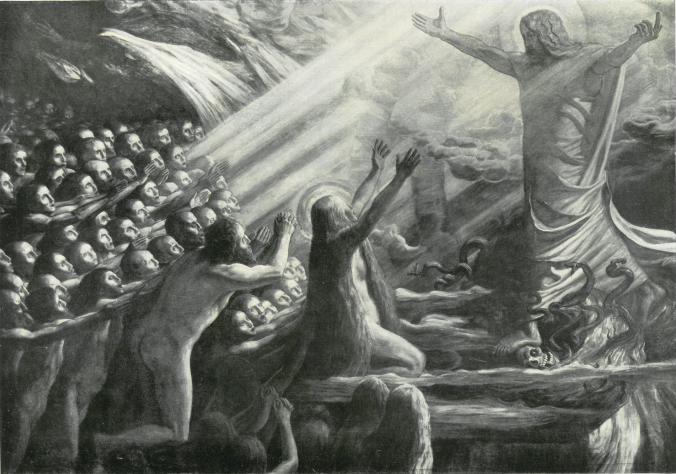
Skovgaard-ChristusImReicheDerTotenBut it probably wasn’t, was it?
Peter says you went and spoke to the “spirits in prison,”
And dear old Dante Alighieri
(Along with plenty others)
Deduced that that meant Hell.

My goodness, how we name your Holy Days.
“Good Friday” when you struggled, suffered, died;
And “Holy Saturday” for time you spent
In an unholy place, as far as you could travel
From the streaming light of God.

“No rest for the wicked,” runs the phrase,
And no rest for the good, it seems,
To take your harrowed soul, and harrow Hell,
Summon hopeless spirits from their separation
And restore them to the light of God.

Perhaps our naming instinct chooses
Better than I thought – it was a Holy Saturday
For spirits held in prison. O blest deliverance,
And blest Deliverer, to break their separation
And restore them to the light of God.

Come, Jesus, on another Holy Saturday
For there are spirits bound alive
By slavery, by wealth, by greed, by bondage to a drug or pride.
O blest Deliverer, come break their separation
And restore them to the light of God.

Before the Finish Line

IMG_2072Oh, what a night.
I shouldn’t be surprised
That they were so surprised
(My friends at last night’s supper).
A holy day is not a time, of course,
For breaking bodies with your bread,
For drinking blood instead of wine
(Hey, did you catch what I did there?
It’s like that plague of Egypt, where
God turned the water into blood?
Hey, anybody? No?).

So maybe telling everyone
That they would flee before the night was out
Was something of a downer.
Peter: Always first, you are
To give me the wrong answer
(Except that one most special time, you know,
Although I think that what you mean by “Christ”
And what I mean might be two different things).
Stay by me? “No, my friend, you won’t.
You will not even own that we are friends
Before the cock crows thrice.”

Oh, what a night. I guess I wore them out,
Or certainly they would have stayed awake
While I was praying, weeping, shaking
In anticipation of the end of night.
Night’s end! It should have been a rosy dawn
Whose colors summon promise, life, and joy!
But no, the day has brought me
No relief from woe.

Day has brought me no relief from woe.
Now they lay on questions.
Now they lay on whips.
Now they make a crown with thorns
(Now whose idea was that?)
And jam it hard into my brow.

It hurts.

It hurts, but less than when I saw my best friends run.
It hurts, but less than when I heard the rooster crow.
It hurts, but less than when I saw the face of Judas
Leaning toward me with a kiss.

It hurts.

Well, do your worst, you Romans.
You will; you always do!
Good luck to you, though, Romans,
Because you’ve broken my poor body
So my shoulders will not bear a cross
Up these stony streets. Take that!

I know you’ll find a way to get me there
And get the cross. You’ll fasten me upon the wood
And lift me up and watch and wait
Until my straining lungs exhale
A final time, my “It is finished.”
You’ll get me to my “finish line.”
(Ha! Foolish Romans! Beat me as you will,
You will not steal from me
A gallows humor even as I look
Upon the cross I cannot carry
Up to Calvary’s hill)

And, foolish Romans, do you think
My “It is finished” line is my finish line?
Not for a moment (Well, all right,
For more than just a moment:
For three days. But let that pass.).
I may not lift my cross, but I will lift my life
From out the grave you’d leave me.
No, Romans; and no, Judas;
No, kings and priests and others
Who would claim to speak for God:

You may drag me to a finish line
And claim I’m finished.
But I am never done, or gone,
And I will turn my finish line
Into a new beginning.

Holy Week: Palm Sunday Stones

IMG_2064Let the stones cry out, O Lord, for we are stunned to silence.
Let the cobbles of uneven paving end their reticence,
Break their stillness (does the shout of rock sound like a cracking?),
Raise their voices. Let the stones cry: “Save us! Lord, Hosannah!
Blessed are You who come to bring salvation of our God!”
Crackling praise. If loud enough, perhaps it might drown out
The heaving of our weeping.

We weep for children poisoned by the falling bombs in Syria.
We weep for warriors slain when missiles came to them with death.
We pray for people walking, standing, falling as the truck rolled on.
We pray for people worshiping, and waving palms, recalling You
And how devotion shattered in concussed reverberation.
Let the stones cry out, because your people’s voices
Have been called to weeping.

“Hosannah!” “Save us!” Cry it, stones, as Jesus makes his storied climb
Beneath the venerated gates, with steady step of his swift-borrowed steed,
The one he chose to honor Zechariah, “Humble, riding on a donkey,”
Yet still a declaration of his majesty. Cry it, stones, though your voice be muffled
By the palm leaves strewn upon your surfaces, by the cloth
That’s laid across your seams. Cry it, stones: “Hosannah! Save us!”
Because our voices have been lost to weeping.

Upon your humble mount, O Jesus, what comes to your ears?
The ears of One divine and human? Do you hear our sobs
Across the centuries, though muddled in the mix of cries,
“Hosannah! Save us! Bless us with salvation from our God!”
Their cry, the cry of stones, the cry of desperate humanity,
Is ours. Save us, Lord, from all the evil we would do:
Because our voices have been lost to weeping.