Dust Prayer

kileaua-iki-sand-20161010“Remember you are dust, and to dust you will return.”

I’m not complaining, God, but I don’t feel like dust.
Sensations far more liquid dominate my body.
Perspiration trickles in the hollows of my spine.
I cannot count the instances of swallowing saliva.
I cannot count the welling tears of sadness,
Or joy, or simply yawning (wetly) at the close of day.
No, I don’t feel like dust. Like mud, perhaps, or clay
Unfired,
Unglazed,
Unfinished,
Unrefined.

“Remember you are dust, and to dust you will return.”

Liquid, then, or solid;
Dust and ashes, then, or dripping clay,
On this day of dust and ashes I recall
That none of this accreted star-stuff of my frame
Assembled to my own design or plan.
Yes, even though I eat and drink, sustaining skin and bone,
I do not, need not, supervise the flowing pathways
Which disperse the building blocks of me
To make
Me
Me.

Yes, I am dust, Your dust, O God:
Fearfully,
And wonderfully,
(And humbly)
Made.

Amen.

Isn’t It Enough to Fly?

nene-201611There is a sad shortage of kites in this story. I’m afraid that the ‘apapane fails to make an appearance. There isn’t even a mongoose.

You were hoping for a mongoose? I’m sorry. There will be other stories with a mongoose, I’m pretty sure.

A baby? Well, sort of. It had been a baby, just not a baby human being. Actually it had been a chick, and now it was a gosling. A young nene.

And this nene: Oh, how he yearned to fly. He wanted to soar above the trees, and learn all the secrets he was sure lingered in the clouds, and to see the whole world changed when he took to the skies. He was sure that flying would make the sun shine more brightly, and the rain fall more sweetly, and make food taste richer and even make his dreams deeper.

But he had to wait. When he was born, well, actually, he wasn’t born. He was hatched, from an egg, exactly like all of you weren’t.

He was hatched with feathers that are completely unsuitable for flying. They were soft and fuzzy and very well suited for keeping him warm at night, but they wouldn’t move air when he moved his wings up and down. So he had to wait to grow the new feathers.

He also had to wait for his wings to grow. There’s a limited amount of space in an egg, so his wings were very small things at hatching. But as he got bigger, so did they, and took on the shapes of flight.

He also had to wait for his muscles to strengthen. Flying takes a good amount of strength, and his newly hatched muscles hadn’t had any exercise at all.

So he waited while feather grew and wings took shape and muscles hardened, and then came the day to fly.

What can I say? He flew round and about just like this (only not like this because my feet are touching the ground and his definitely weren’t), and looked down on the trees and creatures and the other birds and It. Was. Amazing.

But he found that the world really didn’t change. The sun didn’t shine any brighter, and the rain didn’t fall any more sweetly, than it ever had. His dreams were about the same, and as for food, it tasted just like he remembered. In fact, he found himself more hungry more often, because flying is hard work.

So he went to see his grandmother to ask why the world hadn’t changed when he became able to fly.

“Ah,” she said. “Learning to fly doesn’t change the world. It changes you.”

It changes you.

Plenty of moments will come in your life that are times when you’ll fly in new ways: when you graduate from one school and go to another; when you make a new friend; when you graduate from school and go to work.

In each of these times, though, the world will go on much as it has. It’s you that will change.

Mind you, each of your changes will change the world, just a little bit. But each of the times of flying: they make you into you.

nene-in-flight-201702

Nene in flight over Halema’uma’u

Another Day that Should Live in Infamy

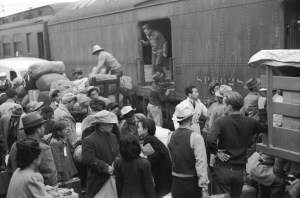
internmentIt’s called Remembrance Day. I only became aware of it a couple of years ago. And, I shamefacedly confess, I am all too subject to forget it. To forget Remembrance Day is not just a terribly irony – it’s a social, moral, and spiritual travesty.

On February 19, 1942, President Frankly Delano Roosevelt signed Executive Order 9066, authorizing the detention and imprisonment of Japanese Americans in the United States without due process of law. Today is the 75th anniversary of that order, and it is a day that should live in infamy.

The irony that the US should imprison citizens in concentration camps – Roosevelt’s word – and condemn Germany for it, is chilling, to say the least. Mercifully, Americans did not seek a “final solution” and begin wholesale murder as the Germans did, but that comes as cold comfort.

Today, the scandal receives little attention. Actor George Takei and a number of theatrical professionals brought the story to Broadway in 2012 in the musical Allegiance, which I saw in a wonderful stage-to-film event a couple months ago. Congress voted restitution payments to survivors in 1988, and included a formal apology in the legislation. The most recent reference I’ve heard to it in national news, however, was author Carl Higbie’s assertion that Order 9066 provided a legal framework for a registry of Muslims.

His Fox News interviewer, Megyn Kelly, was horrified. But it is true that the federal courts upheld Order 9066 during the war – though these decisions were reversed in the 1980s when newly discovered documents revealed that evidence had been withheld, and false evidence presented, during the legal proceedings of the 1940s.

I will not forget.

I may forget the date – I’m not good with dates – but I will not forget the injustice, the suffering, and the evil. Why?

I will remember because many of the parents and grandparents of the people I serve endured the unjust suspicion, prejudice, and oppression of the US military during the Second World War. Two of the people at whose funerals I have officiated were forced into internment camps. And I know members of East Hawai’i’s Muslim community, and they know the history.

They wonder if they are next.

I will remember in order that no one will be next. 

Today in worship, we joined in a litany for Remembrance Day. Written by Ellen Godbey Carson of Church of the Crossroads UCC in Honolulu, it concludes with these words:

Loving God, help us be your hands in the world.
Give us the courage to stand up, speak out,
and protect the dignity and rights of all of your children.
Help us learn to celebrate our differences rather than fear them.
Help us learn to love the whole of Your diverse creation!

Photo by Russell Lee.

Of Love and Kites

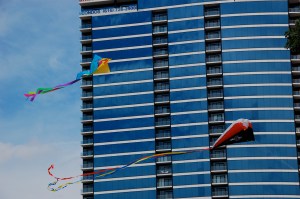
two-kitesToday’s story features the same little girl from last week’s story. You remember her, right?

You don’t?

Well, she was the one who wanted to fly a kite and wanted to know how she’d know when she was loved. Does that sound familiar? No?

Well, it’s on the Internet. You can look it up.

Anyway, this same little girl got up one morning and, once again, she had two things that she wanted to do with her day.

The first one was that she wanted to spend time playing with her neighbor, a boy just a little younger than she was, and a good friend.

The second thing was that she wanted to know how she’d know when she was being loving to someone else. You really have to admit that she liked to ask the Big Questions.

Since she knew it was a Big Question, too, she decided to start with the easier one, so off she went to her friend’s house and knocked on the door. He was perfectly willing to play with her that day, which meant she’d already accomplished one of her goals.

In fact, he wanted to fly his brand new kite, which was even better, because now she knew how to get a kite in the air, since she had been in last week’s story.

And it was nice and windy that day.

So they carried the package with his new kite to a nice open space, and she set out to get it unpacked. She’d done this in the last story, so she knew how it went. She laid out all the pieces, and got the spars together, and got the fabric tight over everything. She attached the tail, and fastened the string to the kite with a good strong knot. Everything was ready to go.

She handed him the assembled kite and told him to stand off a few feet, and when she started running, to toss the kite into the air. Sure enough, when she took off, the kite leaped into the air like it was meant to fly (which, of course, it was) and danced higher and higher into the sky.

He came over and reached for the string, but she said, “No, no, let me show you how to do it,” and that’s when he burst into tears and ran home.

Leaving her all alone in the open field with his kite in the air.

Well, she brought it down to the ground, and wound up the string, and walked it back to his house. She could still hear the crying from outside, so she left the kite on the porch, and went to find her Grandfather.

She cried a few tears of her own as she told him the story.

“Just to make sure I understand,” said Grandfather when she was through, “Did he ask you to put his kite together?”

Well, no, he hadn’t.

“Did he ask you to show him how to fly it?”

No, he hadn’t done that either.

“Did you ask him at all what he needed from you, or what he wanted you to do?”

Well, no.

“When you do the things that people really want or really need,” Grandfather told her gently, “that’s how they know you’re being really loving. So the only way for you to know whether you’re being truly loving is to ask.”

Oh.

She went back to her friend’s house, and this time she knocked on the door. When he came to see her (it must be said that his mother had to tell him to do it), she apologized for doing everything he wanted to do with his kite, and humbly asked, “What do you want to do?”

“I’d like to fly the kite with my own hand on the string,” he said, somewhat cautiously, because he wasn’t sure what she’d say.

“Then let’s do that. I’ll hold the kite while you run and get it into the air,” she said, and that’s just what they did.

The next day, there was wind again, so they both brought their kites, and soon there were two of them aloft. As they watched the two kites dance in the sky, both of them knew this:

They’d been loving to each other.

Love Like the Wind

dsc_0871

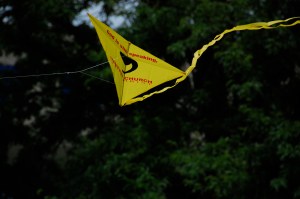
Kite in flight

A little girl set out one day with two things on her mind; two things she was determined to do.

The first looked pretty simple: she wanted to fly a kite.

The second looked more difficult: she wanted to know how she’d know when somebody loved her. She was pretty sure that this was the more awkward question.

That meant that the kite came first.

She got it out of its package, and she put the sticks in their places. She stretched the fabric over it, and attached a streamer tail to the end. She got out the kite string, and attached it to the kite with a good knot. She was all set to fly.

Unfortunately, she’d chosen to go out on a day which lacked one critical ingredient: wind.

Wind is usually plentiful here in East Hawai’i, but not that day. It was one of the hot, still, and muggy days of summer. I guess there was a storm offshore that blocked the trade winds from blowing, and the storm’s winds hadn’t reached Hilo yet.

Whatever the cause, there simply wasn’t a breeze to be felt.

She gave it her all, though. She raced back and forth across her chosen field, letting the kite string out behind her, and gasping each time the kite seemed to take leap skyward on her leg-driven wind.

Each time she came to stop, though, the kite would sag in mid-air, and fall gracelessly to the ground. Sometimes it would plunge to earth even as she ran. All in all, it was really frustrating.

Nothing she tried would get the kite to fly.

Grumbling, she went to see her grandfather, hoping that he would have some wisdom that would get the kite to fly. She poured out her troubles as he listened, and he cast a glance at the trees, where the immobile leaves confirmed the problem.

“I’m sorry,” he gently said when her sad tale had ended, “but without any wind a kite won’t fly.”

Some tears later (she’d been counting on this, after all), she remembered her other question for the day. Rather hopelessly, given how the kite flying had turned out, she raised her other question.

“Grandfather,” she asked, “how do I know when someone loves me?”

Grandfather considered this for a few moments, and smiled.

“Think about your kite for a moment. Without wind, what does it do?”

“Nothing,” pouted the granddaughter. “It falls to the ground.”

“Love is like the wind that lifts the kite,” said Grandfather. “If you feel like somebody is lifting you up; if you feel like somebody is supporting you; if you feel like somebody has helped you to fly, that’s somebody loving you. That’s how you know.”

As she listened, the girl realized that, despite the sorrows that had brought her to her grandfather, she now felt lifted up. She now felt supported. She now felt like her soul had taken flight – a low, short flight (it must be confessed), but flying nevertheless.

So she gave her grandfather and big hug, and said to him, “You mean like right now?”

Grandfather looked at her, and inside he, too, felt like he was being lifted up, like he was being supported. He felt his soul flying. So he smiled his widest as he said:

“Yes, granddaughter. Just like right now.”

There may not have been a kite flying that day, but two souls soared on the wind of love.

Addendum: It was at this point that one of the young people said to me, “Could you please tell us that she was able to fly the kite the next day?”

Why, yes. As it happened, the wind returned the next day, and she was able to fly her kite. Even better, though, it was also a day when she felt lifted up by love as well.

And that’s the best kind of day of all.

The Mongoose Who Wanted to Be Salt

32151641192_cef0f7a32e_o

A Mongoose in Hawai’i

I know a number of you read my Pastor’s Corner this week, about seeing an ‘apapane, so you’re all prepared for a story about what kind of creature this week?

An ‘apapane?

This story is, in fact, about…

A Mongoose.

This mongoose lived right near a church, much like this one. In fact, he lived in a little hole underneath the roof beams, kind of like that hole right over there where a mongoose lives.

In any case, living outside the church the way he did, he had plenty of opportunity to hear the Scriptures read. One day, he was deeply impressed by a reading of Jesus’ words during the Sermon on the Mount: “You are the salt of the earth.” I don’t know why those words, in particular, made such an impact, but he determined to become salt, as Jesus said.

I’m afraid he had a rather literal turn of mind.

Because he started out by searching for salt. Mongooses, as a rule, do not have salt shakers in their burrows. He managed to find a paper salt packet that somebody had dropped from their carry-out tray, and set out to open it and eat it.

Have any of you ever eaten just plain salt?

It’s pretty unpleasant, isn’t it?

This mongoose didn’t like it much either. In fact, he had to go drink a sizable amount of the Wailuku River before he could taste anything but salt. All in all, it was pretty nasty.

He didn’t give up, though. If the salt wasn’t supposed to be eaten, he thought, maybe it’s supposed to be on the outside. So he set out to re-create an ancient way of harvesting salt: by taking sea water, letting it sit in the sun, and gathering the salt as the water evaporated away. But the mongoose wouldn’t use a hollowed stone; he’d use his own fur.

So he took a swim in Hilo Bay, which he didn’t like very much, and then climbed up on shore to let the sun dry his fur.

The problem was that this was Hilo, and as soon as he came out of the water, the clouds rolled in and hid the sun, leaving the mongoose wet, shivering, and unhappy for quite a long time.

Eventually, just as his teeth stopped chattering, the clouds parted and the sun beamed through. At last, he could dry his fur, and the water steamed gently away leaving the salt crystals behind.

It turns out that if you’re a mongoose, it’s really uncomfortable to have salt crystals in your fur and rubbing your skin, so the poor creature returned to the Wailuku River for another bath (this time in fresh water). As he emerged, the clouds rolled in again and drenched him further with rain, leaving him cold, wet, and completely discouraged.

So he did what he probably should have done in the first place. He went to visit his grandmother.

She spent the first part of his visit carefully grooming his fur, which was suffering from all these salt baths and rain, while he poured out his story. “How am I going to become salt?” he moaned.

Grandmother thought about this for a bit, and then said, “When you’re not eating a whole packet of it, salt makes things taste better, doesn’t it?”

The mongoose thought it did, though with the memory of the salt packet still in his mouth he was less sure than he might have been.

“Well, if salt makes things better, then perhaps that’s what you could do. You make my life better every time you see me, every time you talk to me. You’re kind of like salt that increases my happiness rather than dazzles my taste buds.”

The younger mongoose just listened.

“You just keep making my life better, grandson, and make your family’s lives better, and your friends lives better. That will make you salt; the very best salt there is.”

You are the salt of the earth.

Photo by Tony Hisgett, used by permission under Creative Commons license.

Wisdom found on Kilauea

apapane-1_crop2

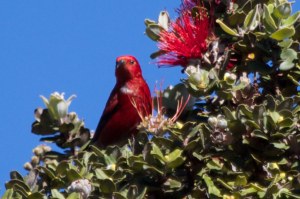
An ‘apapane

Yesterday, as promised, I took myself to the Hawai’i Volcanoes National Park and specifically to the summit area of Kilauea, to hike through groves of ohi’a and sandalwood, and refresh myself with reality and truth.

Walking down a trail to the serenade of songbirds, and later looking down into the furnace that is Halema’uma’u Crater, and hiking back to my car through the dark woods (poor planning, that), I thought about things I’d learned:

Birds sing their songs. If they don’t sing, they don’t live – the next generation doesn’t happen. They sing different songs. They sing to exist.

We must sing our songs.

What you don’t see is still there. Reality exists whether I see it – or you see it – or not.

Look closely. Don’t assume we’ve seen all there is to see.

Going up is more work than going down. Going down you’re more apt to fall.

Let’s be careful about going down. Let’s summon up our strength to go up.

Beauty grows at the edge of devastation.

Let’s appreciate truth and beauty where we find it.

Steam fogs your glasses, making it even harder to see the holes at the side of the trail (which are also steam vents).

Heated words may distract us from truth. We need to look for the realities they hide, and focus on them lest they trip us up – and never fail to name the heated words for what they are.

20170121-womens-march-1

Marcher’s eye view of the Women’s March in Hilo

Now today – today I marched.

Not as far as I hiked yesterday, I grant you. Hilo has a small downtown! But I marched because our new President has already made clear that not all citizens’ rights will be respected, and not all people’s worth will be considered. He has already taken steps to hamstring the Affordable Care Act, without presenting a replacement plan. Millions could lose access to insurance, and those who are now protected from being denied coverage because of their health now face a terrible risk of losing their insurance again.

Today both he and his press secretary repeatedly asserted an untruth. They would accept no evidence to the contrary; they would brook no contradiction. And it is a lie. The crowds at the inauguration today were significantly smaller than those eight years ago.

Women – people of color, both men and women – non-Christians – Christians who refuse to praise the President – journalists who do their jobs with diligence and integrity: These people have all faced the President’s ire.

And so I marched. To face the ire. To declare the truth. And most of all:

To sing my song.

What I’m Doing on Inauguration Day

20160908-pmp1_-9What should I do on Inauguration Day?

I thought and thought about this question. It was not an easy or comfortable debate. Close to my core is a deep love for the democratic forms of this country. The fact that we change policy through the application of the vote, and not through the advances of armies, makes this nation precious to me more than the coincidence of my birth into it. I value the peaceful transfer of power (a phrase I’ve heard several times this past week). I honor it.

Does that mean I need to watch it?

Yes, it would be virtuous of me as a citizen to celebrate the peaceful transfer of power. Yes, it would be virtuous of me as a political creature (i.e., human being) to listen carefully to his words, and assess my appropriate response of support or resistance to particular policies or proposals. Yes, I probably should watch the inauguration.

I don’t want to.

It could be sour grapes. It could be a petulant reaction to a political disappointment.

It could be solidarity. As a candidate, the man who will be inaugurated tomorrow insulted broad swathes of human beings in ways I thought should doom his candidacy. His political senses are better than mine; he won the office. But he left great numbers of people in great anxiety that their economic well-being, their physical health, and their liberties were at risk. They’ve called for a boycott of his inauguration, and as I believe that they should retain their economic well-being, their physical health, and their liberties, I would be proud to stand in solidarity.

Yet I think that will probably wait for another day (most likely the next day, if I can get to the Hilo edition of the Women’s March on time).

Because in truth, I just don’t care to be lied to. I need to spend the day with some truth.

“All politicians lie,” I hear you say, and as generalizations go, this one has more to support it than most. The man who will take the oath of office tomorrow, however, gets caught in falsehoods all the time and it makes no difference to him. He contradicts himself on matters of fact, on assertions of causation, and on predictions of policy with no apparent concern.

He never apologizes. He never says, “I had that wrong, and now I’ve come to a new conclusion.” He simply says the new thing, denies he ever said the old thing (for heaven’s sake, hasn’t a reality television star heard of recordings?) and moves on.

To me, that means that there’s no point to what he says tomorrow. His views on those topics could change by Sunday – or the end of the day Friday. Or they could be the guiding principles for his decisions for months. Who knows? I don’t. I wonder if he does…

Originally, I’d planned to simply say, “I’m working; I don’t have time to watch the inauguration. Oh. Darn,” and go on. I’ve found myself with a day off, however, after working over the weekend. So. Now I’ve had to make the choice.

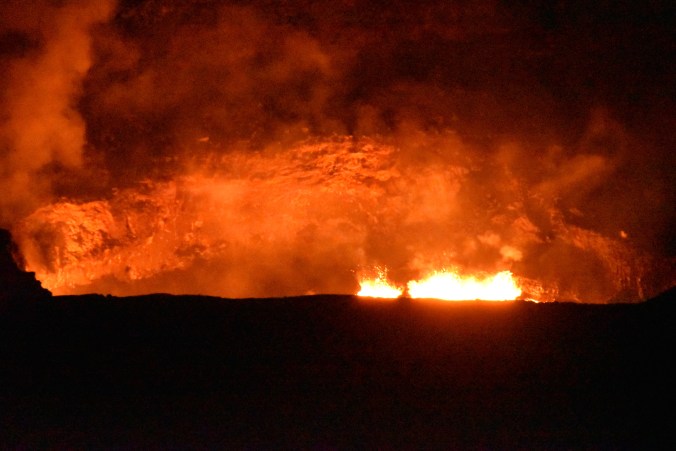
As it happens, I’ve got a gathering to go to for lunch, but when it’s over, I’ll point my car toward the summit of Kilauea and drive. Rather than listen to lies, I’ll spend the afternoon in contemplation of Truth.

Truth that human beings are, after all, very small creatures on a very powerful planet.

Truth that the world is building itself, and reshaping itself, and reforming itself. It has done so before; it will do so again.

Truth that the world is also fragile. The ground can open in great rifts; the air can be poisoned; the water can blast forth in gushes of steam to scald all those about. It can be molded, and molded badly, by human hands.

Truth that I, though small, and frequently reshaped, and sharing the fragility of my home, can also choose.

Who knows? I may learn some new Truths up there.

With this Truth, I will stand to watch the orange glow from the crater, with its promise, and its peril, and its power.

We Must Not Be Silent – Martin Luther King, Jr., Day 2017

img_1818This address in honor of the Rev. Dr. Martin Luther King, Jr., Day was presented on January 16, 2017, at Ho’oheau Park in Hilo, Hawai’i. I am tremendously grateful to have been invited to participate in the program.
It is confession time: I have spent too long silent.

If you’d like excuses, and if if you don’t, I can provide some: I thought the victory had been won: by thousands and tens of thousands and hundreds of thousands of marching feet when I was still a child. I thought the victory had been won.

I thought the victory had been won: by attorneys contesting unjust statutes for the highest courts, and winning their cases. I thought the victory had been won.

I thought the victory had been won: by people of color coming out to vote with courage and commitment. I thought the victory had been won.

I thought the victory had been won: by the repentance of haole hearts.

I was wrong.

The statistics told me the truth. And as long as the rates of incarceration, or poverty, or ill health correlate to a race, the victory has not been won.

People I love told me the truth. And as long as stories told by people of color in their encounters with authority fail to match the stories I tell about my encounters with authority, the victory has not been won.

When the President-elect condemns John Lewis faster than he condemns David Duke, the victory has not been won.

And it has gotten worse.

In my lifetime, I have heard public racial epithets fade away, as those who spoke them paid a social or economic or political price. And in my lifetime, I have heard them return, as those who spoke them failed to pay a social price that they were not willing to pay.

The words, and even more the deeds, the policies, and even more the structures, must face a social, economic, or political price that they are not willing to pay, or the victory will not be won.

In his Letter from the Birmingham Jail, the Rev. Dr. Martin Luther King, Jr., wrote: “My friends, I must say to you that we have not made a single gain in civil rights without determined legal and nonviolent pressure. Lamentably, it is an historical fact that privileged groups seldom give up their privileges voluntarily. Individuals may see the moral high light and voluntarily give up their unjust posture; but, as Reinhold Niebuhr has reminded us, groups tend to be more immoral than individuals.

“We know through painful experience that freedom is never voluntarily given by the oppressor; it must be demanded by the oppressed.”

I would add now, that we are finding through painful experience that freedom may be denied again by a resurgent oppressor.

I must not be silent. You must not be silent. We must not be silent. And the time to speak is now.

Dr. King also wrote, in that same Letter from the Birmingham Jail: “More and more I feel that the people of ill will have used time much more effectively than have the people of good will. We will have to repent in this generation not merely for the hateful words and actions of the bad people but for the appalling silence of the good people. Human progress never rolls in on wheels of inevitability; it comes through the tireless efforts of men willing to be co-workers with God, and without this hard work, time itself becomes an ally of the forces of social stagnation. We must use time creatively, in the knowledge the time is always ripe to do right.”

The time is always ripe to do right.

The time is ripe to reject religious tests for entry into our nation. The time is ripe to demand that citizens not face hurdle after hurdle to exercise their right and responsibility to vote. The time is ripe to demand that health care not be limited to those with wealth, and that those who are sick may obtain the treatment which is their due as human beings. The time is ripe to do right.

I must not be silent. You must not be silent. We must not be silent. The time is ripe to do right.

Thank you very much.


The ‘Apapane Chorus

apapane-on-puu-oo-trail-by-harmony-on-planet-earthWell, last week I told you a story about an ‘ea, a hawksbill sea turtle. So, you know what this week’s story is going to be about, right?

Because you know I tell stories about birds a lot, and there’s one particular bird I keep coming back to. Anybody have a guess as to what this story is about?

That’s right. It’s about an ‘apapane.

Actually, it’s about several of them, and for once, they’re not nestlings. Well, OK, they were nestlings when then met. They happened to grow up in neighboring nests in an ohi’a grove, so they all knew each other. They’d fly about together, and they played games together.

You know, the usual games of small birds, like… football. Or soccer (that’s football in Europe). Or… board games.

Growing up together, whatever games they played, they knew a lot of the same things. Their parents taught them how to live in an ohi’a forest: what an ohi’a lehua blossom is like when it’s the ripest, and which bugs are tasty, and which ones aren’t.

There was one question, though, that none of them could seem to get a straight answer to, no matter how many times they asked their parents.

(Does that ever happen to you? It happened to me. I’d ask my parents something and they just wouldn’t have an answer. It still happens.)

(It probably happens to my kids, too, now that I think about it.)

The question was, “How do you know when it’s time to sing?”

So the parents, no matter which ones they were, would start out by saying, “Well, you know it’s time to sing when…” and their voices would trail away.

“Oh, I know,” they might continue, “it’s when… No. No, that’s not it.”

Long silences would follow, and then this:

“You’ll just know.”

The young ‘apapane didn’t think this was a good answer.

No, not a single one of them.

Fairly soon, the time came for the birds to move on. Ohi’a bloom for a time, and then other trees go into blossom, and the ‘apapane followed their food. Soon the young birds were scattered into several groves, still within earshot, but they couldn’t always see one another.

That’s when they realized how they’d know when it was time to sing. Because it would just happen.

One bird, for no reason he or she could ever describe, would suddenly burst into the distinctive ‘apapane call. The others would join in so quickly that sometimes they couldn’t be sure who had started the song. It just happened.

Over and over again, it just happened.

Someday, it’s going to be time for you to sing. And you’ll know. Somehow, you’ll know, and I know that’s not a great answer to the question, “How will I know?” but you will.

You’ll know.

Sometimes it will be you who’ll be the first to sing – or it will be you – or it will be you. It might be all three of you. Or it might be somebody else’s turn.

But you’ll know. You’ll know when it’s time to sing, when it’s time to lead the song.