Story: Aloha for the ‘Iwa

September 28, 2025

Jeremiah 32:1-3a, 6-15
Luke 16:19-31

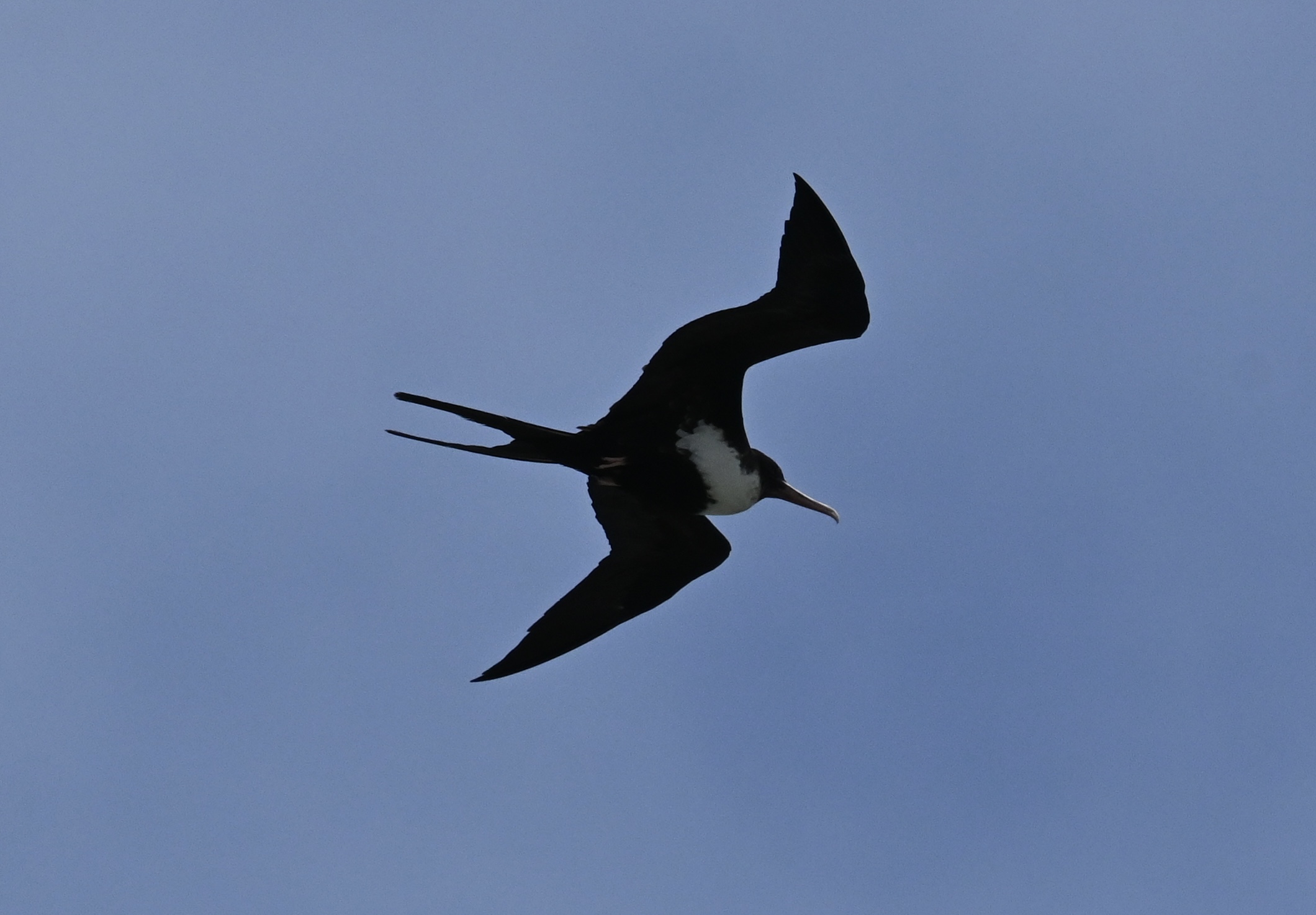
The ‘iwa, or great frigatebird, has a bad reputation among the seabirds around Hawai’i. ‘Iwa have been known to bully other birds to get them to drop their meals, which the ‘iwa then swoops down to eat. That’s pretty nasty. As a result, a flock of koa’e ula – red-tailed tropicbirds – had decided to have nothing to do with them.

When an ‘iwa flew by, they ignored him. Or her. They veered off to one side or another to keep their distance. When the ‘iwa called out a friendly “Aloha!” they said nothing in return. They called out to one another instead.

Except for one bird.

This koa’e ula decided that until an ‘iwa actually did anything mean, he’d assume that they were as worthy of a friendly “aloha” as any other bird. Seabirds tend to swoop around together a lot, which means that the air is full of “aloha,” which sounds a lot like lots of bird calls to us. A shore with lots of seabirds over it can be a very noisy place.

“Why are you greeting the ‘iwa?” asked his friends. “They’re bullies. They’re mean. They’re never going to give you an aloha.”

“I don’t know about any of that,” said the koa’e ula. “None of the ‘iwa I’ve greeted have done anything to me. Except to say, ‘aloha’ right back.”

Koa’e ula can fly for a long time, but they also like to spend some time resting on the ground, usually on smaller islands offshore from bigger islands like Kauai. There came a day when most of this particular flock was resting from some pretty vigorous flying and fishing. On that day something had happened a long way away that they didn’t know about. It was a big earthquake, and it kicked up the water into an ocean-spanning tsunami. All this was much too far away. The birds had no idea.

Hours later, a series of great waves approached the little island. A few of the koa’e ula were aloft, but they weren’t looking at the water closely. As the first wave came closer, an ‘iwa swooped low over the island, right over the place where the friendly koa’e ula had settled.

“Take off! Fly!” cried the ‘iwa. “There’s a big wave coming! Get into the air!”

“Take off! Fly!” shouted the koa’e ula to those near him, and he opened his wings and leapt into the air. Those near him did the same, and in a few moments the island was empty of birds and the sky was filled with them.

They looked down as the first wave washed over the entire island where they’d been. They were so shocked that they forgot to call “aloha” to one another as they circled. Without the warning of the ‘iwa, they’d have been there when the wave came.

“How did you know?” they started to ask the friendly koa’e kea, the one the ‘iwa had come to warn. “Hod did you know that the ‘iwa would know to warn us?”

“I didn’t know,” said the koa’e kea. “I just knew that everyone deserves an aloha. Everybody deserves aloha.”

As the ‘iwa swooped by with an anxious look to make sure her friend was all right, the koa’e ula called out, “Aloha and mahola nui loa to you!” The ‘iwa looked relieved and called back, “Aloha!” and she soared off once more.

I don’t know what other flocks do – there are ‘iwa and there are koa’e ula all around the world – but I can tell you that there’s been lots more aloha among those birds from that day to this, and long may it stay the same.

by Eric Anderson

Unfortunately, the video recording of worship for September 28, 2025, did not include audio, so there is no recording appended.

Photo of an ‘iwa (female) by Eric Anderson.
Light in a Stable

“The true light, which enlightens everyone, was coming into the world.” – John 1:9

The true light may now be at hand,
but the light is lit by flickering flame
and smoky wick. I watch that light
with anxious eye, for fear it spread
its burning oil on the straw below.

The light unsteady served to hide
the dark green sticky contents of
that first cloth barrier, wrapped
inexpertly by unaccustomed fingers round
the infant’s flailing hips,

But did not muffle his fierce cries
of outrage testifying that the light
has lungs! Re-swaddled, he subsides,
and sleeps re-laid into the feeding trough,
while grateful stable denizens rest, too.

The midwife gone, the man and I
trade naps, and watch, and wait
for his next cry. Will he be hungry?
Dirty? Lonely? Or just angry that
the borrowed cloth moves roughly on his skin?

“The light shines in the darkness,” they will write,
and I suppose it does. It murmurs sleepily,
then coos a moment, then subsides.
The crude light wavers at the breeze,
and shadows waver on incarnate light asleep.

I am too weary to compose a poem;
I ache in every muscle, every bone.
I cannot help but think that this poor babe,
in manger laid, could shine so bright
this stable would be taken for a star.

For now, the light is dimmed,
and in its dimness I, at least, can see
that lovelight shines most clearly here,
in common human form, and in
the dark.

A poem/prayer based on John 1:1-18, the Revised Common Lectionary Gospel Reading for Year C, Second Sunday after Christmas Day.

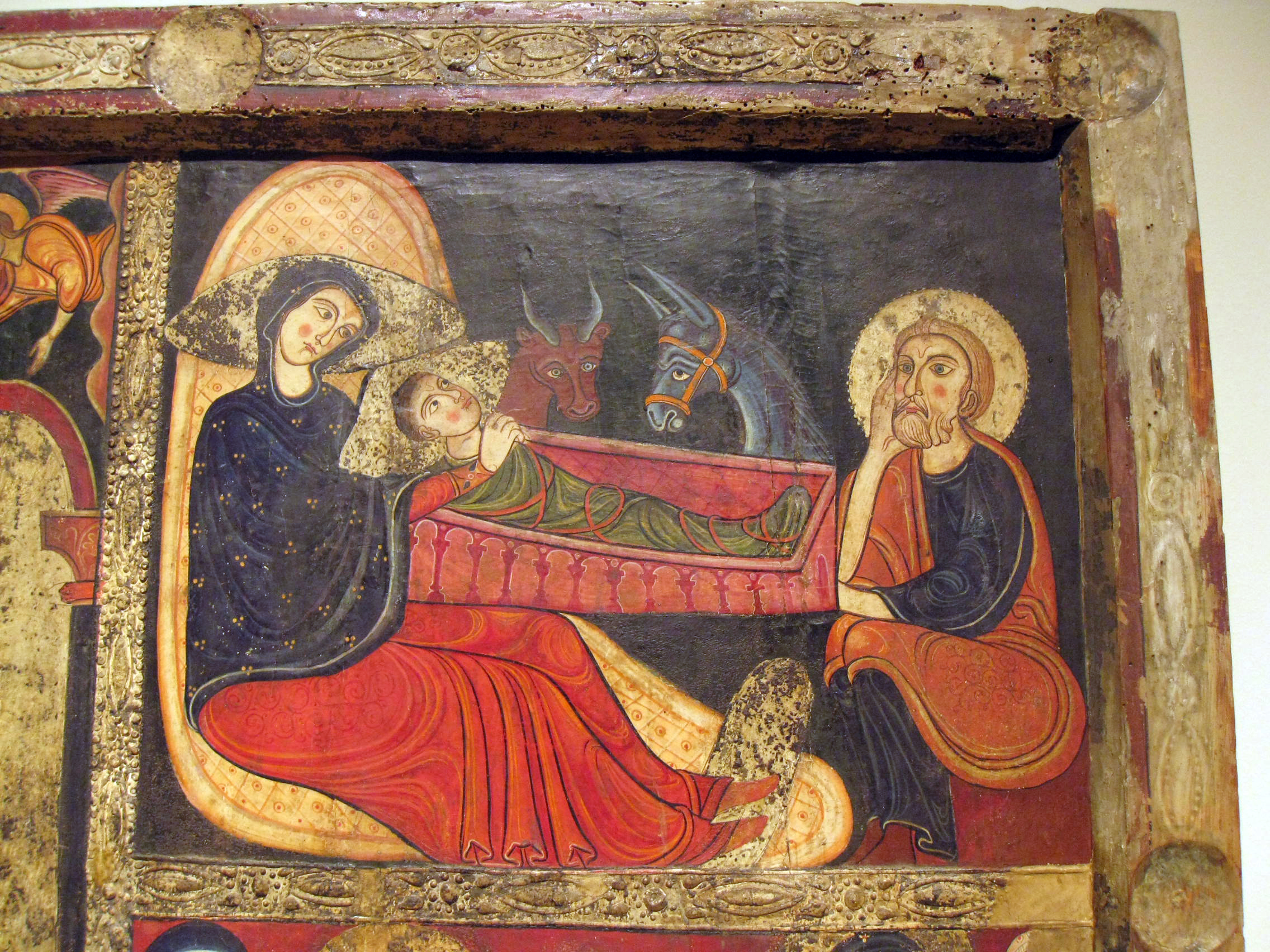
The image is The Nativity, a section of the 13th century altar frontal of St. Mary of Avia Church in Bergueda, Catalonia, Spain, by an unknown artist. The frontal itself is in the National Art Museum of Catalonia in Barcelona. Photo by Enfo – Own work, CC BY-SA 3.0, https://commons.wikimedia.org/w/index.php?curid=21384531.

Story: Sighing on the Wind

February 12, 2023

1 Corinthians 3:1-9
Matthew 5:21-37

“What is love?” the little girl asked her mother at bedtime, but she fell asleep before she heard the answer.

“What is love?” chirped the coqui frog outside her window.  She slept on.

“What is love?” crowed the rooster, who had no idea what time it was and didn’t care whether he crowed at sunrise or the middle of the night.

“What is love?” sighed the dove, and “What is love?” hummed the saffron finch, and “What is love?” purred the cat lying below them.

“What is love?” The question flew about the island, from creature to creature, from voice to voice. ‘Apapane sang about it on the mountain slopes and noio screeched about it above the waves. Pigs grunted it in their shelters and mongoose chittered it in their burrows.

“What is love?” asked the sheep and the pueo and the nene and the dogs. “What is love?” rumbled the mountain and “What is love?” sighed the clouds.

It was the wind who whispered it into the ear of the ‘io. Whispered it, and whispered it again, until the ‘io took wing and cried with a great voice, “Love is what lifts you up! Love is what carries you! Love is what makes you a home!”

The ‘io cried it, and the wind sighed it. The ‘apapane sang it and the pigs grunted it. The nene honked it and the chickens clucked it.

Outside a little girl’s window, a coqui frog chirped, “Love is what lifts you up. Love is what carries you. Love is what makes you a home.”

She woke suddenly, though whether it was the coqui’s voice that waked her I can’t tell you. “Mama!” she called, and both parents hurried to her room.

“I know what love is!” she said, and her mother said, “But of course. I told you when you asked me:”

And the two said together: “Love is what lifts you up. Love is what carries you. Love is what makes you a home.”

by Eric Anderson

Watch the Recorded Story

In the recording above, the story is told from memory of this text. I had no illusions that I would remember all of the creatures I’d put in the story (or the order), but I remembered more of them than I’d expected!

Love You!

June 26, 2022

Galatians 5:1, 13-25
Luke 9:51-62

You may have heard people say that kids can get out of hand. You know. Kids jump about. Kids make lots of noise. Kids butt each other with their heads.

Yes. They butt each other with their heads. You don’t do that? Well of course you don’t. You’re not a… Oh. Right. I’m sorry.

When I say “kids” today, I’m not talking about young human beings. I’m talking about young goats. And those kids can definitely get out of hand, jumping about, making lots of noise, and butting each other with their heads.

One kid, however, was a handful even by kid standards – that is, goat kid standards. He was constantly head-butting and foot-kicking and even mouth-biting. Goat kids can get rather rough with one another, but he was rougher than any of them wanted to deal with. Pretty soon he didn’t have any friends in the pasture. If they let him close he’d butt or kick or bite.

He was sad when he got back to his mother. “Why don’t I have any friends?” he asked, and when he’d explained how he behaved with the other kids, his mother thought for a moment.

“If you want friends, you’ve got to love them,” she said.

“Love them?” he asked.

“Love them,” she said.

He thought about this until he fell asleep and thought more about it when he woke up in the morning. He bounced off to the pasture and happily shouted, “I love you!” to the other kids. Then he rushed up to them, butted one with his head, kicked another with his hooves, and bit a third with his teeth, all the while shouting, “I love you!” The herd of kids scattered and he certainly didn’t make any friends.

“Why don’t I have any friends?” he asked his mother that night.

“Didn’t you love them?” she said.

“I tried. But it didn’t work,” he said.

“Tell me what you did,” she said. He did, and when he finished, she sighed.

“Tell me this,” she said. “Do you enjoy it when another kid hits you or kicks you or bites you?”

“Well, not much,” he admitted.

“If I did that, would you believe that I loved you?” she asked.

He wasn’t sure how to answer that.

“Do you think the other kids believe you love them when you butt them and kick them and bite them?” she asked.

“No,” he admitted. “I guess they don’t.”

“Love isn’t just saying it,” said his mother. “Love is doing things because they help someone or help them be well. Love is not doing things because they hurt someone or make them feel bad. So go back tomorrow and try to love them – and this time, show it.”

I won’t claim that he did it perfectly the next day – he didn’t – but he really did show more love for the other kids than he ever had before. As the days passed, he made friends, and they loved him, too.

by Eric Anderson

Watch the Recorded Story

The video includes the complete service of July 26, 2022. Clicking “Play” will jump to the beginning of the story. The recording is of the story told live without notes. It is not the same as the prepared text.

Photo of goats on Maui by Forest & Kim Starr, CC BY 3.0 us, https://commons.wikimedia.org/w/index.php?curid=70450192.

A Song Worth Living

“If I speak in the tongues of mortals and of angels, but do not have love, I am a noisy gong or a clanging cymbal.” – 1 Corinthians 13:1

They tell me it’s a song, Jesus,
but we’ve lost the tune.

They tell me it’s a song, Jesus,
but we’ve sucked the blood from the words.

They tell me it’s a song, Jesus,
but we’ve forced it into four-four time,
when it was supposed to soar
and warble and hover and dance.

They tell me it’s a song, Jesus.
Hum me the tune.
I want to sing along.

A poem/prayer based on 1 Corinthians 13:1-13, the Revised Common Lectionary Second Reading for Year C, Fourth Sunday after the Epiphany. 

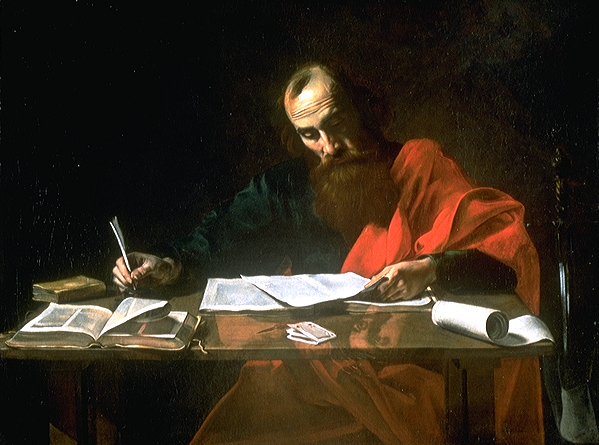
The image is Saint Paul Writing His Epistles by Valentin de Boulogne – Blaffer Foundation Collection, Houston, TX, Public Domain, https://commons.wikimedia.org/w/index.php?curid=596565.

I’m including my own version of the 1 Corinthians 13 text in a song, “Hymn to Love.”

Complicated

“Beloved, let us love one another, because love is from God; everyone who loves is born of God and knows God. Whoever does not love does not know God, for God is love.” – 1 John 4:7-8

The Bible is complicated – Love one another.
Faith requires discernment – Love one another.
Righteousness needs consideration – Love one another.
Perfection results from preparation – Love one another.

In the meantime, I’ll carry on with what I’ve been doing.

Love one another.

A poem/prayer based on 1 John 4:7-21, the Revised Common Lectionary Second Reading for Year B, Fifth Sunday of Easter.

The image is The Head of Christ Carrying the Cross, a wood sculpture by Heinrich Douvermann (ca. 1520-1530) – Photograph from Bildindex der Kunst und Architektur: object 20603132 – photograph number RBA 608 899 – image file mi10859f02a.jpg, Public Domain, https://commons.wikimedia.org/w/index.php?curid=37895066