April 5, 2026
Acts 10:34-43
John 20:1-18
Sometimes a bird on the mountainsides just takes a liking for a particular ohi’a tree. I don’t know whether the nectar tastes better, or if you get a particularly crunchy kind of bug, or if there’s something else that gets a bird excited.
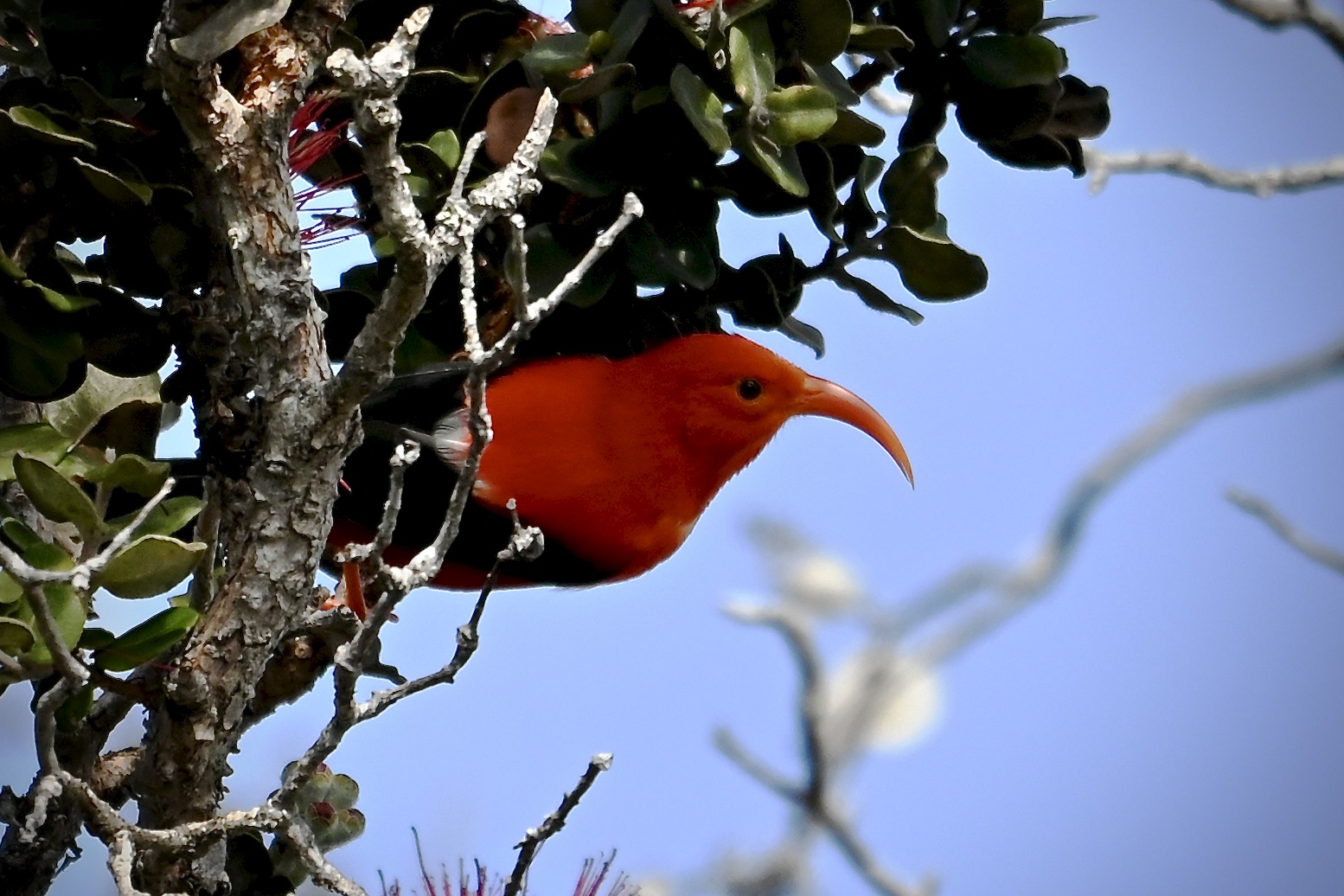
This is about an i’iwi who had a favorite ohi’a tree.
He like other trees as well. When the mamane were in blossom, he’d happily sip from those flowers as well, but as far as he was concerned there was nothing better than his favorite ohi’a tree. The flowers were the right color red, he thought, and they’d get that lovely gold tip as they blossomed. Sometimes there weren’t any flowers on it, of course, but that just meant he’d develop an appetite as he waited for them to bloom again.
It was his favorite tree.
I think you know, however, that sometimes trees in the ohi’a forest die. Sometimes the wind blows them down. Sometimes an earthquake from the volcano shakes the soil loose beneath them. Sometimes an eruption knocks them down. And sometimes, I’m very sad to say, they get very sick very quickly. Their leaves fall and, all too often, no leaves grow ever again.
The i’iwi’s favorite tree got sick.
He didn’t notice at first. He noticed it didn’t have any blossoms, of course, but that wasn’t unusual. A tree can’t bloom all the time. But then he noticed that some of the leaves were browning and dropping away. It looked like the tree was trying to grow new leaves, but there didn’t seem to be a lot of them. The i’iwi realized that the tree was in bad shape.
He shouted out his frustration to the world.
He carried on with living. But he decided it would make him too sad to see his favorite tree get sick and maybe – probably – die, so he spent his time in other parts of the forest. There were good trees there. None of them were his favorite tree. None of them could ever be his favorite tree.
One day, however, the forest’s blossoms were scarce in the groves he’d been browsing. The pattern of flowers led him, tree by tree, toward his favorite tree. He didn’t really want to go there, but if that’s where the nectar was, that’s where the nectar was. Eventually he found himself flying right toward his favorite tree.
It was covered with bright red ohi’a lehua.
Imagine his surprise. He was sure the tree was dead, but it had survived, and it had even thrived. He flew around it, singing for joy. He settled onto a branch and lowered his long curved beak into a flower. The nectar tasted like heaven, even better than before, he thought.
This story is about Easter, but it’s not about mistaking who’s alive for someone who is dead. No. this story is about Easter because it’s about surprise. That i’iwi knew, knew to his soul, that his favorite tree was no more. Jesus’ friends and disciples, Simon Peter and Mary Magdalene, they knew that Jesus had died – as he had.
Both a Hawaiian bird and Mediterranean human beings learned that the world has more surprises in it than they’d imagined. An ohi’a that got better. A Savior who rose again to new life.
Happy Easter!
by Eric Anderson
Regrettably, there was a technical problem this morning, and the story was not recorded.


