“When John heard in prison what the Messiah was doing, he sent word by his disciples and said to him, ‘Are you the one who is to come, or are we to wait for another?'” – Matthew 11:2-3
John, there you are, imprisoned by a king whom you had castigated for a sexual misdeed and took it badly. Beyond the stony walls, you hear, another speaks your word: “Repent!”
“The realm of God is near!”
You know this one. You baptized him despite your protests that he should have baptized you. The water has flowed on beneath the bridge, incarcerating you and prompting him to speak:
“The realm of God is near!”
I’m with you, John, if not behind those iron bars, I’m with you in the need to know: “Are you the One?”… and I believe he is the One, and preach that faith as truth! There is no faith without anxiety, for me as well as you.
“The realm of God is near!”
You said, “I’ve got to know,” and John, I hope you knew to hear about the healing and the good news for the poor. It’s what I hang my hope on, and my faith, and why I trust in God’s eternal love.
“The realm of God is near!”
You know, I hope, wherever you may be today your faith and hope and trust moved in the world alive and powerful and merciful. And I will trust, like you, that our Anointed One still lives.
“The realm of God is near!”
A poem/prayer based on Matthew 11:2-11, the Revised Common Lectionary Gospel Reading for Year A, Third Sunday of Advent.
The image is The Imprisonment of John the Baptist, one of the mosaics in the Baptistery of Saint John, Florence, Italy, unknown artist (early 1300s). Photo by Sailko – Own work, CC BY 3.0, https://commons.wikimedia.org/w/index.php?curid=41892074.
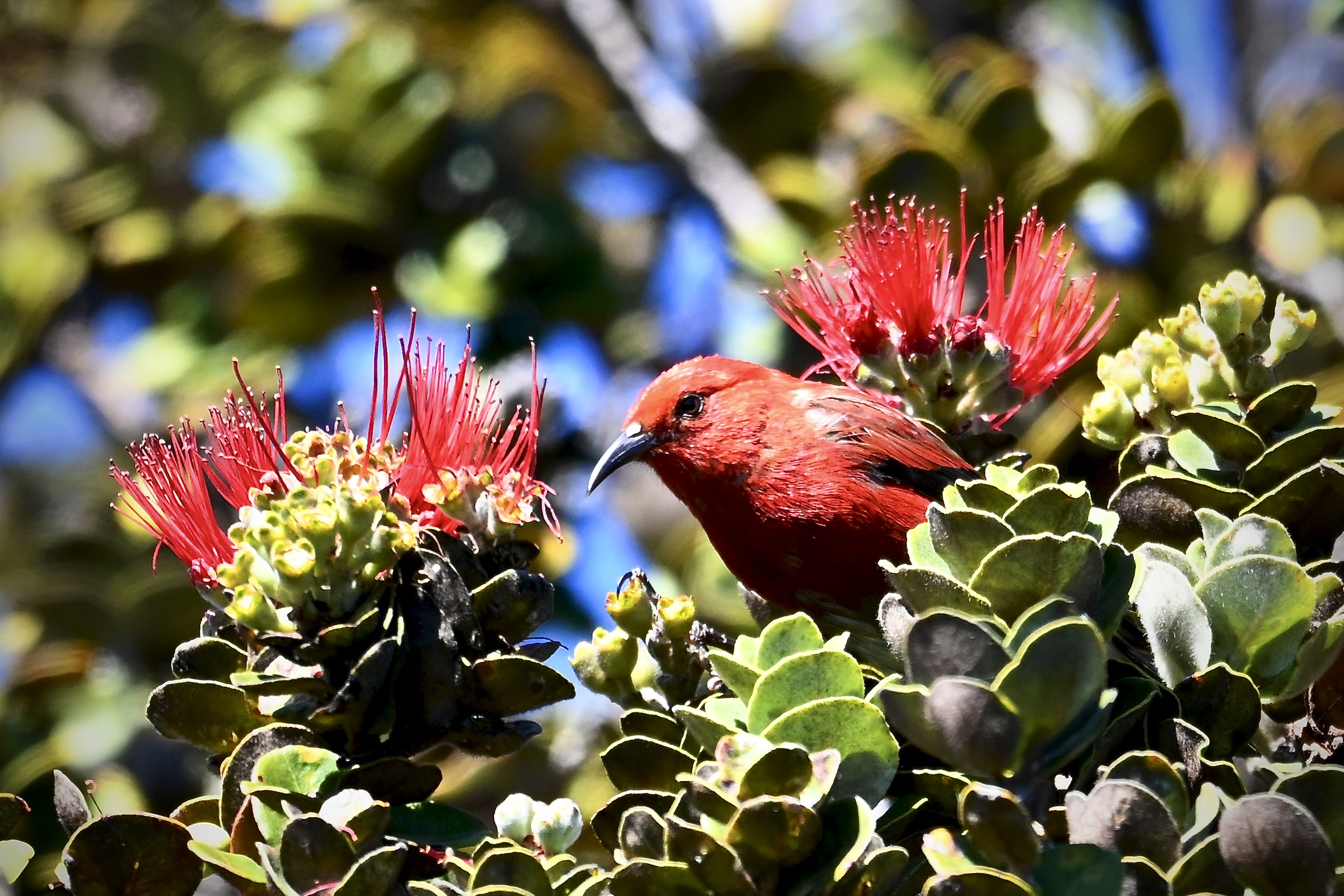
An ‘apapane wanted to know what the best way to be a flock is.
There are plenty of examples if you journey around the island. He found an i’iwi, who said, “Keep it small, less than ten. And chase everybody else away. Speaking of which, ‘apapane, it’s time you got out of here!”
He checked with a myna, who said, “Oh, just get a few birds together.” “Yeah,” said a second myna, “but make sure they don’t argue.” “What do you mean by that?” demanded a third myna. “Don’t you get cross with me!” said the first, and the ‘apapane flew away as the mynas argued about… nothing.
The ‘akiapola’au, the ‘akepa, and the ‘amakihi said that it’s useful to join a flock because then some of the predators, like cats and such, get intimidated. “A good flock is one that keeps us safe,” they told him.
That sounded pretty good.
He looked in on the ‘akekeke, who said, “Just stay together!” He asked the kolea, who prefer to keep some distance from one another. He thought about asking some fish, but they weren’t coming to the surface to talk to any hovering birds.
It was the nene, however, who gave him the most to think about.
When he found a nene to talk to, they were gathered around one of their number who’d hurt her wing. The little group was hungry and rather footsore as they trooped along, looking for ‘ohelo berries (or pretty much anything they could eat).
“Why aren’t you flying?” he asked one of them.
“Because she can’t fly for a while,” said the one in front.
“Can’t you leave her while you go eat?” he said.
The nene looked at him as if he’d lost his mind.
“A good flock is one where nobody gets left behind,” the nene said.
The ‘apapane returned to his part of the forest, and gathered his friends and family and any other birds he could. Together they could find food and shelter. Together they could scare off some of the dangers. But most of all, he told them:
“A good flock is one where nobody gets left behind.”
by Eric Anderson
Watch the Recorded Story
I write these stories ahead of time, but I tell them from memory plus inspiration. As a result, the recording of how I told it does not match how I wrote it.
A shoot shall come out from the stump of Jesse, and a branch shall grow out of his roots. The spirit of the Lord shall rest on him, the spirit of wisdom and understanding, the spirit of counsel and might, the spirit of knowledge and the fear of the Lord.
Isaiah 11:1-2
I hate to break it to you, Isaiah. But then, perhaps you know already. You saw it, after all, in Hezekiah, who trusted in the word of God and watched the army of Assyria retreat from Jerusalem’s walls, but then succumbed to royal pride and showed his wealth to greedy eyes.
These shoots of Jesse had their moments, true, the worst had flashes of your wisdom. But they let the widows cry for justice, let the orphans cry for food, while they enriched the wealthy, fed the full. The best of them, like Hezekiah, fell afoul of hubris like their ancestors before.
And then, Isaiah, came a child anointed by the Holy Spirit, who embraced your words, declared they’d been fulfilled, and best of all with mercy, stories, grace, and healing brought them to fulfillment. You would have cheered to see this shoot of Jesse blossom and bear fruit.
You would have cheered to see the fishermen, the shepherds and the farmers, even tax collectors, daughters of Jerusalem, embark on journeys up and down the land to seek his healing and his word.
They cheered to see the lepers cleansed. They told his stories to their neighbors with excitement and enthusiasm. They affirmed a humble man from Galilee as Christ.
They could not save him, though, Isaiah, from the fear and might of powerful men. They seized him and they beat him.
They called him rebel, and they nailed him to a tree, and jeered to see him suffer there and die.
Isaiah, human folly is enough to break your heart.
A poem/prayer based on Isaiah 11:1-10, the Revised Common Lectionary First Reading for Year A, Second Sunday of Advent.
“So he ran ahead and climbed a sycamore tree to see him, because he was going to pass that way.” – Luke 19:4
I didn’t think my hands could grip so tight. I also didn’t think I’d ever be this high. So let’s be clear that I regret this choice. I wish I hadn’t scaled these heights.
Were I to fall, the people down below would step aside. I grant you that not one of them could cushion me. We’d both be left in broken bones and tears upon the road.
I really wish I hadn’t climbed this high into this tree or into my career. I used to see my neighbors’ faces as they doled out coins. Now I just see the coins.
Their faces turn away before I can pronounce their names, but not before I recognize their scorn, their bitter fear, and their disgust at just how high I’ve gone.
Too high. Too high. When branches creak at heights like this, the climber’s soul sways unassuaged by creature comforts, linen, gold, attentive slaves.
I got myself into this tree. I don’t know how to get myself down to the ground. My hands are knotted to this limb. My breath is hoarse as I cling on.
Ignore me, Jesus, Just pass by. Don’t look up. Don’t notice me. Don’t speak. Don’t call. Don’t ask me anything. Above all else, don’t ask me to come down.
A poem/prayer based on Luke 19:1-10, the Revised Common Lectionary Gospel Reading for Year C, Proper 26 (31).
The image is Zachée sur le sycomore attendant le passage de Jésus (Zacchaeus in the Sycamore Awaiting the Passage of Jesus) by James Tissot – Online Collection of Brooklyn Museum; Photo: Brooklyn Museum, 2008, 00.159.189_PS2.jpg, Public Domain, https://commons.wikimedia.org/w/index.php?curid=10904526.
I remember a good number of things. I also forget a good number of things. Some of them I’m happy to forget, especially if they made me unhappy at the time. Some of them I wish I could remember, especially if they involve the question of where did I put down my keys?
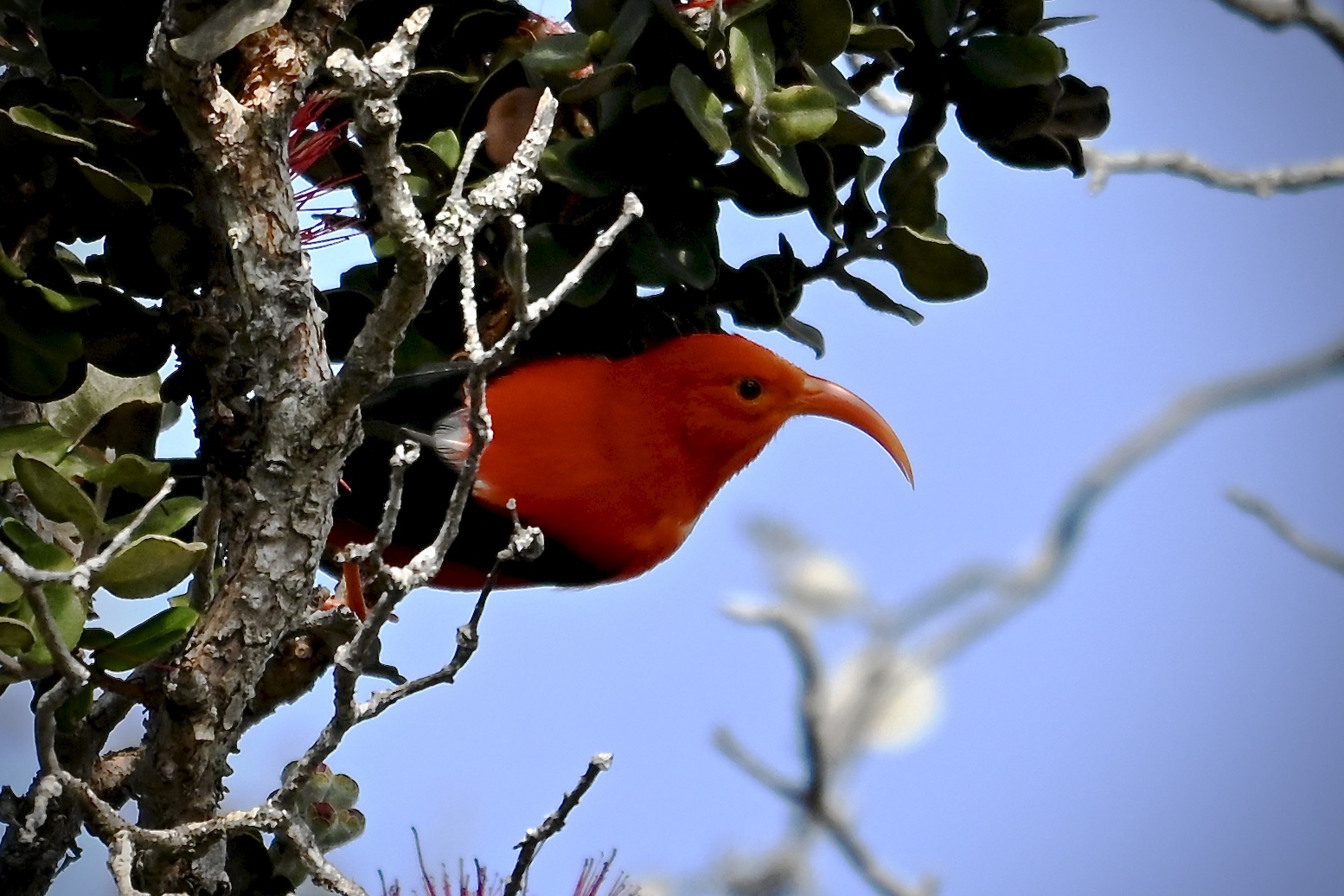
The i’iwi wasn’t much worried about the things he’d remember. He was worried about the things others would remember about him.
A lot of i’iwi get remembered by other birds as being, well, kind of aggressive. Bossy. Selfish. They drive other birds away from the places that they’re eating. Other kinds of birds do that, too, but when an i’iwi gets aggressive, ‘apapane and ‘amakihi will tend to give in and fly away.
“But is that,” he asked himself, “how I want to be remembered?”
He knew plenty of i’iwi that loved to chase other birds away. They claimed that they ate better when they did, but he also knew i’iwi that tended to ignore other birds, even slept in the same trees overnight. They seemed to eat just as well, he thought.
“How do I,” he asked himself, “want to be remembered?”
He had a friend who was one of the most effective bullies around. Where some of the aggressive i’iwi would chase an ‘apapane for a couple of feet, he’d chase them for a twice or three times as far. Sometimes he’d chase a bird so far that he’d find another bird in the place where he’d started, and he’d chase that one, too. If that seems like extra work to you, it does to me, too. Still, he was flashy (but then, all i’iwi are pretty flashy) and he was popular (as long as he wasn’t chasing you).
“But is that,” he asked himself, “how I want to be remembered?”
Then he remembered his grandmother.
She didn’t take any nonsense from other birds, no she didn’t. No ‘apapane had ever driven her away from a cluster of ohi’a blossoms. But she’d never chased an ‘apapane, either, or an ‘amakihi, or a young i’iwi. In fact, she’d let other birds know when she’d found a good spot, whatever the color of their feathers.
His grandmother loved him. He knew that, because she used to hop aside so he could get to the best flowers.
He loved his grandmother.
He went to find her, and said, “I want to be remembered like you, grandmother.”
“That’s good,” she said. “Let’s go see if we can find something good to eat, and then we’ll let everybody else know.”
That’s how both of them would be remembered.
by Eric Anderson
Watch the Recorded Story
I write these stories in advance, but I tell them from memory (plus improvisation) during Sunday worship. The story you have just read will not precisely match the story as I told it.
Photo of an i’iwi (being reflective?) by Eric Anderson.
“[Jesus said,] ‘But woe to you who are rich, for you have received your consolation.'” – Luke 6:24
What’s new, Beatitudes? Woe, woe, woe!
OK, Jesus. I’ll get serious with you, since you’ve got serious with me. I’m hardly rich, you know (except by global standards). I’m hardly full, except when I’ve scraped bare my dinner plate. Nor do I laugh, except, of course at my own jokes (a punster’s lot). And people don’t speak well of me, or, well, I guess they do. From time to time.
What’s new, Beatitudes? Woe, woe, woe!
I’d claim I do not need this list of warnings if I could maintain the case that I would honor them without them. And… as I’m relatively rich, and definitely full, and able to make merry, granted honor that is probably beyond my worth, it looks as if I haven’t taken heed of warnings you have made.
What’s new, Beatitudes? Woe, woe, woe!
Well, bring them on, these challenges to what I’ve done and do. Charge me once again to love my enemies and pray for them, to do them good and not bring harm. I’ll note they do not do the same for me. I’d rather not be struck upon the cheek, but if it comes, I’ll not strike back. I’ll turn the other way, and wait, and hope my tears dissuade a second blow.
A poem/prayer based on Luke 6:20-31, the Revised Common Lectionary Gospel Reading for Year C, All Saints Day.
The image is a detail of the figure of Mary Magdalene in the sculpture The Entombment of Christ in the Church of St. Martin, Arc-en-Barrois, France. Photo by User:Vassil – File:Sépulcre_Arc-en-Barrois_111008_12.jpg, CC BY 3.0, https://commons.wikimedia.org/w/index.php?curid=16942922.
Birds, by their very nature, rely on faith. Every bird knows about gravity; every bird knows that what goes up must come down. Every bird knows that while flight is the most natural thing in the world to them, it is also the most unnatural thing in the world. Somehow they hold those two things together.
At least, most of the time they do.
One young ‘apapane had learned to fly from his parents. He’d flown any number of times on his own. He was also still pretty young, so a lot of his feathers were still grey and brown. That had been fine. Now, however, some of his adult colors were coming in, so he had red feathers mixed among the grey and brown, and he had a speckled look. Frankly, I think he looked really interesting, but he thought he looked odd, even a little ugly.
With feathers that looked like that, he thought, how could he keep up with flying?
I don’t think that makes much sense, do you? He’d been flying just fine, and suddenly he didn’t believe he could fly because his feathers were changing? But you know, the first step in doing something is believing that you can do the thing. He stopped believing he could do the thing.
So he stopped flying.
He did manage to feed himself by journeying to other trees in the slowest, and possibly most exhausting way possible. He hopped from twig to twig, then from branch to branch, and when branches got close he jumped from tree to tree. It took time, and it wore him out, and frankly made him hungrier, but he did it.
It was a funny way to live for an ‘apapane.
It took a while for the other birds to notice, because he did turn up among his family and friends, even if he turned up later than everyone else. They just assumed he’d flown off in some other direction and finally got turned around the right way.
It was Tutu, his grandmother, who noticed the way he hopped, rather than flew, from tree to tree. She hopped over to his branch and said, “Are you all right, grandson? Have you hurt your wings?”
“No, they feel fine,” said her grandson.
“Then why are you hopping everywhere?” she asked. “Why aren’t you flying?”
“Well, just look at me,” he said. “Do these look like flying feathers? If I take off with these I’ll crash a moment later.”
“You think you can’t fly because of these feathers?” asked his grandmother.
“That’s right, Tutu,” he said.
Grandmother thought. She was a wise old bird, and she knew that you have to believe you can fly if you’re going to fly. She was tempted to let him hop around until he finished molting, but she knew he’d be pretty miserable the whole time. And who knows? He might never come around to believing again. That would be sad.
“Grandson, are you an ‘apapane?”
“Yes, of course I am,” he said, puzzled.
“Do you believe that you have wings?”
“Of course I do.”
“Do you believe in your feathers?”
“They’re right here,” he said.
“I believe in your feathers, too,” said Tutu, “the ones you have and the ones you’ll grow. In fact, all your family believes in them. Do you believe us?”
“I’m not sure,” he said.
“It takes just a little belief,” said his grandmother, “and that’s the amount of belief it takes to spread your wings. You’ve done it before. You can do it now.
“Believe it. Spread your wings, grandson. Fly.”
by Eric Anderson
I regret that we continue to have problems with the audio in our video stream, so a recording of this story is not available.
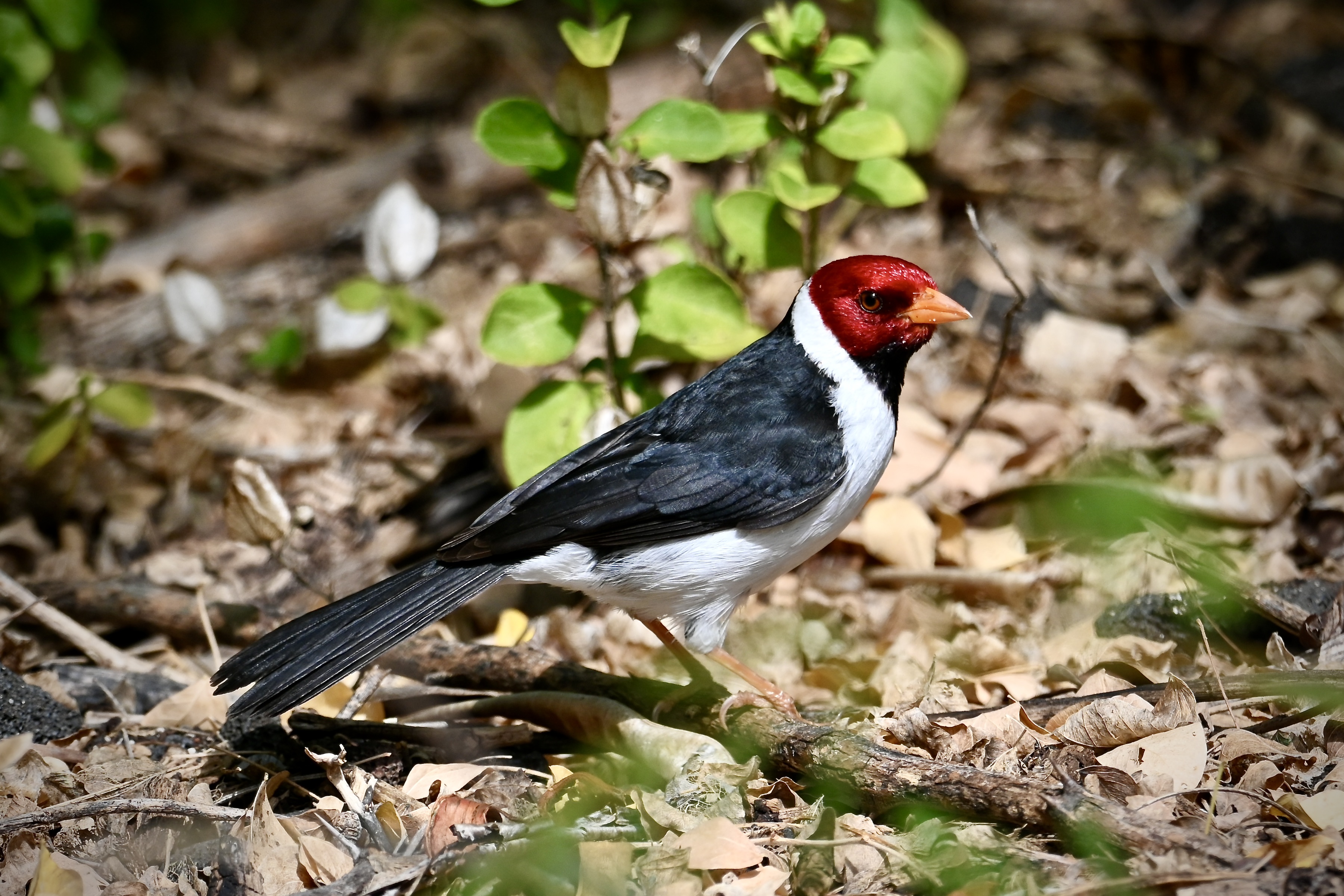
He was a yellow-billed cardinal, and he was young. He was so young, in fact, that the feathers on the top of his head weren’t red; they were brown. He was so young that his bill wasn’t yellow, it was tan.
He was old enough to be living mostly on his own, finding his own food among the seeds and berries, and his own shelter for the night. He was old enough to enjoy a sunrise or a sunset, and he was old enough to enjoy sitting quietly in the sun.
What he wasn’t old enough for was to understand what “peace” was.
That may seem odd, given that sitting quietly and enjoying the sunshine sounds pretty peaceful, but it didn’t always feel that way. For one thing, if he sat in the sunshine for too long, he’d start to feel hungry. Feeling hungry, he thought, wasn’t very peaceful. I guess he had a point there. Being uncomfortable isn’t very peaceful.
Worse than that, though, when he got hungry, he had to find food. He knew how to do that, of course. That wasn’t the problem. The problem was that other birds would show up, and he didn’t like that. Other yellow-billed cardinals were usually OK – he knew a couple of them that tended to tease him – but he really didn’t like it when different kinds of birds turned up. House finches made him nervous. House sparrows were kind of scary. Saffron finches made him feel uneasy about his rather dull coloring.
Worst of all, as you might guess, were the mynas. For one thing, they had brighter yellow bills than he did. For another, they were a good deal bigger. And, of course, they were often really loud, really argumentative, and really frightening.
As he got older and his head feathers turned red and his bill turned more yellow, he still didn’t like it when other birds turned up while he was feeding. He didn’t really notice that the finches and sparrows and kolea really paid him no mind. They just got on with looking for bugs and seeds and worms to eat. So when the myna turned up near him while he was eating, he jumped.
“What’s wrong, youngster?” asked the myna. “Is there something wrong?”
“Oh, no, myna sir,” said the yellow-billed cardinal. “Nothing wrong at all.”
“You jumped,” said the myna. “Did something startle you?”
“Well,” said the cardinal, “you did. You caught me by surprise when you landed.”
“Oh, that’s fine,” said the myna, who sounded somewhat relieved. “Sorry about that. You had me worried for a minute there.”
“You worried?” said the yellow-billed cardinal. “Why?”
“Some birds get upset about mynas,” said the myna. “They think we’re loud and obnoxious. They don’t like it when we’re around.”
The yellow-billed cardinal had thought such things, so he thought that now he’d better stay quiet.
“I’m glad you’re not like that,” said the myna. “I could do with a bit of peace today.”
That’s when the yellow-billed cardinal learned what peace could be – a time when creatures who were rather different could live side-by-side, meet their needs, and not fear one another. A yellow-billed cardinal could be safe from the bullying he feared from a bigger bird. A myna could be safe from the rejection and disdain of a smaller bird.
“I could use a bit of peace myself,” said the yellow-billed cardinal. “Let’s enjoy it while we can.”
by Eric Anderson
Watch the Recorded Story
I write these stories in advance, but I tell them from memory, which means things change.
First of all, then, I urge that supplications, prayers, intercessions, and thanksgivings be made for everyone, for kings and all who are in high positions, so that we may lead a quiet and peaceable life in all godliness and dignity. – 1 Timothy 2:1-2
In a perfect world, prayer should have been enough to win a quiet life in peace, in godliness and dignity. In a perfect world, the Emperor would offer thanks for prayer, would offer to his subjects tranquil peace.
But it is not a perfect world, now is it, Paul? Instead of peace, the emperor presented you a sword, and not to hold. It stilled your tongue, your pen, your breath, and yes, your prayers.
We struggle still to pray for those who persecute our neighbors and ourselves, whose hands retain their firmest grip upon the sword, and strike the pen, the lips, the breath, the prayers from us.
A poem/prayer based on 1 Timothy 2:1-7, the Revised Common Lectionary Second Reading for Year C, Proper 20 (25).
The image is of the mosaic including the beheading of Saint Paul in the Cathedral of Monreale, Sicily (ca. late 12th early 13th centuries). Photo by Holger Uwe Schmitt – Own work, CC BY-SA 4.0, https://commons.wikimedia.org/w/index.php?curid=128492483.
People, in general, don’t do well if they eat a lot of food quickly. It’s a good way to feel sick. Sometimes, somebody who eats a lot of food really quickly will get sick.
Ick.
The young ‘akekeke had learned something similar from his parents as they led him and his sister and brothers around the Alaskan tundra near where they’d hatched. There they found the bugs and worms that filled their bellies and kept them growing. Both mother and father, however, warned them against eating too much, and after one of his brothers ignored their advice and got a nasty stomachache the rest of the chicks decided their parents knew something after all.
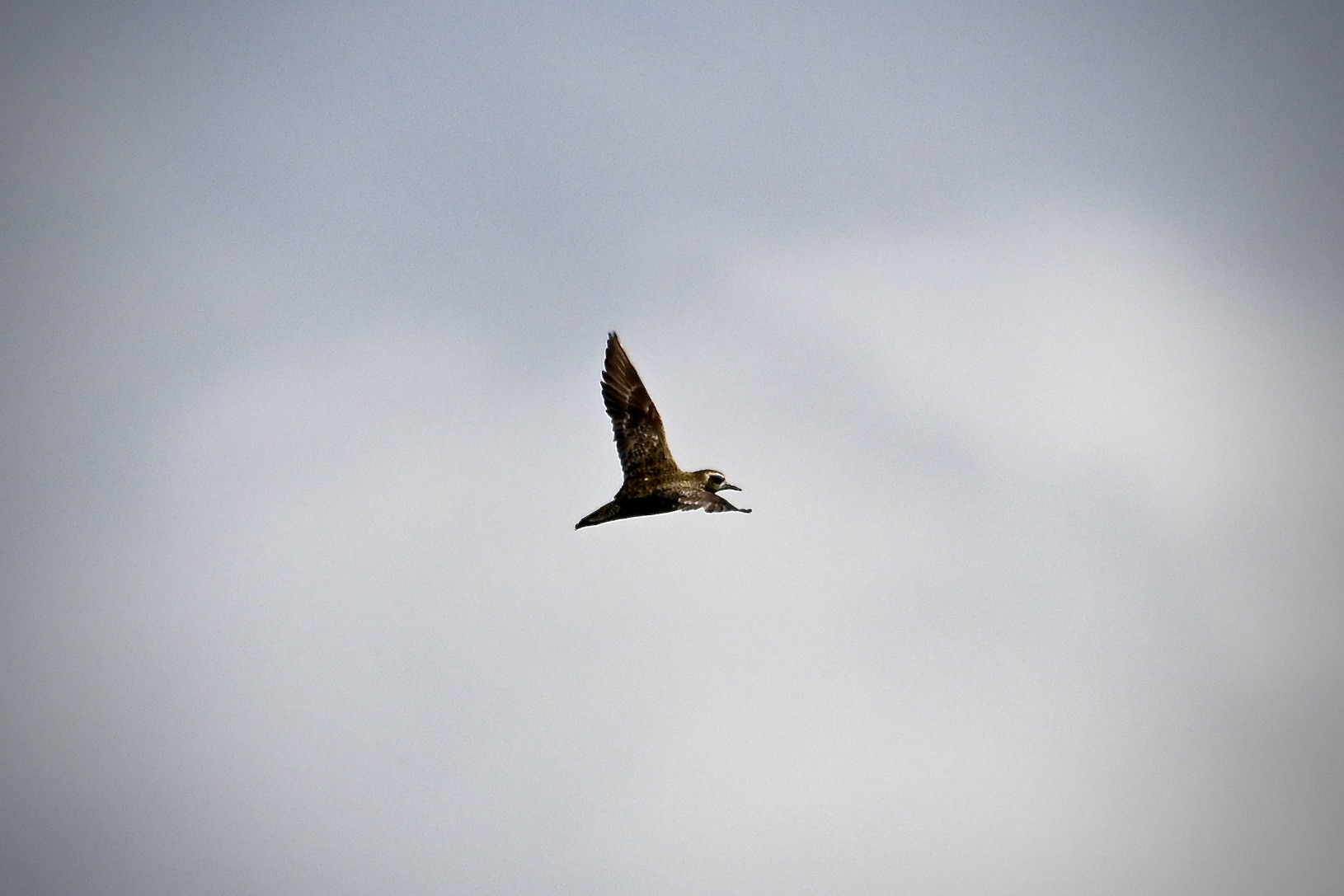
As the summer wore on, it became time for the trip to Hawai’i. The four chicks became fledglings, learned to fly, and watched as more and more of the ‘akekeke began flying toward the coast. Their mother joined in with lots of the other mothers, leaving them with their father to finish flight school with him.
Even more birds departed before their father gathered them along with some other youngsters into a little flock and said, “It’s time to get ready.” They flew to the shoreline where they found a number of other groups of ‘akekeke probing through the shallows for small fish and shrimp.
“It will be time soon,” said their father, “to make the long flight to Hawai’i. You’ll need all the energy you can get for this. So eat. Eat all you can. Eat more than you think you can.”
“But wait,” said his son. “You’ve been telling us for weeks not to eat too much. In fact, when our brother tried it anyway, he got sick. Are you telling us that was wrong?”
“It was wrong then,” said father, “but now we’re doing something very different. We’re making a long flight and there’s nowhere to stop and eat until we get there. This is the time to plan. This is the time to prepare. This is the time to get ready.”
The young ‘akekeke wasn’t convinced. He wasn’t convinced that eating a lot was a good idea, even though his sister and two brothers had plunged right into an outcrop of mussels. He also wasn’t sure that taking such a long flight was a good idea, even if so many of the adults had already gone. His father looked at him with sympathy and with love.
“There’s some time, youngster,” he said. “Take time. Consider. I don’t think you’ll enjoy staying here for the winter – it gets cold, you see. But think it over. I hope you’ll join us.”
The young ‘akekeke thought about it. He thought about being cold, which he couldn’t really imagine. He thought about eating more than he ever thought possible, which he couldn’t really imagine, either, but he could see that his father, sister, and brothers didn’t seem to have any troubles as they ate their way along the shoreline. He thought about Hawai’i, which he also had trouble imagining, since he’d never been there before. Mostly he thought about being the only ‘akekeke in Alaska when everybody else had gone.
A little while later he was industriously feeding himself alongside his father.
“I’ve thought it over,” he said, “and I’ll stick with you.”
by Eric Anderson
Watch the Recorded Story
I write these stories ahead of time, but I tell them without notes, so the text I prepared does not match the way I told it in worship.
Photo of an ‘akekeke (ruddy turnstone) on Hawai’i Island by Eric Anderson.