Jesus bar-Yosef House with a hole in the roof Capernaum, Galilee
Dear sir:
In light of recent events which have damaged your public image, we offer our services as public relations consultants. We believe that we can increase your name recognition and your positive reputation.
To give you some idea of the value of our services, we would like to comment on two recent encounters that resulted in unnecessary conflict with significant public figures. You can evaluate our suggestions here and realize the benefits you would realize from a permanent business relationship with us.
We realize that your followers – or students; one of the things we’d like to clarify is their role in representing you and your ideas – were hungry while you were out walking with them that day. It is regrettable that they had not prepared for a trip. While we are not event planners, we recommend that you get some additional support to see that you are properly supplied.
The public relations concerns arose when they began to pluck grain on the sabbath. Everyone knows that the followers of a religious leader will be properly scrupulous about following the sabbath regulations. Indeed, a higher degree of respect for those practices is simply expected by the populace. In the moment, it would have gone much better if you had said, “Not now, friends. We don’t have far to go. There will be something to eat soon.”
You were walking just a short distance, weren’t you? We’re confident you were.
Alternatively, as noted above, you could have redirected them to use their pre-prepared foods. Best of all, you might have carried some yourself, and distributed those to your hungry followers. Imagine the positive responses to your generosity!
Then there was the man with the hand. We acknowledge that you actually broke no sabbath regulation at all. You didn’t anoint his hand with oil, which is permitted by most authorities. You didn’t even touch it.
Our concern is with your interaction with the other religious leaders in the room. Granted, they didn’t say anything to you. You might have interpreted that as consent, rather than challenging them for hardness of heart. You might also have said, “Let us see what miracles God will do on the sabbath,” which would have been very pious and quite successful.
Best of all, you could have said to the man, “Come see me tomorrow and we will see what God will do. Today we will rest, and God will rest.”
Frankly, Jesus, he’d been living with that hand for some time. One more day would not have been a burden.
These two events, and a couple of others, have generated some opposition to you and to your message. We firmly believe that you can move past them to a better, more productive relationship with the public at large and with your peers among the religious leadership. We think that some circumspection in some areas, and more emphasis of some elements of your teaching, will really resonate with the population. In short, we believe you have potential and hope to represent you.
The proposal in full is attached.
A poem/prayer based on Mark 2:23-3:6, the Revised Common Lectionary Gospel Reading for Year B, Proper 4 (9).
The image is Christ Heals the Man with a Paralyzed Hand, a mosaic in the Cathedral of Monreale, Sicily, Italy (late 12th – mid-13th cent.). Photo by Sibeaster – Own work, Public Domain, https://commons.wikimedia.org/w/index.php?curid=4515630.
Usually I tell you stories about birds. Sometimes I tell you stories about other kinds of creatures, like honu. Sometimes I tell you stories about trees and seeds, and once or twice about clouds. And from time to time, I tell you stories about people, young people and older people.
And I make these stories up.
Today I’m going to tell you a story that I didn’t make up, although I’m putting the words together for it. It’s about a real person who lived and died over two hundred years ago, someone whose life made an enormous difference for you and for me. His name was ‘Opukha’ia.
He was born not terribly far from here in Ka’u. His early life was a sad one. There were wars as Kamehameha I sought to rule all the Hawaiian Islands, and in one of those wars ‘Opukaha’ia’s parents and siblings were killed. He was taken in first by one of Kamehameha’s warriors, and later by an uncle, who was a priest of the Hawaiian gods. The uncle raised ‘Opukaha’ia to become a priest as well.
One day ‘Opukaha’ia visited an American ship anchored offshore, and decided that he wanted to leave Hawai’i, feeling like he had lost his connection with his home with the death of his immediate family. His uncle, I should say, didn’t want him to go. There were two young Hawaiians on the ship, as a young man named Thomas Hopu had already signed on as a cabin boy. The ship made a long voyage, first to Alaskan waters to collect cargo, then to China to sell cargo and take on different cargo, and then all the way around the southern tip of Africa before making their way to the east coast of North America. The ship’s captain invited ‘Opukaha’ia to stay with him at his home in New Haven. New Haven, as it happened, was the site of Yale College, which taught math, science, literature, law – and religion.
The story goes that the young man was sitting on the steps of the main college building when a senior named Edwin Dwight came along and asked him if he wanted to learn. ‘Opukaha’ia wanted to learn very badly, and Edwin Dwight became his tutor. I’m not sure when he adopted the English name Henry. When the ship’s captain had to leave for another voyage, Edwin Dwight found Henry ‘Opukaha’ia another host with a relative named Timothy Dwight. He was, at the time, President of Yale College.
It took some years for Henry ‘Opukaha’ia to accept baptism and membership in the Christian Church, but not because he was slow to believe. He devoured study of Christianity just as eagerly as he ate up study of the English language with a series of mentors and tutors. He wasn’t sure of his own soul. He took it very seriously. He didn’t want to sadden God by falling away from his faith.
I don’t think he did make God sad, by the way.
He had a tremendous influence on the brand-new missionary movement in New England. The American Board of Commissioners for Foreign Missions was founded just a year after Henry ‘Opukaha’ia landed in New Haven. Originally, they planned to send missionaries to India and Sri Lankha. ‘Opukaha’ia made them consider Hawai’i, in great part because he was willing, available, and training to go as a missionary who spoke the language. In 1820, just ten years after the founding of the organization, the American Board of Commissioners for Foreign Missions landed its first missionary company here on this island, over in Kona.
Sadly, Henry ‘Opukaha’ia was not with them. He contracted a disease and in those days there was no effective treatment for it. He died at age 26 in Cornwall, Connecticut. Nearly his last words were, “Aloha o’e.”
by Eric Anderson
Watch the Recorded Story
I prepare these stories ahead of time in writing (it’s what you’ve just read). I tell them on Sunday morning from what I remember of what I’ve written and what I create in the moment. They are not the same.
The image of Henry ‘Opukaha’ia was prepared for the publication of his memoirs, Heneri Opukahaia, A Native Hawaiian, 1792-1818, by Edwin Welles Dwight, 1830.
Author’s Note: This sermon was written for the installation of Kahu Keoki Kiwaha as Pastor of Puka’ana Congregational Church UCC in Captain Cook, Hawai’i. Unfortunately I fell ill and was unable to deliver it. I am deeply grateful to the Rev. Jonathan Roach for taking on that task, literally reading it in the car on the way to the church that Saturday morning.
Kahu Kiwaha has my best wishes and fervent prayers as he begins the work of his calling as Pastor and Teacher, and I look forward to many years of shared ministry.
January 13, 2024
Exodus 3:1-12 Luke 22:14-20, 24-27
When a kahu is first installed or ordained, they make the choice of the Scripture for that ordination or installation service. Other kahu look carefully at their selection, which most of the time, unsurprisingly, is a call story: one of the prophets, one or more of the disciples, perhaps an apostle. It says a lot about how they understand God’s call to them, about the ministry they believe they’ll undertake, even about their ongoing relationship with God.
So I eagerly awaited the word: whose call story would Keoki Kiwaha choose? And it was: Moses.
Wait. Moses?
Moses.
Oh, dear. Keoki, you poor unfortunate soul.
Moses had about as unwelcome a call, and as challenging a ministry, and as unsatisfactory a fulfillment of his ministry, as you can imagine. He was just out watching sheep, when the burning bush and the divine voice called. He was directed to perform the simple task of freeing the people of Israel from Pharoah, and later to guide them to their ancestral home. In the end, he died on a hilltop, gazing at the promised home that he would not reach.
Keoki, I am so sorry. And this certainly explains why you’ve been holding God’s call at arm’s length for so long.
Moses may hold the record for most protests offered to God by a summoned prophet. I count four. One: “Who am I?” Two: “Who are you?” – a good question when a deity starts giving you directions, actually. Three: “They won’t believe me or listen to me.” Four: “I’m a lousy public speaker.”
Four protests. Actually, four unsuccessful protests. Take note. God was more stubborn than Moses. God is more stubborn than you.
Cheryl Lindsay writes at ucc.org, “A common thread in biblical call narratives is the inherent insufficiency of the called. Some are reluctant due to the costs associated with the work. Others question that God is actually seeking them. Nearly all considered themselves ill-equipped for the assignment that God invites them to fulfill.” Dan Clandenin echoes that at JourneyWithJesus.net: “No one in their right mind would think themselves worthy or capable of that call — or any call, for that matter. To speak the unspeakable. To name the Unnameable. The presumption. The audacity. The futility. To remove your sandals and stand on ‘holy ground.’”
Of course you’re not “worthy.” Who is? What you are is the one God called. You have everything you need, or you have the ability to learn everything you need, or you will grow into what you need, and what did God say when Moses asked, “Who am I?”
God said, “I will be with you.”
God says the same to you, Keoki.
Like Moses, you have things to learn. Please learn not to whine as much as Moses. My goodness, he could whine. Yes, the people are hungry. Yes, the people are thirsty. Yes, you don’t know how to find the food and the water not just to satisfy but to nourish them. But you don’t need to go to God and say, “They’re about to kill me.” If they are, God knows that and doesn’t need to be reminded. If they’re not – and they’re probably not – God knows that, too, and do you really need to hear the divine sigh that goes with the divine rolling of the eyes?
“The people are hungry and the people are thirsty and God, I don’t know what to do. I need your help.”
Why couldn’t Moses learn that prayer?
You could also learn to delegate better than Moses. It’s a low bar. One of his regular whines was that everybody depended on him. Because he was really bad at assembling a team of leaders to support his community. Who told him he needed help? Everybody. His family. His father-in-law. The elders he ought to have equipped. His designated successor, Joshua. God. I mean, everybody knew that Moses overdid it.
You have congregational leaders who have done this for a long time. I know that leads to the frustration of “We’ve always done it that way” – but you folks here at Puka’ana know not to say that, right? Some of the things we’ve always done that way – which haven’t always been done that way, just done that way in living memory and sometimes not even that – some of those things are done that way because they work. Some of them don’t work any more. Some of them never did work but it looked like they did. Together you’ll figure out what’s good, what’s better, and what we can leave behind because the past is where it belongs.
Moses… wasn’t good at that.
Moses also wasn’t good at getting support from other leaders around him. You have colleagues on this island, on other islands, and throughout the United Church of Christ. You have access to an educational system that has been equipping kahu for about four hundred years – which, I have to admit, sometimes falls into the category of “perhaps we ought to change this process just a lot.” Get the support you’ll need.
Moses wasn’t good at that.
He was good at staying centered in God’s call – eventually. He kept his focus on the freedom of his people. He kept his focus on their survival. He kept his focus on the standards by which they would live. He kept his focus on their journey with God. None of those tasks were easy, by any means. If Moses had gone after the frequent distractions, however, far too many of them might have failed.
Be clear in your call. That’s not a one-and-done. The fact that you’ve accepted a call to leadership in Christ’s Church at this moment does not define how you live out that call in the coming years. It will shift and it will change. The world’s needs are not constant, so God’s call is not changeless. God’s love, yes. The ministry you do to express God’s love: that is new with the dawn. Be clear in your call.
Moses’ first call was to human freedom. I think that may be a common element for most calls to ministry. Whether it is freedom of the body, or release of the mind, or the unburdening of the soul, God has consistently called prophets and apostles and a Messiah to set my people free.
Be clear in your call.
Remember that you are not Moses. You are Keoki. Keoki has strengths and abilities that Moses did not. You, for example, do not need somebody else to speak for you. You can sing like Miriam as well as speak like Aaron. So you don’t need to make Moses’ mistakes, either. You can make Keoki’s mistakes. I assure you that I’ve found it much easier to make Eric’s mistakes than those of Jeremiah, my own Biblical call icon.
Learn from Moses’ mistakes as well as his successes. Learn also from Keoki’s mistakes and from your successes.
You have a long road ahead, Kahu, and I suspect that like Moses’ journey, the one thing it will not resemble is a straight line. As Harry Chapin sang, “There’s no straight lines make up my life, and all my roads have bends.” Lean with the curves. Lean into the curves. Slow down where you have to, because roadside ditches are unpleasant and the plummeting cliffs that are their alternatives are worse. As I found one day on a road on Maui, sometimes you’ll have to back up and let others go by or things will go very badly indeed.
And… don’t be surprised when you don’t reach the Promised Land in this lifetime.
Commentators over the centuries have spilled a lot of ink over Moses’ death before he reached the Promised Land. Why why why didn’t he make it over the Jordan River? Was it fair? Was it right? Was it consistent with the mercy of God?
Our journey to the Promised Land, however, isn’t one that ends in this lifetime. In this lifetime, we labor and lead and preach and teach for a community that more closely resembles the Peaceable Realm of God. Nobody – including Moses, including Isaiah, including Jeremiah, including Ezekiel, including Mary, including Simon Peter, including Paul of Tarsus, including Jesus – have established the Peaceable Realm on Earth. People have gotten closer. People have stepped further away. But reached it? No.
With all the best wishes for your success in ministry and with all appreciation of your talents and with all anticipation of your growing skills, you’re not going to get there either. Not in this life.
It’s the grace of God that, in the end, sustains us throughout our Earthly journey. It’s the grace of God that, in the end, guides us in sight of our destination. It’s the grace of God that, in the end, makes the bridge from this life, through death, to the goal toward which we’ve labored. It’s the grace of God that, in the end, will bring us home.
Moses. Really? Well. God bless you.
God blessed the world when Moses was called. God blessed the world when Keoki was called. God bless us all as we find our freedom and make our way to God’s eternal home.
by Eric Anderson
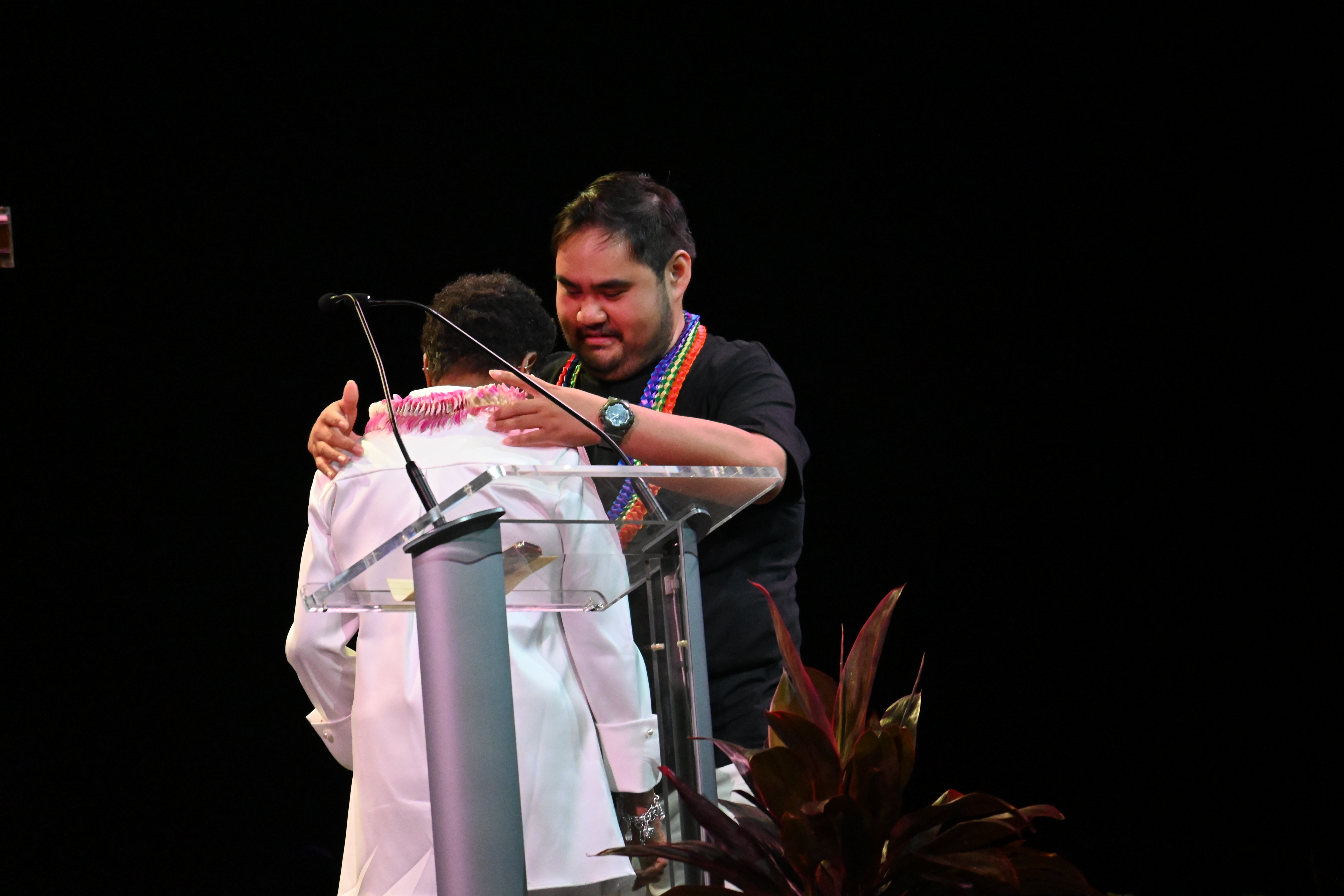
The photo of Keoki Kiwaha (r.) presenting a lei to the newly elected General Minister and President of the United Church of Christ, the Rev. Dr. Karen Georgia Thompson, was taken in July 2023 by Eric Anderson.
They were astounded at his teaching, for he taught them as one having authority, and not as the scribes. – Mark 1:22
Astounded I was, for certain – not, however, in a good way.
I know there’s nuance, theory, opinion, but not so this Jesus.
I’m a great one for clarity. Say what you think but modestly, right?
Not so this Jesus. He laid it out clear and said he was right.
Astounded I was, and a little offended by arrogance there.
That’s when the shouting began. Oh, not me. A poor man afflicted
By demons within. I knew him. We knew him. The Teacher did, too.
“I know who you are!” he cried out, then called him “the holy one of God.”
I was moving to gentle him, comfort him, lead him away and to home, when
Jesus delivered his order: “Be silent! Come out of his spirit!” And silence.
The man drew his breath, then exhaled with a sigh, clearing the tension away.
He smiled, gave his thanks, took his seat near the wall. Nobody knew what to say.
And now I must listen again to this arrogant Jesus who seems to know everything,
Because with a word he set this man’s spirit free. None of the rest of us did.
Perhaps Jesus’ ideas are not just opinion. Perhaps he knows more than he says.
A poem/prayer based on Mark 1:21-28, the Revised Common Lectionary Gospel Reading for Year B, Fourth Sunday after the Epiphany.
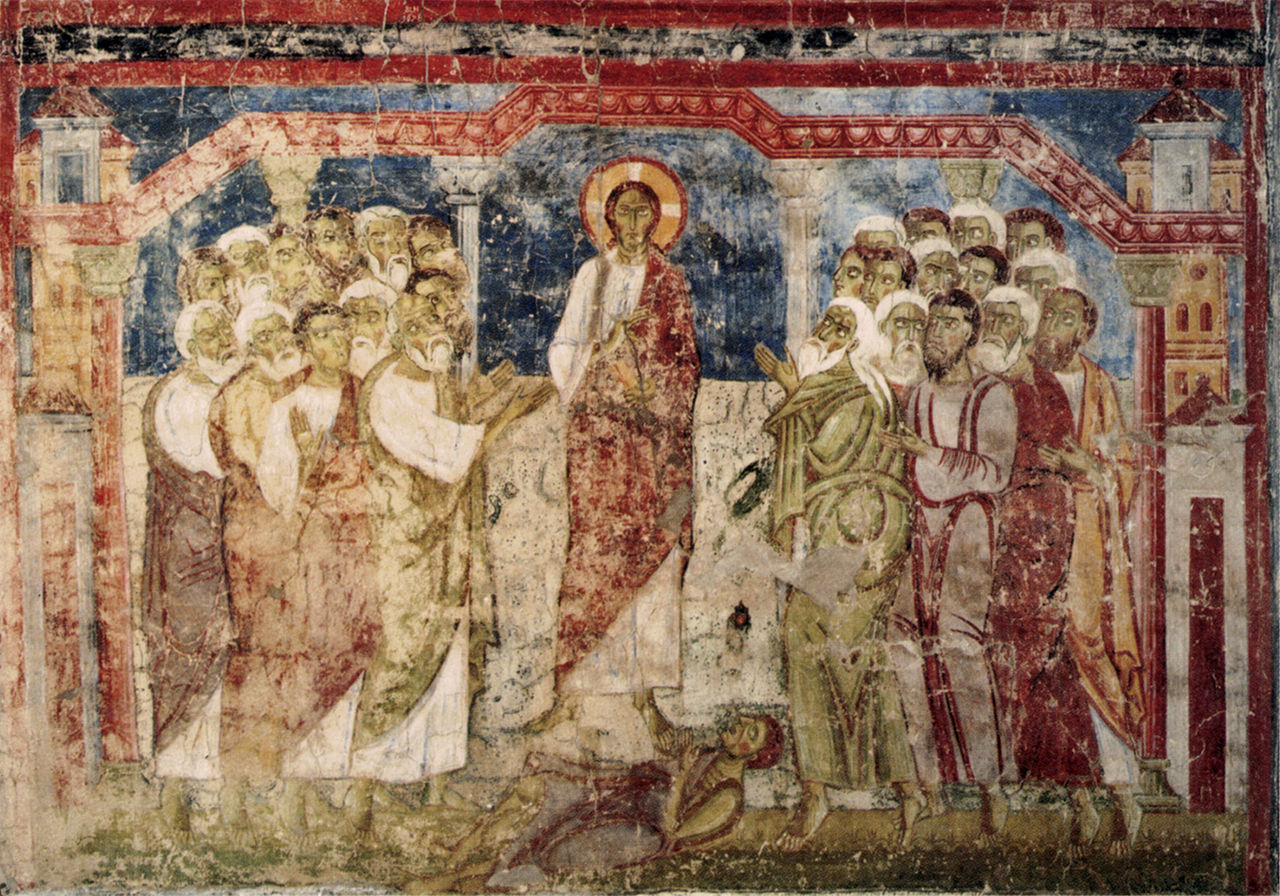
The image is Christ Healing a Possessed Man in the Synagogue at Capernaum, an 11th century fresco in the bell tower of Lambach Abbey, Lambach, Austria, by an unknown artist – Scan aus: Rudolf Lehr –- Landes-Chronik Oberösterreich, Wien: Verlag Christian Brandstätter 2004 S. 79 ISBN 3-85498-331-X, Public Domain, https://commons.wikimedia.org/w/index.php?curid=6633986.


 ordainedgeek