This poem closed the Christmas Eve meditation at Church of the Holy Cross UCC in Hilo, Hawai’i, on Christmas Eve 2022.
May the infant born two thousand years ago, emerge again into our restless lives, to overturn the pretense of our egos, to comfort where we feel the stings of strife.
Awake the wonder of the Christ child, sleeping in that manger of our memory, as angels’ songs were echoed by the shepherds, to summon us from our complacency.
May hope rekindle in our weary hearts and faith revive within our flagging souls for Christ is born, and God’s salvation comes to make the world and all its people whole.
But Mary treasured all these words and pondered them in her heart. – Luke 2:19
Treasuries, they say, are filled with gold. The mansions of the powerful protect the rooms whose contents build the edifices which enclose them.
A treasury, they tell me, is the due of you, dear child, a message from the heavens (though it strangely smells of sheep), and so I lay your well-wrapped form in straw.
An angel spoke to me, he did, and told me not to fear. I thought his greeting odd, but much odder was his word, to tell me that I would become the mother of a King.
A mother I’ve become, but what royal babe is so conceived to summon those suspicious eyes? They’ve followed me for months, though not to Bethlehem.
A mother I’ve become, as witnessed by my groans and pains, by midwife, by my worried Joseph, by the ox whose manger I’ve now stolen for my infant’s bed.
The bloodied rags have vanished, whisked away by midwife’s hands. I tell you, it is hard to hold to memories of angels as a child crowns.
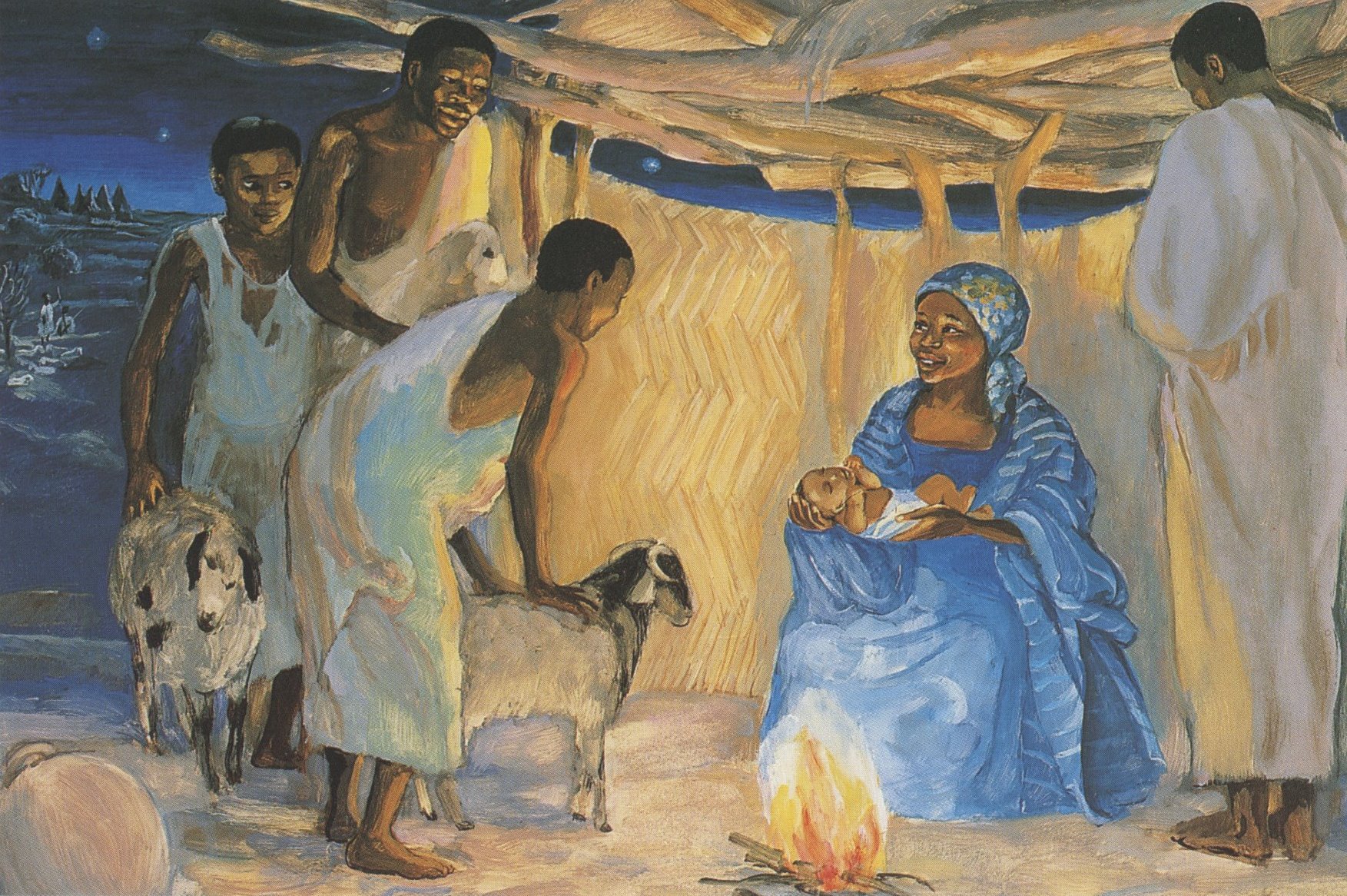
They came, then, those poor wanderers of the fields, abandoning their flocks by night to see a child in a manger. A child. A Savior. A Messiah King.
They spoke of angels singing in the skies, they spoke of glory shining all around them, and they spoke of peace, God’s peace, for all.
In honesty, I’d like to know the reason that the angels sang to shepherds, not to me, this night, since Gabriel’s words have faded in this place.
I’d like to hear the angel once again assure me that the treasury of royalty will be my son’s someday, that he will grow and thrive and save and rule.
For now I must content myself with angels’ echoes in the voices of the poor. For now I must content myself with pondering their words within my heart.
An inn without a room. A stable and a manger. Angels’ voices echoed. Son, your treasury tonight contains no gold. Instead, it is your mother’s heart.
A poem/prayer based on Luke 20:1-20, the Revised Common Lectionary Gospel Reading for Year A, the Nativity of the Lord (Proper I).
The fear of Joseph, who had failed to find a shelter proper for the birth.
The fear of Mary, who had never birthed a child before, nor known her body to take charge.
The fear of neighbors, who awoke to sounds of labor echoing.
The fear of stable owner, wondering if father’s stormy brow meant violence.
The fear of midwife, all experienced with healthy births – and infant deaths.
The fear of all, when mother’s screams went silent, and the universe was hushed.
The fear of mother, marveling to hold a newborn who would not be comforted.
The fear of angels, asking if a band of shepherds was their audience.
The fear of shepherds, so the messenger said first, “O do not be afraid.”
The fear of singers in the heavens’ choir, lest heaven’s song lack harmony.
The fear of watchmen at the gate, confronted by the shepherd band.
The fear of seekers for the infant Christ, uncertain where to find the stable bed.
The fear of parents, shocked to see the hillsides’ wanderers had come.
The fear of parents, hearing angels’ words, which would the fear of monarchs generate.
The fear of monarchs, which would bring no celebration, only tears like rain.
The fear of sleeping child. Who can know what infants know? And who can say what infant Jesus knew of dusty days and stormy seas and quiet conversations by the water’s edge, of questions over meals and by a paralytic’s cot and in the shadows of the night, of lepers leaping thanks unspoken save for one, of baptism and Satan’s snares and stories told and proverbs taught and so much more, and so much more, all leading to an agonizing cross and to a tear-swept joyful dawn.
A poem/prayer based on Luke 2:1-20, the Revised Common Lectionary Gospel Reading for Year C, Nativity of the Lord, Proper I.
In those days Mary set out and went with haste to a Judean town in the hill country, where she entered the house of Zechariah and greeted Elizabeth. – Luke 1:39-40
In those days, Luke? Say rather: “After her imagined life had been upset by visitation of an angel, Mary saw the pretenses of life too well, her friends and loved ones, neighbors, too, persisting in a sad semblance of ‘normal’ when the love of God was breaking in.
“She fled because her efforts to acquaint the villagers of Nazareth with blessing, with deliverance, were greeted with polite discount, with blank incomprehension, silent disbelief, and smirks that smack of shame and slander.
“She fled because she had no outlet for the wonder bottled up inside, no person who would recognize the glory. Who but one already bearer of a miracle would comprehend a miracle before her?
“So in those days she fled. When Mary stood upon the threshold of Elizabeth, received a wave of welcome, knew they shared in wonder, all the pain of others’ disbelief gave way, and in a flood of tears she praised magnificent reversal, pride dispersed, power humbled, humble lifted, hungry satisfied and wealthy leaving empty.
“For in the shared experience of grace, they built on love’s foundation, Mary and Elizabeth, to raise up faith and hope and joy that others would not see.”
Write that, Luke. It’s what you meant by, “In those days.”
A poem/prayer based on Luke 1:39-55, the Revised Common Lectionary Gospel Reading for Year C, Fourth Sunday of Advent.
Far from a barn in Bethlehem in miles and in time, remembering the stories passed and wondering just how much was forgot, and how much lost, of Jesus’ birth that holy night.
Who will recall, in truth, the circumstances of this year? For though we think our times “unprecedented,” it is just a sign of swift forgetfulness, a well-established human trait.
The griefs so hard to bear will not be felt by our descendants, for we did not recall the sorrows of our ancestors, nor think to learn from their successes or their failures to protect ourselves from ill.
Nor will our children’s children hear of ti leaves waving gently in the breeze beyond the window’s Christmas glow. Why should they? They will have their own bedazzling sights and sounds at hand, their own deep scents to breathe.
Now my tree’s glow (in echo of ohi’a blossoming upon the slopes of Kilauea) takes on the shades of stone a-fountaining, a-flowing, and a-pooling at the mountain peak. This might be held in memory.
For this becomes a link between the distant island of Hawai’i and the inn of Bethlehem, the places where the Earth grows thin, and from the deepest places of the planet and the love of God there flows the light a-glowing bright.
Yes, here we have the breaking-in of grace: the one builds up the land and rises from the seas. The other builds up love and joy and peace, reclaiming souls from greed and other-disregarding sin. So come, Lord Jesus! Make the darkness bright.
In the manger of Bethlehem, the infant sleeps. On the Judean hillsides, the shepherds seek their flock. Which of the parents dozes? The father? The mother? Neither one? Both? Love made flesh, power made weak, Majesty made lowly, will soon awake in tears, Seeking the warmth of skin and blood and milk.
Let that infant grow within our hearts. Let that love take form within our purpose. Let that mercy take shape in what we make. Let that peace enfold those we embrace. Let that grace shine forth just like that star: Let the work of Christmas begin in me. Let the work of Christmas begin in us.
A poem inspired in part by Luke 2 and in part by “The Work of Christmas” Howard Thurman. This poem was written for the Christmas Eve meditation of December 24, 2019, at Church of the Holy Cross UCC, Hilo, Hawai’i.
“He promised me the Son of God, the angel did,” she murmured to the sweating, focused midwife. “Promise anything they will,” she answered, not noticing her charge had spoken with an angel. “Now push!” she cried. “And push again!” For in the cries of birth what angel could be heard?
At length the growls and the gasping cease, though night remains unblessed by silence. No. “The Savior has good lungs,” the watching Joseph notes and winces at his piercing tones, distressed by all this labor and this hunger and this cold, now swiftly stifled at the weary Mary’s breast.
“The angel promised me a Savior,” now she sighs as Son of God tries once and twice and squalls, frustrated, not to grasp the nourishment he seeks. She gasps, adjusts the infant’s head by order of the midwife, sighs. At last. The slurping sounds distract her as the midwife mops away.
“Angels, now,” the midwife sighs. “There’s all too few of them.” She gazes at the wincing man, wonders if this “angel” hides a demon, decides to take the mother’s word. “Come, angel. Pile up the straw behind your wife. He’ll nurse much better once her back is straighter.” “I’m not an angel,” says the man, redundantly. She knows.
“He promised me the Son of God.” Now Mary’s eyes arrest the midwife’s gaze. “Of course he did, my love,” she coos, finishes the cleaning, readjusts her gown. “They’re all the Child of God, you know, and this one is for you.” “Oh, no,” the mother says, as flatly as a waveless sea. “This One is for us all.”
A meager coin in hand, the midwife steps into the night. Another one convinced their baby is the Promised One, she thinks. What sorrow for his mother if he follows that drear road! She draws aside to let a band of grimy men pass by. One asks about a baby in a manger, “So the angel said.” She watches as they turn into the stable. Now: she wonders.
A poem based on Luke 2:1-20, the Revised Common Lectionary Gospel reading for Year A, Christmas Eve.



 ordainedgeek
