An ‘apapane wanted to know what the best way to be a flock is.
There are plenty of examples if you journey around the island. He found an i’iwi, who said, “Keep it small, less than ten. And chase everybody else away. Speaking of which, ‘apapane, it’s time you got out of here!”
He checked with a myna, who said, “Oh, just get a few birds together.” “Yeah,” said a second myna, “but make sure they don’t argue.” “What do you mean by that?” demanded a third myna. “Don’t you get cross with me!” said the first, and the ‘apapane flew away as the mynas argued about… nothing.
The ‘akiapola’au, the ‘akepa, and the ‘amakihi said that it’s useful to join a flock because then some of the predators, like cats and such, get intimidated. “A good flock is one that keeps us safe,” they told him.
That sounded pretty good.
He looked in on the ‘akekeke, who said, “Just stay together!” He asked the kolea, who prefer to keep some distance from one another. He thought about asking some fish, but they weren’t coming to the surface to talk to any hovering birds.
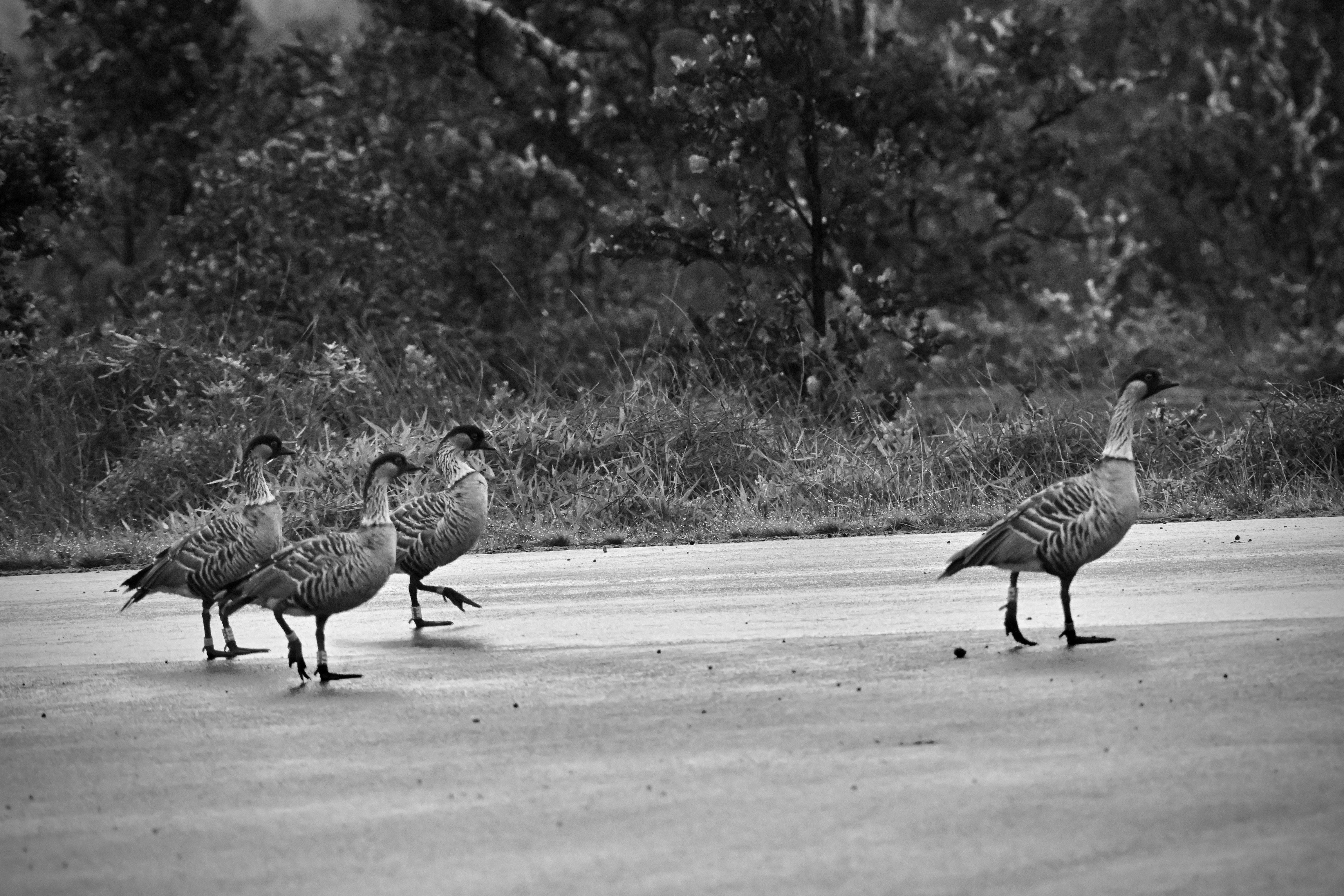
It was the nene, however, who gave him the most to think about.
When he found a nene to talk to, they were gathered around one of their number who’d hurt her wing. The little group was hungry and rather footsore as they trooped along, looking for ‘ohelo berries (or pretty much anything they could eat).
“Why aren’t you flying?” he asked one of them.
“Because she can’t fly for a while,” said the one in front.
“Can’t you leave her while you go eat?” he said.
The nene looked at him as if he’d lost his mind.
“A good flock is one where nobody gets left behind,” the nene said.
The ‘apapane returned to his part of the forest, and gathered his friends and family and any other birds he could. Together they could find food and shelter. Together they could scare off some of the dangers. But most of all, he told them:
“A good flock is one where nobody gets left behind.”
by Eric Anderson
Watch the Recorded Story
I write these stories ahead of time, but I tell them from memory plus inspiration. As a result, the recording of how I told it does not match how I wrote it.
When the birds of the ohi’a forest start to flock together – which tends to happen when the chicks have learned to fly and left the nest – some of those flocks rotate leadership among the birds: an ‘apapane this week, an ‘akepa this week, and who knows? Perhaps an ‘alawi the next.
There came a week when one of the ‘amakihi was chosen to lead, and he was going to lead, by all that was feathered, he was. He had done a lot of watching and a lot of listening to the other leaders, and he knew he’d do a good job. He wouldn’t bully, and he wouldn’t brag, and he would get help from other birds to be sub-leaders, and above all else, he would keep an eye out for food, for shelter, and for danger.
He was, after all, the one in charge.
Things seemed to go just that way for the first couple of days. The other birds followed where he led, they sang cheerfully as they foraged for bugs and nectar, and they avoided both the nuisance of a cranky i’iwi and the dangers of two cats and an ‘io. On the third day, however, something seemed to be going… differently. The birds still followed where he led, but… it almost seemed like some of them were slightly ahead of where he was going. He thought they might just be faster fliers, but as the day went on he noticed that some of them seemed to open their wings just slightly before he did.
What puzzled him about all this was that, as he thought about it, it seemed… perfectly normal. The other flock leaders had also been just slightly behind two or three birds. Which seemed… perfectly normal and perfectly odd.
When the next day came, the same thing was happening, and he kept a close eye on things. Another ‘io came by over the course of the morning, so that a sudden alarm whistle sent everyone deep into the branches. A little while later, the same voice trilled that it was safe again, and the flock took wing for another ohi’a tree – one that he, the leader, hadn’t chosen. He probably would have tried that direction (because the ‘io went the other way), but he hadn’t chosen it. What was going on?
In early afternoon, it happened again. Two or three birds took off just before he did, and later on two or three more took off just before he did, but they were different birds. Still, he spotted what was the same: those birds had been close to another bird, an ‘amakihi, just before they flew.
So he landed right next to that bird when they got to a new tree and found… she was his mother.
“Are you… What are you doing, mother?” he asked. “Are you trying to take over as leader?”
“Not at all,” she said. “I’m following you, just like everyone else.”
“Then how come birds take off ahead of me from around you?”
“Well,” she mused. “I might be mentioning that you’re looking at a tree in a particular direction. They seem to think that’s a reason to go that way. You and I both have been paying attention to what’s safe and what’s in blossom.”
“Isn’t that leading?” he asked.
“It might be,” she said, “if leading is paying attention to what’s good for all the birds of the flock. Which you’re doing. But it’s something that all of us can do along with you. When your leadership time is over, you can do it, too.”
He was a good leader, they all agreed. They were surprised to find, however, that he was an even better follower when another bird’s turn came to lead. He did the best he could to see that all the birds were fed, warm, and safe – and so did his mother.
by Eric Anderson
Watch the Recorded Story
I write these stories ahead of time, but I tell them in worship from memory. Memory plus a fair amount of improvisation.
I was ordained in my home church, Union Congregational Church UCC in Rockville, Connecticut, thirty-six years ago today.
A lot of things have changed in the intervening three and six-tenths decades. For one thing, my home congregation left the United Church of Christ, which is a lingering ache. My father retired from a distinguished career as a public school educator, completed a seminary degree, and was ordained himself. My daughter has also graduated from seminary and I look forward to celebrating her ordination. My son has kept his concentration on the writing and creating he wants to do, a quest that has taken him to the heartland of Arthurian stories in Wales.
The UCC has lost members and lost churches every one of these thirty-six years. We’re not alone. Similar things have happened in “mainline” Protestant denominations and in traditions that have rejected the mainline. The church has aged. Even now, as I have entered my sixth decade, I remain younger than a majority of my parishioners.
It seems like I ought to have learned something over all these years, and to have some wisdom to offer to colleagues, friends, church members, and church leaders. I feel like I should. If I do, I wish it were clearer to me.
The time has passed in the blink of an eye, a blink of an eye that has included innumerable endless days.
A couple weeks ago ministers of the Hawai’i Conference gathered for a retreat, which was held just a few miles from my home. On one of the afternoons, we participants could participate in “adventures.” For various reasons, including the vigorous advocacy of a young person in my congregation, I was asked to be the local pastor who accompanied (and joined) those who took part in a zipline adventure.
It wasn’t entirely outside my wheelhouse. While in Connecticut, I sought training as a ropes challenge course facilitator. I really enjoyed the training and the work of guiding people through an experience of testing their boundaries, trying something scary and finding a new sense of accomplishment. As I’ve put it more than once, facilitators spend their time safely on the ground, but in training we spent more time at the heights. The conference’s retreat center didn’t have a zipline, but I did get a chance to try one before moving to Hawai’i.
The simple truth is that I don’t have much fear of heights, and doing that training and that work taught me to trust the equipment.
I still wasn’t sure how I’d feel until I set off on the first zipline that afternoon. Would it be exhilaration? Had I developed a fear of heights without realizing it? Would something else happen that I didn’t anticipate?
It did. I settled into the harness, glided along the cable, and felt about as relaxed as I’ve felt in some time.
Yes. You read that right. I felt relaxed.
I was surprised, too.
Relaxation can be hard to come by in a pastor’s life. Sometimes pastoral duties come with a lot of anxious energy. The other day I received an urgent call to go to the hospital, as someone from another church, someone I have known and worked with, had been rushed there by ambulance. When I got there, nobody had a record. It turns out that they’d died in the ambulance without ever reaching the hospital.
That afternoon brought a lot of concern, anxiety, shock, and grief.
If I have any wisdom to offer on the thirty-sixth anniversary of my ordination, it’s this: Relax into the glide of the zipline. Ministry can feel like an uncontrolled glide over a yawning chasm at times: mercifully, not all the times. When it does, the mechanisms that keep me from falling aren’t readily apparent, or if they are, I may not be convinced of their strength. Those pitfalls look awfully deep.
Relax into the glide.
You’ll get to the other side.
It’s an imperfect metaphor, of course. One of the features of ziplines is that they make straight lines between one place and another. Ministry frequently doesn’t. You set off in one direction, and find yourself landing in a completely different place. Thirty-seven years ago, did I expect that I’d do interim ministry? Play the guitar and ukulele? Manage IT and publications for a Conference? Facilitate on a challenge course? Pastor a church in Hawai’i?
No, no, no, no, and no.
Not all of my transitions have been gentle (far from it) and not all of my landings have been soft (far from that, too). The ground that looked firm has crumbled beneath my feet both at the beginning and the end of the traverse. I still don’t really understand the systems that have kept from out of the crevasse all these times.
But if I have one piece of advice, it is: Relax into the glide.
You’ll get to the other side.
The photo shows me (a gray figure with an orange helmet) gliding down a zipline over a waterfall. Photo by Ben Sheets.
“As he went ashore, he saw a great crowd, and he had compassion for them, because they were like sheep without a shepherd, and he began to teach them many things.” – Mark 6:34
Bring your compassion, Jesus, for our shepherds howl like wolves. They lay the rod of law with harshness on the poor and spare the ones in power.
Teach us, Jesus.
Bring your compassion, Jesus, for our shepherds carelessly use words that others hear, and hearing ponder. Pondering, they set themselves to violence.
Teach us, Jesus.
Bring your compassion, Jesus, for the shepherds cannot find the way that leads between our Scyllas and Charybdises, and lost, we founder in moral morass.
Teach us, Jesus.
Bring your compassion, Jesus, and teach us many things, like how the shepherd cares first for the sheep, whereas the predator consumes them.
Teach us, Jesus.
We are sheep without a shepherd. Teach us many things. And may we, by God’s grace, learn.
A poem/prayer based on Mark 6:30-34, 53-56, the Revised Common Lectionary Gospel Reading for Year B, Proper 11 (16).
The last installment of this series, to my surprise, is nearly four years old. Since July of 2020 Church of the Holy Cross UCC returned to online-only worship when COVID infections rose dramatically that summer. In-person worship did not resume until April 2022.
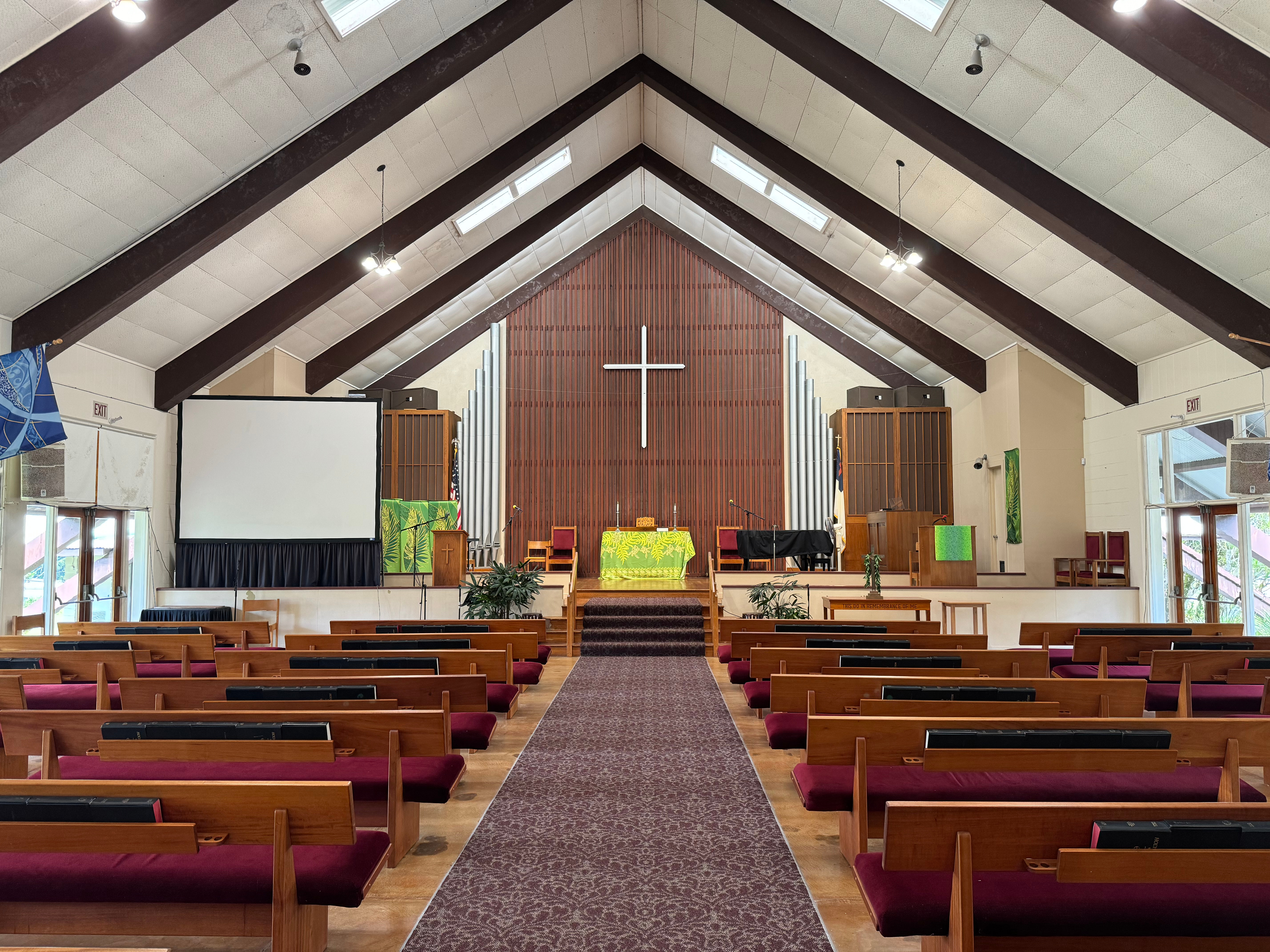
When people returned to the sanctuary, we restored some, but not all, of the pews to the room, maintaining wider spacing. Eventually we returned nearly all of them. We continue to make masks and hand sanitizer available, and we have a policy that dictates when we will require masks, and when we will require online-only services. In the last two years, we have not had to implement that policy.
We found solutions to a number of our challenges during those two years of streaming. Having moved to the pulpit and lectern in the summer of 2020, we remained there, to give more of an in-person feel. We added more music. When people came to the sanctuary, we made some additional changes.
Moving the Consoles
With only the worship team in the sanctuary, we could place the mixing console with its PC, ATEM mini switcher, and remote control for the sound board where it was convenient for cable runs. As I’d noted in the previous piece in this series, we were near the limits of HDMI cable length. With a congregation in place, however, we needed to move the technical station, preferably to the back of the room. How could we get the camera signals there, however?
The answer was fiber-optic HDMI cables, whose prices had plummeted over the last few years. They carried signals over 100′ with no degradation. We initially laid them across the floor with cable covers, but then moved them along the walls above the windows.
In the meantime, Blackmagic Design had issued a series of upgraded ATEM Mini units. We purchased an ATEM Mini Pro. Its four inputs gave us the ability to connect three cameras plus the feed from our internal slides. Best of all, this piece of hardware can display a multiview on an external monitor, allowing us to retire the field monitors.
Camera Upgrades
The little Canon video cameras had done good service, but they were showing problems. They used a mini-HDMI connector, and it was not built for the strains of moving the camera back and forth. We began to suffer short dropouts on cameras, and I began to worry that one or both of the connectors would fail. In addition, we faced the need to move the cameras further back in the sanctuary as people returned. We looked for a better long-term solution.
We invested in three Blackmagic Design Studio Camera 4K Plus cameras. We equipped two of them with longer power zoom lenses and one with a wide power zoom. The wide lens camera stands raised at the back of the sanctuary and provides a shot of the entire room. It has no operator. Volunteers point the other two, permitting us to continue streaming a three camera production. I have really welcomed these new cameras, because for the first time I know which one is active. I recently discovered that a small tweak to their color balance has really improved the look.
Sound
Our Soundcraft Ui24R has continued to serve us well, allowing us to send separate mixes to the speakers in the room and to the live stream. Moving the control console forced us to a new solution for getting the feed to the stream. We’re much too far from the physical mixer to use USB. Instead, we run an analog connection from the appropriate Auxiliary Out port to the back of the room, where it connects to a sound input on the ATEM Mini Pro. With a little bit of delay to compensate for the delay built into HDMI, we have solid sound.
We did add a “house sound” microphone to the mix. It hasn’t been a rousing success. We haven’t been able to place it so that it picks up the congregation without picking up the internal sound as well. We use it primarily during responsive readings, but not much otherwise. I’d still like to improve that somehow.
Movement
When a congregation returned in 2022, one of our members led them in movement, generally to one of the hymns or a musical anthem. As we increased the number of hymns in the service, this became less needed, and eventually we began to schedule the hula with an anthem. Sadly, the member then went through surgery, and we haven’t got her back on the calendar.
On the other hand, there is more movement in the service. The candle lighters go back and forth, and we stand and sit for prayers and hymns. We seem to have returned to that balance of stillness and striding that fosters a sense of worship.
Lights
We replaced the lights illuminating the sanctuary and the chancel with brighter LEDs that have a consistent color temperature. That has improved the video quality as well as the experience of worshipers in the room. It also led us to replace our sanctuary projector. The brighter overhead lamps made it much more difficult to read the screen, and the old projector wasn’t bright enough.
On Video a Lot
In 2016, when I began to serve Church of the Holy Cross, I began a video series called What I’m Thinking, a short improvised reflection on the Scripture text for the coming Sunday. That series recently exceeded 350 episodes. That makes one appearance in front of the camera in a week.
On Wednesdays, I’ve continued to offer A Song from Church of the Holy Cross. I began this program to test camera and microphone solutions, but also to provide some music in what I anticipated would be an all-too-musicless pandemic environment.
On one Friday a month, I offer a one hour Community Concert, which includes songs in the public domain (because copyright) and a few original pieces.
And of course on Sunday, I’m there before the cameras with worship. I’d never imagined becoming a televangelist, but I have to admit I’ve become one.



 ordainedgeek
