Simon Peter went to see a man A Roman centurion with power in his hands. “Speak to us, Peter, we’d like to hear news of a new way of living, one we can choose.”
[Chorus]
Who are the people of Spirit? Open my heart to see. Who are the people of Spirit? Is it you? Is it me?
[Verse 2]
Simon Peter told his story to them How a crucified brow bore a bright diadem. Then he gasped as those Romans, unashamed Displayed in their bodies the Spirit unchained.
[Chorus]
[Verse 3]
Simon Peter brought the Council the word That even in Gentiles the Spirit had stirred. “Who am I, who are you, to hinder our God?” In the grace of the Spirit their spirits were awed.
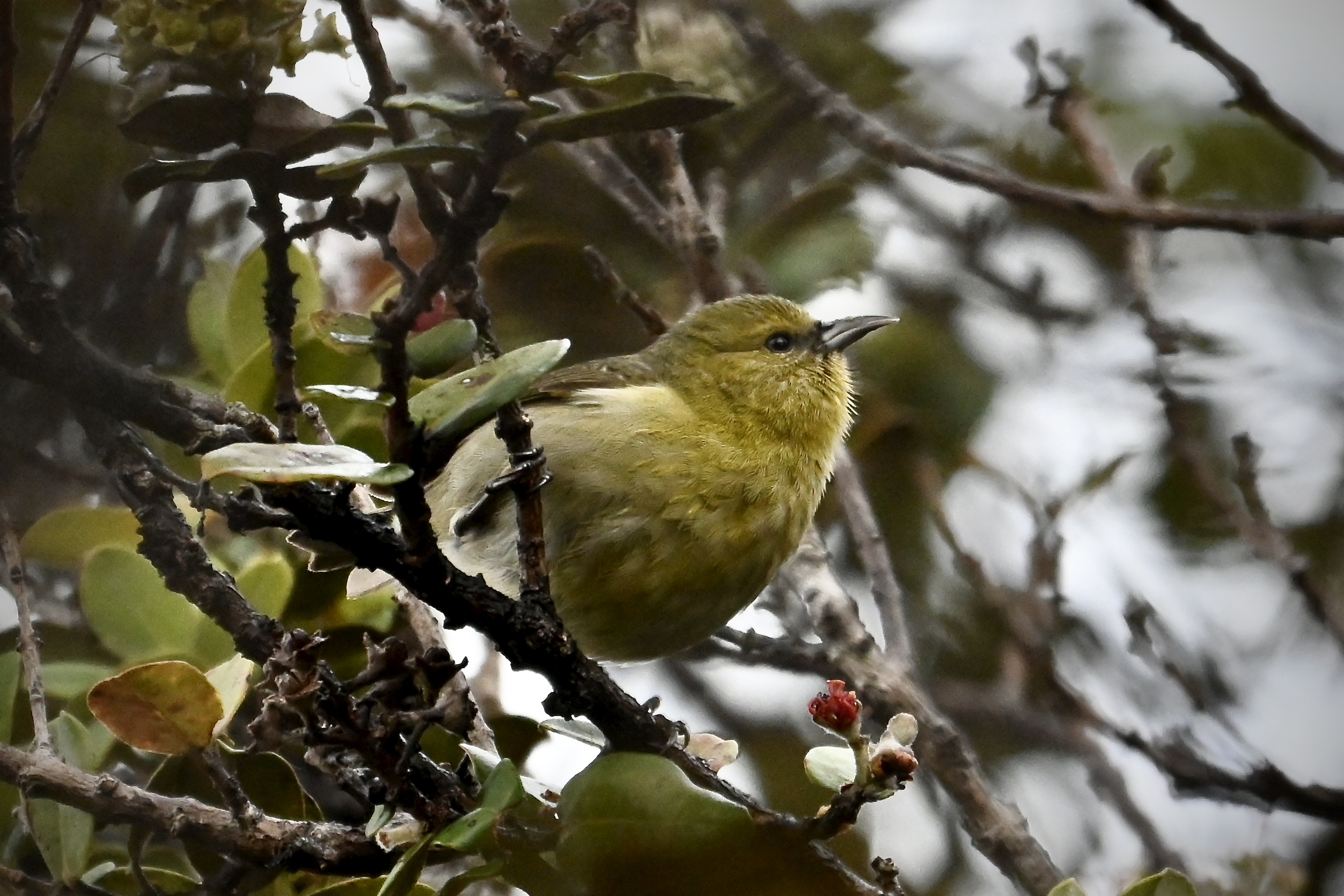
The young ‘amakihi was nervous. She had been busy growing up, which ‘amakihi do a lot quicker than human beings do, but there was a lot to pack into that time. There was eating, and learning what to eat. There was taking care of her feathers, which changed when she molted and the feather lengths changed. And of course there was flying.
Then she had to learn about eating again, because there were things she could get to with working wings that she couldn’t get to in a nest. She learned about new bugs, new fruits, and new flowers. She’d been too busy to be nervous.
She was nervous now, though, because her parents had announced that the family would join a flock for the summer. She wasn’t really used to other birds. She’d met an auntie or an uncle or two, and of course her tutu, but these would be strange ‘amakihi. Would they like her? Would they be mean to her?
It made her more nervous to realize that the flock wouldn’t include just ‘amakihi. It would include ‘akepa, ‘alawi, and scariest of all, ‘apapane. She knew there were a lot of ‘apapane around. She’d seen far more of them than she had ‘amakihi. She’d also seen them chase ‘amakihi through the forest, even her own father. “I got too close to their nest,” he’d explained, and that made sense because she’d seen him chase other birds away from her nest, but still. The ‘apapane made her nervous.
“It will be all right,” said her father. “It’s different when birds aren’t worried about nests and eggs.”
“It will be all right,” said her mother. “You’ll make it all right.”
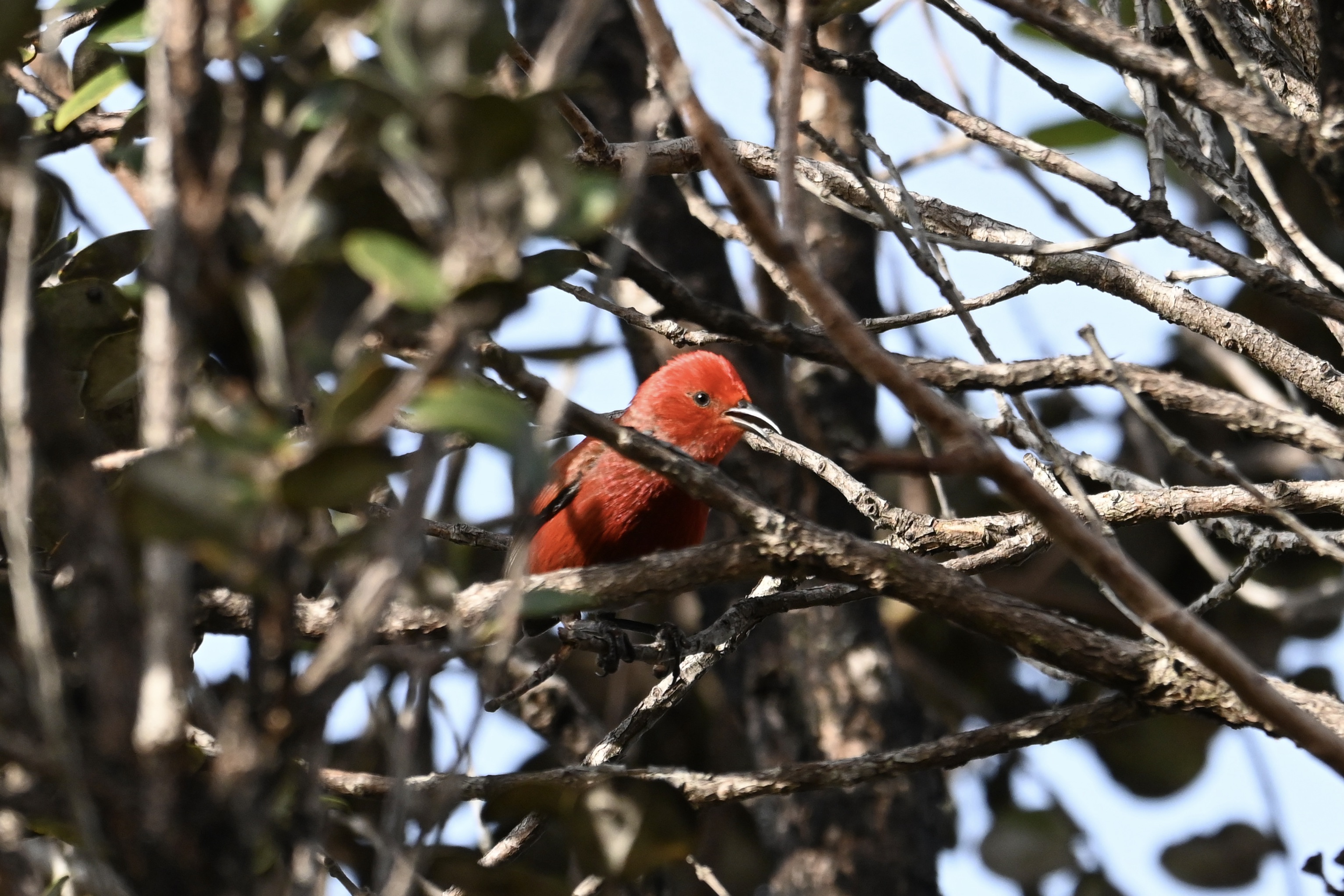
The day came when she and her brother and her parents flew over to an ohi’a tree filled with other birds. There were other ‘amakihi, and she knew some of them because her tutu were there. There was ‘akepa and ‘alawi showing off their green and bright orange feathers. Mostly, though, there were ‘apapane. They hopped through the branches, singing their beautiful songs, and looking very sharp in their red and black feathers.
One of them, who was keeping rather quiet, hopped over to the branch where she was sitting, keeping very quiet and hoping nobody would notice her.
“Hi,” said the ‘apapane. “What kind of bird are you?”
“I’m an ‘amakihi,” she said. “And you’re an ‘apapane.”
“I am,” he said, and looking rather nervous, said, “I feel really dumb. I’ve never seen most of these birds before. Do you know any of them?”
“Well, I know my family,” she said, “and I’ve seen a couple of these other birds before,” – she didn’t mention that they’d been chasing her father away from their nest – “but most of these birds are as new to me as they are to you.”
“Oh, good,” said the ‘apapane. “I guess this is new to most of us youngsters?”
“I think it is,” said the ‘amakihi. “I’ve been worried that nobody would like me.”
“You’ve made me feel better,” said the ‘apapane. “I think most birds would like you for that.”
“And you’ve made me feel welcome,” said the ‘amakihi. “Thank you so much for that.”
Mother had known, after all. She had made it all right.
by Eric Anderson
Watch the Recorded Story
I write these stories ahead of time, but I tell them from a combination of memory and improvisation. As a result, what you’ve just read will not match what you hear.
I’m afraid it’s true that there are not many nene. They are easily outnumbered by the ‘apapane, and more than easily outnumbered by people. You may wonder why, if there aren’t that many of them, you hardly ever see them one at a time. I mean, wouldn’t you expect that a nene would go its own way from time to time, just to find some ‘ohelo berries of their very own?
One nene thought that independence sounded like the way to go.
He’d been to nene school, so he thought he knew it all. He knew how to find food. He knew how to fly. He’d done the drills at formation flying without getting excited about it. He was going to be the nene who made his own way, without relying on (and, you know, sharing with) the other nene.
So off he went to find his own spaces.
There’s a lot more of Hawai’i Island than there are nene, so it wasn’t difficult. If he spotted a little flock of nene in the air or on the ground, he’d just go somewhere else that they weren’t. That was lots of places, and plenty of those places had food, and water, and places to rest and relax. All in all, he thought he was having a pretty good nene life.
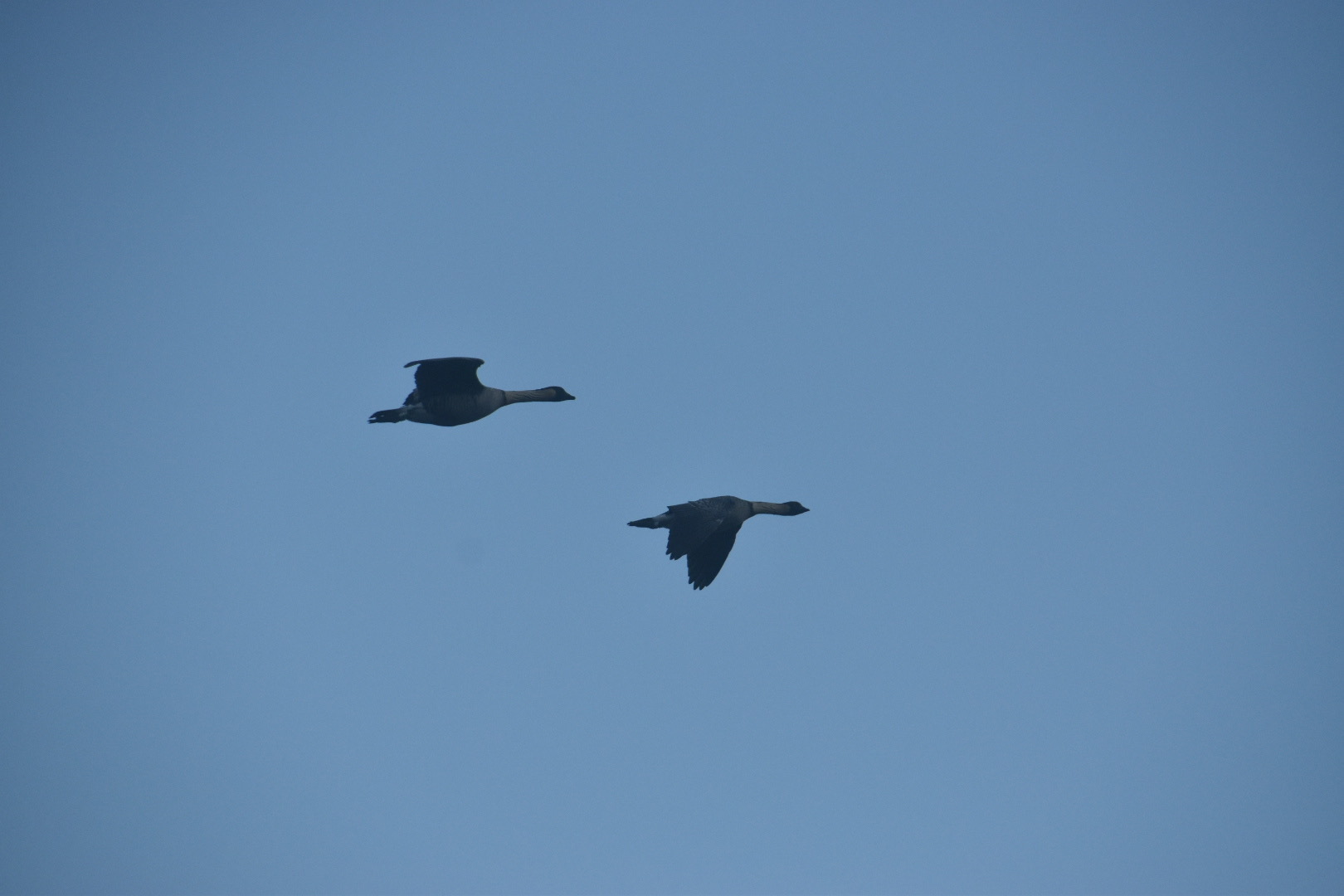
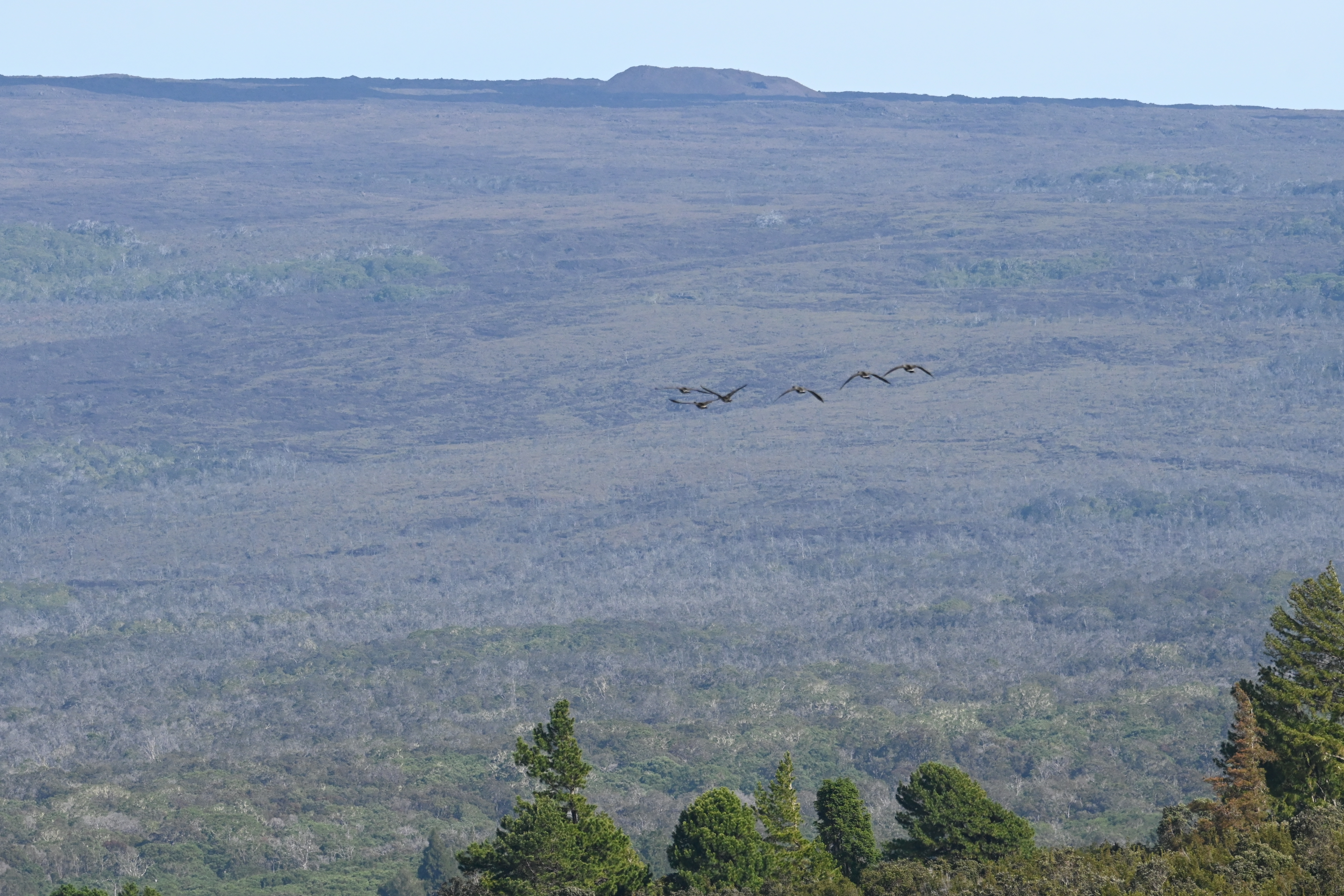
One day as he was in the air looking for another place to relax and eat, he heard the calls of some nene behind him. Glancing back, there was a little “V” shape of five geese flying in formation. They called out a friendly greeting, to which he replied – he liked being alone, but he wasn’t going to be rude about it.
What surprised him, however, was that the little “V” of nene was catching up with him. In fact, they passed him in the air, still calling out their “Hello!” He thought he was a pretty good flier, but they sped on by and he couldn’t keep up. It didn’t take long before they’d disappeared into the clouds.
How had they flown past him so fast?
Sometimes when you don’t know something and you don’t have Google, the best thing you can do is ask someone who should know. So he sought out his nene school teacher. When he found her, she was just finishing up a formation flying class. He waited, mostly patiently, until she was done, and told her about being passed by those other nene.
“Am I just so slow?” he asked her.
“No,” she said. “You’re not slow. You’re alone. Flying together – in that ‘V’ formation – allows us to fly more easily. The wings of the birds in front create good flying air for the birds behind. It makes a difference. We can put more strength into it. We fly better together.”
“You mean,” he said, “that if I always fly alone, I’ll always fly harder and slower?”
“That’s exactly what I mean,” she told him. “Together is the easy way to fly.”
Never let it be said that nene won’t learn. He found his own place in a little flock, and there in its “V” he flew easier and faster than he could remember doing before. Together is the easy way to fly.
by Eric Anderson
Watch the Recorded Story
I write these stories ahead of time, but I tell them from memory plus inspiration. The story you just read will not match the recorded telling of it.
Everyone thought she was one of the best singers among the ‘apapane. Her notes were clear, her improvisations were delightful, and she had the breath to sing long bubbling musical runs. Other ‘apapane used to listen for her in the mornings, and if they heard her, they’d take off in her direction.
It turned out that she used to sing loudest and longest when she found a grove of ohi’a with lots of blossoms, so everybody who flew into the neighborhood got a good meal. She’d sing, however, even in a tree between flowering times. When she did, the other ‘apapane – and the akepa, and the ‘alawi, and the ‘amakihi, and even the i’iwi – settled into nearby trees to listen.
It was like having a great concert every day.
She couldn’t help noticing that a fair number of birds got a free lunch, or breakfast, or dinner out of her songs. At the start she didn’t mind – she was pretty flattered that everyone flew to hear her sing – but as time went on it started to rankle. “Can’t they find their own trees?” she grumped to her brother one day, and if he had anything useful to say, she didn’t listen.
Then she had a bad scare. She’d landed on a branch near to the ground, which she rarely did, and began to sing. Suddenly the branch heaved with a heavy weight. She fluttered into the air, taken by surprise, and only then noticed the hunting cat which had leapt onto her branch and only just missed her.
She flew higher into another tree, whistling with alarm, and watched while the cat climbed back to the ground and disappeared into the forest.
The next day the sun rose, but her voice didn’t rise. The day grew brighter, but nobody heard her song. Other ‘apapane and ‘amakihi and mejiro and the rest begin to sing, but she remained silent.
She found a place deep within some leafy ohi’a branches and hid from the world.
They noticed that she wasn’t singing that day, the other birds did, but they mostly thought she’d gone to another part of the forest and would be back soon. But one day became two, and two became four, and four became over a week and nobody had heard her song. They began to look around, hoping to find her well, and terribly afraid that something bad had happened.
Her mother found her – mothers often have a talent for finding their children – still huddled in her ohi’a tree, silent and afraid. She told her mother about what had happened with the cat.
“I don’t want to sing ever again,” she said.
“Your songs are beautiful,” said her mother. “Everybody loves you for them.”
“Everybody follows me because they think they’ll eat well,” said the daughter. “Somebody else can do that. Not me.”
“Listen for a moment, daughter,” said the mother, and the two were quiet. The forest, however, was not. The calls and songs of the forest birds sailed out over the trees.
“Listen to that,” said mother. “It’s everybody’s song.”
“Won’t they attract cats?” asked the singer.
“They might,” admitted her mother, “but there are ways to sing beyond their reach. Mostly, though, realize that it’s your voice, and your melodies, but it’s not really your song. It’s everybody’s song when you share it, greater and more wonderful than you know.
“What do you think, daughter? Can you sing with everybody’s song?”
In answer, the young ‘apapane opened her beak and sang.
by Eric Anderson
Watch the Recorded Story
I write these stories in advance, but I tell them in worship from memory and from improvisation. What you’ve just read will not match what you watch.
The three nene goslings had grown from the day they’d hatched. They’d joined their parents on walks around the nest area, which had grown longer as they’d grown stronger, to find the grasses and berries that made them a good breakfast. And lunch. And supper. And any-time-of-the-day snack.
Nene don’t really have a lot of use for set times for their meals.
The three goslings had learned to fly once their feathers had grown in and their wing muscles had become strong enough. They’d flown with their mother, and they’d flown with their father, and they’d flown with them both, and a few times just the three of them alone. They’d had something of a scolding from their parents the first time, but not after that.
They thought they’d got themselves set up for living. They had family. They had food. They had flight. What more could you ask?
It turns out that there was something else. To family, food, and flight, they needed to add: flock.
“What’s that?” asked one of the goslings, who hadn’t heard the word before.
“It’s more nene, dummy,” said his slightly older sister, who had heard the word.
“Don’t call your brother dummy,” said their mother.
“Yeah, don’t call him dummy, even when he is,” said the youngest of the three, a little brother who had been practicing teasing his siblings and become good at it.
“Stop teasing,” ordered their mother, “and listen.”
“We’re part of a larger flock,” said father patiently. “We’re a small family, and the other nene are the bigger family. They help us find food when it’s scarce, and they help us keep i’o away, and, well, it’s good to have them there.”
“I don’t need anybody else,” said older brother. “Food, family, and flight. And even some of my family could be better behaved.”
“Look, son,” said mother, “when I was young I didn’t think I needed a flock, either. But the world is bigger than what you’ve seen so far, even though you can fly. There’s an ocean and there are people and there are other creatures. In the flock we get some help when we’re confused. We learn things we wouldn’t otherwise know.”
“Fly with me,” said father, and the little family took off and soon landed amid a larger, but still rather small, group of nene. He introduced the three youngsters to the others.
“You need to become part of the flock,” said one of the new nene, who was actually a kupuna nene. “Fly with us.”
So they did. They took off together and did a series of circles around the place where they’d met. It wasn’t elegant – none of the young nene had been to Nene School yet, so their formation flying was pretty awful. Still, they did their best, and as they flew they realized that the air flowed over them differently when it was shaped by other birds’ wings. As they landed, they realized that the group had chosen a different place, one where the ‘ohelo was abundant.
“You are now part of the flock,” said the kupuna nene. “We are glad to have you fly with us.”
The next day, of course, they began Nene School, so they could eat better and fly better. And they were glad to fly with their new flock.
by Eric Anderson
Watch the Recorded Story
I write these stories in full (it’s what you just read), but I tell them from memory during Sunday worship. Memory and improvisation creates some differences!

 ordainedgeek