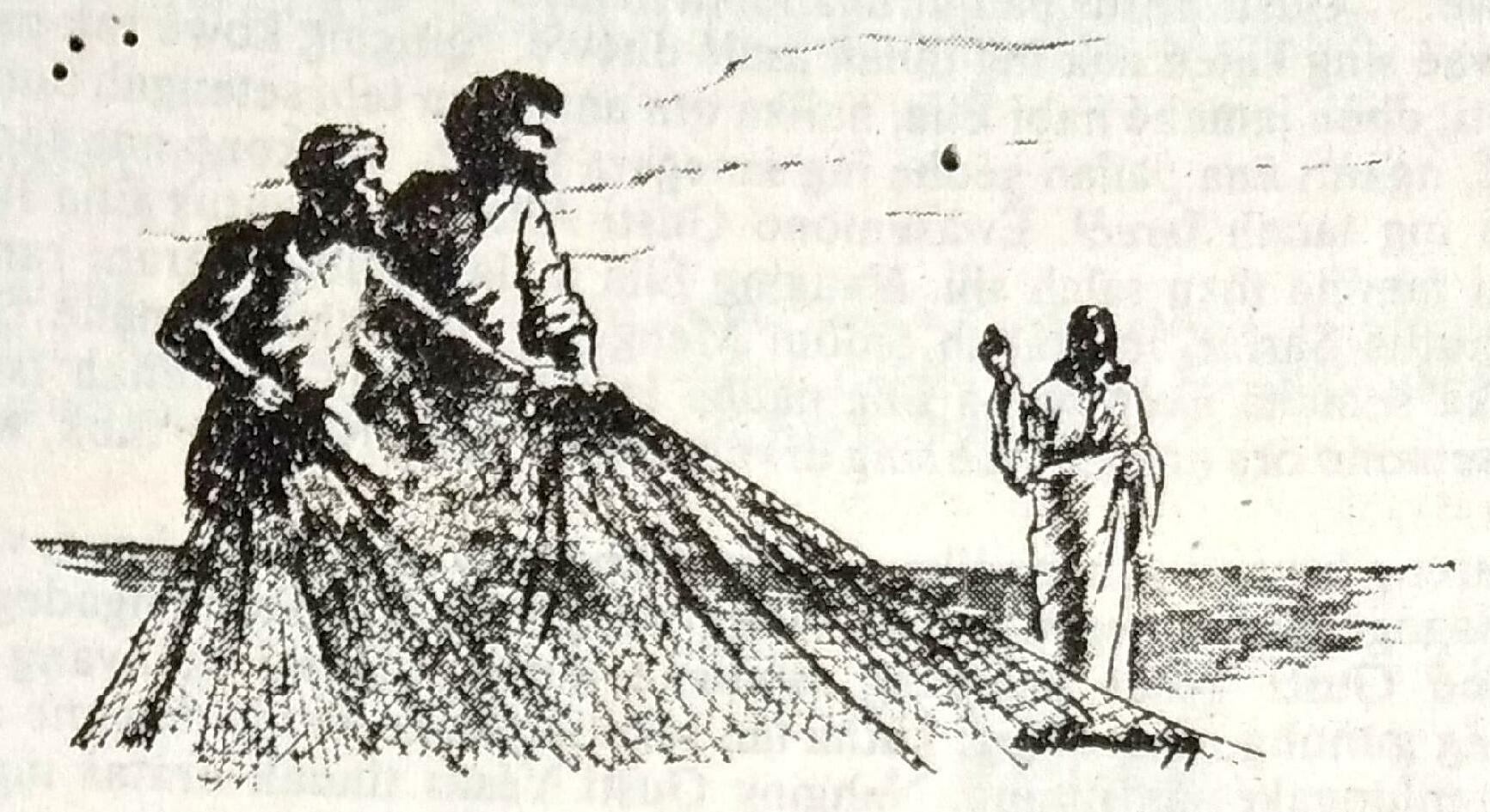
“As he walked by the Sea of Galilee, he saw two brothers, Simon, who is called Peter, and Andrew his brother, casting a net into the sea for they were fishers. And he said to them, ‘Follow me, and I will make you fishers of people.'” – Matthew 4:18-19
Matthew left it out, of course. What did you tell them, Jesus?
“Hey, guys, I’m sort of on the run since they took John, although they probably don’t know my name, so that’s all right, you think? Come follow me.
“Now mind you, folks will hear my name, and quickly, too, if I am any judge. They’ll come even from Syria to seek some healing for their bodies and their souls. Come follow me.
“I’m sure no one will think to look for me atop a mountain peak – unless they follow those who follow me, and frankly guys, I hope to leave a wide and beaten track. Come follow me.
“Now come along. We’ve work to do that doesn’t need a net. No, we’re as likely to be caught in Roman or Herodian nets as John. They’ll lift us high – but not as high as God will raise us all. Come follow me.”
A poem/prayer based on Matthew 4:12-23, the Revised Common Lectionary Gospel Reading for Year A, Third Sunday after the Epiphany.
Birds, by their very nature, rely on faith. Every bird knows about gravity; every bird knows that what goes up must come down. Every bird knows that while flight is the most natural thing in the world to them, it is also the most unnatural thing in the world. Somehow they hold those two things together.
At least, most of the time they do.
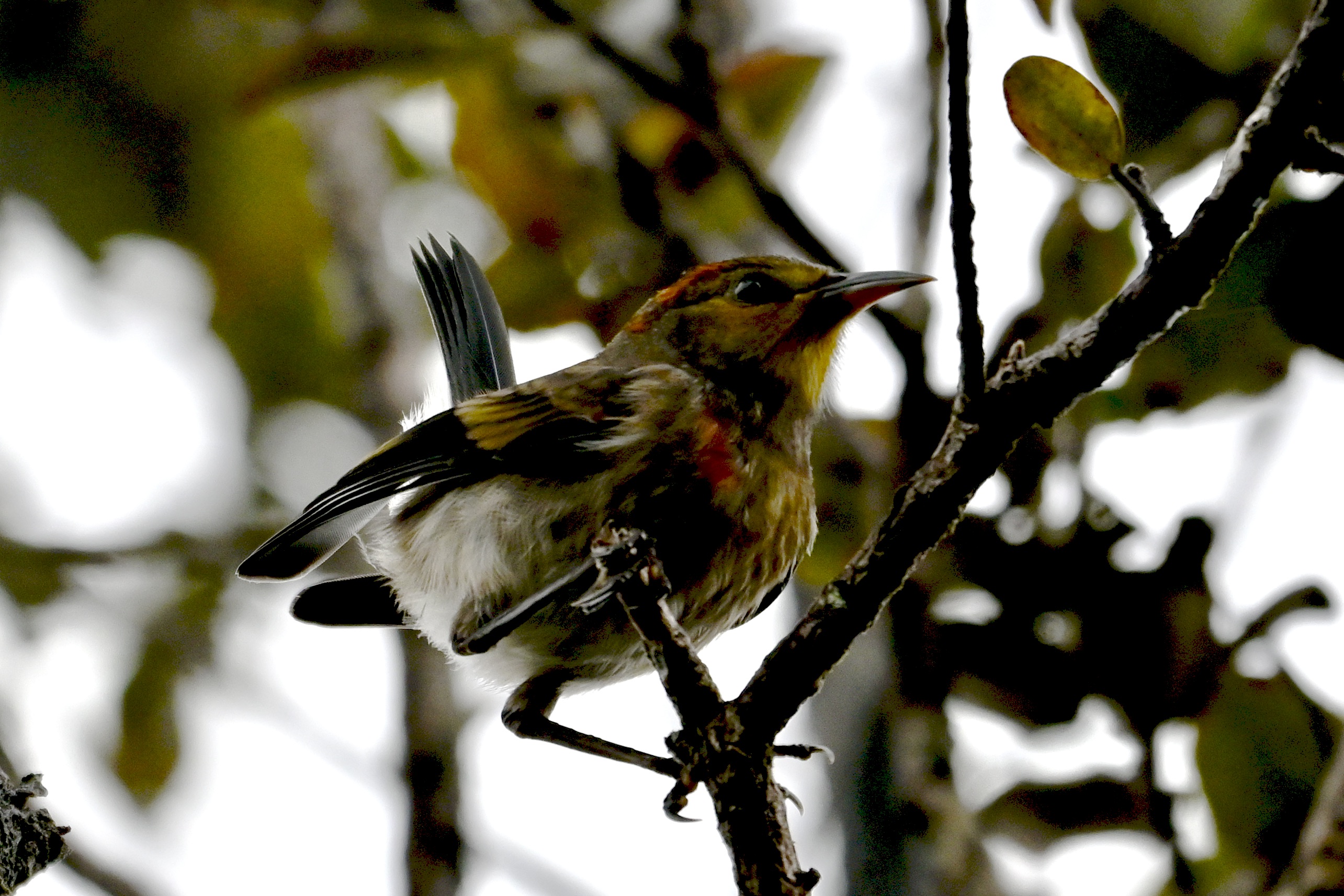
One young ‘apapane had learned to fly from his parents. He’d flown any number of times on his own. He was also still pretty young, so a lot of his feathers were still grey and brown. That had been fine. Now, however, some of his adult colors were coming in, so he had red feathers mixed among the grey and brown, and he had a speckled look. Frankly, I think he looked really interesting, but he thought he looked odd, even a little ugly.
With feathers that looked like that, he thought, how could he keep up with flying?
I don’t think that makes much sense, do you? He’d been flying just fine, and suddenly he didn’t believe he could fly because his feathers were changing? But you know, the first step in doing something is believing that you can do the thing. He stopped believing he could do the thing.
So he stopped flying.
He did manage to feed himself by journeying to other trees in the slowest, and possibly most exhausting way possible. He hopped from twig to twig, then from branch to branch, and when branches got close he jumped from tree to tree. It took time, and it wore him out, and frankly made him hungrier, but he did it.
It was a funny way to live for an ‘apapane.
It took a while for the other birds to notice, because he did turn up among his family and friends, even if he turned up later than everyone else. They just assumed he’d flown off in some other direction and finally got turned around the right way.
It was Tutu, his grandmother, who noticed the way he hopped, rather than flew, from tree to tree. She hopped over to his branch and said, “Are you all right, grandson? Have you hurt your wings?”
“No, they feel fine,” said her grandson.
“Then why are you hopping everywhere?” she asked. “Why aren’t you flying?”
“Well, just look at me,” he said. “Do these look like flying feathers? If I take off with these I’ll crash a moment later.”
“You think you can’t fly because of these feathers?” asked his grandmother.
“That’s right, Tutu,” he said.
Grandmother thought. She was a wise old bird, and she knew that you have to believe you can fly if you’re going to fly. She was tempted to let him hop around until he finished molting, but she knew he’d be pretty miserable the whole time. And who knows? He might never come around to believing again. That would be sad.
“Grandson, are you an ‘apapane?”
“Yes, of course I am,” he said, puzzled.
“Do you believe that you have wings?”
“Of course I do.”
“Do you believe in your feathers?”
“They’re right here,” he said.
“I believe in your feathers, too,” said Tutu, “the ones you have and the ones you’ll grow. In fact, all your family believes in them. Do you believe us?”
“I’m not sure,” he said.
“It takes just a little belief,” said his grandmother, “and that’s the amount of belief it takes to spread your wings. You’ve done it before. You can do it now.
“Believe it. Spread your wings, grandson. Fly.”
by Eric Anderson
I regret that we continue to have problems with the audio in our video stream, so a recording of this story is not available.
The ae’o shouldn’t have had any doubt about the question. But she felt awkward and ungainly, which isn’t unusual when you’ve done a lot of growing in a very short time. She was only about four weeks old, but that was time enough to learn a few things about the world.
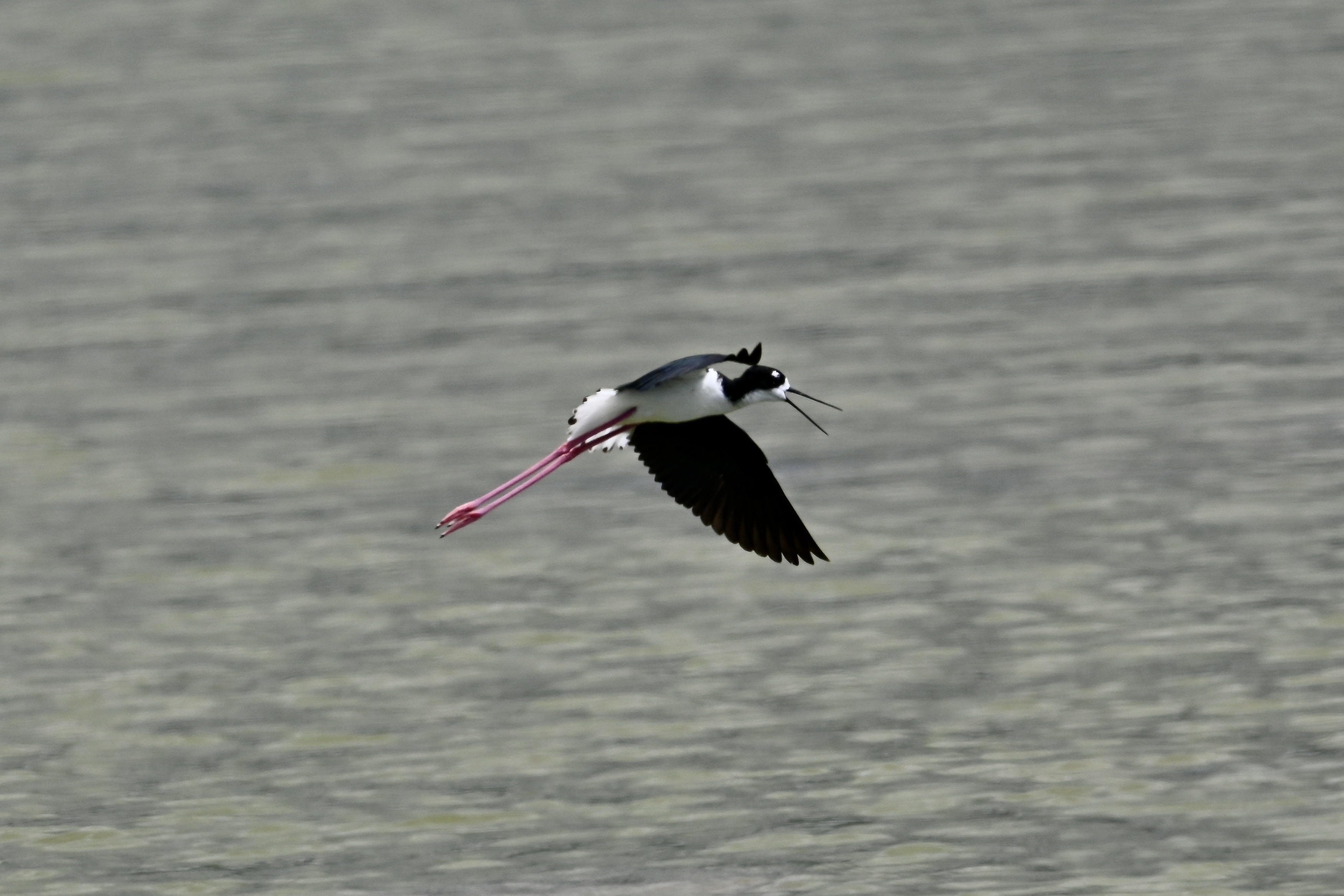
For one thing, she’d learned that she had very long legs as compared to the size of her body. The ae’o, it’s said, has the second longest legs for the size of their body of any bird. That’s a lot of leg, or not a lot of body, depending on how you want to think of it. She’d also learned that those legs were very useful for walking around in the calm waters of a fishpond, and she learned that she could use her long beak to pull food out of the water. She’d learned that in English she was called a “black-necked stilt,” which seemed fair enough, because she had long stilt-like legs and the feathers on her neck were definitely turning black as they changed with her age.
But she’d also learned that other birds were very different. The ‘Alae Ke’oke’o were sort of similar in size, but they had much shorter legs. In fact, they swam across the top of the water. She’d seen kolea and akekeke pecking for bugs and such along the shorelines before they left for Alaska. All of those birds seemed a lot more compact than she did, with her smallish body and long neck and long long legs. She’d watch the kolea wheel about the sky.
And she grew to believe that she could not fly.
I don’t know how she missed the fact that her parents flew quite well. I don’t know how she failed to notice that she, herself, had been taking wing-aided hops for a week. I don’t know how she missed all that. But she did. “I’m not going to be able to fly,” she said sadly one day, thinking that nobody was there to hear her.
“Really?” said a voice. “Why not?”
When she looked over, she saw another bird’s face with a long beak looking at her. It was a cattle egret, one of the many who liked the area of her fishpond.
“Just look at me,” she said. “Look at these long legs. Look at this long neck. Look at these wings. They can’t possibly get me off the ground and into the sky.”
The cattle egret looked her over carefully and said, “I’ve got long legs.”
She took a good look and realized that he did. “And I’ve got a long neck,” he continued.
“So you do,” she said.
“And have you noticed?” he asked. “I can fly.” And to prove it, he took to the air and flew twice around the fishpond before he landed near her again.
“I can’t be sure, but I think you can fly,” he said. “Have you tried?”
She didn’t bother to say, “No,” because they both knew she hadn’t. She didn’t say anything at all, in fact, but she did spread her wings. She looked at him sharply to make sure he wasn’t teasing her, but there was no trace of laughter in his face.
She took off. She flew.
She took three turns around the fishpond – she’d meant to do the same two turns he had, but she miscalculated the landing and had to come back and try it again.
“I can fly!” she said.
“You can,” he said. “I’m glad you tried. And I’m glad you fly.”
by Eric Anderson
Watch the Recorded Story
I write these stories in advance, but I tell them from a combination of memory, improvisation, and of course in conversation with the young people I tell them to.
Photo of an Ae’o (Hawaiian Black-necked Stilt) in flight by Eric Anderson.
It was late April, and it was about to be May. The kolea didn’t know that. Pacific golden plovers, the English name for na kolea, don’t pay much attention to the calendars that people use. I’m not entirely sure what they pay attention to, but they do get a sense at about the same time, don’t they, that it’s time to fly from Alaska to Hawai’i or that it’s time to fly from Hawai’i to Alaska.
It was, in fact, about time to fly from Hawai’i to Alaska. One of the kolea was acutely aware of that, even though he was a fairly young bird. He’d only made the long flight once, from his Alaskan birthplace to the shores of Hawai’i Island. He’d really enjoyed the winter here, even if by our standards it was rather cold. The worms and bugs he ate had been more than plentiful, and the rains tended to drive the worms up from their flooded tunnels.
You and I might call that disgusting. The kolea called it lunch. Unless it was dinner. Or a mid-afternoon snack.
He knew it was time to fly to Alaska because his feathers had changed color. For most of the winter they’d been a dappled cream and brown, handsome enough but not dramatically so. Over the weeks of March and April (which he didn’t call March or April) he’d developed deep black feathers on his chest and face, set off by bands of white. His mother called him handsome. His friends called him handsome, though some of them teased him about it. There was another young kolea that he hoped found him handsome, but he was reluctant to ask her about it.
So he knew it was time to fly.
He just… didn’t want to.
His one trip to Hawai’i hadn’t been dramatically awful, but it hadn’t been great, either. It was just over two solid days in the air, beating his wings twice a second the entire time, with no place to land and rest and nothing to eat the entire way. His eyes had ached from holding them open so long and his wings hurt for days. Why would one ever want to do such a thing more than once?
Hawai’i Island, he thought, made a nice place to live. So he decided to stay.
“Oh, no, you don’t,” said his mother. “This isn’t where we have our families,” said his father. His friends just said, “You’ve got to be kidding.”
Only one young kolea asked him why. So he told her about the aches and the pains and why should one do that ever again?
“Because sometimes you have to be brave,” she told him.
That evening she joined a growing flock of kolea. They would leave together soon. When she turned her head, she saw a familiar bird. “Hello, handsome,” she said.
He might have blushed beneath his feathers, but who could tell?
“I decided that it’s time to be brave,” he said.
As the evening fell, the two of them were part of the flock that rose high in the air and began their long flight back to Alaska.


 ordainedgeek
