Life Dreaming

“Peter put all of them outside, and then he knelt down and prayed. He turned to the body and said, ‘Tabitha, get up.’ Then she opened her eyes, and seeing Peter, she sat up.” – Acts of the Apostles 9:40

“To sleep, perchance to dream – ay, there’s the rub,
For in that sleep of death what dreams may come?”
asked William via Hamlet in the play.
In Joppa Tabitha had ceased her work.

She lay upon the cot unmoving as
her friends displayed with streaming eyes the cloth
and clothing she had made with loving hands
for them, their families, and those in need.

She’d lived a life full well and full of grace,
and if she’d died, a life reborn would come,
so said the messengers who preached the Way,
the Jesus Way she’d taken as her own.

What dreams moved through her soul as she lay still?
What visions came to eyes of spirit now
that those below her brow saw naught? What sight
of welcome to a life eternally?

Somehow she heard the summons, “Tabitha,
get up.” The dreams collapsed as her lids raised,
to see an unfamiliar, anxious face,
perhaps a little bit surprised, above.

She rose. She met her friends once more. What did
she say? We’ll wonder, since the author left
that out, and failed to write as well, what dreams
she’d had, which we may have ourselves someday.

She rose, awoke to love and work, restored
to life ephemeral, a life to end
someday once more, a life she would lay down
again, and dream the interrupted dreams.

A poem/prayer based on Acts 9:36-43, the Revised Common Lectionary First Reading for Year C, Fourth Sunday of Easter.

The image is the Tomb of Tabitha, Jaffa, Palestine by William H. Rau (1903) – This image is available from the United States Library of Congress’s Prints and Photographs divisionunder the digital ID ppmsca.10664.This tag does not indicate the copyright status of the attached work. A normal copyright tag is still required. See Commons:Licensing., Public Domain, https://commons.wikimedia.org/w/index.php?curid=18866918.

This poem includes quotes from Hamlet by William Shakespeare (ca. 1599 and 1601) and “Awake, Awake to Love and Work” by Geoffrey Anketel Studdert Kennedy (1921).

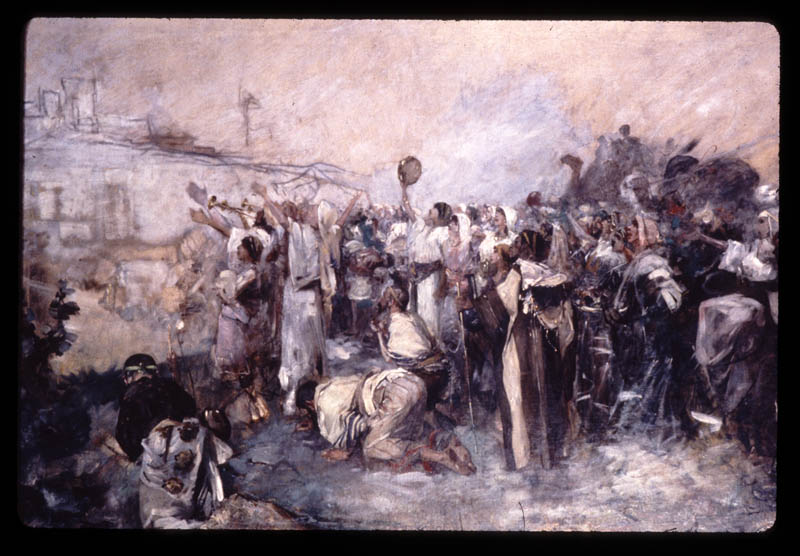
Horse and Rider Thrown into the Sea

“…and Israel saw the Egyptians dead on the seashore.” – Exodus 14:30b

“Then the prophet Miriam, Aaron’s sister, took a tambourine in her hand; and all the women went out after her with tambourines and with dancing. And Miriam sang to them: ‘Sing to the LORD, for he has triumphed gloriously; horse and rider he has thrown into the sea.'” – Exodus 15:20-21

Gasping, panting, wheezing on the edge of the sea.

I can’t imagine where they found the energy
to sing, to sound the tambourine, to dance.
My feet are lead; they sink into the marshy mud
that runs along the reedy shore.

Gasping, panting, wheezing on the edge of the sea.

We were not last in line, but close enough
to feel as if we were the least in all of Israel.
No doubt the chariots and archers were not close
enough, but we could feel their breaths upon our necks.

Gasping, panting, wheezing on the edge of the sea.

I ran, we ran, we galloped through the slime and muck
and knew – and knew – we were too slow. We were
too late. We were too weak. We knew – we knew –
that swords and chains and whips would be our lot.

Gasping, panting, wheezing on the edge of the sea.

Then suddenly we climbed the bank, the shore
had made its way to us, it seemed, lest we
expire before our limbs had carried us to it.
And still we heard the cries of the Egyptians.

Gasping, panting, wheezing on the edge of the sea.

With trembling I reversed my gaze to see
the sword that shortly would relieve my life,
and saw the waters closing, heard the malice
of Egyptian voices carried off by wails of fear.

Gasping, panting, wheezing on the edge of the sea.

And now… I cannot summon up the strength
to sing, or dance, or beat the tambourine.
When breath returns, perhaps I will be strong
to sing a song of thanks that now I do breathe free.

Gasping, panting, wheezing on the edge of the sea.

The churning waters have devoured the Egyptians.
The shores are strewn with all the corpses of the drowned.
One gazes up at me with vacant eyes, no more
surprised than I to see I live and he has died.

Gasping, panting, wheezing on the edge of the sea.

So when I sing, dear Lord, in celebration of this gift
may I remember to regret the slain. Though ill
was their intent, and evil was their goal,
they, too, could claim the title of your children.

Gasping, panting, wheezing on the edge of the sea.

Oh, will a sunrise ever come, O God, that sees
the power-filled renouncing their prerogatives?
When slavery in all its forms is done? When death no longer rules?
When no one casts their eyes on corpses,

Gasping, panting, wheezing on the edge of the sea?

A poem/prayer based on Exodus 14:19-31 and Exodus 15:1b-11, the Revised Common Lectionary First Reading and alternate Psalm Reading for Year A, Proper 19 (24).

The image is Miriam’s Song by Samuel Hirszenberg, Center for Jewish History, NYC – https://www.flickr.com/photos/center_for_jewish_history/3560756375/, No restrictions, https://commons.wikimedia.org/w/index.php?curid=41533409.

Orphaned

[Jesus said,] “I will not leave you orphaned; I am coming to you.” – John 14:18

Technically, I have been an orphan now
for twenty months and three. My mother died
as I was starting to believe that I
was an adult – perhaps, of course, before
I had achieved that title – in the waning months
before my second decade reached its close.
It seems so odd to be now older than she ever was.

My father lived much longer, though afflicted so
in latter years by Parkinson’s Disease, he could
not make the trip to visit me, his eldest son,
in the Hawaiian Islands. The flowers of this place
adorned his passing when I wish they could
have welcomed him as honored guest.
But he greeted eighty years with such a smile.

So I have been left orphaned well into
my middle age, a kinder fate than many folk
endure. If none of us were perfect in our love,
we had at least the grace to learn and grow,
to love anew when older means to love had passed.
So Jesus, if you would, come visit me, I pray,
for I am orphaned, and I weep for your embrace.

A poem/prayer based on John 14:15-21, the Revised Common Lectionary Gospel Reading for Year A, sixth Sunday of Easter.

The photo is of my father and my mother on their wedding day in 1962; photographer unknown.

This poem/prayer fails to honor the woman my father married in 1995; they met while both pursuing M.Div. degrees at Andover Newton Theological School. She has been the mother-to-an-adult my own mother could not be. My son said it best. His grandfather had had the privilege to marry the love of his life twice.

Real Problem

At one time or another,
or many times, in fact,
the ones who serve as pastors
cry, beset with too much evidence
of human triviality,

“Oh, get yourself a real problem!”

And then, we gaze upon the weary brow,
the face so thinned by illness that
we didn’t recognize the sufferer,
and pray, with all our heart,
for triviality.

Photo by Eric Anderson.