Story: Small Differences

January 19, 2025

1 Corinthians 12:1-11
John 2:1-11

The akiapla’au is a small bird. It has a unique beak, with a short lower beak, and a longer top beak that hooks down in front of the lower beak. It may look odd, but the lower beak can drill into tree bark after bugs and grubs, and the top beak hooks them to draw them out.

If that seems strange, just imagine that you had to chase the chocolate chips through a cookie, and you might think a double-purpose beak sounds pretty good.

An akiapola’au is a small bird. It isn’t any bigger than a saffron finch or a yellow-beaked cardinal. There aren’t very many of them, either, perhaps about 1,900 here on Hawai’i Island. There aren’t any anywhere else in the world.

I think they’re pretty wonderful and pretty special.

A youngish akiapola’au, however, wasn’t certain about this. I don’t know whether he knew that birds like him live only on this one island, but I’m certain he knew there weren’t a lot of them around. Think about how you know so many of the people of Hilo, and how many of them you call “auntie” or “uncle.” After a couple of years, he knew pretty much every akiapola’au there was, and he called a lot of them “auntie” or “uncle.”

“There aren’t very many of us, and we’re very small birds,” he said to himself one day. “How will we ever make a difference in the world?” He had dreams, he did. He wanted to make the world better. He wanted someone else to benefit because he lived. He wanted to love the world somehow.

“But how?” he asked himself. “I’m too small to move anything bigger than a caterpillar with this beak of mine. And if we gathered all of us together and flapped our wings as hard as we could, what could we akiapola’au do but make a light breeze that the trade winds would blow away?”

It made him sad.

“Auntie,” he asked one day, “how can I make a difference?”

“What makes you think you don’t?” she asked.

“I’m too small to move anything,” he said, “and there aren’t enough of us together to make anything different.” Sadly, he dug out another little worm, hooked it with his upper bill, and ate it.

“What did you just do?” asked his auntie.

“Nothing,” he said, startled. “Well. I ate a worm.”

“Look at that tree over there,” said his auntie. “What do you see?”

“I see a sick tree,” said the younger akiapola’au. “It’s had so many caterpillars and worms that it’s fading. It might be dying.”

“What about this tree?” asked auntie.

“This tree is doing better,” he said.

“Why?”

“It doesn’t have so many worms and bugs,” he said.

“Why?” she asked.

“Because… I’m not sure. Is it because we’ve been eating them?”

“It is. And not just us. Other birds do the same. Between us, we’re helping this tree stay healthy.”

“But that’s just one tree,” he protested.

“I feed from lots of trees, and you know you do, too,” said his auntie. “That’s still a difference.

“You and I are small in the world,” she told him, “but these trees have better, stronger lives because of us. We make a difference for them, and they make a difference for us. For that matter, they make a difference for all the creatures of this forest. Our small difference contributes to everyone’s lives. You make the world a little better every day.”

by Eric Anderson

Watch the Recorded Story

I write these stories ahead of time, but I tell them from memory supplemented by improvisation. The story you just read will not match the way I told it.

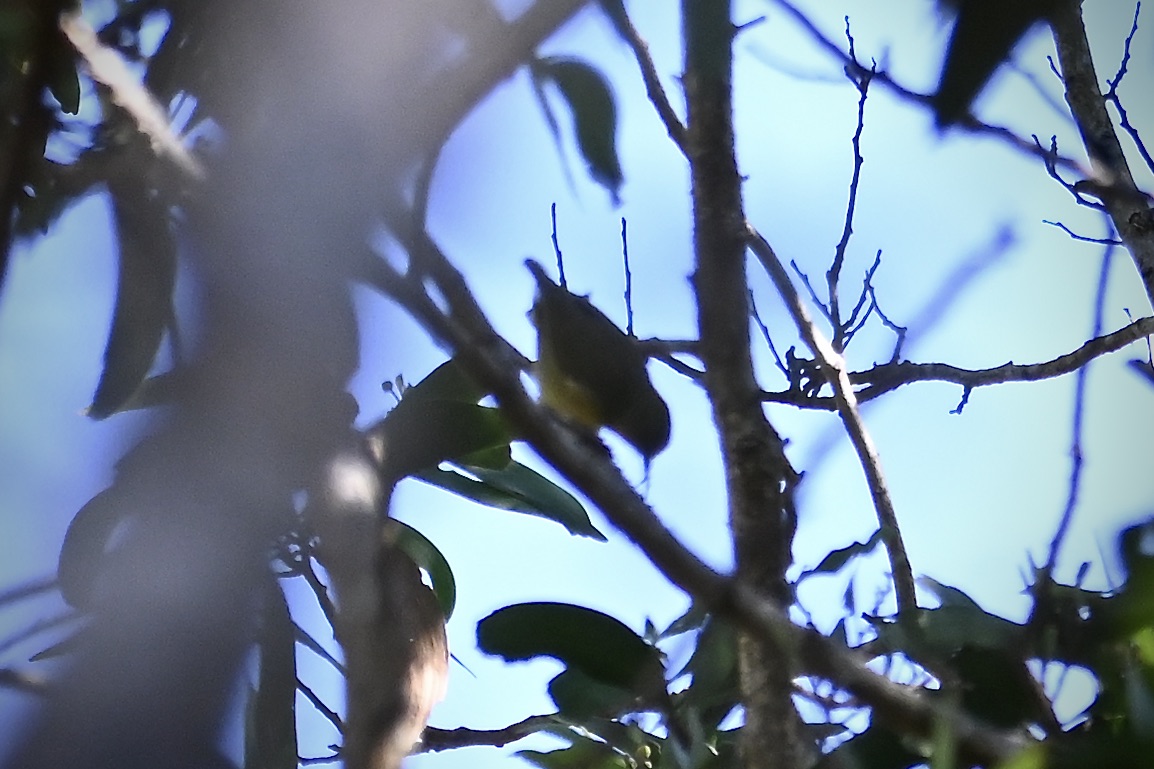
Photo of an akiapola’au (though it’s not a good one) by Eric Anderson.

Story: Soar Loser

May 19, 2024

Acts 2:1-21
John 15:26-27, 16:4b-15

The koa’e kea is a distinctive bird, with its bright white wings and body set off with deep black feathers, and that amazing long trailing tail. It’s distinctive, but it’s not unique to Hawai’i Island or to the Hawaiian Islands. You’ll find white-tailed tropicbirds (to use their English name) flying above and feeding in the warm waters of both the Pacific Ocean, the Indian Ocean, and even the Atlantic Ocean. Although they fish for food in the sea, some of them like to nest on the cliffs of Kilauea. Quite a few of them like to relax by soaring on thermals. That’s the warm air that rises from the black rock of the volcano summit.

One day a visitor to the islands who was knowledgeable about birds was standing at the crater rim and saw the koa’e kea soaring on the thermals. “Look at that,” he said to someone standing nearby. “Those are white-tailed tropicbirds, and they’re quite a ways inland. How odd for a seabird.”

“And it’s even stranger,” said his equally knowledgeable companion. “They’re soaring. White-tailed tropicbirds don’t soar.”

“It’s very odd indeed,” agreed that man and that woman, and they went on to talk about something else.

I’m sure such conversations happen often at those overlooks, but I suspect that more often nobody comments on these things at all. And it is true that koa’e kea don’t soar very much in other places in the world. They’re strong, agile fliers, to be sure, but most white-tailed tropicbirds don’t live where there are steady, reliable rising thermals.

So this wouldn’t have mattered if a koa’e kea hadn’t overheard, and become very concerned, that by soaring on thermals she was doing The Wrong Thing.

So she stopped.

Oh, she’d still fly around the summit craters, and she wasn’t so silly as to leave her nice spot on the cliffside. But when she flew she beat her wings quickly and steadily, the way she flew in all the other places she went.

Since she’d stopped soaring, I guess you’d have to call her a soar loser.

And nobody noticed.

I suppose it wasn’t that big of a difference to spot, but her family didn’t, her husband didn’t, her friends didn’t. Maybe they thought she had somewhere urgent to go. I don’t know.

It was a really young koa’e kea, one who’d been flying for less than a month, who said something.

“Why don’t you soar?” she asked one warm afternoon after they’d returned from successful fishing in the ocean.

“White-tailed tropicbirds don’t,” she said in reply, beating her wings in steady time.

They flew side-by-side over the summit for a while, and the younger one looked at other koa’e kea soaring nearby.

“It looks to me like they soar,” she said.

“They don’t soar in other places in the world,” said the older one, maintaining her wingbeats. “I heard some people discussing it, and people would know.”

“OK,” said the youngster. “But those birds are there. We’re here. I think we can do things differently here.”

The older one said nothing. She just flew along. Until, in a minute or two, her wingbeats stopped, and she held them out straight and firm.

Side by side, the young bird and the older bird soared.

by Eric Anderson

Watch the Recorded Story

I write these stories in advance, in full. In worship I tell them from memory, with a little improvisation added. So what you read here and what you see in the video will not be the same thing.

Photo of a koa’e kea (white-tailed tropicbird) soaring over one of the Kilauea craters by Eric Anderson.

Story: Weird

March 10, 2024

Numbers 21:4-9
John 3:14-21

“I think they’re weird,” said the ‘amakihi.

“Definitely bizarre,” said the ‘akepa.

“Not like us,” said the ‘apapane.

“Not like us at all,” said the i’iwi, who usually doesn’t take part in this kind of conversation but was close enough to overhear.

“They’re not so bad,” said the elepaio, but nobody was listening to him.

“They don’t eat nectar,” said the i’iwi.

“Not everybody does,” said the elepaio, who didn’t.

“They’re not brightly colored,” said the bright orange ‘akepa.

“I’m not either,” said the elepaio, who wasn’t.

“They sit still all the time,” said the ‘amakihi.

“Not everybody needs to hop around to find food,” said the elepaio.

“They don’t sing out the way they could,” said the ‘apapane.

“Would you sing out when there’s an ‘io overhead?” asked the elepaio.

The other birds finally noticed that the elepaio was there.

“What are you going on about?” they asked.

“I don’t see that there’s anything that strange about the ‘Oma’o,” said the elepaio. “In fact, most of the things you’re criticizing are things you could say about me.”

The other birds were silently embarrassed for a while. Some of them had, in fact, said similar things about the elepaio when they thought they wouldn’t be heard.

“Don’t you think they’re different?” asked the i’iwi, who most of the others thought was kind of different himself.

“Certainly they’re different,” said the elepaio. “Different doesn’t mean strange, or bad, or wrong, though.”

The birds were silent.

“If it helps any,” said an ‘oma’o who was sitting there quietly and completely unnoticed in some koa, “I can’t help think that you’re all rather different, too. But you know,” she said thoughtfully, “it seems to work for you.”

The birds looked at one another: red feathers, green feathers, tan feathers, black feathers, yellow feathers, long beaks, short beaks, different shapes to their wings.

“You’re right,” said the ‘apapane thoughtfully. “It does seem to work for us in our different ways.”

“Not so weird.”

“Not so bizarre.”

“Different from us, but it works.”

by Eric Anderson

Watch the Recorded Story

We had a technical failure and lost the audio from the beginning of the story this week. Our apologies!

I write these stories ahead of time, then tell them from what I remember of what I wrote. Since I don’t remember things perfectly, and since I invent new things in the telling, the story I tell may not match the story I wrote.

Photo of an oma’o by ALAN SCHMIERER from southeast AZ, USA – OMA’O (9-4-2017) pu’u o’o trail, kipuka ainahou section, hawai’i co, hawaii -06, CC0, https://commons.wikimedia.org/w/index.php?curid=74675325.

Story: The I’iwi in the Flock

February 25, 2024

John 15:16

It was summertime. The nests around the ohi’a and koa forests had had their eggs, had had their cheeping chicks, and had been emptied. Young birds were flying about with their parents and aunties and uncles. The summer flocks were coming together.

Much of the year, the honeycreepers of the Hawaiian forests don’t gather in big flocks. They move about by themselves or in twos or threes. But in summertime, they gather, and they gather ‘amakihi with ‘akepa with ‘alawi and even some ‘apapane. But not, most of the time, i’iwi. When nesting time comes back around the flocks disperse. In summer, they fly together.

A young i’iwi watched a flock of ‘amakihi and ‘akepa and ‘apapane skimming the trees as they searched bugs and blossoms. He turned to his grandfather. “Should we fly with them?”

“Oh, no!” humphed his grandfather. “They don’t have the right kind of beak.”

In fact, none of the birds in the flock had the long curving bill that the i’iwi did.

He asked his grandmother, “Should we fly with them?”

“Oh, no!” said his grandmother. “They don’t have the right color feathers.”

The ‘apapane came closest, but he had to admit that you could see the difference.

“Should we fly with them?” he asked his friends, and they all said, “No! They can’t do what we do!” in different ways.

A day later, all by himself, he approached the flock, and perched next to an ‘amakihi.

“You don’t have a long curved bill,” he remarked.

“No,” said the ‘amakihi, somewhat puzzled. “I don’t.”

“It seems to work well enough,” said the i’iwi.

“It works pretty well, I think,” said the ‘amakihi.

“It might be awkward to get into an ohi’a blossom from below,” said the i’iwi, and the ‘amakihi admitted this was true.

“You don’t have bright red feathers,” said the i’iwi.

“True,” said the ‘amakihi. “Mine are bright yellow.”

“Do they get you places?” asked the i’iwi.

“They got me here,” said the ‘amakihi.

“Can you do all the things I can do?” asked the i’iwi.

“Probably not,” said the ‘amakihi. “Can you do all the things I can do?”

“Probably not,” said the i’iwi.

Then he asked, “Do you mind if I fly along with your flock?”

“With your red feathers and curved beak and things I can’t do?” said the ‘amakihi. “Join us and welcome.”

That’s how an i’iwi became part of a summertime flock.

by Eric Anderson

Watch the Recorded Story

I write these stories, then tell them from memory. Since my memory can be erratic, the stories as told rarely match the stories as written.

The photo of an i’iwi is by HarmonyonPlanetEarth – I’iwi|Pu’u o’o Trail | 2013-12-17 at 12-43-196. Uploaded by snowmanradio, CC BY 2.0, https://commons.wikimedia.org/w/index.php?curid=30241883

Story: Dive or Skim

October 23, 2022

Psalm 84:1-7
Luke 18:9-14

It’s a funny thing. The koa’e kea – the white-tailed tropicbird – and the noio – the black noddy – eat basically the same foods. They like small fish, they like squid. But they catch their food in very different ways. One koa’e kea had noticed this.

“That,” he said to another koa’e kea, “is disgusting.”

“What is?” she asked. The two were flying out to their fishing grounds from the ledges of Kilauea.

“Them,” said the first, “those noio. Watch them crowd together. Why can’t they hunt alone? There’s a horde of them fishing there. Then the noise. Every last one of them is screeching and calling. They’re flying low, and any bird should know that you can’t spot fish if you’re not high over the water. And most of all“ – he shuddered even as he was flying – “they don’t even know how to do a proper dive.”

“Really?” asked his friend. “What do they do?”

“Watch,” said the first, and they watched as noio after noio skimmed low over the water. The surface of the ocean rippled with the movement of the small fish beneath it. The noio dipped their beaks into the water, seized a fish without landing, and flew on as they swallowed.

“They don’t even pause on the surface to properly appreciate their meal,” he moaned.

“Aren’t there big fish down there, too?” asked his friend, who had noticed larger forms deeper in the water.

“Ahu,” said the koa’e kea, “skipjack tuna. They’re chasing the same fish as the noio. I don’t know why they’re not all crashing into one another, and why none of those noio have become lunch for an ahu.”

They watched the chaotic scene for a while, and then the second koa’e kea said, “You know, it seems to work.”

“What?” he said.

“With those ahu around, the small fish are closer to the surface,” she said, “and with so many birds in the air you wouldn’t want to pause on the surface. From all I can tell from here, none of them look like they’ll go hungry.”

“Do you want to fish like a noio?” he demanded.

“No, I’d rather dive from a good height,” she said, “and I’d rather not have a lot of other birds about because I’d crash into one when I’m diving. I’m not eager to run into an ahu under water, and one of my dives might get down to where they are. I can’t call the noio disgusting, though,” she continued. “They’re living, and thriving, and happy, and fed. That’s a pretty good life for a seabird, don’t you think?”

I don’t know for certain whether she’d convinced him, because he didn’t say anything more as they flew out to their own fishing grounds farther from shore. I’ll call her wise, though, to recognize that there’s more than one way to live a good life as a seabird, and to appreciate a seabird who does things differently.

by Eric Anderson

Watch the Recorded Story

The story is told from memory of this manuscript. That is enough to cause some differences. Today, there was another presentation before the story, and, well, you’ll just have to see it to believe it.

Photo of a noio in flight (though not actually skimming the surface) by Eric Anderson.