Story: The Inattentive ‘Elepaio

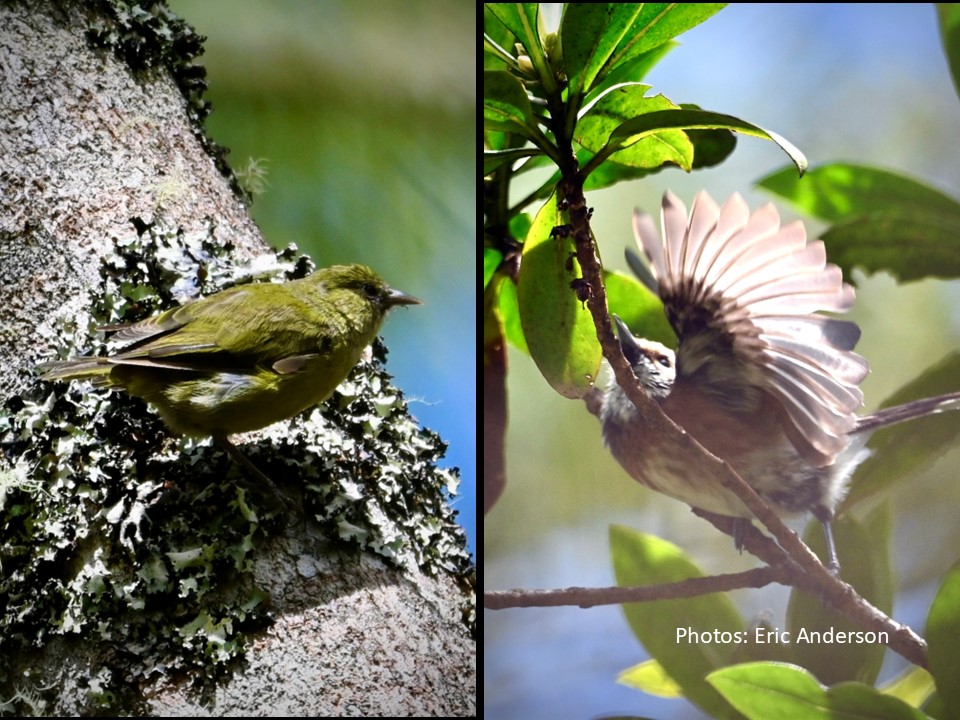
‘Alawi (left) and ‘Elepaio (right)

August 10, 2025

Isaiah 1:1, 10-20
Luke 12:32-40

The ‘elepaio are usually the most actively curious birds in the forest. They hop and flutter and fly their way around the trees from the topmost branches all the way to the forest floor. They look into gaps in the leaves, cracks in the bark, and even holes in the rocks for the bugs and things they like to eat. They’ll perch on a branch and pick up bugs and caterpillars. They’ll pull bugs out of rolled-up leaves. They’ll chase flying insects on the wing.

You can do that if you’re paying attention.

If you’re not paying attention, well… it’s all going to be harder.

There was an ‘elepaio who just couldn’t concentrate. He didn’t pay attention to what was around him. His friends liked to sneak up on him and ruffle their feathers; they made a game of how loud they had to be before he noticed. I’d like to say that he was so inattentive because in his curiosity he was thinking deep thoughts, but no. He wasn’t.

Mostly he was sitting rather sleepily on a branch.

The result was that he got rather hungry. An ‘elepaio is a small bird, for sure, but an ‘elepaio eats small things, so you have to eat a lot of small things to keep from being hungry. He’d get hungry, but it would only rouse him to do a casual look around. If he spotted a bug, well, he could usually catch it. He still didn’t look closely, though, and it surprised those who watched him how many other bugs and caterpillars he’d miss.

It was an ‘alawi that helped him concentrate.

She was moving along a branch near the one he perched on one day, searching for the bugs she liked to eat, which were also pretty much the bugs that the ‘elepaio liked to eat. He wasn’t greedy, so he didn’t chase her away. He was even feeling a little friendly, so he called out a greeting, and then said:

“I’m afraid you won’t find anything there. I’ve been here a while and haven’t seen anything to eat.”

She looked puzzled, because right in front of her, barely hidden by a fold in the bark, was a spider. She took it in her beak, showed it to the ‘elepaio, and ate it rather sheepishly. She felt a little guilty eating in front of a hungry fellow creature.

“Oh,” he said. “I didn’t see that one.”

“How about this one?” she said, showing him another bug.

“Really? There were two?”

“Three,” she said, and then, “Four. Actually, quite a bit more than four.”

He watched in some amazement as she pulled bug after spider after caterpillar from the branch he was sure didn’t have any bugs on it.

“How did you find those?” he asked, astonished.

“I looked,” she said. “I moved along, and as I moved, I looked.”

He thought about what he’d been doing, which was sitting still, and not looking.

“I guess I ought to do more of that,” he said.

“If you don’t want to be hungry, it would work better,” she agreed.

So the two birds moved along their respective branches, and both of them agreed it was good to be fed.

by Eric Anderson

Watch the Recorded Story

I write these stories ahead of time, but I tell them in worship from memory (and improvisation). What you just read will not match the video recording of my telling.

Photos of an ‘alawi and ‘elepaio by Eric Anderson.
You Fool

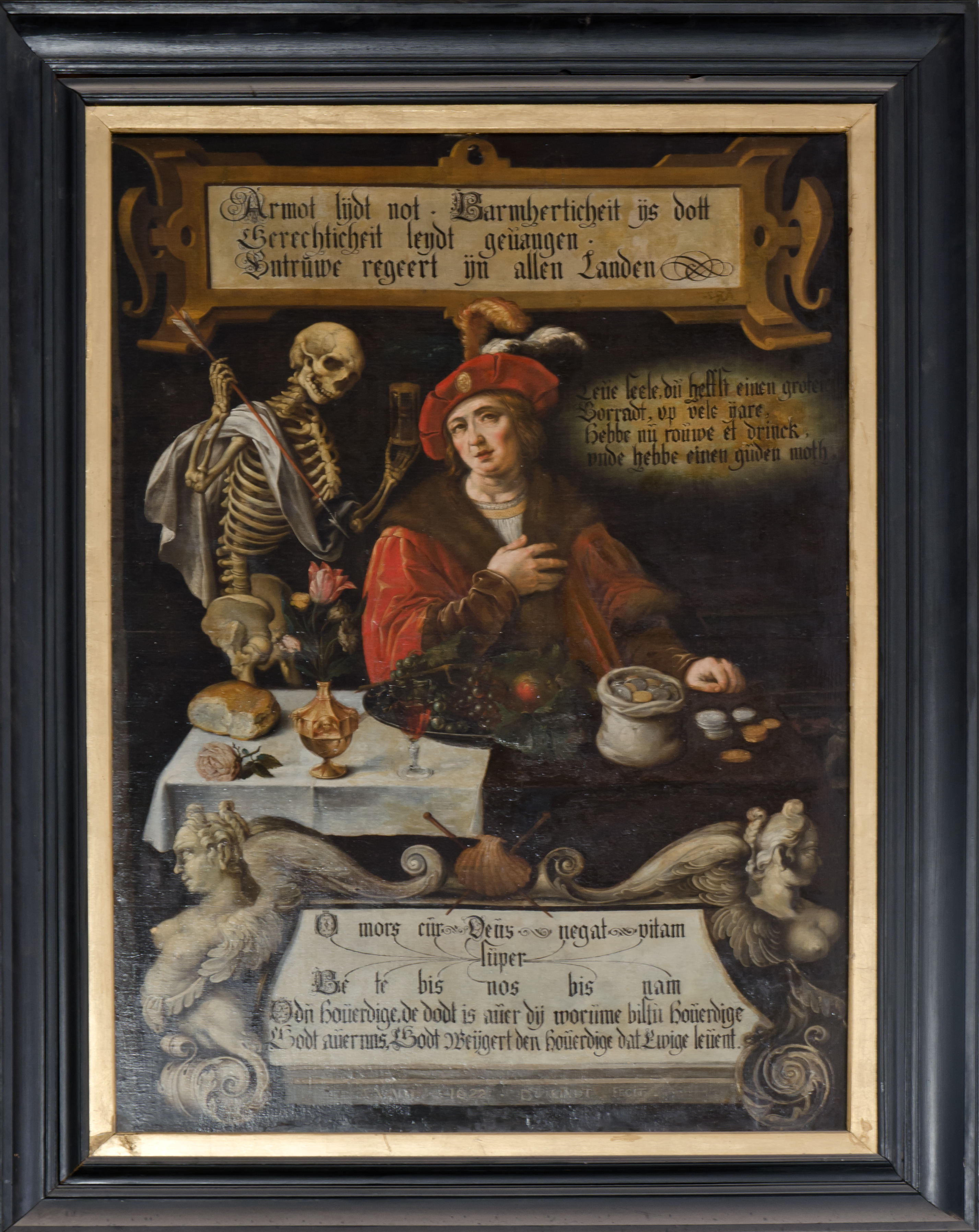
A skeleton stands beyond a seated man in fine clothes with food and coins before him.

“But God said to him, ‘You fool!'” – Luke 12:20

It hardly seems fair to call him a fool.
Call him a practical man,
call him far-seeing,
call him descendant of Joseph, I say.

What did he do when faced with a surplus?
He saved! Did the thing I’ve been told since a lad
I’m to do with the coins that remain.
When the rainy days comes, I’ve been told, they’ll be there.

In Egypt, the dreams of a monarch warned Joseph,
“Prepare when it’s fruitful for days when it’s not.”
And so I’ve been taught (if not followed so well),
and so I have urged when it’s my turn to tell.

What’s wrong the rich man? Why was he a fool?
He followed the ancient advice to the letter:
Built barns that would hold all a good year
produced; saved grain for the needs a bad year would demand.

Is that what he did? No, he said, “I’ll make merry
with all of my goods in my barns and my hand.
I might give a pink slip to all of my workers.
They’ve done all I want, and I want to be done.”

Whose will the grain be? And whose all the wealth
when the soul and the body divorce in the night?
Not his. He has gone where the soul is the seed,
and gold is the spirit which he had ignored.

How easy, how likely, to play such a fool,
to mistake greed for prudence and pride
for precaution. How often, I wonder, have I
played the fool, for much lesser riches

And hubris as great? You know, Storyteller,
and though you disclaim it, I know that
you judge with a knowledge I lack.
Though I’ve no grain for barns,

And no fruit for freezers, I’ll spend
what I have for the people around me:
a poem, a song, or even a sermon.
May God bless these gifts. May God bless us all.

A poem/prayer based on Luke 12:13-21, the Revised Common Lectionary Gospel Reading for Year C, Proper 13 (18).

The image is Der reiche Mann und der Tod (The Rich Man and Death) by David Kindt (1622) – CC BY-SA 3.0, https://commons.wikimedia.org/w/index.php?curid=22079990.

I really like this painting. Subtle it’s not.

Myna Distraction

June 29, 2025

Galatians 5:1, 13-25
Luke 9:51-62

It had been hot and dry. Most creatures, including people, don’t get too surprised by warm weather in East Hawai’i. We get upset if the trade winds subside for very long, but let’s face it. We’re in the tropics. Hot weather comes with that.

Dry, however, was strange and uncomfortable. The grasses didn’t grow as well, so there weren’t as many seeds around. Bugs went looking in different places for their meals, so they were harder to find. As for the worms, well. They dug deeper into the soil, making it harder and harder for the birds to find a meal.

Some of the birds started getting anxious.

“We have to do something,” announced a myna as they hopped around a lawn, picking over the picked-over grasses for a seed somebody had missed, or a careless spider, or a worm that had, for no reason anyone could think of, taken a wrong turn and emerged on the surface.

“Yes, we do!” agreed the other mynas.

“What do we do?” asked one after it became clear that the first myna had said all he was going to say.

“We need to find more worms,” said one.

“We need to find more seeds,” said another.

“We need to keep the worms and seeds we find for ourselves,” said a third. And now, everybody listened.

“Yes!” said another myna. “We’ll drive other birds away and we’ll have all the food.”

“Great!” said yet another myna. “And who will do the driving away?”

“The biggest ones,” said a smaller myna. “They’ll scare the finches away.”

“And while we’re driving them away,” said a big myna, “what will you smaller ones be doing?”

“Waiting for you,” said a smaller myna innocently.

“Yeah, right,” said a big myna, and suddenly the whole flock erupted into an argument about who would guard, and who would eat, and who would wait to eat.

While they argued, a pair of house sparrows landed on the lawn nearby and started hunting for seeds and bugs. They didn’t find a lot, but they did find some.

“What are the mynas arguing about?” said one of the sparrows to the other.

“Who gets to eat,” said the second.

“Why?” asked the first. “While they’re arguing nobody gets to eat.”

“I don’t know,” said the second. “It seems like a distraction to me.”

“That’s what it is,” said the first. “It’s a myna distraction.”

The two of them ate together for a while, then flew off to another place, while the myna distraction went on.

by Eric Anderson

Watch the Recorded Story

I write these stories in advance, but I tell them from memory and with a certain amount of improvisation, so what you have just read will not match how I told it on Sunday.

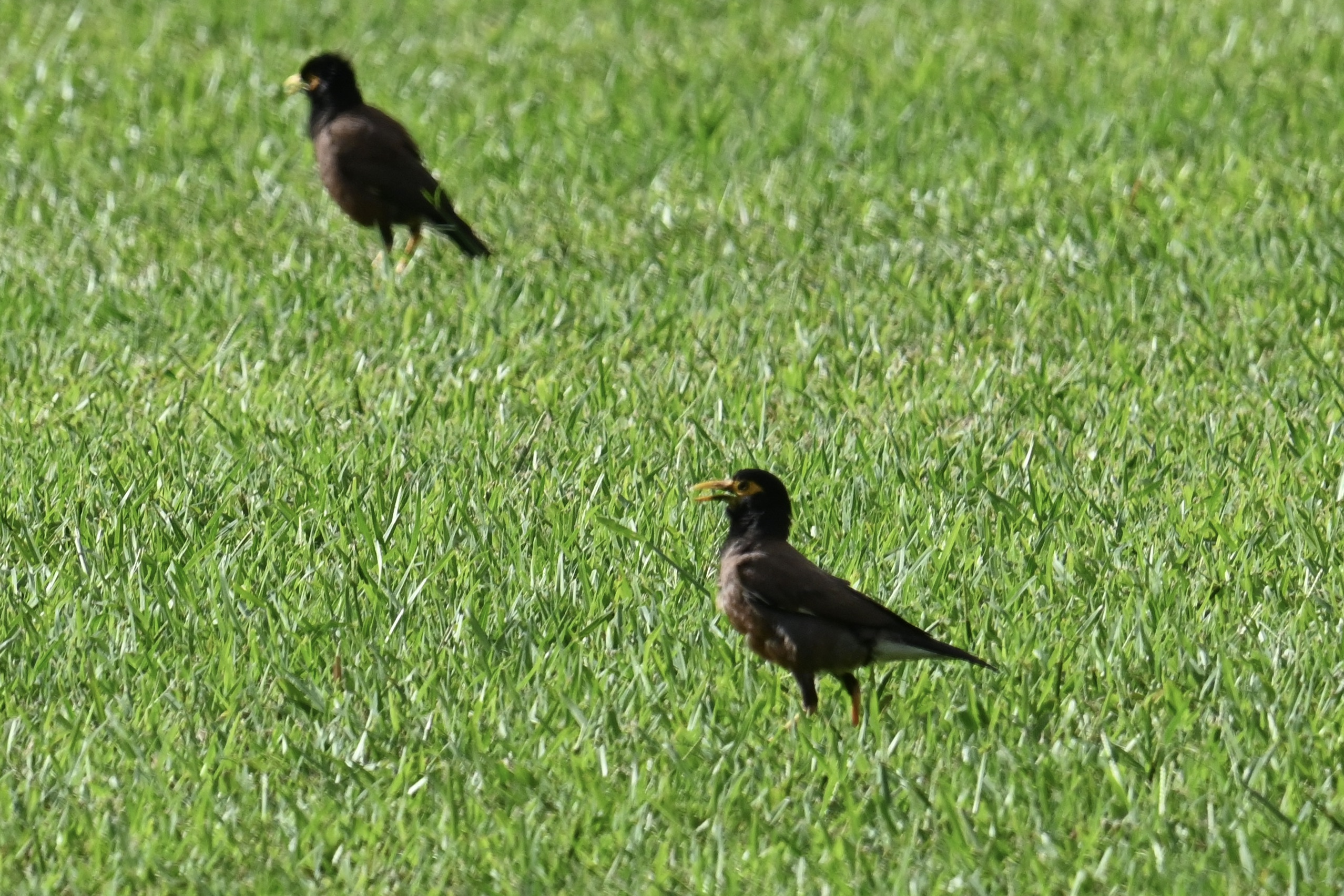
Photo of two common mynas by Eric Anderson.

If Only I Weren’t Distracted

Finally, beloved, whatever is true, whatever is honorable,

I used to call them “Squirrel Days,” O Jesus.
Before I moved here to this island without squirrels,
it was my tag for days when concentration
failed, when focus flailed, when even consciousness would fade.

whatever is just, whatever is pure,

It’s funny how the unimportant can assume
such prominence and even over what is right
before me. Who needs the phone to ring or text to buzz
when adolescent disappointments still possess me?

whatever is pleasing, whatever is commendable,

I cannot even concentrate upon the evils, cannot choose
which one is worst, which ones are worse, which ones
are dangerously proximate. Sufficient for this year
are evils, rages, suffering arising in a single day!

if there is any excellence and if there is anything worthy of praise,

Incarcerated children, children still not reunited with their parents,
refugees denied a hearing, tear gas fired at civilians,
a pandemic dismissed despite two hundred thousand graves,
a tax break for the rich and no relief for those now unemployed.

think about these things.

Oh, I’ll try to follow Paul’s advice, dear Jesus, but
I am… somewhat… distracted.

A poem/prayer based on Philippians 4:1-9, the Revised Common Lectionary Second Reading for Year A, Proper 23 (28).

Distracted photo by Eric Anderson.