Dreaming with Joseph

“But just when he had resolved to do this, an angel of the Lord appeared to him in a dream and said, ‘Joseph, son of David, do not be afraid to take Mary as your wife, for the child conceived in her is from the Holy Spirit. She will bear a son, and you are to name him Jesus, for he will save his people from their sins.'” – Matthew 1:20-21

Let me dream with you, Joseph,
just for a moment.

Let us dream together that our trust
is well placed.
Let us dream together of a
promise fulfilled.

Let us dream together of a
God who is with us.
Let us dream together of a
break in the gloom.

Let us dream together, waking
newly resolved.
Let us dream together and see
a new day.

Let me dream with you, Joseph,
just for a moment.

A poem/prayer based on Matthew 1:18-25, the Revised Common Lectionary Gospel Reading for Year A, Fourth Sunday of Advent.

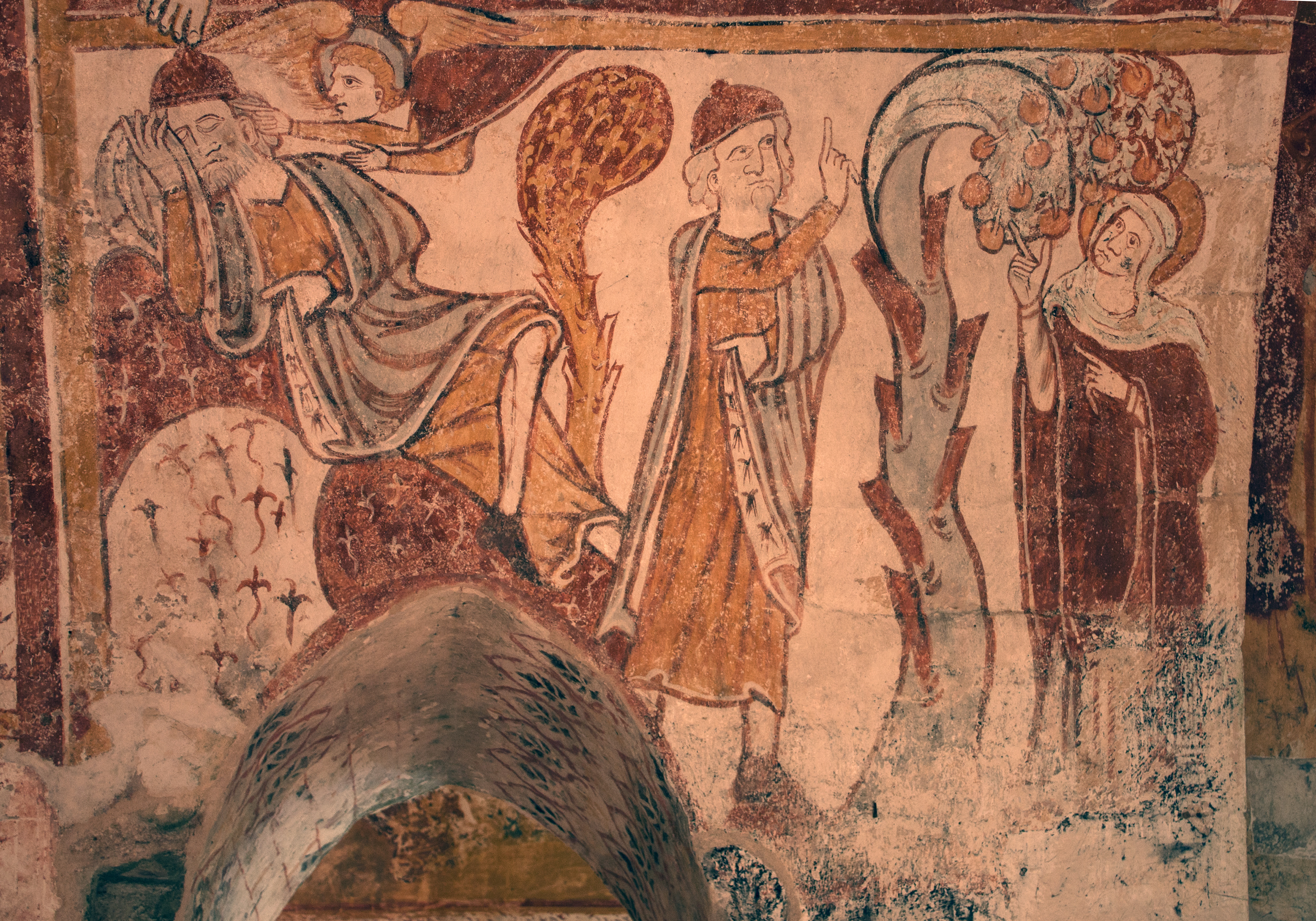
The image is a 12th century fresco of Joseph’s Dream and Joseph and Mary with the Cherry Tree (bizarrely misunderstood as Adam and Eve) in the crypt of the Notre-Dame Gargilesse church, Gargilesse-Dampierre, France. Photo by Daniel VILLAFRUELA, CC BY-SA 3.0, https://commons.wikimedia.org/w/index.php?curid=19347294.

I’ve Got to Know

A mosaic of a bearded figure with a halo behind bars, flanked by armed men.

“When John heard in prison what the Messiah was doing, he sent word by his disciples and said to him, ‘Are you the one who is to come, or are we to wait for another?'” – Matthew 11:2-3

John, there you are, imprisoned by a king
whom you had castigated for a sexual misdeed
and took it badly. Beyond the stony walls,
you hear, another speaks your word: “Repent!”

“The realm of God is near!”

You know this one. You baptized him despite
your protests that he should have baptized you.
The water has flowed on beneath the bridge,
incarcerating you and prompting him to speak:

“The realm of God is near!”

I’m with you, John, if not behind those iron bars,
I’m with you in the need to know: “Are you the One?”…
and I believe he is the One, and preach that faith as truth!
There is no faith without anxiety, for me as well as you.

“The realm of God is near!”

You said, “I’ve got to know,” and John, I hope you knew
to hear about the healing and the good news for the poor.
It’s what I hang my hope on, and my faith,
and why I trust in God’s eternal love.

“The realm of God is near!”

You know, I hope, wherever you may be today
your faith and hope and trust moved in the world
alive and powerful and merciful. And I will trust,
like you, that our Anointed One still lives.

“The realm of God is near!”

A poem/prayer based on Matthew 11:2-11, the Revised Common Lectionary Gospel Reading for Year A, Third Sunday of Advent.

The image is The Imprisonment of John the Baptist, one of the mosaics in the Baptistery of Saint John, Florence, Italy, unknown artist (early 1300s). Photo by Sailko – Own work, CC BY 3.0, https://commons.wikimedia.org/w/index.php?curid=41892074.

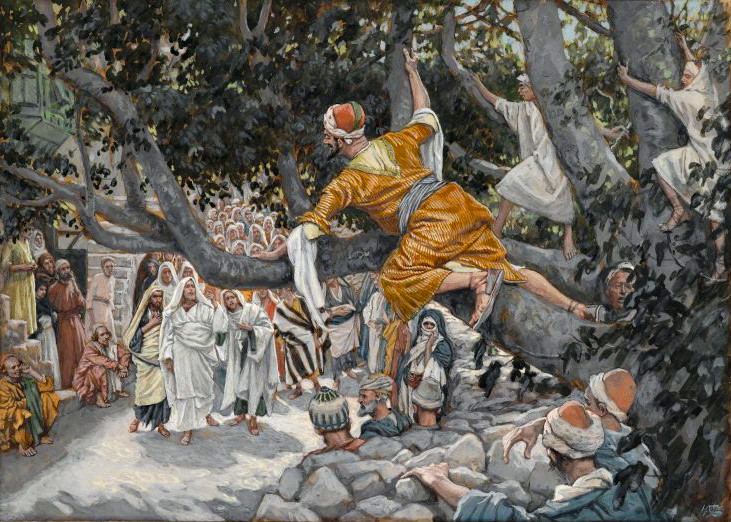
Up a Tree

“So he ran ahead and climbed a sycamore tree to see him, because he was going to pass that way.” – Luke 19:4

I didn’t think my hands could grip so tight.
I also didn’t think I’d ever be this high.
So let’s be clear that I regret this choice.
I wish I hadn’t scaled these heights.

Were I to fall, the people down below
would step aside. I grant you that not one
of them could cushion me. We’d both
be left in broken bones and tears upon the road.

I really wish I hadn’t climbed this high
into this tree or into my career.
I used to see my neighbors’ faces as
they doled out coins. Now I just see the coins.

Their faces turn away before I can
pronounce their names, but not before
I recognize their scorn, their bitter fear,
and their disgust at just how high I’ve gone.

Too high. Too high. When branches creak
at heights like this, the climber’s soul
sways unassuaged by creature comforts,
linen, gold, attentive slaves.

I got myself into this tree. I don’t know how
to get myself down to the ground.
My hands are knotted to this limb.
My breath is hoarse as I cling on.

Ignore me, Jesus, Just pass by.
Don’t look up. Don’t notice me.
Don’t speak. Don’t call. Don’t ask me anything.
Above all else, don’t ask me to come down.

A poem/prayer based on Luke 19:1-10, the Revised Common Lectionary Gospel Reading for Year C, Proper 26 (31).

The image is Zachée sur le sycomore attendant le passage de Jésus (Zacchaeus in the Sycamore Awaiting the Passage of Jesus) by James Tissot – Online Collection of Brooklyn Museum; Photo: Brooklyn Museum, 2008, 00.159.189_PS2.jpg, Public Domain, https://commons.wikimedia.org/w/index.php?curid=10904526.

Song: Hold On

by Eric Anderson
October 17, 2025

I wrote this song for worship on October 19, 2025, and it is based on the story of Jacob wrestling with God in Genesis 32.

[Chorus]

You’ve got to hold on, hold on
Though your limbs are weary
            and your soul is tired
You’ve got to hold on, hold on
For the sun will rise and bless your eyes

[Verses]

Jacob sent all his riches ahead
His brother had pledged to see him dead.
How could he be safe? So he stayed behind
Then he wrestled a man until the morning light.

[Chorus]

Jacob lost that match, and called the victor God.
He held on to be blessed by eternal love.
Now he walked with a limp but he strode out all right
To reconcile with his brother in the morning light.

[Chorus]

When the shadows put you in fear
Never forget: love is every near.
It will come to your aid; it will never deny.
You’ve got to hold on until the morning light.

[Chorus]

October 17, 2025

© 2025 by Eric Anderson

Story: Hold On

October 19, 2025

Genesis 32:22-31
Luke 18:1-8

Where I grew up on the shores of the Atlantic Ocean, there are birds that eat worms. In fact, a lot of birds eat worms. Some of them would eat worms (and bugs, and spiders) that burrow into trees. Some of these would use their beaks to dig holes into the bark to get those caterpillars out. Some would even carve pretty big holes in the wood.

Those birds are called woodpeckers.

On our island, we don’t have woodpeckers, we have the ‘akiapola’au, and I think I’ve mentioned before that it’s a very rare bird. They only live on our island, and there are less than two thousand of them. They have a short lower beak, and they use that to dig into tree bark where caterpillars or worms might be hiding. When they find one, they use the curved top beak like a fishhook, only they’re catching the worm.

I guess you could say they use both the upper and lower beak to actually eat what they’ve caught.

One day an ‘akiapola’au caught a caterpillar, but he wasn’t alone when he did. There were several other birds around, and none of them had the unique beak of an ‘akiapola’au. Therefore they had a lot of different ideas about what the ‘akiapola’au should do with his newly caught caterpillar.

“It’s stuck on your beak,” said an ‘apapane. “You can’t eat it from there. How are you going to get it into your mouth?”

“He could put it down,” suggested an ‘amakihi, who may have said that because he was hungry and thought he could get to the caterpillar if it crawled off.

“Is it too big to eat?” asked an ‘elepaio, which isn’t a very big bird but neither is an ‘akiapola’au. “You could bite it into smaller pieces.”

“That sounds like a good idea!” said the hungry ‘amakihi, who hoped to get one of the smaller pieces.

The ‘akiapoloa’au swung the caterpillar around, using the twigs and branch to get it from the hook of his beak toward his mouth. The other birds chimed in with advice like “Left!” “Right!” “Up!” “Down!” which wasn’t very helpful.

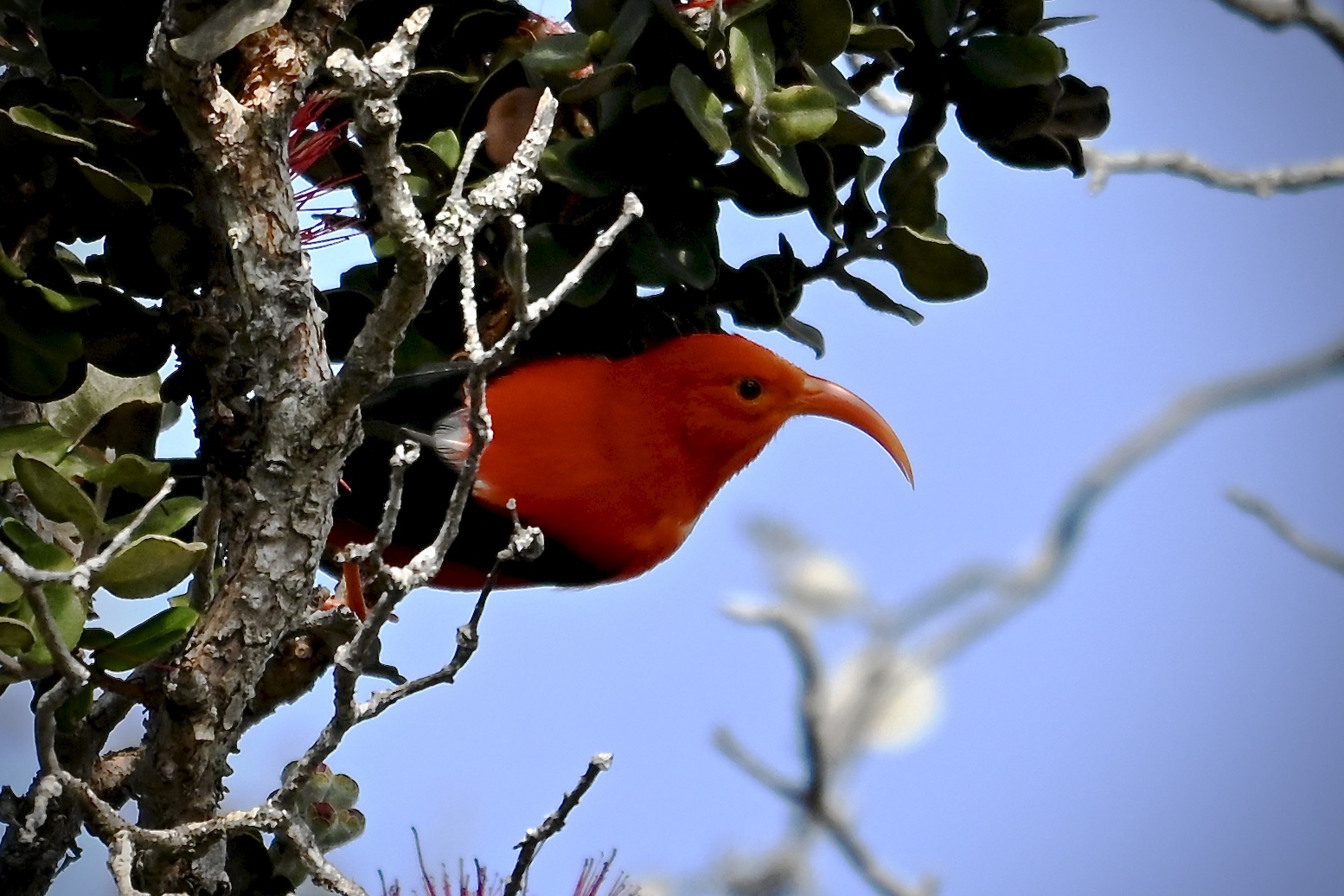
The worst advice came from an i’iwi, whose beak curves pretty dramatically, too. “Just put the caterpillar down,” she said. “Get some flower nectar instead. I mean, yuck!”

The hungry ‘amakihi echoed her, but the ‘akiapola’au ignored them all, all except an ‘alawi, another bird that likes a menu of bugs and caterpillars, who simply said, “Hold on.”

Hold on.

The ‘akiapola’au held on as he used the twigs to get the caterpillar lined up just right, and then, well, he was a happier ‘akiapola’au because he wasn’t as hungry. He looked at the helpful ‘alawi, who was searching for a caterpillar of her own.

“When you find what you need,” he said, “hold on.”

There are plenty of things in life that it’s good to let go of. Hot pans. Mosquitoes. Sharp things. There are plenty of habits in life that it’s good to let go of. Greed. Making fun of other people. Eating too much sugar.

But when you find what you need, whether it’s the food for the body or the food for the soul, the best advice there is, is: “Hold on.”

by Eric Anderson

Watch the Recorded Story

I write these stories ahead of time, but I tell them from memory, so what I said will not match what I wrote.

Photos of an ‘akiapola’au (and his lunch) by Eric Anderson.

Story: ‘Apapane Faith

Juvenile 'apapane with spotted feathering

October 5, 2025

Habakkuk 1:1-4, 2:1-4
Luke 17:5-10

Birds, by their very nature, rely on faith. Every bird knows about gravity; every bird knows that what goes up must come down. Every bird knows that while flight is the most natural thing in the world to them, it is also the most unnatural thing in the world. Somehow they hold those two things together.

At least, most of the time they do.

One young ‘apapane had learned to fly from his parents. He’d flown any number of times on his own. He was also still pretty young, so a lot of his feathers were still grey and brown. That had been fine. Now, however, some of his adult colors were coming in, so he had red feathers mixed among the grey and brown, and he had a speckled look. Frankly, I think he looked really interesting, but he thought he looked odd, even a little ugly.

With feathers that looked like that, he thought, how could he keep up with flying?

I don’t think that makes much sense, do you? He’d been flying just fine, and suddenly he didn’t believe he could fly because his feathers were changing? But you know, the first step in doing something is believing that you can do the thing. He stopped believing he could do the thing.

So he stopped flying.

He did manage to feed himself by journeying to other trees in the slowest, and possibly most exhausting way possible. He hopped from twig to twig, then from branch to branch, and when branches got close he jumped from tree to tree. It took time, and it wore him out, and frankly made him hungrier, but he did it.

It was a funny way to live for an ‘apapane.

It took a while for the other birds to notice, because he did turn up among his family and friends, even if he turned up later than everyone else. They just assumed he’d flown off in some other direction and finally got turned around the right way.

It was Tutu, his grandmother, who noticed the way he hopped, rather than flew, from tree to tree. She hopped over to his branch and said, “Are you all right, grandson? Have you hurt your wings?”

“No, they feel fine,” said her grandson.

“Then why are you hopping everywhere?” she asked. “Why aren’t you flying?”

“Well, just look at me,” he said. “Do these look like flying feathers? If I take off with these I’ll crash a moment later.”

“You think you can’t fly because of these feathers?” asked his grandmother.

“That’s right, Tutu,” he said.

Grandmother thought. She was a wise old bird, and she knew that you have to believe you can fly if you’re going to fly. She was tempted to let him hop around until he finished molting, but she knew he’d be pretty miserable the whole time. And who knows? He might never come around to believing again. That would be sad.

“Grandson, are you an ‘apapane?”

“Yes, of course I am,” he said, puzzled.

“Do you believe that you have wings?”

“Of course I do.”

“Do you believe in your feathers?”

“They’re right here,” he said.

“I believe in your feathers, too,” said Tutu, “the ones you have and the ones you’ll grow. In fact, all your family believes in them. Do you believe us?”

“I’m not sure,” he said.

“It takes just a little belief,” said his grandmother, “and that’s the amount of belief it takes to spread your wings. You’ve done it before. You can do it now.

“Believe it. Spread your wings, grandson. Fly.”

by Eric Anderson

I regret that we continue to have problems with the audio in our video stream, so a recording of this story is not available.

Photo of a young ‘apapane by Eric Anderson.

Take Your Watchpost

“[Jesus said,] ‘Would you not rather say to him, “Prepare supper for me; put on your apron and serve me while I eat and drink; later you may eat and drink”?'” – Luke 17:8

Stand at your watchpost, Holy One, and see,
if I have brought your sustenance to table
where the hungry you have called are blessed
by word, and heart, and bread.

Stand at your watchpost, by the door,
to see if any leave with bellies pinched,
with faces sad, with spirits quenched.
See if your banquet has been served.

Stand at your watchpost, Jesus, to observe
if I have nurtured that so precious seed of faith
into a shelter for the birds and beasts and people.
O Jesus, have I grown my faith in you?

A poem/prayer based on Luke 17:5-10, the Revised Common Lectionary Gospel Reading for Year C, Proper 22 (27), with an additional nod to Habakkuk 1:1-4, 2:1-4.

The image is a photo of the shrine at the Tomb of Habakkuk in Tuyserkan, Iran. Photo by hamid3 – Own work, CC BY 4.0, https://commons.wikimedia.org/w/index.php?curid=99699676. The tower may date to the 11th or 12th centuries, an architect’s attempt to render Habakkuk’s vision of the watchtower.

Story: Considering and Preparing

September 7, 2025

Philemon 1:1-21
Luke 14:25-33

People, in general, don’t do well if they eat a lot of food quickly. It’s a good way to feel sick. Sometimes, somebody who eats a lot of food really quickly will get sick.

Ick.

The young ‘akekeke had learned something similar from his parents as they led him and his sister and brothers around the Alaskan tundra near where they’d hatched. There they found the bugs and worms that filled their bellies and kept them growing. Both mother and father, however, warned them against eating too much, and after one of his brothers ignored their advice and got a nasty stomachache the rest of the chicks decided their parents knew something after all.

As the summer wore on, it became time for the trip to Hawai’i. The four chicks became fledglings, learned to fly, and watched as more and more of the ‘akekeke began flying toward the coast. Their mother joined in with lots of the other mothers, leaving them with their father to finish flight school with him.

Even more birds departed before their father gathered them along with some other youngsters into a little flock and said, “It’s time to get ready.” They flew to the shoreline where they found a number of other groups of ‘akekeke probing through the shallows for small fish and shrimp.

“It will be time soon,” said their father, “to make the long flight to Hawai’i. You’ll need all the energy you can get for this. So eat. Eat all you can. Eat more than you think you can.”

“But wait,” said his son. “You’ve been telling us for weeks not to eat too much. In fact, when our brother tried it anyway, he got sick. Are you telling us that was wrong?”

“It was wrong then,” said father, “but now we’re doing something very different. We’re making a long flight and there’s nowhere to stop and eat until we get there. This is the time to plan. This is the time to prepare. This is the time to get ready.”

The young ‘akekeke wasn’t convinced. He wasn’t convinced that eating a lot was a good idea, even though his sister and two brothers had plunged right into an outcrop of mussels. He also wasn’t sure that taking such a long flight was a good idea, even if so many of the adults had already gone. His father looked at him with sympathy and with love.

“There’s some time, youngster,” he said. “Take time. Consider. I don’t think you’ll enjoy staying here for the winter – it gets cold, you see. But think it over. I hope you’ll join us.”

The young ‘akekeke thought about it. He thought about being cold, which he couldn’t really imagine. He thought about eating more than he ever thought possible, which he couldn’t really imagine, either, but he could see that his father, sister, and brothers didn’t seem to have any troubles as they ate their way along the shoreline. He thought about Hawai’i, which he also had trouble imagining, since he’d never been there before. Mostly he thought about being the only ‘akekeke in Alaska when everybody else had gone.

A little while later he was industriously feeding himself alongside his father.

“I’ve thought it over,” he said, “and I’ll stick with you.”

by Eric Anderson

Watch the Recorded Story

I write these stories ahead of time, but I tell them without notes, so the text I prepared does not match the way I told it in worship.

Photo of an ‘akekeke (ruddy turnstone) on Hawai’i Island by Eric Anderson.

Weakness Obstructed

“…but [God] said to me, ‘My grace is sufficient for you, for power is made perfect in weakness.'” – 2 Corinthians 12:9

In weakness God makes power.
In the stammering speech.
In the thinning skin.
In the cane-assisted stride.

In weakness God makes power.
In the eyes that do not see.
In the ears that do not hear.
In the legs that do not bear.

In weakness God makes power.
In the mind that cannot focus.
In the hand that cannot grasp.
In the appetite that cannot resist.

In weakness God makes power.
But those who are made
in the image of God
make obstacles; and why?

In weakness God makes power.
In the root that makes its soil.
In the child that makes its generation.
In the death that promises eternal life.

In weakness God makes power.

A poem/prayer based on 2 Corinthians 12:2-10, the Revised Common Lectionary Second Reading for Year B, Proper 9 (14).

Photo by Eric Anderson

Don’t You Care?

“But he was in the stern, asleep on the cushion; and they woke him up and said to him, ‘Teacher, do you not care that we are perishing?'” – Mark 4:38

For once, it wasn’t me.
I’m known, of course, for saying all
the dumb things I could say to Jesus.
This time, it wasn’t me.

(And wouldn’t you know, the time
it wasn’t me, they left the culprit
unidentified. I ask you,
was that fair to me or not?)

No, I was busy with the flying rig,
and leaning hard to counter all
my lubberly companions who
knew nothing of the balance of a boat.

I thought it best to wake him, too.
I couldn’t calm the lubbers down.
Perhaps he could, and then old James
and John and Andrew might have saved the day.

Not even I, with all my lack of sense,
would dare to utter what he did
(I, too, will shelter here the guilty one).
“We’re perishing! Or don’t you care?”

Though rope ran slick along my bloody palm,
I winced to hear those words. I’d said them
to my mother once, and only once.
“I don’t believe you care at all!”

I knew that Jesus would respond
no better than my mother had.
Like her, he fixed the problem first,
the wind and sea subsided,

But then he turned that steely glare
upon us, one and all, even those
who never would have mouthed
those ill-considered words, and said:

“Why are you mewling cowards? Do
you ask me if I care? Have you no sense?
No confidence? No faith?”
And we said nothing back at all.

In truth, my confidence was lacking then.
I trusted in my seaman’s skills
in preference to God. But none of us
appreciated then what he had asked of us.

He asked us not to trust in him awake,
but trust in him asleep. He asked not to trust
in God when fiery pillars stride, but when
the way is still unknown.

He asked us not to trust in signs,
but in their absence. He asked us not
to trust in prophecy, but in
the new things prophets had not said.

We asked the question, “Who is this?”
as if the answer mattered more
than how we meet the challenges of life
encouraged by our trust in God.

A poem/prayer based on Mark 4:35-41, the Revised Common Lectionary Gospel Reading for Year B, Proper 7 (12).

The image is Stillung des Sturmes durch Jesus (Jesus Calms the Storm), a relief on the exterior of the Stuttgart Stiftsckirche (Collegiate Church of Stuttgart), 1957, by Jürgen Weber. Photo by Andreas Praefcke – Self-photographed, CC BY 3.0, https://commons.wikimedia.org/w/index.php?curid=15039823.