On Second Thought, Call Me Servant

“[Jesus said,] I do not call you servants any longer, because the servant does not know what the master is doing; but I have called you friends, because I have made known to you everything that I have heard from my Father.” – John 15:15

Pedant that I am, I have to tell you, Jesus, that
you’ve never called us servants.
Students, yes, and followers.
You’ve nicknamed some of us
(and isn’t Simon just the perfect Rock
(between the ears?)) but never
servants.

To tell the truth, I can’t recall you’ve called
us friends. It’s quite a lift
from slave to friend you’ve given us.
And all you’ve asked is that we love
each other as you’ve shown your love to us.
That’s your command: it makes us friends, not
servants.

I wish I were as sure as you that I
know what you’re doing, Jesus. I
don’t think that I do. If I’ve been quicker on
the uptake than our brother Simon Rock,
he’s not the brightest lamp within the room.
I hardly feel I know what friends would know, not
servants.

If I let fall the barriers I’ve used to hide
the things you’ve told us from my understanding, then
I know the reasons you have called us friends. And I’m
not comfortable with that. Friends are responsible
for what they do in friendship. They have to think
and act themselves, not wait for orders like a
servant.

On sound reflection, Jesus, might you
reconsider making us your friends? Might you not
step forth majestically in power? Then we,
your servants, rise with you, to rule
with humble title but substantial privilege.
Set our direction, Jesus, as your servants, not
your friends.

A poem/prayer based on John 15:9-17, the Revised Common Lectionary Gospel Reading for Year B, Sixth Sunday of Easter.

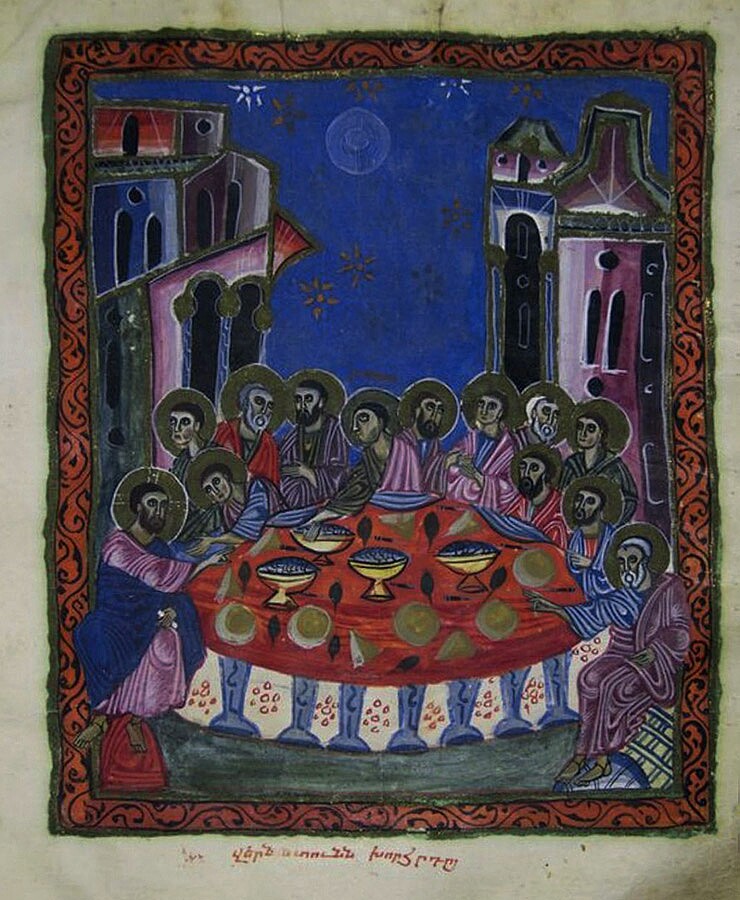
The image is a page from the Targmanchats Gospels (1232), ms2743 Matenadaran collection. Photo by Grigor – https://regionalpost.org/en/articles/a-treasury-of-medieval-thought-in-a-modern-institution.html, Public Domain, https://commons.wikimedia.org/w/index.php?curid=119401477.

Story: Sometimes It’s Simple; Sometimes It’s Not

April 28, 2024

Acts 8:26-40
1 John 4:7-21

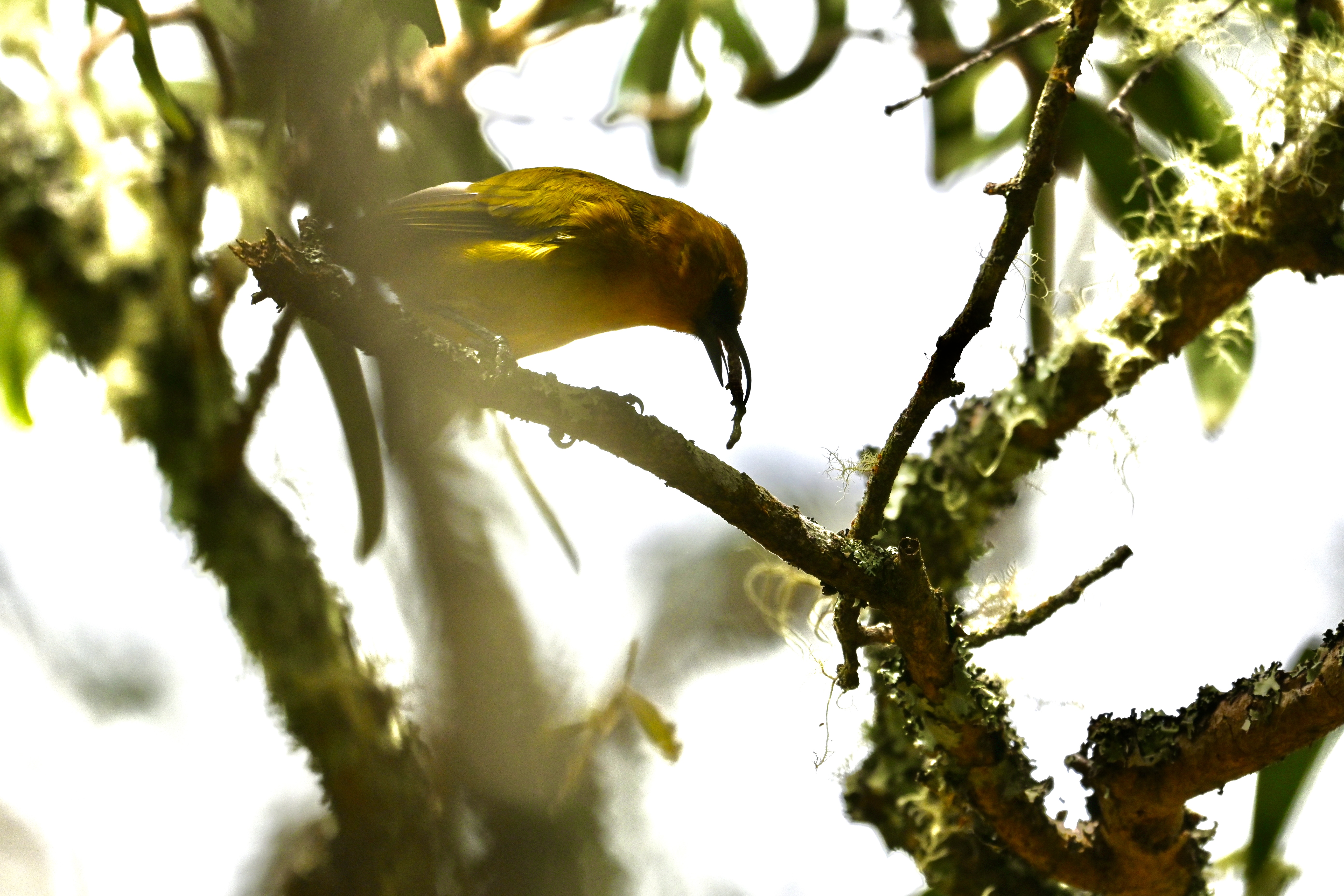
The i’iwi eats nectar. Human beings tend to complain about a diet that is mostly liquid, but we might complain less if it was mostly nectar. I’iwi don’t complain about it. Their long curved bill works really well for getting nectar from flowers that other birds like the ‘apapane can’t reach.

I’iwi have a neat trick for feeding from some flowers which open down. One will hang below the flower and poke its beak up into the nectar reservoir. There are other birds on the island that do this, but the i’iwi do it most often.

One young i’iwi came to believe that, because this was a hard-won skill, she had to use it all the time. On every flower. Whether they opened downward or upward.

Believe it or not, it sort of worked. It worked very well on those downward flowers, of course. That’s why i’iwi developed that technique.

It worked on sideways facing flowers, though it was more of a strain to get her neck into the right position. She kept at it, though. If she was going to do something, she’d do it right. And as with many things, constant practice meant that she did, indeed, get better and better.

It was more of a struggle, though, with flowers that opened upward. A lot of ohi’a blossoms, for example, open upward, and i’iwi sip a lot of ohi’a nectar. Still, ohi’a is a pretty open flower, without a lot of petals to get in the way. She managed.

Then there were the flowers with upward petals and, well, those didn’t go well at all.

Her mother came for a visit one day as she was flitting about from tree to tree. She didn’t say anything when she hung upside down for downward facing flowers. She didn’t say anything when she reached up for sideways flowers. She opened her beak but didn’t say anything about the ohi’a flowers she sipped from beneath.

But when she tried to get at a big hibiscus blossom from underneath, she said, “What are you doing?”

“I’m eating,” said her daughter.

“No you’re not. You can’t get at the nectar in that flower from down there.”

“Sure I can. It’s just a matter of technique.”

Mother watched daughter struggle to get her curved beak around the petals and to the nectar at the flower’s center. Eventually the younger bird, with a glance at her mother, perched just above and to the side and took a good long sip.

“You don’t always need to come at things from underneath,” said mother.

“Isn’t that the i’iwi way?” asked her daughter.

“The i’iwi way is to fly, eat, deal with the neighbors, get a good sleep each night, and be the most stylish birds on the mountain,” said her mother. “Nothing says you have to do something the hard way all the time.

“Sometimes things are simple. Sometimes they’re not. Doing simple things in a complicated way doesn’t get you fed, or flying, or sleeping. Doing complicated things in a simple way doesn’t get any of those things done either.

“When it’s simple, do it simply, daughter. Save the complicated techniques for when it’s hard.”

by Eric Anderson

Watch the Recorded Story

I write these stories ahead of time, and tell them from memory – which means that I improvise at the same time.

Image of an i’iwi feeding upside down by Bettina Arrigoni – Iiwi | Hakalau NWR | HI|2018-12-02|13-43-26-2, CC BY 2.0, https://commons.wikimedia.org/w/index.php?curid=75174870.

Story: Unbelief

March 31, 2024


Isaiah 25:6-9
John 20:1-18

In the gospel stories about Easter, there’s a common theme. It’s unbelief. People heard – from angels, initially – that Jesus had risen from the dead, and… they didn’t believe them. Later people heard from other people that Jesus had risen from the dead, and they didn’t believe the people. I guess that makes sense. If you don’t believe angels, how likely are you to believe people?

Once there was an ‘apapane who didn’t believe in love.

If that seems hard to believe, well, it was hard to believe. He had been raised with two sisters by attentive parents who fed them well, kept them warm in the rain, and taught them all to sing. They flew with him, they brought him to good trees to find bugs and nectar, and they kept him company when the nights got long and lonely.

But he didn’t believe in love.

You might be thinking that his sisters teased him all the time and that’s why he didn’t believe in love. It’s true. They teased him. But not much, really. More to the point, the teasing didn’t bother him. He teased them back and they all would laugh at the silly things they’d say.

Still, he didn’t believe in love.

“You’re just taking care of me because it keeps the family going,” he told his parents, who really didn’t know what to say about that.

“You’re just good to me because you expect I’ll be good to you,” he told his sisters, and he was good to them, but as he said, it was because he expected them to be good to him.

I suppose it might have been because nearly the entire time since he’d cracked the shell that the skies had been gray, the winds had been cold, and the rain had plummeted down.

I sometimes find it hard to believe in love after too many days of cold, grey, windy rain.

He and his sisters had put in a hard day of nectar- and bug-seeking. There might have been ohi’a flowers in blossom, but they were hard to see in the grey light. The bugs were hiding from the rain, not even troubling to go find nectar to eat. The three siblings huddled for the night on a branch, cold, wet, and hungry.

He was grateful for their warmth but he still didn’t believe in love.

When morning came, he blinked his eyes to an unfamiliar light. The clouds had cleared overnight, and the wind gently rustled the leaves. He and his sisters, all three, stared at the golden light of the sun rising over the trees. As it got higher, the ohi’a blossoms opened in scarlet and gold glory. As it got higher, its warmth dried their feathers.

“Wow,” said the sisters. “What a difference that makes.”

“More than you know,” said their brother. “It’s like a completely different world.”

“Is this a world where you can believe in love?” asked one sister.

He thought about it for a while.

“You know, I think it might be,” he said.

They helped one another get their drying feathers into shape – that’s kind of an ‘apapane hug – and flew off into the sunrise over the glorious bloom of ohi’a.

As they flew, they sang together. You know what they sang?

“I think I believe in love.”

by Eric Anderson

Watch the Recorded Story

I write these stories ahead of time, then tell them from memory – memory plus whatever I feel like saying in the moment.

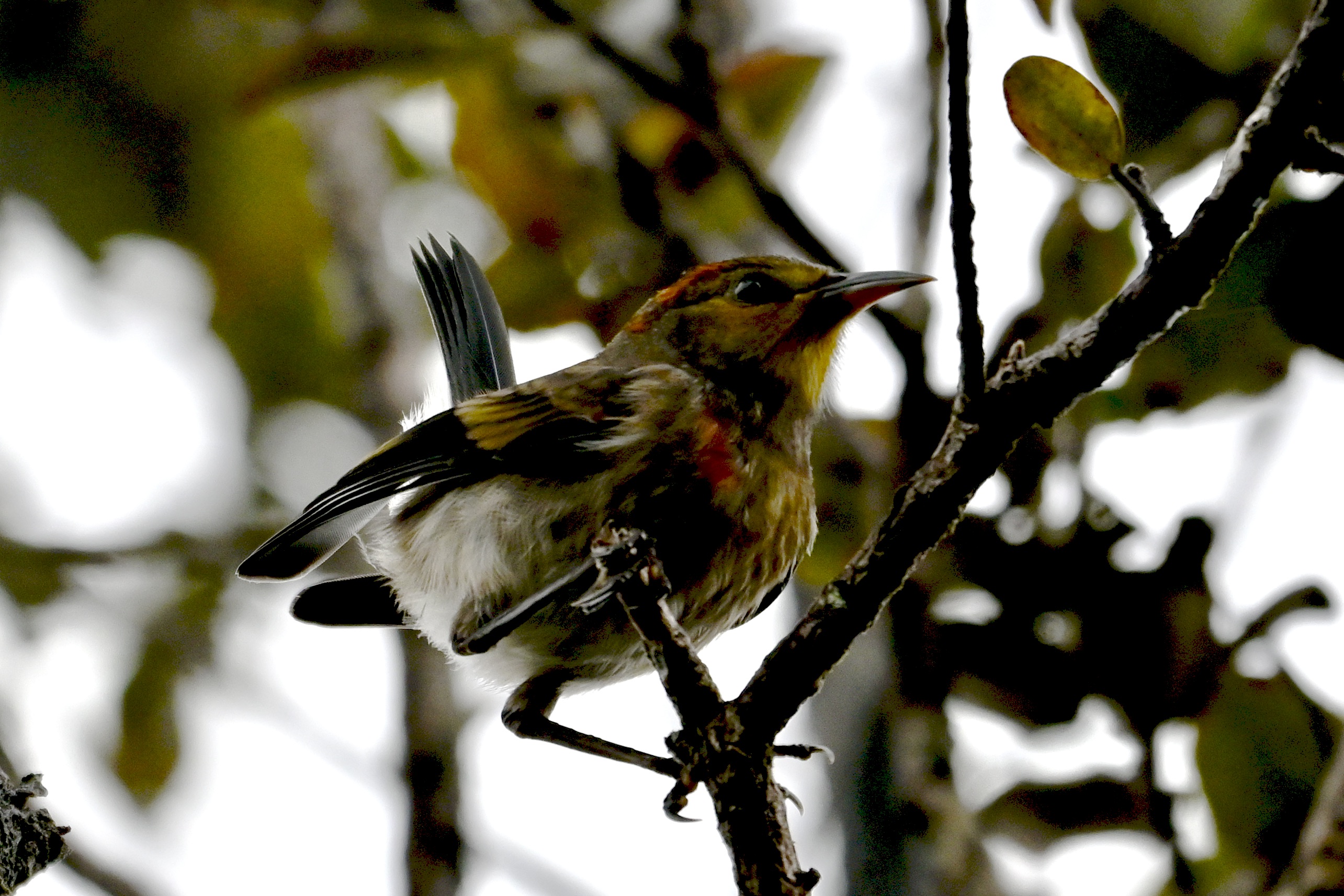
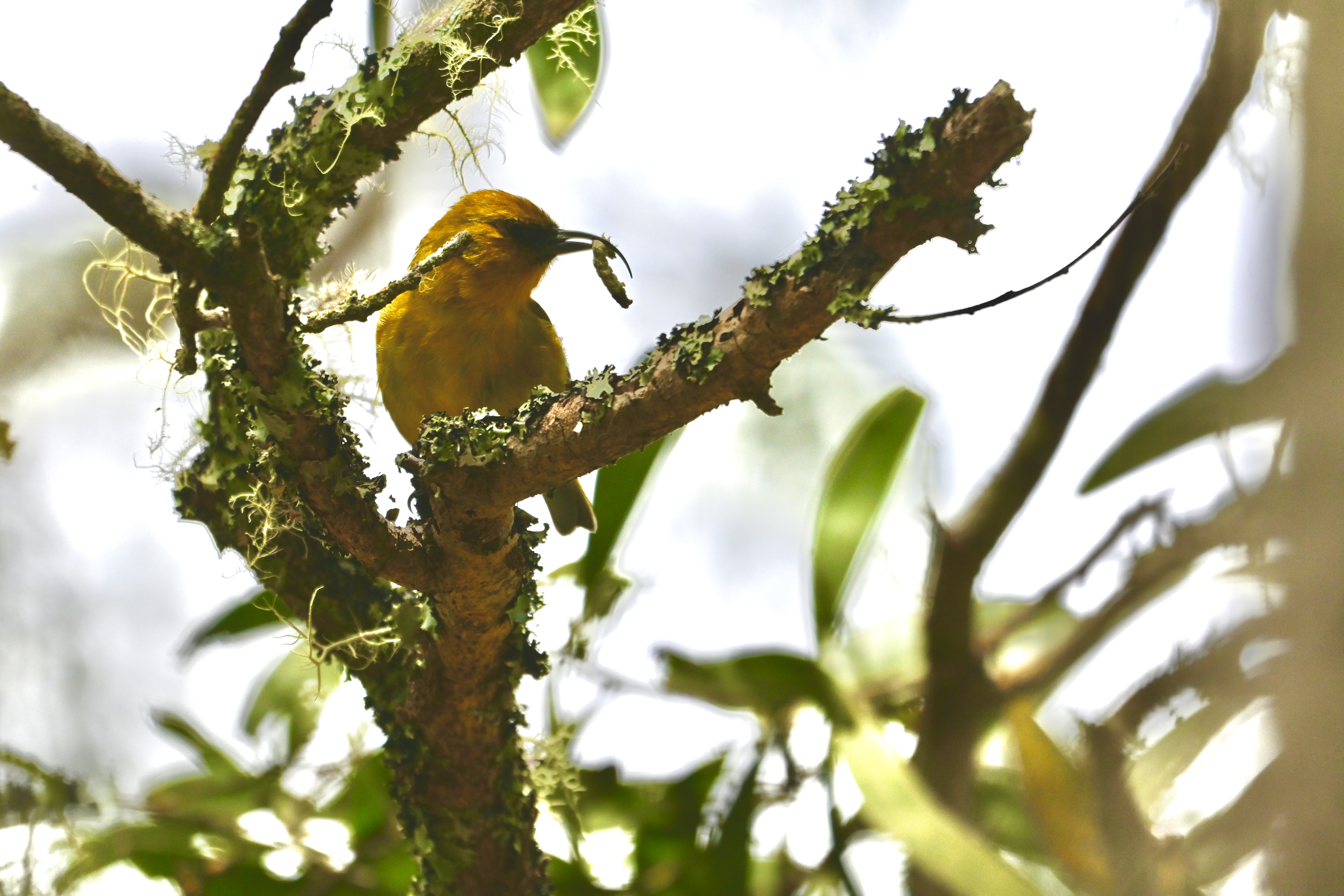
Photo of an ‘apapane by Eric Anderson.

Story: No Signs

kolea (Pacific Golden Plover)

March 3, 2024

Exodus 20:1-17
1 Corinthians 1:18-25

The kolea had successfully made his first flight to Hawai’i the previous fall. He’d hatched a young bird in Alaska, he’d been fed by his parents, he’d learned to find his own food, and eventually he’d taken off for the long journey to Hawai’i. He’d found a spot here to look for worms and seeds and berries. He’d worn his mottled tan and brown feathers through the winter months. He was starting to put on the black and white feathering of summer.

He’d also been paying attention to people. I advise you to pay good attention to people, because you are people, and paying attention to people who are people like you helps you to learn how to be people, and it also helps you to know what other people are going to do, like when they might step backward and one people steps on another’s people’s toes.

Um. Person’s toes.

While it’s useful for people to listen to people, it’s not always so useful for other creatures. For some reason, this kolea heard a lot of people talking about signs. If you want to find your way to Hilo, follow the signs. If you want to find your way to the beach, follow the signs. If you want to go not too fast and not too slow, follow the signs.

Where, wondered the kolea, would he find signs on the way to Alaska?

Mind you, people do put signs out on the waters. If you look around Hilo Bay, there are marker buoys out there to help boats find their way to the harbor mouth and back home. They’re easier to see at night, when they blink red and green. As you get further from the shore, however, there are fewer of them, and not many at all across the vast expanse of ocean.

The kolea hadn’t noticed any on the way to Hawai’i, and didn’t expect to see any on the way to Alaska.

“Where will I find the signs?” he asked.

“Why do you want signs?” an older kolea wanted to know.

“People use them all the time,” he answered, and the other kolea thought he meant kolea people rather than human people, and flew away because he wasn’t making any sense.

It was another older kolea who sat him down for a heart-to-heart, brain-to-brain, and feather-to-feather talk.

“What signs do you expect to see?” she wanted to know.

“Clouds, stars, lights, glowing plankton in the ocean,” he said.

“Did you see any coming here?” she asked.

“Of course I did,” he told her, because those things happen around the oceans.

“Did they tell you how to get here?” she asked.

Well, no, they hadn’t.

“How did you get here?” she asked.

He gave her an answer that he understood, and she understood, because they’re both kolea and they can fly three days over open ocean without signs, but that I don’t understand because I’m a human person and I don’t know how they do it.

“The signs are inside you,” she told him.

We live with a lot of signs around, it’s true, telling you everything from what the name of this church is to how far it is to Kona. Some things, however, and some of that is in our lives of prayer, take place within us, in our hearts and in our souls. There are signs for that, like the Bible, but down deep we’ll find the guidance of the Holy Spirit to bring us safely home.

by Eric Anderson

Watch the Recorded Story

I write these stories ahead of time and tell them in worship services from memory. As a result, the prepared text and the told story rarely match. I’m quite pleased how much of the paragraph with all the people I remembered this week.

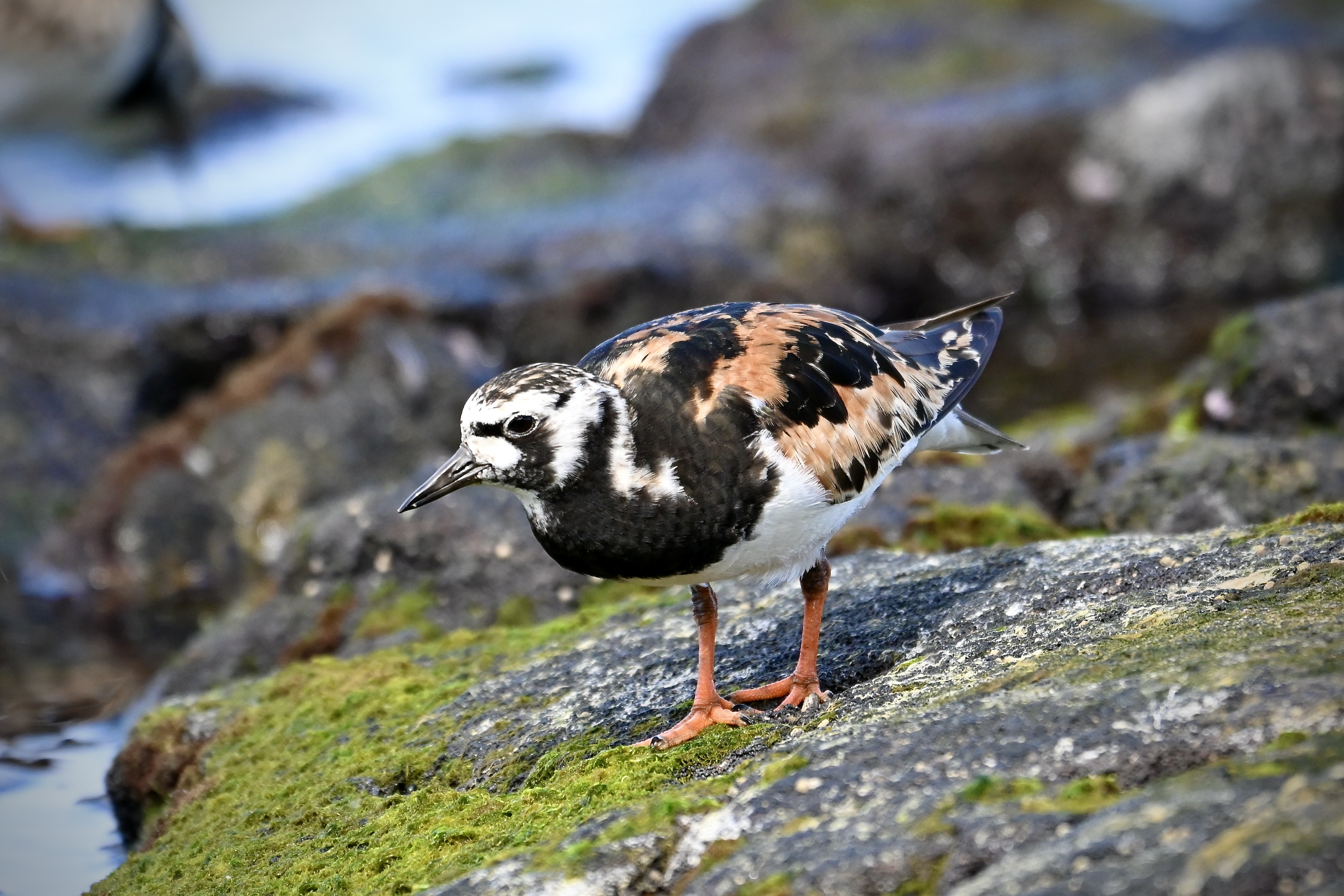
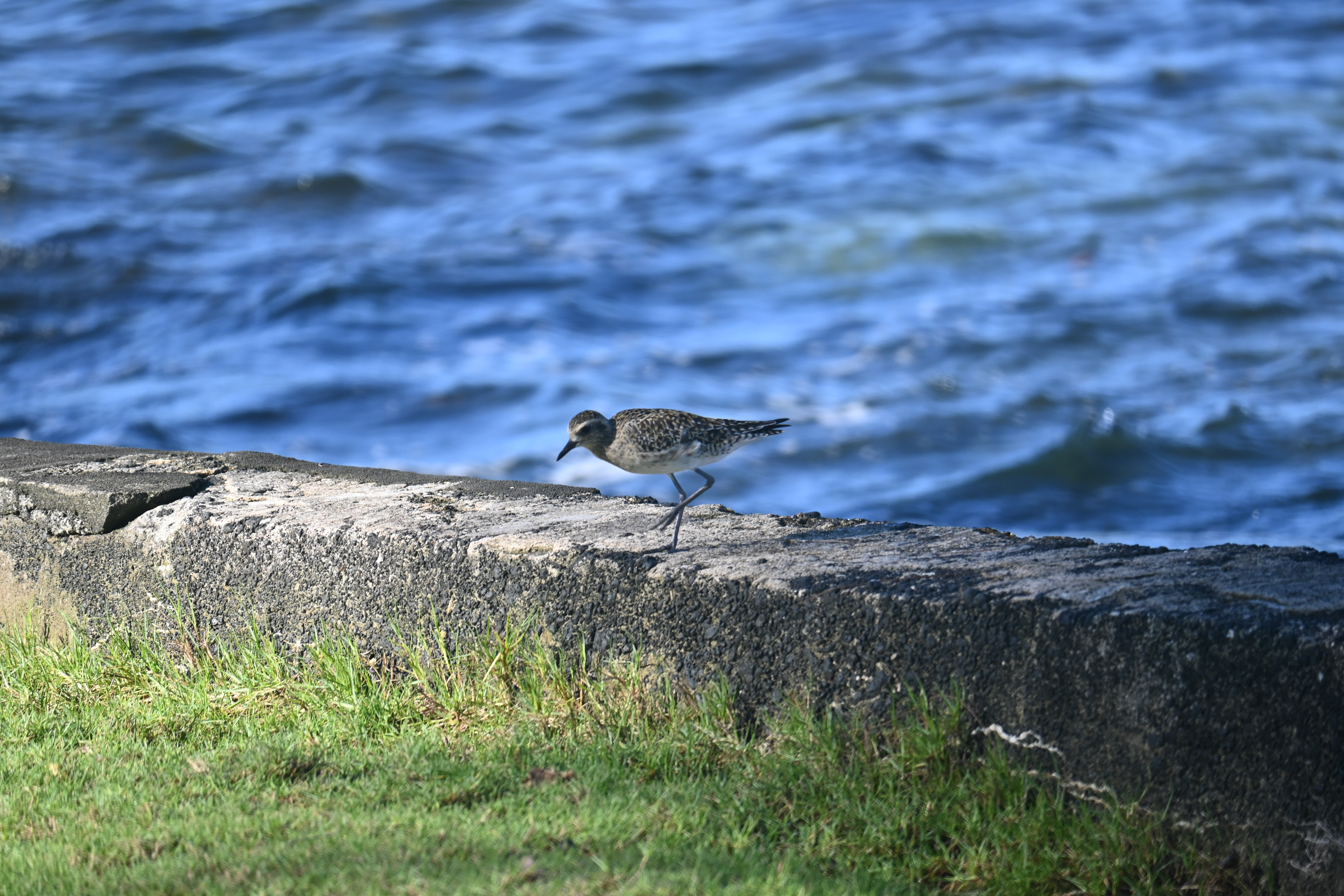
Photo of a kolea in Hilo by Eric Anderson.

First Denial

February 21, 2024

[Verses]

Don’t you like it, Simon, when I say
that your Messiah is not what you want?
Don’t you like it, Simon, when I tell you
I’ll be raised up on a cross?

Of course you don’t, dear Simon.
How could anyone be pleased to hear
Messiah is no conqueror,
except to turn the tables on Death.

I told you, but you wouldn’t hear it, Simon.
You tell me how to live my life
and die my death, and no. That’s not yours
to settle or define. It’s mine. And God’s.

Ah, Simon Peter, my dear Rock,
so hard of head, transparent of heart,
so certain of things that must be true,
and come to pass, and be:

I chide you hard for this denial now.
A night will come when your denials will
tap like a clock ticking toward dawn.
And then, I will not chide,
for you will turn aside

And weep.

© 2024 by Eric Anderson

This song is based on the #lectionprayer “Simon Peter’s First Denial.” As you’ll find there, I was asked if the poem had been set to music. It hadn’t – but now, with some lyric adjustment, it has.

The song’s premiere performance was on February 28, 2024.

The Magic of Snow

Author’s Note: This reflection was originally published as a Facebook Note (the platform’s never-fully-and-no-longer-much-at-all-supported blogging utility) on January 9, 2011. I’m reposting some of those Notes here because they’re difficult to find in Facebook now, and in some cases impossible.

January 9, 2011

As I was shoveling my driveway this morning, my next door neighbor had a question for me. ‘You’re a man of the cloth,’ he said, ‘Do you believe God makes it snow?’

‘Well, not at any particular time,’ I said. ‘I mean, I think God set the laws of nature that make snow happen, but that it snowed today rather than…’ and I waved my hand vaguely.

He nodded. ‘I don’t think God makes it snow,’ he replied. ‘If he did, you wouldn’t be out there shoveling it now.’

I laughed, but I also thought to myself, ah, but if somebody I really disliked were shoveling this snow right now, I might be inclined to think God had brought it for this moment. That would feel to me like divine justice. Or at least as if God were responding to my concerns in the world.

As I shoveled and thought, I realized that what I was thinking about (and not shoveling) wasn’t divine justice, but magic. Not the public performances of illusion we enjoy, but the exercise of power through invocation of other forces.

The appeal of magic is that it is reliable (stay with me here). That is, if I do the spell correctly, I get a predictable result. In the history of human religious thinking, gods were frequently invoked in the performance of magic. I recall that many years ago, archaeologists found a storehouse of papyrus fragments in Egypt, many of which had clearly been sold in the marketplace as spells of protection, blessings, or even curses against someone else. As I remember, the God of Israel was among the deities invoked, and also, I think, Jesus…

But the God I know is not one who is ‘magical.’ The God I know isn’t so controllable, so predictable, that I can call down snow on the unjust. Those ancient spells are attempts to control and to direct divine powers. The God I know merely smiles at the very idea.

The God I know invites human beings into relationship, into friendship, into mentorship, into worship. The God I know sends rain (and snow) onto the just and the unjust, and invites both to accept the free gift of divine grace. The God I know listens, considers, and acts in the world: but I would never pretend to predict just what this God will do. Merely be thankful when I recognize those acts for the blessings they are.

And to appreciate, as well, the wonders of random, not-necessarily-specifically-directed, and ‘magical’ in a different sense, snow.

The photo was taken by Eric Anderson on January 12, 2011, in Portland, Connecticut, after another snowstorm.

Story: Two Wings and a Prayer

August 7, 2022

Hebrews 11:1-3, 8-16
Luke 12:32-40

The oma’o is a fairly small bird, living on the lower slopes of the volcanoes from Hamakua to Ka’u. When you’re an oma’o chick, you’re even smaller. He hatched and grew up in a hole in a koa tree, and about the only thing he could even imagine as he looked out from the hole was:

It’s a great big world, and I’m a very small bird.

He was, of course, a very small bird, but he grew to become, well, a larger but still very small bird. The world outside was still a lot bigger than he was. He watched his parents fly back and forth to and from the nest, and wondered how they did it. Their wings seemed awfully small to carry even their small bodies. Their feet seemed awfully fragile to grip a twig. How was someone like him to have any place in a huge world like this?

Young oma’o do some experiments that lead to flying. They move their wings around and start to preen them, to settle their feathers with their beaks. They start to hop and stretch their legs in the nest – but they don’t leave the nest. In fact, after they leave the nest, they don’t come back to it. They’ll stay where their parents can find them – they still feed them for a  while – but they don’t go back to the nest.

This young oma’o, however, wasn’t sure he wanted to leave the nest. Big world. Small bird. Small wings, big air. It was a night that the winds blew hard that he came to a decision.

“No,” he told his father. “I’m staying here.”

“Very smart, son,” said his father. “It’s a nasty night. The nest is a good place for now, and it’s not a great time to take your first flight.”

“No,” said the youngster. “I mean I’m just staying here. I’m not going to leave.”

The father didn’t know what to say, so he didn’t say anything. Nor did mother when the youngster told her in the morning.

“What are you going to do just staying in the nest?” asked mother.

“What I’m doing now,” he said.

“Wouldn’t you like to fly?” asked father.

“I don’t think so,” said the child.

It was mother who settled down with him and got him to say what was going on. The world was too big. The winds were too strong. His wings were too fragile. He was too small.

Then he asked, “How do you do it, Mom?”

She thought about it. “It is a big world,” she said. “I’m a small bird. My little wings aren’t much to carry me through strong winds. But I’ve got a couple of things that carry me through it all.”

“What?”

“Well, I haven’t got one just wing. I’ve got two. With only one, I don’t think I’d get far. With two, I can get anywhere I want.”

“But how did you make that first leap of faith?” he asked.

“I just flapped my wings and hopped, and as I hopped I hoped and prayed. Suddenly my wings caught the air and I was flying.”

Without even realizing it, the young fledgling was hopping and flapping. “So a wing and a prayer?” he asked.

“Two wings and a prayer,” said his mother, “and I took my first flight – just like you’re doing now.”

Sure enough, his flapping wings had caught the air and he’d taken off on his first short flight.

“Just like that,” he marveled, “on two wings and a prayer.”

by Eric Anderson

Watch the Recorded Story

The story was told from memory of this manuscript text – which means that in the recording, it’s told differently.

Photo by Bettina Arrigoni – Omao | Hakalau NWR | HI|2018-12-02|13-40-46, CC BY 2.0, https://commons.wikimedia.org/w/index.php?curid=75174855.

A Mechanical God

“Now faith is the assurance of things hoped for, the conviction of things not seen.” – Hebrews 11:1

Oh, for a mechanical God,
a God who spins when I pull down the lever,
a God who chimes when I haul on the rope,
a God whose actions I’d predict
infallibly each day.

Oh, for a magical God,
a God invoked by sound and tone,
a God directed by desire,
a God to do my will
infallibly each day.

Oh, for a predictable God,
a God whose rulings I affirm,
a God whose justice I approve,
a God whose mercy I… receive
infallibly each day.

Ah, but an uncontrollable God,
a God creating in profusion,
a God with greater grace than mine,
this God I humbly worship…
quite fallibly…
each day.

A poem/prayer based on Hebrews 11:1-3, 8-16, the Revised Common Lectionary Gospel Reading for Year C, Proper 14 (19).

Photo by Eric Anderson

Returning Tide

June 5, 2022

Genesis 11:1-9
Acts 2:1-21

The opihi – do you know about opihi? They’re a shellfish, a little bit like scallops or clams. Scallops and clams, of course, have two shells and a hinge. They’ve got protection from creatures that like to eat them on top and on the bottom. And when things are safer, they can open up and let the water bring the little bits of seaweed and tiny creatures to them.

An opihi, however, only has one shell. I suppose it’s a little bit like a hat, only it’s a hat that covers the entire creature. An opihi – they’re called limpets in English – finds a spot on the rocks and holds tight as its shell grows over its top. And then it continues to hold tight. It might move a little bit to get to another spot on the rock with more algae, but you and I might not even notice them on the move.

And they don’t talk much. There’s not a lot to talk about, when you’re an opihi.

Here’s the thing: they like to live in the shallows along the shorelines of our islands. In those places, the tides come in, and the tides go out. Sometimes when the tide goes out, an opihi is in a pool of water. But sometimes, it finds itself above the water after it drains away. Sometimes it just sits there in the open air.

A honu pulled itself up on a rock to nap in the sun one day and found an opihi already there. I’m a little surprised it noticed. A honu is a lot bigger than an opihi. But they both have shells, so the honu felt a little bit of sympathy for this opihi, stranded on the rock outside the water.

“Do you need help?” the honu asked. “I see you’re out of the water here.”

The opihi wasn’t used to conversation – there’s not a lot to talk about when you’re an opihi (I may have mentioned that). But finally it found a reply:

“No. I’m fine.”

“Isn’t being out of the water a problem?”

“Well, not so much. If it went on a long time, that would be a problem,” said the opihi.

“How do you know it won’t be a long time?”

The opihi thought about this. “Honestly, I don’t know that it won’t be a long time. I suppose it could be. This isn’t the first time I’ve been left high and dry. Some of those times really did seem pretty long.”

The honu waited. Finally the opihi finished:

“The tide has always come back. I trust the tide more than I trust myself to swim if you swept me off the rock into the water.

“The tide has always been good to me. I’ll hold on here until it returns again.”

by Eric Anderson

Watch the Recorded Story

The story is told from memory of this prepared text – and thus will never be quite the same.

Photo of opihi in Honokanaia, Kahoolawe, Hawaii, by Forest & Kim Starr, CC BY 3.0 us, https://commons.wikimedia.org/w/index.php?curid=71815389.

Lightened

“Jesus stood still and said, ‘Call him here.’ And they called the blind man, saying to him, ‘Take heart; get up, he is calling you.’ So throwing off his cloak, he sprang up and came to Jesus.” – Mark 10:49-50

He heard the Nazarene was near.
He called the name,
He shouted “Jesus, Son of David!
Come and bring me mercy!”

He saw more clearly than the ones
Who sought to quell his voice.

They sternly ordered him,
But quiet would not serve the time.
“Son of David, come!
Come and bring me mercy!”

He saw more clearly than the ones
Who shortly would declare, “Hosanna!”

They would acclaim a conquering prince.
He shouted for a healer’s power.
They would prefer their preconceptions
To the Way the Christ would tread.

He saw more clearly than the ones
Who sought to sit at left and right.

“The Teacher calls,” the word had spread,
And hearing, he erupted from the ground,
Now lighter in his movements as
His cloak was left a-flutter in the dust.

He saw more clearly than the ones
Who’d take two tunics on the Jesus road.

So Jesus, tell me true,
Because I find myself confused.
Why when he asked to see again,
You said, “Your faith has made you well”?

You might have said, in deepest truth,
“My friend, you see. You do.”

A poem/prayer based on Mark 10:46-52, the Revised Common Lectionary Gospel Reading for Year B, Proper 25 (30).

The image is Christ Giving Sight to Bartimaeus by William Blake – XQENbMVCvBS7kw at Google Cultural Institute maximum zoom level, Public Domain, https://commons.wikimedia.org/w/index.php?curid=22207218.