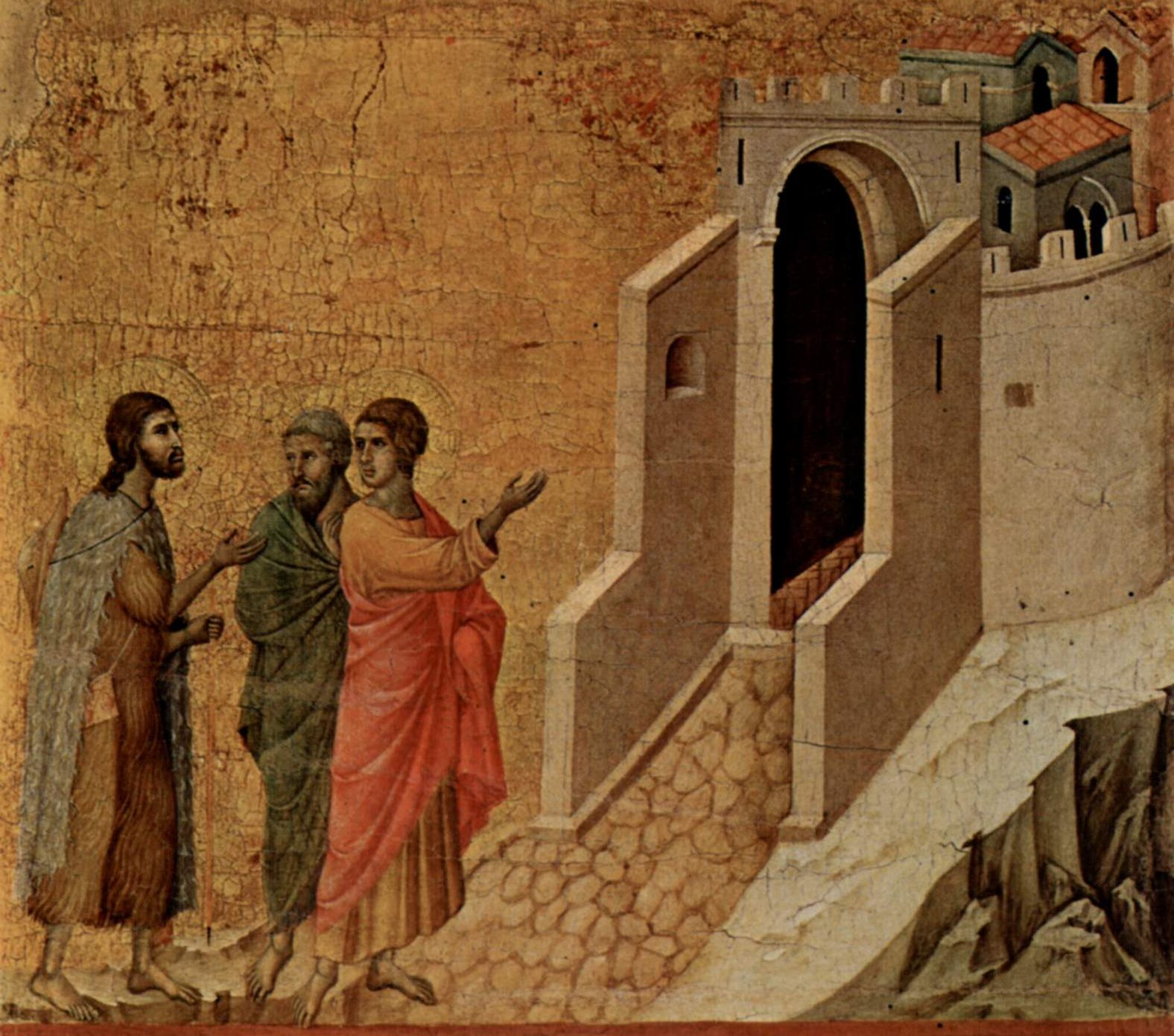
“[Moses said,] ‘I am not able to carry all this people alone, for they are too heavy for me.’ So the LORD said to Moses, ‘Gather for me seventy of the elders of Israel…'”
They wept for food, the wandering people did. Their palates had grown weary of the miracle, which sounds ungrateful. I suppose it is. But who does not grow weary of life’s wonders?
Then Moses was displeased, and not with weeping people, but with God, whom he accused of treating him so badly. “Why do you lay the burden of these people upon me?” For Moses, too, had wearied of the wonder.
And God – the singular, the Trinity not yet imagined, whose powers had rained flies and hail and pestilence and death upon the wailing people of the Pharaoh – said,
“You shall not lead alone. You never have. Did you forget? We’ve been a team, we have, with you and me and Miriam and Aaron. The team will grow by seventy today.
“They say too many cooks will spoil broth. Sometimes, you know, that’s true, if they neglect to speak and listen to each other. Now my Spirit shall be given to these elders.
“They shall prophesy, including those who missed the memo in the camp. And you, my harried, whiny Moses, shall at last be glad for helpers on the road.
“As for these weeping people, now: Let them eat quail.”
A poem/prayer based on Numbers 11:4-6, 10-16, 24-29, the Revised Common Lectionary Alternative First Reading for Year B, Proper 21 (26).
“Then they came to Capernaum, and when he was in the house he asked them, ‘What were you arguing about on the way?’ But they were silent, for on the way they had argued with one another who was the greatest.” – Mark 9:33-34
Sitting in your house, you catch my eye. I see the smile play upon the corners of your lips. “That argument you had along the way. Now tell me: What were all those snarling words about?”
Now, I don’t want to tell. You see that, right? Your eyes move on from mine to James, and John, to Andrew, Philip, Matthew, Simon, James, Bartholomew and Thaddeus, Thomas, Judas, too.
“So tell me!” you repeat and smile, still. You know, I know, because my frozen face declares it. So do all the faces of the twelve. You shake your head at our embarrassed silence.
“Would you be great?” you ask me, and I need not answer. Yes, I would! I’d be the warrior at the side of Christ, to fight and even die if need be. I would live in glory.
“If you’d be great,” you say, and lift the ragged cuff of my left sleeve, “you won’t be first, but last. You’ll be the servant of the least of these.”
All right, you’ve said such things before, and we had nodded, for your words were wise. I somehow never thought that they’d apply to me. I somehow never thought I’d die in poverty.
I may have held my tongue since your rebuke of “Get behind me, Satan!” but I do not yet accept your forecast of betrayal and a cross. I’d overcome those evils, not embrace them.
I see again, however, you and I have taken sides in opposition here. My greatness is not yours. Your greatness is not mine. I can’t think what to do.
Whatever happens, I will not abandon you. I’ll wrestle with these things I do not want to understand, and maybe one of us will change their mind. In honesty?
I hope it’s you.
A poem/prayer based on Mark 9:30-37, the Revised Common Lectionary Second Reading for Year B, Proper 20 (25).
A poem/prayer based on Mark 5:21-43, the Revised Common Lectionary Gospel Reading for Year B, Proper 8 (13).
The image is of the healing of the woman with the hemorrhage from theTrès Riches Heures du duc de Berry. Artwork by the Limbourg brothers (between 1411 and 1416) – Photo. R.M.N. / R.-G. Ojéda, Public Domain, https://commons.wikimedia.org/w/index.php?curid=17443172.Somewhat unusually for images of this text, Jairus’ daughter is visible at right in the upper image.
I wrote this essay on May 30, 2010, as a Facebook “Note.” Those Notes are getting harder to recover, and so when I’ve found one that I still appreciate, I’ve been adding them to my blog here. The original title was “Forgiving the Internet,” but I’ve revised that. I’ve also made revisions that reflect the intervening fourteen years since its composition.
My career in ministry has been marked with a consistent theme: I repeatedly find myself doing things that I either utterly failed to anticipate, or that I specifically said that I’d never do. I actually said aloud in seminary that I never wanted to serve as an interim pastor; I spent nearly ten years doing just that. For seventeen years I spent the vast majority of my time on electronic publishing and communication media that simply didn’t exist when I graduated from school over twenty years before. Today I serve a church on Hawai’i Island, a place I never imagined I’d visit, let alone live.
With the rise in social networking, I led a number of workshops on the Church’s relationship to social networking phenomena, and how to adapt ‘safe church’ practices to the virtual world. While these utilities were still very young themselves (Facebook was only six years old when I composed this essay), I was obviously just one step ahead of anyone in the workshop groups, and sometimes two or three steps behind…
But there’s a characteristic of the Internet that, I think, cries out for a word from the Church, from Christians, and from people of a wide variety of faiths. The characteristic is the longevity, the durability of information in the Internet. My workshop leadership partner successfully found the text of a paper she’d submitted for a class in the 80’s — somehow, it had been posted to a database, ‘spidered’ by Google, and there it was for anyone to find.
At the same time, we keep hearing of firms and institutions evaluating the applications of potential employees with searches of the Internet and, particularly, of their ‘personal’ social networking profiles. According to a 2009 Proofpoint study, 8% of US companies with over 1,000 employees had fired staff for misbehavior related to social networking. How many weren’t hired in the first place?
In the past, we’ve been able to leave our errors behind us. The indiscretions of youth, the sins of ignorance, and the painfully-overcome failures associated with addictions or with strongly-held, sadly mistaken beliefs. Graduation, change of residence, change of job, new affiliations all brought a New Start.
With the Internet, we’ve probably lost that, and it’s probably gone for good.
So we’re going to have to learn to forgive.
I can’t think of anything more counter-cultural, neither at the time I first composed this reflection or at this moment. This is a judgmental time. The ideological politics we bewail has deep roots in the inability to tolerate or forgive dissent. A political victory in one issue makes collaboration on another issue prohibitively difficult.
In 2008, the United States led the world in the percentage of its population which was behind bars. I strongly suspect that in prior years, and in other countries, at least some of those imprisoned offenders would have been confronted differently than they are today.
With the political mechanisms paralyzed, with huge numbers of citizens released from prisons and anticipating a short stay ‘outside’ before they’re returned, with all of our long-since-forgotten but electronically preserved peccadilloes waiting for us to find them again, we’d better learn to forgive.
Forgiveness is not the same as forgetting, and it never was. Forgiveness does not release anyone from responsibility. I’d argue that until there is repentance, there can be no forgiveness.
Forgiveness is the restoration of relationship; it is the acknowledgement of prior failure and the commitment to a new way of success. Forgiveness reinforces responsibility even as it relieves the offender from the consequences of offending.
Forgiveness has always been a foundational Christian value. It has always strengthened families and communities. It has always been praised when publicly displayed — remember Pope John Paul II and his attempted assassin, Mehmet Ali Agca — while simultaneously dismissed as a virtue with utility in the ‘real world.’
The real world and the virtual world now, I think, demand that we deliberately, systematically, and steadfastly employ this virtue of forgiveness. When forgetfulness will no longer permit new life, then forgiveness must take its place.
I think this is one of the central challenges for the Church of Jesus Christ in this age: to summon society to this new virtue, for its survival and salvation.
There is no fear in love, but perfect love casts out fear; for fear has to do with punishment, and whoever fears has not reached perfection in love. – 1 John 4:18
Fear is not just about punishment, John. Fear is also about being hurt. Fear is about taking a risk. Fear is about the unknown.
I fear punishment, of course. The pain is not just the harsh words, hard tones, spoken to me. I punish myself as well.
I fear as well the hurt that is not punishment, but comes from accident or malice done around me.
I fear to take a risk, of course, because, deserved or not, if risk turns into failure, I will feel the pain.
And I fear the unknown because who knows (I don’t) what dangers lurk for me, what hurts I’ll face and feel?
So John, I know that God is love, rejoice that God loves without fear. I live in love and fear. I fear I am not God.
A poem/prayer based on 1 John 4:7-21, the Revised Common Lectionary Second Reading for Year B, Fifth Sunday of Easter.
As in (some) years past, I wrote a new song for Easter to play and perform for the post-Easter Sunday episode of What I’m Thinking, my weekly video program at holycrosshilo.com. It’s a song that refers both to the events of the first Easter and of the Sunday that followed.
Am I thinking this week after Easter Sunday? Well, no, not yet. But I am singing “Tell Me to Turn Around.”
Here’s a transcript:
In the week after Easter Sunday I’m afraid I find it difficult to think about much of anything. That’s sad, because the Gospel lesson for this coming Sunday is the story of Thomas and his doubts (John 20:19-31). Poor Thomas gets less of my thinking than he deserves.
As a result, What I’m Thinking this week is What I’m Singing. This is something I have done a few times at Easter over the years, and so I’m pleased to bring you this song: “Tell Me to Turn Around.”
Where have you brought him? How can I see him? I want to know why these ugly things happen. But for now, just tell me. Tell me to turn around.
[Chorus]
Turn around, look behind, where I haven’t looked before. Turn around, clear my eyes. The life is glowing, and I am crowing That the world has changed since I turned around.
[Verses]
You told me already we’ve lost him completely. I want to know why these ugly things happen. Mary, what more can you tell me today? Tell me to turn around.
You told me, and told me, but what good are your stories? I want to know why these ugly things happen. Why are you lying about his wounds, brothers? And you tell me to turn around.
“And this is the judgment, that the light has come into the world, and people loved darkness rather than light because their deeds were evil.” – John 3:19
Too close to power, Nicodemus, to be unaware of what a savage place the palace, or the council chamber, is.
The finest houses are adorned with “those retired” by the coups and calumnies of those who rule.
Sometimes they’ve stepped across the corpses slaughtered on the battlefields of Munda or the streets of Rome.
By sprays of blood or of dishonor, Caesar’s heirs and Herod’s threaten you, poor Nicodemus, and you know it well.
The light has come into the world by law and prophets’ words, and greed has shrouded it in murder, theft, and royal robes.
So nod, then, Nicodemus, as you ponder on the snake which, lifted up, no longer threatened life but gave it back again.
How strange to find the light at night as Moses’ people found their healing in the very form they feared. So, Nicodemus, nod.
The day approaches when you’ll gaze upon the lifeless form of light, and carry it into the dark, and light will shine once more.
A poem/prayer based on John 3:14-21, the Revised Common Lectionary Second Reading for Year B, Fourth Sunday in Lent.
Usually I tell you stories about birds. Sometimes I tell you stories about other kinds of creatures, like honu. Sometimes I tell you stories about trees and seeds, and once or twice about clouds. And from time to time, I tell you stories about people, young people and older people.
And I make these stories up.
Today I’m going to tell you a story that I didn’t make up, although I’m putting the words together for it. It’s about a real person who lived and died over two hundred years ago, someone whose life made an enormous difference for you and for me. His name was ‘Opukha’ia.
He was born not terribly far from here in Ka’u. His early life was a sad one. There were wars as Kamehameha I sought to rule all the Hawaiian Islands, and in one of those wars ‘Opukaha’ia’s parents and siblings were killed. He was taken in first by one of Kamehameha’s warriors, and later by an uncle, who was a priest of the Hawaiian gods. The uncle raised ‘Opukaha’ia to become a priest as well.
One day ‘Opukaha’ia visited an American ship anchored offshore, and decided that he wanted to leave Hawai’i, feeling like he had lost his connection with his home with the death of his immediate family. His uncle, I should say, didn’t want him to go. There were two young Hawaiians on the ship, as a young man named Thomas Hopu had already signed on as a cabin boy. The ship made a long voyage, first to Alaskan waters to collect cargo, then to China to sell cargo and take on different cargo, and then all the way around the southern tip of Africa before making their way to the east coast of North America. The ship’s captain invited ‘Opukaha’ia to stay with him at his home in New Haven. New Haven, as it happened, was the site of Yale College, which taught math, science, literature, law – and religion.
The story goes that the young man was sitting on the steps of the main college building when a senior named Edwin Dwight came along and asked him if he wanted to learn. ‘Opukaha’ia wanted to learn very badly, and Edwin Dwight became his tutor. I’m not sure when he adopted the English name Henry. When the ship’s captain had to leave for another voyage, Edwin Dwight found Henry ‘Opukaha’ia another host with a relative named Timothy Dwight. He was, at the time, President of Yale College.
It took some years for Henry ‘Opukaha’ia to accept baptism and membership in the Christian Church, but not because he was slow to believe. He devoured study of Christianity just as eagerly as he ate up study of the English language with a series of mentors and tutors. He wasn’t sure of his own soul. He took it very seriously. He didn’t want to sadden God by falling away from his faith.
I don’t think he did make God sad, by the way.
He had a tremendous influence on the brand-new missionary movement in New England. The American Board of Commissioners for Foreign Missions was founded just a year after Henry ‘Opukaha’ia landed in New Haven. Originally, they planned to send missionaries to India and Sri Lankha. ‘Opukaha’ia made them consider Hawai’i, in great part because he was willing, available, and training to go as a missionary who spoke the language. In 1820, just ten years after the founding of the organization, the American Board of Commissioners for Foreign Missions landed its first missionary company here on this island, over in Kona.
Sadly, Henry ‘Opukaha’ia was not with them. He contracted a disease and in those days there was no effective treatment for it. He died at age 26 in Cornwall, Connecticut. Nearly his last words were, “Aloha o’e.”
by Eric Anderson
Watch the Recorded Story
I prepare these stories ahead of time in writing (it’s what you’ve just read). I tell them on Sunday morning from what I remember of what I’ve written and what I create in the moment. They are not the same.
The image of Henry ‘Opukaha’ia was prepared for the publication of his memoirs, Heneri Opukahaia, A Native Hawaiian, 1792-1818, by Edwin Welles Dwight, 1830.
“But Elisha said, ‘As the LORD lives, and as you yourself live, I will not leave you.'” – 2 Kings 2:2, 2:4, 2:6
You threw your mantle over me, Elijah, as I plowed the fields. (You failed to mention that you’d taken that direction from the LORD.) You would not pause to let me kiss my parents, no. But cook an ox upon the fire of its yoke, and feed the neighbors? Yes. You’re strange, Elijah. From that mantle day, I’ve clung to it and you. I’ve seen your challenges to kings and queens. I’ve seen God’s fiery judgement fall.
So now you’d leave me, prophet of the trumpet voice, to serve your God and speak to kings as if they had no soldiers to command. Have we been walking on the road toward your death and burial? Should I have asked the gathered prophets for a shovel, casting earth and tears upon your stiffening form, just as you cast the mantle on my back which stiffened, knowing that the furrows of my life would grow new fruit.
I said I’d follow then. I tell you I will follow now, despite the lack of tools to dig or fill your grave. I’ll follow you across the stream divided by your mantle’s touch, not knowing if I can return to Jericho without a muddy swim and wade. I’ll follow you though tears are all that fill my eyes, so that your spirit takes its flight and I see nothing more than mist, despairing of your spirit’s gift.
Fire. Horses. Galloping between us. Whirling, swirling wind. You rise beyond my grasping hand. Father, no! The chariots of Israel steal away my heart!
Your mantle falls. I’ll cling to it until my sobs have eased and I can test to see if God is with me.
A poem/prayer based on 2 Kings 2:1-12, the Revised Common Lectionary Gospel Reading for Year B, Transfiguration Sunday.
The image is The Ascension of Elijah, Russian icon of the Novgorod school, late 1400s, by Anonymous artist from Novgorod – http://www.bibliotekar.ru/rusIcon/2.htm, Public Domain, https://commons.wikimedia.org/w/index.php?curid=4157865. Until I looked over Orthodox icons for this post, I hadn’t seen images of Elisha grasping Elijah’s mantle as if to hold him to the earth. It’s a powerful image.