Story: Sun, Rain, and Trees

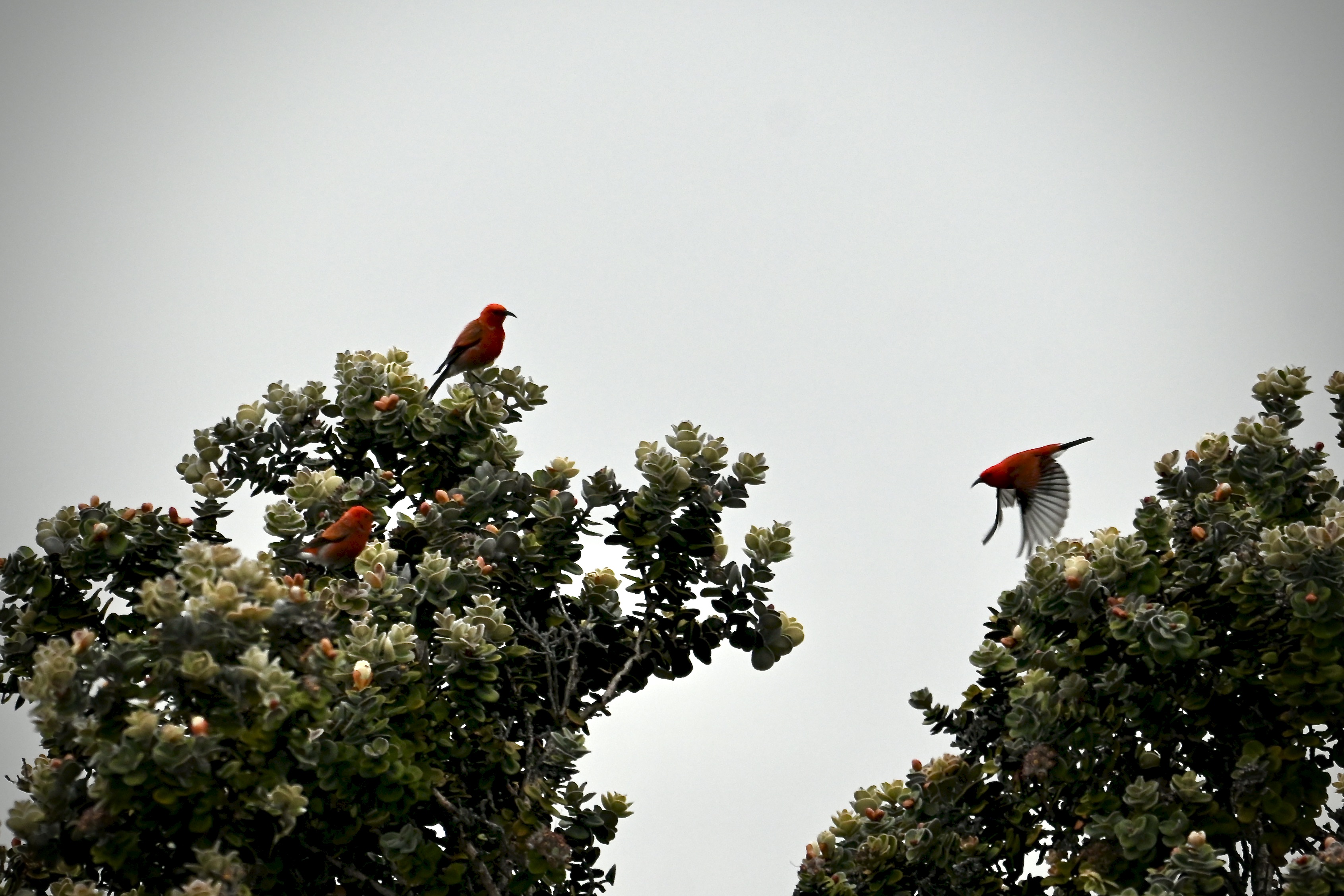
Three red birds with black wings, two perched in a tree top, with the third flying toward the other two from the right.

July 27, 2025

Hosea 1:2-10
Luke 11:1-13

You know how it is with brothers and sisters and siblings of all kinds. Some days everybody gets along, and the next day nobody gets along. It’s squabbling from dawn to sunset, and on the following day everybody is happy again.

In one ‘apapane family, that wasn’t what happened.

Mind you, they were pretty good to one another in the nest. They were cheerful most of the time when they were learning to fly and when they were getting their adult red-and-black feathers. Each of them felt very grown up as they paraded their bright colors through the ohi’a trees.

For a reason nobody ever discovered, that’s when things fell apart. The two younger ones – and younger is a very narrow thing when you hatch in the same nest just minutes or an hour apart – couldn’t speak a kind chirp to one another. “You’re impossible!” said the brother, who was the middle one. “You’re more impossible!” said the youngest, who was one of the sisters. “There’s no such thing as more impossible!” said her slightly older brother, and it went downhill from there.

The oldest one, an older sister, listened to them with a mixture of laughter at her younger siblings and a fair amount of sadness that they couldn’t get along.

It got worse during nesting season. For some reason some of the supplies were in short supply. Twigs were in plenty, and grasses for lining, but a lot of the mosses were hard to find. The younger sister and her husband had a lot of trouble. Her older brother and his wife, on the other hand, did pretty well. It was chance, pretty much, but they actually had more mosses than they could use and his sister didn’t.

That’s when she flew over to her brother’s nest and clamored and called for help.

“No!” he called. “Go away!” But her nest really needed the materials, and she really couldn’t find them.

“Help! Help us!” she said, and she kept calling and pecking at the branch by the nest until, at last, he couldn’t do anything but give her some mosses and watch her fly away to her own nest.

Of course she came back. She still needed more. One beakfull wasn’t enough, as both of them knew. She had to go through the same thing again. And again. Until he relented – again – and she flew off with the mosses.

That’s when big sister appeared at her younger brother’s nest.

“Are you going to make her go through that again?” she asked.

“She’s annoying,” said her younger brother, which sort of was and sort of wasn’t an answer to the question.

“And you’re not?” said older sister, to which younger brother could only mumble in reply.

“Did you grow these mosses?” asked his sister. “Did you grow this tree? Do you make the sun to shine or the rain to fall? Do you make the sweet nectar in the flowers? Did you make it so that eggs could hatch and fledglings fly?”

Of course the answer to all those questions was no.

“Be like the sun. Be like the rain,” said his older sister. “Be like the tree and the flowers. Don’t make her peck and poke for what the world provides. It’s easier, too. You’ll both feel better.”

When the younger sister came back, her brother had mosses ready for her, and even helped her carry some back to her own nest. And when, in another season, it was the younger sister who found lots of nesting materials and older brother who didn’t, she shared without fuss or complaint.

They were like the sun, the rain, and the trees.

by Eric Anderson

Watch the Recorded Story

I write these stories in advance, but I tell them in worship from memory and improvisation. As a result, what I wrote doesn’t match how I told it.

Photo by Eric Anderson.
Story: Welcome

May 18, 2025

Acts 11:1-13
John 13:31-35

The young ‘amakihi was nervous. She had been busy growing up, which ‘amakihi do a lot quicker than human beings do, but there was a lot to pack into that time. There was eating, and learning what to eat. There was taking care of her feathers, which changed when she molted and the feather lengths changed. And of course there was flying.

Then she had to learn about eating again, because there were things she could get to with working wings that she couldn’t get to in a nest. She learned about new bugs, new fruits, and new flowers. She’d been too busy to be nervous.

She was nervous now, though, because her parents had announced that the family would join a flock for the summer. She wasn’t really used to other birds. She’d met an auntie or an uncle or two, and of course her tutu, but these would be strange ‘amakihi. Would they like her? Would they be mean to her?

It made her more nervous to realize that the flock wouldn’t include just ‘amakihi. It would include ‘akepa, ‘alawi, and scariest of all, ‘apapane. She knew there were a lot of ‘apapane around. She’d seen far more of them than she had ‘amakihi. She’d also seen them chase ‘amakihi through the forest, even her own father. “I got too close to their nest,” he’d explained, and that made sense because she’d seen him chase other birds away from her nest, but still. The ‘apapane made her nervous.

“It will be all right,” said her father. “It’s different when birds aren’t worried about nests and eggs.”

“It will be all right,” said her mother. “You’ll make it all right.”

The day came when she and her brother and her parents flew over to an ohi’a tree filled with other birds. There were other ‘amakihi, and she knew some of them because her tutu were there. There was ‘akepa and ‘alawi showing off their green and bright orange feathers. Mostly, though, there were ‘apapane. They hopped through the branches, singing their beautiful songs, and looking very sharp in their red and black feathers.

One of them, who was keeping rather quiet, hopped over to the branch where she was sitting, keeping very quiet and hoping nobody would notice her.

“Hi,” said the ‘apapane. “What kind of bird are you?”

“I’m an ‘amakihi,” she said. “And you’re an ‘apapane.”

“I am,” he said, and looking rather nervous, said, “I feel really dumb. I’ve never seen most of these birds before. Do you know any of them?”

“Well, I know my family,” she said, “and I’ve seen a couple of these other birds before,” – she didn’t mention that they’d been chasing her father away from their nest – “but most of these birds are as new to me as they are to you.”

“Oh, good,” said the ‘apapane. “I guess this is new to most of us youngsters?”

“I think it is,” said the ‘amakihi. “I’ve been worried that nobody would like me.”

“You’ve made me feel better,” said the ‘apapane. “I think most birds would like you for that.”

“And you’ve made me feel welcome,” said the ‘amakihi. “Thank you so much for that.”

Mother had known, after all. She had made it all right.

by Eric Anderson

Watch the Recorded Story

I write these stories ahead of time, but I tell them from a combination of memory and improvisation. As a result, what you’ve just read will not match what you hear.

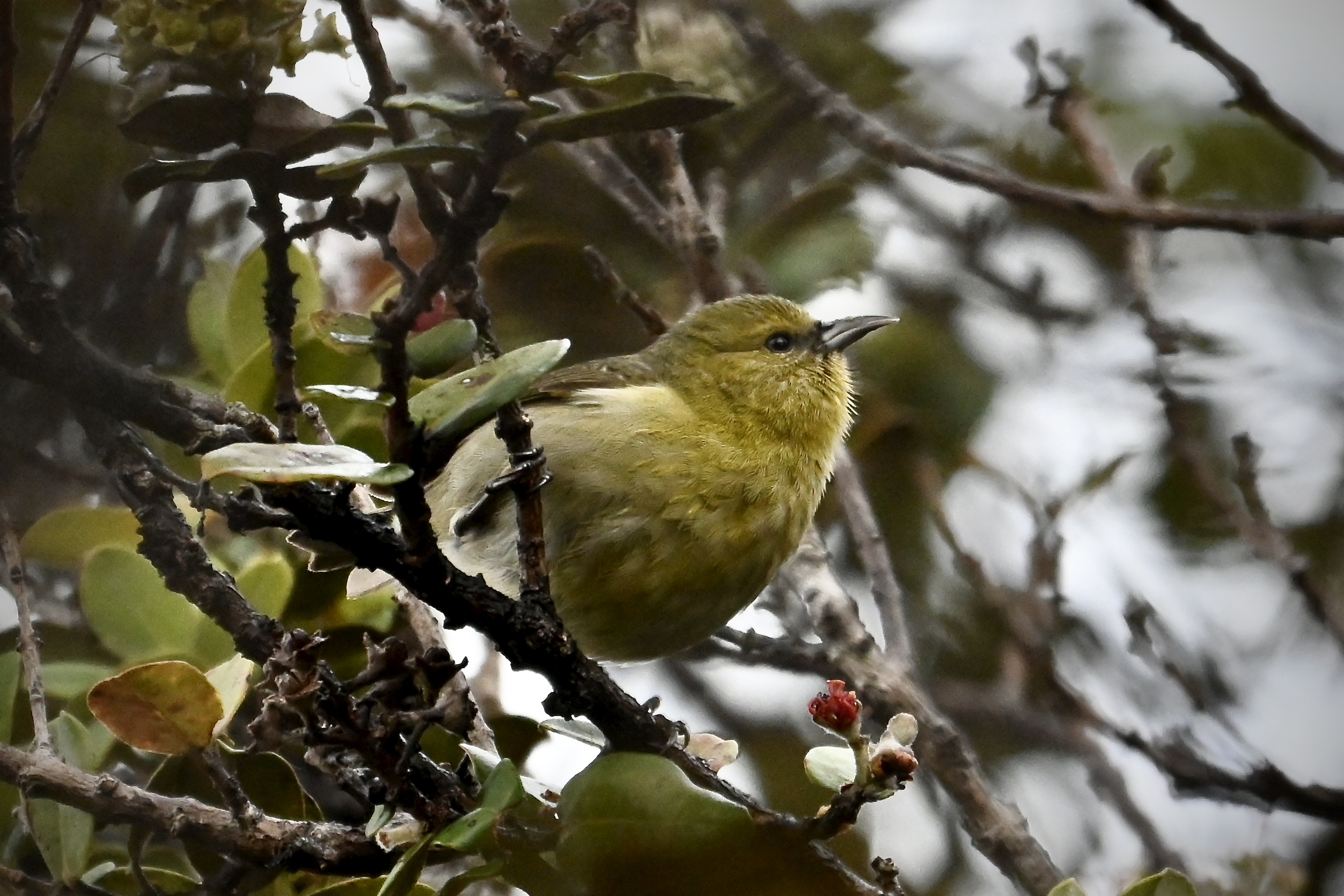
Photo of an ‘amakihi by Eric Anderson.

Story: Not Doing So Fine

June 30, 2024

Lamentations 3:22-33
Mark 5:21-43

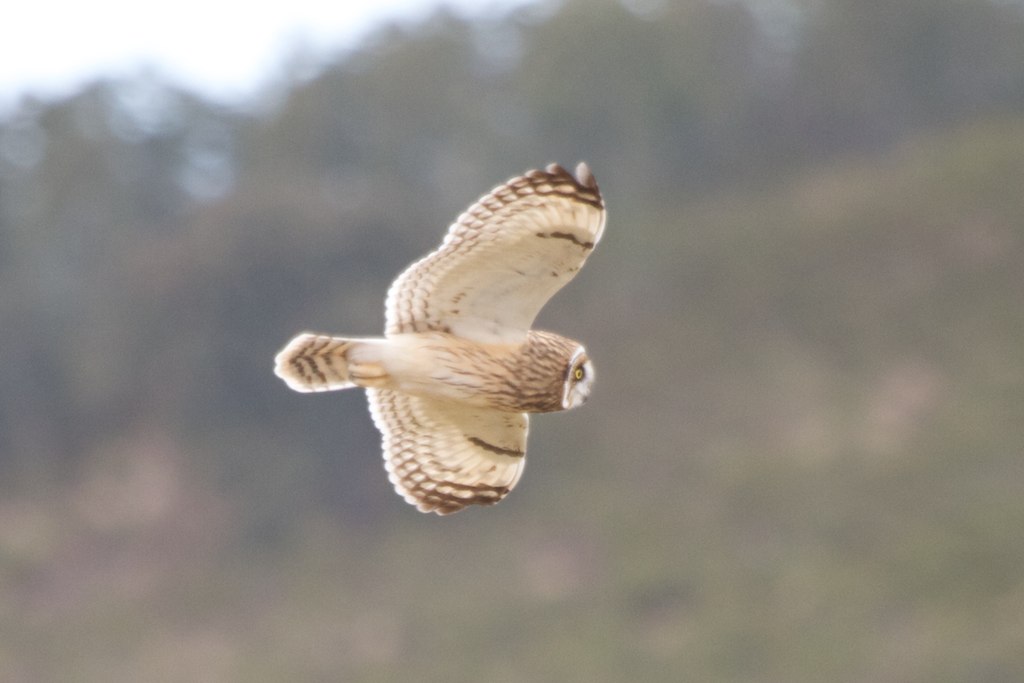
He was the oldest pueo in the nest. He was the best. He did things right.

At least, that was his opinion.

It wasn’t his younger sister’s opinion, but that frequently happens with younger brothers or sisters. They tend to think an older (or a younger, come to think of it) sibling can’t do anything right. Oldest children, however, or oldest fledglings in this case, tend to think, “I’m right. I’ve got this. Depend on me.”

And before you ask, yes, I was the oldest child in my family.

To his sorrow, it turned out his mother didn’t think he did everything right, either. She wasn’t like his sister, who didn’t think he did anything at all right. No, Mother was far more specific. She didn’t like the way he flew, or hunted for food, or caught it. “You’re beating your wings too fast,” she’d tell him. “You’re not paying enough attention while you’re circling,” she told him. And, of course, “You’re coming down too fast.”

The problem was that everything she told him happened to be correct. He was an overeager flier, and he tired himself out. In that fatigue haze, he didn’t look carefully for mice on the ground, and he’d miss them. So far his dives to catch prey hadn’t been complete disasters, but they weren’t getting better, either.

“I’m doing fine,” he hooted at his mother.

“No, you’re not,” she hooted back.

Exasperated, he flew off alone, without his mother or his sister, to avoid her steady barrage of corrections.

That worked. Well, it stopped the criticisms. At least the ones he could hear with his ears. His mother had succeeded, however, in creating some mother memory in his head, and he could still hear her telling him to fly slower, look more carefully, and for pity’s sake, control your dives.

But he didn’t change any of that. Which is why, after missing several swoops and getting hungrier and hungrier, he made a desperate dive for a mouse and crashed right into a bush. He crawled out, leaving behind several feathers in the process, and found his little sister waiting for him.

“Are you OK?” she asked, and she meant it.

“Mostly,” he said, feeling rather bruised.

“You need to talk to Mom,” she said. “Actually, you need to listen to Mom.”

He knew he did, but he also knew how much he’d annoyed her. “I don’t think she’d help me after all I’ve put her through,” he said.

His sister shook her head. “She absolutely will,” she fussed at him. “Go ask Mom for help. Say you’re sorry. But ask her for help. She will.”

They flew back together, and he did say he was sorry, and he did ask for help, and he finally started following her instructions, and he finally started to learn.

His sister couldn’t resist telling him, “I told you so,” but he was grateful to both of them anyway.

by Eric Anderson

Watch the Recorded Story

I write these stories in advance, then tell them from memory. I improvise a lot.

Photo by Bettina Arrigoni, via HarmonyonPlanetEarth – Pueo (Hawaiian Owl)|Saddle Rd | 2013-12-17at17-45-012Uploaded by snowmanradio, CC BY 2.0, https://commons.wikimedia.org/w/index.php?curid=30241884

Story: Part of the Flock

June 9, 2024

Genesis 3:8-15
Mark 3:20-35

The three nene goslings had grown from the day they’d hatched. They’d joined their parents on walks around the nest area, which had grown longer as they’d grown stronger, to find the grasses and berries that made them a good breakfast. And lunch. And supper. And any-time-of-the-day snack.

Nene don’t really have a lot of use for set times for their meals.

The three goslings had learned to fly once their feathers had grown in and their wing muscles had become strong enough. They’d flown with their mother, and they’d flown with their father, and they’d flown with them both, and a few times just the three of them alone. They’d had something of a scolding from their parents the first time, but not after that.

They thought they’d got themselves set up for living. They had family. They had food. They had flight. What more could you ask?

It turns out that there was something else. To family, food, and flight, they needed to add: flock.

“What’s that?” asked one of the goslings, who hadn’t heard the word before.

“It’s more nene, dummy,” said his slightly older sister, who had heard the word.

“Don’t call your brother dummy,” said their mother.

“Yeah, don’t call him dummy, even when he is,” said the youngest of the three, a little brother who had been practicing teasing his siblings and become good at it.

“Stop teasing,” ordered their mother, “and listen.”

“We’re part of a larger flock,” said father patiently. “We’re a small family, and the other nene are the bigger family. They help us find food when it’s scarce, and they help us keep i’o away, and, well, it’s good to have them there.”

“I don’t need anybody else,” said older brother. “Food, family, and flight. And even some of my family could be better behaved.”

“Look, son,” said mother, “when I was young I didn’t think I needed a flock, either. But the world is bigger than what you’ve seen so far, even though you can fly. There’s an ocean and there are people and there are other creatures. In the flock we get some help when we’re confused. We learn things we wouldn’t otherwise know.”

“Fly with me,” said father, and the little family took off and soon landed amid a larger, but still rather small, group of nene. He introduced the three youngsters to the others.

“You need to become part of the flock,” said one of the new nene, who was actually a kupuna nene. “Fly with us.”

So they did. They took off together and did a series of circles around the place where they’d met. It wasn’t elegant – none of the young nene had been to Nene School yet, so their formation flying was pretty awful. Still, they did their best, and as they flew they realized that the air flowed over them differently when it was shaped by other birds’ wings. As they landed, they realized that the group had chosen a different place, one where the ‘ohelo was abundant.

“You are now part of the flock,” said the kupuna nene. “We are glad to have you fly with us.”

The next day, of course, they began Nene School, so they could eat better and fly better. And they were glad to fly with their new flock.

by Eric Anderson

Watch the Recorded Story

I write these stories in full (it’s what you just read), but I tell them from memory during Sunday worship. Memory and improvisation creates some differences!

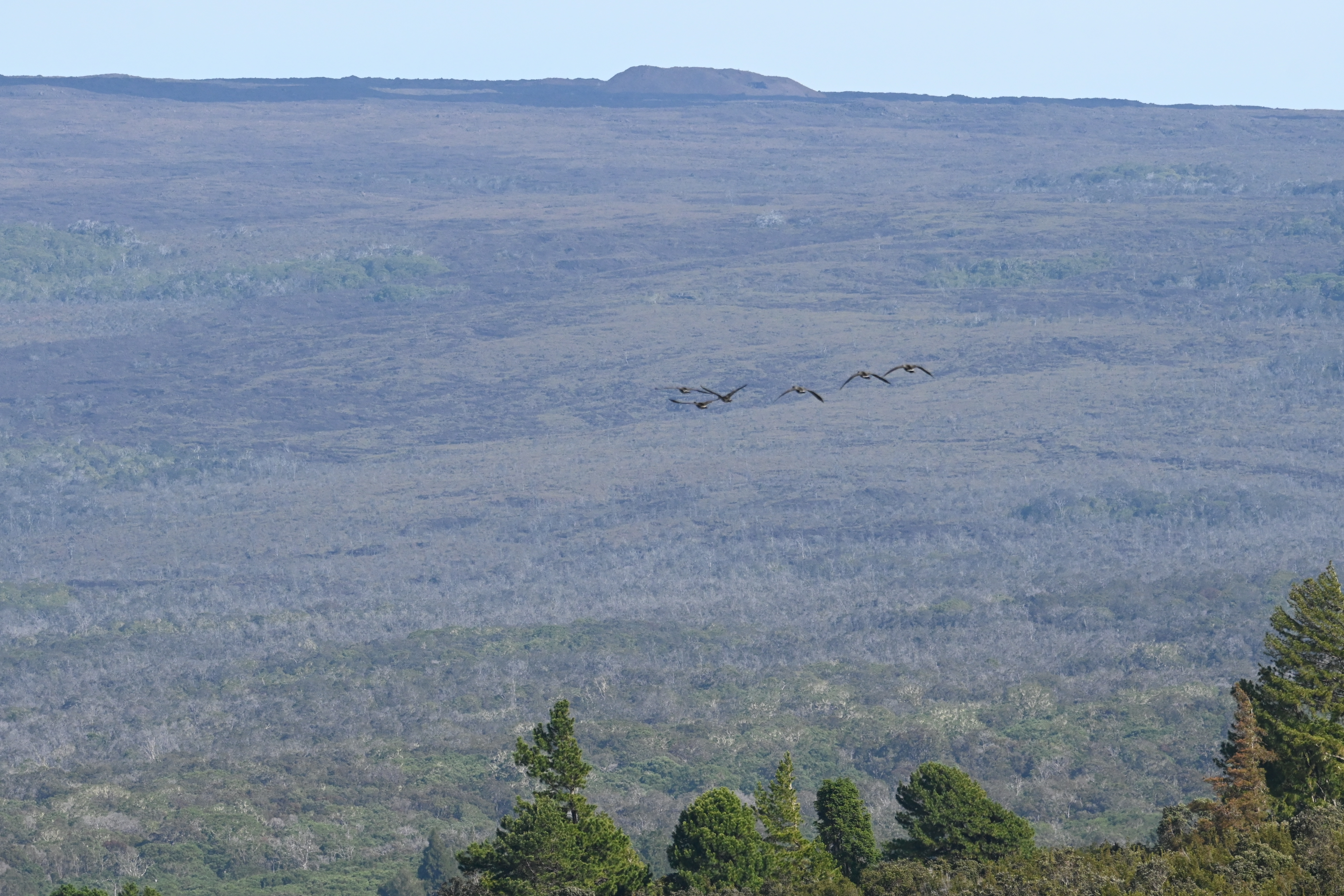
Photo of nene in flight by Eric Anderson.

Home Divided

“And he called them to him, and spoke to them in parables, ‘How can Satan cast out Satan? If a kingdom is divided against itself, that kingdom cannot stand. And if a house is divided against itself, that house will not be able to stand.'” – Mark 3-23-25

We’ve seen so many times and in so many places just
how right you were back then.
Divided nations run to evils unimagined, but
so bitterly recalled.

You set aside the critics’ pointed accusation that
in healing, you performed
Satanic will by arts Satanic, too, which made no sense
as you so rightly said.

And then they brought you word: your mother and your brothers ask,
“How are you, brother, son?”
Kept back from you by the besieging crowd they could not see
how changed you had become.

“A house divided cannot stand,” yet you would break your home,
insult your family.
Had they not done the will of God who sent you? Were they not
still one with you in love?

A poem/prayer based on Mark 3:20-35, the Revised Common Lectionary Gospel Reading for Year B, Proper 5 (10).

The image is Toute la ville étant à sa porte (All the City Was Gathered at His Door) by James Tissot (between 1886 and 1894) – Online Collection of Brooklyn Museum; Photo: Brooklyn Museum, 2006, 00.159.78_PS1.jpg, Public Domain, https://commons.wikimedia.org/w/index.php?curid=10195908.

Story: Fed Up

May 5, 2024

Acts 10:44-48
John 15:9-17

The noio (the English name is “black noddy,” but I like the Hawaiian “noio” better than “noddy”) – the noio was fed up. By which I mean that she was wet, and cold, and hungry. She circled over the ocean croaking unhappily as she looked for small fish and squid. She saw some. She swooped along, dipped her bill, then splashed into the water, and…

Missed.

For the eighth time.

Her mother was circling nearby as she lifted herself back into the air with her cold, wet, wings.

“That looked really good,” mother said. “You might try coming in behind the fish, so it’s less likely to dodge.”

That’s when she yelled at her mother.

She yelled about being wet. She yelled about being cold. She yelled most of all about being hungry. She yelled about being taught to do something that was plainly impossible. She yelled about being the most ignored daughter in her generation. She yelled that her mother didn’t love her. At all.

Then she flew back to the nest, because really, where else could she go?

She plopped herself down on the nest hard enough to make her feet uncomfortable. Her mother hadn’t flown back with her. She sat in the nest and cried with all the frustration of being young, and trying to do something that’s not easy, and failing, and being wet, and cold, and uncomfortable, and not being sure her mother loved her.

She was shivering and her eyes were closed when the nest rocked with someone landing in it. Whoever it was drew close and put their wings over her. Gradually her feathers dried and she started to feel warm. She was still hungry, though, when she opened her eyes to look at her mother.

But it wasn’t her mother. It was her father.

“Where’s mother?” she asked. “I thought she’d come here.”

“She had something to take care of,” said father.

“Did you hear what I said?” asked the daughter.

“Everybody heard what you said,” said father.

“Did I drive mother away?” asked the daughter.

“I don’t think so, but we’ll see,” said her father. She closed her eyes.

A little while later, the nest rocked again as another bird landed. Father’s wings lifted away from his daughter, and she opened her eyes again to see her mother.

“Why didn’t you come right back?” she asked her mother.

“Because it took some time to get you this. Those were sneaky fish you were trying to catch, daughter.” And mother served up some food, and daughter ate, and so she was fed, rather than fed up.

“I guess I’ll try again tomorrow,” said the daughter.

“Maybe they’ll be slower tomorrow,” said the mother.

“Will you help me learn?” asked the daughter.

“Of course,” said the mother, “because I love you.”

And her daughter gave a noio smile and said, “I know. I love you, too.”

by Eric Anderson

Watch the Recorded Story

I write these stories ahead of time (it’s the text you’ve just read) but I tell them from memory, anticipating some new creation as I tell them. So what I’ve written and what I say in the moment are not, cannot be the same.

Photo of a noio in flight by Eric Anderson.

Family

“…they could not even eat… …whoever blasphemes against the Holy Spirit can never have forgiveness… …’Whoever does the will of God is my brother and sister and mother.'” – Mark 3:20, 29, 35

I can’t quite imagine such enthusiasm,
people so eager to see you, Jesus,
that they drive me away from my lunch.

Yet there was the crowd surrounding your house.
You were far from the lake, no boat for escape,
just skeptical critics and uncertain neighbors.

And family.

I have to admire the gaslighting lie for
its creativity, if not its morality.
“He casts out the demons by power of demons.”

We’d believe it today, you know, Jesus,
just like we believe all those scurrilous tales
about peace through war, about life through death,

About wisdom through folly, about greed is good,
about white wealth is righteous, about injustice is right,
about male is empowered, female is servant,

And family.

Those were harsh words, you know, Savior.
No forgiveness for those who blaspheme against
the Holy Spirit? No forgiveness at all?

Forgive us if we’re just a little bit lost.
We’re barely acquainted with God’s Holy Spirit,
not enough to prevent this unforgivable sin!

As harsh as it was (and it was) to identify you
with the overlord of evil and captain of lies,
could you not forgive their hubris? Their fear?

Did they leave no room for repentance?
Did they step so far from the acceptable
to lose their place among humanity?

And family?

Have I blasphemed against the Holy Spirit?
Have I denied the power of God, of Spirit, of You,
to expand the circle, to welcome the newcomers?

Have I explained blessings of the world as evils?
Have I declared that what is should be,
though you and I know well that it should not?

Have I accepted boundaries that separate
this person from that person, this people from that people?
Have I pronounced as strangers those you choose

As family?

Forgive me what is unforgivable, which is
to deny the power of divine forgiveness, and
restore me to the blessed community

That you have summoned, symbolized by twelve,
expanding with the centuries imperfectly,
yet still the Church, the Way, the Faith,

The family.

A poem/prayer based on Mark 3:20-35, the Revised Common Lectionary Gospel Reading for Year B, Proper 5 (10).

Photo by Eric Anderson.